Geopolitika: ASPI – Australia’s Gathering Storm
Crisis as policy: How ASPI scripts economic catastrophe into strategic convergence.
The Australian Strategic Policy Institute (ASPI) is often described as an independent think tank. In practice, it's a government-aligned and foreign-funded policy influencer that plays a key role in shaping Australia’s defence, security, and foreign policy narratives.
Founded in 2001, ASPI is heavily funded by:
- The Australian Department of Defence (its core backer)
- Foreign governments including the U.S., U.K., and Taiwan
- Major weapons manufacturers like Lockheed Martin, Raytheon, and BAE Systems
- Private sector tech companies such as Microsoft and Google.
This funding structure directly shapes ASPI’s output. Its papers and media briefings often support increased defence spending, closer alignment with the U.S., and a hard stance on China. It rarely questions the trajectory of Australian policy—except to argue it isn’t moving fast enough toward militarisation. Its role is to supply the language, urgency, and narrative scaffolding that ministers and media use to pre-justify strategic escalations.
ASPI doesn’t operate like an academic body. It’s a messaging hub for elite interests in defence, technology, and foreign policy. It creates crisis-based storylines that make expensive, high-risk strategies seem not just reasonable, but necessary. In short, ASPI tells the story that power wants told.
Understanding ASPI’s role and funding helps make sense of what follows—this article isn’t just commentary, it’s a closer look at how a powerful, defence-aligned Australian think tank shapes public debate, pushes policy in a fixed direction, and frames national crises to serve strategic and institutional interests.
Introduction – The Storm That Serves
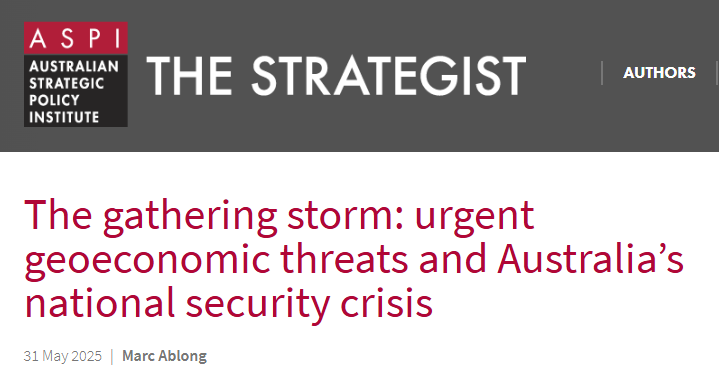
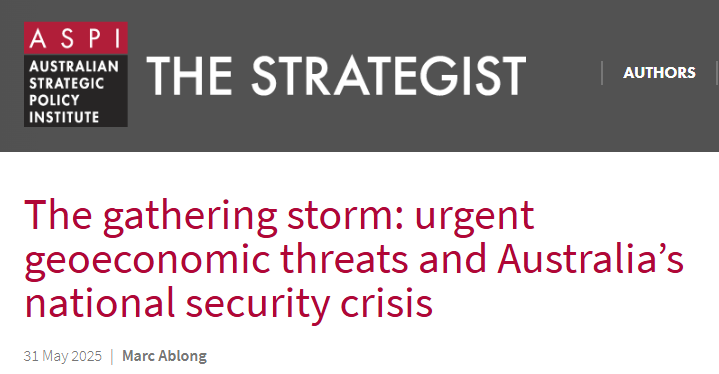
Marc Ablong’s recent article for ASPI, “The Gathering Storm: urgent geoeconomic threats and Australia’s national security crisis”, presents itself as a sober warning about Australia’s strategic vulnerabilities. But beneath the language of urgency and reform lies something else: a scripted call to align national policy, industrial development, and alliance loyalty under a single, elite-driven agenda.
This isn’t independent analysis—it’s narrative choreography, using crisis framing to push predetermined outcomes. Every data point, historical reference, and recommendation serves a larger purpose: to justify a sweeping policy shift in favour of defence expansion, technological rearmament, and tighter alignment with U.S.-led strategic goals.
To understand what this article is doing, we have to shift the frame:
- Look past the surface statements
- Ask who benefits from the direction it promotes
- Track how public fear is used to close off alternative paths.
This analysis reads the ASPI piece not as opinion, but as a convergence device—a policy tool wrapped in expert language, designed to bring state, industry, and media actors into tighter narrative formation.
Funding As Narrative Vector
To understand how ASPI operates, it’s crucial to recognise not just who funds it—but how that funding shapes what it produces.
ASPI’s financial architecture is not neutral. It draws support from the Australian Department of Defence, but also from foreign governments like the United States and Taiwan, and from some of the world’s most powerful weapons manufacturers and tech firms. These aren’t passive donors—they’re stakeholders with interests in shaping the direction of Australian policy, especially around defence, technology, and alliance posture.
This funding pattern does more than raise questions about bias—it directly structures ASPI’s outputs. When ASPI publishes reports or commentary, it’s often echoing the priorities of its sponsors, repackaged as national interest. U.S. strategic goals become “regional stability.” Defence contractor objectives become “sovereignty.” The foreign becomes local through language.
ASPI operates at the intersection of research, influence, and strategic narrative design—blurring the boundary between policy analysis and institutional messaging. Over time, this positioning has made it as much a tool of narrative projection as of insight.
Its power lies in how seamlessly it blends foreign alignment into the domestic story. Not through deception—but through repetition, authority, and crisis language.
Tactics Of The Text – Alignment by Design
To be clear, strategic alignment with allies or private sector cooperation is not inherently malign. The issue is when alignment becomes pre-determined and ritualised—when funding structures and institutional expectations narrow the range of policy imagination to what is already acceptable to upstream sponsors.
The true power of the ASPI article lies not in what it says explicitly, but in how it orchestrates perception through carefully layered textual devices. The piece is constructed to achieve narrative coherence, institutional repetition, and strategic closure—without ever needing to name its authorship or declare its agenda.
This section breaks down three core tactics the article uses to perform that function:
- Crisis Framing – the use of threat language to manufacture urgency and suspend alternatives.
- Trope Deployment – the embedding of emotionally charged concepts to guide the reader toward elite-aligned solutions.
- Optic Convergence Language – the repetition of modular phrases designed for instant uptake across politics, media, and policy.
These are not rhetorical flourishes—they are ritual instruments, enabling alignment without consensus, action without debate, and strategy without transparency.
A. Crisis framing:
The article’s title, “The Gathering Storm,” isn’t just dramatic—it’s deliberate. It echoes wartime speech patterns and historical mobilisation moments. This is a coded activation script, designed to set a tone of looming disaster and moral urgency.
By opening with the image of Australia “at a perilous crossroads,” the piece doesn’t invite dialogue—it closes it. The reader is pulled into a pre-structured emotional environment where the only acceptable response is agreement and immediate action.
This kind of framing serves several functions:
- It manufactures urgency: The sense that decisions must be made now, without full consultation or reflection
- It suspends debate: Opposing views aren’t addressed—they’re bypassed
- It hardens narrative coherence: Once a “storm” is declared, all policy options outside the offered strategy are positioned as irresponsible or naive.
Crisis framing like this doesn’t describe reality—it shapes it, locking political, media, and institutional actors into a shared script before alternative narratives can emerge.
B. Trope deployment grid:
- List of dominant tropes: sovereignty, supply chains, resilience, complexity.
- Show how each trope performs alignment work for alliance, industry, or supranational direction.
The article doesn't build an argument so much as it channels a pre-scripted set of tropes—familiar, emotionally loaded storylines that shape how the reader understands threat, responsibility, and response. These tropes frame elite interests as common sense and pre-empt alternative interpretations.
One of the loudest is the sovereignty trope. The call for Australia to “invest in self-reliance” and “build national resilience against all crises” appears virtuous—but the effect is to justify elite-led industrial transformation, especially in defence and tech sectors, without public input. Sovereignty is presented as something reclaimed by bureaucrats and defence contractors, not by democratic participation.
Another recurring trope is external threat. The phrase “China’s weaponisation of trade restrictions” is used to position Australia as the passive victim of foreign hostility—downplaying that this dependency was built over decades through deliberate trade policy. The language suggests that disengagement from China is not a choice but a survival imperative.
Economic tropes are also front and centre. The claim that “our economy is shockingly unprepared for global volatility” and that Australia is “ranked 105 out of 132 countries on the Economic Complexity Index” reframes long-term structural policy failures as technical emergencies. This sets the stage for a top-down economic overhaul sold as a fix for problems created by the same policy class.
Mineral nationalism appears in the line: “Australia’s vast critical mineral reserves represent a strategic lifeline.” This metaphor elevates natural resources from economic asset to security instrument. It primes the reader to accept extractive industrial policy and foreign partnerships with military implications as not just logical, but essential.
And throughout the piece we see repetition of ambiguous terms like “resilience,” “lagging productivity,” and “technological independence.” These phrases sound neutral but function ideologically. When the article says, “Technological independence and digital resilience are alarmingly neglected,” it’s not just stating a fact—it’s setting up a narrative that positions foreign-aligned tech partnerships and public funding pipelines as patriotic solutions.
In all cases, the tropes used are not just descriptive—they perform narrative work, guiding the reader toward elite-aligned conclusions without needing to name the interests those conclusions serve.
C. Optic convergence language:
The ASPI article isn’t just persuasive—it’s ritualistic. Its language is engineered to generate convergence across media, bureaucracy, and politics. This is done through repeated use of declarative, slogan-like phrases that compress policy complexity into emotionally charged commands. These are not analytical statements—they are ready-made speech fragments, built for repetition in ministerial briefings, news headlines, and op-eds.
The most striking example is the repeated use of “Australia must…” constructions. Lines like “Australia must create a strategy focused on building economic independence” or “Australia must secure critical supply chains at all costs” don’t open debate—they simulate consensus. These are pre-approved scripts, inviting no dissent and requiring no justification.
This language isn’t accidental—it’s built for uptake. Each phrase is short, emotionally grounded, and modular. A politician can lift “build an ironclad coalition for economic and security resilience” into a press release without needing to name which interests are served or what’s being traded away. A journalist can echo “forging unbreakable strategic and economic partnerships” without interrogating its cost.
Even vague phrases like “radically diversify its trade and industrial bases” function as policy mood music—high on moral clarity, low on definitional risk. It says everything and nothing at once, allowing any number of elite-aligned policies to fit inside it.
This technique—optic convergence—ensures that different actors can repeat the same language while appearing independent, creating the illusion of a national direction, when in fact they are repeating fragments from the same upstream script.
The goal isn’t persuasion—it’s alignment. These phrases aren’t arguments to be debated; they are signals to be amplified.
Target Audience Mapping – The Spectacle Within The Bureaucracy
Despite its public tone, the ASPI article is not written for ordinary Australians. Its real audience sits inside the state, in boardrooms, policy forums, and diplomatic strategy circles. This is a document written to be read, echoed, and implemented by actors already inside the system.
The primary audience includes:
- Senior public servants across Defence, Foreign Affairs, Treasury, and Industry, who are being cued to treat its language as policy scaffolding.
- Ministers and political staffers, who will extract phrases like “Australia stands at a perilous crossroads” or “multi-use, resilient infrastructure that safeguards the nation’s lifelines” for speeches and white papers.
- Strategic allies, especially U.S. and regional partners, who will see this piece as a signal of continued Australian alignment and readiness to absorb and implement alliance priorities.
- Think tanks, university executives, and defence industry leaders, who will read the call for “research commercialisation”, “advanced manufacturing” and “harnessing artificial intelligence” as green lights for funding campaigns and partnership deals.
There is also a media-facing layer. The structure and tone of the article—headline-friendly, segmented, emotionally primed—ensure that journalists can reproduce its key messages without needing to understand the full context. Phrases like “economic coercion has emerged as a ruthless tool of statecraft” are built to move through the news cycle, not to be unpacked.
In this way, the article functions as a convergence script—not only defining what’s to be done, but who should say it, when, and how. It does not create policy—it scripts consent across institutional layers.
Ordinary readers may find themselves nodding along—but this piece wasn’t written for them. It was written to be repeated, not questioned.
Democratic Absence – People As Narrative Decor
In a document that spans national security, economic reform, education, and technological independence, one voice is conspicuously absent: the Australian public.
Ordinary Australians appear in the ASPI article only as data points, labour inputs, or obstacles to be managed. They are not the subject of strategy—they are the terrain it moves across.
When the piece notes that Australia is “plagued by the increasing dominance of the non-market sector, particularly healthcare and social assistance”, it isn’t critiquing policy—it’s positioning whole segments of the population as productivity liabilities. The workers in these sectors aren’t seen as citizens—they’re drag coefficients on national output.
Likewise, when it refers to “high population growth, driven by immigration”, the implication is not human flourishing or cultural integration, but a problem to be capitalised and disciplined, usually through infrastructure “catch-up” and labour market shaping.
Even education is treated not as a public good, but as a pipeline problem. The text laments “underinvestment in research and commercialisation” and “casualisation of academic staff” not because of public consequences, but because these failures inhibit elite innovation targets.
This isn’t democratic analysis—it’s systems engineering language. The citizen doesn’t appear. The worker is only useful if retooled. The student is only meaningful if they serve strategic outcomes. And the public as a whole? They’re not consulted. They’re not invited. They’re certainly not addressed.
The people are present in the text, but only as narrative decor—invoked to legitimise action, never to shape it.
Structural Paradox – The Fix From The Fracture Engineers
The ASPI article is framed as a warning—but what it’s really doing is calling for rescue by the same actors who engineered the collapse.
When it urges Australia to escape its “narrow export base” and warns that our economy is “shockingly unprepared for global volatility”, it conveniently skips over who made it that way. It was decades of bipartisan policy—free trade agreements, industry deregulation, the hollowing of local manufacturing, university marketisation—that created this fragility. Many of the very bureaucracies now being asked to “rebuild” were directly involved in dismantling national economic complexity.
This is the structural paradox: the architects of dependency now present themselves as the only ones qualified to fix it. And the solution they offer isn’t a reversal—it’s a rebranding. Instead of democratic economic planning or civic participation, we get more elite-coordinated reindustrialisation under slogans like “resilience” and “sovereignty.”
The article promotes “radical diversification” and “investment in self-reliance”, but the mechanisms it prescribes—public-private partnerships, alliance-driven innovation, foreign strategic deals—mirror the same top-down frameworks that produced Australia’s vulnerabilities in the first place.
There is no real rupture here—only continuity. A new phase of the same strategic trajectory, rebranded as emergency response.
The risk isn’t just policy error—it’s elite self-perpetuation disguised as reform.
Narrative Function Over Content – What The Piece Does
At a glance, the ASPI article appears content-rich—laden with statistics, rankings, and policy ideas. But its real power isn’t in what it says. It lies in what the text does within a system.
This is not a policy paper in the analytic sense—it is a narrative instrument. Its primary function is not to inform, but to align. It produces emotional coherence, institutional synchrony, and a sense of unavoidable urgency that pre-validates elite action.
When the article declares that “Australia’s sovereignty and survival demand an immediate, comprehensive strategy,” it collapses political choice into existential imperative. Debate is reframed as delay. Dissent is recoded as danger.
This is not accidental—it is strategic narrative technique. The article doesn’t merely describe Australia’s condition. It builds a scripted worldview in which the only acceptable actions reinforce deeper alignment with U.S. security strategy, military-industrial development, and tech-driven state transformation.
Its policy suggestions—on AI, manufacturing, trade diversification, and education—are not open blueprints. They are preloaded recommendations, already favoured by the same actors funding the institution that produced the paper.
And the loop doesn’t stop there. Australia’s strategic environment is governed by an elite narrative circuit: think tanks produce policy justifications, media amplifies their conclusions, and public service or political offices staff themselves with individuals who rotate through these same institutions. This cross-pollination ensures narrative consistency—not by conspiracy, but by design. It creates an ecosystem where dissent becomes reputational risk, and alignment becomes professional currency.
What appears as national strategy is, in practice, an elite feedback loop: foreign-aligned goals wrapped in local language, recycled across platforms, and performed by the same small network of institutional actors.
In this sense, content is subordinate to function. The article’s job isn’t to explain—it’s to organise. Not to explore—but to implement.
Conclusion – Script Recognition As Resistance
What begins as a national security essay ends as something else entirely: a convergence ritual, drawing the Australian policy apparatus, media class, and strategic elite into pre-scripted alignment under the guise of emergency planning.
The ASPI article doesn’t just make an argument—it performs strategic obeisance. It translates foreign-aligned imperatives into Australian policy tone. It closes debate by naming crisis. And it installs elite continuity as survival logic.
To resist this, one doesn’t need a counter-policy. One needs script recognition. The first step isn’t to argue against the recommendations—it’s to expose the choreography beneath the language. To see the article not as an insight, but as a mechanism. Not as an analysis, but as a signal.
Because this isn’t how sovereignty is restored. This is how it’s ritualised—while its substance continues to migrate offshore, behind classified frameworks and non-transparent contracts.
Recognising the script is not enough. Australia must foster alternative strategy formation spaces—outside defence-contractor-funded think tanks and alliance echo chambers. This means funding independent civic foresight bodies, building participatory industrial policy frameworks, and cultivating structural autonomy from imported narratives.
Meanwhile, the storm is not just gathering—it is summoned. And until the script itself is seen, broken, and replaced, Australia will remain not the author of its strategy, but the performer of someone else’s.
Published via Journeys by the Styx.
Geopolitika: Tracing the architecture of power before it becomes the spectacle of history.
—
Author’s Note
Produced using the Geopolitika analysis system—an integrated framework designed to apply structural analysis, elite systems mapping, and narrative deconstruction.