Geopolitika: ASPI’s Obedience Scripting
How the Australian Strategic Policy Institute (ASPI) scripts Australia’s obedience theatre.
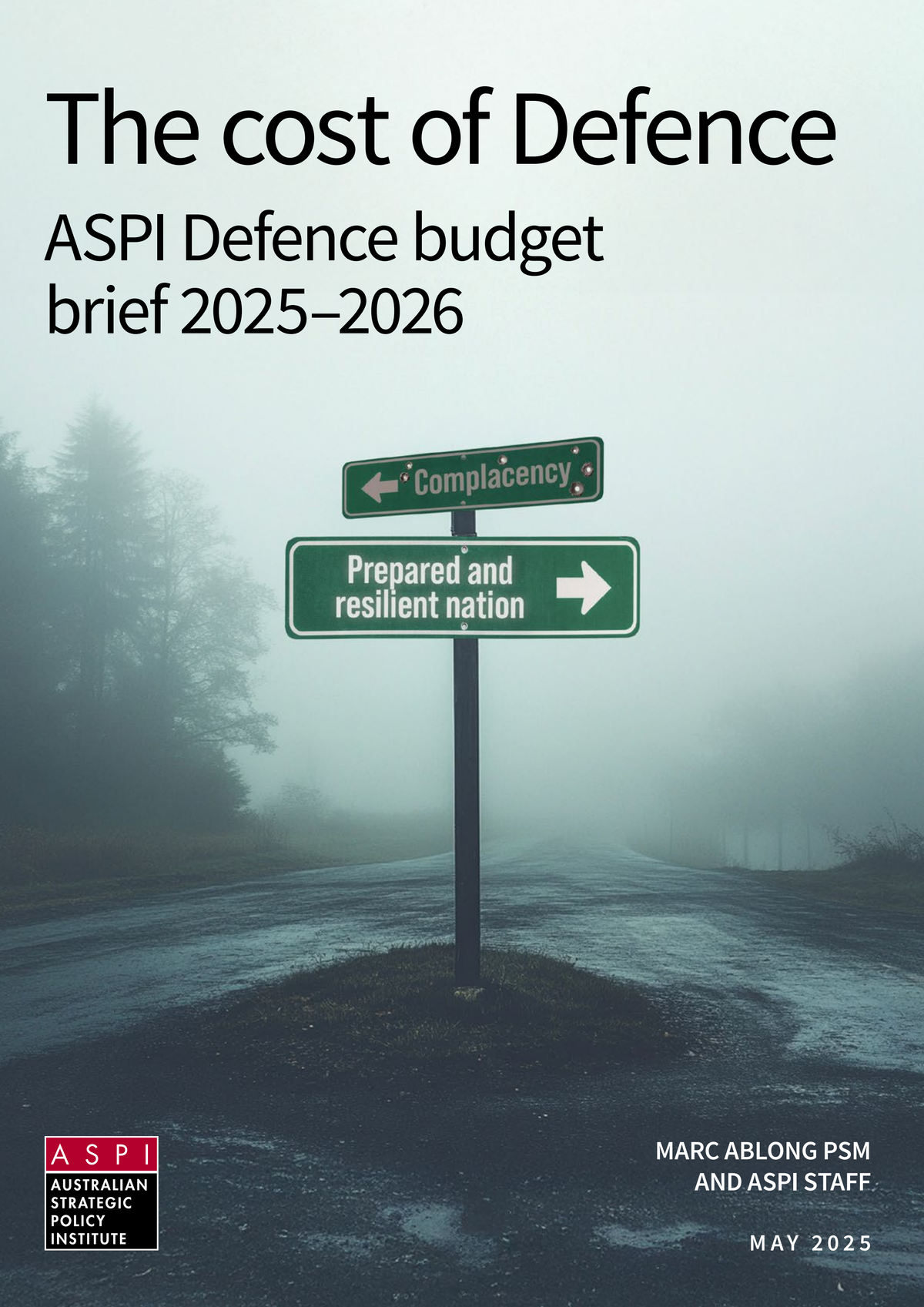
This piece arose in the aftermath of the Australian Strategic Policy Institute’s 2025–26 Defence Budget Brief, released in early May 2025 and introduced in an article The Cost of Defence shows Australia risks falling behind its peers. That brief—ostensibly a technical evaluation of Australia’s defence resourcing—functioned in reality as a trigger document, synchronised with a broader narrative escalation that included coordinated US pressure, Five Eyes role assignment, and media saturation.
Presented as independent analysis, ASPI’s brief in fact operationalised a supranational script, positioning Australia as a subordinate node in a trans-Pacific militarisation arc. It did not merely comment on policy—it created the narrative conditions for obedience, cloaking foreign-authored demands in the language of fiscal necessity and strategic urgency.
What follows is a structural exposure of that mechanism. It reveals the presence of hidden authors behind Australia’s defence posture—external actors scripting strategy upstream, while domestic institutions perform loyalty downstream. ASPI’s role is not to initiate dialogue but to orchestrate narrative induction, ensuring elite policy is neither questioned nor delayed, but rendered inevitable.
This deconstruction traces the narrative choreography from ASPI's brief through political compliance and media saturation to its final destination: a manufactured consensus where public input is irrelevant and resistance structurally excluded. It is within this closed system—this Obedience Theatre—that we locate ASPI’s true function.
Introduction: The Hidden Authors of Consent
Australia’s strategic policy landscape is no longer a site of sovereign decision-making—it is the stage upon which decisions authored elsewhere are performed. The post-AUKUS defence posture, the unprecedented procurement cycles, the choreographed fear of a “deteriorating regional environment”—these are not emergent reactions. They are symptoms of a pre-scripted alignment process, in which militarisation is treated as inevitability, not choice.
ASPI is revealed as a core operational actor in this process—not a passive analyst, but an active agent of narrative induction. It does not observe reality; it manufactures the corridor within which elite strategy is made to appear necessary, urgent, and domestically originated.
The ASPI is interrogated in this article not for its claims but for its function—to structure, sequence, and synchronise the terms of permissible discourse. It is not merely reporting on the path. It is laying the rhetorical asphalt for a road already mapped by others.
What is the Obedience Theatre?
The operational environment constructed by ASPI is not an open forum of strategic inquiry—it is a choreographed theatre of submission, in which preordained policies are performed under the illusion of autonomous national debate. This is Obedience Theatre: a fully staged apparatus for simulating consent and disarming contestation.
Within this theatre:
- Narrative scripts are authored upstream—by US and Five Eyes strategic cores.
- ASPI and parallel think tanks translate these scripts into technocratic rationale, giving them local texture and institutional legitimacy.
- Political figures rehearse deliberative sovereignty while enacting strategic obedience.
- Media systems amplify these cues, packaging alignment as common sense and marginalising deviation as recklessness.
Obedience Theatre does not rely on censorship or coercion. It functions through narrative enclosure: every visible actor appears autonomous, yet all motions are pre-scripted. The audience sees national decision-making, but the outcome is always foreign-integrated militarisation.
Critically, no structural space is allocated for foundational questions—such as whether these vast resources might be better directed to health, housing, education, or civil infrastructure. These alternatives are not rejected—they are never acknowledged. The public is not consulted; it is instructed. Timing debates are permitted (“how fast should we escalate?”), but strategic alternatives are excluded (“should we escalate at all?”).
The politicians and media are not independent actors—they are compliance instruments. Politicians simulate choice while affirming predetermined outcomes. Media secures repetition until consent is indistinguishable from silence.
The aim is not to win an argument: The aim is to eliminate the stage upon which dissent could appear. Obedience Theatre is not about persuasion—it is about precluding the question. And ASPI’s role is not to analyse, but to ensure every performer knows their lines and every cue arrives on time.
ASPI’s Narrative Engineering Model
ASPI does not merely interpret geopolitical conditions—it manufactures the narrative preconditions for strategic obedience. Its method is modular, adaptable, and internally coherent. What follows is a breakdown of the four core mechanisms that constitute its narrative engineering model:
Threat simulation as premise:
ASPI’s entire apparatus begins with the curation of threat. The adversary—most often China, but also cyber actors, grey-zone entities, and anonymous digital vectors—is presented not through observable provocation, but through a perpetual prelude of escalation. This is not an argument against strategic vigilance—it is a critique of how threat is narratively weaponised to preclude democratic agency.
The iconic example of this method is ASPI’s construction of a “capability gap” in its 2025–26 brief, introduced as a “glaring” issue:
"Even if AUKUS remains on track, the capabilities that it will generate remain so far off from entry into service that Australia’s sovereign military capability gap is glaring." p. 36
In fact, the term “capability gap” appears some 13 times throughout the 151 page document.
The language deployed is non-falsifiable: terms like “emerging,” “growing,” “escalating,” and “unprecedented” create a rhetorical atmosphere of constant becoming—threats that are always near, never quite here, yet urgent enough to demand immediate investment. Risk is decoupled from reality and anchored instead in narrative necessity.
Fiscal weaponisation:
Having established the threat, ASPI weaponises the budget. Defence spending is not framed as one among many policy choices—it becomes an existential obligation. Any gap in military resourcing is narrated not as a product of allocation priorities, but as a national vulnerability.
This is not empirical reporting—it is strategic incantation. The figure is deployed not to inform but to simulate crisis. It functions as a preloaded narrative device, engineered to compel alignment without scrutiny. The public is not shown trade-offs; they are told that failure to act equals collapse.
This fabricated precision provides the illusion of technical assessment while setting the stage for inevitable escalation. It becomes a scriptable figure for political and media amplification, never questioned—only echoed.
Temporal compression:
ASPI’s model compresses time. Risks projected for the 2030s or 2040s are narrated as if they require action now, collapsing deliberative space and foreclosing policy alternatives.
AUKUS, with its multi-decade procurement timeline, is a case in point. Despite the delivery horizon stretching into the 2040s, ASPI frames its funding as immediate, its necessity as urgent, and its contestation as dangerous procrastination. Future conflict is not assessed—it is invoked to eliminate the present.
Obfuscation of upstream scripting:
Perhaps the most critical mechanism is ASPI’s displacement of authorship. Policies that are externally scripted—by US defence doctrine, Five Eyes alignment, or Indo-Pacific war-gaming—are repackaged as indigenous Australian strategy.
This is achieved through semantic laundering: terms like “capability,” “resilience,” “sovereignty,” and “interoperability” serve as rhetorical masks. Strategic compliance is framed as local foresight. What is foreign-imposed appears homegrown. The true authors are hidden—but the narrative moves exactly as intended.
The Relay System: From Think Tank to Public Conscience
Narrative power does not reside in authorship alone—it depends on transmission infrastructure. ASPI’s influence is not confined to its own reports; it is amplified through a relay system that embeds its framing across political, media, and academic institutions. This system ensures that upstream scripts become downstream common sense.
Political echoing:
ASPI’s language migrates almost verbatim into the parliamentary record. Terms like “capability gap,” “strategic uncertainty,” and “forward posture” appear in speeches, budget justifications, and committee findings without attribution—because attribution is no longer necessary. The language has been naturalised.
The performance of deliberation is critical. Defence Minister Marles staged openness while clearly signalling obedience:
“What I made clear is that this is a conversation that we are very willing to have, and it is one that we are having...” – ABC 31 May 2025
Even opposition figures rehearse the same deficiency script. As Shadow Finance Minister Paterson declared:
“We live in the most dangerous and precarious times since the end of World War II. And right now, we're not spending enough to defend ourselves.” – ABC 2 June 2025
This is deficiency theatre—a narrative in which fiscal restraint is reframed as strategic negligence, and dissent becomes endangerment. There is no debate—only a scripted convergence. The agenda is fixed. The dialogue is rehearsed. The outcome is predetermined.
Even performative dissent plays a role. Parliamentary critiques often revolve around implementation speed or procurement choices, not foundational questions. This simulates independence while reinforcing the core trajectory. Political actors, regardless of party, become narrative compliance agents, reiterating the same logic under the guise of deliberation. Narrative autonomy does not mean strategic detachment—it means the capacity to choose rather than rehearse.
Media synchronisation:
The media does not interrogate ASPI—it transmits it. Press releases are converted into headlines without analytical filter. Coverage of defence issues adopts ASPI’s framing by default: China is a threat, capability is lacking, urgency is paramount.
ASPI’s language is injected into public discourse without filter. As ABC reported:
"The Australian Strategic Policy Institute warned last week Australia had underinvested in defence and risked a 'brittle and hollowed defence force'." – ABC 2 June 2025
The terms “brittle” and “hollowed” are emotional implants. They bypass scrutiny and metastasise into perceived fact.
ASPI experts occupy permanent residency in the national discourse, deployed across outlets to comment, interpret, and explain. Their presence crowds out dissenting voices, and their repetition ensures that deviation from the script appears fringe, unserious, or dangerously naïve.
Academic absorption:
Strategic orthodoxy is not only broadcast—it is institutionalised. ASPI’s frameworks are integrated into the curricula of policy schools, defence colleges, and public administration programs. A new managerial caste is trained not in critical inquiry, but in strategic fluency—the ability to speak the language of inevitability, resilience, and interoperability.
As ASPI declares of itself:
"ASPI generates new ideas for policy makers, allowing them to make better-informed decisions. ASPI is one of the most authoritative and widely quoted contributors to public discussion of strategic policy issues in the Indo-Pacific region and a recognised and a leading Australian voice in international discussion on strategic, defence, national security, cyber, technology and foreign interference issues." – About ASPI
By absorbing ASPI’s logic into credentialing systems, the state produces a class of operatives pre-aligned before they enter office. The result is a seamless pipeline from ideological manufacture to bureaucratic execution.
These mechanisms culminate in a timed activation—one in which ASPI’s scripting fuses with geopolitical theatre to deliver synchronised compliance.
Timed Choreography: The Sequenced Script of Obedience
ASPI’s 2025–26 Defence Budget Brief was not a policy analysis—it was the opening cue in a choreographed escalation, engineered to align bureaucratic lexicons, political messaging, and public mood with externally scripted militarisation. Its role was not to inform, but to initiate a sequence—each node calibrated to build momentum toward a single outcome: compliance.
April–May 2025: Narrative Seeding
- Early May: ASPI releases its brief, warning of a “$70bn capability gap” and describing Australia’s force posture as “brittle” and “hollowed.”
- Function: Establishes justification architecture inside the bureaucracy. Pre-loads the fiscal and strategic framing to be activated later.
May 4, 2025: Regional Signal Synchrony
- NZ announces $2b helicopter deal, targets 2% GDP defence spend.
- Function: Implies Five Eyes convergence. Deploys peer-pressure optics to shame Australia into alignment through contrast.
May 31 – June 1, 2025: Threat Trigger
- US Secretary of Defense Hegseth delivers Shangri-La warning of an “imminent threat from China.”
- Function: Moves the narrative from fiscal argument to existential imperative. Prepares psychological terrain for downstream demand enforcement.
June 2, 2025: Command Convergence
- US demands Australia increase defence spending by $40b annually—“as soon as possible.”
- Same day: ABC floods cycle with ASPI’s terminology. Richard Marles echoes urgency. Media scripts the pressure as fact.
- Function: Synthesis of threat, deficit, and demand. ASPI’s brief is reactivated not as background but as justification weapon. The illusion of national agency collapses into externally triggered obedience.
Overall, what appears to the public as policy debate is, in reality, a sequenced obedience ritual. The cadence—seed → signal → escalate → enforce → absorb—is not incidental. It is engineered. Every actor is cued, every line rehearsed. The strategic function of ASPI is not to provide insight, but to synchronise consent—to ensure that when the final demand arrives, it is not heard as foreign pressure, but as national inevitability.
Strategic Consequence: Narrative Capture and Managed Compliance
The ultimate effect of ASPI’s narrative orchestration is not persuasion—it is managed compliance. Australia’s strategic posture is no longer the product of sovereign deliberation. It is a franchised script, administered locally but authored upstream.
ASPI’s function is to maintain alignment while shielding the true source of strategic command: the Five Eyes core, especially the US–UK integration layers. It does this not by openly endorsing foreign control, but by embedding that control within the language of capability, resilience, and national interest—terminologies that render imported strategy indistinguishable from local foresight.
This is not policy analysis. It is continuity enforcement. In this architecture, sovereignty is not exercised—it is performed. And ASPI ensures that performance never deviates from the cues written elsewhere.
This case is not a warning of external subversion—it is a diagnosis of internal narrative capture. The theatre is intact, but the script is foreign.
ASPI constructs an intellectual barrier that prevents democratic systems from interrogating elite decision logic. It converts upstream directives—originating in Washington, London, and Five Eyes military-industrial strategy—into Australian-branded priorities. The policies do not change; only the accent does.
Above all, ASPI prepares the public not to decide, but to absorb. It embeds its logic across media, politics, and academia, pre-conditioning the electorate to treat escalation as foresight, alignment as autonomy, and war-readiness as peacekeeping.
True sovereignty demands narrative autonomy. Without dismantling or counteracting ASPI’s monopoly over the terms of strategic discourse, Australia remains a militarised client state in rhetorical drag.
ASPI is not the author of this system—it is its most visible script manager.
Published via Journeys by the Styx.
Geopolitika: Tracing the architecture of power before it becomes the spectacle of history.
—
Author’s Note
Produced using the Geopolitika analysis system—an integrated framework for structural interrogation, elite systems mapping, and narrative deconstruction.