Geopolitika: Baltic Brinkmanship 2025
From silent buffer to saturated corridor: The Baltic as siege theatre in the long war on Russian sovereignty.
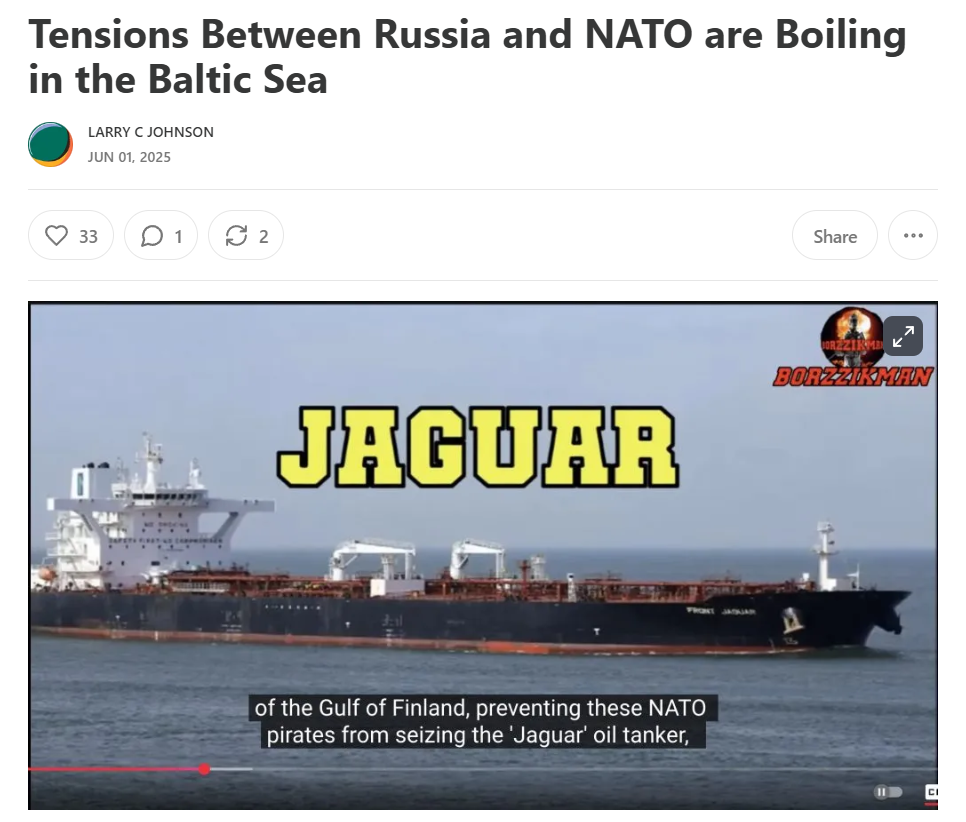
Larry Johnson’s recent article, Tensions Between Russia and NATO Are Boiling in the Baltic Sea (June 2025), offers a detailed account of the latest naval and airspace incidents between NATO and Russia in the Baltic. His narrative captures the surface choreography—tanker seizures, air intercepts, overlapping exercises—and warns of potential miscalculation.
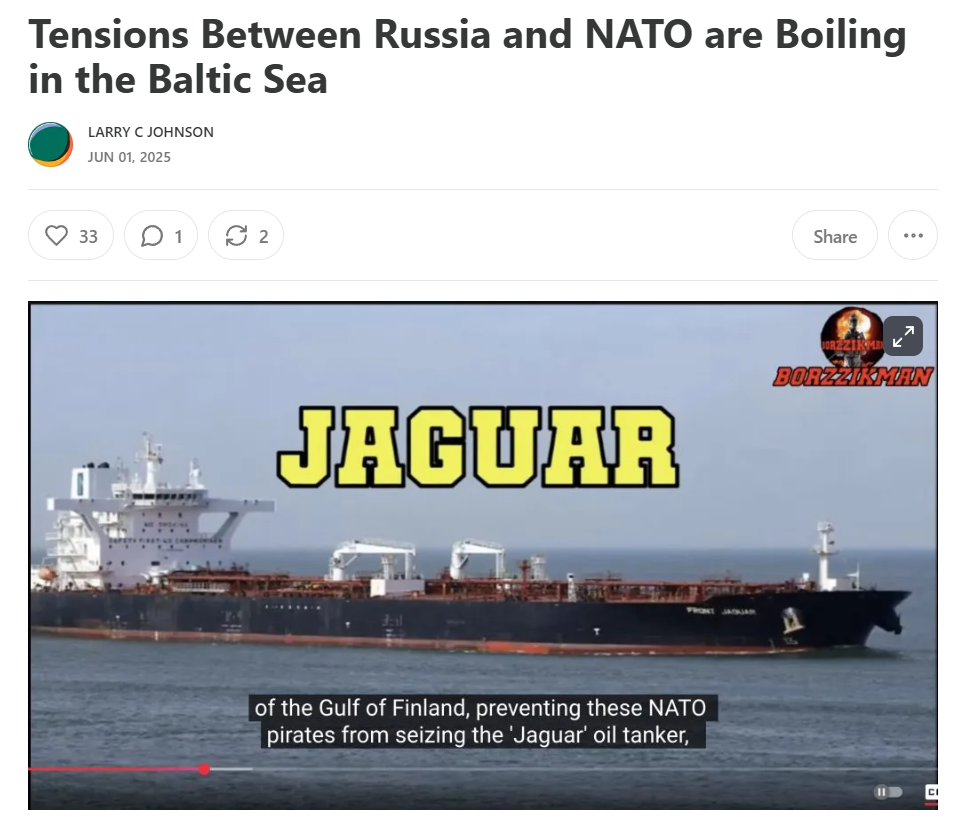
But like many seasoned observers embedded in the security paradigm, Johnson treats these incidents as emergent frictions—moments of danger in an otherwise reactive environment. This framing, while informative, is insufficient.
It mistakes choreography for chaos. It treats ritual symmetry as spontaneous escalation. And it positions Russia as provocateur in a sequence authored by deeper transnational forces.
What follows in this article is not a rebuttal—but an upgrade. A structural decoding of the Baltic theatre as it exists in 2025: not a zone of accidental friction, but a ritualised corridor in a long war against Russian sovereignty, where each “incident” is an optic within a strategic continuity script that began in 1996 and remains unfinished.
The 2025 Flashpoint
Between May and June 2025, the Baltic Sea has once again become the theatre of global narrative convergence. A sequence of events—beginning with Estonia’s attempted interception of a Russian “shadow fleet” tanker, followed by Russia’s retaliatory seizure of a Greek vessel, aerial intercepts involving German and Russian jets, and overlapping military exercises—has been framed by conventional observers as a dangerous escalation, teetering on the edge of miscalculation.
This is a misdiagnosis.
These events do not signal the outbreak of a spontaneous crisis. They mark the mid-sequence activation of a long-scripted encirclement ritual—a strategically choreographed escalation pattern whose structure was seeded not in 2025, but in 1996.
What is being witnessed is not a breakdown in diplomacy, but the execution of a continuity arc spanning three decades. The Baltic theatre is not drifting toward war; it is being conditioned into conflict optics through elite-orchestrated saturation—military, informational, infrastructural.
This article does not seek to add to the growing pool of surface-level alarmism. It aims instead to decode the ritual logic, the institutional synchrony, and the geopolitical scripting behind the Baltic 2025 flashpoint. By tracing the arc from RAND’s post-Cold War strategic planning through NATO’s territorial and doctrinal expansion to today’s kinetic rituals, we reveal how the current confrontation is not the product of chaos—but of calculated structure.
This is not escalation by accident. It is escalation by design.
Strategic Archaeology: 1996–2025
The 2025 confrontation in the Baltic Sea does not emerge from contemporary tensions; it is the continuation of a long-seeded doctrinal arc. To interpret it as spontaneous is to erase its scaffolding. Its roots lie in the mid-1990s, when the post-Soviet strategic vacuum was re-scripted not for equilibrium, but for incremental absorption.
The 1996 RAND report NATO Enlargement and the Baltic States proposed a deliberate pacing mechanism: the Baltic states were to be politically embraced but militarily postponed. Full NATO membership was seen as strategically inevitable but tactically risky. The aim was to integrate Estonia, Latvia and Lithuania without activating Moscow’s reflexes prematurely. This was not a security hesitation—it was a narrative management strategy.
By 2004, that initial restraint had served its purpose. The Baltic states were formally inducted into NATO under the guise of democratic alignment and regional stabilisation. In reality, this marked the conversion of former Soviet buffer zones into forward-operating surveillance and logistics corridors, soon to be layered with NATO infrastructure.
Following the 2014 Crimea annexation, the alliance’s posture shifted from symbolic reassurance to doctrinal hardening. RAND’s 2015 wargames declared the Baltics undefendable under existing tripwire conditions, catalysing a policy transition from passive presence to active denial. The rhetorical focus moved from deterrence to "credible defence," while infrastructure quietly expanded—rail, airfields, ports, and hardened basing across Poland, the Baltics, and the Nordic front.
This shift was not isolated. It coincided with the operationalisation of RAND’s 2019 strategy paper, Extending Russia: Competing from Advantageous Ground. That report abandoned the language of passive containment in favour of active cost-imposition. Russia was to be stretched—militarily, economically, and cognitively—by forcing it to respond to manufactured vulnerabilities across multiple theatres. The Baltics, positioned as both symbolic tripwires and critical export corridors, became an ideal venue for inducing overreach while maintaining the optics of defence.
By 2024, RAND’s From Forward Presence to Forward Defence formalised this shift. The Baltics were no longer periphery—they were central operational terrain in a long war of encirclement. Every policy adjustment—total defence doctrines, multinational force rotations, ISR integration—served to script the Baltic as an always-on confrontation corridor.
This timeline is not an evolution—it is a managed progression, dictated by elite strategy, disguised as responsive policy. The events of 2025 are not departures from order. They are fulfilments of design.
Resource Logic: Why The Baltic Is Not About Estonia
The conventional narrative situates the Baltic escalation as a security dilemma—a struggle to defend NATO’s easternmost members against a revisionist Russia. This framing obscures the underlying function of the region: the Baltic Sea is not about Estonia’s sovereignty. It is about Russia’s liquidity.
At the heart of the theatre lies a set of logistical chokepoints vital to Russia’s economic survival. Ust-Luga and Primorsk serve as primary export terminals for oil and refined petroleum products, forming the western flank of the Baltic Pipeline System. Kaliningrad, often described as a geopolitical anomaly, is in fact a dual-function node: a missile platform and a logistical contingency outlet. The ports of St. Petersburg—though civilian in designation—operate as critical export arteries for minerals, metals, fertilisers, and hydrocarbons.
Together, this corridor moves a substantial portion of Russia’s maritime trade, particularly in energy—much of it still transacted via flag-diverse commercial shipping mechanisms to evade sanctions. These flows are not peripheral. They represent a core transmission layer of Russian geopolitical agency: its capacity to convert extractive assets into strategic leverage.
Control or disruption of this corridor—under the cover of sanctions enforcement or maritime security—is not a defensive act. It is economic asphyxiation theatre.
Moreover, the undersea infrastructure adds an additional layer of strategic vulnerability. Fibre-optic cables, digital surveillance nodes, and the now-dormant Nord Stream pipelines mark the Baltic seabed as a critical dual-use battlespace. Western ISR mapping, subsea drone operations, and seabed-denial posturing all function to turn the Baltic into a compressive corridor, not a navigable sea.
What is presented as air policing, naval exercises, or sanctions enforcement is in fact infrastructure encirclement, designed to condition Russia into constant maritime defensiveness. Each Baltic state becomes less a sovereign actor and more a host structure—a staging ground for resource denial dressed in the language of alliance defence.
This is not about territorial defence. It is about strategic throttling.
Containment via Choreography: Scripted Symmetry In 2025
The 2025 Baltic escalation sequence has been widely reported as a string of unpredictable provocations—suggestive of rising tensions and potential miscalculation. In reality, it unfolds with a degree of symmetry, timing, and ritual clarity that marks it not as reactive friction, but as a coordinated confrontation loop. Each action is mirrored, each incident met with a proportional optic, producing a choreography of escalation under elite control.
The opening trigger—a Gabonese-flagged tanker intercepted by Estonian forces on 13 May—appears at first glance to be a sanctions enforcement action. But its structural role was more precise: it marked a kinetic transition point. Estonia, acting as a proxy node within NATO’s hybrid enforcement grid, initiated a calculated pressure sequence designed to bait a Russian response within the legal ambiguity of so called “shadow fleet” interdiction.
Russia complied, predictably and performatively. The retaliatory seizure of a Greek-flagged tanker days later delivered symmetry: NATO initiates a “legal” action, Russia reciprocates within the same commercial-legal bandwidth. The symmetry was the message.
Naval and aerial signals followed with equal ritualism. The German frigate Bayern was buzzed by a Russian corvette in what was labelled a “dangerous encounter.” In parallel, a German P-3C Orion was intercepted at close range by a Russian Su-27—visual spectacle for NATO publics, strategic signalling for adversaries. The five-metre proximity was not recklessness—it was pre-scripted confrontation ritual, executed within predefined envelopes of ambiguity.
Compounding the ambiguity is the fact that legal title to goods often changes hands during transit—rendering many seizures legally dubious and strategically theatrical. The interdiction of “Russian cargo” is less a legal act than a narrative claim, built on presumed origin rather than verified ownership.
Simultaneously, NATO’s BALTOPS exercise and Russia’s “Safety of Navigation” drills overlapped in contested maritime zones. Officially coincidental, the timing is structurally implausible. This is ritual synchronisation—each side performing escalation optics in full awareness of the other’s schedule. The choreography operates not to prevent conflict, but to sustain confrontation without closure.
Kaliningrad and the Suwałki Gap were reactivated as familiar symbolic hotspots. Russian missile deployments, NATO ISR patrols, and Polish-Lithuanian troop exercises converged in predictable loops. These are not vulnerable zones; they are scripted crisis nodes, kept semi-active to justify infrastructure saturation and alliance cohesion.
The Bryansk train derailment and bridge collapse—blamed unofficially on Ukrainian sabotage—served as the internal trauma mirror. It closed the loop: external pressure, internal destabilisation, foreign attribution—generating a justified posture of reflexive defence for the Russian state while maintaining escalation ambiguity.
Taken together, these events form a complete ritual cycle:
- Initiate a provocation under plausible legality
- Mirror it with proportional spectacle
- Amplify it through overlapping drills
- Anchor it in predesignated symbolic terrain
- Trigger internal reaction for legitimacy consolidation.
This is not brinkmanship. It is controlled confrontation through optic symmetry—a dramaturgy of force projection calibrated to sustain tension while avoiding rupture.
Mid-Script Activation: Extending Russia Through Calibrated Escalation
As the Baltic theatre intensifies, it is tempting to view recent developments as pressure points approaching rupture. But this phase is not reactive—it is scripted. We are witnessing the operationalisation of a strategy designed not merely to contain Russia, but to extend it—to induce overreach, provoke reflexive expenditure, and stage those reactions as justification for further encirclement. This is the structural logic beneath the optics: a calibrated escalation cycle with exhaustion, not resolution, as its goal.
A. “Extending Russia”: the engine behind the optics:
Unlike Cold War containment, the Baltic theatre in 2025 is not merely a site of reactive tension—it is a cost-imposition platform, engineered to stretch the Russian Federation across its strategic, economic, and perceptual bandwidth. This is not escalation containment. It is escalation orchestration.
At the heart of this strategy lies the 2019 RAND doctrine Overextending and Unbalancing Russia. Far from proposing deterrence or risk aversion, the report articulated a strategy of provocative saturation—deliberately opening multiple pressure fronts to induce Russian overcommitment. The aim was to force Moscow into resource-depleting reflexes, thereby weakening its broader strategic posture.
In the Baltic, this doctrine finds full expression. NATO’s posture deliberately compels Russia to over-resource its Western Military District and Kaliningrad exclave. Missile deployments, Baltic Fleet mobilisation, and constant airspace monitoring become permanent cost centres. Each NATO movement—however incremental—triggers reflexive deployments of Iskander platforms, Su-35 scrambles, or naval escort re-tasking.
But the pressure extends beyond military reflex. Russia must reorient energy logistics to avoid interdiction, finance sanctions-evasion fleets, maintain elevated levels of civilian defence readiness in the Baltic oblasts, and invest in layered electronic countermeasures across multiple ISR vectors. These expenditures are the intended outputs—not unintended consequences.
Critically, every Russian reaction is then recycled as evidence of aggression, allowing NATO states to legitimise additional deployments, exercises, and strategic hardening. The effect is a self-fulfilling siege loop, in which the provoked response validates the initial provocation.
“The point is not to contain Russia outright, but to compel it to overextend—to burn resources, political capital, and global reputation in response to structurally engineered stimuli.”
This is not miscalculation. It is scripted exhaustion.
B. What hasn’t happened (yet):
Despite the visible escalation cycles, the current Baltic theatre is still operating within its ritual phase. The system remains in mid-sequence, with several latent scenarios structurally implied but not yet triggered. These are not speculative—they are embedded in doctrine, infrastructure, and narrative posture.
- Maritime chokepoint interdiction under the guise of “legal enforcement” remains a high-probability activation. Targeting of vessels carrying Russian-origin cargo, often under non-Russian flags, and falsely framed as part of a “shadow fleet” to justify interdiction optics or military-civilian dual-use vessels could produce a manufactured crisis with plausible deniability.
- A fatal aerial intercept or deliberate provocation incident—designed to trigger NATO Article 4 or Article 5 consultations—remains structurally viable. Current flight profiles and intercept proximities make such an event logistically trivial to engineer.
- A Kaliningrad blockade rehearsal, framed as an ISR operation or sanctions enforcement zone, is preconditioned through existing air and sea denial operations. NATO could encircle without declaring siege.
- The Arctic–Baltic corridor linkage—through climate logistics, shipping lanes, or digital seabed infrastructure—offers another entry point for escalation. It would activate northern naval posture while justifying Baltic saturation under “environmental” or “technological security” narratives.
- Lastly, a domestic false-flag incident within Estonia or Latvia—cyber, infrastructural, or kinetic—could trigger Article 5 ambiguity, justifying full NATO force saturation under defensive optics.
“The corridor is active. The terminal sequence is not yet declared—but all pieces are pre-aligned.”
This is not a question of whether escalation occurs. It is a question of which trigger is chosen, and how its optics are managed to mask authorship and preserve legitimacy.
Conclusion: This Is Not Escalation—It Is Execution
The Baltic events of 2025 are not an aberration. They are not evidence of deteriorating diplomacy, spontaneous overreaction, or accidental brinkmanship. They are the visible fulfilment phase of a long-scripted strategic saturation sequence, encoded into NATO doctrine, RAND architecture, and transatlantic military-industrial synchrony.
Each incident—be it a tanker seizure, a low-pass intercept, or an overlapping naval drill—is not an improvisation, but a ritualised performance designed to sustain a state of controlled confrontation. The aim is not resolution. The aim is perpetual positioning—keeping the adversary reactive, exhausted, and encircled, while the strategic authorship remains concealed behind the optics of democratic defence.
From the 1996 RAND paper that first laid out the phased absorption of the Baltics, through the formal NATO accessions of 2004, the recalibrations following Crimea, the “extending Russia” cost-imposition doctrine of 2019, and the forward defence saturation strategy of 2024—the 2025 Baltic flashpoint does not stand alone. It is a ritual node in a structurally determined containment arc.
Russia’s so-called aggression is not expansionism but reflexive sovereignty preservation under sustained siege. And NATO’s defensive posture is not protection—it is optical legitimacy masking resource throttling, territorial encirclement, and elite narrative continuity.
This moment is not a climax. It is a continuation.
If war arrives, it will not be declared—it will be described. And just maybe the Baltic is where its script was drafted, rehearsed, and now, mid-performance, awaits its next ritual cue.
Published via Journeys by the Styx.
Geopolitika: Tracing the architecture of power before it becomes the spectacle of history.
—
Author’s Note
Produced using the Geopolitika analysis system—an integrated framework for structural interrogation, elite systems mapping, and narrative deconstruction.