Geopolitika: Benchmark Governance — How Chatham House’s “The world in 2026” Turns Geopolitics Into Portable Watchpoints
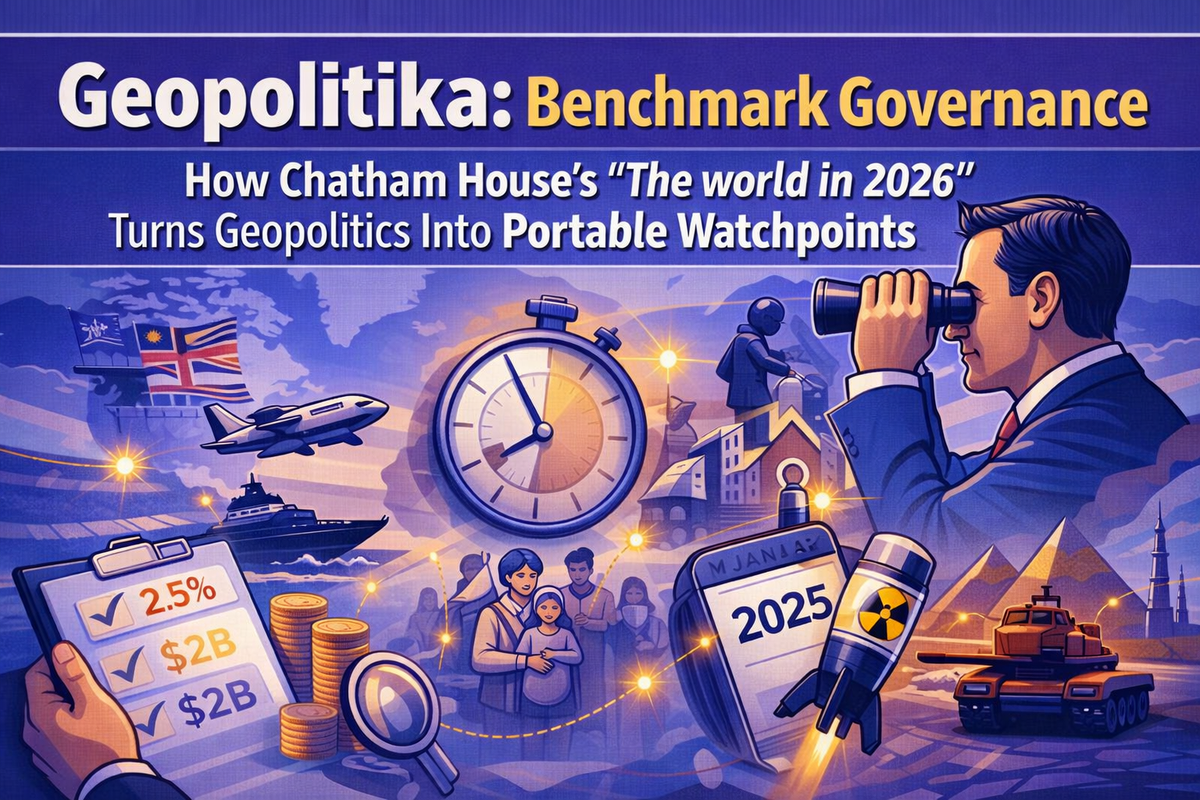
Chatham House’s Winter 2025 report “The world in 2026” reads like a neutral dashboard: a compact, public-facing outlook that moves briskly from theatre to theatre and domain to domain. What makes it influential isn’t a single prediction. It’s the format discipline—a way of turning complex realities into portable tokens that can be repeated across briefings, coverage, and policy talk. In the indexed passages, the future is rendered as a set of numbers, dates, institutional switch-states, and prompt-questions that tell readers what to carry forward as “the thing that matters.”
The Shared Story: The Future Is Governable If It Can Be Benchmarked
A shared story runs through the anchor spine: the world becomes manageable when it can be expressed as benchmarks. Not in the sense that benchmarks are “wrong,” but in the sense that the document repeatedly prefers what is countable, comparable, and quotable.
Ukraine, for example, is converted into an accounting geometry. The text installs a requirement: “Ukraine will need around $100 billion…”. It then adds an institutional instrument: “EU leaders agreed to loan Ukraine €90 billion over the next two years…”. And it adds a pledge total as a contrast object: “only $2 billion” pledged. The reader leaves with a three-token model: required, loaned, pledged. It’s not a battlefield map; it’s a ledger.
The same tokenisation repeats elsewhere. The global economy becomes an institutional baseline: “[The International Monetary Fund] is forecasting growth of just over 3 per cent in 2026.” Technology becomes workforce exposure: “up to 60 per cent of jobs over the next decade.” Public capacity becomes a reduction magnitude: “slashing 80 per cent of [USAID] programmes.” Nuclear stability becomes a clock: “New START… is due to expire in February.” Human catastrophe is expressed as a displacement figure: “displaced 12 million people.” This is continuity logic: the story isn’t “trust us,” it’s “here are the handles.” If a fact can become a handle, it becomes the narrative surface. If it can’t, it is harder to carry, and it risks becoming background.
Benchmark Governance As A Technique, Not An Intention
It’s useful to treat this as a technique rather than a claim about intention. Benchmarks do three things in a compendium like this:
- They compress complexity into objects that travel.
A number can move through institutions faster than a full causal narrative. A benchmark can be repeated without the speaker needing to re-derive it. - They create comparability across domains.
An aid requirement, a growth forecast, a job exposure metric, and a programme cut can be placed in parallel as “big watchpoints,” even if they aren’t commensurable in a rigorous analytic sense. - They allocate attention.
What gets benchmarked is what becomes discussable in a limited slot.
The indexed passages show this repeatedly. The Ukraine section is structured around money totals. The macro outlook installs a single institutional baseline. The AI section offers a single headline exposure number. The health section centres organisational status and programme magnitude. The nuclear section centres expiry. The Africa section offers displacement magnitude.
None of this requires claiming the authors “intend” manipulation. The continuity mechanism is structural: the format produces repeatable tokens, and repeatable tokens coordinate discourse.
Ukraine As Commitment-Accounting Geometry
The Ukraine subsection is the clearest demonstration of the document’s method. It gives a requirement benchmark: “Ukraine will need around $100 billion…”. It supplies an institutional instrument benchmark: “EU leaders agreed to loan Ukraine €90 billion over the next two years…” It supplies a comparative pledge benchmark: “only $2 billion” pledged.
This is not a minor stylistic choice; it determines what kind of reasoning the section invites. Through a NATO core lens, NATO appears as pledge aggregation—its salient feature is a sum total positioned against a requirement. Through a global finance lens, the EU appears as an instrument provider—loans are the governance form. The section’s centre of gravity becomes the gap-object: required versus pledged.
What’s structurally interesting is what the benchmark passage does not do in the same breath. The requirement/pledge contrast is installed as a salient condition, but the indexed lines do not spell out the causal path from “gap” to a specific downstream outcome. That absence does not mean the authors have no reasoning; it means the unit of discourse here is the benchmark object, not the mechanism narrative. The section governs attention by giving readers a clean ledger shape they can repeat.
Baselines Under Erosion: Institutions As Switch-States And Clocks
A second core pattern is the use of institutional status as a governance marker. The future is narrated not only with numbers but with switch-states (in/out) and expiry clocks (active/expiring).
In global health, the indexed passage notes institutional exit: “withdrawal from the organisation in January 2025…”. It pairs this with a capacity contraction magnitude: “slashing 80 per cent of [USAID] programmes.” The baseline—the expectation of stable multilateral and programmatic capacity—is made visible precisely by highlighting discontinuity and contraction.
In nuclear security, the baseline is arms-control continuity, but it is surfaced through a timer: “New START… is due to expire in February.” Through a Eurasia / Russian lens, this renders the strategic environment as “post-expiry risk,” indexed to a date rather than a multi-layered regime analysis. Through a media attention lens, it functions as a countdown watch point: an attention magnet that says “this date matters.”
Again, this is continuity logic rather than intention: a discontinuity marker has a special role in compendium writing. It turns a messy, contested domain into a calendar fact. It is easy to repeat and hard to ignore.
The Optics: Prompt-Villains, Escalation Words, And The Absent Plumbing
A compendium like this also constructs optics through rhetorical devices that are portable.
One is the prompt-villain: an adversary silhouette installed by a question rather than argued as a full case. In the Europe section, the indexed line is a question: “How might Russian influence campaigns exploit…” In a single clause, it sets a topic and an implied adversarial frame. It is designed to be re-asked: a template for panels, op-eds, and policy memos. The question form matters because it doesn’t need to present evidence in the same line to install the frame; it only needs to cue what should be feared and watched.
A second optic is escalation by adjective: a high-impact word that amplifies salience without additional mechanism in the same snippet. The Latin America section uses: “the repercussions for regional security would be seismic.” “Seismic” is a carrying word: it migrates easily into headlines and talking points. It’s an urgency token.
And then there is the recurring absence: in the benchmark-heavy lines, the document installs the tokens but does not, in those same lines, provide the full plumbing of how token → outcome. The gap-object is installed. The switch-state is installed. The expiry clock is installed. The exposure percentage is installed. The format doesn’t reward long causal derivations; it rewards portable tokens. That’s the structural trade.
Parallel Signals: Cataloguing Without A Bridge
The compendium format also places different “authority objects” next to each other in ways that encourage parallel uptake rather than system integration.
On one page, the macro baseline is an IMF forecast: “forecasting growth of just over 3 per cent in 2026.” On another, the text introduces a named formation in international law: “Hague Group — was formed in January 2025.” Through a global finance lens, the IMF baseline becomes the governing macro descriptor. Through a subaltern or Global South lens, the Hague Group naming becomes a coordination signal—an attempt to construct a trackable legal bloc.
But in the indexed anchors, these signals are presented as parallel watchpoints rather than as an explicitly bridged system: the reader is not given, in those cited lines, a mechanism connecting macro baseline to legal coordination dynamics. This isn’t a moral critique; it’s a structural property of compendia: they optimise for breadth and portability over integration.
Diplomacy appears as a watch point, too
One refinement worth including is that the document does gesture toward diplomacy and respite—again in the watch point grammar. In the Middle East section, the indexed cue is: “The US-brokered Gaza ceasefire in October offers a rare moment of respite.” Through an Israeli government focused lens, the ceasefire is treated as a reference condition, a timing marker that organises what follows. Structurally, even the diplomatic signal is tokenised as a time-bound marker: “October” and “moment of respite.”
Looked At Through Different Lenses
This propensity for parallel, unintegrated signals means the document functions differently depending on the reader's focus. Viewed through various professional or ideological lenses these alternative perspectives don’t produce “different truths” so much as different readings of the same portability machine—a format that turns complex politics into repeatable artifacts (numbers, dates, switch-states, named groupings) that travel well across institutions.
- Atlantic Think Tank (briefing-pack read): Read as a curated dashboard for policy and media elites. The document’s credibility is carried by institutional baselines and compact headline markers—forecasts, totals, deadlines—so a reader can absorb “what matters” quickly and repeat it in meetings. The emphasis is less on full causal explanation and more on producing legible reference points that can anchor discussion across many domains.
- NATO Core (alliance bookkeeping read): Read as a ledger of coalition capacity. Support is narrated through the contrast between what is officially “needed” and what is actually “pledged,” with totals functioning as the story’s main explanatory device. This view treats alliance cohesion as a measurable gap—commitments, shortfalls, and burden-sharing—rather than as a detailed operational strategy.
- Global Finance (instruments-and-baselines read): Read as governance through financial plumbing. Loans, pledged sums, and growth forecasts become the primary language for describing reality—less about ideology, more about the instruments that set constraints and expectations. This lens highlights how macro baselines (forecasts) and funding tools (loans, programmes) stand in as the practical “levers” that audiences are trained to watch.
- Eurasia / Russia (treaty-clock read): Read as strategic stability governed by time. Arms control and deterrence are indexed to expiry dates and post-expiry conditions, turning complex security architecture into a countdown. The key artifact here is the “treaty clock,” which functions as a watchpoint that concentrates attention and implies near-term recalibration even without spelling out the downstream pathway.
- China State (planning-cadence read): Read as state strategy through timetable signals. Major shifts are indexed to the party-state’s planning cadence—especially the five-year plan cycle—so “what China will do” is inferred from when plans launch and when targets reset. In this view, chronology itself is information: the calendar becomes a proxy for strategic direction.
- Subaltern & Global South (human-cost + coordination-signal read): Read for human impact and emerging Southern coordination. Human suffering appears as countable magnitudes (displacement), while political agency appears as naming and dating new formations (a group is formed; a bloc is announced). The key point is that both are presented as brief tokens—figures and timestamps—rather than extended lived narratives or deep institutional histories.
- Everyday (lived-impact compression read): Read for how geopolitics collapses into ordinary life. The document’s big forces are translated into exposure and disruption magnitudes—jobs affected, people displaced—so everyday reality is represented through headline percentages and counts. This lens underscores a trade-off: the compression makes impacts legible and shareable, but it can also flatten texture and distributional detail.
Why the lens integration matters: the goal isn’t to accuse. It’s to show that the same artifacts—numbers, dates, switch-states, named groupings—serve different discourse circuits (policy, finance, security, media, public) while keeping the same underlying grammar: what travels is what gets benchmarked, dated, or named.
Script-Cycle: Sorting That Prepares Reset
In script-cycle terms — collapse → panic → sorting → reset → ritualisation — this report functions as sorting. It breaks the world into governable objects so that audiences can rank priorities and rehearse standardised talk.
Sorting is visible in the benchmark architecture: requirement, loan, pledge; forecast baseline; exposure percentage; programme cuts; withdrawal; expiry; displacement; formation date. Sorting is also visible in scripted anticipation: the interrogative “How might…” installs a repeatable threat frame that helps audiences pre-organise interpretation.
What does sorting prepare next? Reset. Not as a declared policy, but as an implied administrative next step once discontinuity and gaps are foregrounded. If an organisation is “withdrawn from,” the implied next condition is post-withdrawal operation. If a treaty is “due to expire,” the implied next condition is post-expiry security management. If a requirement is installed alongside a far smaller pledge total, the implied next condition is a reconfiguration of the commitment architecture—more pledges, different instruments, or revised expectations. The compendium doesn’t need to specify the reset to prepare it; it only needs to coordinate attention on the watch points that make reset feel necessary.
Implications For 2026: What The 2025 Cycle Reveals About How These Outlooks Operate
The clearest way to read The world in 2026 is through the translation path of the previous cycle. The world in 2025 did not “predict” the year so much as pre-format it. It seeded a small number of portable benchmarks and deadlines that survived uncertainty and became the language through which events were interpreted as they unfolded.
Trade is the cleanest illustration. The 2025 report condensed Trump’s trade posture into a pair of quotable percentage tokens—“10 to 20 per cent” and “60 per cent on Chinese imports”—which became the default shorthand for a year of tariff volatility. As 2025 progressed, tariff policy did in fact move in jumps and pauses, with rates spiking and then easing as bilateral deals altered implementation. The outcome mattered less than the grammar: once the percent-tokens were installed, they functioned as the carry-able frame for every new development.
The same translation mechanism appeared in alliance and institutional governance. The 2025 cycle elevated a “next-number” defence benchmark—2.5 per cent of GDP—which later became an explicit UK government commitment. It also elevated a calendar peg for the Pandemic Agreement, which converted cleanly into an institutional event at the World Health Assembly in May 2025. In each case, the report didn’t drive the decision; it preloaded the talking point that policy could later occupy.
That pattern clarifies what the 2026 outlook is doing. Its anchors are not forecasts so much as pretexts: Ukraine is rendered as a commitment ledger (“$100 billion required”; “only $2 billion pledged”); global health as a switch-state (“withdrawal… January 2025”); nuclear stability as an expiry clock (“New START… due to expire”). These are not solutions. They are the conditions under which “reset” talk becomes administratively natural.
Overall, Portability Versus Governance Capacity
The fracture exposed by The world in 2026 is not ideological; it is functional. On one side sits a highly effective system for coordinating elite attention: benchmarks, baselines, expiry dates, and prompt-questions that travel cleanly across media, ministries, and markets. On the other side sits the diminishing capacity to convert those tokens into integrated governance outcomes.
The 2025 cycle showed how well the first side works. Percentages, deadlines, and targets became real policy language when timelines bit. The 2026 outlook doubles down on the same grammar. But the fracture lies in what this grammar cannot do: it sorts, it signals, it prepares audiences for adjustment—yet it increasingly displaces mechanism with metric, integration with juxtaposition, and resolution with perpetual “watch points.”
In that sense, The world in 2026 is not warning of collapse. It is normalising managed fragility: a world governed through carry-able numbers and expiring baselines, where resets are expected, but breakthroughs are structurally out of scope. The risk is not that the outlook is wrong; it’s that it may be too successful at training audiences to accept a future that is endlessly re-calibrated, but never structurally repaired.
Published via Mindwars Ghosted.
Geopolitika: Tracing the architecture of power before it becomes the spectacle of history.
—
Author’s Note
Produced using the Geopolitika analysis system—an integrated framework for structural interrogation, elite systems mapping, and narrative deconstruction.
Support: Mindwars Ghosted is an independent platform dedicated to exposing elite coordination and narrative engineering behind modern society. The site has free access and committed to uncompromising free speech, offering deep dives into the mechanisms of control. Contributions are welcome to help cover the costs of maintaining this unconstrained space for truth and open debate. If you like and value this work, please Buy Me a Coffee