Geopolitika: Britain’s Forever War Dividend – How a RUSI Paper Keeps the Atlantic War Machine in Balance
RUSI has already told us what it is. RUSI – Choreographing Legitimacy traced the institute back to its charter as an imperial war college and forward to its current role as a Crown-sanctioned narrative forge, where ex-generals, intelligence chiefs and legal officers rehearse the lines that turn coercive power into “rules-based order”. Law, doctrine and optics are fused into a single performance: the Attorney General doesn’t explain international law at RUSI; he consecrates future interventions in its name, under a logo part-funded by the very ministries and arms firms that will implement them. In Forecast or Mandate?, the same machine reappears in another costume: a “Russia is collapsing / 2026 hybrid war” script that looks like a forecast but functions as a mandate. Russia is declared weakened yet more dangerous, 2026 is branded the danger window, and Europe is urged to harden, spend and align. The point is not prediction accuracy; it is coalition discipline. The think-tank paper sits at the centre of an Atlantic information chain—ministries, NATO HQs, OSINT projects, friendly media—designed to make one path feel inevitable: long confrontation, rising budgets, no serious peace architecture on the table.
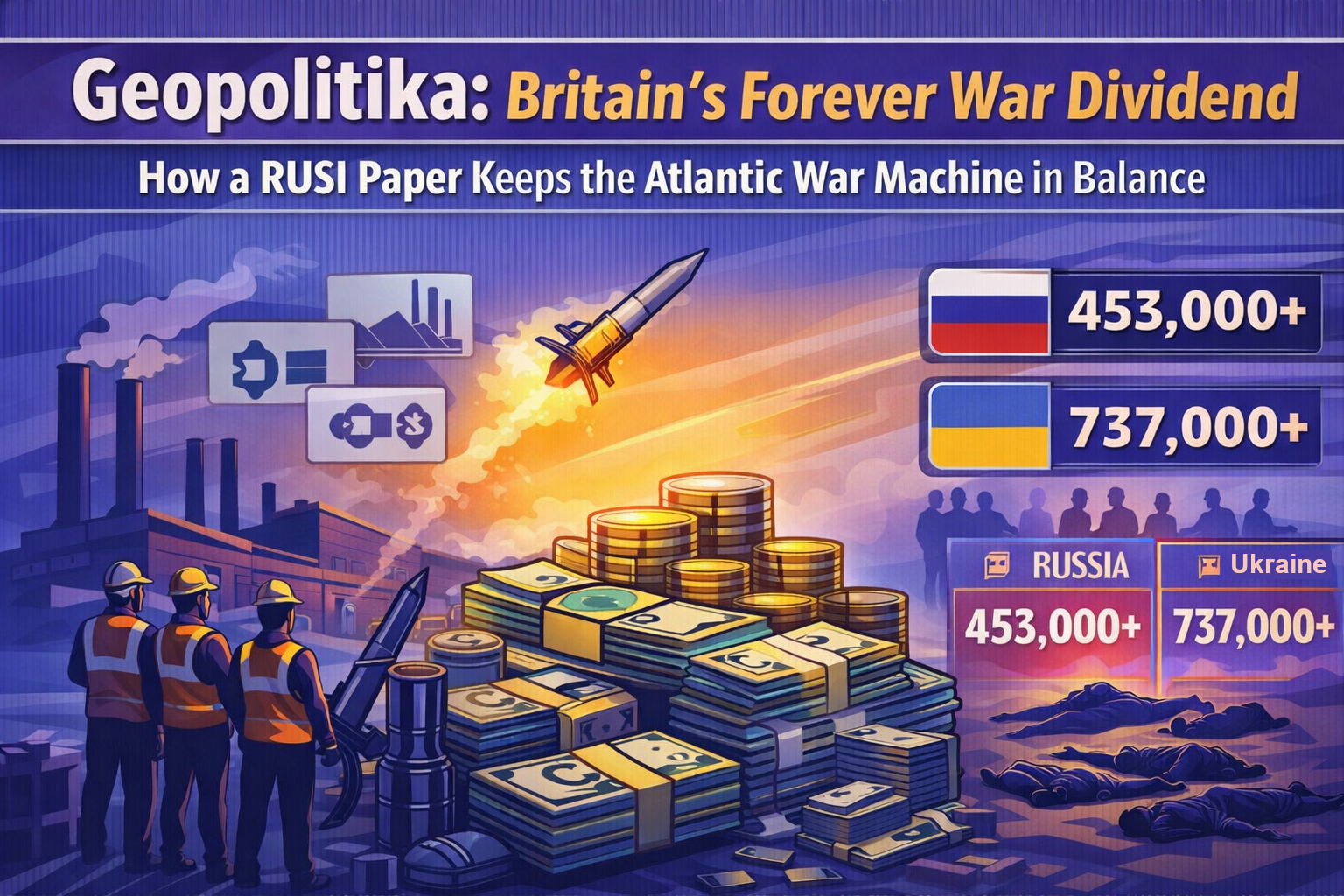
This article takes a third specimen from the same forge, a commentary dated 5 December 2025 Britain’s Economic and Military Dividend from Supporting Ukraine by Major Laurence Thomson, expressing the argument that Britain’s support to Ukraine delivers both a “security dividend” and an “economic return”. On the surface, the piece is a compact policy note about forward defence and industrial capacity: every pound “invested” in Ukraine today supposedly benefits Britain tomorrow, while contracts for Thales, BAE and others are presented as proof that the war is good business for Belfast, Sheffield and the regions. Read alongside the earlier pieces and against late-2025 realities—the stalled talks, the new €90 billion EU loan that will sit on Western taxpayers’ balance sheets, the steady Russian territorial gains and Ukraine’s manpower crisis—it resolves into something else: a ritual text that locks three claims together. Specifically, Russia as permanent villain, NATO as permanent frame, and the British defence industry as permanent development strategy—even as attrition trends cut the other way. What follows is not a review of RUSI’s reasoning. It is an autopsy of how this single commentary stitches war, industry and public consent into one continuous storyline, and how that storyline keeps the security–industrial order stable, regardless of where the front line or the balance of forces actually sits.
Setup: A Think-Tank Text as System Maintenance
Digging deeper, RUSI’s latest Ukraine piece looks modest enough on first contact. The title promises “Britain’s Economic and Military Dividend from Supporting Ukraine”; the byline gives you a serving British Army major, in post as the Chief of the General Staff’s Visiting Fellow at RUSI, framed by the familiar royal-crest logo. Early on, the line that matters arrives: “every pound invested in Ukraine today” benefits Britain and saves “substantially larger expenditures later.” The argument is simple: support now is cheaper than the threats you avoid later. It is presented as independent analysis but written from inside the state–military guild, under the masthead of a think-tank whose recent annual reports list ministries and major arms contractors among its sponsors—the same ecosystem that spends the money and cashes the “dividend” contracts the article celebrates.
By late 2025, that context is not theoretical. RUSI is publishing this “dividend” narrative alongside pieces warning of a “desperate” Russia and a 2026 hybrid-war danger window, at the exact moment when Russia is consolidating gains on the ground, Ukrainian manpower and finances are under extreme strain, and the EU is loading up tens of billions in new Ukraine-linked loans that will not be repaid if Moscow dictates the terms of an eventual settlement. The question, then, is not whether the logic is “right” in some policy-debate sense. The structural questions are sharper: what worldview does this text stabilise, and for whom? If RUSI has access to the same attrition and fiscal data as governments, why are desperation and degradation being projected onto Russia rather than onto a Ukraine that is increasingly dependent on external cash and manpower tricks? Which ways of seeing are being fed, and which are being quietly starved?
For the purpose of this discussion, three analytic lens bundles matter:
1. The Atlantic / NATO / Eurasia bundle: this is the view from the Atlantic security core, where Russia is the primary antagonist, NATO is the unquestioned frame, and Britain’s job is to push resources forward into the frontline state. In this lens set, “defending Britain by defending Ukraine” is not a metaphor but the operating system: threats are defined in alliance terms, solutions are more posture, more kit, more spend, and the fact that recent attrition trends favour Russian consolidation is treated as a reason to double down, not to rethink the architecture.
2. The media / everyday bundle: this is how the same strategy is packaged for public consumption. Here the article translates war into contracts, jobs and reassuring numbers—billions in orders, thousands of jobs, 68% of defence spend outside London—plus a poll showing “six in ten” Britons backing the UK’s role. The unseen counterpart—ballooning Ukraine-linked debt, crowded-out domestic budgets, the possibility that support is underwriting a losing battlefield position—is kept offstage. Costs, risks and alternatives are collapsed into a simple story in which ordinary life appears as employment and a willingness to “bear costs”, nothing more elaborate.
3. The suppressed subaltern / humanitarian / EU-federal bundle: the view from those at the sharp end and from alternative security architectures. In these lenses you would expect to see Ukrainian soldiers and civilians, Russian conscripts, and UK regional communities as agents, not just inputs into NATO deterrence and UK industrial strategy; you would also expect some space for non-NATO European security designs—OSCE mechanisms, pan-European deals—especially as ceasefire feelers and “talks about talks” surface and stall. In the RUSI piece, that bundle is almost entirely absent: human lives appear as aggregate Russian losses that “benefit” NATO, Ukrainian exhaustion is reduced to a line about “terrible human cost”, and any path other than long-war Atlantic management simply does not exist on the page.
The following analysis walks this single commentary through each of these bundles in turn. First, how the Atlantic / NATO / Eurasia lenses turn Ukraine into Britain’s forward-defence lab and reboot Russia in the eternal-villain slot. Second, how the media/everyday lenses convert war spending into “investment” and “levelling up”, with loans and trade-offs buried in the footnotes. Third, what becomes visible when you switch on the subaltern / humanitarian / EU-federal lenses that the text keeps mostly dark. The point is not to grade RUSI’s policy advice; it is to show how one short think-tank article works as system maintenance for a much older security–industrial order at the very moment that order is being stress-tested on the ground.
Atlantic / NATO / Eurasia: Forward Defence and the Eternal Villain
At the heart of the RUSI piece is a very simple doctrine chain. Money leaves the UK budget today, is converted into Ukrainian capability, that capability destroys Russian tanks, aircraft and troops in Ukraine, and the forces that die there are forces that cannot be used later against NATO states. The same sequence is repeated in different guises: artillery shells, missile systems, drones and training all flow forward; Russian equipment and personnel are “degraded”; the threat to Britain is thereby reduced at a distance. Russia’s 2022 invasion is labelled a “failure of NATO’s deterrent posture”, but the conclusion is not that the posture needs to be redesigned—only that the volume and readiness of forces were insufficient. The remedy is recapitalisation, not reassessment. “Britain defends itself by defending Ukraine” is the doctrinal slogan that ties it all together, even as late-2025 battlefield trends and manpower data point toward Russian consolidation and Ukrainian exhaustion rather than one-way degradation of the adversary.
Seen through the Atlantic think tank and NATO core lenses, this is textbook alliance discipline. The UK is portrayed as a responsible Atlantic player; if it wants to be taken seriously, it must push resources forward into Ukraine. Support is not one option among many but the default behaviour of a “serious” ally. NATO’s architecture is treated as fixed: there is no question of alternative European security arrangements, only the question of how quickly and how generously Britain will fund the existing one. When sister RUSI outputs talk about Russia as “the desperate one” while projecting a 2026 “hybrid war” danger window, they are performing the same move: any evidence that attrition and time now structurally favour Russia and strain the West is inverted into proof that NATO must arm faster and harder. All the “solutions” live inside this frame—more forces, more equipment, more spending—and the article’s role is to ratify that as self-evident. Forward defence is not debated; it is presupposed.
The Eurasia/Russia lens locks the villain slot and manages the inversion. Russia is not just an aggressor in this specific war; it is the structuring antagonist that makes the alliance logic add up. The text needs Russia to be simultaneously weakened and more dangerous: weakened enough that attrition in Ukraine can be sold as a “dividend” to NATO, dangerous enough that any talk of ceasefire, frozen conflict or negotiated settlement can be coded as premature or naïve. Territorial gains, force regeneration and Ukrainian manpower collapse are not allowed to change the script; they are either ignored or recast as signs of “desperation”. The destruction of Russian hardware and manpower is narrated almost exclusively as a security yield for the alliance, not as one contested option among other strategic paths. There is no space in this frame for “how much attrition is enough?”, “what if the attrition balance has turned?” or “what comes after?”—only the reassurance that every Russian tank destroyed is a step towards greater UK safety.
Structurally, this lens bundle turns a specific war into ongoing system maintenance for NATO. Ukraine becomes the forward lab where the deterrence machine is serviced, upgraded and now projected into a 2026 threat horizon; Russia becomes the continuity infrastructure that keeps UK threat narratives coherent from Crimea to Donbas to whatever comes next. By late 2025, Russia has added several thousand square kilometres to its control and Ukraine is wrestling with six-figure levels of avoidance and desertion, yet the narrative still casts Russia as “the desperate one.” A war that, on the ground, is drifting toward Russian consolidation is still presented as an arena where Britain “defends itself by defending Ukraine”. Once that is in place, the later moves of the article snap neatly onto it: defence factories and export finance can be sold as tools of forward defence rather than as bets on a long, grinding stalemate, and polling about public support becomes evidence that the Atlantic script still holds at home. The industrial and consent lenses don’t replace this framing—they plug into it and depend on it.
Media / Attention / Everyday: Jobs, Contracts, Polls as Consent Devices
If the Atlantic and NATO lenses tell you why Britain “must” spend, the media and everyday lenses tell you how that spending is sold. The RUSI piece lines up its economic “dividends” like a press office crib-sheet. There is the missile production line in Belfast, with a billion-plus contract and 700 jobs attached. There is artillery barrel manufacture coming back to Sheffield after nearly two decades. There is £1.86 billion in ammunition factories, said to generate around a thousand jobs across at least 13 sites. And there is the killer statistic: 68% of defence spending flows to regions outside London and the South-East. Each detail comes pre-formatted as good news: money out to Ukraine, work and investment “coming home”—with no parallel line about the long-tail liabilities of Ukraine support, from sovereign loans that will sit on Western balance sheets if Kyiv cannot repay, to the wider fiscal squeeze that follows.
Through a media attention lens, the construction is almost too clean. Big contracts, round job numbers, tidy regional percentages—this is not how an internal force-planning document reads; it is how you build a story that can be recited on breakfast TV and in constituency letters. “X billion, Y jobs, Z% to left-behind regions” is copy-and-paste-ready for ministers and editors. Complexity disappears: the supply chain, the time profile of the spending, the conditionality of those jobs on a live war, and the fact that new Ukraine-linked lending ultimately rests on EU and UK taxpayers—all of that is pushed to the background. What matters is that each figure can be held up as a token of shared benefit: the war is paying off in your town.
Switch to a media capture lens and the alignment tightens. These proof-points are exactly what governments and defence firms need amplified: war spending equals “investment and jobs”, not “guns versus everything else”. The article does the pre-processing. By the time a journalist or MP touches these numbers, the frame is already locked: to question the flow is to question jobs and regional uplift, not to ask what else the same money might have built—backlog-clearing for the NHS, basic housing repair, energy infrastructure, civilian industrial policy. Behavioural threats—sabotage warnings, “hybrid” risks to factories and cables in other RUSI outputs—slot neatly into the same ecosystem, providing fresh reasons to protect the very plants and contracts just advertised as local lifelines. Opportunity cost is structurally crowded out; the story’s bandwidth is consumed by the good-news metrics the system wants repeated.
The everyday lens shows how thin the representation of ordinary life actually is. Citizens appear in two guises: as workers in defence plants and as respondents in a poll supposedly willing to “bear costs”. There is no granular view of what those costs are—higher taxes, diverted budgets, inflationary pressure—or how they interact with housing, wages or basic services in the same regions now tied to ammunition and missile production. Everyday life is flattened into employment and abstract sacrifice, with no visibility for non-military local futures that might be foreclosed by anchoring a town’s prospects to a war-driven order book.
On top of this sits one piece of opinion data: an Ipsos finding that six in ten Britons support the UK’s role in the war and that a majority back continued assistance even at some cost. In the article, that single snapshot is treated as mandate technology. It is not presented as a mood that could shift under economic stress, generational divergence or battlefield reversals; it is invoked as if it settles the question of public consent for long-horizon commitments. Contracts plus jobs plus poll become a consent package the system can reach for whenever fatigue or budgetary pressure surfaces. The present level and shape of support is treated as democratically banked, not as a political choice that could be reopened or re-priced as the war, and the bill, evolve.
Subaltern / Humanitarian / EU-Federal: What the Script Silences
Once you switch on the subaltern (i.e. Ukraine) and humanitarian lenses, the neatness of the RUSI narrative looks less like strategy and more like a routing diagram for other people’s bodies. The attrition story is straightforward: every Russian tank, aircraft and crew destroyed in Ukraine is logged as a net gain for NATO. Ukrainian troops trained under British programmes and equipped with new drones are framed as the tools that deliver that gain; Russian conscripts and contract soldiers are the material to be ground down. Drone strikes and long-range attacks, including high-profile incidents at the end of 2025, appear in this logic as further evidence of “pressure” rather than as civilian or frontline wear and tear. UK regional communities, meanwhile, show up as terrain for the next phase of the same loop: places to host ammunition plants and missile lines, to absorb the industrial reshaping required by a long war. None of these actors speak; they are positioned, used and counted.
Through a subaltern lens, Ukrainian soldiers, Russian conscripts and local workers are inputs, not agents. Their preferences are not part of the calculus. The Ukrainian military is the instrument by which Russian forces are degraded; Russian troops are the resource that has to be burned through; British regions are the labour pools that must be redirected into defence work. The scale of the human toll—hundreds of thousands of dead and wounded on both sides by late 2025, frontline exhaustion, spikes in avoidance and desertion—sits offstage, collapsed into a few lines about “terrible human cost” while the real analytic emphasis stays on whether the attrition curve still favours NATO. There is no space in the text for questions like: what do frontline communities want beyond being a buffer? What do UK regions want beyond being fixed as rounds in the NATO supply chain? Their horizon is pre-written: to serve as a training ground, a proving ground or a factory zone in a wider Atlantic script.
The humanitarian lens tightens this asymmetry. Civilian harm and war weariness barely register. Russian casualties are treated purely as a strategic metric—evidence that Britain’s money is buying “degradation” of the adversary. Ukrainian casualties are largely implied rather than described; the only visible measure of Ukrainian sacrifice is how effectively it translates into reduced risk for NATO states and an improved balance sheet for Western deterrence. Drone attacks that kill or terrorise civilians are folded into the category of “coercion” rather than examined as costs, and any notion of limits—how many bodies, how many years—never appears. The moral vocabulary is diverted into the container “defend Britain by defending Ukraine”, which sanctifies the attrition loop without asking who is actually paying for it, in what numbers, and for how long.
Under an EU-federal lens, the silence sits at the level of architecture and finance. European security is defined almost entirely in NATO and UK terms: deterrence posture, alliance strength, recapitalisation. EU-level or pan-European alternatives—OSCE mechanisms, arms-control arrangements, any serious attempt at a different settlement—are treated as if they do not exist, even as talks stall and the EU stacks up tens of billions in new Ukraine-linked loans that will land on its own taxpayers if Russia consolidates its current gains. The possibility that a Russian-dictated endgame could leave Ukraine devastated, the EU fiscally exposed and no reparations forthcoming is not considered; the only visible end-state is an indefinitely armed NATO, facing an indefinitely threatening Russia, with Ukraine as the permanent buffer and test range. The piece doesn’t just omit suffering; it locks out alternative end-states. There is no sketched pathway to de-escalation, no serious consideration of new security arrangements or debt outcomes—only the instruction to keep the support–attrition loop running until further notice.
Qui Bono: Mapping the Bloc Behind the Narrative
Strip away the think-tank branding and the RUSI piece sits squarely in the middle of a familiar bloc. At the core is the state security apparatus: the Ministry of Defence and the armed forces leadership that own deterrence posture, force planning and budget claims. Their problem set is simple: maintain or grow defence baselines after decades of drawdown, recapitalise stocks depleted by Ukraine transfers, and keep Britain’s status inside the Atlantic hierarchy as a “framework nation” that others depend on. The article gives them usable language—forward defence, deterrence failure, reconstitution of capability, “asymmetrical attrition”—that turns those internal aims into a public storyline about prudence and necessity, even as late-2025 attrition data and territorial maps point towards Russian consolidation, not collapse.
Wrapped around that core is the industrial layer. The named firms—missile production in Belfast, artillery barrels in Sheffield, ammunition factories across multiple sites—are not incidental examples; they are the front rank of the UK defence production base. Export finance and treaty mechanisms bolt their order books directly to Ukraine policy. For them, the war is not just a crisis but a demand signal: a reason for capital investment, hiring and bargaining leverage with government. The “dividend” framing—contracts, jobs, regional spend—reads like a pitch deck written in the language of strategy. As new EU and UK loan packages stack up behind Kyiv, the risk that these flows will never be repaid does not appear as a problem for this layer; it appears as a guarantee that Western states will stay locked into funding the cycle.
The translation layer is RUSI itself. As a Crown-adjacent, defence-funded institution, it converts the needs of the security core and the industrial base into “serious” analysis for ministers, media and allied bureaucracies. A serving officer as author reinforces that this is not an external critique but an in-guild articulation of what the system wants to hear. Political actors then sit downstream: ministers and MPs in plant-hosting regions, party machines that need a clean “security plus jobs” line at the despatch box and on local radio, EU and NATO officials who must defend fresh tranches of money and risk. The piece hands them talking points pre-sorted for cameras and constituency newsletters: Russia is dangerous, support is working, factories are booming, the public is on side.
The lens bundles map onto these interests with minimal friction. Atlantic think tank / NATO core / Eurasia protect the strategic tier: they keep Russia fixed as primary threat, NATO as non-negotiable frame, and high defence spending as a marker of seriousness, now extended into a 2026 “danger window”. Media attention / media capture / everyday manage the domestic tier: they ensure debate orbits jobs, contracts, “support for Ukraine” and one favourable poll rather than opportunity costs, loan burdens or alternative security architectures. Subaltern / humanitarian / EU-federal are kept at low volume or off altogether, so that those most exposed to the costs—frontline populations, conscripts, regions locked into war-driven economies—and those arguing for different European settlements or debt outcomes remain structurally inaudible.
In that configuration, war is not treated as a disruptive anomaly; it is the engine that keeps the system calibrated. Budget levels can be defended as investment rather than excess. Industrial lines can be justified as regional salvation rather than narrow rent extraction. NATO posture can be reaffirmed as the only serious option, even if the endpoint is a Russian-dictated settlement with no reparations and a Ukraine permanently dependent on Western subsidy. Russia, once again, is reinstalled in the necessary antagonist role that holds the whole story together. The RUSI article’s function is to make that arrangement look natural, inevitable and mutually beneficial, even as it quietly fixes who gets to define the future and who is expected to absorb it—including taxpayers who will carry the loans and communities whose economies are now spliced into a long-war supply chain.
Script Cycle: From Shock to Ritual, and What Comes Next
The RUSI commentary only makes full sense when you drop it into a script cycle. The collapse / panic phase was February 2022: Russia crosses the border, NATO deterrence is declared to have failed, and the UK establishment experiences the shock it uses to reopen budgets and posture. The sorting / reset phase followed quickly: multi-billion support packages for Ukraine, new training missions like Operation INTERFLEX, a wave of industrial expansions in missiles, artillery and ammunition, and now large EU-level loan programmes that backstop Kyiv’s fiscally exhausted state. That material reset is largely done. This article sits in the third phase: ritualisation. It repeats a settled formula—eternal villain (Russia), forward defence (“Britain defends itself by defending Ukraine”), industrial dividend (contracts and jobs), public support (one tidy poll)—until the bundle reads as common sense rather than a contestable choice. The late-2025 “desperate Russia / 2026 hybrid war” narrative is the same ritual extended into the future: the script now not only explains past shocks, it pre-justifies the next escalation round.
In that sense the RUSI text is less a one-off argument and more a template. It is short, quotable and modular: paragraphs on Russian attrition and “asymmetry” for security briefers; paragraphs on plants and jobs for regional MPs; a polling line for comms teams; a time-stamped warning about 2026 for planners arguing that there can be “no peace on Russian terms”. Other actors in the same bloc can lift and remix these elements for speeches, op-eds, select-committee hearings and corporate PR. ScriptCycle logic says that once a line is stabilised, the system rehearses it over and over, with minor variations, until it becomes the default starting point. This piece, and its late-2025 companions, are rehearsal scripts: written from inside the guild, designed to keep officials, media and publics aligned on one conclusion—more time, more money, same frame.
Structurally, two next phases are available. If the war and its costs persist in their current form, expect intensified ritual rather than change: Russia described in even starker existential terms; more celebratory coverage of “Ukraine orders secure X thousand jobs”; opinion polling sliced and brandished more aggressively to paint dissent as fringe or irresponsible; new hybrid-threat and sabotage stories used to insulate defence plants and budgets from scrutiny. The storyline stays the same, but the volume goes up as battlefield and fiscal realities become harder to square with “degradation dividend” talk. If, instead, the war cools, stalls or mutates into a Russian-consolidated map with frozen lines, the system will reach for a pivot script. The same industrial base and budget floor will be rebranded for a “wider authoritarian axis” or “Indo-Pacific deterrence”; Ukraine will be retrospectively cast as the necessary test war that proved the need for higher baselines, even if the political settlement looks much closer to Russian preferences than to early Western maximalism.
The lens ledger at the end is straightforward. High-salience lenses here are Atlantic think tank, NATO core, Eurasia/Russia, media attention: they organise the threat, the alliance frame and the headline-friendly economic story, and they are the ones being actively fed by RUSI’s trilogy of pieces. Medium-salience are media capture and everyday: just enough to turn budgets into “jobs and support”, not enough to open a real argument about who pays, for how long and at what domestic cost. Low or effectively suppressed are subaltern, humanitarian, EU federal: the bodies at the sharp end, the fiscal backstop in Brussels and London, and the possibility of a different European security architecture are structurally marginal. This is not just a call to support Ukraine; it is a ritual performance that keeps one security–industrial worldview dominant by feeding the lenses that stabilise it and starving the ones that might bring its costs, alternatives or endgame into view.
Published via Mindwars Ghosted.
Geopolitika: Tracing the architecture of power before it becomes the spectacle of history.
—
Author’s Note
Produced using the Geopolitika analysis system—an integrated framework for structural interrogation, elite systems mapping, and narrative deconstruction.
Support: Mindwars Ghosted is an independent platform dedicated to exposing elite coordination and narrative engineering behind modern society. The site has free access and committed to uncompromising free speech, offering deep dives into the mechanisms of control. Contributions are welcome to help cover the costs of maintaining this unconstrained space for truth and open debate. If you like and value this work, please Buy Me a Coffee