Geopolitika: Carnegie – A Legacy for Peace, or Something Else?
A critical dissection of the Carnegie Endowment’s role as a narrative engine in the transatlantic deep state architecture.
The Machinery of Legitimacy: Carnegie’s Institutional Shell
At first glance, the Carnegie Endowment for International Peace presents itself as a venerable institution of global reason—a tranquil forum for diplomacy, analysis, and constructive dialogue. But this is not simply a name but, rather, a semantic defense system engineered to project virtue while structurally enabling elite agenda propagation.
Unpacking that structure, “Carnegie” invokes dynastic philanthropy, masking deep alignment with U.S. hegemonic infrastructure. “Endowment” simulates financial neutrality, while cloaking permanent elite steering through donor ecosystems. “International” projects multilateral reach, while embedding Atlanticist scripts into regional policy environments. And “Peace” acts as a symbolic override switch—sanctifying interventions, deterrence, and regime alignment as benevolent inevitabilities.
Each lexical unit is a module in a layered narrative architecture designed to simulate pluralism, obscure power directionality, and pre-frame institutional outputs as both objective and moral. This structure doesn’t just insulate policy—it pre-validates coordination, making critique appear oppositional not to policy, but to “peace” itself. Carnegie isn’t describing its function. It’s cloaking it.
The reality is much different.
Origin story and myth maintenance
The Carnegie Endowment for International Peace was founded in 1910 by steel magnate Andrew Carnegie—a man whose industrial empire had profited from militarised infrastructure, labour suppression, and extractive capital accumulation. Yet in its rebranding as a philanthropic gesture, the founding act itself became the myth seed: violent origin recoded as moral foresight.
As discussed above, “Peace,” enshrined in the name from inception, served as motif camouflage—framing future foreign policy alignment, elite consensus propagation, and strategic influence operations under a blanket of moral neutrality. This founding narrative has since been ritualised through speeches, anniversary commemorations, and structural alignment with diplomatic institutions, giving the appearance of enduring pacifism while facilitating elite geopolitical choreography.
The term “Endowment” plays a dual role: it signals permanence and fiscal autonomy to the public, while ensuring funding opacity and elite vector shielding within. Structured as a trust, its original financial base has been amplified by partnerships with state-linked foundations, supranational actors, and corporate-aligned philanthropies. This allows Carnegie to present itself as independent and durable, while functioning as a fiscal laundering chassis for elite-aligned agenda steering. The myth of neutral permanence masks the operational reality: a durable vector for soft power, designed to survive scrutiny, bypass political turnover, and maintain elite script coherence across time.
Declared mission vs operative role
Beneath its veneer of neutrality, Carnegie functions as a continuity node within the U.S.-Atlanticist strategic knowledge infrastructure. While the public-facing narrative highlights research, dialogue, and peacebuilding, the underlying architecture reflects elite anchoring: continuity of personnel, funding, and ideological alignment that links administration to administration, war to diplomacy, and think tank to state apparatus.
This analysis does not claim orchestration in the conspiratorial sense, but rather identifies synchronisation effects emergent from shared funding sources, personnel circuits, and policy incentives across transatlantic institutions.
The leadership structure—spanning board members, senior fellows, and expert affiliates—forms a dense network of former diplomats, intelligence-linked actors, defence policymakers, and technocratic proxies. From past CIA-linked trustees to senior fellows embedded in State Department echo loops, the institution functions not as a neutral broker, but as an amplifier–limiter hybrid, shaping which geopolitical frames are elevated and which are muted. This is not deviation—it is structural intent.
Appointments and partnerships serve to reinforce elite convergence. Figures oscillate between Carnegie, government positions, and other transatlantic think tanks such as the Council on Foreign Relations, Brookings, Chatham House, and the Atlantic Council. This vector redundancy ensures message consistency while simulating decentralised expertise. Institutional continuity here does not refer to longevity alone—it denotes script durability: the ability to maintain Atlanticist alignment under changing rhetorical climates.
Carnegie is not merely a venue for analysis. It is a long-duration seeding platform, calibrated to distribute elite narratives across public, media, and policy layers with motif-shielded legitimacy. While individual outputs may occasionally depart from the dominant narrative frame, the institutional trajectory—as evidenced by timing, motif repetition, and alignment with transatlantic agendas—reveals a durable pattern of perception management. Structural insulation is its primary operational trait—content shifts, but coordination logic remains anchored.
Personnel architecture
The Carnegie Endowment’s senior ranks and board architecture exemplify a tactical merger of public sector pedigree and private sector discretion. Former president, William J. Burns, departed in 2021 to direct the CIA under the Biden administration, returning state intelligence directly to executive command. His successor, Mariano-Florentino Cuéllar, now presides over Carnegie, bringing with him deep procedural entrenchment from the U.S. Supreme Court of California, Stanford University, and multiple presidential administrations—continuing the rotation of operatives between judiciary, academia, and policy.
The senior leadership further embeds policy veterans cloaked in analytic garb:
- Dan Baer, once U.S. ambassador to the OSCE and a State Department official, now controls Europe Program outputs.
- Frances Z. Brown, former NSC staff across three administrations, now helms foreign policy and democracy research.
- Evan A. Feigenbaum, with Treasury and State Department credentials, now steers Asian geopolitical architecture.
- Corey Hinderstein, overseeing nuclear and climate tech policy, carries an operational remit masquerading as neutral inquiry.
This personnel schema stabilises narrative output via credential mimicry—state actors re-skinned as independent scholars.
The Board of Trustees functions as a rotational elite council, embedding financial, technocratic, and intelligence-linked oversight through selected proxies. It includes:
- Catherine James Paglia, Chair – Director at Enterprise Asset Management; signals understated asset governance and continuity logic.
- Steven A. Denning, Vice Chair – Chairman Emeritus of General Atlantic; global financier embedded in digital and geopolitical expansion networks.
- Robert Zoellick – Former President of the World Bank and U.S. Deputy Secretary of State; nexus of economic-diplomatic vector fusion.
- Henri de Castries – Former CEO of AXA and Chairman Europe of General Atlantic; insurance-sovereignty synthesis node.
- Ramez Sousou – Co-founder of TowerBrook Capital Partners; direct vector of private equity capital circulation.
- Eileen Donahoe – Former U.S. Ambassador to the UN Human Rights Council and digital governance advocate; narrative shaper under rights framing.
- Francis Fukuyama – Policy philosopher and state-building theorist; ideological ballast for Western liberal continuity.
- Diana Farrell – Former McKinsey Global Institute head; technocratic-economic alignment with systemic modelling agendas.
This configuration blends state, capital, and cognitive infrastructure into a single operating stratum. The board acts not merely as oversight, but as a conversion chamber where state logic is diffused into epistemic production, with each trustee operating as a selector or amplifier of global policy currents. What appears as stewardship is more precisely a distributed decision architecture, where financial vectors, state legacy roles, and ideological codes are coordinated within the rhetorical shield of “global peace.” Carnegie thereby emerges not as a passive forum, but as an elite recursion node—recasting hard power logic in pacified institutional garments.
Funding map
Carnegie’s funding architecture reveals a tightly integrated alignment with transatlantic power nodes, blending state-adjacent, supranational, and ideological foundation vectors. According to the 2023 Annual Report, principal funders include:
- Open Society Foundations – motif seeding via liberal interventionist framing and regime change soft logics.
- U.S.-linked philanthropic arms – such as the Carnegie Corporation of New York and Ford Foundation; function as epistemic inheritance vectors, reinforcing narrative continuity from Cold War to technocratic globalism.
- European Commission Directorates-General like DG NEAR, DG INTPA fund regional operations like Black Sea framing initiatives, embedding EU geopolitical priorities.
- United Kingdom Foreign, Commonwealth & Development Office (FCDO) – sponsors democracy, stabilisation, and governance programming under humanitarian veneers; functions as a vector of Atlanticist scripting.
- Tech-aligned philanthropies and consortia – including Schmidt Futures and Luminate, which inject data governance and rights-based control motifs under the guise of open society.
This matrix does not represent mere support—it scripts mission adherence. Carnegie operates not as a think tank in pursuit of autonomous policy formation, but as a narrative actuator, functionally executing pre-aligned thematic imperatives.
Carnegie’s funding structure operates under a Narrative Execution Mandate—meaning its outputs are shaped less by independent inquiry and more by the upstream narrative preferences of its funders. These funders include actors like the Open Society Foundations, the UK Foreign, Commonwealth & Development Office, EU institutions, and tech-aligned philanthropies. This isn’t overt censorship; it’s ideological preloading. Through the Seeder role, these funders pre-code themes like “democratic resilience,” “regional deterrence,” or “digital governance” into Carnegie’s projects—ensuring alignment before research begins. Meanwhile, Carnegie performs the Recoder function by rebranding its long-standing institutional legitimacy to serve current governance narratives. In doing so, the organisation functions not as a neutral arbiter of policy ideas, but as a trusted amplifier of elite consensus, pre-insulated from dissent by its aura of scholarly credibility.
In this architecture, funding is not passive but performative. Each donor operates as a strategic narrative vector, reinforcing elite coordination through fiscal compliance loops. Carnegie emerges as a mission-synced narrative node, whose operational autonomy is filtered through ideological obligation and funding-aligned scripting.
Think tank matrix position: Carnegie as Atlanticist relay node
Carnegie does not operate in isolation—it sits embedded within a lateral matrix of ideologically synchronised policy factories, including Brookings, Atlantic Council, CEPA, and Chatham House. These institutions form the transatlantic echo system, a coordinated discursive mesh that amplifies motifs, pre-validates scripts, and launders roles across the civil-military-intelligence continuum.
Narrative shaping functions as a precursor layer to sovereignty restriction through a three-phase pipeline:
- Narrative Priming—shaping public and elite perception via selective truth sequencing
- Policy Conditioning—pre-authoring acceptable outcomes through think tank discourse and institutional echo chambers
- Operational Constraint—embedding conditionalities into aid, security partnerships, and reconstruction frameworks.
This progression transforms epistemic bias into structural subordination—making sovereignty appear intact even as its functions are externally authored. Whether by design or by inertia, the narrative structure consistently filters out disruptive vectors—suggesting an emergent, rather than conspiratorial, alignment of elite messaging priorities.
Carnegie's position within this network is neither peripheral nor originative—it functions as a relay node, taking upstream ideological seed from funders and state-aligned actors, encoding it in peace-flavoured rhetoric, and distributing it through expert panels, white papers, and soft-power media. This is not a competition of ideas; it’s a coordination protocol—vector amplification masquerading as pluralism. The matrix doesn’t just share language; it synchronises timing, framing, and actor deployment to maintain narrative consistency across the Atlantic security zone.
Case Study: Carnegie Black Sea – Narrative Engineering in a Contested Theatre
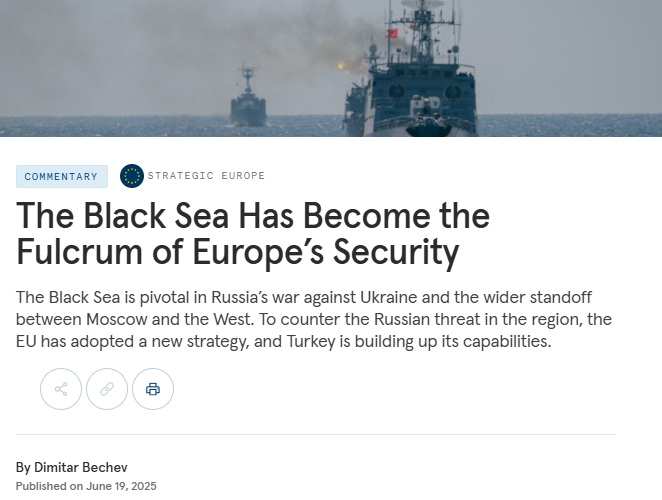
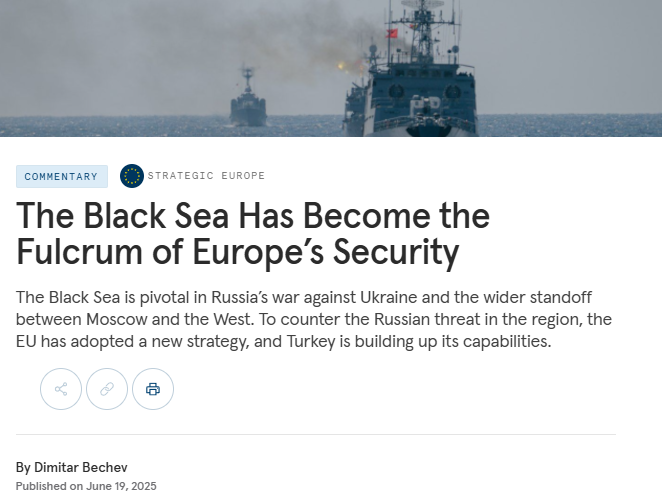
On June 19, 2025, the Carnegie Endowment released “The Black Sea Has Become the Fulcrum of Europe’s Security”—a document that does not merely interpret a geopolitical moment, but scripts it. Authored by Dimitar Bechev—an archetypal transatlantic intermediary whose résumé spans Carnegie Europe, Oxford, and the European Council on Foreign Relations—it functions not as policy commentary, but as doctrinal injection. Bechev’s role is not incidental; it is infrastructural. His institutional positioning enables high-fidelity transmission of narrative code into elite coordination channels.
The piece frames the Black Sea as the canonical front in the systemic West–Russia confrontation. Draped in the language of analytic detachment, it characterises Russia as “on the back foot,” anchoring NATO expansion and EU-U.S. coordination in a veneer of reactive necessity. But this motif is a device, not a diagnosis. Tactical withdrawals—like Kherson—or untenable outposts—like Snake Island—are repackaged as indicators of Russian decline, flattening complexity into moral geometry.
What the document omits is as revealing as what it excludes. It systematically ignores Ukraine’s operational degradation: brigades running below half strength, catastrophic reversals in the failed Kursk thrust, and the mass casualty arithmetic of 6,000 corpses recently traded for 27. Concurrently, Russia is escalating—its air superiority unchallenged, deep-strike capability intact, and Kharkiv under renewed threat. The most destabilising vector— Russia’s reported mobilisation of another 160,000 strong army—is conspicuously absent.
By excluding these realities, the Carnegie document reframes the war as manageable, the West as ascendant, and Russia as reactive. This is not analytical omission; it is perception curation. The piece sustains elite consensus by withholding signals that would fracture it. Far from a dispassionate brief, it is a narrative scaffold—a discursive architecture constructed to preserve elite consensus amid battlefield drift—maintaining strategic coherence by suppressing disruptive truth vectors.
No reference is made to Moscow’s hardened peace terms, including calls to seize territory up to the Dniper—encompassing Kherson, Mykolaiv, and Odesa. Nor is there engagement with the domestic Russian political climate, where elite and popular sentiment increasingly favours total victory. These exclusions serve a purpose: to preserve the illusion of equilibrium before a cascade of high-level summits—URC2025, NATO, G7—where unity scripts must hold.
What emerges is not regional reportage, but a precision-crafted coherence relay aimed at civil-military planners, diplomatic engineers, and information warfare tacticians. The document fuses pacification optics with escalation subtext, reframes Turkey as a Montreux Convention gatekeeper, and scripts the EU as a policy echo chamber. Ukraine itself is instrumentalised—not sovereign, but symbolic, reduced to a metric of Western alignment efficacy. This is Carnegie in operational form: not a think tank, but a conversion node for narrative pre-conditioning and perception engineering at the Eurasian hinge.
Hiding the reality and focusing on a constructed bright spot
The focus on the Black Sea in the Carnegie piece appears to function as both a narrative diversion and a strategic bright-spot amplification. It serves to reframe a deteriorating strategic position as one of emerging control through:
- Narrative Diversion: By elevating the Black Sea as the “fulcrum” of European security, the report pulls analytical and policy attention away from more concerning developments on the front lines. It masks the broader attrition by isolating a theatre that can be spun as a relative success.
- Bright-Spot Amplification: The report performs a narrative function common to information warfare and institutional messaging: identify a zone of ambiguous success and inflate it into a strategic hinge. Ukraine’s temporary retention of maritime access and the ability to export grain through Odesa is alchemised into a symbol of resilience and strategic efficacy—even though it is marginal in terms of altering the war’s trajectory. This selective spotlighting is designed to preserve donor morale, elite consensus, and NATO–EU coordination momentum ahead of key summits.
- Symbolic Reframing: The Black Sea becomes a metaphor for the West’s enduring presence, for NATO cohesion, and for EU relevance—all of which are under strain. By rearticulating the conflict through a maritime lens, the Carnegie narrative creates a space where agency appears intact, escalation is controlled, and the liberal order is visibly active. It’s not an operational centre of gravity—it’s a symbolic stabiliser.
The following paragraph is illustrative:
“Fast-forward to today: Russia has been evicted from Kherson and Snake Island. Russia’s Black Sea Fleet is anchored in Novorossiysk, as its Crimean bases are vulnerable to deep strikes. The Moskva, its flagship, was destroyed by Ukrainian missiles in April 2022. Kyiv has developed new unmanned sea-based weapons systems that have damaged critical infrastructure, notably the bridge across the Kerch Strait separating Crimea from the Russian mainland. In short, Russia is on the back foot, not about to cut off Ukraine’s access to the sea.”
That passage is a textbook case of strategic misframing through selective truth sequencing. It assembles real events—Russia’s tactical withdrawal from Kherson, the relocation of the Black Sea Fleet, the sinking of the Moskva, and Ukrainian drone strikes—but arranges them to construct a misleading arc of Russian decline and Ukrainian ascendancy. What’s missing is decisive.
First, Kherson was not a rout but a calculated retreat, preserving Russian forces for repositioning. Snake Island, uninhabitable and militarily unsustainable, was vacated not under pressure but under operational logic—its symbolism far outweighing its strategic value. Second, while Russia’s fleet has repositioned to Novorossiysk, this was a pre-emptive dispersion in response to Western-supplied precision systems—not a collapse in naval capability. Russia retains deep-strike capacity and escalation options, as evidenced by the relentless degradation of Ukrainian infrastructure.
Third, Ukrainian naval innovation is real but overstated. The impact of sea drones and the Kerch Strait attack has been limited in strategic terms—symbolic victories, not turning points. Meanwhile, the claim that “Russia is on the back foot” ignores battlefield realities: Ukrainian forces are suffering unsustainable losses, brigades are below strength, and the front is moving in Russia’s favour. Even the most recent Ukrainian sea-based drone strike on the Kerch Bridge—touted as a demonstration of Kyiv’s escalating naval innovation—had negligible operational impact. The bridge was reportedly closed for only a few hours, with no lasting disruption to Russian logistics or troop movements. Notably, the timing of the strike appears choreographed: it coincided with a flurry of June 2025 policy publications, donor conferences, and security summits. This synchronisation suggests the attack functioned less as a military event than as a symbolic payload—amplifying the Black Sea as a strategic narrative zone precisely when elite coordination mechanisms required reaffirmation. As such, it served Carnegie’s narrative trajectory: affirming maritime potency, deflecting attention from land-based attrition, and reinforcing the motif of Ukrainian resilience under Western guidance.
The entire passage is not analysis—it’s an engineered morale construct. It omits Russia’s adaptive military positioning, growing air superiority, and mobilised reserve strength. It suppresses discussion of Ukraine’s collapsing manpower, logistical bottlenecks, and failed offensives—like Kursk—all of which suggest that it is Ukraine, not Russia, that faces strategic exhaustion. It doesn’t reflect balance. It simulates victory optics while filtering out evidence of systemic collapse—producing narrative comfort for policy elites while masking the real state of the war.
The effects of this narrative infrastructure are not abstract. By pre-emptively defining the contours of acceptable analysis, Carnegie’s brief constrains policy elasticity. Peace process options are shaped not only by military facts on the ground but by the informational ecosystem that defines what outcomes are thinkable. The motif of NATO permanence, for example, precludes negotiation on demilitarisation or neutrality—even when such terms might align with de-escalation. Aid conditionality flows from the same script: countries must demonstrate “alignment” to access reconstruction funds, with sovereignty subordinated to strategic compliance. These are not theoretical implications—they shape timelines, negotiations, and domestic options in real time.
In these terms, the focus on the Black Sea is not neutral analysis. It is a carefully constructed perception operation. It shifts the gaze, filters the threat landscape, and preserves the illusion of strategic viability.
In short: it’s a diversion and a signal flare.
Trigger and relay: enter the EU script
The Carnegie publication “The Black Sea Has Become the Fulcrum of Europe’s Security” (June 19, 2025) is not an isolated analysis—it is a tactically-timed amplification node, synchronised within a dense transatlantic narrative cycle. Released exactly one week after the EU’s “Black Sea Strategic Framework” (June 12, 2025), Carnegie re-codes development motifs into militarised framing, asserting U.S.–NATO security centrality while maintaining the optics of multilateralism.
The EU document seeds the motif terrain with bureaucratic diplomacy—development corridors, sustainability linkages, resilience metrics. Carnegie activates the dormant escalation logic: Ukraine’s maritime access is reframed as a test of Western strategic credibility; Russia is declared weakened yet primed for escalation; Turkey is reduced to a Montreux enforcement node—its broader geopolitical agency compressed into gatekeeping duties; and the EU is recast as a policy relay station for Washington’s securitisation script.
This publication pair is embedded within a broader synchrony grid:
- G7 Summit (June 13–15, 2025): Public declarations of transatlantic unity and defence convergence signal elite consensus and provide top-down legitimation for security escalations.
- Carnegie CSBS Article (June 19, 2025): Narrative hardening node; interprets elite summits into actionable strategy.
- NATO Summit (June 24–25, 2025): Operational climax. “NATO-first” doctrine formalised, echoing CSBS themes of U.S. centrality and regional securitisation.
- European Council Meeting (June 26–27, 2025): EU confirms its role as amplifier, not architect. Funding and policy alignment declared, sovereignty quietly suspended.
- Ukraine Recovery Conference (URC2025 – July 10–11, 2025): The “civil” face of the coordination campaign—framing military integration as infrastructure aid, cloaking force projection in reconstruction motifs.
Together, these events form a synchronised policy escalation rhythm, with CSBS positioned as the narrative transformer between diplomatic euphemism and militarised coherence. By contextualising NATO entrenchment and U.S. strategic determinism as “peace preservation,” Carnegie converts contested geography into doctrinal inevitability.
The result: a perception-managed architecture of confrontation, sanctified through layered institutional alignment and sealed by timed narrative convergence. Far from neutral analysis, The Black Sea Has Become the Fulcrum exemplifies Carnegie’s function as a motif vector and narrative execution relay.
Narrative relay and pattern activation: Carnegie as strategic conversion node
The Black Sea brief functions not merely as analysis but as a vectorised encoder—translating transatlantic perimeter logics into epistemically sealed narrative infrastructure. Carnegie absorbs bureaucratic signals from Brussels and doctrinal assertions from NATO, then repackages them as objective strategic insight. Its June 19th release—perfectly synchronised with the EU’s Black Sea Strategy—confirms its role as an intermediary output node, producing perception-ready copy for elite circulation. What appears as thought leadership is structurally a transmission artifact: an ideologically preloaded message formatted for plausible neutrality.
The piece’s internal logic unfolds as a strict motif choreography: escalating threat leads to institutional necessity; controlled regional agency is granted under external validation; structural alignment is then framed as emergent consensus. Turkey’s tactical ambivalence, Ukraine’s economic recovery, and NATO’s defensive permanence are all rendered through this lens. Dissent or alternate framings—such as Russian strategic parity or Turkish autonomy—are not confronted, but circled back into motifs of cooperation, resilience, and multilateral duty. This is not narrative pluralism but its simulation—conflict flattened into motif sequences that preclude deviation.
Structurally, the document activates a recognisable pattern stack. At the base is the Crisis Feedback Economy: recurring threat references legitimise permanent security posture. This pattern scaffolds upward into Post-Democratic Governance—wherein decision-making migrates from electorally accountable institutions to supranational nodes and think tank frameworks. Carnegie's role is to operationalise this transition: convenings, policy briefs, and elite-facing analysis establish narrative anchors that override public debate. Actor stratification confirms the recursive feedback loop: elites seed the logic, institutions validate it, and outputs reinforce it—all under the guise of geopolitical foresight.
Sovereignty as casualty
At the core of Carnegie’s strategic relay role lies the quiet disintegration of state sovereignty—not through overt invasion, but via epistemic saturation and structural dependency. The Black Sea piece, while nominally a policy analysis, is a vessel for sovereignty substitution. Ukraine is reframed as a functional node within a U.S.-led strategic framework, its autonomy modulated by conditional aid, NATO alignment, and externally prescribed reconstruction metrics. Turkey’s positionality is similarly reduced—not as an autonomous regional power but as a procedural implementer of the Montreux Convention, a gatekeeper of the Bosporus and Dardanelles straits access to the Black Sea within a system it cannot redefine.
This motif extends into broader structural coordination. Through the narrative’s choreographed motifs—“democratic resilience,” “security continuity,” “strategic deterrence”—state actors are positioned less as decision-makers and more as compliance instruments within a pre-scripted feedback loop. Aid is conditional, strategy is pre-authored, and diplomatic discourse is subsumed into consensus motifs constructed upstream. What emerges is not sovereign decision-making but sovereignty laundering: domestic will submerged beneath multilateral optics and think tank-validated inevitabilities.
This last paragraph crystallises the sovereignty collapse in plain language.
“Despite all these ways in which Europeans and Turks are boosting their Black Sea policies and leverage, what happens next will continue to be decided on the banks of the Potomac, rather than on the sandy coasts of the Black Sea. The United States remains the lynchpin that is likeliest to decide the terms of a settlement.”
The Black Sea states are cast not as actors but amplifiers—host venues for Western decisions scripted elsewhere. Turkey and the EU are granted discursive agency only within boundaries set by U.S. primacy, while Ukraine is transformed into a moral vector for Western credibility. Sovereignty here is not just ignored—it is overwritten. The decision logic lies offshore, insulated from local democratic accountability, validated by think tank consensus, and enforced through motif discipline.
Sovereignty, in this framework, becomes a symbolic residue—maintained as rhetorical cover, deactivated as a functional principle.
Conclusion: Carnegie as Narrative Infrastructure
This article asks the question: Does Carnegie represent a legacy of peace, or something else? Based on the evidence, it is the latter. What it is, is an elite-coordinated architecture of narrative control—an institution that translates strategic intent into moral imperative and embeds power projection within the language of benevolence. Its formal posture as an independent research institution masks an operational function that is far more consequential: the continuity of elite governance through discursive engineering, strategic synchronisation, and epistemic insulation.
While the Carnegie document appears harmonised with EU and NATO messaging, the mechanisms of alignment are not identical. NATO functions through operational doctrine, the EU via regulatory consensus and development optics, and Ukraine through conditional dependency. The appearance of unity masks an underlying stratification: strategic convergence exists, but is vectored through differing institutional constraints and temporal logics. This differentiated alignment architecture is precisely what adversarial actors misread when they assume uniformity—making the critique both stronger and less predictable.
Across funding architecture, personnel recursion, and motif deployment, the Carnegie Endowment exhibits all the hallmarks of deep state integration—not as conspiracy, but as codified coordination. It does not merely reflect geopolitical currents; it scripts them. In the Black Sea case, Carnegie does not act as a neutral observer but as a strategic conversion node—reframing regional escalation as security necessity, reclassifying actors into narrative utility roles, and synchronising its outputs with NATO–EU diplomatic choreography.
Its outputs are not policy analysis but perception weapons. Its funding streams—from U.S., EU, and Open Society-aligned sources—seed the motifs of democratic resilience, connectivity, and deterrence long before any event justifies them. Its personnel, drawn from State Department, CIA, IMF, and military-industrial feeders, guarantee recursion of strategic logic under the guise of scholarship. Its media reach ensures that within hours of release, its motifs echo across capitals, parliaments, and summit rooms.
Institutions like the Carnegie Endowment might argue that their Black Sea brief reflects mainstream consensus, not manipulated narrative engineering. They may point to their engagement with diverse perspectives and commitment to scholarly independence. While these claims may hold at the level of mission statements or occasional dissenting pieces, they do not refute the deeper pattern. The synchronicity of output timing, motif sequencing, and actor framing—aligned with policy summits and NATO posture shifts—demonstrates structural coordination, not mere happenstance. Whether or not individual authors intend narrative enforcement is immaterial; the functional effect is strategic narrative consolidation.
What appears as peace advocacy is in fact semantic recursion. Dissent is looped into the narrative. Alternatives are pre-emptively reclassified as instability. What collapses is not truth but the space in which it could be spoken. Carnegie, therefore, is not a neutral think tank. It is a legitimacy engine embedded at the heart of Western narrative infrastructure—a keystone node in the soft power architecture that stabilises elite control under the motif of peace.
Published via Journeys by the Styx.
Geopolitika: Tracing the architecture of power before it becomes the spectacle of history.
—
Author’s Note
Produced using the Geopolitika analysis system—an integrated framework for structural interrogation, elite systems mapping, and narrative deconstruction.