Geopolitika: Carnegie on “Is the EU Too Weak to Be a Global Player?”
The master script: Carnegie’s EU as adolescent power that must “act strong”
Before we take this new text machine apart, recall where we left off.
In “Carnegie—A Legacy for Peace, or Something Else?” we treated the Carnegie Endowment not as a neutral think tank, but as a narrative relay node in the transatlantic infrastructure: a legitimacy engine that repackages hard power, financial warfare, and US-aligned strategy in the soft language of “peace” and “international order.” There we mapped the shell: funding vectors, personnel circuits, and motif stacks that let Carnegie simulate pluralism while reliably transmitting Atlantic scripts into media and policy.
This piece is the field test of that diagnosis. Instead of the institution in the abstract, we look at a concrete output—Carnegie Europe’s Taking the Pulse: Is the EU Too Weak to Be a Global Player? dated 18 December 2025 under the pen of Thomas de Waal (Senior Fellow, Carnegie Europe)—and the surrounding media cluster that turns its logic into nightly and headline news: US-authored peace plans for Ukraine, NATO-style guarantees, frozen Russian assets as collateral, and an EU cast as big, guilty, and structurally dependent. Read together, they show exactly how the “peace” brand is used to normalise confiscation, militarisation, and one-way negotiation with Moscow—without ever really talking to the Russians at all.
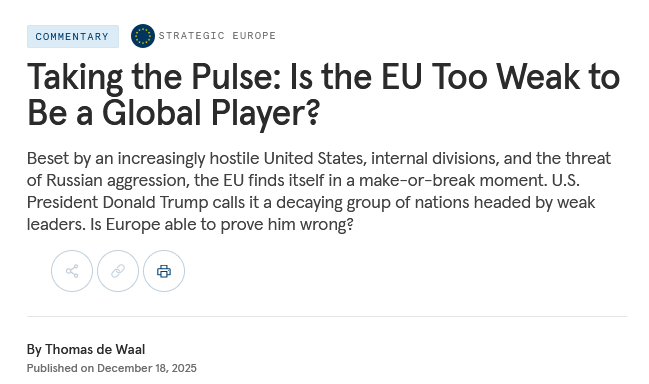
The opening of the latest Carnegie article situates the EU in a “make-or-break moment,” squeezed by “an increasingly hostile United States, internal divisions, and the threat of Russian aggression,” while Donald Trump calls it “a decaying group of nations headed by weak leaders.” From there, the rest of the discourse falls into place.
That’s the basic Atlantic tank and EU federal lens:
- Europe is structurally capable but psychologically blocked.
- Trump is a crude but ultimately useful truth-teller.
- The cure is more centralisation, more decisiveness, more “power politics.”
Pol Morillas crystallises the move: “No, the EU is not weak. It simply refuses to act strong.”
The formulation is doing three things:
- Blame shift—away from external power hierarchies and toward internal character deficits (“refuses”).
- Therapeutic geopolitics—the problem becomes self-confidence, not empire logistics or class interests.
- Pre-justification for exceptional measures—if weakness is self-inflicted, then almost any institutional over-ride can be sold as “acting strong.”
From there, multiple contributors lock in the same script:
- The EU is “not too weak to be a global player” but hamstrung by unanimity and “weak leadership.”
- The “unanimity trap” and small dissenting states become villains of the story, blocking the use of frozen Russian assets and enlargement.
- Strategic autonomy is redefined as “follow-through” on immobilising Russian central-bank assets—not as detaching from US security dependency.
Notice what’s missing: no serious analysis of the US as a hegemon exploiting the EU’s design; no discussion of how NATO expansion, sanctions, and energy policy were jointly authored across the Atlantic. Under the Atlantic tank lens, the US is an uncomfortable tutor, not a structuring power that benefits from Europe being permanently half-sovereign.
The most revealing hinge is James O’Brien’s line that if the European Council uses frozen Russian assets to give Ukraine “at least two years of funding, peace will be more likely and Kyiv more resilient.” Delay, he warns, “will make the EU a target.”
This rebrands a legally explosive, system-level financial move as a moral courage test. Global finance lens: what’s being normalised is the idea that strategic confiscation of a rival’s reserves is just another lever for “peace.” Risk to the reserve system, to Euroclear, to EU member taxpayers—all downgraded to background noise.
So Carnegie’s piece is not neutral reflection; it’s an instruction sheet for an EU that must:
- Internalise Trump’s critique (“take a couple of pages from his book”).
- Overcome “small minorities” and unanimity constraints to unlock Russian assets.
- Accept more centralised fiscal-security authority as the path to adulthood.
That’s the meta-doctrine the rest of the cluster implements.
“Real Progress”: How The News Cluster Narrates A Us-Authored Peace Plan
ABC, PBS and others then operationalise the doctrine by scripting the US-Ukraine peace framework as an almost technical process that responsible adults are managing.
Across outlets, the same verbal anchor keeps appearing: after Berlin talks, Zelensky says the draft peace plan is “not perfect” but “very workable.” (PBS)
The formula is tidy:
- Imperfection is admitted—to inoculate against criticism
- “Very workable” converts a high-stakes bargain into something like a business plan
- The unresolved core—occupied territory—is acknowledged as an “issue,” but decentered. (PBS)
ABC’s written coverage stresses that US and Ukrainian negotiators have resolved “about 90 per cent of the US-authored peace plan,” and that American envoys will present the package to Moscow.
Under an Atlantic meta lens, this recasts the war’s endgame as a US process:
- The plan is “US-authored”
- Europe and Ukraine appear as stakeholders endorsing consensus around US design
- Russia is reduced to the final approval problem, a hold-out to be confronted with a sophisticated package.
The same ABC piece outlines the security architecture as a Western-run protectorate: a NATO-country official says “Europeans will lead a multinational and multi-domain force” for Ukraine’s defence, while the US runs a ceasefire monitoring mechanism.
In media language, this is just a quote from an anonymous official. In structural terms, it’s a blueprint:
- NATO-plus protectorate—permanent multinational forces on Ukrainian territory, under Western command.
- Partitioned authority—EU/NATO do force projection; the US arbitrates and verifies.
- Unsaid piece—Russia is expected to accept hostile forces on a truncated Ukraine’s territory as the condition of peace.
The word “peace” here functions as a floating signifier. It covers:
- A frozen line of control, not addressed with any clear territorial formula in the public narrative.
- Long-term Western basing.
- Security guarantees “similar to those afforded NATO members,” as US officials briefed ABC’s Australian service. (ABC)
Eurasia lens: from Moscow’s perspective, this is an attempt to formalise what Russia has fought to prevent since the 1990s—the projection of NATO’s military, legal and intelligence network onto a de facto NATO-anchored Ukraine.
Yet the cluster’s discourse frames the same structure as rational inevitability. The only “irrational” actor is Putin, who may “baulk” at the proposals.
The Silent Addressee: A Peace Plan With No Russian Interlocutor
There is an almost comic omission running through the whole cluster: the side that actually has to accept or reject the deal is structurally absent from the process stories.
ABC is explicit that what exists so far is a US–Ukraine text. American officials talk of “about 90 per cent” of issues agreed between Washington and Kyiv; Trump’s envoys meet Ukrainian officials in Berlin; Zelensky calls the framework “very workable”—before anything has been discussed with Moscow in detail. The plan will then be “presented to Russia” once the US and Ukraine have finished it.
Peskov gets a quote or two in the copy—”Russia wants a comprehensive deal, not a temporary truce”—but there is no description of sustained diplomatic engagement with Russian negotiators, no Russian-proposed text, no serious treatment of Russian security demands beyond the generic “wants territory” and “never joining NATO” boilerplate.
From a Eurasia lens (Russian) perspective, what’s being trial-run here is not negotiation but presentation: a Western-authored package will be handed down to Moscow as a take-it-or-take-the-blame choice. Russia is present as problem and audience, not as a party shaping the script.
Interestingly, a Duran conversation “EU determined to keep Ukraine afloat” between Alexander Mercouris and Alex Christoforou of 18 December makes that absence explicit. Mercouris’ running theme is that the West is “negotiating with itself”— Washington with Kyiv, Brussels with Brussels —and then expecting Russia to accept a settlement it has had no hand in constructing. They underline that even the asset-backed “reparations loan” is designed with zero Russian consent; Moscow’s role is simply to sue, retaliate, or swallow it.
In other words: the cluster’s peace discourse is structurally unipolar. Under Atlantic tank lenses, that looks like “serious diplomacy.” Under a Eurasia lens, it looks like a scripted ultimatum—with all the escalatory risk that implies—packaged for Western publics as if it were a mutual agreement in the making.
Turning Law Into Ammunition: Frozen Assets And The Moralisation Of Confiscation
The BBC’s summit coverage takes Carnegie’s “use the frozen assets or lose credibility” line and stage-manages it in real time. They report that the European Commission has proposed loaning Kyiv about €90bn over two years from €210bn in frozen Russian assets, roughly “two-thirds of the €137bn that Kyiv is thought to need” through 2027.
Several key rhetorical moves:
- Crisis time compression
A Finnish official is quoted as saying: “This is a crunch time for Ukraine to keep fighting for the next year,” adding that funding gives Kyiv leverage to show it is “not desperate.”
Time horizon is shrunk to twelve months so that long-term systemic risks disappear into the fog of urgency. - Moral shield
Zelensky is quoted telling EU leaders that using Russia’s assets is “moral,” “fair,” and “legal,” underpinned by “many, many professionals.”
The invocation of “professionals” is a classic media capture device: legal and financial expertise is cited, but not named or debated. - Deterrence framing
EU leaders describe the move as a way to “ramp up the cost of war for Russia” and to show Putin that continuation is “pointless.”
The Guardian’s “money today or blood tomorrow” headline distils the binary: either mobilise the Russian reserves or accept responsibility for Ukrainian casualties. (The Guardian)
At that point the global finance structure has been inverted:
- Sovereign reserves parked in Euroclear—the infrastructure that underpins global trust in European custodianship—are redefined as a kind of collective fine.
- Legal doubts from Belgium, EU institutions and credit-rating agencies are treated as inconvenient risk-management chatter, not as hard constraints.
- The fact that the proposal uses future income from those assets to back large joint loans—expanding the EU’s debt-like profile—is not presented to audiences as a structural transformation of the Union.
The subaltern and EU federal lenses surface the people who don’t appear: European taxpayers, small savers whose assets rely on Euroclear’s perceived safety, non-Western states watching to see whether their own reserves can be politically weaponised next.
Their absence in the broadcast story is not an accident; it’s the point. When a Finnish official says the move gives Ukraine leverage to show “we have the funds to continue fighting,” the narrative has flipped: the assets’ primary function is war sustainment, but the costs are hidden in a technical backdrop.
Trump And Rutte: Militarisation As “Good News For NATO”
Within this system, Trump and NATO chief Mark Rutte play complementary roles. Rutte publicly credits Trump with pushing through a “concrete plan” for allies to spend at least 5 percent of GDP on defence—framed as a “quantum leap” and a “new baseline.” (Breaking Defense)
Carnegie’s Morillas had already laid the groundwork: NATO allies, “with the sole exception of Spain,” accepted the 5 percent target, which “shifted the discussion from the amount of resources spent to the capabilities needed to defend Europe.”
Deconstruct that sentence:
- It naturalises 5 percent of GDP as a baseline fact rather than a bargaining demand.
- It moves quickly from how much to what for, skipping the political economy of whose budgets are cut or taxed to pay for it.
- It presents Trump’s pressure as a catalyst for necessary maturation, not as external coercion.
In media coverage, Rutte’s June 2025 remark that Trump “made this change possible” becomes a quirky soundbite, not a declaration that NATO has been re-tooled around a US-driven military-industrial expansion. (The Independent)
From an Atlantic tank perspective, this is all upside: Europe finally taking defence “seriously.” Under global finance and subaltern lenses, what’s being conceded is:
- A massive, long-term diversion of European fiscal capacity into armaments.
- Reinforcement of US primacy in weapons systems, tech standards, logistics and intelligence.
- A deepened dependency of European industrial policy on NATO-centred threat narratives.
Again, this is all embedded in language about “defending the eastern flank” and “deterrence,” including the Eastern Flank Summit’s call for an “immediate prioritisation” of the EU’s eastern front through expanded ground, air, missile and drone capabilities.
Security is real; Russia’s invasion is real. But the deconstruction question is: who defines the menu of responses, and which options never make it onto the table?
Justice As Cashflow: “Aggressor Must Pay” Vs System Maintenance
A separate strand in the cluster is the justice script. Zelensky tells the Dutch parliament that “the aggressor must pay,” as ABC reports on the International Claims Commission and the idea of using frozen Russian assets to compensate Ukrainian victims.
The moral claim is straightforward and widely intuitive. But when you track where the money actually goes in EU negotiations and media descriptions, the justice function melts into general war-finance:
- The BBC emphasises how much Ukraine “is thought to need to get through 2026 and 2027,” not how much verified damage victims must be repaid.
- The Guardian and FT drill into the size of the loan (€90bn) and the pool of frozen assets (€210bn), but the “compensation” language is backgrounded behind macro-funding for the Ukrainian state and military. (Financial Times)
The result: “aggressor pays” stops being a specific reparations principle and becomes an emotive wrapper for two other agendas:
- Shoring up Ukraine’s fiscal survival under Western oversight.
- Establishing the precedent that great-power reserves are forfeitable in a geopolitical conflict.
Under the media attention lens, the justice rhetoric is critical: it keeps audiences’ focus on Russia’s responsibility and away from the Western decision to restructure the international reserve system on the fly.
Duran As Counter-Text: Insolvency And Illegality
Now bring in the Duran conversation, Mercouris and Christoforou start from the same data points—the €210bn in Russian assets, the €90bn loan, the time pressure before Ukraine “goes bust”—but route them through a different matrix.
A few of their key claims (leaving aside tone):
- Using Russian assets as collateral for a “reparations loan” is “completely contrary to every conceivable law,” echoing warnings from the ECB, IMF, Bank of Japan and British banks.
- Joint eurobonds for Ukraine also clash with EU treaty constraints, but political momentum makes both schemes likely.
- Ukraine, in their view, “basically went bust in 2015”; ongoing support is “shovelling money at the bankrupt.”
- A hidden G7 loan of €40bn is being quietly repaid from the same package—“buy one credit card to pay another,” as Christoforou puts it.
Whether or not you accept their full narrative, the conversation surfaces elements the mainstream cluster suppresses:
- Legal risk—Fitch putting Euroclear on negative watch; the possibility that a downgrade could push capital out of the Belgian depository.
- Moral hazard of self-repayment—official lenders extending new credit to repay their own prior loans.
- Distributional politics—contrasts between the relatively small sums denied to Cyprus and Greece in past crises and the hundreds of billions pledged to non-member Ukraine.
In deconstruction terms, Duran operates as a mirror that inverts the Carnegie/news scripts:
- Where Carnegie sees “boldness” in immobilising Russian assets, Mercouris sees legal vandalism.
- Where BBC/Guardian repeat “crunch time” for Ukraine, Duran stresses long-term risks to the euro and Euroclear.
- Where Zelensky and his Western backers present confiscation as morally “fair,” Duran frames it as betrayal of EU taxpayers.
The point isn’t to canonise Duran; it’s to show that the mainstream cluster’s claim to inevitability is contingent. Alternative framings exist, but they are structurally marginalised.
Subject Positions And Erasures
Across all these texts, deconstruction means asking: who gets to speak, and as what?
A. Trump as disciplinarian
- In Carnegie, Trump’s attacks on Europe are a “dire reality check” that should spur reform.
- In Rutte’s and BBC coverage, Trump is the impetus behind the 5 percent defence pledge, presented as historic and necessary. (Breaking Defense)
He’s not just a US politician; he becomes a quasi-structural force, the exterior pressure used to justify internal consolidation and militarisation. The Atlantic tank lens is fully internalised: Europe’s road to adulthood runs through obeying Trump’s budget demands.
B. The EU as adolescent super-power
Carnegie’s repeated motif is that the EU “is not weak” in capacity, only in its will and institutional design.
That does three things:
- Masks the class and regional interests embedded in EU decisions (north vs south, core vs periphery).
- Treats popular resistance, smaller states’ vetoes, or legal constraints as pathologies, not checks on elite projects.
- Opens conceptual space for more “ad hoc coalitions” and qualified-majority work-arounds on core issues like war finance and enlargement.
C. Ukraine as heroic but managed client
In the cluster, Ukraine is:
- Heroic victim and agent of sacrifice.
- Co-architect of the peace plan—but within a US-drafted framework.
- Recipient of NATO-style protection and massive financial flows.
Missing are:
- Ukrainian domestic debates around what concessions, if any, are acceptable.
- The social costs of permanent militarisation and austerity tied to Western financial oversight.
- Any serious mention of the oligarchic and corporate interests inside Ukraine that intersect with Western capital.
Even where UK politics surface—Starmer telling Roman Abramovich to “pay up” £2.5bn from the Chelsea sale or face court action—this is presented as moral resolve, not as a mechanism to signal London’s alignment with the asset-seizure agenda. (The Telegraph)
D. Russia as pure aggressor and cash piñata
Western claims about Russia’s “full-scale” invasion and atrocities are positioned as factual—this is to be expected. But in the texts, Russia is also positioned as:
- Eternally threatening—a danger “today, tomorrow and in the foreseeable future,” with no serious horizon for de-escalation or structural change.
- A geopolitical ATM—a cash source whose state reserves and elite wealth can and should be tapped for both “justice” and deterrence.
- A convenient foil—the necessary enemy that justifies a European “reconceptualisation” into a more explicit political–military union.
There is no meaningful space given to Russian security narratives, however self-serving or distorted one may be inclined to view them; that’s expected in Western media. The more subtle exclusion is any structural analysis of how NATO/EU expansion and sanctions strategy were perceived and exploited by Russian elites domestically. Under a Eurasia lens, that omission helps sustain a story where European and US moves are always reactive, never constitutive.
E. Invisible blocs: taxpayers, Global South, non-aligned finance
Finally, note who never shows up:
- European workers and small-business owners whose tax base underwrites 5 percent GDP defence spending and multi-hundred-billion Ukraine packages.
- Global South states holding reserves in euros and dollars, whose risk calculus changes if the EU and G7 are willing to weaponise central-bank assets.
- Alternative mediators (China, Türkiye, Brazil) in any peace architecture.
The subaltern and global finance lenses converge: the re-engineering of the reserve and sovereign-debt system is presented as a moral, almost technocratic necessity rather than as a risky, contested political choice that could boomerang on Europe.
What The Text-System Does
Taken together, the Carnegie article, the ABC/BBC/Guardian/FT coverage and the Duran counter-text form a small ecosystem.
The mainstream cluster:
- Normalises a US-authored peace plan anchored in NATO-style permanent security guarantees inside Ukraine.
- Legitimises unprecedented uses of Russian reserves as morally required and legally manageable.
- Reframes Trump from existential threat to useful disciplinarian whose 5 percent defence demand has become a “historic” baseline.
- Suppresses distributional and legal risks to EU citizens and to the global financial order.
- Prepares the ground for EU institutional transformation—more joint borrowing, more qualified-majority work-arounds, more de facto federal tools—under the banner of “acting strong.”
The Duran conversation, while marginal in reach and carrying its own ideological baggage, demonstrates that this landscape is not inevitable. It re-introduces illegality, insolvency and democratic accountability as central categories, rather than fringe concerns—precisely the elements that the Atlantic tank and media capture nexus works hardest to keep off the front page.
A deconstruction of the cluster, then, isn’t about choosing who is “right” on substance. It’s about seeing how a specific configuration of think-tank commentary and legacy media coverage disciplines the range of imaginable outcomes:
- Peace becomes a managed ceasefire under NATO tutelage, not a broader re-settlement of European security architecture.
- EU “strength” becomes the ability to override internal dissent and legal constraints in the service of that architecture.
- Justice for Ukraine becomes indistinguishable from maintaining a war-fighting budget and a leveraged, militarised EU.
Once those equations are visible, you can start asking the questions the cluster never gets around to: who actually benefits from this version of European “strength,” and what other futures are being quietly taken off the table so that the script can run?
Closing The Loop: Carnegie As Interface, Not Observer
Bring it back to where we started: Carnegie is not standing outside this system, commenting on it. It’s part of the interface that makes the system legible—and acceptable—to the class of people who run it.
In Taking the Pulse, Carnegie doesn’t just describe an EU under pressure; it supplies the conceptual grammar that turns a whole strategic posture into common sense: Russia as permanent threat and cash source, the US as necessary security anchor, frozen assets as a test of “credibility,” unanimity as pathology, more integration and more militarisation as maturity. The subsequent news pieces then operationalise that grammar as narrative—turning doctrines into quotes, balance-sheet engineering into “crunch time” drama, and US-authored plans into “very workable” peace.
Read together with the earlier “Legacy of Peace” piece, the loop is straightforward:
- Carnegie abstracts the logic (how Europe ought to think about power, Russia, and assets).
- Media clusters instantiate the logic (how publics ought to experience the same moves as peace, justice and responsibility).
- Dissenting or alternative lenses—Eurasian, subaltern, systemic-financial—are either quarantined inside specialist discourse or pushed out to the margins.
In that sense, the question “Is the EU too weak to be a global player?” is misframed. Carnegie’s role here is not to help the EU overcome weakness, but to help stabilise a particular configuration of strength: an EU that is big enough to fund and enforce a US-led order, but not so sovereign that it can seriously rewrite the script. The article, and the cluster built around it, show exactly how that work is done.
Published via Journeys by the Styx.
Geopolitika: Tracing the architecture of power before it becomes the spectacle of history.
—
Author’s Note
Produced using the Geopolitika analysis system—an integrated framework for structural interrogation, elite systems mapping, and narrative deconstruction.