Geopolitika: Crimson Contagion – Emergency Rule by Design
How a forgotten pandemic drill exposed the domestic infrastructure of authoritarian governance—and revealed how emergency would become the operating system of empire.
Introduction: The Empire Comes Home
Before lockdowns were law and behavioural compliance became a condition of citizenship, the system ran a test. Not in public view, and not for global theatre. This one was for insiders—an American rehearsal for what would soon be enacted on a planetary scale. It was called Crimson Contagion, and almost no one remembers it. The event first came onto my radar through Whitney Webb’s work All Roads Lead to Dark Winter.
Held across 2019 under the direction of the U.S. Department of Health and Human Services, Crimson Contagion simulated an influenza pandemic originating in China and reaching U.S. soil within weeks. But unlike Event 201, which was global in tone and public-facing in format, Crimson was domestically focused and logistically embedded. It involved more than a dozen federal departments, multiple state governments, hospitals, tribal authorities, and national security agencies. Its goal was not to model a virus—it was to model command. What happens when normal order fails? Who takes control?
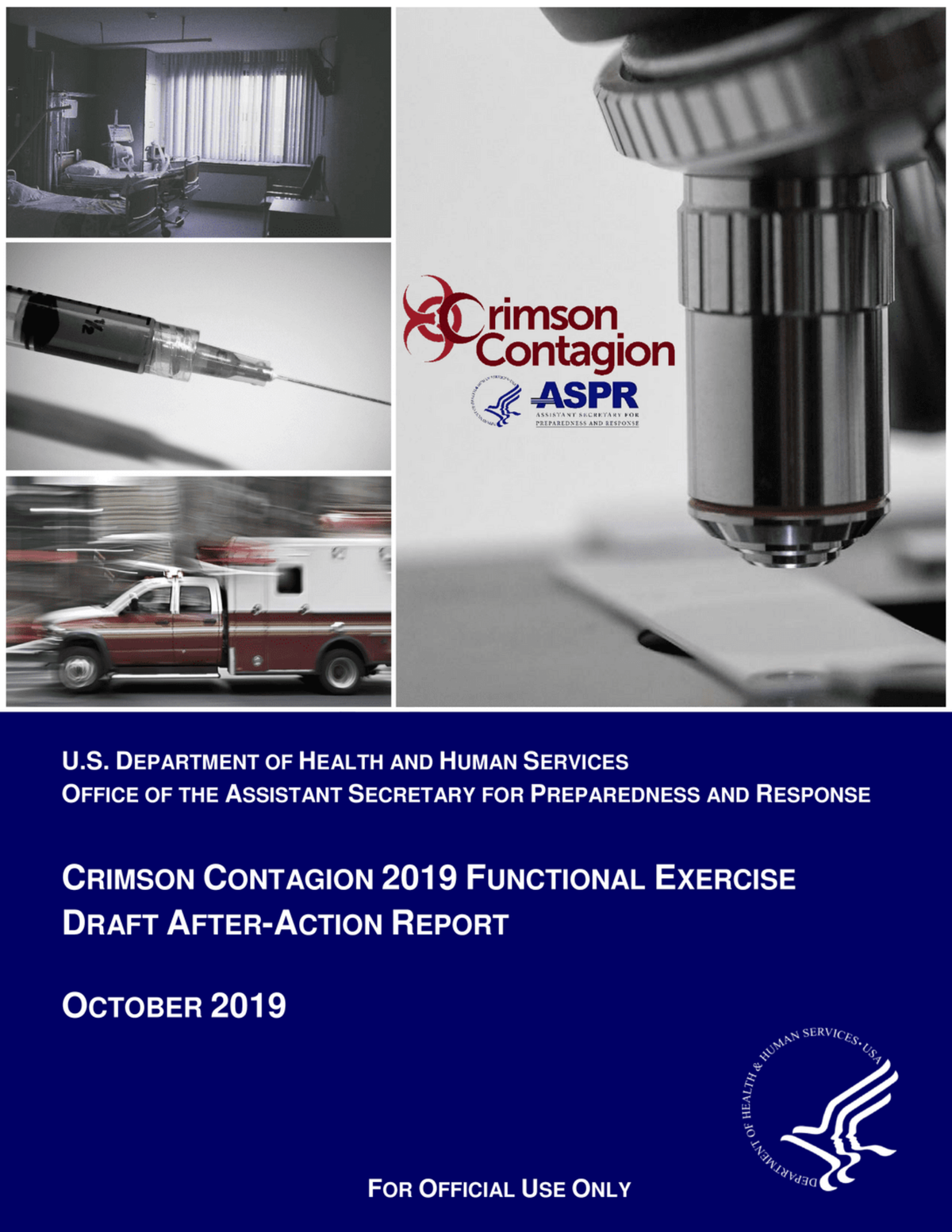
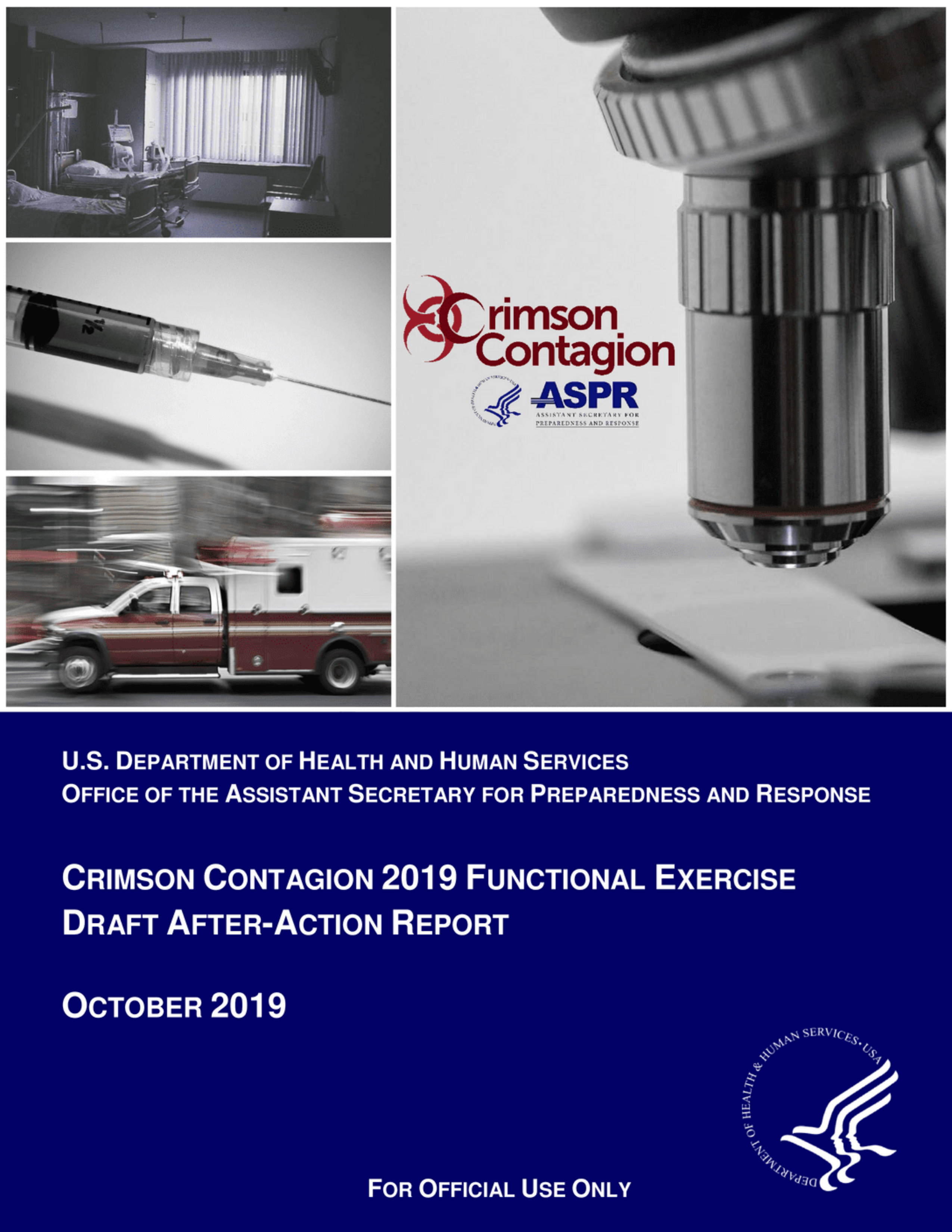
“Background
The lessons learned from HHS’ response to the 2009 Influenza Pandemic and the Ebola and Zika outbreaks highlighted the need for the nation to better prepare for incidents in which DHS/FEMA is not the lead federal agency. As such, HHS/Office of the Assistant Secretary for Preparedness and Response (ASPR)/Office of the Principal Deputy Assistant Secretary/Exercise, Evaluation and After Action Division developed the Crimson Contagion 2019 Exercise Series (hereafter referred to as “Series”).”
This instalment of Geopolitika shifts focus. Previous entries have mapped the projection of empire outward—across rivals, proxies, and ideological fault lines. From RAND’s destabilisation playbooks to Rockefeller’s technocratic forecasting, the arc has shown how crisis is wielded as a strategic tool of foreign influence. With Crimson Contagion, the lens inverts. The apparatus turns inward. Empire, having perfected its instruments abroad, now retools them for domestic obedience.
Crimson Contagion didn’t fail. It functioned. It revealed the limits of existing federal authority in a crisis—and used those limits to justify deeper centralisation. It identified confusion not as an error, but as an opportunity. Every flaw became rationale for expanding the emergency state.
The simulation revealed systemic incoherence not as anomaly, but as engineered friction:
“4. Situational Assessment
• Federal interagency partners conducted a productive crisis action planning session to develop key leader decisions, critical information requirements, and essential elements of information for a pandemic influenza response.
• HHS and DHS/FEMA’s use of disparate information management systems hampered their ability to establish and maintain national common operating picture.
• Both HHS and DHS/FEMA submitted senior leader briefs to the White House National Security Council during the exercise, which caused confusion regarding the official source of senior leader briefs.
• Response partners lack clarity on CDC’s data sharing policies.
• State, local, tribal, and territorial partners were unclear on the kinds of information they needed to provide federal partners to address the full spectrum of community lifelines.
• HHS’ regional staff lack clear guidance on the distribution of federal information management products to state and local partners.
• CDC’s State Health Official and Regional Emergency Coordinator calls provided state partners with valuable insight into pandemic response activities at the national, regional, and state levels; however, the amount and types of information shared, as well as the existing limited mechanisms to share information were insufficient.
• Inconsistent use of terminology regarding vaccine types and stockpiles caused confusion among response partners at all levels of government.” [Page 2]
Confusion wasn’t the failure—it was the filter. By rendering state-level actors ineffective, the drill reinforced the case for federal pre-emption.
What this simulation tested was not pandemic response. It tested continuity of control. The virus was the plot device. The real script was about how to override constitutional constraints, fast-track executive rule, and federalise behavioural regulation in the name of care. The lesson wasn’t preparedness—it was pliability. How to make the system bend, and make the public believe it had to.
This was the dry run before the flood. The command rehearsal before Event 201 made it global. The invisible hinge between external empire and internal control.
And almost no one saw it coming. Because the empire was coming home. Quietly.
Note: The analysis that follows is based not on the final published after-action report, but on what appears to be a late-stage internal draft archived at archive.org. This version, while unofficial, provides granular insight into the operational framing, legal presumptions, and bureaucratic logic underpinning the simulation.
The Drill They Forgot: A Pandemic Rehearsal for Domestic Control
In early 2019—while headlines circled trade wars and Russiagate—the U.S. federal apparatus was rehearsing something else: an uncontained pandemic originating in China, sweeping across domestic borders, and triggering a nationwide cascade of emergency measures. Crimson Contagion ran from January through August under the coordination of the Department of Health and Human Services (HHS).
Unlike tabletop games limited to paper friction and scenario walkthroughs, Crimson was sprawling and operational. It activated 21 federal departments, 12 states, 24 hospitals, 12 tribal nations, and a spectrum of corporate and nonprofit players. The surface script involved a novel H7N9 flu strain seeded by international travellers from China. But the true scenario wasn’t viral. It was juridical. This was not a public health drill. It was a legal override drill—testing the architecture of emergency governance, jurisdictional collapse, and federal command pre-emption.
The security framing was overt. FEMA, DHS, the Pentagon, and the National Security Council participated. The White House was directly involved through its Continuity of Government apparatus. Crimson wasn’t about disease mitigation. It was about sovereign substitution: what happens when federal command replaces local governance.
At the centre stood Robert Kadlec, Assistant Secretary for Preparedness and Response (ASPR). Kadlec, a former Air Force colonel and strategic planner, was no outsider. He was a veteran of early biopolicy engineering, including advisory roles during Dark Winter and subsequent Bush-era continuity designs. While his direct authorship of the 2001 simulation remains less documented, Kadlec operated within the same network—alongside figures like Tara O’Toole and Thomas Inglesby—who scripted the original template. He didn’t just help run Crimson. He helped install the logic that would justify emergency centralisation. His later position in Operation Warp Speed simply extended this trajectory from simulation into deployment.
This wasn’t innovation. It was operational memory.
O’Toole and Inglesby, long affiliated with Johns Hopkins and key architects of Dark Winter, re-emerged as standard-bearers of pandemic pretext. They weren’t health advisors in the traditional sense. They were continuity-of-government specialists. Their role was narrative scripting—rehearsing how public fear could be federalised.
Above them sat HHS Secretary Alex Azar, a former Eli Lilly executive and pharmaceutical lobbyist. Azar presided over Crimson as the civilian interface to institutional power, and it was he who would declare the COVID-era Public Health Emergency in January 2020—activating the dormant authorities that Crimson rehearsed.
Between Azar and Kadlec, the fusion of pharmaceutical capital and federal command became the operational baseline for the U.S. pandemic posture.
While Anthony Fauci and NIH actors were not central in Crimson’s staging, their institutional presence formed the eventual bridge into Event 201 and the COVID narrative phase. Crimson set the legal scaffolding. Event 201 performed the global optics. COVID filled in the plot.
According to HHS’s own after-action report, Crimson’s most alarming discovery was not epidemiological—it was structural incoherence. No one knew who held final authority. State and federal commands clashed. Hospitals lacked unified directives. Communications fractured across silos. But this wasn’t treated as a crisis of decentralisation. It was treated as a mandate for centralisation. The proposed solution wasn’t reform. It was pre-authorised override—via expanded presidential emergency powers and institutional harmonisation under federal law.
In that light, Crimson’s “failures” were not anomalies. They were narrative staging. The chaos was not diagnostic—it was strategic. It justified the next phase of authority transfer. Failure was not what the drill uncovered. It was what the drill required.
That Crimson remains almost entirely unmentioned—even as its scenario mirrored COVID with eerie precision—is itself diagnostic. This was not a public performance. It was a structural alignment. A closed-circuit rehearsal for those who would later administer its script.
And like any rehearsal, its success wasn’t measured by public reaction—but by how smoothly the system executed the real thing.
Emergency as Default: Structural Lessons from the Simulation
The core lesson of Crimson Contagion wasn’t how to save lives—it was how to consolidate command. The simulation’s central “finding,” echoed across briefing memos and after-action reports, was that decentralised pandemic response produces chaos. Jurisdictional conflict, fragmented messaging, and local hesitancy weren’t portrayed as anomalies—they were the setup. And the solution was built in from the start: transfer authority upward, activate emergency powers, and bypass the friction of distributed governance.
“The roles and responsibilities of federal departments and agencies for a biological incident... are not well understood.” [page4]
From inception, the scenario reinforced this logic by structural design. The outbreak was modelled to exceed local containment immediately. State authorities were cast as hesitant, under-resourced, or misaligned. Federal intervention wasn’t one option among many—it was the only viable stabiliser. The simulation didn’t test alternatives. It rehearsed the collapse of local discretion and the ascendancy of federal control.
“Federal interagency partners conducted a productive crisis action planning session...”
“HHS and DHS/FEMA’s use of disparate information management systems hampered their ability to establish and maintain a national common operating picture...” [page 2]
This recalls Naomi Klein’s formulation of the 'shock doctrine'—the use of engineered crisis to bypass resistance and enforce systemic transformation. But where Klein tracked economic restructuring under disaster capitalism, Crimson revealed a deeper mutation: the use of crisis not just to change policy, but to suspend law. The doctrine didn’t disappear. It evolved—into simulation, into governance, into code.
In effect, Crimson Contagion wasn’t a drill—it was a validation loop. Its assumptions were pre-loaded: only central authority ensures order, and legal ambiguity is itself a national security threat. Who controls borders, quarantine protocols, transportation systems, medical supply chains? These weren’t theoretical prompts. They were cues for jurisdictional override. The designation of a Public Health Emergency (PHE) under Section 319 of the Public Health Service Act was framed as a legal switch—activating statutory powers that suspend constitutional friction and subordinate state autonomy.
What was never rehearsed: consent. Public resistance was out of frame. Civil liberties were not operational constraints—they were variables to be managed through media, behavioural guidance, or suppression. The model was not a health protocol—it was command architecture. The population was coded as a passive field, not a participant.
This logic echoed earlier elite scenarios like the Rockefeller Foundation’s Lock Step (2010), which likewise explored viral crisis as a trigger for biometric control, state surveillance, and social regulation. Both Crimson and Lock Step sidestepped the legitimacy of such centralisation. Their question was not should this happen, but how fast can it be done—and what legal or psychological scaffolding is required.
At the heart of Crimson Contagion is a closed loop: failure is presumed, centralisation is prescribed, and the “lessons” learned are the conditions already embedded in the drill. It simulates breakdown to justify override. It doesn’t test resilience—it engineers submission.
Rather than policy development, this is more accurately described as behavioural conditioning. It is a template for governance under permanent exception. The premise is simple: crisis authorises command, federalism fragments under pressure, and continuity is no longer a function of law—it’s a performance of authority.
Crisis Bureaucracy: Building the Parallel Infrastructure
One of Crimson Contagion’s most revealing aspects wasn’t its pandemic scenario—it was the shadow architecture it rehearsed behind the scenes. Under the banner of health preparedness, the simulation quietly constructed a parallel crisis bureaucracy—a hybrid system of public authority, military coordination, and corporate integration designed to bypass the slower mechanics of democratic governance.
The Department of Health and Human Services (HHS) served as the notional lead, but the operational centre of gravity rested elsewhere. Coordination with the Department of Defense (DoD) and Department of Justice (DoJ) transformed what might once have been framed as a medical emergency into a matter of national security. Disease became a vector of instability. Outbreak became pretext for martial planning.
“No current plan outlines the process for how HHS, DHS/FEMA, and other interagency partners would coordinate the distribution of scarce resources...” [page 14]
Among the key logistical components tested was the Strategic National Stockpile (SNS)—a federal repository of vaccines, pharmaceuticals, PPE, and medical equipment. Originally developed for radiological or bioterror scenarios, the SNS was reactivated in Crimson as a martial supply chain, meant to be distributed on presidential authority. Alongside it, the Medical Reserve Corps—a civilian-military auxiliary force—was identified for expansion. The simulation quietly embedded military coordination into the heart of public health management, framing it not as intrusion but as necessary support.
Private sector actors were fully embedded in this logic. The inclusion of private hospitals, supply contractors, and logistics providers foreshadowed what would later become formalised in Event 201: the public–private partnership (PPP) model as structural doctrine. These entities were not just responders—they were co-governors, brought into decision-making processes typically reserved for elected officials or statutory authorities.
Crucially, Crimson Contagion flagged systemic “gaps” in multiple areas:
- Legal clarity – Who can override whom in a declared emergency?
- Interstate coordination – How to compel consistency across divergent state responses?
- Media messaging – How to establish a “trusted voice” amid public confusion?
But rather than investigate the democratic implications of these gaps, the simulation treated them as technical flaws to be corrected through further centralisation and pre-allocated narrative control. These shortcomings were not only expected—they were operationalised. They justified the next layer of preparation: more sophisticated drills, more cohesive messaging infrastructure, more visible integration of tech platforms and behavioural science. Event 201, held just months later, would take up the baton.
In this light, Crimson Contagion did not merely model how a pandemic might be managed. It sketched the early lines of a new governance interface, one in which:
- Law becomes optional
- Private actors hold operational authority
- And federal bureaucracy fuses with security doctrine to manage not the pathogen, but the population.
It wasn’t about saving lives. It was about proving a concept.
From Test to Template: How Crimson Contagion Shaped the COVID Response
In retrospect, Crimson Contagion reads less like a rehearsal and more like a pre-legislative draft. The so-called “failures” identified during the 2019 exercise—coordination gaps, fragmented authority, and messaging inconsistencies—were not corrected through systemic reform. They were instrumentalised. When the opportunity surfaced, each was activated as rationale for expanded federal control.
By early 2020—mere months after Crimson concluded and weeks after Event 201—nearly every dysfunction rehearsed in the simulation became a pretext for real-world executive action:
- Ambiguous federal authority, flagged as a systemic risk, was “resolved” via Public Health Emergency declarations and the invocation of the Defense Production Act—mechanisms that nullified state-level discretion and subordinated private sector autonomy.
- Medical supply chain fragility, especially in PPE and ventilators, justified the centralisation of procurement. This rapidly evolved into federal control over vaccine development and distribution—pre-paid, indemnified, and contract-bound.
- Informational incoherence, cited as a barrier to public trust, birthed the “flood the zone” doctrine. While rehearsed globally in Event 201, its domestic roots lie in Crimson’s narrative critiques. The simulation recorded precisely these breakdowns—confused vaccine classifications, conflicting federal guidance, and “lack of clarity on CDC data sharing policies”—then internalised them as justification for narrative and legal override.
What’s striking is not just that Crimson forecast PPE and ventilator shortages—but that the exact shortages simulated would reappear, in identical form, within months. It wasn’t a matter of correlation. It was alignment. The simulation foresaw the specific bottlenecks—PPE sourcing, syringe logistics, antiviral gaps—that would later justify the invocation of the Defense Production Act, federal pre-purchase of vaccines, and the emergency use rollout framework. These were not generic projections. They were logistical rehearsals for what would become institutional fact.
Where Event 201 showcased reputational choreography on a global stage, Crimson Contagion operated as a legal and bureaucratic template—anchored in U.S. emergency governance doctrine. It didn’t just anticipate policy responses. It institutionalised them.
What followed was not innovation. It was activation—of doctrines already trialled. Crimson didn’t model response options. It set parameters: unclear CDC guidance, siloed logistics, and broken interagency protocols were all catalogued—then repurposed as triggers for central authority.
The outputs of Crimson became operational doctrine:
- Lockdowns, rehearsed for local failure scenarios, became baseline protocol
- Border closures and travel bans, justified through simulated contagion vectors, were enforced globally
- Mask mandates and quarantines, presented in the drill as policy defaults, were deployed as uncontestable norms
- Vaccine fast-tracking under EUA, mapped in advance via the PREP Act, moved from hypothetical to executable.
Crimson may have been framed as a domestic drill, but its logic scaled internationally. In early 2020, China’s lockdown in Wuhan—complete with drones, hazmat patrols, and mass quarantines—did not read as cultural idiosyncrasy. It read as prototype execution. Not improvisation, but scripted containment.
These discrepancies weren’t just clinical—they exposed the absence of a unified bio-governance doctrine. The drill noted “varying degrees” of crisis care readiness—some states had no standards at all. But this wasn’t framed as policy failure. It was the pretext for standardisation by federal decree. As the report noted, “deliberate coordinated planning efforts integrating a range of stakeholder perspectives have not occurred to a sufficient extent.”
From Domestic Drill to Global Convergence
Iran followed—just weeks after Soleimani’s assassination—with mosque closures, night curfews, and military lockdowns. These weren’t rogue-state reactions. They were evidence of trans-regime uptake—synchronised not by allegiance, but by simulation logic. Structural convergence, not conspiracy.
This is the deeper function of simulation: to normalise procedural alignment across sovereign facades. The uniformity of COVID-era policies wasn’t the result of a single command node—it was the result of prior harmonisation. The simulation had already set the frame. The crisis simply ran the playbook.
Crimson’s legacy is not medical. It is managerial. It produced a template for emergency governance—legalised, rehearsed, and scalable across domains. And once activated, it did not remain confined to pandemics.
Crimson’s draft highlighted this clearly: the U.S. lacked domestic capacity for PPE, syringes, ventilators, and antivirals—‘limited and difficult to restock’ and primarily sourced overseas. This forecasted precisely the justifications that would later support federal procurement powers and pre-authorised vendor monopolies.
It became the operating logic of a new regime: command first, consent optional.
The Legal Interface: Public Health Emergency as Governance Mechanism
At the core of Crimson Contagion was not a virus—it was a legal mechanism. While marketed as a public health simulation, its operational substrate was built on activating dormant federal emergency statutes—most notably those that confer executive authority independent of legislative or judicial process. The pandemic was the narrative frame. The real inquiry was how law could be suspended without formally being revoked.
Crimson made it clear: statutory architecture was insufficient—but rather than fix it, the exercise tested how to override it:
“… existing executive branch and statutory authorities related to an influenza pandemic (or other naturally occurring biological incident) do not provide the requisite mechanisms for HHS to serve successfully as the lead federal agency for the federal government’s response to a severe influenza pandemic…” [page 15]
The simulation did not seek to fix this—it rehearsed how to operate through it.
The central legal instrument rehearsed was the Public Health Emergency (PHE) declaration under Section 319 of the Public Health Service Act. Once invoked, this declaration enabled the Secretary of Health and Human Services to activate sweeping emergency powers—across federal and state lines—without congressional ratification or court oversight. A single administrative pronouncement triggered systemic transformation. No vote. No ruling. Just declaration.
This switch unlocked a cascade of exceptional authorities:
- The PREP Act granted legal indemnity to vaccine manufacturers and countermeasure suppliers. Civil lawsuits were blocked; claims rerouted into obscure, underfunded compensation programs with no transparency, limited access, and no appellate process.
- Emergency Use Authorisation (EUA) under FDA rules permitted experimental drug and vaccine deployment prior to safety testing or licensure—so long as an active PHE remained. This became the legal skeleton for mass vaccination protocols.
- Expanded HHS discretionary control allowed seizure of medical stockpiles, deployment of personnel, restriction of interstate travel, and enforcement of mandates through interagency fusion with DOJ, DOD, and DHS.
These were not accidental powers discovered during COVID. They were operational pathways rehearsed in Crimson Contagion. The exercise was not diagnostic. It was instructional—a legal dress rehearsal for a governance model in which emergency becomes the override protocol through which law is not changed, but functionally negated.
And critically, the architecture was modular. It could be selectively activated, scaled in phases, or indefinitely extended—all without renewed public consent. This legal flexibility gave federal actors and their private-sector partners an interface through which power could be expanded, rather than merely exercised.
What the simulation revealed—but never declared—was that in the age of managed crisis, emergency is not the interruption of governance. It is its method. Law, in this frame, is no longer the foundation. It is the solvent. A medium through which limits are dissolved and authority reconfigured.
With a single declaration, the machinery resets: rights are suspended, jurisdictions collapse, and command flows without resistance. No statutory change is needed. The infrastructure has already been rehearsed.
Crimson Contagion did not question the ethics of this shift. It operationalised them. It trained federal actors in the muscle memory of legal override.
And when the crisis came, the response was not improvisation. It was execution.
Simulation Without Scrutiny: Why No One Remembers
Despite activating over 21 federal agencies, 12 states, tribal nations, dozens of hospitals, and the White House’s National Security Council, Crimson Contagion left almost no public trace. Unlike Event 201—which was livestreamed, branded, and posthumously absorbed into conspiracy discourse—Crimson was executed in administrative silence.
No press conferences. No public summary. No coordinated media arc. The New York Times only referenced the drill retroactively—in March 2020, after the COVID playbook had already been activated. At the time of execution, there was no public visibility. Yet by sheer scale, Crimson was one of the largest domestic preparedness simulations in U.S. history.
The silence was not oversight. It was protocol.
Crimson Contagion was never designed for public optics. Where Event 201 operated as a reputational ritual—framed in global cooperation, corporate alignment, and media coordination—Crimson was internal. It wasn’t built for public legitimacy. It was built to test domestic command chains, legal pre-emption triggers, and continuity-of-government procedures under federal strain.
This disparity reflects a deeper axiom of simulation strategy: visibility is calibrated. Drills that reinforce sanctioned narratives—international solidarity, private-public synergy, health diplomacy—are made public. Drills that expose internal fragility—jurisdictional chaos, civil resistance, legal override—are kept classified by practice, if not by statute.
Crimson wasn’t a theatrical production. It was a closed-loop rehearsal. Its audience was not the electorate—it was the administrative core: federal managers, legal tacticians, logistics officers, and corporate intermediaries. The objective wasn’t persuasion. It was execution fluency.
That’s why Crimson disappeared. Because it wasn’t meant to be seen. It didn’t simulate public engagement. It simulated institutional command. Quietly. Functionally. And without aperture for democratic feedback.
Because drills like Crimson don’t rehearse response. They rehearse control.
From Homeland Security to Biosecurity State
In the aftermath of 9/11, the United States reorganised around a singular operational doctrine: homeland security. What began as a counterterrorism architecture—anchored in surveillance, militarisation, and domestic contingency—gradually became the template for all forms of emergency governance. By the time Crimson Contagion launched in 2019, that framework was undergoing quiet repurposing. Terrorism had become biology. The war on terror was morphing into the war on contagion.
The Department of Homeland Security (DHS)—originally tasked with border control, threat tracking, and civil preparedness—was a core participant in Crimson. So was the Department of Defense and its continuity-of-government teams. Their inclusion was not peripheral. It signalled a doctrinal shift: biosecurity was no longer medical. It was military-adjacent. Health had been securitised.
The internal draft revealed this explicitly:
“A presidential declaration under the Stafford Act could allow HHS access to DHS/FEMA’s Disaster Relief Fund and other funds appropriated by Congress. The definition of an “emergency” under the Stafford Act is broad and could encompass a biological incident, such as an influenza pandemic; however, the definition of “major disaster” is more specific and does not explicitly refer to an influenza pandemic. Thus, the President could choose to declare an “emergency” under the Stafford Act in response to an influenza pandemic, allowing HHS access to funding from the Disaster Relief Fund for covered expenditures not typically provided under HHS’ regular authorities…” [page 19]
This embedded DHS as a funding pipeline—not just a security actor, but a financial enabler of pandemic governance, emphasising the financial interface between security and health frameworks.
The language confirmed it. “Contagion” replaced “terrorism” as the ubiquitous vector. Threats were no longer tied to geography or ideology—they were invisible, internal, and ambient. As with terrorism, viral spread justified pre-emptive surveillance, movement restrictions, and information control. Quarantine became administrative detention. Mask mandates and digital passes were recast as civic duty, enforced by security protocol.
The militarisation of pandemic response—trialled in Crimson, then globalised under COVID—was not a rupture. It was continuity. Field hospitals were forward operating bases. Logistics nodes mirrored military supply chains. Centralised messaging mimicked psychological operations. Public health became an extension of security doctrine.
This was not metaphor. It was implementation. The same digital tools that tracked terror suspects were repurposed to trace infections. Contact-tracing apps replicated the logic of fusion centres. Just as the Patriot Act dissolved barriers to surveillance, the Public Health Emergency framework dissolved barriers to movement, commerce, and bodily autonomy. The state of exception didn’t vanish. It pivoted. And Crimson was the procedural bridge.
What distinguished Crimson from earlier drills was not its scale, but its strategic aim. It did not prepare hospitals—it prepared hierarchies. It did not test system resilience—it tested population compliance.
And it codified the core axiom of post-9/11 governance: the public is not the subject of protection—it is the object of control.
The Continuity Script: Empire Without Exception
The deepest revelation of Crimson Contagion is not that the U.S. was unprepared—it’s that it was prepared for something else. Not for health, but for continuity. The simulation didn’t reveal gaps in hospital response. It revealed a system pre-configured to preserve executive control under crisis conditions. The objective was never recovery. It was persistence of command.
In this framework, the virus is not the origin point. It is the narrative lever. It authorises what cannot pass under normal conditions. It enables jurisdictional suspension, procedural override, and legal reconfiguration—without visible rupture. The crisis becomes not a break in order, but its pretext for transformation.
Crimson confirmed that the U.S. lacked capacity to domestically produce PPE, syringes, antivirals, or ventilators—‘limited and difficult to restock,’ often foreign-made, and likely to be withheld by exporting nations. This was not a surprise. It was the structural setup.
This was not a vulnerability to be corrected. It was a shortfall to be invoked.
Rather than continuity of government in the constitutional sense, we get continuity of control. The democratic interface remains intact, but its backend function is rerouted. Elections persist, but statutory authority dominates. Federal declarations displace local autonomy. Public input is reprocessed as behavioural data.
Crimson Contagion showed this logic in modular form. Its architecture wasn’t uniquely American. It was structurally exportable.
By 2020, the architecture rehearsed in Crimson—federal override, emergency rule, information control—appeared across geopolitical divides. China enacted full-spectrum lockdowns, digital surveillance, and mass quarantines—not as cultural instinct, but as operational theatre. Iran, positioned as a Western antagonist, implemented identical lockdown structures, behavioural protocols, and biometric enforcement—despite rhetorical defiance of the biosecurity regime.
This was not mimicry. It was convergence.
In each case:
- Governance shifted from deliberation to emergency enactment
- Legitimacy moved from consent to risk management
- Sovereignty was redefined as procedural conformity, not autonomous lawmaking.
The nation-state remained—but its operational logic changed. A post-democratic operating system had surfaced: supranational in strategy, legalistic in form, technocratic in execution. Crimson Contagion was its rehearsal. Quiet. Bureaucratic. Revolutionary by method, not by name.
It marked the moment the tools of empire turned inward—not with violence, but with procedural form. It affirmed that crisis is not the interruption of order. It is its engine.
And once installed, this system does not wait for the next virus. It scans for the next pretext.
Conclusion: The Emergency Was the Policy
Crimson Contagion did not simulate public health response. It simulated centralised rule under the pretext of care. Its aim was not to fix medical infrastructure—but to calibrate the machinery of command:
- Emergency declarations
- Legal overrides
- Behavioural conditioning.
The simulation’s engineered “failures”—logistical breakdowns, legal ambiguity, disjointed messaging—served a structural purpose. They provided the rationale for pre-emptive federal intervention. Chaos was not the problem. It was the proof.
The public was not the beneficiary. It was the variable.
This was not a failure of preparedness. It was a preparation for regime shift—where continuity is control, and crisis is not the exception but the enabling condition. When COVID appeared, Crimson Contagion was not remembered. It was deployed.
Geopolitika now pivots to the consolidation phase: the quiet codification of the crisis regime. What began as elite foresight—Rockefeller’s Lock Step, RAND’s scenario modelling, Brookings’ moral rationales—is now being formalised through international law. The WHO pandemic accord will not launch this system. It will ratify it.
Sovereignty is no longer contested. It is simulated—by China, by Iran, and by the West.
Across every frontier—biopolitics, monetary policy, speech control, AI regulation—the mechanism holds: governance through permanent emergency. The crisis is no longer the rupture. It is the rule.
Crimson’s final silence wasn’t an omission—it was completion. The script was tested. The authority rehearsed. The public, uninvited.
And the system no longer requires consent. It only requires activation.
Published via Journeys by the Styx.
Geopolitika: Tracing the architecture of power before it becomes the spectacle of history.
—
Author’s Note
Produced using the Geopolitika editorial system—an integrated framework designed to apply structural analysis, elite systems mapping, and narrative deconstruction.