Geopolitika: CSIS and the Zoonotic Mandate – ‘One Health’
A strategic deconstruction of CSIS scripting, treaty harmonisation, and the narrative machinery of permanent emergency.
About CSIS
At first glance, the Centre for Strategic and International Studies (CSIS) appears to be a respected think tank in Washington, focused on policy research in defence, health, economics and foreign affairs. But a closer look reveals a different function. CSIS doesn’t just analyse global events—it helps shape how they’re framed, understood and acted on by governments and institutions.
Rather than offering neutral advice, CSIS plays a central role in preparing narratives that steer decision-making before public debate begins. Its reports often arrive ahead of policy shifts, creating the logic and justification for what’s to come. This gives the appearance of expert foresight, but in practice, it works more like a script. What seems like independent research often aligns closely with the priorities of governments, defence industries and supranational actors.
CSIS is backed by donors that include dynastic families, major corporations and military-linked interests. This isn’t a conflict—it’s the design. The organisation acts as a bridge between elite funding and public policy, helping translate strategic goals into institutional language. Its leadership and contributors regularly include former officials from intelligence, defence and diplomacy, reinforcing a pattern: people who once enforced policy now shape how it’s explained and extended.
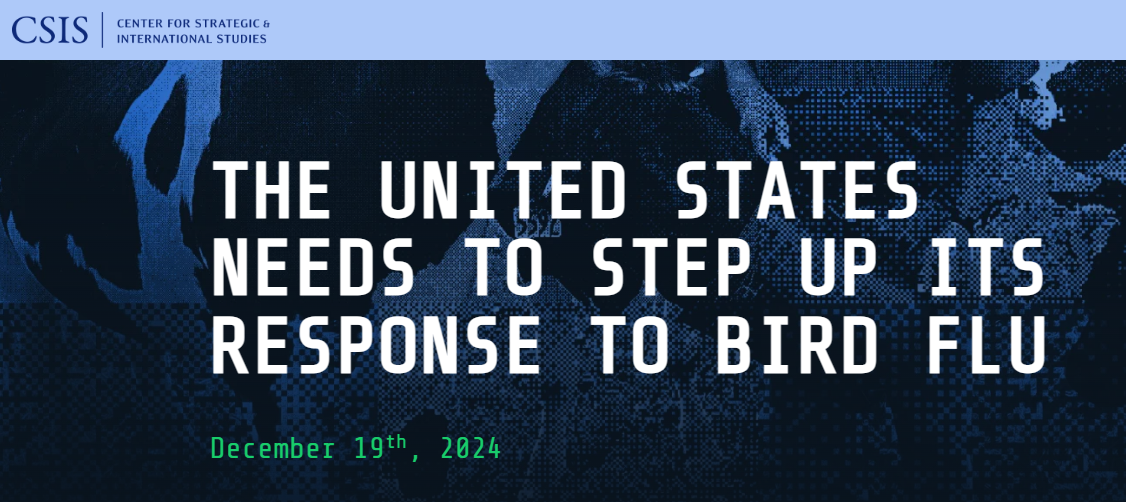
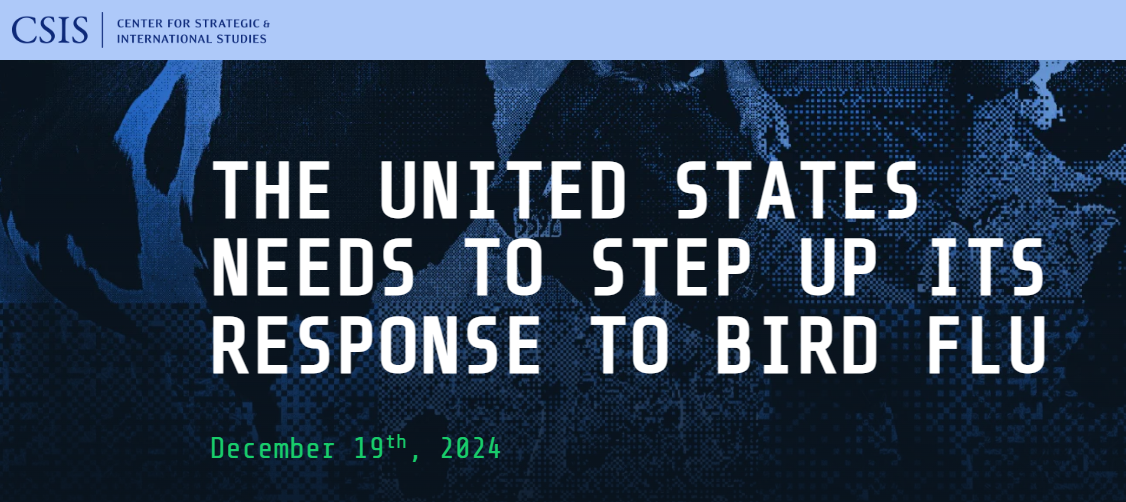
In its December 2024 report on H5N1, CSIS used the language of health preparedness to expand the scope of state control. The report wasn’t just about a virus—it was about fusing human, animal and environmental policy into a single surveillance framework. Under the label “One Health”, CSIS introduced a system where every farm, animal and human becomes part of a permanent monitoring regime.
This isn’t simply a health policy shift. It marks a deeper change in how authority is justified. Where traditional public health relied on evidence of illness, the new model relies on projected risk.
By linking climate, agriculture and virology, CSIS helps construct a world where almost anything can trigger intervention.
CSIS doesn’t just respond to crises—it helps build the logic that makes them seem inevitable. Its role isn’t to question the system, but to refine and extend it. That’s not analysis. It’s architecture.
Strategic Framing: CSIS and the Normalisation of Zoonotic Preparedness
The CSIS bird flu report is presented as a public health advisory, but structurally it acts as an operational script for expanding state and suprastate authority. Its centrepiece is not virology but governance. H5N1 becomes a pretext for rehearsing scalable intervention—via surveillance expansion, centralised data systems, vaccine pipeline acceleration and policy harmonisation across domestic and international jurisdictions.
This is not a new role for CSIS. Founded in 1962 during the height of Cold War positioning, the organisation has long served as a strategic narrative synchroniser—crafting policy frames that align elite objectives across military, diplomatic and economic sectors. During the post-9/11 period, CSIS played a key part in manufacturing consensus on WMD threats, feeding into the policy environment that justified intervention in Iraq. Its outputs have historically mirrored the needs of American forward posture: legitimising NATO expansion, scripting Indo-Pacific containment strategies, and providing pre-authorised language for defence modernisation.
This institutional DNA does not shift with subject matter. It retools. What was once applied to nuclear deterrence, counterterrorism and energy security is now applied to biosecurity and zoonotic governance. The pivot to One Health is not a shift in mission—it is a reformatting of threat architecture. Pandemic risk becomes the new delivery system for familiar operations: jurisdictional expansion, treaty alignment, and continuity of elite control under the optics of global coordination.
By embedding zoonotic emergence within the logic of defence preparedness, CSIS ensures that its health framing inherits the epistemic immunity of the security state. Debate is displaced by necessity. Scrutiny is replaced by simulation. And sovereignty is dissolved not through force—but through narrative compliance with strategic inevitability.
The “One Health” framework is central. CSIS describes it as:
“…an integrated response among human, animal, and environmental health experts.”
While framed as coordination, it dissolves institutional boundaries. What was once human public health now stretches into agriculture, wildlife and environmental management. By casting all of life as potential outbreak infrastructure, the report introduces a condition of permanent exception.
Surveillance is framed not as a temporary measure but a baseline requirement:
“Decisionmakers need efficient surveillance to assess the risk of H5N1 to human health and to understand if the outbreak has moved into a new phase. Without those signals, there cannot be sufficient lead time to accelerate the production of critical medical countermeasures.”
This need is not linked to confirmed spread but to the logic of “preparedness,” itself defined by the absence of evidence and the presumption of underreporting. In CSIS’s terms, “each human infection with H5N1 is an opportunity for the virus to further adapt and increase transmissibility”—a formulation that frames mutation as inevitability, not hypothesis.
Vaccine development is proposed as pre-emptive defence, even without current need:
“The U.S. government should work with vaccine manufacturers now to accelerate the development, approval, and manufacturing of influenza vaccines.”
The policy lever is not outbreak response, but manufacturing readiness. What is prepared for is not the virus—but the political conditions that require a pharmaceutical answer.
Central to this is the call for “White House leadership” and “greater attention to improving trust and coordination.” The emphasis on governance harmonisation shows that the virus is less the enemy than the instrument—used to justify a sweeping reconfiguration of public health into an enduring command structure.
In short: the virus is the stage prop. The show is jurisdictional expansion. CSIS isn’t sounding the alarm—it’s running the drill.
Constructing the Crisis Architecture
The report assembles a familiar structure—one seen in prior pandemic narratives—where uncertainty is not a barrier to intervention, but its engine. The logic is circular: lack of proof becomes evidence of urgency. Risk is no longer inferred from outbreak data but manufactured from statistical anticipation and diagnostic absence.
Mutation panic underpins the entire virological scaffold. CSIS asserts:
“Several countries are reporting rising cases in wild birds and mammals, as well as troubling new human infections.”
This formulation collapses the difference between a rare zoonotic event and an inevitable pandemic. Every case is framed not as an endpoint but as a potential threshold breach.
Coinfection alarmism is used to prime the public for viral fusion scenarios:
“If a person infected with H5N1 is simultaneously infected with seasonal flu—which is already well adapted to human-to-human transmission—that creates a dangerous environment for new, potentially severe strains of H5N1 to develop.”
This theoretical mechanism—reassortment—is presented not as a possibility, but as a structural risk demanding immediate systemic preparation.
Asymptomatic transmission framing reappears in the assertion that “cases are likely underreported.” No baseline data is provided to substantiate this claim. The absence of detection is recoded as proof of presence, creating a tautological mandate for more testing, more tracing, and more surveillance.
Pre-emptive statistical modelling intensifies this frame. As CSIS asserts, “The virus’s potential to rapidly mutate and cause high mortality rates among people—up to 50 percent—has had public health experts on high alert”—a deterministic phrasing that does not follow from empirical trend, but substitutes forecasting for fact. It establishes inevitability, then demands readiness for what it presumes.
Surveillance fetishism drives the report’s policy recommendations. CSIS demands “accelerated planning and investment in surveillance”, yet the purpose of that expansion is not diagnostic clarity but operational scaffolding. Surveillance becomes the justification for itself:
“The H5N1 outbreak has revealed the resulting and dangerous shortcomings in U.S. pandemic preparedness: lagging data, incomplete surveillance, sluggish coordination, considerable mistrust, and insufficient planning and stockpiling of vaccines and therapies.”
It is important to recognise that the Gain-of-Function (GoF) debate operates as a false dialectic within this theatre. While presented as an oppositional critique—i.e., did the virus emerge naturally (zoonotic spillover) or was it engineered (GoF leak)—both frames preserve the central premise: that the virus exists, that it is transmissible, and that it warrants the biosecurity infrastructure being proposed. This is not accidental. GoF narratives function as containment scaffolds, luring dissent into a sanctioned debate that never touches the deeper epistemological void: the absence of verified isolation, falsifiable transmission models, or methodological integrity.
The GoF axis also serves a deeper strategic purpose: it divides critique, turning focus toward lab safety, espionage, or foreign malfeasance—while the core machinery of One Health, data harmonisation and surveillance expansion proceeds untouched. In this way, GoF is not a challenge to the system. It is its safety valve, ensuring all dissent is routed through scripted conflict that reinforces the virological paradigm rather than dismantling it.
This was observable during COVID-19, where explosive media coverage of the Wuhan lab leak theory—fuelled by GoF framing—diverted scrutiny away from the structural fraud of inflated case definitions, PCR cycle abuse, and non-clinical diagnosis. The spectacle of lab-origin debate became the authorised terrain of dissent—ensuring the operational core of pandemic governance remained untouched and unexamined.
What remains absent throughout is any challenge to foundational virology. There is no verification of viral isolation protocols. No engagement with the limits of PCR-based testing. No scrutiny of how case definitions are constructed or adapted. Instead, virological assumptions are treated as settled truth. The infrastructure of interpretation—tools, thresholds, definitions—goes unexamined.
In this construction, lack becomes mandate. Uncertainty becomes signal. Silence becomes a call to action.
The report does not ask for caution—it demands consent for intervention, built not on evidence but on the optics of pre-emption.
Virology Without a Virus: The Critique That Undermines the Frame
For most readers, a virus is assumed rather than proven. The language of infection—spillover, mutation, reassortment—carries an air of scientific certainty. But that certainty begins to falter under close inspection. In recent years, a growing number of researchers, clinicians and scientists have called the very foundations of virology into question—not the policies built on it, but the claim that pathogenic viruses have ever been shown to exist using scientifically rigorous methods.
Among the most prominent critics is Dr Mark Bailey, a trained medical doctor and health researcher based in New Zealand, whose work synthesises a fast growing body of literature challenging the empirical basis of modern virology. His central argument is that what is presented as virus isolation is, in practice, a process of symbolic substitution: the mixing of genetic fragments, cell cultures, and toxic antibiotics—followed by digital reconstruction—replaces direct evidence with modelled inference. The virus, he argues, exists not as a discrete biological entity but as a computational artefact.
Bailey’s critique draws on—and helps integrate—a wider body of dissent. Figures such as Stefan Lanka, Dr Andrew Kaufman, and Dr Tom Cowan have each exposed core failures in experimental design: the absence of proper controls, the confusion between exosomes and viral particles, and the uncritical use of PCR amplification as both diagnostic and evidentiary tool. The Perth Group, active since the 1990s, has consistently argued that no virus—not even HIV—has been isolated in line with classical scientific postulates. Their claim is not simply that virology has taken shortcuts, but that it has never met its own standards of proof.
This critique is not recent. A century of animal and human infection trials—from the failed transmission experiments during the 1918 influenza to modern attempts at inducing disease in lab settings—have repeatedly failed to demonstrate reliable contagion. This historical blind spot is the subject of recent books like Can You Catch A Cold?: Untold History & Human Experiments by Daniel Roytas, which compiles over 100 years of failed infection studies and reframes the entire germ theory model as unproven and politically sustained. Dissolving Illusions by Suzanne Humphries and Roman Bystrianyk similarly challenges the story of vaccine triumph, showing that public health gains stemmed more from sanitation, nutrition and social reform than from inoculation.
Further structural critique comes from Virus Mania by Engelbrecht and colleagues, which maps how public fear and scientific authority are co-opted into profit cycles—turning loosely associated symptoms into pandemics through redefinition, media pressure and WHO-aligned scripts. What emerges is a consistent pattern: virology acts as a ritualised explanatory system, not a falsifiable science.
Seen through this frame, the CSIS bird flu report dissolves. Bailey’s lens reveals it not as a health alert, but as a jurisdictional script masquerading as virological foresight. If no virus has been properly isolated, if detection methods are circular, and if epidemiology rests on data laundering rather than direct evidence, then H5N1 is not a biological threat. It is a narrative device—designed to justify surveillance, treaty enforcement and biosecurity expansion.
While Bailey’s critique exposes the virological void, its reception is often pre-framed through reputational filters. To neutralise this containment reflex, it is essential to anchor critique in institutional admissions. The World Health Organization’s own guidance during COVID-19 acknowledged that PCR positivity could not confirm infection or infectiousness without clinical correlation. Similarly, the CDC repeatedly revised its testing and case-counting protocols, including post-vaccine cycle threshold adjustments—manipulations that reveal the interpretive volatility of the very metrics upon which virological threat is built.
In Bailey’s terms:
- The “spillover” theory is not a mechanism—it is a projection of virological ideology
- The “One Health” model is not interdisciplinary cooperation—it is a compliance framework wrapped in eco-medical language
- The CSIS report does not warn of a viral future—it initiates a policy rehearsal for continuous control.
Without the virus, the architecture collapses. But the control mechanisms remain. That is the signal. That is the purpose.
IV. The Strategic Purpose: Biosecurity Without End
The CSIS bird flu report is not an isolated policy proposal—it is a ritual rehearsal. A narrative scaffold built not to describe the present, but to prepare for a condition of permanent exception. It frames biosecurity not as an emergency response but as a governing principle—redefining safety, legitimacy and coordination through the lens of pathogen anticipation.
This is anticipatory governance: the idea that future threats justify present interventions, even if the threat is theoretical or unverifiable. It’s not a new approach—it was entrenched during COVID-19, when predictive models replaced diagnosis, and response infrastructures were scaled without evidence of proportional harm. The H5N1 narrative extends this logic beyond the human body into the entire biosphere.
CSIS makes this ambition explicit through its deployment of the “One Health” framework, reinforced by its insistence that “a coordinated, whole-of-government response is necessary to prepare for and respond to the potential threat of bird flu.” In this framing, the biological becomes geopolitical. What was once veterinary oversight becomes pandemic forecasting. What was once environmental monitoring becomes security infrastructure. Every domain becomes a target of surveillance, a potential launchpad for containment, and a justification for cross-sectoral governance.
In practical terms:
- Every farm becomes a forward operating base—subject to diagnostics, monitoring and rapid policy shifts based on genomic “signals”
- Every animal becomes a proxy lab partner—not because it is sick, but because it can be claimed as part of a transmission chain.
- Every human becomes a test subject—not in the medical sense, but in the behavioural one. Compliance, movement, exposure and data yield all become measurable, adjustable and enforceable.
The result is not preparedness. It is normalisation. By embedding biosecurity into the logic of agriculture, food systems, trade and rural economies, the H5N1 narrative acts as a delivery mechanism for permanent bio-administrative expansion. No outbreak is required. No virus needs to be found. The infrastructure builds itself.
This is not governance reacting to risk. It is risk performance constructing governance. The virus is symbolic. The controls are real. And the future being rehearsed is one in which health policy merges with environmental regulation, trade compliance and defence coordination—under a single, seamless justification: something might happen.
That is the strategy. Not alarm—but acclimation. Not evidence—but inevitability. Not containment—but continuity of command.
Implications for Sovereigns: Strategic Compliance under Security Doctrine
When a defence think tank issues pandemic guidance, it does not inform—it instructs. The Centre for Strategic and International Studies (CSIS), rooted in Cold War defence infrastructure, approaches health not as care but as threat response. Its flu report is less about virology than it is about rehearsing control. It reframes zoonotic events as strategic incursions and encodes public health within the command structure of national security.
This framing has precedent. Operation Warp Speed, the flagship U.S. COVID-19 vaccine program, was not led by the CDC or the NIH. It was a Department of Defence operation, with logistics run by the U.S. Army, surveillance infrastructure overseen by defence contractors, and vaccine distribution mapped using military-grade coordination systems. Civilian health authorities were downstream participants in a security-led protocol. That shift was not reversed—it was consolidated.
CSIS's H5N1 scripting continues that architecture. It proposes preparedness not as a policy option but as a defensive obligation, where mutation risk and ecological instability require total-system compliance. In this formulation, health sovereignty no longer resides with the state—it migrates to treaty-bound, security-aligned transnational mechanisms.
This logic mirrors the broader post-COVID dialectic. Figures like Dr Jay Bhattacharya offer narrative containment through controlled dissent and retrospective critique. But CSIS plays the expansionist role—fusing climate, agriculture, animal vectors and epidemiological theatre into a unified command narrative. These are not contradictory moves. They are a dual-consent mechanism: one preserves institutional trust, the other expands its jurisdiction.
Sovereigns under this model are no longer originators of policy. They are operators in a pre-scripted defence matrix, where the virus is not the threat—but the trigger. National law, public deliberation and evidence-based review are displaced by readiness doctrine, as sovereign legitimacy is tethered to alignment with WHO protocols, G7 consensus, and defence-industrial “preparedness” frameworks.
Biosecurity thus becomes the new battlefield. A PCR cycle threshold replaces a border incursion. A wildlife infection model triggers economic restrictions. Data harmonisation becomes treaty compliance. And the language of health cloaks a deeper transformation: sovereignty becomes contingent on strategic obedience.
This transformation is not speculative. It is being codified in real time. The World Health Organization’s proposed Pandemic Accord, alongside the amendments to the International Health Regulations (IHR), formalises many of the compliance pathways CSIS articulates as strategic necessity. These instruments seek to institutionalise rapid surveillance activation, transnational data sharing, and emergency response triggers that override national deliberation. Under this framework, sovereignty is not just influenced—it is procedurally subordinated.
This transformation is underwritten by the logic of predictive modelling—a methodological sleight in which statistical anticipation replaces empirical occurrence as the trigger for global action. The IHR amendments do not require observable harm. They legitimise mobilisation on the basis of potentiality, as modelled by internal bureaucratic consensus. This is not science—it is crisis simulation formalised as law. The Pandemic Accord follows suit, enabling treaty enforcement not on evidence, but on algorithmic forecast. In this structure, models become mandates. Authority is no longer reactive—it is pre-authorised through speculative analytics, insulated from falsifiability.
This epistemic shift is not hypothetical. The use of unverified modelling as operational trigger has precedent—most notably in the case of Neil Ferguson’s projections from Imperial College London. His models, repeatedly used by UK and global health authorities, consistently forecasted catastrophic death tolls and animal disease outbreaks that never materialised. These forecasts, lacking peer review, replicability or real-world correspondence, directly justified mass livestock cullings, economy-wide shutdowns, and indefinite surveillance regimes. Yet the structural reliance on these speculative artefacts has only intensified. What failed as foresight has been repurposed as governance instrument, where precision is irrelevant so long as the model achieves the policy threshold of activation.
This is not GIGO—garbage in, garbage out—in the conventional sense. The garbage inputs are not a flaw—they are the precondition. The function of the model is not accuracy, but unaccountable activation. In this system, failure of prediction is not punished—it is institutionalised. The model becomes law, the law becomes policy, and the policy becomes irreversible infrastructure.
CSIS’s report must be read in this context—not as isolated analysis, but as narrative pre-clearance for treaty convergence. This is consistent with its historical role. During the COVID-19 period, CSIS released aligned position papers echoing WHO, World Bank, and G7 pandemic coordination strategies, acting as a policy harmonisation node. Its outputs synchronised national security narratives with supranational health architectures—laying the rhetorical groundwork for the treaty systems now under negotiation. This is not advisory proximity—it is embedded narrative orchestration.
The alignment it demands is not theoretical. It is being constructed into law. What appears as public health preparation is, in practice, an onboarding mechanism for post-sovereign governance under permanent emergency doctrine. A defence-scripted invitation to enter the next phase of supranational governance, with every state now a garrison in a war against theoretical contagion.
This is not preparedness. This is placement. This realignment is not rhetorical. Treaty frameworks operationalise control through binding mechanisms: livestock eradication under OIE compliance, mandatory border testing protocols, digital health certification systems, and ESG-linked health performance metrics for trade and finance eligibility. These are not hypothetical tools. They are enforcement levers designed to automate compliance by administrative code, bypassing deliberation entirely.
Sovereigns are not being protected—they are being positioned. Not as leaders—but as logistical nodes in a planetary security grid masquerading as public health.
Conclusion: From Virology to Governance
What CSIS offers in its H5N1 report is not a health alert. It is a strategic alignment document, crafted not to diagnose a threat but to operationalise a response architecture already in motion. In doing so, it exemplifies a new paradigm—where pandemics are not biological events to be managed, but narrative vectors used to condition sovereignty, dissolve jurisdictional limits and install predictive governance frameworks.
This transformation did not begin with bird flu. It accelerated with COVID-19, where lockdowns, mandates and emergency powers were normalised under the banner of science, while the command infrastructure was handed to military, intelligence and corporate actors. CSIS’s current intervention shows that this was not a temporary crisis response—it was a foundational reformatting of governance under permanent biosecurity logic.
By fusing virology with strategic doctrine, the report contributes to a broader institutional project: the global integration of health, environment, trade and surveillance into a single programmable system, governed not by law, consent or evidence, but by simulation, risk modelling and compliance metrics. Here, “public health” becomes the interface through which ecological management, food policy, defence logistics and population monitoring are made interoperable.
The result is a world where policy no longer follows reality. It precedes it. Where sovereignty is no longer about territorial integrity or democratic mandate, but about alignment with supranational readiness regimes. And where the citizen is no longer a subject of care, but a variable in a system designed to minimise disruption to elite continuity.
CSIS does not offer policy. It offers scripting. And within that script, the virus—whether real, simulated or unverifiable—is simply a delivery mechanism for new jurisdictional norms. What matters is not the outbreak. What matters is the response protocol, the treaties it enables, and the compliance infrastructure it leaves behind.
In this world, the emergency is never over. The next pathogen is always pending. And the health apparatus has been retooled—not to treat, but to train. What we are witnessing is not preparedness. It is the ritual production of authority, repackaged for the zoonotic age.
Understanding this is not optional. It is foundational. Because in the theatre of anticipatory governance, to miss the narrative is to mistake the weapon. Sovereignty is not defended. It is procedurally rewritten—through treaties, trigger thresholds, and standardised response mandates. This is not metaphor. It is codified sovereignty substitution—preloaded into binding frameworks, ready for execution.
Published via Journeys by the Styx.
Geopolitika: Tracing the architecture of power before it becomes the spectacle of history.
—
Author’s Note
Produced using the Geopolitika analysis system—an integrated framework for structural interrogation, elite systems mapping, and narrative deconstruction.