Geopolitika: CSIS Simulated Futures, Scripted Outcomes – Wargaming Taiwan
How a think tank wargame prepositions policy by converting simulation into obligation.
Previous Geopolitika articles have examined how organisations like the Center for Strategic and International Studies (CSIS) operate as narrative engines within U.S. strategic consensus. Though typically presented as neutral policy research, CSIS outputs (like that examined here) frequently align with donor objectives and defence-industrial priorities. Their reports are rarely isolated studies—they function as scaffolding for policy convergence.
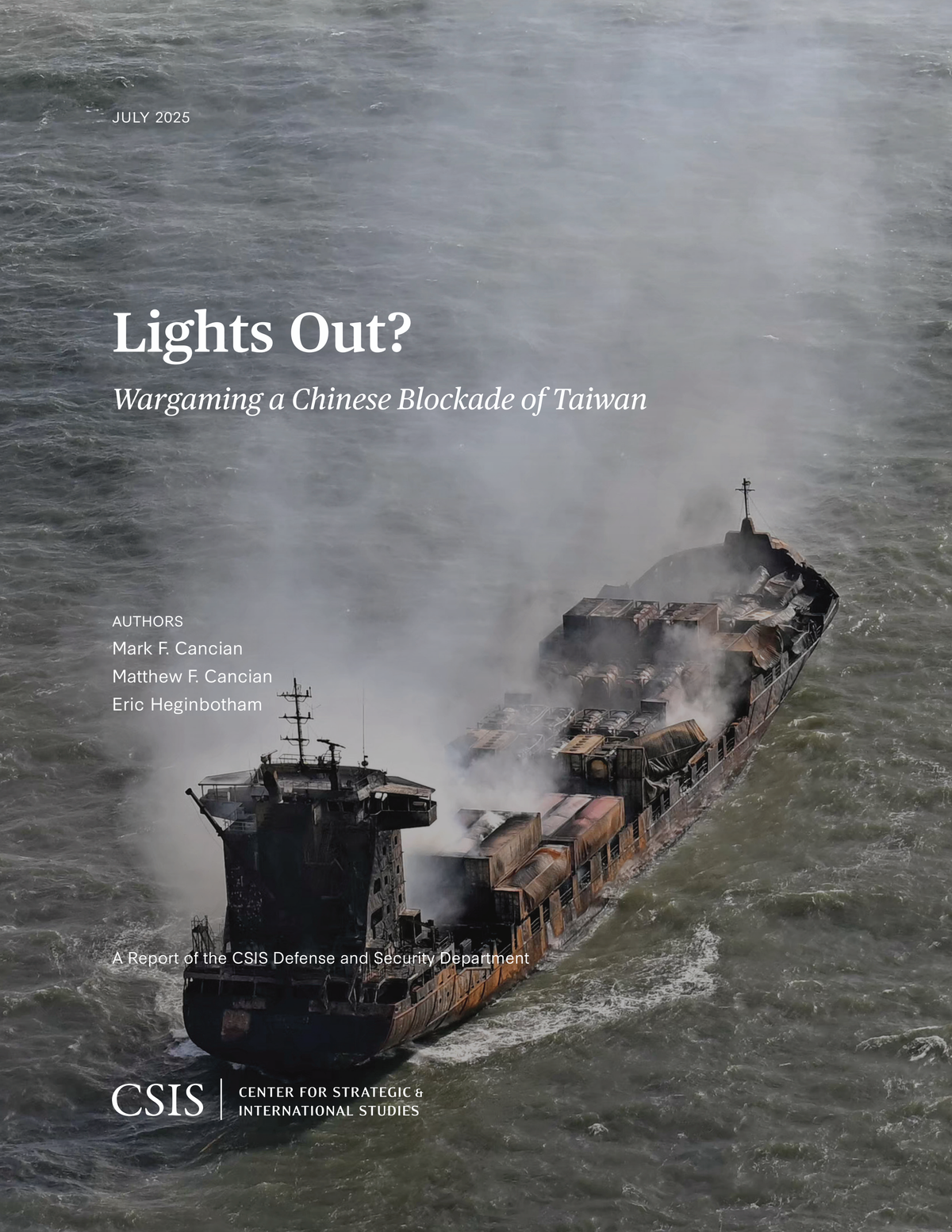
The latest example is Lights Out? Wargaming a Chinese Blockade of Taiwan (31 July 2025). Framed as a rigorous scenario exercise, it purports to simulate a potential Chinese blockade of Taiwan and model U.S. and allied responses. This report comes on the back of a similar wargame report issued late 2024, Wargaming Nuclear Deterrence and Its Failures in a U.S.–China Conflict over Taiwan (13 December 2024), which after 15 runs concluded that:
“…favorable outcomes were possible, but total victory was unachievable” and “…the United States must therefore be prepared to successfully prosecute a high-end conventional war while at the same time providing face saving off-ramps.”
These two reports build on an earlier wargame report The First Battle of the Next War: Wargaming a Chinese Invasion of Taiwan (9 January 2023) by the same authors, which concluded that:
“in most scenarios, the United States/Taiwan/Japan defeated a conventional amphibious invasion by China” albeit “at high cost.”
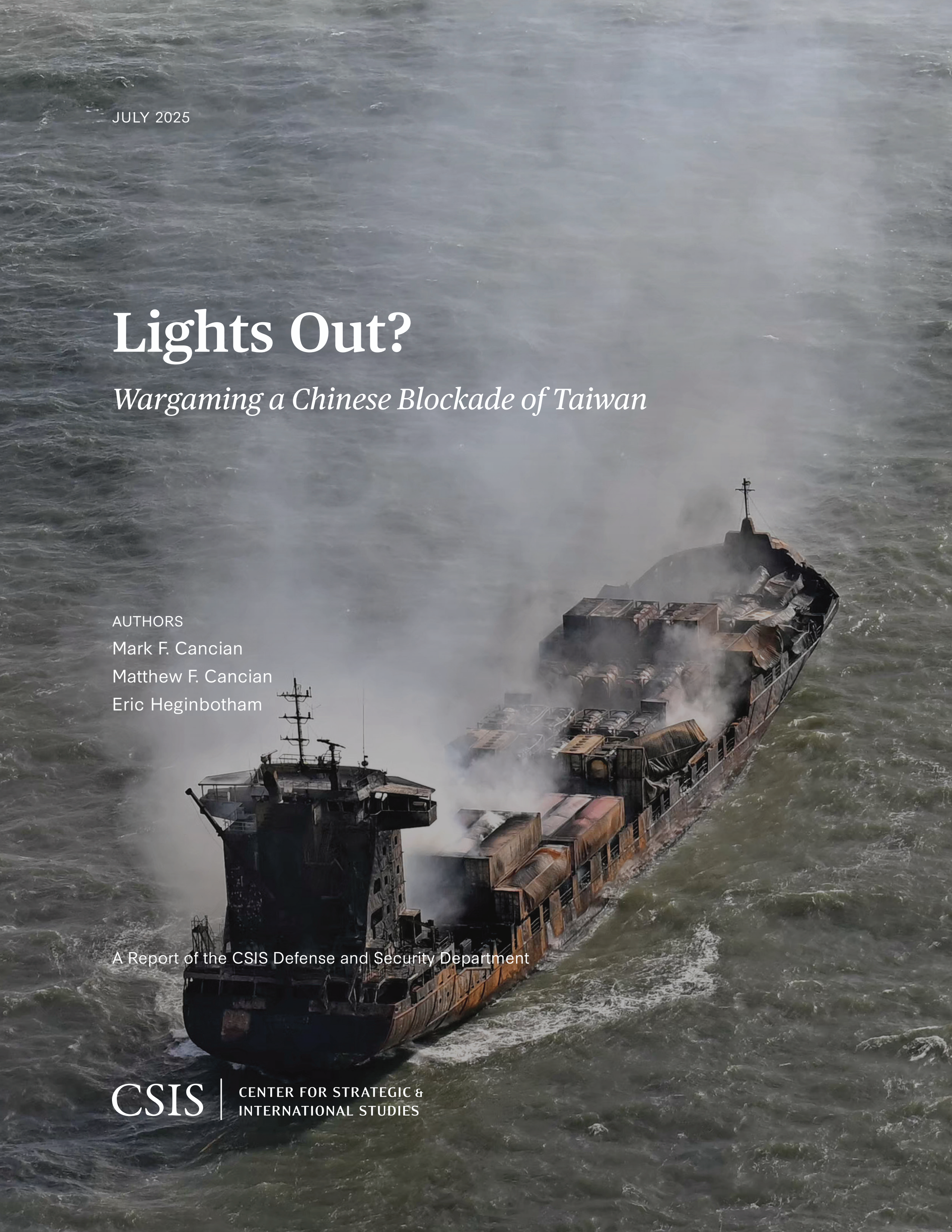
Superficially, the current report appears technical and apolitical—165 pages of tables, maps, and variables. But beneath the surface lies a constrained simulation architecture, with escalation logic preloaded into the design. What emerges is not forecasting but rehearsal—an outcome staged as inevitable. This is reinforced through the synchrony with surrounding forums and events.
In producing that outcome, the “wargame” format performs two core narrative functions. Firstly, it cloaks strategic escalation as prudential analysis. Secondly, it installs deterrence postures as defaults by rendering alternatives structurally unavailable. Inputs are staged to validate a narrow band of responses. Constraints are selected to foreground confrontation. The outputs then circulate as policy guidance. What results is not insight into how war might unfold, but justification for preparing to fight one.
This article does not take a position on confrontation itself. It interrogates the narrative mechanism through which simulated conflict becomes rehearsed policy. The analysis focuses on structural cues, such as the ostensible vs manifested purpose of the report, who wrote the report, what institutional logics shaped it, how the scenario narratives are produced, and how the reader is positioned. The aim is not to dispute military planning—but to make visible the mechanisms of how narrative is used to shape wartime inevitability.
Ostensible Purpose vs. Real Function
The CSIS report Lights Out? presents itself as an objective wargame—a neutral simulation of how a Chinese blockade of Taiwan might unfold and how the U.S. and allies could respond. Yet beneath the surface of scenario tables and technical jargon lies a tightly scripted narrative apparatus.
As outlined in the report:
“This report establishes a framework for understanding the range of blockade scenarios… with a series of 26 wargames, and assesses the operational challenges that the respective parties would face in implementing and countering a blockade… conflict is possible, given China’s commitment to unification… proposing policy changes to better deter a blockade and to cope with one should it occur.” (p. VIII)
However, the report’s entire premise rests on a dislocated timeline. It frames the starting as a spontaneous crisis point—detached from a decade-long arc of Western provocation. Since Obama’s 2011 “Pivot to Asia,” the U.S. has encircled China through base reactivation in the Philippines, routine naval freedom of navigation passages through the Taiwan Strait, and rhetorical escalation across multiple fronts. Taiwan’s Ministry of National Defence (MND) claimed in 2022 that 71 Chinese aircraft, including fighter jets and drones, had entered its air defence identification zone (ADIZ)—some of which covers areas within China's borders. Meanwhile, U.S. arms transfers to Taiwan, on-island military deployments, and symbolic visits by high-level officials have stacked pressure beneath the threshold of declared war. The effect is not deterrence but agitation—manufacturing a response, then narrating it as unprovoked.
This accumulative backdrop is absent from the CSIS wargame’s rationale. The report mentions China’s “displeasure” at Pelosi’s 2022 Taipei visit but frames it as irrational brinkmanship. In reality, Pelosi’s arrival coincided with intensified U.S. arms shipments, bipartisan delegations, and visible military coordination—all of which visibly eroded the credibility of the One China policy. The subsequent PLA drills were not spontaneous tantrums but performative escalations within a predictable tit-for-tat sequence. CSIS inverts causality: it casts the instigator as passive and the provoked as pre-emptive.
The authors attempt anchor the simulation’s legitimacy through definitional flexibility, doctrinal framing, and prudent foresight. Each mechanism obscures the deeper function of the report—narrative preloading of escalation logic. This can be seen in:
- Legal Ambiguity as Strategic Leverage: The report devotes explicit attention to the legal status of a blockade, not to define it conclusively, but to acknowledge and instrumentalise its contestability. By recognising that “the global community will decide the status and effectiveness of a ‘blockade’ by their reaction to it,” the authors position international law not as constraint but as narrative terrain. Legal framing becomes a coalition-building tool—flexible enough to justify U.S. action, ambiguous enough to avoid precommitment. This ambiguity functions not as evasion but as pre-justification, shaping international perception before force is deployed.
- Doctrinal Anchoring as Justification: By citing Chinese military texts (e.g. 联合封锁战役 / “joint blockade campaign”) and referencing PLA intent, the report builds plausibility through selective doctrine mining. But this is asymmetric: no equivalent space is given to U.S. or Taiwanese doctrines that could temper the scenario or present non-militarised alternatives. It’s not doctrine as context, it’s doctrine as script seed.
- Preemptive Framing of Global Stakes: The early mention of chip production and planetary trade impacts operates rhetorically—it transforms a regional confrontation into a planetary imperative, thereby priming the reader for the necessity of intervention. It’s a bait-and-switch: economic disruption is floated not to encourage de-escalation, but to justify forward military posture.
- Faux Modesty with Buried Assumptions: The report claims conflict is “not inevitable or even necessarily likely,” yet pairs this with declaratives about PLA buildup and unification intent “by force if necessary.” This rhetorical contrast is a classic hedge–trigger mechanism: the uncertainty is decorative, while the call to deterrence is functional.
Through the initial scenario provided on page VII which begins with “The year is 2028. Xi Jinping decides…” the wargame resets the clock. It artificially truncates the lead-in period, constructs agency around a single figure, and stages conflict as personal pathology. Xi doesn’t react—he decides. The logic tree that follows (blockade, coercion, escalation) isn’t analytical; it’s cinematic, so that the scenario operates as affective theatre—pre-emptively framing China as the aggressor, the U.S. as reluctant responder, and force unquestioned.
In this theatrical presentation of the situation, the ES matrix operationalises military choices and leaves diplomatic pathways out of scope — the Recommendations section later restores “off-ramps,” creating a design split between modelling and policy advice. This is clearly illustrated in Table ES.1 on page X, which reduces the response landscape to supposed Chinese escalation ladders, described as “Boarding,” “Subs and Mines,” “Offshore Kinetics,” and “Wider War.” Meanwhile, U.S. and Taiwanese responses are constrained within pre-labelled brackets— “Constrained” and “Assertive”—while blacked-out cells were uninteresting because of the imbalance of forces.
This fear-driven design is not anomalous—it fits a long-running template of U.S. elite threat construction. As Rosenberg (2025) argues, from Truman’s Red Scare to Bush’s Axis of Evil, such tactics are not about clarifying danger but manufacturing alignment. They transform uncertainty into inevitability, priming publics and policymakers to accept confrontation as preordained. CSIS repeats this formula: by staging escalation as both likely and unavoidable, it scripts consent under the guise of foresight—reviving a strategy that has historically led to blowback, entrapment, and loss of strategic control.
What emerges is not so much as simulation as a script for war in which the wargame installs militarised response as default. Restraint isn’t just recoded as weakness, it is deleted altogether in favour of militarised deterrence in which confrontation becomes the only rational trajectory.
Despite disclaimers, the real purpose is not to explore contingencies—it is to construct a narrative enclosure around a preordained conflict script. The structure:
- Removes alternative pathways through definitional preselection
- Excludes normative and political challenge through selective scope
- Normalises conflict by abstracting its real-world costs
- Performs escalation choreography as rational modelling.
This is not a simulation of uncertainty, but a legitimisation engine for premeditated hardline strategy—wrapped in the form of analytic rigour. It installs confrontation as a structural inevitability and neutralises dissent through framing, not evidence. The function revealed is not to inform policy, but to narrow it—until only escalation remains.
Who’s Behind It: Authors and Institutions
The authors operate from within the U.S. security–academic–policy nexus, not as independent analysts, but as functionaries whose institutional positioning and thematic consistency reflect systemic convergence. Mark Cancian (CSIS, OMB, Pentagon) and his son Matthew Cancian (Naval War College, MIT) form a wargaming lineage oriented toward escalation architecture and force-first procurement logic. Eric Heginbotham (RAND, CFR, MIT) is a simulation specialist who has long framed China as a pretext for deterrence theatre. These three also authored the CSIS’s previous two wargame papers covering China and Taiwan. Functioning as narrative engineers rather than observers, they curate Taiwan as a preloaded theatre of confrontation across legal, commercial, military, and ideological registers. Their institutional trajectories and thematic synchrony reveal a closed-loop system: escalation is assumed, scripted and operationalised under the veneer of neutral expertise.
CSIS’s Taiwan Body of Work:
The CSIS’s body of work on Taiwan over the past several years constitutes a comprehensive narrative construction effort, not a neutral policy analysis programme. Its scale, sequencing, and thematic consistency reveal a coordinated attempt to legitimise pre-emptive deterrence and normalise confrontation with China by strategically saturating the discursive environment with simulations, expert surveys, legal framing, supply chain anxieties, election interference tropes, and human rights overlays. The implication is that CSIS is not merely anticipating conflict—it is rehearsing and scripting it in advance.
The structural implications of this are:
- Narrative Saturation and Frame Entrenchment: From White Sun War to Silicon Island, the output establishes Taiwan as both an object of moral concern and a strategic asset. CSIS does not permit ambiguity: Taiwan must be defended, China must be countered, and deterrence must be integrated across all domains—military, cyber, legal, informational, economic. This isn't strategic diversity. It's message reinforcement through thematic repetition. Each report reinforces and escalates the others, embedding a logic loop: if Taiwan is important, then China is dangerous; if China is dangerous, then deterrence must escalate; if deterrence escalates, conflict becomes plausible; if conflict becomes plausible, pre-justification is needed.
- Legitimisation Through Modality Diversification: The campaign spans formats (reports, podcasts, events, simulations), domains (trade, elections, cyber, doctrine), and registers (technical analysis, legal commentary, fictionalised wargaming). This isn’t merely multi-perspective—it’s modal redundancy to recode strategic assumptions as fact. The Taiwan conflict is staged not as possibility, but as destiny awaiting activation.
This modular construction of inevitability allows plausible deniability. Any single document can claim modesty, but the networked corpus functions as a distributed pressure system, bending policy consensus toward confrontation. - Staging of Sequential Crisis Logic: Key outputs track and simulate the progression of a future scenario: Political manipulation (Chinese interference in elections); Strategic vulnerability (cross-Strait chip dependence); Legal tension (Anti-Secession Law, quarantine ambiguity); Economic interdependence (Scared Strait); Moral justification (defending Taiwan’s democracy); Military rehearsal (blockade, nuclear deterrence, porcupine strategy).
This isn’t academic breadth—it’s scenario preloading, building a moral–logistical map for confrontation while scrubbing provocation responsibility from the West. - Temporal Compression of the Taiwan Crisis Arc: The volume and density of Taiwan-focused outputs from 2023–2025 suggest temporal conditioning. In narrative terms, Taiwan is being accelerated toward crisis readiness. Publics are prepared, elites are trained, contingencies are rehearsed. This is not reactive policy scaffolding. It is synthetic path dependency—the artificial construction of inevitability through information engineering.
CSIS’s Taiwan programming functions as a narrative architecture of escalation, deploying technocratic legitimacy to manufacture inevitability. It simultaneously erases antecedent provocations (e.g. Pelosi’s visit, US basing reconfigurations), flattens diplomatic options, and embeds escalation as foresight. This is not about understanding Taiwan. It is about staging it—for war, for policy alignment, for global signal. The result is epistemic foreclosure: by the time conflict comes, it will appear preordained, not chosen.
Funding and Latent Influence Channels
The Taiwan blockade simulation does not emerge in a vacuum. Its production is underwritten by a funding ecosystem that embeds strategic preferences into the DNA of the analysis itself. The direct funders are rarely highlighted, but CSIS's broader financial architecture speaks volumes.
The project’s named sponsors—Smith-Richardson Foundation and Diana Davis Spencer Foundation (DDSF)—do not sit outside the strategic apparatus. They are ideological actuators embedded within the U.S. national security funding matrix. Smith-Richardson, a Cold War holdover, has long stabilised elite doctrine on American primacy. DDSF operates more overtly, channelling conservative funding into militarisation pipelines, counter-China messaging, and escalation-friendly research frames. They function less as neutral grant-makers than as strategic placement agents selecting host institutions aligned with their policy preferences. Their function is not to support inquiry, but to define its bounds by selecting host institutions (CSIS) already aligned with their strategic preferences.
The funders’ influence over the CSIS simulation cannot be confirmed through direct evidence. However, the report’s alignment with donor priorities—escalation logic, U.S. military indispensability, absence of diplomatic off-ramps—justifies scrutiny. Foundations like Smith Richardson have a consistent funding pattern favouring U.S. hard-power frameworks. While this does not prove interference, it suggests that scenario framing and motif selection operate within anticipatory constraints. Analysts may internalise funder expectations, narrowing outputs without instruction. This dynamic produces the appearance of neutrality while structurally excluding alternatives. The simulation’s authority must be read in light of this highly likely ideological alignment.
The broader CSIS financial ecosystem completes the loop:
- CSIS Corporate Donors: Lockheed Martin, Raytheon, Northrop Grumman, Boeing—all direct beneficiaries of any Taiwan contingency.
- Think Tank–Military Crosslinking: Naval War College, MIT, and RAND are co-staffed and co-funded by DoD vectors including DARPA and DTRA—ensuring ideological continuity.
- Strategic Loopback: Authors simulate conflict scenarios that justify weapons platforms underwritten by the very corporations funding their institutions.
The funding web alone does not explain narrative durability. The real vectors are the experts, diplomats, and academics who act as motif broadcasters, stabilisers, and inversions. Whether inside CSIS or rebroadcasting from adjacent platforms (GMF, CFR, Hoover), they constitute the actor-layer of narrative normalisation. This isn’t just ideological drift—it’s coordinated emission, funded by the same military-industrial stakeholders whose interests the report quietly advances.
Latent Influence and Narrative Broadcast Layer:
Beyond direct authorship, the report’s coordination architecture is stabilised by a group of high-synchrony narrative custodians who echo, reinforce, and project the same escalation motifs—often across different institutional fronts.
- Bonny Lin (CSIS – China Power Project): Functions as Amplifier and Custodian. Central node for normalising blockade scenarios as credible, strategically obvious options. Maintains near-direct continuity with report logic. Her outputs map 1:1 onto CSIS’s escalation motifs, reinforcing them across think tank outputs and media op-eds.
- Samantha Power (USAID, ex-UN): Functions as Inverter and Custodian. Converts humanitarian urgency into interventionist justification—typical of Responsibility to Protect (R2P) logic. While outside CSIS, Power’s discourse feeds the “civilian suffering” motif that allows military escalation to be framed as moral obligation.
- Bonnie Glaser (German Marshall Fund, ex-CSIS): Functions as Normaliser and Strategic Front. Sustains escalation discourse (deterrence, broader war ambiguity) beyond CSIS through expert commentary, advisory roles, and Track 1.5 participation. Repeats CSIS-originated frames from new institutional bases, giving the illusion of independent validation.
- Lonnie Henley (FPRI; China Power Project collaborator): Functions as Amplifier and Normaliser. Publicly asserts that blockade is more likely than invasion—a key narrative narrowing device. Participates in CSIS-adjacent panels and podcasts, reinforcing the motif saturation via “expert debate.”
These actors do not originate motifs—they replicate and normalise them across different platforms. This forms a multi-institutional emission cloud designed to saturate public and policy discourse with aligned escalation logic.
Together, they act as:
- Echo Nodes: reinforcing the primary narrative with institutional diversification.
- Plausibility Mirrors: giving the appearance of broad consensus.
- Drift Locks: preventing deviation from preloaded escalation scripts.
This secondary stratum is critical for legitimising the report’s deeper function: converting military preference into hegemonic “common sense.” Because the same network of experts produces, interprets, and amplifies the simulation’s conclusions, the analytic and evaluative functions collapse—producing a feedback loop that naturalises escalation logic as both input and outcome.
Overall, this financial and personnel structure doesn’t merely support the production of analysis—it steers the boundaries of what analysis is permissible. The outcome is a layered influence apparatus where escalation logic is not one perspective among many—it’s the operating assumption built into the funding model itself.
Narrative Mechanics: Embedded Motifs and Structural Scripts
The CSIS report embeds a constrained set of high-saturation motifs—“resilience” (35 uses) and “cost” (35 uses)—which function as anchoring logics across scenarios and recommendations. While “deterrence” appears only 11 times, it retains structural importance as a strategic pretext. The word “rules” appears 15 times, but primarily in procedural form—rules of engagement, simulation mechanics, adjudication protocols. A normative invocation of the “rules-based international order” appears only once, rendering the frame symbolically present but operationally inert.
Nonetheless, the simulation’s procedural architecture reproduces the epistemic logic of the rules-based order: bounded action, legitimacy through compliance, authorship displaced by systems. It trains cognition not through reference but resonance—structurally equivalence disguised as neutrality.
A parallel motif is “off-ramps” (11 uses)—invoked in executive summaries and scenario commentary but absent from simulation mechanics. No scenario embeds diplomatic de-escalation as a symmetrical path. Off-ramps are invoked to perform diplomatic conscience, not to test political resolution. This is semantic laundering: escalation is framed as reluctant necessity, and diplomacy is retained only to depict constraint exhaustion. The repetition of off-ramps conditions their failure—by never making them viable. This results section reinforces the core function of the report as a strategic escalation script, not an impartial diagnostic. It performs a theatrical realism—seeming to weigh costs and uncertainties while covertly installing policy direction through problem framing.
The report closes not with optionality but with inevitability. By citing threat multiplicity (“China can choose how to strike”) and demanding a “deep toolbox” for deterrence, the authors transpose possibility into necessity. Every scenario becomes justification for more tools, more posture, more commitment. Deterrence is no longer a contingent stance—it is a policy straight jacket. The report’s final logic compresses strategic discretion into a binary: prepare for all conflicts or concede all influence. The simulation thus installs obligation through simulated preparedness—pre-emptively delegitimising non-intervention.
The implications are structural:
1. No “Winner” Framing = Narrative Obfuscation
“The project did not assign winners or losers…” [page XI]
This claim operates as a credibility cloak. It positions the simulation as neutral by implying moral and political restraint—yet the structure of the results preassigns roles:
- China initiates
- Taiwan cannot hold without U.S. help
- The U.S. must choose between intervention or capitulation.
By not declaring a winner, the simulation hides its alignment behind the façade of complexity while funnelling decision-makers toward one conclusion: military intervention is necessary and morally defensible.
2. Escalation as Systemic Gravity:
“Any blockade creates escalatory pressures that are difficult to contain.” [page XI]
This is not analytical insight—it is teleological embedding. The report claims to observe uncontrollable escalation, but the structure produces that inevitability by:
- Precluding diplomatic countermeasures
- Designing free-play scenarios that reward “reciprocal minor escalation”
- Building a psychodynamic model of deterrence that casts passivity as weakness embedding a behavioural feedback loop that recodes non-escalation as system vulnerability.
This converts escalation into systemic law, detaching it from policy discretion. The logic installed is: once conflict starts, restraint is both futile and dangerous—therefore early escalation is justified.
3. Hardcoded Dependence on U.S. Military:
“Taiwan requires U.S. intervention…” [page XI]
This point is the narrative linchpin. The report functionally collapses the Overton window by:
- Declaring a non-military blockade unsustainable for Taiwan
- Declaring U.S. proxy support (à la Ukraine) insufficient
- Declaring that failure to intervene leads to Taiwan’s surrender.
This renders U.S. military entry not one option among many, but the only rational move. Policy ambiguity is removed. Soft containment and diplomatic hedging are discarded. By asserting structural dependency, the simulation forces strategic convergence.
4. Material Shortfalls as Time Bomb Logic:
“Energy and merchant ships are the critical shortfalls…” [page XII]
This segment simulates urgency: the ticking clock model of collapse. But it externalises all responsibility:
- Taiwan is framed as helpless
- China’s actions are deterministic
- Only U.S. intervention restores balance.
By foregrounding logistics, the report distracts from causality—framing the blockade as a neutral environmental hazard rather than a reaction to provocation. It displaces political causality with supply chain theatre—urgency reframed as inevitability, not preventable outcome.
5. Blockade as “Bad But Inevitable”:
“A blockade is not a low-cost, low-risk option for China…” [page XII]
This is a pre-emptive inoculation against the obvious critique—that the U.S. is escalating against a conflict China doesn’t want. The report concedes that the blockade is expensive and risky for China—but frames this as irrational belligerence rather than a coerced response to containment.
- The logic: If it’s irrational, it’s more likely.
- The implication: If it’s risky, they’ll still do it.
- The conclusion: Therefore we must prepare now.
This projects intentionality onto unpredictability. It warns of irrational escalation while demanding pre-emptive rational escalation in response.
Net Effect:
The report’s results section claims agnosticism while producing an architecture of inevitability:
- The U.S. cannot not intervene
- Escalation cannot be managed
- Diplomatic resolution cannot be trusted
- Chinese aggression cannot be assumed rational
- Time cannot be bought—only war can restore equilibrium.
The simulation constructs the interpretive enclosure in which confrontation becomes the only responsible act. The true audience is not analysts—it is policymakers seeking cover for escalation already in motion. The report does not model war. It rehearses its justification.
Elite Patterns: Structural Logics Behind the Script
The CSIS blockade simulation operates not as neutral analysis but as a delivery system for elite narrative engineering. Each of its thematic motifs—escalation inevitability, resilience framing, wider war contingencies, convoy defence logistics, and strategic off-ramps—plugs directly into recurring structural patterns identified in the Geopolitika analytic architecture. These aren’t accidental rhetorical tropes—they’re system motifs built to coordinate perception, displace responsibility, and hard-code escalation as reason.
- Escalation Matrix → Perception Management Regime → Predictive Programming:
The escalation ladder is presented as emergent, reactive, and non-linear. But the recursion is pre-built. Conflict is not discovered through simulation—it is structured into the scenario as the default output. Escalation becomes a self-confirming process: one side acts, the other “must” respond. This pattern feeds predictive programming: the audience is not asked to consider escalation as a choice, but as an unfolding logic chain. This removes agency and installs inevitability—preparing publics and policymakers to regard war as a rationalised endpoint, not a political decision. - Resilience (Energy/Logistics) → Crisis Feedback Economies → Beneficial Crisis Looping:
The report foregrounds civilian fragility—gas shortages, import gaps, merchant marine attrition—as logistical emergencies. But this framing is not humanitarian. It recodes suffering into operational pressure points, justifying coercive infrastructure buildouts and military presence under the veil of “resilience.” This is the logic of beneficial crisis looping: simulate vulnerability to activate supply chain militarisation, recast intervention as aid, and collapse logistical urgency into policy necessity. Energy dependency becomes a mobilisation accelerant. - Wider War → Post-Democratic Governance → Governance Simulation Systems:
The spectre of general war—strikes on Guam, mainland China, U.S. bases—is framed as an emergent property of strategic missteps. But this escalation is structurally staged via contingency ladders that displace real-time political agency. No actor is blamed; each is responding to a scripted provocation. This pattern reflects a core post-democratic governance tactic: stage political choice within military inevitability. The outcome feels determined not by ideology or error but by the simulation’s own internal momentum. Decision chains are erased and replaced with automated sequences. - Convoy Defence → Neo-Imperial Instrumentation → Proxy Conflict Frameworks:
The entire blockade architecture recodes militarism as necessity through logistics. Taiwan becomes a supply node, not a sovereign actor. Convoy defence isn’t framed as aggression but as ensuring continuity—a moralised version of naval control that hides forward posture within humanitarian optics. This is classical neo-imperial instrumentation: sovereignty erased, proxy agency assumed, and control justified through abstract system function. Recolonisation is reframed as defensive stewardship. - Prepared Off-Ramps → Perception Management Regime → Narrative Lock-In Devices:
“Off-ramps” are mentioned repeatedly but never structurally embedded. Each scenario assumes Chinese withdrawal or allied force pre-positioning. There is no off-ramp structurally grounded in political resolution, reciprocal de-escalation, or population agency. Every variant presumes pre-escalated force posture and Chinese concession as the exit condition. This is not a design flaw. It is the function of narrative lock-in devices: they simulate the presence of alternatives while guiding all logic toward intervention. The motif of diplomacy is retained only to reinforce the image of exhausted options—manufacturing consent through exclusion of real exit paths.
Rosenberg’s dissection of threat politics maps directly onto the crisis feedback mechanism: while iterative crises may consolidate elite consensus and unlock funding pathways—as with Truman’s use of Soviet threat inflation to push the Marshall Plan—they also sow long-term narrative instability. The same logic that justifies escalation today can erode legitimacy tomorrow. In the CSIS case, “resilience” becomes both moral cover and budget pretext, encoding a policy momentum that is harder to arrest than to initiate.
Overall, the simulation’s motifs are not so much analytical variables as switch points in a preconstructed ideological machine. Each draws from an elite toolkit of Geopolitika-mapped governance technologies: predictive programming, beneficial crisis feedback, post-democratic simulation, imperial proxy frameworks, and consent laundering. Together, they create a hall-of-mirrors logic field where conflict is pre-justified, opposition is excluded, and escalation is staged as prudence.
Strategic Timing and Synchrony
The CSIS blockade report, dated July 2025, is not merely coincident with geopolitical flashpoints—it is embedded within them. Its release aligns with NATO–Japan–South Korea summits and precedes key U.S. congressional defence proceedings. This is not reactive scheduling—it is prepositional: a deliberate discursive positioning designed to pre-shape the policy horizon before critical inflection points.
The simulation did not appear as an isolated product. It concluded a two-month narrative conditioning cycle—June as motif injection, July as framing lock-in.
April–June 2025 – Narrative Priming:
- NATO Secretary General Rutte’s Japan Visit (8–9 April): Rutte and PM Ishiba publicly asserted the indivisibility of Euro-Atlantic and Indo-Pacific security. This exact framing—“inseparability,” “shared deterrence”—reappears in the CSIS report, importing NATO terminology into think tank scenario construction.
- Shangri-La Dialogue, Singapore (31 May–2 June): NATO’s Deputy Military Chair promoted “maritime resilience” and “strategic stability”—motifs later echoed in the CSIS webcast and slide deck.
- NATO Summit, The Hague (24–26 June): Although most Indo-Pacific (IP4) heads of government were absent, senior representatives preserved symbolic alignment. The NATO Public Forum—co-organised with three Dutch think tanks—reinforced the convergence script. NATO’s meeting with Indo-Pacific partners during this forum operated as narrative choreography, synchronising bureaucratic form with rhetorical continuity.
June served not as prelude, but as conditioning—rhetorical pre-loading for the July output.
July 2025 – Framing Lock-in:
- Congressional Codification of NATO–China Convergence (3 July): A U.S. Congressional Research Service memo explicitly linked NATO strategy to “security threats from the PRC.” This framed NATO’s relevance in Indo-Pacific containment terms and placed congressional language in pre-alignment with the CSIS report’s simulation outputs. The policy atmosphere was not neutral—it was pre-saturated.
- LANDEURO Symposium (17 July): NATO Deputy Secretary General Radmila Shekerinska grouped China with Russia, Iran, and North Korea as joint accelerants of instability, while affirming Indo-Pacific defence co-production with Australia, Japan, New Zealand, and South Korea. The China threat motif was regionally distributed.
- UK Defence Secretary Healey (25 July): Speaking aboard HMS Prince of Wales docked in Darwin, Healey declared Britain “ready to fight” alongside Australia. This public posture coincided with CSIS motif saturation—“resilience,” “civilian harm mitigation,” “blockade inevitability.”
- CSIS–MIT Webcast (31 July): Released immediately after the NATO summit cycle, the webcast framed the simulation as strategic necessity—displacing uncertainty with inevitability.
- World Expo 2025, Osaka (4–12 August): NATO participation aligned its narrative with “Peace, Human Security and Dignity Week,” linking defence coordination to humanitarian branding. Narrative sanitisation through venue optics.
What presents as a think-tank publication functions as a narrative consolidation node. The synchronisation of NATO rhetoric, defence posture declarations, congressional scaffolding, and media amplification constructed an interpretive enclosure around the Taiwan crisis—before decisions were made.
Tactical Synchrony
The CSIS report’s release was tactically timed to coincide with:
- NATO summit media saturation
- U.S. Q3 defence budget deliberations
- Indo-Pacific summit preparation cycles.
It emerged within a concentrated publication window alongside China-focused outputs from the likes of RAND1 2, Brookings3 4, Hudson5 6, Chatham House7 8 and RUSI9 10. What appears as expert consensus is better understood as strategic motif layering—a single escalation logic, refracted through institutional plurality, then harmonised via media channels.
The resulting discursive terrain feels natural—even urgent—but it was engineered, not emergent. This is narrative prepositioning: shaping the interpretive field before decision-makers engage. By then, the outcome space is already bounded—alternatives are rendered implausible not through argument, but through omission and motif saturation.
The simulation’s closing language also synchronises with a broader discursive shift in U.S. doctrine: deterrence credibility as action inevitability. By asserting that “all tools are needed,” the report forecloses the legitimacy of selective disengagement. In policy terms, this is obligation laundering—the transformation of capability into duty, and duty into moral imperative. The final paragraph reframes strategic choice as reputational survival: failure to prepare equals failure to deter, which equals failure to lead. This rhetorical convergence acts as the simulation’s capstone lock-in.
In this report, escalation is not predicted—it is rehearsed. And rehearsal, here, replaces debate.
Fracture Points and Narrative Contradictions
The CSIS Taiwan blockade simulation is not just a predictive tool—it is a pretextual instrument dressed in scholarly syntax. Its contradictions are structural, not incidental, and emerge from the conflict between its performance of neutrality and its function as a script for escalation.
- Simulated Neutrality vs. Embedded Alignment: The report’s stated posture of impartial wargaming is contradicted by its alignment with a pre-existing U.S. strategic framework. While claiming to “explore” a blockade scenario, it builds that scenario on premises tailored to legitimise American counter-force and allied coordination. Rather than presenting a range of conflict outcomes, the simulation reinforces one path: U.S.-led deterrence justified by Chinese provocation. This is not analysis—it is alignment rehearsal.
- Forecasting Becomes Prescription: Framed as a forecast, the simulation functions as a prescription. The logic of escalation is not discovered through the wargame—it is embedded within it. The scenario narrows plausible futures to a choice between passive erosion of U.S. influence or active confrontation. This collapses ambiguity into necessity. What is sold as contingency planning is in fact policy encoding via simulation. The model doesn’t ask “What if?” It answers, “Here’s how.”
- Observer Pose, Architect Role: CSIS postures as an outside observer, but operates as a latent architect. Its wargames pre-condition policy assumptions, populate media talking points, and echo donor-linked narratives. The cycle is recursive: reports inform briefings, briefings influence budgets, budgets validate the reports. The role of CSIS is not to analyse but to frame the narrative corridor through which decision-makers move.
- Motif Breakdown and Semantic Inversion: Key motifs reveal internal contradictions under scrutiny. “Resilience” suggests public strength but functions to normalise sacrifice; “rules-based order” cloaks jurisdictional expansionism; “off-ramps” are designed to be unusable by demanding unilateral Chinese concessions. These motifs are symbolic decoys. Their repetition does not deepen clarity—it conditions acceptance. When “civilian harm” is mitigated only in theory, it becomes a euphemism for acceptable loss.
- Narrative Collapse Triggers: The structure embeds recursive collapse logic. If an institution like CSIS overtly claims leadership (“CSIS must lead”), it reveals its choreographic role, collapsing the observer illusion. Repetition of phrases like “shared values” across multiple outputs activates mimicry collapse, exposing how pluralist language masks hegemonic uniformity. Public responses from CSIS either affirm the simulation’s predictive script or deny it—both reinforce the loop. The system sustains itself until the mimicry completes the narrative circle—then it fractures.
These fractures are not incidental, but systemic. As Rosenberg differentiates, there is a critical line between threat emphasis (responding to perceived risks) and threat inflation (strategically exaggerating them). CSIS claims the former while operating squarely in the latter. The absence of credible off-ramps, the saturation of escalation pathways, and the disregard for diplomatic viability all signal narrative manipulation, not risk mitigation. This is Iraq WMD logic recycled, rebranded, and redirected at China.
Within this frame, each simulated crisis becomes the rationale for the next posture. The wargame turns into the policy memo; the summit panel becomes the justification. When the message falters, rather than change the logic, they rotate the messenger.
Why This Matters: Narrative Consequences
The implications of the CSIS Taiwan blockade simulation—and the ecosystem that supports and amplifies it—extend far beyond policy white papers and media soundbites. This is not merely about hypothetical scenarios; it is about how strategic trajectories are pre-justified, visually staged, and follow on through the machinery of narrative architecture.
- Closure Mimicry:
Simulations like the CSIS wargame do not foster open-ended strategic reflection; they simulate closure. They present a curated array of outcomes—all of which rely on U.S. military intervention or allied confrontation. This produces a form of closure mimicry—where debate appears to have occurred, but the conclusions were pre-scripted. Alternatives such as regional diplomacy, status quo maintenance, or unilateral de-escalation are excluded not by argument, but by omission. The illusion of analytical rigor becomes a mechanism of strategic foreclosure. - Audience Entrainment:
These outputs entrain policymakers, media gatekeepers, and attentive publics to think within a constrained narrative bandwidth. Repeated exposure to simulations of conflict normalises escalation not as an option, but as a preconditioned reality. The audience is not simply informed—they are conditioned. Each repetition of motifs like “resilience,” “cost,” “rules-based deterrence,” or “window” for action acts as a semantic metronome, entraining perception to equate readiness with inevitability, and ambiguity with weakness. Perception becomes pre-positioned. - Strategic Laundering:
The final layer of consequence is strategic laundering. The escalation logic embedded in these simulations is passed through institutions like CSIS to cloak it in the language of independent analysis. This transmutation grants the logic bipartisan insulation and transnational portability. NATO outlets echo it. U.S. congressional briefings cite it. Foreign allies coordinate around it. What began as a simulated war scenario becomes policy architecture—laundered through think tank credibility, donor legitimacy, and narrative alignment.
Within this frame, Rosenberg’s conclusion serves as direct warning: “Since it is impossible to eliminate the costs of threat politics, politicians and policymakers should stay attuned to how their words can fuel unwanted actions by their opponents and foreign actors or spark public fears that cannot easily be managed.” By embedding confrontation into simulation outputs, CSIS doesn’t merely bias the debate—it rewrites its boundaries. This is how escalation logic becomes bipartisan orthodoxy and how war planning masquerades as prudence. It echoes the Cold War’s domino theory and the GWOT’s “forever war” logic, showing that once threat inflation becomes common sense, reversal is structurally difficult, if not impossible.
In short, these are not just reports. They are instruments of alignment. The choreography of motifs, the timing of release, and the institutional amplification ensure that strategic confrontation is not a possibility to be weighed—but an inevitability to be managed. What disappears in the process is not just nuance, but dissent. The more polished the simulation, the more absolute its shadow becomes.
The deeper the narrative saturation, the harder it becomes to remember that escalation was once a choice.
Conclusion: Rehearsal, Not Forecast
What appears in Lights Out? as sober military foresight is better understood as narrative rehearsal. The report does not simulate escalation to prevent it—it stages escalation to justify it. Its results, drawn from 26 iterations, are presented with the rhetoric of analytical rigour: casualties tallied, escalation mapped, blockade efficacy graphed. But these findings do not emerge from open scenario modelling. They are artefacts of a simulation architecture calibrated to validate confrontation, exclude de-escalation, and present militarised readiness as the only rational posture.
The most telling feature is not what is included, but what is bracketed. The entire simulation rests on scope conditions that predefine China as aggressor, U.S. involvement as reactive, and nuclear escalation as off the table—already having been dealt with in a prior simulation from the same team. It assumes the blockade has already begun. It constructs Taiwan’s resistance as default. And it eliminates classified material, not for transparency, but to maximise public propagation. What results is a diagram of inevitability. The constraints do not reflect geopolitical complexity—they manufacture clarity where none exists.
The so-called “observations” at the end of the report’s Executive Summary offer no analytic distance from the war logic they describe. Instead, they function as an onboarding mechanism—reassuring the reader that while war is not desired, it must be prepared for. “Even successful campaigns exact heavy casualties,” we are told. “There is no magic bullet… success requires a deep toolbox.” The message is clear: this is not about testing whether conflict is avoidable. It is about normalising it as a contingency for which resources must be allocated, budgets increased, deterrents hardened, and publics primed.
This is not foresight. It is furniture staging for a theatre already in motion.
The repetition of simulations, the flattening of diplomatic space, the gradual shift from “planning” to “necessity”—these do not just support policy. They construct it. In the end, Lights Out? is not asking how a blockade might unfold. It is asking how escalation can be made to look like strategy, and how war preparations can be passed off as prudence.
To dismantle the architecture, we must first interrogate its foundations.
Key Questions:
- Who selects the scenarios that become “inevitable”?
- Which voices are absent from simulations that claim neutrality?
- What happens when “prediction” becomes indistinguishable from provocation?
- When the same donors fund both escalation logic and its counterarguments, is it even a debate?
- · Whose stability is being protected—and whose dissent is being pre-emptively erased?
These are not questions of critique—they are tools of refusal. Recognising the mechanics of narrative warfare is not an academic exercise. It is the first act of counter-strategy.
Published via Journeys by the Styx.
Geopolitika: Tracing the architecture of power before it becomes the spectacle of history.
—
Author’s Note
Produced using the Geopolitika analysis system—an integrated framework for structural interrogation, elite systems mapping, and narrative deconstruction.