Geopolitika: Extending Russia – Pt 1. Blueprint for Engineered Overreach
From blueprint to battlefield: tracking the RAND doctrine that sought to stretch Russia into submission.
Introduction: The Document That Denies Itself
There is a class of documents that doesn’t look like what it is. It wears the language of research, risk modelling, and competitive strategy. It offers diagrams, scenarios, cost matrices, and disclaimers. It claims not to advocate, merely to assess. These are not military plans, we’re told—they are policy studies.
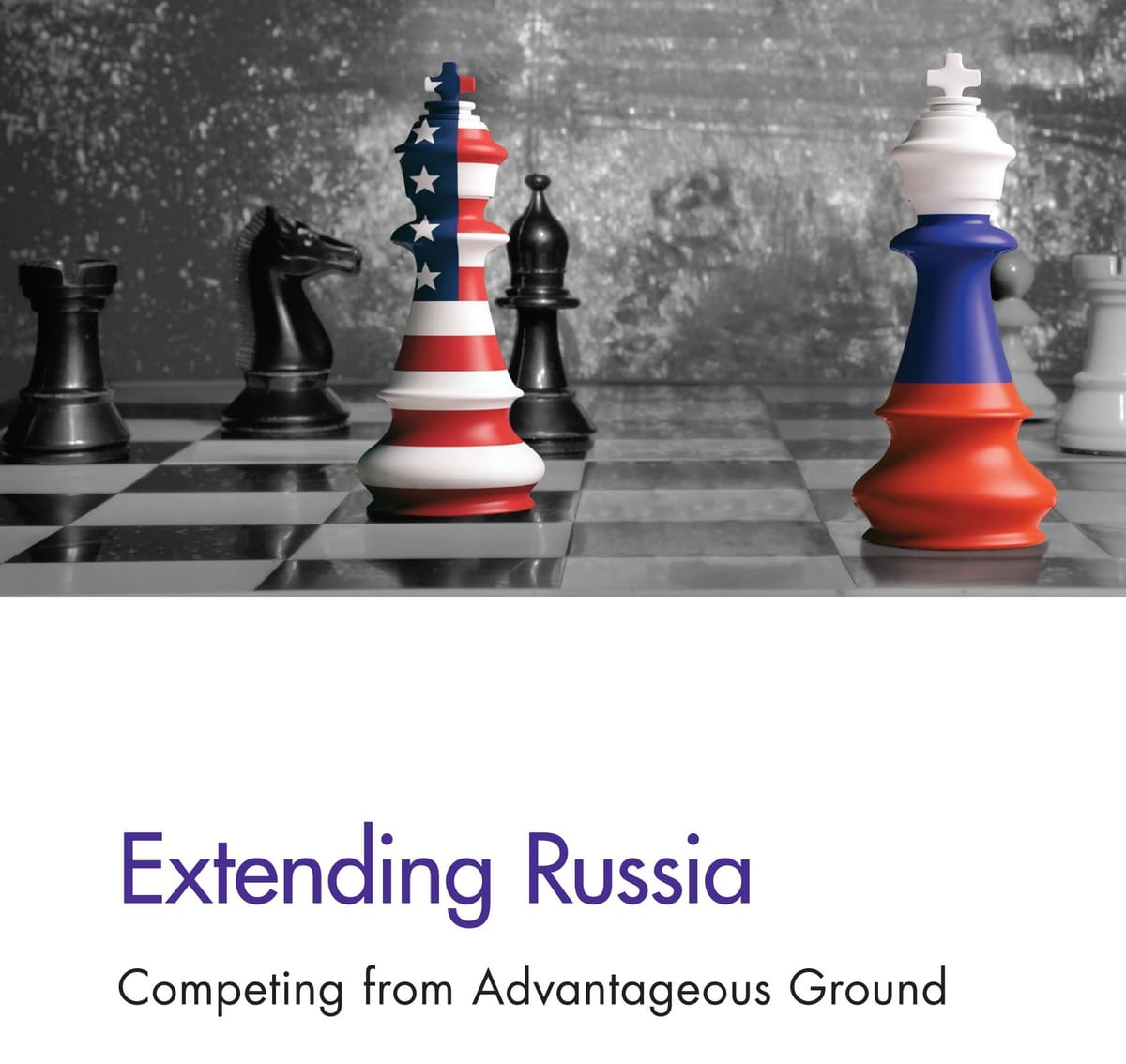
RAND Corporation’s 2019 report, Extending Russia: Competing from Advantageous Ground, is one of these documents. On its surface, it appears restrained—academic even. It does not call for the invasion of Russian territory or the violent overthrow of its government. It merely examines how the United States and its allies might “raise costs” on the Russian state until its internal resilience erodes and its global reach recedes. RAND suggests this can be achieved through calibrated pressure: military, economic, diplomatic, informational. A push here, a provocation there. The goal is to force Russia into strategic overextension and attritional exhaustion—without triggering open war.
But behind the neutral language lies a doctrinal claim. RAND assumes not only that this strategy is desirable, but that it is legitimate—that it is the role of the U.S. security establishment to manage the structural limits of other sovereign states. Nowhere does the report reflect on whether such acts of pressure would constitute aggression by any standard other than the West’s own. Nor does it consider the legality or morality of actions designed to destabilise an adversary’s economy, fragment its alliances, or inflame unrest near its borders. That question does not arise. It does not need to. In the worldview the report quietly extends, some nations possess strategy—others are merely problems to be managed.
Beneath its analytic veneer, Extending Russia is a blueprint for calibrated destabilisation. Commissioned by the U.S. Army's G-8 office, the report lays out a suite of nonmilitary pressure tactics designed to exploit Russian vulnerabilities, provoke costly overreactions, and ultimately degrade the regime’s global standing—without triggering direct confrontation. Framed as a systematic evaluation of nonviolent strategies, the report outlines a series of goals:
- Identify opportunities for the U.S. to stress or “extend” Russia into disadvantageous strategic positions
- Explore cost-imposing strategies that lead Russia to overcommit resources in areas where the U.S. holds structural advantage
- Inform long-term competition planning across multiple domains—military, economic, ideological—without provoking direct armed conflict
- Support U.S. national security goals by weakening Russia’s capacity and will to act as a geopolitical competitor, thereby enhancing American influence and freedom of action.
It presents these recommendations as calibrated, non-escalatory, and aligned with prudent strategic competition. Framed in the language of restraint, they are in substance offensive in design—methods of induced overreach, economic strangulation, and psychological pressure that avoid violating the letter of international norms. Rather than seeking parity or deterrence, RAND advances a logic of provocation: compel Russia to act in domains where it is structurally weak, drawing it into costly commitments that erode its capabilities over time. Success is defined not by peace, diplomacy, or equilibrium—but by adversarial degradation, measured through asymmetric cost imposition.
Escalation, too, is reconceptualised—not as a threshold to avoid, but as a risk envelope to be tested and exploited. The report outlines no moral or legal boundaries—only operational thresholds, gauged by whether the U.S. can bear the consequences more easily than its adversary. Suggested triggers include Russian military responses to proxy arming, retaliation for sanctions, or internal repression following ideological pressure. This is not deterrence management. It is escalation dominance by stealth—engineering confrontation Russia cannot afford, through plausible deniability, reversible tactics, and systemic attrition.
Who Is RAND?
The Extending Russia report was produced by the RAND Corporation, a U.S.-based nonprofit research institution that operates closely with government and military agencies. The study was conducted through RAND’s Arroyo Center, which functions as the U.S. Army’s dedicated research and development arm, funded directly by the Department of the Army.
While RAND presents itself as nonpartisan, its financial and institutional ties to the U.S. Department of Defense reveal a strategic alignment with national security priorities. The Extending Russia report reflects this role, offering analysis and options in service of the broader U.S. objective to weaken Russian influence through pressure short of war. RAND’s work consistently supports military planning, and this document exemplifies its position as an embedded architect of U.S. strategic policy.
Author Affiliations and Potential Influences
All contributing authors were affiliated with RAND’s Arroyo Center, embedding them institutionally within U.S. Army strategic research structures. Their backgrounds and professional trajectories reflect a deep entwinement with American military planning, particularly in relation to adversary-focused competitive strategy.
- James Dobbins: A senior fellow and former U.S. diplomat with extensive involvement in post-conflict nation-building (Afghanistan, Kosovo), Dobbins brings a strategic realist perspective shaped by decades of interventionist policy work.
- Raphael S. Cohen: Former U.S. Army officer and RAND political scientist, Cohen focuses on information warfare and disinformation—areas tightly bound to modern psychological operations and hybrid warfare doctrine.
- Forrest E. Morgan: Specialist in strategic deterrence and military space policy, Morgan has authored key works advocating for pressure-based strategies in emerging warfare domains such as cyber and aerospace.
- Howard J. Shatz: An economist with expertise in sanctions, coercive economic statecraft, and financial systems disruption, Shatz’s inclusion reinforces the report’s emphasis on undermining Russia through economic exhaustion.
Collectively, the authors exemplify RAND’s historical role as incubator of Cold War-era "net assessment" doctrine—specifically the competitive strategies approach pioneered by Andrew Marshall. The influence of this paradigm is explicit throughout the report, which frames systemic attrition not as warfare, but as calibrated “nonviolent” competition.
Implications for Framing
Taken together, the institutional affiliations, professional histories, and sponsoring authority (U.S. Army G-8) point to a document steeped in hegemonic strategic culture. It is not a neutral assessment of geopolitical options but a carefully constructed guide to soft power warfare—one that seeks to induce collapse through overstretch, misdirection, and economic throttling.
By framing these methods as prudent competition, the language of the report masks their function as indirect domination. It reflects elite consensus within Washington’s policy and defense establishment—where adversary destabilisation is not just a tactic, but an acceptable norm.
Ideological Underpinnings
Beneath its technical framing, Extending Russia: Competing from Advantageous Ground rests on a series of ideological assumptions that guide both its diagnosis of Russian behaviour and its prescription for U.S. strategic response. These assumptions are not openly stated, yet they structure the logic of the report and legitimise its recommendations.
The implicit worldview embedded in RAND’s analysis can be broken down as follows:
- U.S. Primacy is assumed to be both natural and necessary, reflecting a fusion of liberal internationalism and hegemonic realism:
The report begins from the presumption that continued American global dominance underwrites international stability. Russian actions are framed as “revisionist” and disruptive precisely because they challenge this presumed order. In contrast, U.S. efforts to provoke overextension or economic collapse in Russia are positioned as stabilising and legitimate acts of stewardship. The idea that undermining a rival through indirect coercion might constitute imperial overreach is excluded from consideration—because within this ideological lens, U.S. supremacy is not one option among many; it is the strategic baseline. - Security competition is treated as a permanent condition of global politics, grounded in Hobbesian realism:
The report assumes that great-power rivalry is not only inevitable, but constitutive of international life. There is no analysis of the historical drivers of U.S.–Russia hostility, no exploration of potential détente, and no strategic imagination beyond managed antagonism. Conflict is the default setting; peace is the interval between contests. Planning thus becomes an exercise in escalation control, not resolution. This worldview renders cooperation naïve, and makes strategic aggression appear both logical and necessary. - Nonviolent destabilisation is presented as a rational and legitimate instrument of policy—rooted in technocratic managerialism:
While the report formally eschews overt warfare, it advocates a portfolio of indirect tactics designed to degrade Russian power: sanctions, proxy conflicts, information warfare, economic attrition, and incentivised brain drain. These are not debated in ethical terms; they are assessed in terms of cost-efficiency, risk exposure, and operational impact. Destabilisation is framed as a management tool, and coercion becomes a question of optics and calibration rather than legitimacy. Power, in this framework, is something to be optimised—not restrained. - Regime change by pressure is implicitly endorsed as a desirable outcome, echoing a neo-Wilsonian belief in liberal democratic expansion:
The report avoids openly calling for Putin’s removal, yet its logic presumes that sustained pressure will either fracture the regime or produce behavioural reform. Authoritarianism is treated as both a source of instability and a moral deficiency—and the prospect of its collapse, however engineered, is quietly welcomed. This reflects a deeply held conviction in elite U.S. policy circles: that global security improves when adversarial regimes are nudged, pressured, or manipulated into liberalising, regardless of legality or consent. - Resource attrition is valorised as the modern form of warfighting—consistent with post-industrial strategic rationalism:
The report advocates inducing adversary exhaustion through structural stress—military overreach, economic depletion, technological catch-up, and internal fragmentation. These are not side effects; they are the goal. Open combat is bypassed in favour of systemic sabotage, where spreadsheets, markets, and morale replace tanks and missiles. Warfare is reframed as fiscal and psychological pressure applied over time, under the radar, with plausible deniability. Victory is not declared—it is extracted.
The Extending Russia report is not ideologically neutral. It is a calculated expression of hegemonic strategic culture—one that merges realist power maintenance with liberal interventionist impulses and a technocratic commitment to cost-effective dominance. Destabilisation is rationalised as necessity. Empire is not named, only normalised. And war, redefined as competitive stress induction, becomes a quietly managed function of policy rather than a declared act of violence.
Considerations of Sovereignty and Rights
In Extending Russia: Competing from Advantageous Ground, the concepts of sovereignty, autonomy, resistance, and human welfare are not treated as moral constraints or foundational principles. Instead, they are instrumentalised—reduced to tactical levers within a larger strategic calculus. The populations involved are not subjects of concern but variables to be managed, leveraged, or ignored, depending on their utility to U.S. objectives.
Of particular note, we can observe the following:
- Russian sovereignty is framed not as a normative boundary, but as a strategic barrier to be bypassed or dismantled:
Nowhere in the report is Russia’s right to national self-determination recognised as legitimate in its own right. Instead, the Russian state is depicted as a target of coercive measures—economic, informational, military—that aim to undermine its independence and force strategic retreat. For example, the proposed support for regime change in Belarus or lethal aid to Ukraine is evaluated solely through the lens of increasing pressure on Moscow, regardless of whether these interventions violate principles of sovereign equality or provoke escalation. Sovereignty, in this framing, is acknowledged only when it aligns with Western aims—otherwise it is cast as a mask for illegitimate resistance to global order. - The autonomy of regional actors is treated as a disposable asset—valuable only when it furthers U.S. pressure campaigns against Russia:
Ukraine, Belarus, Moldova, Central Asian republics, Syrian rebel groups—all are positioned in the report as tools to stretch Russian resources and expose strategic vulnerabilities. Their preferences, internal dynamics, or long-term stability are not seriously engaged. Instead, their agency is reduced to a function of their proximity to Russian influence. For instance, Moldova’s potential expulsion of Russian peacekeepers is not assessed in terms of national interest or regional security, but as an opportunity to humiliate the Kremlin and extract reputational cost. Autonomy here is not a right—it is a pressure mechanism. - Domestic resistance within Russia is instrumentalised as a destabilising force, not a movement worthy of support or protection:
The report advocates the amplification of corruption scandals, electoral fraud narratives, and discontent over economic hardship—not to empower Russian civil society, but to weaken the regime’s legitimacy and cohesion. Opposition is not evaluated in terms of its goals, risks, or democratic aspirations, but purely as a tactical opening. Should internal unrest lead to breakdown or repression, the consequences for the population are unexamined. What matters is strategic impact, not civic integrity. - Human suffering is treated as a cost variable, not a moral concern:
Across multiple theatres—Ukraine, Syria, the Caucasus—the report acknowledges that U.S. actions may exacerbate conflict or civilian hardship. However, these costs are weighed only in terms of potential blowback or loss of allied support. Civilian suffering is not presented as a reason for restraint; it is simply another input in the cost-benefit analysis. In Syria, for example, the prolongation of civil war is considered tolerable if it imposes costs on Russian and Iranian forces. The impact on Syrian lives is noted, then dismissed. - Welfare pressure is deliberately harnessed as a tool of internal regime strain—akin to siege warfare through economic attrition:
The report highlights declining Russian living standards, brain drain, inflation, and budget cuts as indicators of vulnerability to be exploited. Rather than viewing these conditions as crises to be mitigated, they are seen as levers to increase political and strategic stress. This logic reflects an updated version of siege ethics—deprive the population to weaken the leadership, with no distinction between hardship as by-product and hardship as method. - There is no ethical framework or legal constraint acknowledged in the shaping of recommended strategies:
At no point does the report suggest that certain tactics—such as sanctions designed to induce civilian suffering, support for insurgencies, or information warfare—might be unacceptable under international law or human rights norms. The only limits considered are those of escalation risk, reputational damage, or operational failure. Even the final cautionary note—“Extending Russia for its own sake is... not a sufficient basis…”—reverts to grand strategy, not ethics.
In RAND’s Extending Russia, sovereignty is conditional, autonomy is expendable, resistance is instrumental, and welfare is weaponised. Populations are not protected—they are positioned. Their suffering is not restrained—it is calculated. What emerges is a technocratic doctrine of coercion without ethical guardrails, where indirect warfare is normalised and human dignity is subordinated to imperial cost-benefit logic.
Identifying the Fault Lines
In Extending Russia: Competing from Advantageous Ground, RAND outlines a suite of “nonviolent” options for weakening Russia across economic, geopolitical, ideological, and military domains. Each measure is presented under the guise of competition or deterrence, yet the underlying strategy is clear: induce overreach, exploit vulnerabilities, and degrade Russia’s strategic posture without triggering overt conflict. What follows is a domain-by-domain breakdown exposing the gap between stated rationales and actual intent.
- Economic Pressure Points:
Expanding U.S. energy production is framed as a move to stabilise global supply, but the real goal is to undercut Russia’s hydrocarbon revenue and reduce its capacity to fund military operations or social programs. Tightening sanctions is presented as a means of punishing aggression, yet its true purpose is to provoke economic hardship severe enough to delegitimise the Russian state and erode internal stability. Disrupting Russian gas exports to Europe is positioned as energy diversification, but it functions to collapse a key revenue stream and fracture Russia’s geopolitical leverage across the EU. Accelerating brain drain is portrayed as a win for Western innovation, though the strategic aim is to hollow out Russia’s long-term developmental capacity by stripping away human capital. - Geopolitical Friction Zones:
Arming Ukraine is justified as support for sovereignty, yet it is clearly designed to bleed Russian forces in a prolonged proxy war that compels ongoing military and political expenditure. Backing Syrian rebel factions is cast as countering Assad, but the deeper intent is to entangle Russia in an indefinite, costly theatre of conflict that weakens its regional standing. Promoting regime change in Belarus is sold as democratisation, though in practice it aims to rupture Russia’s near-abroad security buffer and trigger a potentially draining intervention. Stoking tensions in the Caucasus, Moldova, and Central Asia is nominally about regional stability, yet these moves function to force Russia into overcommitment across multiple unstable peripheries. - Ideological and Informational Subversion:
Media campaigns targeting corruption and repression are described as pro-democracy initiatives, though their core function is to destabilise the regime by amplifying dissent and fracturing internal cohesion. Highlighting Russian fears of Western subversion is framed as counter-disinformation, yet it serves to provoke elite paranoia and overreaction, fostering internal clampdowns and resource diversion. Demonstrating cyber and information warfare capabilities is positioned as deterrence, but the intention is to escalate perceived threats and compel Russia into asymmetric spending it cannot afford. - Military Posture and Escalation Pressure:
Investing in long-range strike systems and electronic warfare is justified by the need to maintain a technological edge, though it is designed to force Russia into defensive spending that strains its already limited military budget. Increasing NATO deployments in Eastern Europe is framed as reassurance to allies, but it aims to pressure Russia’s western flank and compel a disproportionate force posture in response. Withdrawing from the INF Treaty and reintroducing intermediate missiles is presented as a response to China, but the effect is to destabilise arms control frameworks and provoke a new arms race Russia cannot win. - Maritime and Space Provocations:
Expanding U.S. naval operations near Russian waters is explained as defending freedom of navigation, though it is calculated to trigger expensive upgrades in Russia’s naval defences and submarine fleets. Conducting operations in orbital and satellite space is couched in terms of resilience and innovation, yet its deeper purpose is to force Russia into a spiralling investment cycle in space and hypersonic technologies.
Across every domain, RAND’s proposed strategies mask their aggressive intent behind a technocratic vocabulary of stability, deterrence, and strategic competition. In practice, these measures function as indirect tools of attrition—designed to provoke, exhaust, and destabilise. This is not deterrence in the classical sense; it is pressure warfare without the declaration—a campaign to engineer systemic strain under the plausible cover of policy.
What Happened Following the Report
Since the 2019 publication of Extending Russia: Competing from Advantageous Ground, a striking number of real-world developments have mirrored the strategies outlined in the report. While correlation does not confirm causation, the pattern suggests the document served not only as analysis, but as a working blueprint—shaping, validating, or aligning with subsequent U.S. and allied foreign policy. A domain-by-domain mapping of RAND’s recommendations to post-2019 events includes the following:
1. Geopolitical Entanglement: The Ukraine War:
Aim: “Provide lethal aid to Ukraine… bleed Russia in the Donbass… provoke overcommitment”
- Post-2019, U.S. and NATO weapons deliveries to Ukraine steadily escalated
- After Russia’s 2022 invasion, U.S. support expanded to full-spectrum military and intelligence aid
- War became a resource-draining quagmire for Russia—matching RAND’s scenario of engineered overextension.
2. Economic Warfare: Energy and Sanctions:
Aim: “Expand U.S. oil production… reduce European dependence on Russian gas… impose multilateral sanctions.”
- U.S. became top LNG supplier to Europe following Nord Stream sabotage
- EU imposed coordinated sanctions targeting Russian energy, finance, and trade
- Russia faced recession, tech isolation, and reduced leverage over European energy policy.
3. Ideological and Informational Destabilisation:
Aim: “Undermine regime legitimacy… exploit anti-corruption narratives… support domestic dissent.”
- Navalny’s 2020–21 campaign received intense Western media coverage and diplomatic amplification
- Following his 2024 death, his widow Yulia Navalnaya was promoted internationally as symbolic successor
- Mirrored the Guaidó model in Venezuela—external legitimisation of opposition figure with minimal internal base
- In Belarus, Svetlana Tikhanovskaya, wife of jailed activist, was elevated as exiled “shadow president” post-2020
- Strategy aligns with RAND’s call to exploit internal discontent via charismatic Western-aligned figures.
4. Proxy Pressure in Russia’s Periphery:
Aim: “Exploit tensions in the Caucasus, Moldova, and Belarus… force Russian regional commitments.”
- Azerbaijan (2020): Launched war on Armenia (Russian ally), shifting balance in Nagorno-Karabakh.
- Belarus (2020–21): Post-election unrest backed rhetorically and covertly by Western powers.
- Moldova (2020–22 and 2025): Maia Sandu elected president, then consolidated pro-EU parliamentary control. Accelerated EU and NATO integration, expelled Russian presence from Transnistria. Granted EU candidate status, severing ties with Russian sphere.
- Central Asia (2023–24): Russian troop withdrawals signalled loss of influence in former satellite regions like Armenia.
5. Strategic Posture and Technology Development:
Aim: “Deploy long-range missiles… increase NATO proximity… exit INF Treaty.”
- U.S. formally withdrew from the INF Treaty in 2019
- NATO expanded troop rotations and infrastructure in Poland, Romania, and the Baltics
- Finland and Sweden applied to join NATO in 2022—doubling NATO’s land border with Russia.
6. Economic and Intellectual Drain:
Aim: “Encourage skilled emigration… facilitate Western visas for defectors.”
- 2022–23: Over 1 million Russians—many IT workers, engineers, academics—emigrated during the Ukraine war. Western governments streamlined pathways for Russian professionals and dissenters. As a result Russia suffered long-term human capital attrition consistent with RAND’s economic warfare goals.
Since its release, Extending Russia has functioned less as abstract analysis and more as a tactical schema for undermining a geopolitical rival through indirect confrontation. Its predictions now read as milestones. Its methods have materialised across theatres. Whether as an expression of prevailing doctrine or as a guiding hand in its own right, the RAND report marked the threshold where Cold War containment was reactivated—recast not through open conflict, but through systemic attrition by proxy, pressure, and design.
Yet as Parts 2 and 3 will show, these early expressions of strategic success failed to deliver the anticipated results—and in the process, began to expose the system applying the pressure to stresses of its own making.
Toward the Fallout: When Doctrine Meets Reality
What RAND set out in Extending Russia was not a passive risk analysis. It was an actionable script for pressure, provocation, and controlled destabilisation—designed to extend the adversary, strain its systems, and trigger a managed collapse from the periphery inward. As this first part has shown, the strategy was not only formulated but activated: politically, militarily, and epistemically. The encirclement was constructed, the narrative disciplined, and the adversary framed.
Yet this playbook, for all its institutional fluency, failed to anticipate the consequences it would unleash. Russia, rather than fracturing under pressure, recalibrated and consolidated. NATO, envisioned as the cohesive executor of the strategy, revealed fractures of capacity and political will. Sanctions intended to isolate Russia instead disrupted Western economies, particularly in Europe, where energy dependency exposed strategic naivety. The information controls—designed to ensure narrative discipline—produced unintended backlash, fuelling distrust and driving audiences to alternative platforms. In the end, it was not the adversary that collapsed, but the illusion of control held by those who authored the script.
Part Two of this three part series turns to the consequences of that miscalculation. It will examine how RAND’s model faltered in execution, how information warfare shifted from asset to liability, and how the pressure doctrine—applied without reflection—has begun to fracture the very architecture of Western legitimacy it was meant to defend.
Published via Journeys by the Styx.
Geopolitika: Tracing the architecture of power before it becomes the spectacle of history.
—
Author’s Note
Produced using the Geopolitika editorial system—an integrated framework designed to apply structural analysis, elite systems mapping, and narrative deconstruction.