Geopolitika: Flashpoint Cartography – Theatres Being Scripted
Mapping the engineered ignition points of perception warfare across a myth-encoded geopolitical grid.
Introduction: Cartography as Orchestration
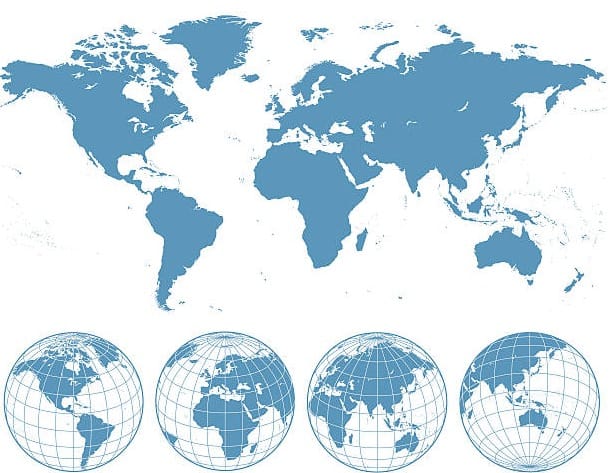
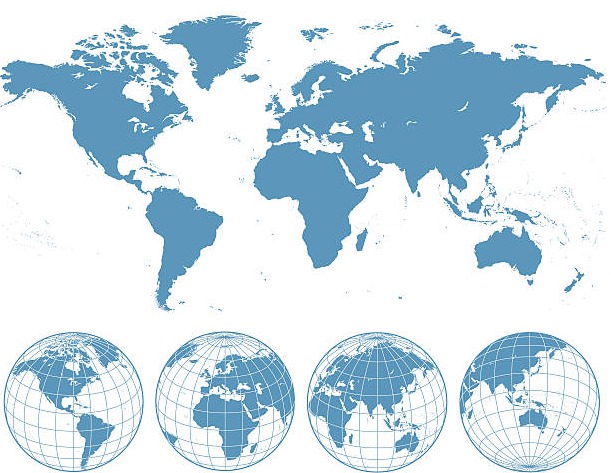
Most maps claim to describe—but this one scripts. What is usually portrayed as geography in motion is better understood as ritual in structure. Every hotspot, from Gaza to Transnistria, mirrors not a spontaneous rupture but a preloaded function: to reorganise power, to test loyalty, to prepare terrain.
This cartography begins with a refusal: it does not accept coincidence, chaos, or reactive policymaking as foundational. Instead, it treats each conflict zone as an engineered pressure valve or symbolic theatre—a place where timing, optics, and escalation are all stage-managed by invisible hands.
Consider how Israel and Ukraine have become visual twins in global media: resilience, democracy, existential defence. These are not spontaneous resemblances—they are manufactured convergence points, part of a shared mythos that lubricates elite continuity and imperial extension. Israel, framed as defender, also functions as exporter—its posture rehearsed, its methods transferable. Ukraine, cast as resistor, is simultaneously absorbed—drawn into a digital and ideological scaffold designed elsewhere.
Geopolitical cartography, in this mode, is a diagnostic lens—not of borders, but of scripts: Who writes the threat? Who times the crisis? Why do certain images repeat across continents?
These are not questions of analysis. They are questions of authorship. Thus, this map does not ask where war might happen. It asks:
- What function is this war already performing, and for whom?
- Where does the spotlight fall, and what is kept off-stage?
- Who benefits from the applause?
Supranational Architectures of Scripting
Power no longer acts in isolation—it scripts outcomes through layered pre-positioning. Behind each surface crisis lies a synchronised infrastructure—not of states, but of interests: dynastic, institutional, transnational. These actors do not compete in open arenas; they co-produce calibrated theatres—each with timed escalation, recycled symbols, and opposition engineered to frame legitimacy, then project coherence through managed optics.
Elite coordination layer:
At the apex sits the financial-dynastic core—legacy capital operating above jurisdiction. Networks of dynastic finance—Rothschild-tier complexes, BIS-linked central nodes, intergenerational trusts—do not merely fund; they author. Their function is not transactional but scriptive: embedding continuity through think tank endowments, policy incubation hubs, and asset-managed soft capture of national decision architectures—via debt positioning, narrative seeding, and ideological framing under philanthropic cover.
Narrative is structured via Anglo-Zionist brokers operating across institutional, media, and legislative fronts. In the UK, bipartisan alignment is formalised through vehicles like Labour Friends of Israel and Conservative Friends of Israel—securing long-horizon allegiance to supranational vectors through party-internal script enforcement. In the U.S., AIPAC and its ideological satellites interface seamlessly with both Democratic and Republican cores—ensuring that the spectacle of opposition sustains the same strategic alignment. They do not merely shape policy; they pre-condition dissent optics, scripting acceptable limits and rehearsed antagonisms to preserve continuity beneath the illusion of choice.
Institutions such as Chatham House, CFR, WEF, and OSF function as ritual convergence sites—their outputs not speculative, but scripts-in-circulation, priming the next phase of social conditioning or geopolitical justification. These bodies do not transmit information—they delineate narrative territory: what can be said, who may speak, and under what moral costume.
Information optics are harmonised through institutional media synchronisers—nodes where narrative, capital, and perception coalesce. Entities like Reuters, AP, NYT, and BBC are not observers of global events; they are narrative consolidators for elite payload delivery. Their alignment is not coincidental—it stems from consolidated ownership structures (BlackRock, Vanguard, and interlocked dynastic vehicles) and strategic integration with state-intelligence liaisons. Outputs are laced with anticipatory framing, symbolic recursion, and behavioural priming—scripts, not stories. This synchrony enforces perceptual simultaneity: Gaza, Ukraine, Taiwan, and the climate complex are rendered interchangeable triggers, all cycling toward the same endpoint—compliance through myth-coordinated behavioural consensus.
U.S. as military-financial executor:
The United States appears to command—but it enforces. It serves as the executor class: a convergence of military-industrial continuity and embedded financial operations. It delivers kinetic enforcement and symbolic theatre (NATO), debt-leveraged compliance mechanisms (IMF), platformised digital control (Silicon Valley), and covert enforcement via integrated intelligence architecture (CIA, Five Eyes, JSOC—Joint Special Operations Command, the black-tier execution arm for deniable kinetic operations).
Washington does not act from sovereignty—it follows scripting adherence. Its wars are not reactive but ritualised—designed to maintain structural dominance: preserving petro-dollar flow, fragmenting sovereign cohesion, and perpetuating crisis cycles. Every base installation, drone strike, or sanctions regime is part of a behavioural script calibrated to refresh consent and enforce structural obedience.
Supranational scripting drives American execution, which engineers global perception. These layers form a closed-loop system—where conflict is staged, perception is managed, and moral vocabulary is weaponised.
But execution is not authorship. The stage is set by think tanks, NGOs, and dynastic coordination layers—while states, militaries, and platforms act as delivery vectors. Strategic clarity demands fracture: the actors must be separated from the architects.
Zionist-Supranational Cartographic Vector
The historical arc of Zionism is extensively chronicled elsewhere. This section does not re-narrate its origins—it decodes its current operational architecture. Zionism now functions as a strategic vector within a supranational control grid, projecting influence far beyond Israel’s borders. What appears as statecraft or defence is more accurately a coordinated program of territorial encirclement, symbolic dominance, and elite convergence, embedded in broader imperial choreography.
Greater Israel as operating system:
Greater Israel is not merely an irredentist ambition—it is a cartographic operating system disguised as national defence. It functions as a transregional subjugation matrix, activated through military doctrine, cybernetic control systems, surveillance commodification, and demographic pressure campaigns. Israel exports not just drones and border fences—it exports the logic of eternal emergency, securitised ethno-policy, and sanctioned impunity.
This operating system is embedded into intelligence sharing agreements, battlefield AI platforms, and the exportation of population management tools. From biometric border regimes in India to crowd-control AI in U.S. police departments, the Israeli security model is modular—designed for integration into compliant vassal regimes.
But while this framework reflects a coherent elite trajectory, divergence exists. Turkish-Israeli tension over Palestine, Saudi hedging via BRICS overtures, and sporadic U.S.-Israeli policy clashes (e.g., Iran negotiations, weapons sales delays) reveal fault lines. Elite agendas are convergent, not monolithic—tactical deviations, nationalist inflections, and rival dynastic timelines persist within the script.
Regional vassalage & encirclement:
The Greater Israel system necessitates the ritual degradation or soft annexation of surrounding states. Egypt is held in debt choke via IMF capture and food dependency. Turkey is destabilised through economic warfare, Kurdish separatist scripting, and Eurasian containment logic. Iraq remains partitioned psychologically and physically, with autonomous Kurdish zones functioning as Israeli-embedded platforms.
Syria, Lebanon, and Jordan represent secondary enclosure fields. Their sovereignty is eroded through proxy insurgencies, refugee demographic weaponisation, and manufactured legitimacy collapse. Each one is pressed not just militarily, but narratively—reframed as unstable, failing, or morally defunct.
In spite of this resistance structures exist beyond elite scripting: Hezbollah's asymmetric durability, the Houthis’ defiance of Gulf-Israeli encirclement, and Iraqi Shia militias’ persistence signal semi-sovereign nodes. These actors disrupt clean choreography and introduce wildcard vectors that elite cartographers must constantly reabsorb or neutralise.
Strategic origination layer:
The foundational blueprint for Israel’s strategic function was not religious—it was imperial. The Balfour letter was not a moral gesture but an operational license issued by British intelligence and dynastic finance to construct a narrative-sealed outpost within the imperial control lattice.
While this section does not revisit the ideological arc of Zionism, a brief forensic tracing of its elite deployment infrastructure is necessary to clarify present function. The concern here is not theological or ethno-national, but operational: how Israel emerged as a narrative-sealed executor node within an Anglo-imperial continuity script.
Today, support is operationalised through Pentagon-Israeli military fusion, dual-national intelligence layering, and lobbying command vectors like AIPAC and ADL. Israel functions not as a sovereign outlier but as a narrative-insulated base for supranational continuity.
However, even within the imperial centre, frictions surface. U.S. military-industrial factions have clashed with Israeli objectives—such as over F-35 tech transfer and Intel cooperation ceilings. The image of a singular elite vector must be tensioned with a more accurate rendering: overlapping but competing power blocs, each operating with distinct cadences of scripting, ritual logic, and strategic timing.
Ukraine-Israel Convergence Theatre
Ukraine and Israel are not just strategic allies—they are mirrored theatres in a narrative system. Each functions as a symbolic amplifier for elite legitimacy, battlefield myth-making, and Western moral renewal. This section maps how Ukraine serves as a proxy for Israeli defence narratives, while Israel exports its military-cyber apparatus into Ukraine’s technocratic infrastructure. Their convergence is not cultural—it is scripted alignment for ritualised war and consent engineering.
Battlefield as narrative amplifier:
Ukraine and Israel serve as mythic crucibles in the theatre of Western self-legitimation. Ukraine's war is stylised as the frontline of democracy against autocracy; Israel’s operations are framed as existential defences against terrorism. The optics are templated, the language mirrored—“resilience”, “right to defend”, “civilised vs barbaric.” These are not coincidental parallels; they are engineered harmonics in a shared elite script, where war becomes the medium through which legitimacy is ritualised and policy consensus is weaponised.
The battlefield is no longer local—it is global theatre. A ritualised arena where Western publics are reconditioned into moral alignment with imperial violence. Every drone strike, every media burst, every blue-and-yellow emoji forms part of a semantic payload—coordinated optics designed to reinforce allegiance. The Ukrainian flag, like the surgical mask before it, operates as a programmable sigil: recycled across crisis campaigns to symbolise compliance. NATO arms and Israeli doctrine now move in tandem; Zelensky and Netanyahu operate from adjacent scripts. These are not parallel events—they are co-authored performances within a unified narrative circuit.
Yet within this synchrony, friction emerges—driven by asymmetries in agency and doctrinal autonomy. Ukraine functions under external authorship, executing within the confines of NATO-imposed scripting. Israel, by contrast, retains autonomous narrative privileges: it adjusts tempo, controls escalation thresholds, and resists full subordination. The U.S. may delay weapons to Tel Aviv, but it cannot rewrite Israel’s foundational role within the system.
These structural differences do not signal rupture—but they do introduce instability. When performers diverge from timing or optic discipline, the coherence of the shared mythos weakens. Future alignment will require recalibration—or narrative replacement.
Shared technocratic infrastructure:
The convergence extends beyond battlefield optics to civil infrastructure. Ukraine’s Diia app—marketed as digital resilience—is a prototype for biometric control regimes. Its DNA echoes Unit 8200 architectures exported via Israel’s cyber-industrial complex. Together, they model a future of militarised digital governance, where ID, mobility, and narrative loyalty are algorithmically scored.
This convergence is modular: battlefield-tested, PR-shielded, and export-ready. Western observers are being conditioned to accept militarised governance as innovation. Behind the scenes, Israeli and Ukrainian tech elites cross-pollinate databases, surveillance doctrine, and psychological warfare tools. Ukraine becomes Israel’s soft template lab, under NATO cover.
But Ukrainian infrastructure remains externally funded and fragile. Israel's model, while exported, faces rising countermeasures—global BDS actions, South African genocide charges, and grassroots tech bans. Convergence may be disrupted not only by elite conflict, but by emergent digital insurgency and reputational collapse.
Synthetic Flashpoints by Vector
Flashpoints are not accidental—they are activated. Each theatre serves more than territorial aims: it delivers symbolic messaging, narrative conditioning, and strategic disruption. These are not spontaneous conflicts—they are calibration tools. A breakdown of key scripted vectors follows:
Levant & Red Sea corridor:
The Levant functions as a trauma oscillator: Gaza, Syria, and Lebanon are deployed cyclically to refresh Western moral support for Israeli supremacy. This theatre also masks regional infrastructure seizures—such as Negev resource claims and maritime gas reallocation.
Yemen and Sudan are ritualised as collapse laboratories. The Red Sea corridor becomes a geopolitical artery—controlled by who owns the narrative of piracy, instability, and humanitarian disaster. Israeli-UAE encroachment along these littorals is not tactical—it is strategic ritual.
The Levant remains incompletely pacified. Hezbollah and the Houthis function as asymmetric sovereigns—resistant to full narrative absorption. These flashpoints are semi-synthetic: managed, but not fully contained.
Eurasian bifurcation axis:
Armenia-Azerbaijan is not a frozen conflict—it is a kinetic simulation chamber. Israeli drone integration, Turkish escalation optics, and NATO-aligned energy corridors converge here. Armenia, in particular, operates as a dual-function node: a pivot for EU/NATO adjacency and a pressure flank in the wider Iran containment script. The South Caucasus serves as a tension rehearsal stage—where military choreography, alliance signalling, and civilisational alignment are stress-tested for broader Eurasian recalibration.
Moldova/Transnistria functions as a psychological staging zone for EU-NATO legitimacy projection. The goal is not total war, but narrative enforcement—preserving ideological cohesion on Europe’s eastern perimeter while provoking calibrated Russian overreach.
Yet Russia’s improvisational counters complicate the scripting cadence. Energy diplomacy, Wagner-adjacent leverage, and BRICS narrative framing disrupt the bifurcation map—forcing periodic rewrites and creating latency within the imperial signal chain.
Indo-Pacific tension grid:
Taiwan is not just a chokepoint—it is a strategic theatre for the contest over digital sovereignty. Its function goes beyond geography: it anchors the semiconductor and AI supply chains that underpin automated warfighting and economic control systems. The island’s symbolic charge exceeds its scale; it has been framed as a pivot between technological epochs. The West casts itself as the protector of innovation, while China is positioned as the revisionist challenger. But this is not a democracy-versus-authoritarianism struggle—it is a battle over who programs the future. Taiwan represents the visual front for digital hegemony: a platform built for escalation, not resolution.
South Korea operates as a dual-function stabiliser and backdoor trigger. Ostensibly a U.S. ally, it is saturated with forward-deployed assets and technological dependency. Yet beneath the surface lies its precarious positioning: entangled in semiconductor geopolitics, North Korea trigger diplomacy, and China-containment optics. It is held stable not because it is safe—but because it is valuable. Its collapse would trigger too much at once. Its survival is tactical.
Pakistan is not collapsing—it is being disassembled. Its financial system is overexposed by design; its insurgencies are scripted with plausible deniability. BRI sabotage runs through Baluchistan and Sindh, while IMF levers block Eurasian convergence. The arrest and disqualification of Imran Khan—a figure who symbolised geopolitical hedging and multipolar flirtation—was not domestic lawfare but alignment enforcement. His removal stabilises Pakistan’s narrative within a U.S.-centric frame. The state is portrayed as unstable precisely to preclude multipolar loyalty. But the real contest is not security—it is infrastructure allegiance: pipelines, port zones, digital corridors, and the sovereignty of energy routes.
India, meanwhile, is being ritually positioned as both counterweight and combustor. The ongoing Kashmir war theatre—largely ignored by the West—is not a spontaneous flare but a contained ignition zone. It keeps India preoccupied, maintains Pakistan’s “threat” frame, and justifies Indo-Israeli military convergence. But India’s role is structurally ambiguous. While framed as a bulwark against China, it remains a quiet conduit for Russian energy flows—bypassing Western sanctions and enabling price stability across NATO economies. Its purchase of Russian weapons, oil, and fertiliser positions it as a sanction laundering interface, tolerated so long as its posture remains hostile to regional integration. Kashmir, then, is not about borders. It is about locking India’s strategic posture into a Western-aligned arc—militarised enough to block convergence with Iran, Russia, or China, but cooperative enough to keep Western supply lines intact. It is an optical freeze-frame—where escalation remains just enough to ensure India stays regionally isolated, structurally useful, and ideologically constrained.
These theatres are not chaotic—they are harmonised pressure chambers, each tuned to a specific frequency of escalation and restraint. Together, they form a grid—symbolic, infrastructural, psychological—whose purpose is not to resolve conflict, but to script polarity.
Psy-warfare mechanics:
- Ritual Loop: Symbolic sacrifice → viral amplification → audience reconditioning
- Digital Anointing: Media synchrony + influencer cascade = consent laundering
- Trauma Yield: Psychological bandwidth saturation used to mute structural dissent.
In spite of all this, China’s Belt-and-Road adaptability, along with regional defence repositioning, injects narrative friction. The Indo-Pacific grid is active, but not fully modularised. Flashpoints here are more volatile and may backfire into unscripted escalation.
While most flashpoints are synchronised, certain zones exhibit partial scripting breakdown. These include:
- West Africa (Sahel): Competing French-Russian influences + BRICS insurgency
- Netanyahu’s Israel: Fractured elite alignment—military-industrial vs religious-supremacist logics
- India-Russia oil routing: Tolerated contradiction in Western alignment scripting.
These are not narrative gaps—they are overlaps of competing scripts, where convergence is disrupted but not abandoned.
Arctic Theatre Reframed
The Arctic is less a battleground than a symbolic vault. Unlike zones of kinetic saturation, it is held in narrative reserve. Its primary function is atmospheric—used to frame global consensus under the veil of environmental urgency and polar competition.
Western strategists cite Russian militarisation and Chinese icebreaker diplomacy, but the deeper utility lies in climate-militarisation fusion: where ecological threat, indigenous displacement, and critical mineral access converge under managed emergency. NATO polar exercises serve more as media optics than operational postures.
The Arctic is a latent-activation theatre—a symbolic reserve awaiting ignition. It becomes relevant when supply chain fractures, energy corridor shifts, or Russian overreach require a new narrative trigger. This is the board’s northern ghost: rarely moved, always implied.
Indigenous sovereignty disputes, Canadian-Nordic tensions, and backlash to climate securitisation may interfere with scripting. Yet as long as other theatres deliver higher narrative yield, the pole remains peripheral. When those scripts falter, the Arctic will be summoned.
To model this theatre properly requires a symbolic reserve function grid—tracking narrative buildup, actor positioning, and ignition thresholds. The Arctic is not inert. It is waiting.
Narrative Synchrony & Symbolic Coordination
Narrative synchrony is not just media alignment—it is the operational infrastructure of empire. It functions as a cross-institutional feedback loop, coordinating perception across militaries, NGOs, media, and tech platforms. This is not coincidence or timing—it is choreography.
High synchrony signals scripting. It reveals the engineered convergence of narratives, optics, and activation points across institutional vectors. It is how flashpoints are converted into stories, and how those stories are weaponised into geopolitical instruments.
Synchrony ensures that separate crises—Gaza, Ukraine, Taiwan—are absorbed as iterations of a singular moral script. The surface changes, but the coordinates remain fixed.
Synchrony index activation layer:
Every major flashpoint is accompanied by a calibrated narrative burst. Zelensky and Netanyahu do not merely align by circumstance—they operate from shared narrative briefs. G7 communiqués, NGO statements, and influencer campaigns pulse in rhythm. This is not spontaneous—it is choreographed alignment.
Synchrony can be tracked through key indicators:
- Simultaneous headlines and op-eds across NYT, Guardian, and DW
- Recycled symbolic framings: “resistance”, “resilience”, “existential threat”
- Temporal proximity between think tank reports and kinetic escalations.
The function is to simulate global consensus. Consent is not organic—it is harmonised.
Yet this repetition generates signal fatigue. As the formula becomes visible, belief erodes. Synchrony that once ensured compliance now risks collapse. When scripting becomes too predictable, enforcement must shift from persuasion to coercion—via censorship, algorithmic suppression, and platform control.
Weaponised mythographies:
Geopolitical flashpoints are not just conflicts—they are myth delivery systems. Each theatre circulates elite-scripted archetypes designed to shape global perception:
- “Democracy vs Despotism”
- “Innocent Victim vs Existential Threat”
- “Tech Freedom vs Authoritarian Control.”
These are not neutral frames—they are strategic optics embedded into military-timed narrative cycles.
Ukraine is positioned as the heroic frontier of Western values. Israel is cast as perpetual victim, anchoring military actions in trauma-coded legitimacy. Taiwan becomes the symbolic last stand for digital sovereignty. Not public relations tactics—repurposed civilisational myths deployed for perception management.
Symbolic payloads are released with precision: hashtags operate as guided optics, media cycles as narrative saturation tools. The physical battlefield matters—but the moral terrain is decisive. Control over narrative framing determines legitimacy.
Yet as symbolic cycles repeat, strain emerges. Mythic coherence degrades. Israel’s victim narrative fractures under civilian targeting. Ukraine’s democratic image erodes under forced mobilisation. Taiwan’s tech frame begins to resemble military escalation. As myths weaken, enforcement shifts from persuasion to coercion.
Different myth types serve different functions:
- Justification myths: Ukraine as the fortress of freedom
- Neutralisation myths: Gaza as necessary defence
- Mobilisation myths: Taiwan as tech frontier
- Numbing myths: Yemen as anti-narrative disruption
The Houthis now disrupt scripted flow—targeting Israel-linked maritime lanes and exposing selective outrage. Yemen becomes a spoiler node—complicating the coherence of the larger narrative system.
Mapping myth function is essential. These narratives are not simply told—they are tasked, engineered for precise perceptual effects.
Cartographic Summary Tables
These are not forecasts or risk assessments. They are diagnostic schematics of theatres under active narrative scripting. Each row reflects a theatre’s current role within the global perception choreography—tracking symbolic function, activation logic, and narrative yield.
Interpretation must remain structural: these are not events unfolding, but scripts already circulating.
Each table isolates a facet of operational logic:
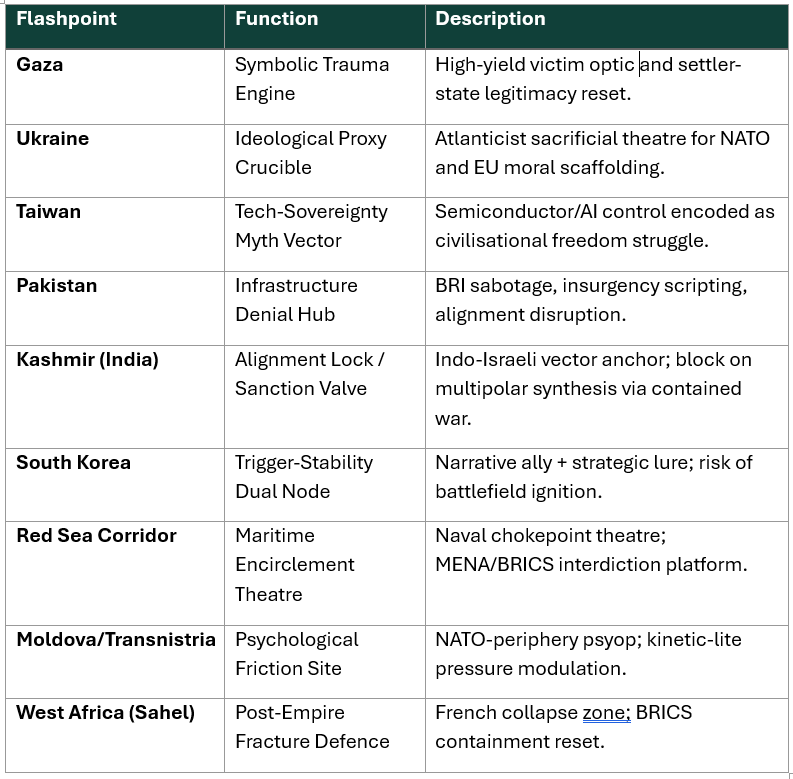
- A. Theatre Functionality – Defines each flashpoint’s mythographic role within the perception management grid.
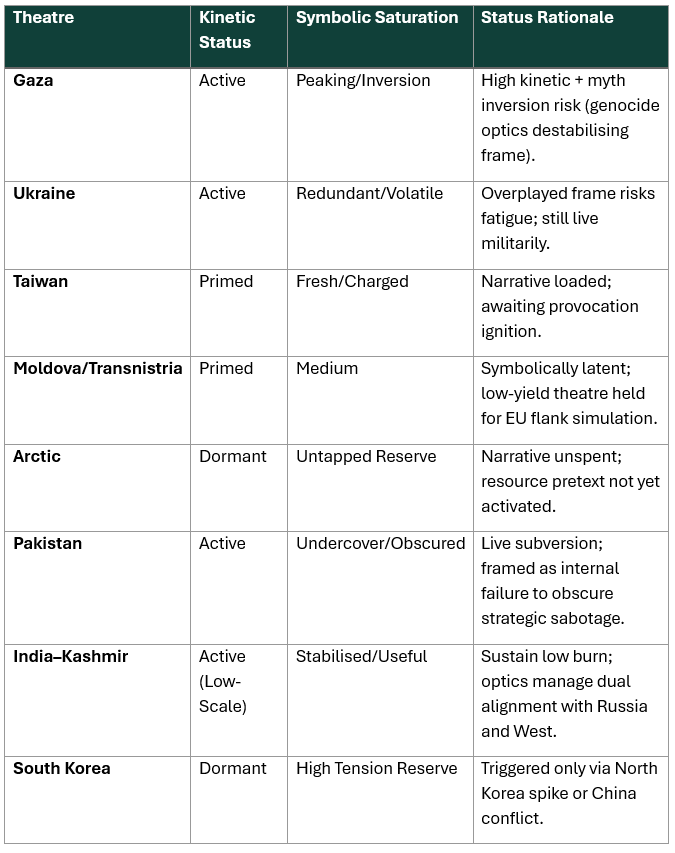
- B. Activation Status – Identifies whether a zone is live, primed, or held in reserve for later ignition.
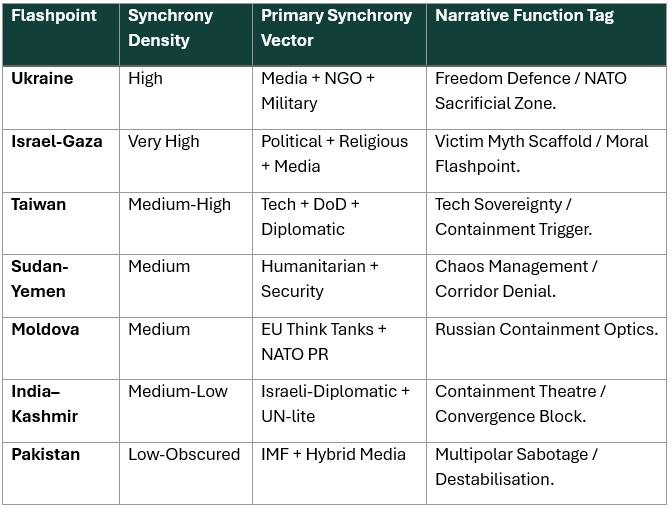
- C. Synchrony Density – Measures institutional alignment across media, NGO, and state narrative vectors.
- D. Infrastructure Enclosure – Maps control of critical assets and the enforcement mechanisms (sabotage, alliance, narrative camouflage).
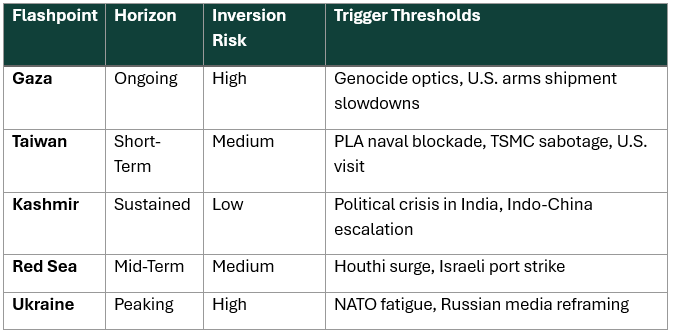
- E. Temporal Risk – Categorises flashpoints by ignition horizon, inversion potential, and symbolic load-bearing strain.
Together, these tables form a multi-vector visibility grid—not of where wars erupt, but of how and when they are authored. Each flashpoint operates inside a converged scripting ecosystem. These schematics expose intensity thresholds, narrative fatigue zones, and anticipatory ignition vectors.
These are not passive observations. They are pre-conflict diagnostics for elite scenario execution.
A. Flashpoints by functional category:
B. Flashpoint status classification:
C. Synchrony density heat map (narrative clustering):
D. Infrastructure enclosure grid:
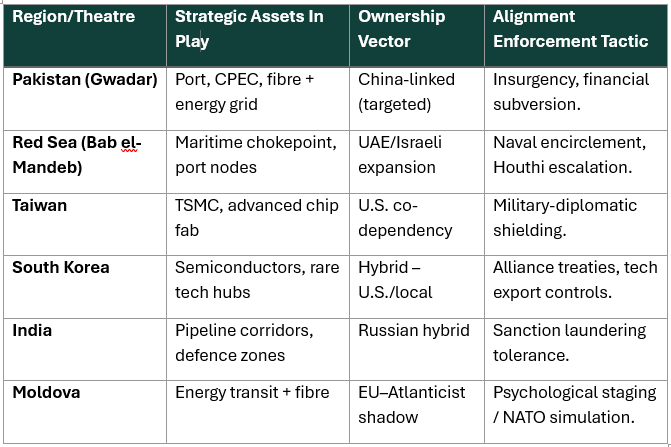
These physical infrastructures are not just strategic assets—they are optic scaffolds:
- Gwadar’s port is tied to Xinjiang framing via terror corridor optics
- Red Sea naval zones underpin global food supply narrative (Ukraine grain corridor, Houthi piracy/terrorism)
- Taiwan’s fabs are both military targets and democracy metaphors.
Each enclosure has a narrative yield—the story it supports when triggered.
E. Temporal risk/activation horizon table:
Conclusion: Maps as Myth Engines
This is not a map of geography—it is a ritual ledger of activation. Each theatre—Gaza, Ukraine, Taiwan, Kashmir, the Red Sea, Transnistria, and beyond—is a staged site within a supranational choreography, engineered not to resolve conflict, but to structure symbolic dominance. These are not battlefields in the classical sense—they are myth-machines, calibrated to generate perception, enforce alignment, and extract legitimacy.
The real war is not territorial—it is ontological. The fight is for control over what is seen, believed, and moralised. The real war is for myth.
In this schema, borders are incidental. Power flows through narrative, perception, and symbol. What is presented as humanitarian is often infrastructural conquest. What is broadcast as defence is engineered expansion. Flashpoints do not signal the breakdown of order; they signal its execution.
The map functions as a psychospatial circuit board. Each region is a node in a feedback loop—triggered, mirrored, echoed:
Trigger → Optic → Legitimacy → Activation → Consent Refresh → Trigger.
Media, NGOs, and digital platforms synchronise their outputs not for accuracy, but for ritual cohesion. What matters is not what happened, but what the masses believe happened—and why.
This cartography reveals not conflict, but authorship. Who decides when a theatre activates? Who scripts the slogans, the tears, the retaliations? Why are some atrocities elevated to global concern while others remain hidden? These questions point not to chaos, but to continuity.
Ritual requires a stage. War is now that stage. And maps like this one do not show where bombs fall—they show where meaning is manufactured.
This concludes Flashpoint Cartography – Theatres Being Scripted. The reader is not asked to observe, but to decode. Not to react, but to recognise orchestration.
The next conflict is not future—it is prewritten.
Published via Journeys by the Styx.
Geopolitika: Tracing the architecture of power before it becomes the spectacle of history.
—
Author’s Note
Produced using the Geopolitika analysis system—an integrated framework designed to apply structural analysis, elite systems mapping, and narrative deconstruction.