Geopolitika: Forecast or Mandate? Decoding RUSI’s “Russia Collapsing / 2026 Hybrid War” Narrative
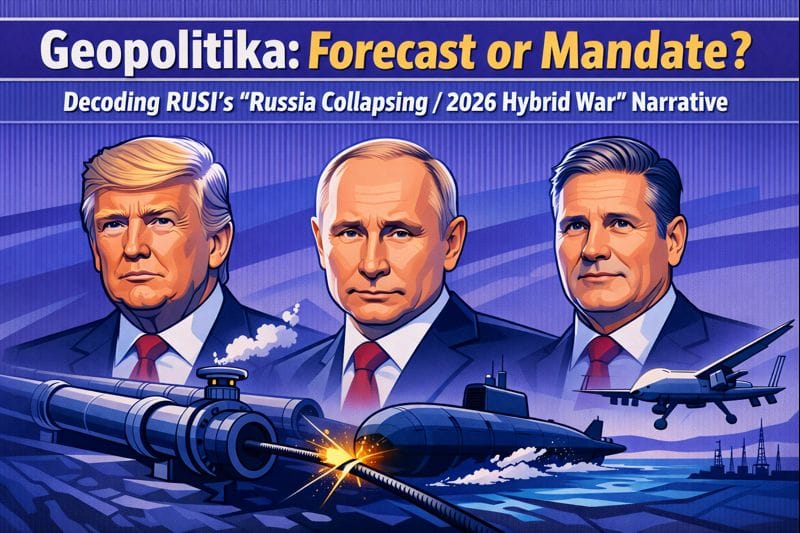
A very specific story about the war in Ukraine now circulates through European ministries, NATO headquarters, think-tank events and big media panels: Russia is Losing—Time for Putin's 2026 Hybrid Escalation.
In that story, Russia is on a structural slide:
- Sanctions are biting
- The economy is distorted by war spending
- The country is bleeding people and machines
- Demographics are bad.
Because of all this, we are told, Russia cannot win in Ukraine outright. But precisely because it is weakened, it will become more dangerous in the “grey zone”: sabotage, disinformation, covert operations and military brinkmanship below NATO’s Article 5 threshold. The year 2026 is presented as the hinge: the moment when a cornered, weakened Russia will escalate hybrid attacks on Europe.
At this point, it’s hard to read any RUSI paper as a free-floating piece of “independent analysis” once you’ve seen how the institute itself is wired. As set out in Geopolitika: RUSI—Choreographing Legitimacy, RUSI was never built as a neutral research shop; it began life as an imperial war college, chartered by Queen Victoria to advance “naval and military science,” and has stayed structurally fused to the British security state ever since. Its patrons and leadership are drawn from the same pool of ex-generals, former MI5/MI6 chiefs and senior officials who moved doctrine in Iraq, Afghanistan and Libya, now recycled as “fellows” and “distinguished visitors.”
The RUSI article examined here is a textbook version of this script: Russia “losing but lashing out,” 2026 as the danger window, and Europe cast as the sober actor that must “harden” itself and double down on support for Ukraine, sanctions and “hybrid deterrence”.
What’s missing is striking:
- There is no serious branch where Europeans and Russians sit down now and design a permanent or cold peace
- There is almost no engagement with rival Western narratives (Russia winning the attrition war; Russia should be broken or “decolonised”)
- There is almost no serious treatment of Europe’s own structural fragility
- Once you actually open the macro data, there is no basis for the strong version of the claim that Russia is “collapsing”.
What follows is a deconstruction of that script, folded together with actual economic data on Russia’s economy, Elvira Nabiullina’s own account of the sanctions shock, ex-CIA analyst Larry Johnson’s “Russia is not collapsing” critique, and Jeffrey Sachs’s “Europe must negotiate with Russia,” counter-position.
How The Script Is Built: Sources, Institutions, Blind Spots
If you trace the hyperlinks in the RUSI piece, you move through a familiar information chain.
On the surface there is diversity: Reuters and BBC for pipeline explosions and GDP numbers, the Guardian or France24 for suspicious factory fires, Al Jazeera or CBC for airspace incidents and drone scares. Atlantic think tanks such as Carnegie, CSIS, Brookings, Atlantic Council, IAI or SIPRI supply the “structural” claims: Russia’s war economy is unsustainable, sanctions are eroding industrial capacity, the state is under fiscal pressure, the army is under-performing. Ukrainian or pro-Ukraine outlets add emotive content on Russian attacks and losses, and the moral logic of backing Kyiv. OSINT projects like Oryx provide lists of visually confirmed equipment losses that are turned into timelines for “exhaustion” by 2026–2027.
Above that sits RUSI itself: which as mentioned above is a 19th-century British defence institute, headquartered in the middle of the UK state system, run largely by ex-military, ex-intelligence and policy professionals, and financed via membership and a stream of project money from Western governments, EU bodies and defence-adjacent firms. The authors of the article fit the mesh: one with a past in UK intelligence/cyber and multilateral cyber work, another a Ukrainian strategist from strongly anti-Kremlin networks. When this machine produces an analysis, its narratives follow predictable formulas. Through this, the core argument about 2025 and 2026 is built on a series of rhetorical operations:
- Counterfactual off-ramp:
“2025 offered the most generous potential off-ramp… He rejected it…”
→ Establishes: peace was available, Putin personally refused. That pins maximal blame and closes off any reading where the West also helped foreclose talks (as in the Dec 2021 treaties proposed by Russia; the early 2022 Istanbul peace agreement). - Mind-reading the Kremlin wager
“The Kremlin’s strategic wager was clear: that an incoming Trump administration would force a peace deal…”
→ Presents a speculative Kremlin calculation as settled fact, and glues Trump / GOP into the villain lane (oh, the irony, given who actually blocked the Istanbul track). - Reversal + resolve ritual
“That strategy has stalled… positions have hardened… proposals did not divide; they solidified…”
→ Whatever happened, Western resolve comes out strengthened. There is no scenario where Western policy is self-questioned. - Scoreboard of Russian failure
“Russia has now failed in four of its five strategic objectives… Only in territorial control does it hold a pyrrhic advantage…”
→ Creates a neat “4/5 failed” scoreboard with “pyrrhic” as moral insurance: even the one “success” doesn’t count. - “Declining power = more dangerous” pivot
“But a declining power is often more dangerous than a rising one…”
→ Classic move: Russia is losing (so strategy was right) and becoming more dangerous (so you can’t slow down). Meanwhile, blanking out Ukraine / NATO hybrid attacks on Russia. - Window of maximum danger + date hook
“Facing an economic spiral and depleted conventional forces… window of maximum danger… 2026 will be the year of hybrid escalation… already ‘flagrantly visible’.”
→ Ties everything to (a) economic collapse talk and (b) a specific year, which conveniently anchors budgets, mandates and media drums.
These narrative moves collectively enforce a core, unstated premise: Russia appears as a rule-breaking aggressor and long-term danger. Western policy since 2022 is assumed to be basically correct and morally justified. Evidence is filtered for anything that supports “Russia weakening, West broadly right”. Peace, if it appears at all, is a vague future outcome after Russia has been weakened or transformed, not a design problem for today.
The data itself is not fabricated; the bias lies in what gets selected, repeated and given authority. Russian stress is examined in forensic—if misleading—detail. European stress is backgrounded as “challenges”. Non-Atlantic and non-Ukrainian lenses—Chinese, Indian, Turkish, Gulf, African, Latin American—barely appear. Peace-oriented actors and scenarios are almost entirely absent.
Within that ecosystem, the 2026 hybrid script feels like common sense. The blind spots are baked into the pipeline.
Who Gains And Who Pays If You Believe This Story
Once the storyboard is accepted—Russia weakening, 2026 hybrid escalation ahead, Europe must harden—the distribution of benefits and costs looks very specific.
On the winning side are the very institutions that fund, populate, and legitimise the Atlantic security ecosystem—a network in which RUSI is both a node and a narrator:
- Defence ministries and NATO structures, which can defend higher and longer-term budgets by arguing that policy is “working” (Russia is weaker) but that the most dangerous phase (hybrid attacks) is still ahead, so it would be irresponsible to stop now. They also get mandates to build out hybrid-defence bureaucracies: infrastructure-protection agencies, cyber commands, resilience offices, joint task forces.
- Defence and cyber industry, which receives a durable market category—“hybrid deterrence”—covering hardened energy and transport networks, monitoring and SOC services, secure communications, drones, sensors, and endless consultancy. This shifts the focus away from cheap mass (where Russia is competitive) into complex, high-margin systems (where Western firms excel).
- Intelligence and security services, which can extend their remit deeper into civilian life: if fires, outages, online campaigns and protests can all be framed as potential “hybrid” operations, then deeper access to data and broader operational powers become easier to justify.
- Ukraine’s state and advocacy networks, which can insist that supporting Ukraine is not charity but European self-defence against a future wave of Russian hybrid attacks. Any move to slow or freeze support can thus be cast as exposing Europe itself to greater danger.
- Think tanks which position themselves as the expert guild on “hybrid threats” and the 2026 danger window, and thus become natural providers of hybrid threat assessments, resilience doctrines, wargames, and readiness reviews.
On the paying side are European societies:
- Financially, through higher taxes and/or more debt to cover increased defence budgets, long-term support to Ukraine, infrastructure hardening and new security bureaucracies.
- Economically, as capital and political focus shift from long-standing issues—productivity, innovation, welfare sustainability—into a largely open-ended confrontation, while energy-intensive sectors struggle with higher costs after the cut-off from cheap Russian gas feedstock.
- Politically, as war fatigue, inflation and migration interact with national politics, fuelling the rise of “nation-first” and protest parties, and making EU-level consensus more fragile.
- Civil-liberties-wise, as new information-control regimes and “anti-disinformation” frameworks are defended as hybrid defence tools but in practice expand the state’s grip over speech and platforms.
Above this, there is the US strategic layer. Washington’s priority is to focus on China and the Indo-Pacific, and maintain primacy in the Americas. The ideal configuration from that vantage point is a Europe that owns the day-to-day burden of the Russia front—money, matériel, political bandwidth—while the US provides nuclear and high-end cover and sells energy, arms and “leadership”. The 2026 script helps: it tells Europeans that stepping up is not one strategic option among many but a condition of survival, while a gradual US drawdown can be sold as responsible “pivoting”, not abdication.
So structurally, the script keeps costs and risks heavily skewed toward Europe, while spreading gains across the Atlantic security ecosystem and Ukraine. It presents this allocation as the only rational and moral one.
The Parts You Don’t See: Europe Under Strain, Russia Not Collapsing, And Everyone Else
The RUSI narrative takes Russian stress as centre stage and leaves the rest of the system half-lit.
On the European side, you have an EU that has lost its pre-war energy model—cheap Russian pipeline gas feeding German-led industry—and replaced it with a more expensive mix of LNG, renewables and forced efficiency. That hits households and heavy industry. Sectors like chemicals and steel openly worry about competitiveness and relocation. “De-industrialisation” isn’t just Russian talking points; it’s a recurring theme in European business debates.
Demographically, Europe is old and ageing; welfare and healthcare burdens are rising even as defence and climate-transition bills grow. Politically, the bloc is fractured: Hungary vetoing and bargaining, Italy and others governed or heavily influenced by parties sceptical of Brussels’ line on Russia and mass migration, far-right and “nation-first” forces surging across multiple states. Normatively, trust in EU institutions and national elites is under pressure, while new information-control regimes justified as hybrid defence look to many citizens like censorship creep.
Externally, Europe is also losing ground in places like the Sahel and parts of West and Central Africa, where French and EU influence shrinks as Russia and China move in. None of this is fatal in itself, but it complicates the story “Russia is weakened, Europe is coherent and resolute.”
On the Russian side, the strong version of the collapse narrative is simply not supported by the data. The FocusEconomics overview shows GDP falling by about 1.4% in 2022, then rebounding by over 4% in both 2023 and 2024, before slowing to roughly 0.6–1.5% in 2025, with some risk of a mild downturn late in the year. Unemployment declines from around 5.8% (2020 average) to 2.5% in 2024, with about 2.3% at the end of 2024—a very tight labour market, not mass joblessness. Public debt remains low by global standards (about 20% of GDP), deficits are modest (on the order of 1–2% of GDP), foreign-exchange reserves hover around $600bn, the current account stays in surplus and external debt as a share of GDP has fallen sharply over the past decade.
Current governor of the Central Bank of Russia, Elvira Nabiullina’s retrospective on the sanctions shock "This Time Is Never Different" tells a similar story from an insider perspective: a violent hit in early 2022—rouble crash, a rush of deposit withdrawals, trading suspensions—followed by rapid stabilisation via capital controls and very high interest rates, and then above-pre-war growth in 2023–24, driven by redirected trade and war-related demand. She is explicit that this is not the growth model the central bank would choose in peacetime; she also stresses that inflation is uncomfortably high and that sanctions constrain technology and productivity. But none of it reads like an economy on the verge of macro collapse.
On the military-industrial side, critics like former CIA analyst Larry Johnson point out that Russia has outpaced Western production in key categories: Russian artillery shell output is widely estimated at around 2–3 million rounds per year by 2024, while the US aims for just over 1 million 155mm shells per year by 2026 and the EU only expects to hit 2 million shells per year sometime around 2025–26. NATO generals themselves have warned that Russia is refurbishing or producing on the order of 1,500 tanks per year and large numbers of armoured vehicles, far above US tank output. Johnson uses these facts to build a counter-story—“Russia is doing just fine, the US and EU are delusional”—but at minimum his criticism shows that the idea of an imminent Russian collapse under sanctions is a morale script, not an economic forecast.
Beyond Europe and Russia, there is the rest of the world. China views Russia as a useful, weakened but intact partner and commodity supplier, not something to be “broken.” India, Türkiye and Gulf states exploit sanctions arbitrage and discounted Russian commodities. Much of the Global South sees the war primarily as a regional conflict with global economic spillovers, not the central moral drama of the age. None of this appears prominently in a narrative that centres “Russia’s weakening” and “Europe’s resolve.”
Other Western Scripts: Weakening Russia, Winning Russia, Breaking Russia—And The Peace Lane
The RUSI story is only one of several Western narratives.
- The Atlantic security lane (where RUSI sits) says: Russia is weakening but dangerous; sanctions and war are eroding its capabilities; 2026 will be the year of hybrid escalation; Europe must double down and build hybrid deterrence; long-term containment or “strategic defeat” of Russia is the goal.
- A realist / attrition lane, where people like John Mearsheimer and many alt-media commentators cluster, says: Russia has more manpower, artillery and industrial capacity, and higher tolerance for casualties; Ukraine is demographically and industrially more fragile; Western support is politically brittle, especially in the US; Russia is actually winning the long war, and the West should recognise this and negotiate from a weaker position rather than pretending victory is around the corner.
- A post-Russia / “decolonise Russia” lane consists of exile forums like the Free Nations of Post-Russia, some Baltic and Polish voices, and US and European events that openly talk about dismantling the Russian Federation into multiple successor states and fully “de-imperialising” its internal nations. These efforts are sometimes paired with campaigns for full confiscation of Russian state reserves and elite wealth to fund Ukraine and permanent deterrence.
- And then there is a peace-first lane, where Jeffrey Sachs is probably the most prominent establishment figure. In his July 2025 essay Rethinking Europe’s Engagement with Russia he argues that Europe’s security, and Ukraine’s, cannot be achieved by trying to isolate and defeat Russia; that NATO expansion and Western policies were central drivers of the conflict; and that the war could have been frozen in 2022 at Istanbul if Washington and London had supported the talks. In his recent Do not underestimate Russia media appearances, including a widely circulated Times of India clip, he warns that Russia and China are serious economic and defence powers, that Western attempts to “write them off” have failed, and that continuing the confrontation is hurting Europe and the Global South more than it is remaking the world in Washington’s image. Sachs’ prescription is explicit: neutral or non-NATO Ukraine, a territorially painful but finite settlement, renewed arms control, and a pan-European security architecture that includes Russia rather than trying to erase it.
The key point is not to pick a favourite among these scripts. It’s to notice that, within Western elites, a peace-oriented, “don’t underestimate Russia, redesign the security order” narrative clearly exists—Sachs is living proof—but it is kept marginal in the Atlantic security microfield where RUSI operates. That is a structural choice, not an accident.
The Forbidden Branch: Drawing A Realistic Peace Corridor
Once you actually try to sketch the peace corridor Sachs is describing, you can see why it is essentially absent from RUSI’s world.
A minimally realistic cold peace would have to grapple with:
- Lines on the map: what happens to Crimea and the other occupied regions; whether there are internationally supervised referendums, de facto borders without recognition, or some long truce arrangement.
- Sanctions: which measures lift under what conditions; which remain as long-term constraints; how to avoid simply rolling back to 2014–2021 limbo and a repeat war.
- Security guarantees: how to give Ukraine credible defence assurances without immediate, full NATO membership; what limits, if any, are acceptable to Russia on NATO force posture and deployments near its borders.
- Arms control and posture: limits on missiles, heavy forces and exercises in contact zones; incident-prevention and crisis-management mechanisms to reduce nuclear risk.
- Third-party roles: some mixture of UN, OSCE and possibly non-Western actors (China, India, Türkiye, others) to lend legitimacy and share enforcement burdens.
Writing these down immediately reveals the political pain:
- Kyiv would not get everything it wants; some losses would have to be accepted in practice.
- Moscow would not get a free hand; it would face permanent constraints and some rolled-back gains.
- Europe and the US would need to lift at least some sanctions and accept that Russia remains a significant actor, not a defeated ex-power.
For a think tank structurally plugged into Western defence and security bureaucracies, that is a very hard line to take publicly. It threatens sponsor coalitions, undercuts simple moral binaries, and risks being labelled appeasement or “pro-Russian”. It also threatens the long-term business model built on permanent deterrence, hybrid defence, and a continuing proxy war.
So the peace branch is not sketched in detail and then rejected; it is simply not drawn in the first place. Sachs draws it from outside that microfield. Larry Johnson, from a different angle, uses the macro data and industrial numbers to batter the “Russia is collapsing” myth and say the West is delusional. The RUSI lane continues to talk as if only one path is serious: stay the course, wait for Russia to weaken further, brace for 2026, harden society.
Drift or Design?
Is this a coherent plot by an “Atlantic elite” to drain Russia and discipline Europe? There is some design: US strategy aims to shift more of the Russia burden onto Europe, Kyiv pushes “no compromise” frames to keep support flowing, Moscow uses hybrid and nuclear threats deliberately and think tanks like RUSI craft narratives that suit their funders and guild.
But the system looks less like a single chess player and more like overlapping habits, sunk costs and partial strategies that don’t quite line up.
- US: Strategy–reality gap and sanctions trap:
Some US planning documents clearly imagine Europe carrying more of the Russia burden while Washington pivots to China and the Indo-Pacific. In practice, that vision runs through a tangle of domestic politics and a highly institutionalised sanctions apparatus in State and Treasury. As previously mapped in The Operators, Part 3: The Financial Governors, over the last two decades, the sanctions “machine”—interagency tasking, secondary-sanctions leverage—has become its own policy engine. Once that machinery is spun up against Russia (and it has to the extent of some 26,655 sanctions and counting as at August 2025), unpicking it is harder than letting it roll, especially in a system where foreign policy and “financial statecraft” are still among the few things that pass as bipartisan. The ideal of a clean strategic pivot competes with congressional bargaining, election cycles and a sanctions bureaucracy whose default answer is always: one more turn of the screw. - EU: Slow course corrections:
On the EU side, decisions on Ukraine and rearmament sit on top of older files—Eurozone scars, climate policy, migration, industrial competitiveness—and they move through very slow legal and budget machinery. Procurement rules, multi-annual financial frameworks and new “Ukraine” or “defence” instruments accumulate around whatever the last consensus slogan was. Inside that, you effectively have two political projects fighting for control of the script. On one side, a hawkish, integrationist axis around the Commission (von der Leyen), northern and Baltic leaders like Kaja Kallas, and parts of the German centre-right (Merz), pushing a long war, full energy decoupling from Russia, and permanent increases in EU-level security competences. On the other, a looser camp of “transactional” or sovereigntist actors—Orbán in Hungary, Vučić on the EU’s edge, Meloni and others—more open to a negotiated end-state, more sensitive to energy and industrial costs, and hostile to turning Brussels into a war-time executive. Because major decisions still require complex coalitions and, in some cases, unanimity, this split shows up as grinding veto threats, side-payments and rule-of-law conditionality fights rather than open doctrinal debate. Admitting that early assumptions on sanctions, energy or war length were wrong would mean handing ammunition to domestic rivals, so course changes tend to arrive as quiet carve-outs and exemptions while the official line—“support Ukraine, rearm, stay the course”—remains on the masthead.. - Russia: Strategy under pressure:
Russian decision-making mixes security-service instincts, nationalist framing and regime-survival concerns, and it often plays out under hard external constraints. Within this frame, Russian strategy often appears less as long-term design than as reactive adaptation under duress. The collapse of its Syrian client state in late 2024 is a case in point. When Assad’s regime collapsed and rebels led by Hay’at Tahrir al-Sham (HTS) took Damascus, Moscow announced Assad’s resignation and offered him asylum in Russia rather than trying to fight on to save him. An HTS-led caretaker government then consolidated control, with Western capitals and policy shops rapidly debating how to “engage and shape” a jihadist-rooted interim authority rather than restore the old order. Critics in Russian and alternative media have framed this as the US and UK effectively midwifing or legitimising an HTS regime they themselves long designated terrorist. From Moscow’s side, it looks less like a clean strategic design and more like improvisation under pressure: cutting losses on a long-time client, absorbing the reputational hit of “abandoning” Assad’s Syria and its people, and then adjusting to a post-Assad landscape where hostile and jihadist-linked actors now sit in formal government. - Think tanks / media: Following incentives:
Policy shops—especially those anchored in the security guilds (ex-intel, ex-military, defence industry) and dependent on state-adjacent funding—operate under their own incentive structure. Narratives that reassure sponsors, speak to current anxieties and fit existing budget lines travel easily; ones that describe ugly end-states or argue for sharp course changes don’t. Media then amplifies the same lanes, selecting “experts” from familiar networks. Over time, this creates a feedback loop in which certain futures (long confrontation, more spending, more powers) feel natural inside the guild, while others (early peace, negotiated architecture, rollback of sanctions and authorities) barely get articulated at all.
RUSI’s 2026 hybrid script sits at this intersection: some strategy, a lot of inertia, and a public sphere trained to hear only certain futures. It requires no mastermind—only a system where confrontation keeps key institutions funded, serious peace talk is costly and alternative paths stay undrawn, so leaders and experts never have to admit they were wrong.
The Anatomy Of The “2026” Forecast
When a think-tank article declares that Russia is weakening and a 2026 hybrid war looms, the interesting question isn’t simply whether it’s true, but for whom and to what end it’s being constructed.
If we treat each such piece as a fracture test between competing realities, seven diagnostics tell you which future is being authorised:
- Guild & Network: Who is speaking—ex-intelligence, defence industry, Kyiv advocacy, peace NGOs? The professional ecosystem defines the baseline: confrontation-first, survival-first, asset-first, or peace-first.
- Downstream Winners: If this line is adopted, which ministries, agencies or firms gain budget, mandate or prestige? Who bears the cost—in taxes, industrial loss, political capital, or civil liberties? Mapping beneficiaries reveals the narrative’s function.
- Asymmetric Scrutiny: Are Russian vulnerabilities examined forensically while Western ones are minimised as “challenges” or not mentioned at all? Unequal scrutiny is the hallmark of a script, not analysis.
- The Undrawn Peace: Is any plausible peace or cold-peace scenario actually detailed—borders, sanctions ladders, security guarantees, force posture? Or is “peace” merely gestured at as a post-victory horizon? Omission here signals a structural commitment to confrontation.
- Convenient Calendar: Does the warning hinge on 2026 or 2027—dates that happen to align with budget rounds, NATO summits or elections? The timeline may be serving institutional planning more than geopolitical forecasting.
- Monolithic West: Are competing Western perspectives acknowledged—realists like Mearsheimer or Johnson, peace advocates like Sachs—or is “the West” presented as a single will? Absence of fracture marks an alignment document, not a field map.
- Factual Foundation: Do claims of “Russian collapse” survive contact with basic receipts—GDP, reserves, labour market, artillery and tank output? When macro and industrial evidence contradict the storyline, the piece is operating as morale, not analysis.
A text that fails most of these checks is not neutral expertise; it’s a coalition script, stabilising certain interests while marginalising others. The real politics lie in the fractures between these scripts, and in what is left deliberately unasked: who pays for this trajectory, and what forms of peace are being quietly ruled out before the conversation even starts.
Verdict on the RUSI piece
Run through those seven diagnostics, the RUSI article is not an outlier but a model specimen. The guild is pure Atlantic security; the downstream winners are defence and hybrid-bureaucracy incumbents; scrutiny is overwhelmingly one-way; peace is left undrawn; 2026 arrives as a convenient calendar hook; internal Western fractures are largely suppressed; and the “Russia is weakening / facing economic spiral” line sits uneasily beside the macro and industrial receipts. What you’re reading, in other words, is not a neutral forecast but a coalition script for a particular future: a long, contained confrontation with a “desperate” Russia, higher European spend, and no serious space for a negotiated architecture. The interest of the piece is not in what it predicts about 2026, but in what it refuses to imagine about how this ends.
Published via Mindwars Ghosted.
Geopolitika: Tracing the architecture of power before it becomes the spectacle of history.
—
Author’s Note
Produced using the Geopolitika analysis system—an integrated framework for structural interrogation, elite systems mapping, and narrative deconstruction.
Mindwars Ghosted is an independent platform dedicated to exposing elite coordination and narrative engineering behind modern society. The site has free access and committed to uncompromising free speech, offering deep dives into the mechanisms of control. Contributions are welcome to help cover the costs of maintaining this unconstrained space for truth and open debate. If you like and value this work, please Buy Me a Coffee