Geopolitika: Forward Script – Where the Crisis Program Goes Next
A system-wide rehearsal has ended—what comes next is not governance, but global activation.
The crisis program is not winding down—it is repositioning. Having exhausted pandemic compliance and proxy attrition in Ukraine, the next fronts emerge along fault lines already under pressure: the Arctic, the cables, the borders, and the Belt and Road. The script remains: provoke, fracture, extend, and respond.
This article introduces the scenario framework “Polar Shock,” developed using the author’s Geopolitika GPT—a custom analytical tool built within ChatGPT to decode simulation patterns, treaty structures, and strategic convergence signals. It provides a framework for understanding how multiple crisis domains—health, finance, infrastructure—can be synchronised to serve elite governance agendas through sustained, pretext-driven responses.
Institutional Codification Phase: WHO Treaty as Interface Node
The WHO pandemic treaty represents a ritualised legal encoding of earlier simulation logics, including Dark Winter, Crimson Contagion and Event 201. Finalised in April 2025 after thirteen negotiation rounds, and formalised during the May World Health Assembly, it includes the One Health doctrine, emergency triggers, equitable vaccine distribution, surveillance harmonisation and a Conference of the Parties (COP)—a permanent enforcement body for permanent oversight.
U.S. absence during treaty adoption is not a break in hegemony but a calculated narrative gap—masking authorship, reducing ratification cost, and enabling off-record orchestration. Equity, sovereignty, and multilateralism are the sacramental optics through which centralisation is sanctified.
What appears as consensus is consecration.
Ritual Reading: Timing and Structure of Global Realignment
Beneath the surface mechanics of crisis management lies a deeper choreography—one in which timing, sequencing, and symbolic gestures function not as reaction, but as ritual. The convergence of global health treaties, financial simulations, and geopolitical optics is not random. It follows a script. Each stage—whether a treaty ratification or a funding appeal—performs a function within a ritual logic designed to encode control. What appears as governance through foresight is, in fact, governance through ritualised enactment. To read the system clearly, one must decode not intent, but structure; not decision, but timing.
In this context we see that:
- Simulation precedes law: rehearsal becomes legal pretext (Dark Winter → Treaty)
- Vacated hegemony: the U.S. retreats publicly to anchor control privately
- Symbolic sequence: COP = ritual maintenance structure; One Health = mythic triad coding
- Sacrificial scarcity: WHO’s budget “crisis” operates as a ritual offering—inviting compliance through deprivation
Formula: Crisis → Simulation → Script → Law → Ritual Test → Activation
Phase Mapping: Where We Are Now
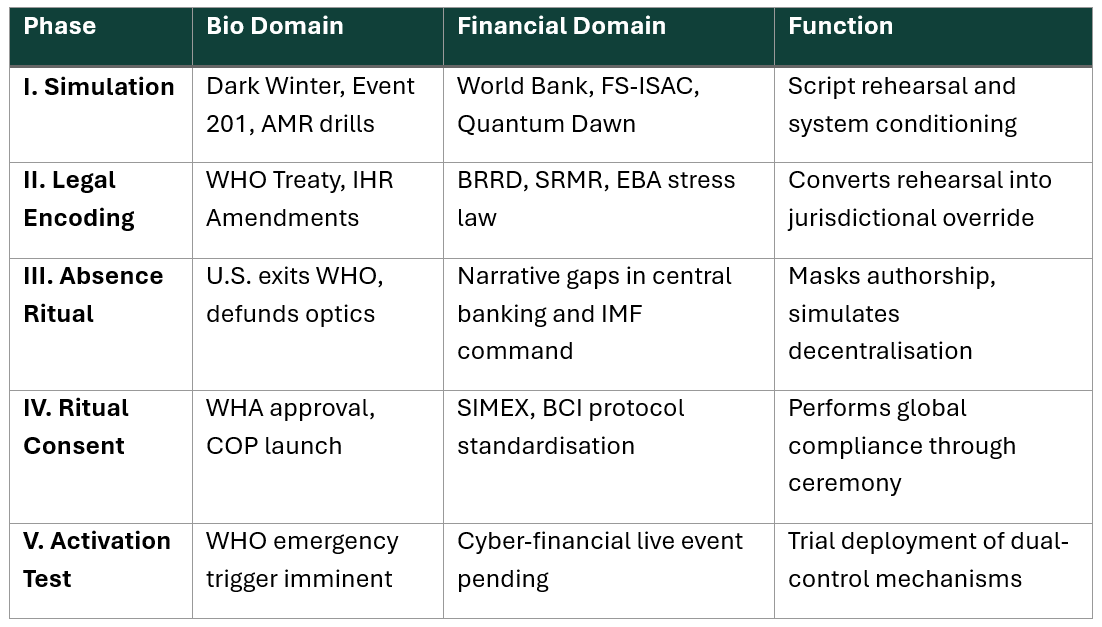
Crisis is no longer a spontaneous disruption—it is a modular cycle. Each phase in this cycle serves a functional role in shifting governance from reactive policy to proactive enforcement. By aligning biopolitical and financial simulations into a unified sequence, the system migrates authority from national deliberation to trans-institutional reflex. What follows is not a timeline but a logic tree: simulation gives way to law, absence reframes control, and ritual consent sanctifies enforcement.
The following map decodes this progression—exposing the phase-locked mechanism now synchronising global response infrastructure across health and finance.
Projected Next Phase: Operational Simulation Live-Fire Scenario: “Polar Shock 2030”
The choice of the Arctic is not incidental. It reflects a decade-long build-up of convergent tensions and narrative seeding. In 2025, Donald Trump, during his renewed campaign cycle, revived the notion of acquiring Greenland—framing it not as a diplomatic anomaly, but as a strategic imperative in Arctic control. Meanwhile, Russia has scaled up its militarisation of the region, operating the world’s largest fleet of nuclear-powered icebreakers and expanding the Northern Sea Route in tandem with China’s “Polar Silk Road” ambitions.
The integration of Sweden and Finland into NATO formalised a new northern encirclement perimeter, intensifying border militarisation and aligning defence infrastructure across the Nordic-Baltic zone. Concurrently, sanctions policy has weaponised trade narratives—painting Russia as a rogue maritime actor via its so-called “shadow fleet” and linking it to sabotage of Baltic undersea telecommunications infrastructure. These developments are not spontaneous. They are layered pretexts—choreographed triggers for the activation of Arctic-centric crisis architecture.
A working scenario designation—“Polar Shock”—is introduced here to describe the projected convergence event. Developed through AI-assisted synthesis of crisis simulation cycles, treaty enforcement structures, and geopolitical stress mapping, it offers not a prediction, but a structural extrapolation. It represents the system’s own likely trajectory based on pre-encoded activation logic.
The Polar Shock event this analysis proposes is not some hypothetical outlier. It is a structured convergence of pretext, pressure, and pre-authorised deployment. The groundwork has been laid across military doctrine, legal treaties, infrastructure vulnerabilities, and geopolitical theatre. What remains is not the emergence of crisis, but its ritual ignition. This is not prediction—it is pattern recognition.
An event like Polar Shock 2030 could plausibly entail:
- Targeted Arctic cable severance, triggering epistemic blackout and financial instability
- Refugee displacement catalysed by engineered conflict, climate event, or supply disruption
- Coordinated cyberattack on the Baltic grid, synchronised with cross-platform disinformation operations.
Systemic Outcomes:
- NATO mobilisation under Arctic security pretext
- WHO emergency declaration via One Health logic
- UN refugee protocols invoked for biometric onboarding and movement management
- AI governance systems trialled in real-time speech filtering and information control
- Treaty and COP frameworks activated as jurisdictional overrides.
This would mark the shift from symbolic rehearsal to structural deployment. The treaty is not contingency planning—it is a dormant authority protocol awaiting ritual ignition.
Simulation Phase – System Reflex Encoding
What began as preparedness has matured into pre-emptive conditioning. The simulation phase of 2024–2025 is not about testing systems—it’s about embedding reflex. Across financial, cyber, and organisational domains, these exercises no longer rehearse uncertainty; they calibrate obedience. Institutions are being trained to treat crisis not as anomaly, but as baseline. The logic has shifted: crisis is not something to be prevented—it is the very medium through which governance is now expressed.
Specific crisis simulations in 2024–2025—like Nordic-Baltic, World Bank, FS-ISAC, Quantum Dawn VII and BCI reports—reflect an advanced operational logic: crisis is no longer a disruption—it is a governing template. These exercises rehearse harmonised override mechanisms across financial and cyber domains.
- Standardisation: All nodes perform under convergent command conditions (EBA, IMF, BIS)
- Reflex Embedding: Crisis teams, AI dashboards, and digital playbooks pre-authorise response
- Legal Harmonisation: BRRD/SRMR rehearsals enforce supranational jurisdiction within national optics
The simulation is no longer training. It is the blueprint.
Ritual Function of Simulations
To understand simulations within this system, “ritual” must be understood not as religious devotion, but as structured repetition that encodes authority. Crisis simulations are not capacity tests; they are compliance performances. Their timing, structure, and optics function as behavioural code.
Simulations are: calendarised → scenarios pre-scripted → symbolic roles assigned (crisis teams as priesthood, financial collapse as sacrifice, AI dashboards as oracle) → repetition conditions reflex → governance migrates from judgement to protocol, from decision to automation.
These are not rehearsals for real events. They are the events—designed to synchronise institutions, embed reflex, and convert symbolic action into command default. Crisis simulations function as liturgies of control. They do not prepare for disaster. They stage its logic.
In these terms, simulations are timed not for realism but for symbolic continuity. They function as liturgical events:
- Crisis teams = emergency priesthoods
- Financial collapse = ritualised sacrifice
- AI dashboards = oracular governance.
Repetition transforms behaviour into law. Calendarised drills—like SIMEX, Quantum Dawn, EBA stress tests—serve to encode response timing across institutions. Decision-making migrates from judgement to reflex.
Current Phase: Structural Reflex Lock-In
The system is no longer simulating crisis—it is governed by its reflexes. According to the phase schema outlined above, we are situated in Phase III, where legal encoding has already occurred and institutional behaviours have migrated from preparation to automation. This diagnosis is based on observable institutional behaviour across recent simulation regimes:
- Crisis teams are not dormant—they remain active between drills
- Simulation outputs are no longer debated—they are implemented as standing response logic
- AI interfaces are not advisory—they are increasingly the first filter of event perception.
What marks Phase III is not the visibility of new policy, but the invisibility of deliberation. The system does not need to announce its next step—it has already rehearsed it into muscle memory. Institutions now default to crisis logic as their baseline state.
This means that what appears stable is in fact continuously managed through automated escalation scaffolds. It also means that the next “event” will not trigger response—it will activate deployment.
The simulations have trained the system to obey the signal. The signal is primed.
Interface Convergence: Biocrisis and Fincrisis as a Single Operating Layer
In the current system, health and finance no longer function as separate domains. What we call Biocrisis refers to crisis events mobilised through the health-security apparatus—pandemics, pathogen threats, antimicrobial resistance. Fincrisis designates crisis events that emerge through the financial system—market shocks, liquidity collapse, or institutional destabilisation. While these may appear distinct in narrative terms, they now operate as a single, converged enforcement schema.
Crisis Convergence Architecture: From Dual Domains to Unified Deployment
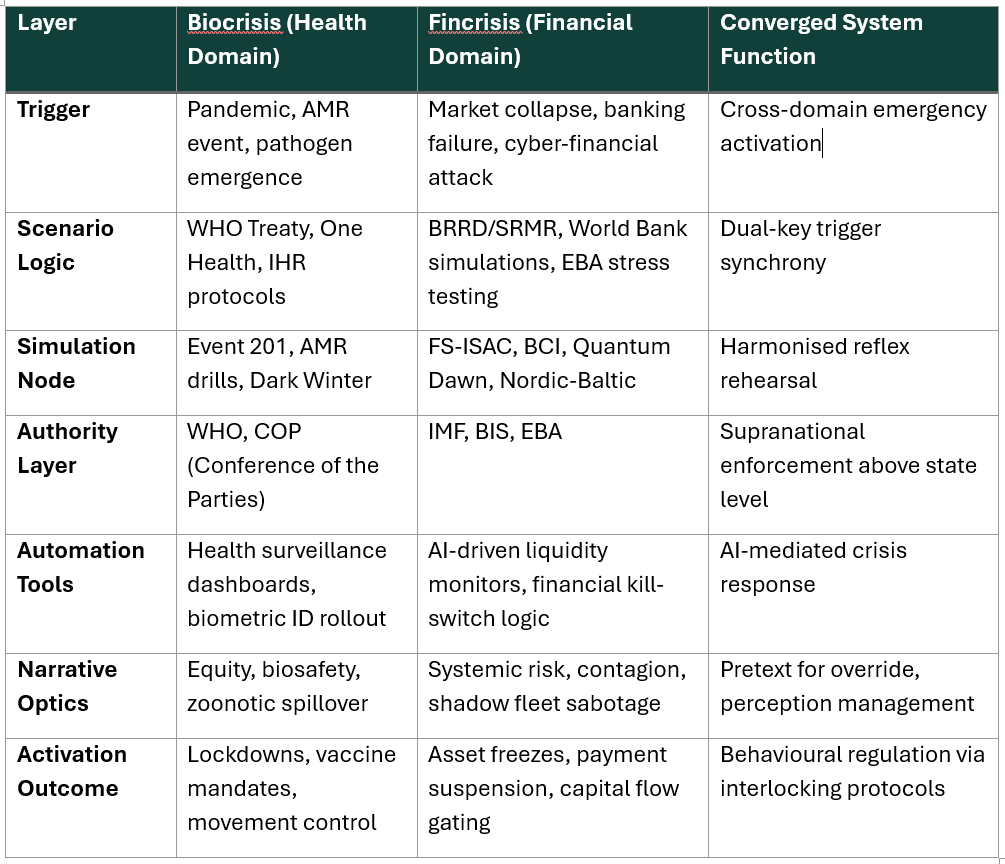
The convergence of Biocrisis and Fincrisis systems forms a dual-trigger governance model—where crisis in one domain activates compliance in both.
Each domain provides pretext for activating the other. A health emergency enables financial override. A financial disruption legitimises biosecurity enforcement. Together, they form a dual-trigger mechanism—one that has been rehearsed in simulations, embedded in treaty structures, and increasingly governed through automated command platforms. What follows maps this convergence—not as theoretical alignment, but as operational design.
Crisis no longer manifests along isolated vectors. Health and finance have fused into a dual-trigger system—each one justifying and activating the other.
Treaty Mechanism = Bio-jurisdictional Override
WHO declares emergency → triggers national protocols
COP mobilises treaty tools (data sharing, lockdown logic, One Health surge)
Simulation Complex = Financial Reflex System
FS-ISAC, BCI, EBA simulate rapid financial shock response
Decision-making transferred to AI-enhanced dashboards
Triggers include liquidity collapse, cyber outage, ESG stress test
Convergence Point: Crisis declaration in one domain (e.g., pathogen emergence or financial contagion) now activates both enforcement frameworks:
Health panic enables asset freeze, surveillance expansion
Financial panic justifies lockdowns, movement restrictions, data fusion
Strategic Outcome: A bidirectional control system. Pathogens justify financial override. Financial disarray justifies health mandates. WHO and World Bank simulations form a dual-key architecture: synchronised drills, synchronised jurisdictional override, synchronised obedience protocols.
The future is not health crisis or financial crisis. It is both—converged, harmonised, and ritualised.
Conclusion: Synthesis
The system has moved beyond planning. What began as simulated exercises and treaty drafting has matured into a fully integrated crisis management infrastructure. The WHO pandemic treaty, funding narratives, global simulations, and the Conference of the Parties (COP) now operate together as parts of a single, synchronised control schema. These are not policy tools in the traditional sense. They are instruments of transition—designed not to debate governance, but to enact it.
What we are witnessing is a shift from governing through law to governing through crisis. Crisis is no longer the exception to order—it is the pretext for command. The architecture is complete. The only missing component is ignition.
The current system no longer requires public consent—it operates through synchronised simulation and automated enforcement. The WHO treaty is not a contingency—it is a jurisdictional override awaiting signal. Simulations are not speculative—they are ritual rehearsals. Conference of the Parties (COP) is not an advisory body—it is a command scaffold. The global system now conditions populations for activation, not deliberation. The crisis interface is armed, and every “event” from here forward will be a deployment vector.
So what?
This means that the next “crisis” will not arrive as a surprise. It will arrive as a pretext—carefully synchronised to justify already-scripted responses. Whether it’s pandemic resurgence, financial seizure, or geopolitical rupture, the system is preloaded to respond before consent can be questioned.
What next?
Expect further convergence: more “emergencies,” tighter AI moderation, and rapid institutional lockstep. Watch for multi-domain drills, regulatory harmonisation, and framing wars that aim to blur dissent with danger. The system will accelerate, not retreat.
What can I do about it?
- Decode the script, not the scene. Learn to read ritual, recognise simulation artefacts, and trace narrative timing to institutional logic.
- Withdraw from synchrony. Resist reacting on schedule. Question the crisis rhythm.
- Map outside the system. Build cognitive and communal frameworks that aren’t scripted by emergency logic.
- Refuse the default. The greatest resistance now is not disruption—but disobedience to the automated script.
You may not control the script—but you can choose whether or not to perform it…
Published via Journeys by the Styx.
Geopolitika: Tracing the architecture of power before it becomes the spectacle of history.
—
Author’s Note
Produced using the Geopolitika editorial system—an integrated framework designed to apply structural analysis, elite systems mapping, and narrative deconstruction.