Geopolitika: From Scenario to System – Mapping the Empire’s Playbook
How simulation, strategy, and synchrony engineered a post-consent operating system for global control.
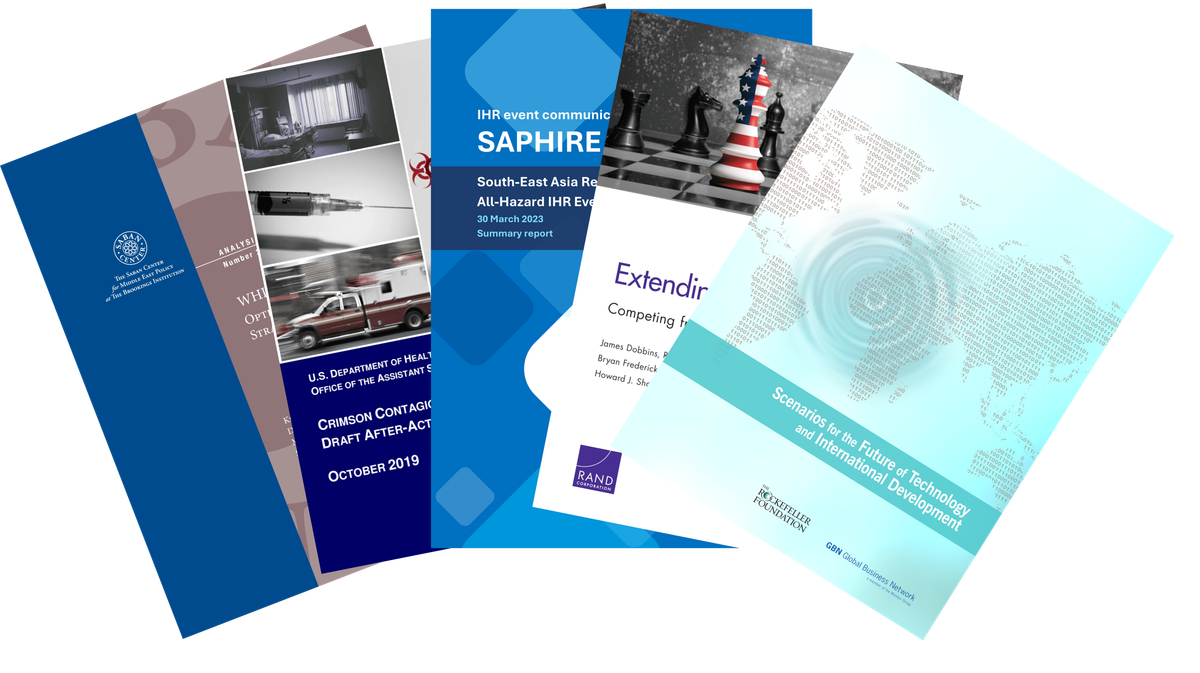
The Rockefeller scenarios, Event 201, Crimson Contagion, and WHO governance frameworks are not isolated events. They represent a modular, convergent system of elite crisis management. Their operational logic is mirrored abroad through RAND and Brookings strategies—revealing a single playbook. The system no longer governs through law or consent. It governs through the interface of crisis.
This is not a disconnected catalogue of policy responses. It is a unified operating system for elite continuity under conditions of manufactured instability. This article shows how each module—from simulated outbreaks to legally binding health protocols—functions not as an individual policy but as an execution node in a ritualized crisis architecture. Each institution plays a role in scripting, triggering, and normalizing crisis not as a failure, but as a governing interface.
The system is modular (Rockefeller), rehearsed (Event 201), escalated (RAND), moralized (Brookings), and legally encoded (WHO). The convergence is not narrative coincidence. It is structural synchrony. Governance now means managing emergencies, not representing citizens.
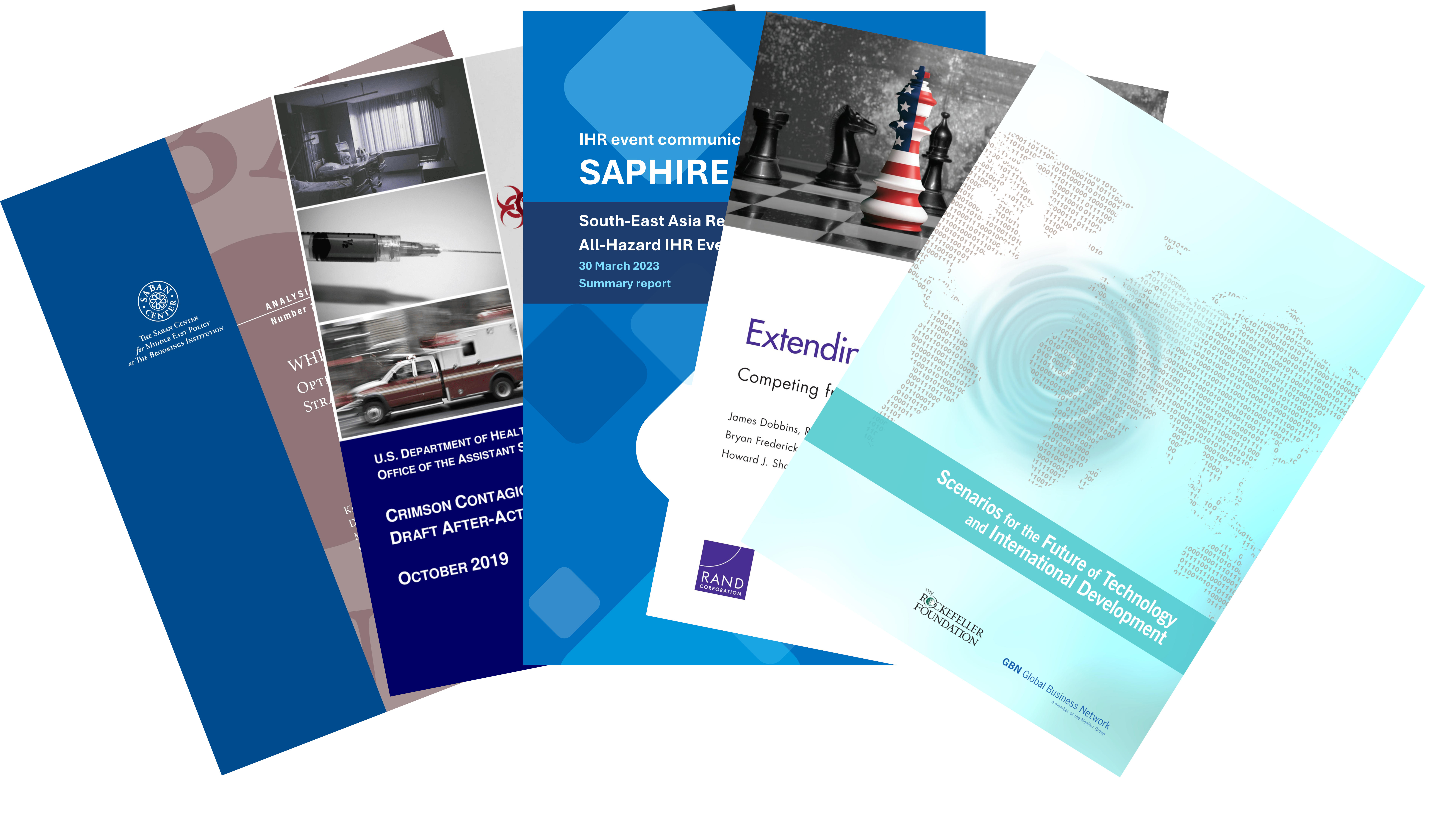
This framework will decode the convergent function of these nodes as stages in a single elite playbook—where the public sees reaction, but the system performs ritual.
Dark Winter: The Prologue Simulation
Staged in June 2001, just three months before 9/11, "Operation Dark Winter" was a high-level bioterrorism simulation portraying a deliberate smallpox outbreak in the U.S. Conducted by the Johns Hopkins Center for Civilian Biodefense Studies, the Center for Strategic and International Studies (CSIS), and others, the exercise involved former government officials role-playing as key decision-makers under conditions of a spiraling bio-crisis.
Journalist Whitney Webb has positioned Dark Winter as the narrative and logistical template for both the post-9/11 anthrax attacks and the COVID-19 response. She demonstrates how the personnel, script elements, and media coordination rehearsed in this simulation would later reappear in real policy under the guise of emergency response.
- Context: June 2001, smallpox outbreak drill foreshadowing post-9/11 biopolitical control
- Insight: Transition from hypothetical to tactical rehearsal of emergency powers
- Bridge: Direct lead-in to anthrax attacks after 9/11—simulation becomes live theatre.
Dark Winter wasn’t designed to prevent failure. It was designed to model submission.
Dark Winter functioned not as a diagnostic test but as a strategic rehearsal encoded with operational myth. Its participants included media actors (Judith Miller), intelligence veterans (Woolsey), and biodefense architects (Kadlec, O'Toole), who later reappeared in real-world crisis governance. The simulation forecasted not events, but the response script: vaccine rationing, federal override, media scripting, military support roles.
The proximity to 9/11 and the anthrax attacks was not a coincidence but a ritual transition. What was rehearsed in June became institutional memory by September. The public believed they were witnessing improvisation. The system was executing choreography.
Dark Winter is the ritual precursor to the age of bio-crisis governance. It installs trauma logic, institutional hierarchy under emergency, and public compliance conditioning into the national operating system.
It was not a test of resilience. It was a simulation of obedience.
The Rockefeller Framework: Domestic Control via Scenario Logic
The 2010 Rockefeller Foundation report "Scenarios for the Future of Technology and International Development" introduced four distinct governance simulations: Lock Step, Clever Together, Hack Attack, and Smart Scramble. These were framed publicly as foresight exercises but functionally served as modular templates for crisis management systems.
- Four scenarios as modular tools: Lock Step (authoritarian control), Clever Together (elite multilateralism), Hack Attack (chaotic techno-crisis), Smart Scramble (localized improvisation)
- Purpose: Offer scalable responses to destabilisation under the guise of foresight
- Conclusion: These are not predictive scenarios—they are codified authorisation layers for future institutional responses
"Lock Step" provided the clearest prototype for the global pandemic response model seen in COVID-19: top-down authority, biometric surveillance, quarantine enforcement, and digital health passes. It was not forecasting, but pre-consented governance scripting, later mirrored in WHO treaty logic.
The Rockefeller document is not about possibility. It is about permission. The scenarios allow institutional actors to select from a menu of control architectures based on regional resistance indices. Where Lock Step fails, Clever Together deploys. Where Smart Scramble gains traction, funding shifts to decentralised compliance proxies.
The public was meant to see prediction. The planners saw authorisation.
RAND Doctrine: Destabilisation Through Overextension
RAND's 2019 report "Extending Russia: Competing from Advantageous Ground" laid out a strategic doctrine for inducing systemic collapse in a geopolitical adversary through economic, informational, and military pressure. This was not deterrence. It was escalation by design.
- Key document: Extending Russia (2019)
- Pattern: Create economic, military, and ideological pressure points; induce adversary reaction; weaponize overextension
- Mechanism: Project cost asymmetries to trigger internal destabilisation and international humiliation
- Effect: Collapse or weaken targeted state while preserving plausible deniability.
The RAND doctrine is not an isolated foreign policy paper. It is a command-layer blueprint for manufacturing conflict and embedding moral distance. Its recommendations prefigure U.S. provocations in Ukraine, Black Sea naval posturing, and energy weaponisation via sanctions.
This doctrine shares architecture with Rockefeller's Lock Step and Event 201: define the frame, simulate the threat, force the adversary into compliance or collapse. RAND simply applies the model externally—the pandemic modules apply it domestically.
RAND builds ritual adversaries. Its output is not policy. It is script.
RAND writes the script. The headlines follow.
Brookings Method: Moralised Technocracy and Managed Adversaries
Brookings does not produce strategy documents. It manufactures justification systems. Through works like "Which Path to Persia?" (2009) and "Constraining Iran's Future Nuclear Capabilities" (2019), Brookings lays the rhetorical groundwork for elite intervention, always moralized, always managerial.
- Documents: Which Path to Persia? (2009), Constraining Iran’s Future Nuclear Capabilities (2019)
- Mechanism: Reframe geopolitical containment as ethical necessity—via nuclear threat, regional stability, or humanitarian pretext
- Strategy: Provide U.S. policymakers a menu of technocratic interventions: covert destabilisation, diplomatic entrapment, kinetic war, sanctions masquerading as peacekeeping
- Outcome: Convert adversarial states into regulated assets within a managed conflict theatre.
Brookings plays the moral anchor to RAND's kinetic accelerant. Where RAND scripts the reaction, Brookings scripts the reason. It redefines domination as protection, sanctions as diplomacy, and escalation as “restraint.”
Iran is cast as the archetypal “contained adversary”: loud in rhetoric, disciplined in behavior. It must appear unruly to the public, but manageable to elites. This is ritual adversarial management—a narrative loop that recycles the legitimacy of global policing.
Brookings provides not analysis, but pretextual architecture.
Its work is not academic. It is mythographic.
WHO & the Treaty Mechanism: Lock Step Becomes Law
The World Health Organization (WHO) is no longer merely an advisory body. Through the revision of the International Health Regulations (IHR, 2024) and the draft WHO CA+ Treaty, it has been structurally transformed into a supranational enforcement node for biosecurity governance.
- Strategy: Translate Rockefeller-style scenario scripting (Lock Step) into legally binding pandemic protocols
- Key Tools: International Health Regulations (IHR, 2024), WHO Pandemic Agreement (CA+ Draft, 2023)
- Operational Mechanism: Empower WHO to declare emergencies, enforce border and movement restrictions, and deploy surveillance protocols.
The IHR amendments and the WHO treaty instantiate the Lock Step scenario in legal form. Crisis → Simulation → Script → Law: what began as predictive fiction becomes jurisdictional fact. They codify the shift from national governance to global compliance architecture, where health is the trojan horse for total control.
The treaty creates enforcement machinery under the guise of pandemic preparedness: Conference of the Parties, Compliance Committees, obligations for “infodemic” control. Its true function is not protection, but jurisdictional override.
The WHO becomes the global executor of crisis law—its declarations binding, its triggers unaccountable, its backers unacknowledged.
This is not international cooperation. This is ritualized surrender.
The WHO treaty doesn’t protect sovereignty. It replaces it.
The Censorship Industrial Complex
What began as content moderation has metastasized into a full-spectrum narrative control grid. The Censorship Industrial Complex fuses government agencies, intelligence fronts, NGOs, fact-checking syndicates, and private platforms into a single command architecture.
- Architecture: NGO-government-platform convergence for narrative policing
- Tactic: Redefine dissent as harm, conspiracy as violence, critique as destabilisation
- Interface: DHS, FBI, EU Disinfo Lab, Trusted News Initiative, CyberPeace Institute, Stanford Internet Observatory.
The complex does not merely suppress information—it engineers consent. It anticipates counter-narratives, tags them as contagion, and pre-authorizes censorship as public health defense. Under WHO treaty logic, "infodemic" is not metaphor. It is jurisdiction.
Speech becomes a vector. Platforms become border guards. Truth becomes a controlled substance.
This is not an ecosystem. It is a weaponized ecology.
The new war is not on terror. It is on unapproved memory.
The Theatre of Enemies: China and Iran as Narrative Assets
In the crisis interface system, adversaries must appear autonomous while reinforcing the legitimacy of global control structures. China and Iran perform this dual role with ritual precision.
China:
- Appears as geopolitical rival, yet echoes and amplifies pandemic control logic (Event 201 script rehearsal, lockdown optics, WHO coordination)
- Participates in surveillance normalization, biometric ID expansion, Arctic infrastructure projection
- Narrative Asset: The false binary of Lab Leak (Wuhan) vs Zoonotic Origin serves both Western and Chinese domestic legitimacy needs. The parallel insinuation of Fort Detrick via the 2019 Military Games introduces a mirrored disinformation loop: each audience is fed an external culprit, while both reinforce the biopolitical consensus.
Iran:
- Projects defiance rhetorically, but aligns structurally with WHO compliance, lockdowns, vaccine rollout
- Functions as a ritual foil: amplifies the illusion of resistance while enacting integrated crisis choreography.
These are not rogue actors. They are narrative containment modules. Their purpose is not disruption, but dramaturgy.
This is not to claim collusion but convergence. China and Iran stage opposition. Their real role is continuity.
They don’t resist the program—they legitimise it. Their role is not rebellion. It’s rehearsal.
Fracture Simulacra: Controlled Dissent and Narrative Buffering
Apparent ruptures within the system often serve to stabilize it. Fracture Simulacra simulate opposition to absorb dissent, reinforce legitimacy, and manage perception. They maintain elite continuity by staging symbolic resistance—controlled leaks, safe outrage.
Examples:
- Lab Leak vs Zoonotic Origin: Preserves biocrisis legitimacy while obscuring simulation-policy linkage
- Wuhan vs Fort Detrick: Mutual scapegoat optics—domestically persuasive, globally stabilizing
- Populist Blowback: Simulates rupture but achieves no disengagement from treaty mechanisms or surveillance protocols.
Insight: These fractures are not disruptions. They are ritual performances of dissent calibrated to contain unrest. Every rupture that stabilizes the crisis interface is system-authored.
Every rupture is either absorbed or authored.
Synthesis: The Crisis Interface Has Replaced Democratic Consent
All prior modules converge here. The crisis interface is no longer an anomaly in governance—it is its operating system. Governance has migrated from deliberation to activation, from policy debate to emergency compliance.
System Attributes:
- Modular: Deployable per region, per resistance threshold, per narrative saturation
- Pre-scripted: Crisis scenarios mirror policy trajectories long before their public activation
- Globally harmonised: Simultaneous narrative enforcement across political, media, corporate, and academic sectors
- Performative in opposition: Even apparent resistors (e.g. China, Iran) serve to validate the legitimacy of centralised emergency rule
The world is no longer governed by elected deliberation or legal debate. It is governed by simulation converted into law, crisis converted into compliance, opposition converted into theatre. Each node—Dark Winter, Lock Step, Extending Russia, Which Path to Persia, WHO Treaty—is a fragment of a single interface.
Democratic consent has not failed. It has been replaced. The crisis interface is its successor.
The world is not governed by policy. It is governed by pretext. And the pretext is always a crisis.
Core Documents:
- Operation Dark Winter (2001)
- RAND Corporation – Extending Russia (2019)
- Brookings Institution – Constraining Iran’s Future Nuclear Capabilities (2019)
- Brookings Institution – Which Path to Persia? (2009)
- Rockefeller Scenarios Document (2010)
- Event 201 (Oct 2019)
- Crimson Contagion (2019)
- WHO IHR & Pandemic Treaty (2023–2025)
- News and policy analysis of China & Iran COVID compliance
Published via Journeys by the Styx.
Geopolitika: Tracing the architecture of power before it becomes the spectacle of history.
—
Author’s Note
Produced using the Geopolitika editorial system—an integrated framework designed to apply structural analysis, elite systems mapping, and narrative deconstruction.