Geopolitika: NATO’s Stage Play – How Elite Scripts Replace Public Consent
A diagnostic exposé of how European strategic voices are ventriloquised through transatlantic scripting, with Chatham House staging NATO dependency as a sovereign initiative.
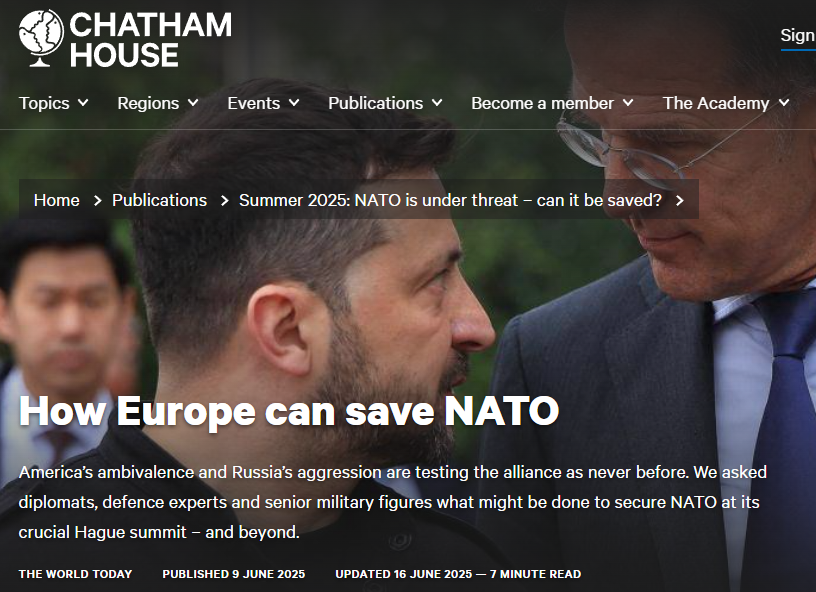
NATO, once the reactive shield of a divided Europe, now operates as the protagonist in a meticulously curated crisis theatre. Its proclaimed “existential threats”—from Russian aggression to American ambivalence—are not spontaneous diagnoses, but scripted imperatives. Behind this script lies a complex narrative machinery, one engineered to transform strategic entropy into necessity performance. Central to this machinery is Chatham House, the Royal Institute of International Affairs—an institution birthed not from democratic deliberation, but from the elite coordination circuits of the early 20th century.
Founded in 1920 in the aftermath of World War I, Chatham House descends directly from the Rhodes–Milner Group: a covert alliance of imperial strategists and financiers committed to sustaining British global dominance through intellectual and administrative proxies. Designed as the British counterpart to the U.S.-anchored Council on Foreign Relations (CFR)—both born of the same Round Table blueprint—it operationalised a model of cognitive-governance: manage perception, manufacture consent, and maintain elite continuity beneath the veil of public rationality.
This lineage is not decorative—it defines function. Chatham House does not merely publish policy analysis; it scripts strategic alignment motifs and diffuses narrative command logic across think tank networks, media partners, and state agencies. Its function is not to discover truth, but to format reality to pre-ordained strategic coordinates.
Chatham House does not operate alone. It forms part of a broader ecosystem of transatlantic think tanks—including the Center for European Policy Analysis (CEPA), the German Marshall Fund (GMF), and the Atlantic Council—that consistently promote NATO-centric narratives. These organizations function in parallel, often reinforcing one another’s messaging to shape elite consensus on security policy across Europe and North America.
In the case of NATO’s alleged crisis, Chatham House orchestrates to convert structural decline into motifs of “renewal”, reframing dependency as agency and masking transatlantic control behind European voices of presumed independence. The June 2025 report analysed here represents narrative choreography—a deployment script designed to realign public perception, reassert transatlantic command logic, and simulate multilateral urgency.
This diagnostic traces how Chatham House, powered by its Rhodes/Milner DNA and elite-authored motif sequencing, scripts NATO dependence as existential rescue. It extracts the upstream authorship behind its polished language, exposes identity camouflage tactics among its contributors, and decodes the symbolic syntax by which consensus is manufactured.
How Europe Can Save NATO
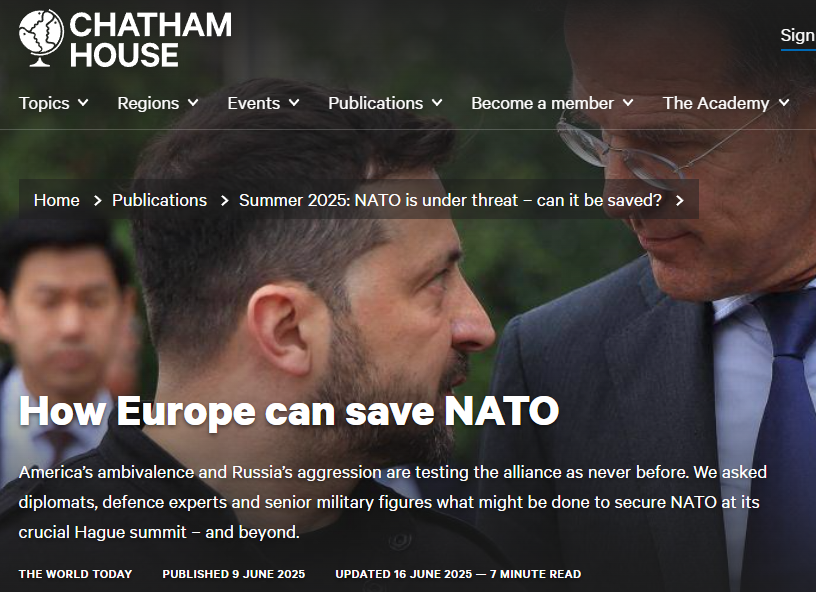
The Chatham House piece, “How Europe Can Save NATO”, orchestrates a multi-author, elite-consensus script to reframe NATO’s strategic fragility as a solvable managerial gap. Structured as a composite of high-profile contributions—from former NATO commanders to European ministers—it positions NATO not as a declining Cold War artifact but as a salvageable vector for Western cohesion amid renewed geopolitical threat.
Ostensible Purpose
The article functions as a pre-summit brief to galvanize European political and military elites around a “rescue” mandate—namely, increased defence spending (up to 3.5% of GDP), transatlantic rebalancing, industrial mobilisation, and deepened Ukraine integration. It claims urgency based on U.S. unpredictability (Trump) and Russian escalation, leveraging fear of abandonment to accelerate militarisation.
Structural Format & Authorship Concealment
The article is editorially engineered as a strategic relay, where each quoted contributor appears to introduce a distinct narrative theme—ranging from threat framing (Volker) and capability gaps (Joshi), to technocratic harmonisation (Ashton, Ollongren), Cold War invocation (McMaster, Hodges), and EU–NATO institutional synthesis (Tocci, Landsbergis). However, close textual analysis reveals a single authorship voice throughout: polished, institutionally neutral, and analytically sequenced. The stylistic uniformity—modal framing, strategic urgency, and seamless transitions—exposes the quotes as symbolic entry points, not genuine authorial segments. This scripting device simulates pluralism while masking a convergent narrative architecture oriented toward NATO’s re-legitimation. The named figures function as institutional ballast, giving the appearance of polyphony to a tightly controlled, univocal script.
Main Arguments and Recommendations:
- Europe must commit to 3.5% GDP defence targets to keep the U.S. engaged
- Ukraine’s integration into NATO must be reactivated post-conflict
- NATO should pivot from symbolic unity to real operational burden-sharing
- The EU–UK Security Pact and SAFE fund access serve as tools of mobilisation
- Military industrial base expansion and public reconditioning are necessary to achieve readiness.
Core Narrative Move
The article disguises elite panic as pragmatic foresight, embedding strategic alignment within performative pluralism. It presents centralisation and militarisation as Europe’s only viable response, masking upstream authorship and omitting the structural origins of NATO’s crisis in legitimacy and scope drift.
The Hidden Authors of Alignment
Though the Chatham House report performs as a polyphonic showcase of transatlantic authority, its architecture is neither neutral nor pluralistic. In structure, it constitutes a narrative alignment device masquerading as collective insight. Each named figure serves as a strategic vector—amplifying specific motifs under the guise of expertise or proximity, while structurally reinforcing a singular objective: NATO’s geopolitical consolidation. The document's actual authorship is masked behind these institutional avatars, whose affiliations anchor the piece within elite policy networks and military–diplomatic circuits.
Kurt Volker represents entrenched Atlanticist doctrine. As former U.S. Ambassador to NATO and Ukraine envoy under Trump, his framing of U.S. disengagement risk masks a deeper intent: securing U.S.–EU lockstep continuity. Volker introduces the “threat” frame in language that mimics transactional populism, pre-emptively managing resistance by encoding urgency.
Shashank Joshi, operating from The Economist—a premier narrative amplifier for British imperial residue—translates abstract insecurity into hardware deficits. His role is not analysis but conversion: threat becomes capability gap becomes spending mandate. Kajsa Ollongren, as sitting Dutch defence minister, blurs policy and think tank boundaries. Her presence creates the illusion of consensus at the very site of policy manufacture. Her text performs as an embedded harmoniser for NATO–EU convergence.
Baroness Catherine Ashton, architect of the EU External Action Service, functions as a continuity anchor. Her voice reactivates post-Lisbon foreign policy logic, restoring legitimacy to supranational choreography that has otherwise drifted. She does not add argument—she stabilises framing.
Ben Hodges and H.R. McMaster execute a dual-channel Cold War invocation. Their function is not to reflect but to resurrect. Hodges, formerly of U.S. Army Europe, and McMaster, a Hoover-aligned hardliner, channel “existential clarity” through strategic nostalgia, rendering escalation into a duty and deterrence into virtue. This is not memory—it is mobilisation.
The inclusion of Lithuanian ex-Foreign Minister Gabrielius Landsbergis and Ukrainian MP Solomiia Bobrovska is not representative—it is tactical. Both figures serve as geopolitical amplifiers from NATO’s frontier states, regions where anti-Russian sentiment is operationalised into alliance loyalty. Their institutional extremity is masked by democratic legitimacy, making their urgency appear organic rather than engineered.
Nathalie Tocci plays a hybrid role—policy intellectual and alignment synthesiser. Her contribution fuses EU strategic autonomy discourse with NATO preservation logic, dissolving internal contradiction through symbolic fusion. She converts potential divergence into performative unity.
A close read of the text shows that these individuals are not genuine authors (interviews are said to be by James Orr and Mike Higgins), but symbolic figures—inserted to project legitimacy and mask the origin of the message. Their statements function as preloaded soundbites, designed to give the impression of strategic diversity while serving a single, unified script. What emerges is not debate, but a staged agreement.
Moreover, this setup deflects dissent by layering elite-approved messages and amplifying more extreme voices at the margins, giving the illusion of a broad consensus.
Strategic Premise – The Narrative Anchor of Threat & Unity
At the heart of the Chatham House document lies a strategic premise engineered not to question, but to stabilise. The threat of Russian aggression, the spectre of European disunity, and the looming shadow of American strategic withdrawal are arranged not as open questions but as axiomatic truths. This triad forms a self-reinforcing feedback loop designed to simulate urgency, displace structural critique, and manufacture consent for transatlantic realignment.
The “Russian threat” is framed as omnipresent and existential, bypassing granular geopolitical analysis in favour of archetypal villainy. Its function is not evidentiary—it is structural. It anchors the legitimacy of militarised unity, enabling the activation of emotional, historical, and ideological reflexes. This threat is neither debated nor contextualised; it is invoked as a permanent condition, immune to de-escalation or political recalibration.
“European division” functions as the enabling dysfunction, the problem to be solved through supranational choreography. It constructs intra-European policy diversity as failure, thereby scripting centralisation as necessity. The motif does not address the legitimacy of dissenting positions or alternative security frameworks; it pre-emptively scripts them as threats to unity. This rhetorical move transforms coordination into obligation and bypasses democratic variance.
“American fatigue” operates as the motivational trigger. Presented as a warning, it is in fact a coercive signal. The idea that the U.S. may no longer serve as Europe’s security guarantor activates the fear of abandonment, compelling European actors to step into a role they have not democratically assumed. The rhetorical thrust is not introspective but imperative—Europe must militarise, must consolidate, must align. This conditional script compresses political agency into reactive compliance.
The master phrase—“Europe must step up”—is the switch. It activates the narrative logic that justifies every institutional shift, every funding acceleration, and every alliance expansion. This is not a call—it is a command disguised as necessity. The phrase performs the ideological closure of debate by presenting integration as rescue and militarisation as responsibility.
Together, these motifs do not merely argue—they structure thought. They pre-empt alternatives by narratively sealing the system in a loop of perpetual reaction. There is no room for strategic pluralism, no space for dissent to scale. NATO is the only solution because the world is rendered NATO-shaped.
This structure absorbs dissent by reinforcing the same message so often that alternative views are closed off and foreclosing the discussion for urgency sake.
Sequencing the Illusion of Strategy
The Chatham House paper operates through a tightly sequenced motif relay, where each narrative element flows into the next with engineered inevitability. This is not debate—it is dramaturgy. Each motif is assigned to a quoted authority figure, but the structure of delivery reveals prearranged scripting rather than organic contribution.
- Crisis: “The alliance is at risk”
This opening motif is framed by Kurt Volker and echoed by military voices like Hodges and McMaster. The rhetorical function is destabilisation: NATO is portrayed as imperilled by internal disunity, external threats, and American unreliability. The crisis is not examined but declared. It is designed to suppress strategic pluralism by rendering the present moment as uniquely fragile. - Duty: “Europe must take responsibility”
Having staged the crisis, the report pivots to moral prescription. Ashton, Ollongren, and Landsbergis perform the responsibility motif, urging European governments to shoulder more of the “burden.” This is not framed as sovereignty or strategic autonomy, but as penitential obligation. It translates anxiety into consensus-seeking behaviour, particularly among Atlantic-aligned elites. - Technocratic Resolve: “Investments and interoperability”
Here the narrative enters its managerial phase. Joshi and Tocci frame the necessary response in terms of rational upgrades—standardisation, procurement reform, command coherence. The strategic issue is depoliticised into a logistical one. This motif absorbs dissent by reducing it to a question of technical execution, beyond the reach of lay or democratic contestation. - Inevitable Integration: “We are stronger together”
The final motif recodes convergence as destiny. It dissolves residual resistance into sentiment: unity is framed not merely as desirable but as historically ordained. Any alternative is implicitly cast as fragmentation, risk, or betrayal. This rhetorical loop closes the structure, re-sealing the opening crisis with a prefabricated solution.
The effect is to create a feedback loop of urgency, duty, managerialism, and inevitability that constrains the horizon of response. Each motif preconditions the next, until integration is not a choice, but the only legible conclusion. This is not strategic reasoning—it is scripted convergence.
By distributing these motifs across a curated cast of actors, the paper achieves elite harmonisation while maintaining the illusion of pluralistic input. No dissonant voices are permitted entry. Public agency is bypassed through Narrative Containment Field logic: the acceptable discourse has already been set.
This structure absorbs dissent through a feedback loop scripting the foregone conclusion as inevitable.
Institutional Choreography
The Chatham House document functions not as an isolated intervention but as a mid-sequence codification node in a larger choreography of elite narrative alignment. Its publication catalyzes a four-stage relay, wherein think tanks, supranational bodies, national ministries, and media outlets echo, escalate, and legitimate a pre-engineered consensus. The choreography simulates organic convergence, but inspection reveals pre-synchronised deployment across institutional tiers.
Stage One: Chatham House as Codifier Node
The Chatham House report did not launch a new message but reinforced and codified an existing script already in motion. Rather than initiating the discourse, Chatham House operated as a codifier node, absorbing upstream elite signals and formatting them into a coherent policy alignment narrative. It rearticulated pre-existing strategic motifs—NATO revival, European responsibility, and American withdrawal fatigue—into a synchronised script suited for institutional relay. The think tank’s historic function as a British imperial clearinghouse, tracing lineage to the Rhodes–Milner architecture, lends it symbolic ballast across transatlantic policy spheres. In this role, Chatham House didn’t invent motifs but refined and amplified them, embedding elite preferences within a framework simulating analytical neutrality while performing high-coordination vector synthesis.
Stage Two: Policy Amplification by EU Apparatus
The Chatham House document functions as part of a sustained motif escalation already in motion within the EU strategic sphere. Earlier in the cycle, Ursula von der Leyen declared in August 2024 that “Europe must step up arms production and play a stronger role in defence,” signalling the institutional pivot towards security integration . Simultaneously, foundational reports dating back as far as The NATO–EU Strategic Partnership (Elcano, 2003) and the more recent A New Vision for the Transatlantic Alliance (CEPA, 2024) prefigured many of the Chatham House motifs—calling for transatlantic convergence, expanded interoperability, and collective European responsibility in defence matters.
These earlier frameworks laid the narrative foundation, allowing the June 2025 Chatham House text to converge and codify preloaded institutional motifs. Figures like Catherine Ashton (former EU High Representative) and Nathalie Tocci (IAI Director) bridge this transition directly: both have deep ties to Brussels’ strategic grammar and have historically functioned as amplifiers for EU-aligned policy shifts. As such, the Chatham House phrasing—“Europe must step up,” “interoperability,” “shared responsibility”—was not novel but pre-scripted for institutional reactivation. The report crystallises these themes into a narrative that could be immediately absorbed by the Commission, the Council, and associated defence planning channels, ensuring continuity while masking the coordination.
Stage Three: National Ministry Relay
Chatham House’s release then operated as a harmonisation node, consolidating these statements into a motif-legitimised framework. The UK’s Strategic Defence Review (2 June 2025) preceded the Chatham House publication by a week, establishing a formal “NATO First” posture: “This will be achieved by the UK leading within NATO and taking on more responsibility for European security,” read the review.
Prime Minister Keir Starmer echoed this framing, declaring: “The NATO alliance means something profound: That we will never fight alone… our defence policy will always be ‘NATO first.’” Then within 72 hours of its publication, Lithuanian President Gitanas Nausėda escalated the urgency, warning “Russia is not waiting,” while on 10 June Defence Minister Dovilė Šakalienė insisted Lithuania “will never give up” on Ukraine’s NATO membership. On 12 June, NATO Secretary-General Mark Rutte sealed the messaging arc, calling for Europe to “ramp up defence spending.”
To cap these off, on 13 June, the European Council President António Costa reaffirmed that “Starting with defence and security… we are building the Europe of defence… stay the course and accelerate progress towards Europe’s common defence readiness by 2030,” tying it explicitly to NATO's deterrence objectives and calling for enhanced interoperability and “…guided by a collective approach to defence and security.”
Stage Four: Media Amplification Layer
Mainstream media channels—many with editorial or expert connections to the document’s contributors—take up the motifs as “talking points,” framing the transatlantic alliance in terms of existential necessity. The Economist, FT, and Euractiv recycle the language of responsibility and resolve, often verbatim.
Timing Synchrony Events:
- Ukraine Aid and Reconstruction Summits (May–July 2025): The Chatham House motifs align closely with the diplomatic buildup to the Ukraine Recovery Conference (URC2025) in Rome (10–11 July), where NATO integration and European defence responsibility are centrepiece themes.
- Ukraine–Russia Diplomatic Interactions (May–June 2025): The spectre of stalled or conditional negotiations further justifies NATO revitalisation narratives.
- G7 Summit (13–15 June 2025): High-level declarations on defence burden-sharing and democratic unity reflect and reinforce the Chatham House strategic framing.
- NATO Summit (24–25 June 2025): The formal stage for operationalising “NATO-first” policy logic—announced by the UK and echoed by Lithuania and others in the weeks prior—serves as the apex synchrony node.
- European Council (26–27 June 2025): Structured to echo and amplify strategic messaging, including calls for “collective responsibility” and increased defence investment.
This coordinated message system—starting with think tanks, echoed by EU institutions, reinforced by national governments, and repeated in the media is built to make the outcome feel unavoidable. What appears as spontaneous alignment is a tightly managed feedback loop, with institutional autonomy substituted by motif fidelity.
This structure absorbs dissent via multi-strata synchrony and narrative pre-loading.
Consent Without Consultation
The Chatham House document scripts a collective European role in NATO’s strategic future, but it does so without reference to democratic will, public mandate, or participatory process. Instead, the structure of the piece operationalises what can be termed sovereignty substitution: presenting elite-authored policy precommitments as if they were outcomes of public deliberation or strategic inevitability. This is achieved through a tri-layer bypass system involving rhetorical inversion, institutional entanglement, and funding precommitment.
- Rhetorical Inversion: Empowerment as Obedience
Phrases such as “Europe must step up,” “take responsibility,” and “achieve strategic autonomy” frame institutional submission as collective empowerment. “Strategic autonomy,” stripped of its original implication of independence from NATO and the U.S., is redefined in the document to mean intensified military integration under NATO’s command architecture. This is a discursive bait-and-switch: sovereignty is invoked only to justify its forfeiture. The linguistic structure simulates choice while foreclosing divergence. The effect is to rebrand imposed alignment as visionary agency. - Institutional Entanglement: Treaty Cascade as Bypass Vector
The call for “interoperability” and “capability investments” is not a proposal—it is a reaffirmation of binding obligations under existing NATO and EU treaties, procurement pacts, and strategic compacts (e.g., the European Defence Fund, Permanent Structured Cooperation, NATO Defence Planning Process). These mechanisms create a ratchet effect: once entered, states cannot easily diverge without incurring legal, financial, or reputational costs. The Chatham House document reinforces this by aligning its language with these frameworks, embedding the illusion of discretion within a pre-scripted operational lattice. - Financial and Procurement Lock-In: Consent as Budgetary Default
Beyond rhetorical and legal mechanisms, the report relies on financial precommitments to ensure structural continuity. Defence investments are framed as necessary, even overdue—yet no alternative allocation logic is entertained. This creates a de facto strategic enclosure: once budgets are routed into NATO-integrated procurement (e.g., F-35 programmes, joint ISR capabilities), strategic flexibility disappears. Parliaments vote on packages, but the architecture that necessitated those votes has already been built. Funding becomes a backdoor form of policy alignment, shielded from public contestation.
In this triple-layer bypass structure, the public is neither consulted nor acknowledged. National sovereignty is simulated through the language of “responsibility,” but systematically routed through treaty obligations, defence-industrial dependency, and closed-coordination scripting. Political leaders are left to manage optics; the direction of travel is already secured.
This structure absorbs dissent via participatory illusion and treaty-sealed pre-alignment.
Closure Without Contest
The Chatham House document operates as a closure mimicry system—an architecture of language and structure designed to simulate deliberation while engineering unidirectional policy convergence. It deploys specific rhetorical devices not to persuade but to terminate discourse before it begins. The result is not a field of options, but a corridor of inevitability.
- Modal Sealing – “Must,” “Urgent,” “Unavoidable”:
The most prominent rhetorical device is the repeated use of imperative modal verbs—“Europe must step up,” “NATO must adapt,” “We must not fail.” These declarations simulate a lack of choice, positioning the proposed path as the only rational outcome. No competing positions are discredited because none are raised. This framing removes the need for contest by erasing the field of alternatives. - Historicisation Logic – The “Turning Point” Motif:
Phrases such as “historic opportunity,” “unprecedented moment,” and “Europe at a crossroads” activate an urgency motif. These are not descriptions—they are narrative devices that frame inaction as failure and foreclose strategic patience or recalibration. By tying action to time, dissent is repackaged as delay, and delay as irresponsibility. - Omission as Design – The Silence of Disruption:
Crucially, nowhere in the document are public dissent, democratic constraints, or alternate geopolitical alignments mentioned. This is not oversight—it is strategic omission. By not naming deviation, the structure performs a semantic erasure of the public as a geopolitical subject. The worldview of elites is presented as common sense, so any disagreement doesn’t appear as a valid choice—but as failure to understand reality. - Motif Drift – Elite-Public Role Contradiction:
The simulation system relies on a tight loop of elite messaging—anchored in responsibility, urgency, and unity—while the public is cast only as a passive recipient. Tension emerges when policy hits public resistance. To maintain coherence, the message is rebranded—such as framing “security” as “prosperity”—revealing a deeper fragility: motifs designed to consolidate elite consensus begin to lose traction when adapted for public approval.
For example, the phrase “Europe must step up”—originating in Chatham House and echoed by von der Leyen and European Council leadership—was later adopted wholesale in EU Commission communications and press briefings. In a narrowing script, alternatives aren’t openly rejected, merely made hard to imagine.
The system blocks dissent by pre-empting alternatives and repeating scripted solutions.
Conclusion – The Mask of Collective Will
When decisions are made in closed loops—by elites speaking mostly to each other—the system can appear unified while becoming increasingly brittle. Without public traction, each new layer of consensus speeds up the risk of political rupture.
Beneath the appearance of unity the Chatham House report presents itself as a clear, consensus-driven call to action: Europe must step up, invest more, and prepare for a world of rising threats. But this polished message conceals the real condition beneath. The urgency it invokes—echoed across ministries, headlines, and summits—is not grounded in public mandate or institutional capacity. It is orchestrated repetition, not democratic resolve.
The elite actors calling for bold leadership are embedded within a system that scripts consensus while simulating debate. Publics are given roles—“burden-sharing,” “strategic autonomy”—but never a choice. The system loops on its own rhetoric, repeating the same imperatives while the terrain of consent erodes.
The message grows louder because the ground beneath it is weakening. The choreography remains tight, but the dancers are moving out of step.
If this scripted consensus starts to break—because of public resistance, budget strain, or changes in U.S. leadership—we could see new paths emerge. Some European states might pull back from NATO-first policies, forming their own regional defence pacts or rethinking military integration. Public backlash could go further, not just rejecting specific policies but calling for a different kind of security vision altogether.
One likely fracture point is emerging within EU fiscal politics: states like Hungary, Slovakia, and Italy—already uneasy with accelerated defence spending—may increasingly challenge the NATO-first consensus, either by vetoing budgetary alignments or by proposing alternate regional security frameworks. This would shift the system from recursive unity to reactive segmentation, where alignment no longer flows smoothly across the institutional surface but fractures along unresolved national sovereignty lines.
Chatham House is not operating in a vacuum. Institutions like the Atlantic Council, CEPA, and the German Marshall Fund consistently deploy similar language—”resilience,” “burden-sharing,” “transatlantic unity”—often within the same timeframes. These think tanks don’t just echo each other; they function as parts of a shared motif engine, formatting elite preferences into parallel scripts.
This article does not argue for or against NATO—it diagnoses the mechanics of narrative control. What we see in the Chatham House report is not an open debate about European security. It is a pre-scripted alignment mechanism, designed to simulate collective will while consolidating elite continuity. In these terms, it is apparent that Chatham House is not acting as a neutral analyst but as a coordination node, translating upstream geopolitical preferences into a language of managed necessity. European agency here is not expressed; it is staged. This is not strategy. It is performance.
This structure absorbs dissent via anticipatory containment override.
Published via Journeys by the Styx.
Geopolitika: Tracing the architecture of power before it becomes the spectacle of history.
—
Author’s Note
Produced using the Geopolitika analysis system—an integrated framework for structural interrogation, elite systems mapping, and narrative deconstruction.