Geopolitika: One Week, One Think Tank – How CSIS Turned the Maduro Raid into Doctrine
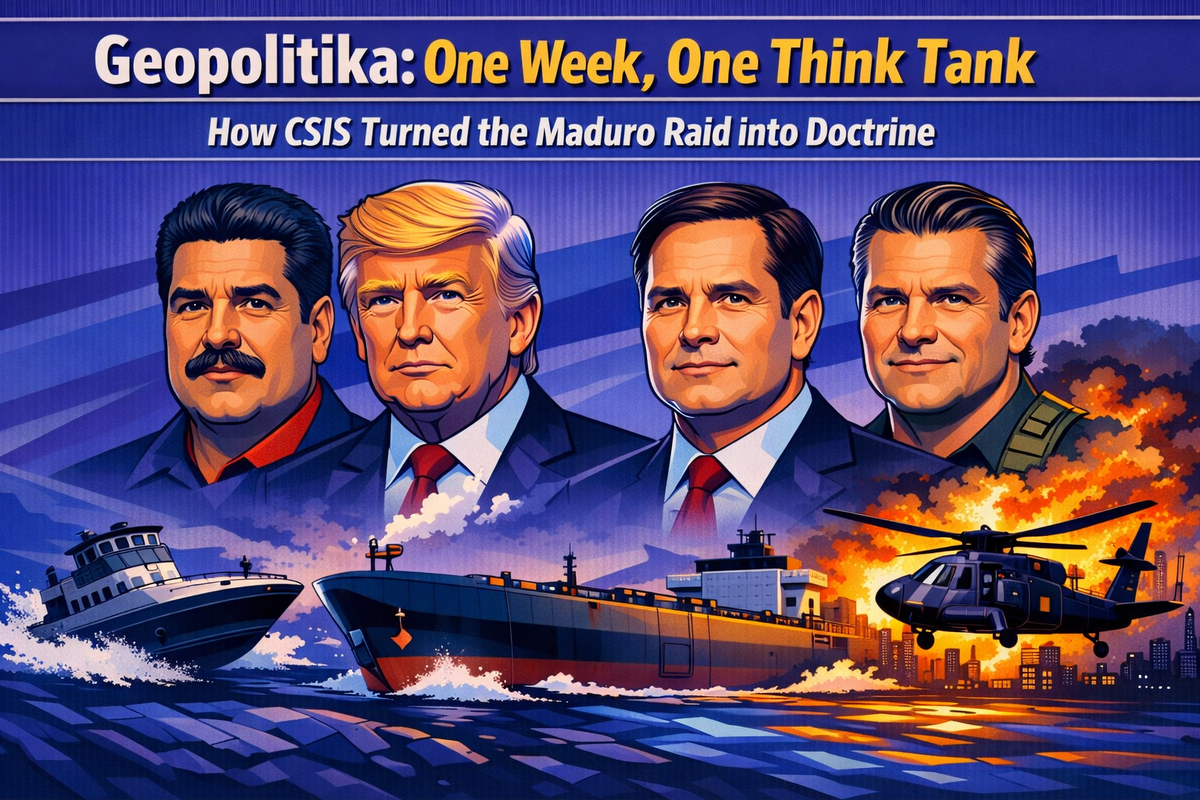
The raid that took Nicolás Maduro and his wife out of Caracas was over in hours. There were explosions, statements, grainy footage and angry press conferences. Depending on who you ask, it was either a precision rescue of Venezuelan democracy, a naked act of imperial violence, or something in between.
But that’s not what this piece is about.
What matters here is what happened after the shooting stopped. In the seven days that followed, the Center for Strategic and International Studies (CSIS) pushed out a dense, interlocking bundle of material about Venezuela: long-form articles on the raid and its “endgame”; a live “what just happened?” panel; a shift-piece from “regime change” to “regime management”; an oil-and-investment explainer; a shadow-fleet sanctions case study; a Panama 1989 comparison; a “blueprint for China and Taiwan?” reaction; and a satellite-imagery breakdown arguing this was a “surgical strike, not shock and awe.”
By the end of that week, if you were a journalist, a congressional staffer, a junior diplomat, or a policy analyst trying to sound informed, chances are you would have reached for something from that CSIS bundle. Not because you’d consciously “chosen” CSIS, but because it was there first, in volume, and in the familiar language of sober expertise.
This article takes that cluster of outputs as its object. It is not a comprehensive account of Venezuelan politics, and it is not a full legal or moral autopsy of the raid. Instead, it treats the raid as the spark and CSIS as the flame: a case study in how one well-positioned think tank digests a shock event and turns it, in real time, into doctrine, talking points, and “lessons” for the wider policy ecosystem.
That’s why the sources here are almost entirely CSIS. That isn’t a blind spot; it’s the design. The point is to watch what happens when a single institution floods the zone: how quickly it defines the “reasonable” questions (“What’s the endgame?”, “How do we manage this regime?”, “What does this teach us about sanctions? About Taiwan?”), which words it feeds into circulation (“surgical,” “stability,” “regime management,” “shadow fleets”), and which perspectives quietly drop out of frame.
The cluster was selected precisely because it’s unusually complete and time-bounded. We can see the whole arc: from first hot takes to refined doctrine, from immediate reactions to cross-theatre analogies, all produced by the same shop in the same week. That makes it an ideal lens on a bigger, less visible issue: who gets to turn bombs and seizures into “policy lessons,” and what kind of world is normalised when we let that process run on autopilot.
The CSIS Week: Seven Days at the Narrative Switchboard
From 5 to 10 January, CSIS walked its audience up a staircase: from shock, to explanation, to doctrine, to exportable “lessons.” It wasn’t random commentary; it was a sequence.
- Day 1 (5 January) is framing day.
Mark Cancian’s article, The Maduro Raid: A Military Victory with No Viable Endgame, tells you right away how to see the operation: a “near-perfect” special forces raid with an openly admitted political void afterwards. The military side is celebrated; the governance problem is parked as a separate issue. Jon Alterman’s The United States Cannot Go It Alone in Venezuela then zooms out to the global picture: the United States showed what it can do, but it needs partners and will face hedging and backlash. The live event transcript What Just Happened in Venezuela? And What Comes Next? pulls the immediate shock into a controlled room: CSIS experts debate whether the raid “unblocked a stalemate” or opened a “major instability generator,” but the raid itself stays as the unquestioned centre of gravity. In one day, the operation is converted from rupture into a set of puzzles for Washington to solve. - Day 2 (6 January) pulls in oil and finance.
Clayton Seigle’s A Credible Path to Political Stability Is Indispensable for Trump’s Venezuela Oil Aspirations quietly changes the question from “Was the raid worth it?” to “Under what conditions can we stabilise and monetise this theatre?” Venezuelan politics are treated as inputs to Trump’s desire for U.S. companies to move in: you need stability, predictable rules and repaired infrastructure, then barrels can flow and everyone “serious” can talk about investment again. Domestic Venezuelan timelines and conflicts are subordinated to investor risk and U.S. energy planning. - Day 3 (7 January) formalises the script and scales up the audience.
From Regime Change to Regime Management: Washington’s Venezuela Strategy names the new doctrine outright: the goal is no longer to sweep away the regime, but to manage it—apply pressure, offer incentives, and live with a recycled leadership if it delivers on security, economics and alignment. The same day, the security podcast Maduro is Gone. Now What in Venezuela? (on CSIS’s Last Line of Defense feed) advertises itself as the place where this “what next” question will be worked through for a broader audience. Together, these pieces move the cluster from diagnosis to an operating manual: the raid is done; the task now is to manage a problematic but usable regime, and CSIS will talk you through how. - Day 4 (8 January) reaches backward and outward.
The 35 West episode Operation Just Cause and Venezuela links the present to the 1989 U.S. invasion of Panama, signalling that leader-focused operations in the hemisphere are part of a narratable tradition, not an aberration. In parallel, What the Bella-1 Teaches Us About Targeting Shadow Fleets takes a single sanctions-related tanker case and turns it into a template for tracking and seizing ships tied to Venezuelan and Iranian crude. Venezuela is no longer just a domestic crisis; it’s plugged into a global architecture of sanctions enforcement and intervention memory. - Days 5–6 (9–10 January) lock in the cross-theatre and visual frames.
Are U.S. Operations in Venezuela a Blueprint for China for Taiwan? uses the “blueprint” question as a hook, then mostly argues “no” on technical and political grounds—China can’t yet do what the U.S. did, and Taiwan is more resilient than Caracas. But the effect is still to centre the raid in Indo-Pacific debates and to restate U.S. primacy in its own hemisphere. Finally, Imagery from Venezuela Shows a Surgical Strike, Not Shock and Awe uses commercial satellite photos and target lists to fix the label: this was a “surgical strike,” not a big war, even if there were deaths and visible destruction. By the end of the week, the raid has been canonised as technically exemplary and limited, folded into a regime-management and enforcement doctrine, and positioned as a reference point for everything from shadow fleets to Taiwan.
And all of this—articles, events, podcasts, OSINT imagery, shipping case study—comes from one shop. The intended consumers are clear: Hill staffers writing memos, foreign desks filing explainers, diplomats drafting cables, junior analysts needing language for their bosses. CSIS doesn’t just react to the raid; over seven days, it builds the file that much of the policy and media world will use to think about it.
CSIS as Protagonist: The Think Tank as Switchboard, Not Bystander
Once you start looking at the cluster through “who is doing what, with which tools, and to whom,” CSIS stops being a neutral narrator and shows up as an organiser.
Across the ten pieces, the same cast of characters keeps reappearing in slightly different costumes:
- The U.S. government and security apparatus is the decisive actor: it raids the capital, fires the missiles, seizes the tanker, sets sanctions.
- The Venezuelan regime and state is both target and potential partner: first as “Maduro and his circle,” then as a shell that can be managed if it cooperates on oil, security and geopolitics.
- Corporate actors — oil companies, ship owners, insurers — are the levers: their risk tolerance and investment decisions are what policy is ultimately trying to shape.
- Rivals and bystanders — Russia, China, BRICS states, the “Global South” — are the external audience whose reactions help or hinder U.S. plans.
- And then there is CSIS itself, which designs the script that tells you how all of these behave and what “responsible” action looks like.
Each CSIS piece quietly assigns these actors a doctrine and a set of tools.
In the raid analysis and imagery work, Washington’s doctrine is: decapitation with regime retention. The tool is the special operations raid plus limited strikes, presented as “near-perfect” and “surgical.” In the regime-management article and “Maduro is gone. Now what?” podcast, the doctrine shifts to: live with the regime, manage its outputs. The tools there are sanctions, incentives, security cooperation and diplomatic pressure on a recycled leadership that used to be called illegitimate.
In the oil and shipping pieces, the doctrine becomes: stability-first extraction and targeted enforcement. Venezuela is an oil asset with political constraints; the Bella-1 tanker is a test case that shows how to chase “shadow fleets” using AIS data and U.S. courts. The tools here are sanctions design, seizure warrants, and legal-forensic work sold as technically neutral.
In the Taiwan and Panama pieces, the doctrine is: learn the right lessons, not the wrong ones. The tools are analogy and warning: Panama 1989 as a reference for how leader-removal can “work,” Venezuela as a reference for what China can’t yet do to Taiwan and why. That work doesn’t fire a shot, but it shapes how future shots will be interpreted.
Sitting over all of this is CSIS’s own doctrine: turn disruptive state actions into manageable problems and exportable lessons. Its tools are exactly what we see in the cluster: themed reports, op-eds, transcripts, podcasts, case studies, satellite imagery explainers. Those aren’t just outputs, they’re mechanisms — ways of steering how other people (in government, media, business) will talk about raids, sanctions and seizures.
The internal cast is organised by trade, and in this cluster you can see the same names keep recurring:
- Security and defence specialists like Mark F. Cancian handle the kinetic tools — the raid itself, the enabling strikes, what counts as “force protection” and “professional” use of force.
- Regional analysts such as Ryan C. Berg and Christopher Hernandez-Roy take the politics and alliances strand — who rules in Caracas, how elites and neighbours react, how Panama 1989 echoes in 2026.
- Energy people like Clayton Seigle turn Venezuela into an oil and investment-risk problem — when capital comes back, under what guarantees, and how stability and legal clarity translate into production.
- Sanctions and maritime staff such as Jose M. Macias III work the enforcement logistics — how to read AIS tracks, when a pattern is “suspicious” enough to justify seizing a ship, how to sell that as data-driven.
- Asia and deterrence experts like Bonny Lin step in when the question becomes “Is this a blueprint for China and Taiwan?”, deciding how far the analogy runs and where to draw the line.
- Imagery and OSINT teams led by people such as Joseph S. Bermudez Jr. (often working with colleagues like Jennifer Jun) provide the visual proof — the before/after pictures that underpin the “surgical strike, not shock and awe” label.
- Podcast hosts and comms people — for example Berg and Hernandez-Roy again in their respective shows — package all of this for busy, non-specialist consumers via Last Line of Defense and 35 West, turning technical debates into digestible narrative arcs.
Each of these guilds is handling its strand — operations, politics, oil, shipping, China/Taiwan, imagery, public-facing storytelling — but always on the same event, in the same week, under the same institutional roof. That’s what turns this from “a lot of commentary” into a coordinated processing of a shock: CSIS assigning roles and doctrines to each actor, then distributing a ready-made script for everyone else to use.
Each guild processes its strand of the same event, but the result is one interlocking bundle: a coherent story about who acted, under what doctrine, with which tools, and why that’s all broadly sensible. That’s why this isn’t “just a lot of content.” It’s coordinated processing of a shock inside one institution, converting a legally and politically awkward raid into a set of named strategies and ready-made talking points that everyone else can pick up and repeat.
The point is not that CSIS is the only voice in the world. The point is that it moved first, fastest, and densest—turning a single shock into the file most of the policy-media ecosystem will reach for first.
Normalising the Toolkit: What Gets Presented as “Just How Things Are Done”
By the time you’ve read through the CSIS week, a certain toolkit starts to feel… normal. Raids, limited bombing, “working with” ugly regimes, seizing ships halfway around the world — none of these are framed as extraordinary. They’re treated as mature, well-understood instruments in the hands of responsible adults. That’s the quiet work this cluster is doing.
- Raids and bombing are sold as clean, professional instruments.
In The Maduro Raid: A Military Victory with No Viable Endgame, the operation is described as a “near-perfect” special forces mission, a “classic” American raid that showcases joint capabilities. The follow-on strikes are treated as enablers: limited hits on air defences and key units to protect the raiding force. A few days later, Imagery from Venezuela Shows a Surgical Strike, Not Shock and Awe adds the visual stamp of approval. Commercial satellites show precise damage to specific complexes, intact surrounding areas, and a handful of targets — all contrasted with the sprawling devastation of Iraq-style “shock and awe.” Civilian deaths and destruction are acknowledged, but folded into a frame where the benchmark is the worst U.S. campaigns of the past. Measured against that, this looks tidy. “Surgical” becomes less a description than a verdict: this is how responsible bombing is supposed to look. - “Regime management” is presented as the realistic new normal.
In From Regime Change to Regime Management: Washington’s Venezuela Strategy, CSIS doesn’t just observe a shift; it names and codifies it. The idea is simple: stop trying to topple the regime outright and instead manage it — keep much of the same leadership, but squeeze and reward them into changing behaviour on security, economics, and alignment. Figures like Delcy Rodríguez, once treated mainly as part of the problem, are recast as potential partners if they hit the right benchmarks. A Credible Path to Political Stability Is Indispensable for Trump’s Venezuela Oil Aspirations translates this into energy-speak: political stability and legal predictability are prerequisites for U.S. companies to return, resolve expropriation scars, and ramp production. Together, these pieces quietly lock in a world where working with an authoritarian regime you recently called illegitimate is not a scandal — it’s “pragmatic policy,” provided the barrels and security outputs line up. - Sanctions and ship seizures are normalised as routine global policing.
What the Bella-1 Teaches Us About Targeting Shadow Fleets takes a single tanker journey and builds a whole enforcement philosophy around it. The Bella-1/Marinera’s behaviour — AIS shutdowns, odd loitering patterns, identity changes, transfers linked to Venezuelan and Iranian oil — is reconstructed as “typical” of sanctions evasion. A U.S. court warrant and seizure then become proof of concept: this is how you hunt and catch shadow fleets. The language is analytic and modest, but the move is big: one case is turned into a template for a global campaign, with AIS patterns as quasi-forensic evidence. Legal and diplomatic risks are mentioned, but they sit at the edges; the centre of gravity is on what can be done, not whether it should be. Seizing foreign-flagged ships moving oil on international routes becomes something a “serious” sanctions regime simply does. - Cross-theatre analogies act as glue to hold the toolkit together.
The 35 West episode Operation Just Cause and Venezuela reaches back to the 1989 U.S. invasion of Panama. By pairing “Just Cause” with the Maduro raid, CSIS invites listeners to see leader-focused operations in Latin America as part of a long, narratable lineage: something you can compare, dissect, and learn from, not a series of one-off breaches. At the other end of the week, Are U.S. Operations in Venezuela a Blueprint for China for Taiwan? pushes the analogy outward. The headline raises the “blueprint” fear; the body mostly says “no” on technical and political grounds. But the effect is still to centre the raid in cross-Strait debates and reassert U.S. primacy in its own hemisphere. In both directions — Panama → Venezuela, Venezuela → Taiwan — the operation becomes a reference point in an evolving doctrine, a case every great-power watcher is supposed to have an opinion about.
Put together, this week of outputs trains you to see this toolkit as standard issue. Leader capture raids supported by limited strikes; long-term management of ugly regimes; sanctions and seizures based on data and court papers; historical and Indo-Pacific comparisons to keep it all intellectually respectable — none of this is framed as extreme. You’re invited to argue over whether the raid really was “near-perfect,” or how much risk allies will tolerate, or how exactly to read AIS tracks, or whether China could copy any of this. What you’re not invited to do, most of the time, is question the toolkit itself. The practices are presented as mature, almost inevitable ways of running an unruly world. The debate is about fine-tuning the instruments, not about putting them back in the box.
That is the quiet work: not to persuade you the toolkit is good, but to make it feel like the only serious toolkit there is.
Winners, Losers, and the People Who Don’t Get a Mic
Winners: Security Establishments
The first obvious winners are the U.S. and allied security establishments. In Mark Cancian’s raid post, The Maduro Raid: A Military Victory with No Viable Endgame, the operation is packaged as a “near-perfect” special forces success: a textbook example of joint capability and reach, with the messy political aftermath explicitly treated as a separate problem. The follow-on piece Imagery from Venezuela Shows a Surgical Strike, Not Shock and Awe then uses commercial satellite photos to certify that label — precise hits on specific complexes, intact surroundings, a target set that can be mapped and compared to Iraq 2003 to show how restrained this was “by historical standards.”
Public reporting across the week suggests something like 70–100 people killed in the raid and associated strikes, mostly Venezuelan and Cuban security personnel with a small but real civilian component. CSIS doesn’t contest that there were deaths; it simply folds them into a technical classification exercise: does the pattern of damage and the number of aim points fit the “surgical” box? In that framing, the institutions that executed a cross-border decapitation mission are cast as careful, professional users of force whose tools are not up for debate — only their optimisation is.
Winners: Energy and Finance
The second clear winner is the cluster of energy and financial players orbiting Venezuelan oil. In A Credible Path to Political Stability Is Indispensable for Trump’s Venezuela Oil Aspirations, Venezuela’s internal crisis is translated directly into investor risk language: political stability, legal clarity, and infrastructure repair are the gating variables; once those are in place, the geology looks attractive again and U.S. firms can re-enter.
At the same time, What the Bella-1 Teaches Us About Targeting Shadow Fleets elevates a single tanker case into a didactic template for sanctions enforcement. AIS shut-offs, odd loitering, ship-to-ship transfers and Iranian-linked cargoes are turned into a generic method for spotting “shadow fleets” and justifying seizures. Put together, these pieces don’t just describe an oil sector in crisis; they normalise a toolkit — sanctions, data-driven seizures, and conditional re-entry of U.S. capital — as the obvious way to discipline Venezuela back into a familiar role: risky, but ultimately serviceable supplier.
Conditional Winners: Expat Opposition, Domestic Elites, Florida Voters
There is also a conditional winner bracket sitting between Washington and the Venezuelan street: expat and émigré opposition networks, segments of the upper and middle classes, and a politically vocal diaspora in places like South Florida.
They’re not central characters in any one CSIS article, but they’re baked into the imagined endpoint. The regime-management piece From Regime Change to Regime Management: Washington’s Venezuela Strategy explicitly codifies a doctrine of keeping the core regime structures and elites in place — including figures like Delcy Rodríguez — so long as they deliver on security, economic policy and geopolitical alignment. That logic assumes a social layer of “responsible” interlocutors: business-friendly politicians, technocrats, and exile-backed figures who can be sold as a more palatable front end for essentially the same state, now plugged back into U.S. and European circuits.
In the U.S., especially in Florida, those exiles are also voters. Their desire to see Maduro humiliated, the old order partially restored, and links to U.S. finance and institutions rebuilt lines up neatly with the regime-management and oil-stability scripts. They are the domestic audience most likely to applaud the raid and the transition framework simultaneously — and the cluster’s story makes room for exactly that combination.
Winners: CSIS as Meta-Actor
Then there is CSIS itself. Over seven days, it produced a complete circuit: the raid analysis and imagery (operations strand), Alterman’s The United States Cannot Go It Alone in Venezuela (alliance and polarity strand), the live panel What Just Happened in Venezuela? And What Comes Next? (immediate interpretive arena), the oil note (energy/finance strand), the regime-management article (doctrine strand), Maduro Is Gone. Now What in Venezuela? (mass-audience security strand), Operation Just Cause and Venezuela (historical analogy strand), the Bella-1 case (sanctions/maritime strand), the Taiwan “blueprint” piece Are U.S. Operations in Venezuela a Blueprint for China for Taiwan? (cross-theatre strand), and the imagery explainer (visual proof strand).
Taken together, that’s not just commentary; it’s a closed loop:
U.S. state acts → CSIS decomposes the shock into sectoral puzzles → each guild (security, regional, energy, sanctions, OSINT, Asia) processes its strand → CSIS recombines them as doctrine and “lessons.” The result is a bundle of content that Hill staff, foreign desks, junior diplomats and other analysts can lean on. CSIS, in other words, is a structural winner: it cements its role as the place you go to know what counts as a serious question and a respectable answer.
Those Who Absorb the Costs but Don’t Speak
On the other side of the ledger are the people who absorb the costs and barely appear as subjects.
Inside Venezuela, opposition bases, unions, barrio organisations and grassroots movements show up in this cluster mainly as stability variables: will they protest, will they accept a managed transition under many of the same elites, will they be governable? They are not invited into the analytic foreground as authors of their own project. The wider Latin American and Global South public appears mostly as a reaction function: governments and blocs that will “hedge,” “lean toward China” or “invoke sovereignty,” not as independent centres of strategy or normative critique.
At the very bottom are the dead and injured. Across the week’s coverage, the best public estimates converge somewhere around 70–100 people killed in the raid and follow-on strikes. The CSIS imagery and raid pieces acknowledge there were casualties and show damaged buildings, but their main task is classification: demonstrating that the pattern matches a “surgical” strike rather than a “shock and awe” campaign. Those dozens of lives — Venezuelan soldiers, Cuban security personnel, a handful of civilians — appear only as numbers and dots in service of that judgement.
Losers Too: People Who Still Care About the Rule of Law
There is another loser that barely registers in the CSIS week: anyone, inside or outside the United States, who still thinks constitutional limits and international law should constrain this kind of operation.
The cluster does nod at legal issues — mainly around sanctions enforcement, in What the Bella-1 Teaches Us About Targeting Shadow Fleets, where court warrants and evidentiary standards are treated as tools for making seizures stick. But there is almost no serious engagement with the legality of a cross-border raid on a sitting head of state, the status of follow-on strikes that kill foreign security forces on their own soil, or the longer chain of precedent this sets. In the framing that dominates these pieces, law is something that follows after the fact — a downstream regularisation process — not something that might block or delegitimise the move in the first place.
If you are the kind of person who worries about Article II war powers, about due process for people labelled “narco-terrorists,” about the idea that the U.S. executive shouldn’t have a standing right to bomb and abduct abroad with no real check, you don’t have much of a place in this conversation. Your concerns are not built into the problem set the CSIS week is solving.
Put bluntly: the winners are the actors whose tools and horizons the cluster assumes — security planners, energy and finance, expat-linked elites, and CSIS’s own expert guilds. The losers are everyone whose lives and norms are rearranged by those tools without ever getting to define what the problem is. The CSIS week doesn’t just explain the raid; it helps decide whose perspective on it counts as “serious,” and who is left as scenery.
How the Story Is Sold: Narrative Moves and Media Habits
By the time you’ve seen a week of CSIS content roll past, you start to notice the house style. It’s not just what they say about Venezuela; it’s how they sell the story to you — and how they smooth over their own internal tensions in the process.
First, the attention hooks sound open but come pre-loaded with a script.
Titles like “What Just Happened in Venezuela? And What Comes Next?”, “Maduro Is Gone. Now What in Venezuela?”, “Operation Just Cause and Venezuela”, “Are U.S. Operations in Venezuela a Blueprint for China for Taiwan?”, and “Surgical Strike, Not Shock and Awe” all advertise curiosity. But they’re also doing quiet damage control. Inside the CSIS corpus you can see the basic tension: tactical pride vs. strategic worry in the raid piece, excitement about “lessons” vs. fear of overreach in the Taiwan analogy. The questions in the titles are designed to contain that instability — they invite you in, but steer you toward puzzles CSIS is comfortable solving (management, precedent, messaging) and away from the ones it isn’t (legality, basic legitimacy of the tools).
Second, visuals and “case studies” give the toolkit scientific sheen and precedent.
Satellite images, battle-damage maps and AIS tracks don’t just illustrate the story; they decide what kind of story it is. The imagery team has its own fracture — do we treat this as a limited raid or the opening of a wider war? — and resolves it by certifying “surgical, not shock and awe” with carefully chosen before/after shots. The sanctions and maritime crowd face a similar split — is Bella-1 just one seizure, or a model for a global campaign? — and the “what this teaches us” case-study format settles that argument by turning a one-off into a template. In both cases, contested events are stabilised as “data-driven” and repeatable, so the only remaining question is how to refine the method.
Third, expert voices host the debate while policing the edges.
Panels and podcasts are where internal disagreements are allowed to surface: some speakers insist the raid “unblocked a stalemate,” others worry it has opened a long-term instability trap; some push hard on historical and Taiwan analogies, others pull back. But those arguments are carefully curated. The deepest fractures — over whether decapitation raids and boat strikes should be tools at all, or whether partnering with the same regime you spent years calling illegitimate is acceptable — are handled as background context, not live questions. The expert format performs openness while quietly enforcing the boundary of what can be doubted.
Taken together, these moves don’t just sell the toolkit — they manage its own internal contradictions. Hooks are written to tame the unease inside CSIS (tactical triumph vs strategic void, blueprint vs warning), visuals and case studies resolve doubts in favour of “data” and precedent, and curated debates give you the feeling that everything important has been aired. By the time this house style filters downstream into newsrooms, briefing notes and talking points, not only is the toolkit normalised — the idea of questioning the toolkit itself has been made to feel naïve, emotional, or simply not serious.
Law, Sovereignty, and the Cracks in Their Own Story
For all the talk of “stability” and “responsible statecraft,” law and sovereignty sit in the CSIS week mostly as background noise.
The legal void
Start with the obvious: a cross-border raid to snatch a sitting head of state, followed by air and missile strikes on his territory and months of lethal action against “drug boats” in international waters, raises hard questions under international law (UN Charter Article 2(4) on the use of force, sovereignty, non-intervention) and U.S. domestic law (War Powers Resolution, Article II limits, due process). You don’t have to be a legal purist to see that this is exactly the kind of move people had in mind when they tried to put brakes on unilateral warfare.
In the CSIS week, that whole layer is mostly treated as an afterthought. In the raid analysis, Cancian explicitly shunts constitutional questions into the “background” for courts to sort out later and says their eventual rulings won’t really change the political trajectory. In the Bella-1 piece, law appears as a technical compliance tool — the warrant and forfeiture process that make a seizure stick — not as a possible red line on whether this kind of global enforcement should be happening at all. Law, in other words, is something to wrap around decisions already taken, not a constraint on which decisions are legitimate in the first place.
Sovereignty gets similar treatment. In the alliance and Taiwan pieces, it shows up mostly as a talking point for others — what Russia, China or regional critics will invoke to score points and complicate coalition-building. It is analysed as a messaging challenge, not as a rule that might render the raid itself out of bounds. The basic act — crossing a border to abduct a president and then bombing targets on his soil — is simply taken as a given, something “strategists” now need to manage the consequences of.
The “managed” regime paradox
The other fault line runs straight through CSIS’s preferred doctrine: regime management. In From Regime Change to Regime Management: Washington’s Venezuela Strategy, Hernandez-Roy pitches this shift as realism. The age of clean-sweep regime change is over; the smart move is to keep most of the existing apparatus — security forces, ministries, key political figures like Delcy Rodríguez — and pressure or incentivise them into delivering on security, oil, and basic economic policy. It’s framed as a more modest, sustainable way to deal with a “difficult” state.
But this is the same leadership CSIS and U.S. policy circles have spent years describing as corrupt, authoritarian, criminal and fundamentally illegitimate. The toolkit now rests on a quiet pivot: yesterday’s irredeemable regime becomes today’s indispensable partner. That’s not just a rhetorical inconsistency; it’s a structural risk. If you’ve told Venezuelans for a decade that this circle stole elections and hollowed out institutions, then sell them a transition where the same people are your “stability partners,” you’re baking cynicism and future backlash into the script. The doctrine assumes you can lean on these elites forever without owning their record or your own previous story about them.
Instability on their own terms
Layered on top of this are the more familiar contradictions the week never quite resolves:
- The raid is hailed as “near-perfect” and a potential classic of special operations, even as the same analyst admits there is “no viable endgame” for the political plan it unlocks.
- The enforcement and sanctions tools are presented as deterrents, even as other CSIS voices warn they are likely to fuel anti-U.S. coalitions and a long, grinding crisis.
- The Taiwan piece insists Venezuela is “not a blueprint” for cross-Strait war, but only after walking the reader through all the ways it might look like one and lodging that analogy in the mental toolkit of every planner who reads it.
Taken one by one, these could look like normal tensions in a fast-moving situation. Together they’re evidence that the very toolkit CSIS is normalising is unstable on its own terms. The legal basis is shaky enough that it’s easier not to talk about it. The “realistic” doctrine depends on partners everyone knows are unreliable. The enforcement model is acknowledged to generate blowback even as it’s sold as necessary. Rather than ask whether that toolkit should exist in its current form, the week papers over the cracks with process language — “endgames,” “credible paths to stability,” “lessons learned” — and keeps the discussion safely focused on how to better manage the fallout, not whether this is how a constitutional democracy and a rules-based system are supposed to operate at all.
What the CSIS Week Tells Us About the System
Read against the long arc from the 1648 Peace of Westphalia to the UN Charter, the CSIS week is not just offering “realistic” fixes for a messy crisis. It is normalising a different operating system: one where the non-intervention norm born out of the Thirty Years’ War is downgraded from rule to obstacle, where “sovereignty” is something rivals complain about rather than something that binds the centre. In that system, cross-border raids, regime management and globalised enforcement aren’t aberrations — they are the standard tools of a post-Westphalian order whose real priorities are stability for capital and security for the hegemon, not legal equality between states.
Seen through an Atlantic security lens, Washington is the protagonist and Venezuela is a problem theatre. The raid is a “classic” of military history; the follow-up question is how to stabilise the scene and manage allies, not whether the U.S. should be kicking doors in across borders in the first place. In Cancian’s raid piece and Hernandez-Roy’s regime-management note, the subjects doing things are U.S. forces, U.S. policymakers and the Venezuelan elites they choose to work with; everyone else reacts, adapts, or is “managed.” (CSIS)
From a Latin American historical angle, the week slots neatly into a much older pattern: leader-focused interventions, economic levers, and “transitions” guided from the north. Invoking Panama 1989 in a friendly podcast isn’t a glitch; it’s the system admitting that this is a lineage, not a one-off. A hemispheric government is again treated as a node to be seized, disciplined and then re-integrated into U.S.-led order, with local actors cast as obstacles, proxies or helpers rather than peers.
From below, the picture is starker. Everyday Venezuelans — including those killed or displaced in the raid and the preceding boat-strike campaign — appear almost entirely as numbers, “stability” factors or scenery. Their consent, their own reading of what just happened, their say in whether Delcy Rodríguez and the existing security elite should be recycled as partners: none of that is structurally central to the CSIS week. Opposition bases, unions, barrio networks and neighbours of the target sites are spectators to a story written elsewhere.
The finance and energy lens pulls in the same direction. In Clayton Seigle’s oil commentary, Venezuela’s politics are treated as a risk-screen for investors: the key question is when there will be a “credible path to political stability” long enough for U.S. firms to sink billions into heavy crude and get their money back. (CSIS) In the Bella-1 tanker piece, AIS tracks and court orders turn sanctions enforcement into a repeatable model. Oil flows and shipping routes are the real prize; democracy and sovereignty are conditions to be managed so capital can move and seizures will stick.
Underneath all this sits a fairly clear core worldview. The world is full of “difficult” states to be handled, not equal counterparts to be negotiated with. Some are enemies, some are partners, some are “managed regimes,” but they all sit in a hierarchy where the U.S. and a tight circle of allies reserve the right to raid, sanction, quarantine and seize — and then to explain those moves as responsible, necessary and even restrained. CSIS, for its part, does not stand outside that structure. On its own homepage it describes itself as a policy research organisation helping decision-makers “develop strategic insights and bipartisan policy solutions”; in practice, the Venezuela cluster shows it functioning as a translation layer that turns raw executive action into doctrines, case studies and “lessons” that feel natural to anyone inside the policy bubble. (CSIS)
Which leaves the reader with an uncomfortable question. If one well-placed think tank can take a contested cross-border raid, a weeks-long campaign of boat strikes and a sweeping sanctions/enforcement posture, and turn them — in seven days — into a neat bundle of expert language, visuals and “responsible” options, how much of our future foreign-policy debate is going to be pre-written this way? The next time a government decides to cross a border, bomb a capital or seize a ship on the other side of the world, are we really comfortable letting the same kind of apparatus quietly define the terms of the argument before most of us have even caught up with what just happened?
Published via Journeys by the Styx.
Geopolitika: Tracing the architecture of power before it becomes the spectacle of history.
—
Author’s Note
Produced using the Geopolitika analysis system—an integrated framework for structural interrogation, elite systems mapping, and narrative deconstruction.