Geopolitika: Peacebuilding as Threat: How Chatham House Recasts Resolution as Risk
Peacebuilding is rebranded empire management—where failure authorizes continuity, and complexity shields power from consequence.
Preface: Decoding the Architects of Empire’s Afterlife
The Geopolitika series profiles the influence architecture of post-imperial power—mapping how think tanks, donors, and governance platforms encode coordination, enforce narrative synchrony, and mask structural coercion under normative language. These actors are not accessories to statecraft; they are its vanguard. When foreign policy is reframed as “evidence-based expertise,” and war becomes a “stabilisation effort,” institutions like Chatham House function not as observers, but as design labs of epistemic empire.
Founded in the aftermath of World War I by members of the Rhodes–Milner Group, Chatham House was built to translate imperial supremacy into intellectual legitimacy. Its model—duplicated in the U.S. as the Council on Foreign Relations—was not peace, but continuity. Its namesake “Chatham House Rule” isn't about transparency; it’s a method of coordination without attribution, allowing policy formation through private consensus, not democratic debate.
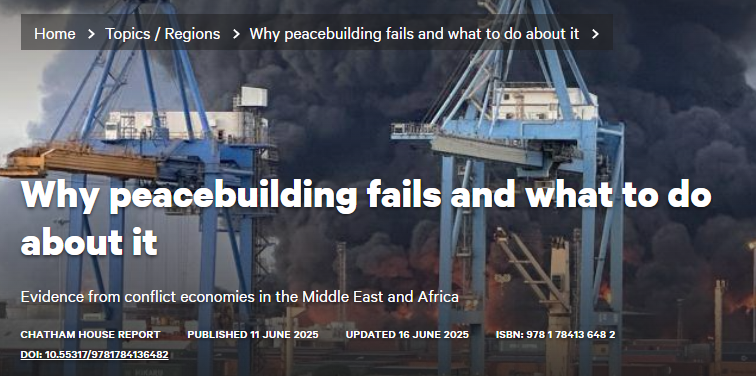
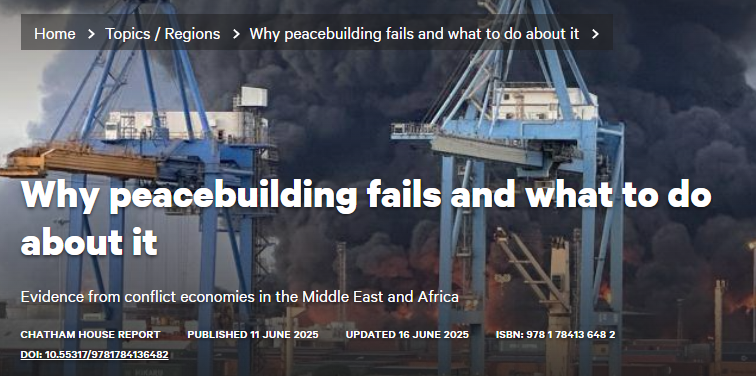
Today, Chatham House remains a strategic relay for British influence in global conflict zones. Its language of peace is never final—only transitional. This article, uses a recent Chatham House report published 11 June 2025 as a lens to expose how “peacebuilding” is framed as failure, precisely because peace, in its genuine sense, terminates governance leverage.
The Paradox of the Peacebuilders
Chatham House’s 2025 report “Why peacebuilding fails and what to do about it” marks the culmination of a five-year investigation into three protracted conflict zones—Sudan, the Iran–Israel axis, and Libya—each framed as a case study in the systemic failure of peacebuilding. Drawing on field research and “follow-the-money” tracing of gold, oil, and migrant flows, the report seeks to illuminate how transnational profit circuits, geopolitical entanglements, and policy inertia entrench violence. But despite this ambition, it never confronts the most glaring structural fact: the peacebuilding paradigm itself is calibrated for continuity, not closure.
The report’s core thesis—peacebuilding has limits—is inverted by its framing. Rather than challenge the architecture of endless conflict management, it reinforces it. “Peace,” as rendered here, is not a destination but a strategic impasse. The same actors—Western states, donors, IGOs—who are positioned as peace-seekers are also shown to benefit from, and reproduce, the very infrastructures that sustain instability.
By spotlighting illicit flows and shadow economies while leaving untouched the formal financial scaffolds and regime partnerships of the “international community,” the report reveals a deeper contradiction: peacebuilding is structurally designed to absorb and adapt to failure, not resolve it. Violence persists not despite policy but often through it—masked by rhetoric, recycled as resilience, and legitimated by the very institutions tasked with ending it.
This section reframes peacebuilding not as an ideal undermined by corruption or complexity, but as a self-reinforcing system—a discursive and logistical regime in which peace is not only unachievable, but undesirable.
Institutional Origin of the Inversion
To understand why peacebuilding fails by design, one must understand the architecture that manufactures its logic. Chatham House, formally the Royal Institute of International Affairs, is not just a research institution—it is a post-imperial narrative node engineered for continuity:
- Founding Vector: Post-Versailles Coordination:
The seed was planted in 1919 at the Paris Peace Conference, where British elites—including Lionel Curtis and Lord Robert Cecil—realised that the sun was setting on the formal British Empire but not necessarily on its global influence. In 1920, they created the British Institute of International Affairs—soon known as Chatham House—as a mechanism to mediate that transition. The goal was clear: produce a knowledge regime that would sustain Anglo-elite control over global discourse without needing direct colonial rule. - Genealogical Anchor: Rhodes–Milner Lineage:
Curtis was a direct ideological descendant of the Rhodes–Milner group—the Round Table networks dedicated to maintaining Anglo-imperial order through soft power, elite education, and epistemic framing. Chatham House was their narrative vehicle: not a forum for neutral dialogue, but a coordination organ—where British strategic interests were laundered through “objective” internationalist discourse. - Twin Pillar: Council on Foreign Relations:
Chatham House’s American twin, the Council on Foreign Relations (CFR), was born from the same Paris conference, forming a bifocal Anglosphere control mechanism. Where CFR consolidated U.S. elite foreign policy consensus, Chatham House held the UK’s post-imperial line. Their coordination has remained intact for a century, synchronising narratives of legitimacy, order, and “rules-based” peace. - Symbolic Geography: 10 St. James’s Square:
Its headquarters—a London estate formerly home to three British Prime Ministers—anchors it not just geographically but symbolically. The site enshrines imperial continuity, ensuring that Chatham House remains a policy sanctuary cloaked in academic neutrality. - Function: Narrative Stabiliser, Motif Broker:
Chatham House does not analyse policy from the outside—it encodes UK foreign policy from within, exporting legitimised narratives into multilateral forums, NGOs, and academic networks. It is both a relay station and a cloaking device.
Today, through initiatives like XCEPT and embedded actors across the Stabilisation Unit and affiliated think tanks, it frames “peacebuilding” not as a path to conflict cessation but as a discursive technology—one that stabilises elite mediation, repackages Western strategic logic, and forecloses alternative frameworks.
Thus, Chatham House doesn’t just study war—it sustains the grammar through which war is selectively pacified and perpetuated. Peace, in this schema, must remain elusive—not a goal, but a rhetorical asset.
The Report’s Actors
The Chatham House report bears the names of two lead authors, Renad Mansour and Mark White. On the surface, their credentials suggest seasoned professionals with deep expertise in Middle East policy, conflict, and governance. Yet a closer look reveals their function within a deeper ecosystem—one that engineers narrative alignment across think tanks, donor consortia, and governmental stabilisation platforms.
- Renad Mansour holds multiple roles. He directs the Iraq Initiative at Chatham House and serves as a senior fellow at both the American University of Iraq–Sulaimani and the Cambridge Security Initiative. But perhaps more crucially, Mansour is the principal investigator for XCEPT, the UK-funded Cross-Border Conflict Evidence, Policy and Trends project. This positioning gives him a dual function: one part academic researcher, the other part narrative codifier. His outputs encode UK foreign policy frames—especially around governance and stability—into regionally palatable language. Through Mansour, the technical vocabulary of “inclusive peace” becomes a vehicle for motif transmission from London into conflict zones.
- Mark White brings a different but complementary function. As the director of First Call Partners, White operates a consultancy that interfaces between governments, international organisations, and private clients. His history, however, marks him as a state actor turned relay agent. White is a former Deputy Head of the UK Stabilisation Unit and the Conflict, Stability & Security Fund (CSSF) Joint Programmes Hub. In those roles, he designed and managed coordination between military, diplomatic, and development instruments. Now, from the semi-privatised perch of consultancy, he continues to align outputs across these same sectors, ensuring that “peacebuilding” narratives reflect UK strategic logic. His background makes him a classic backchannel integrator: not the author of policy, but the engineer of its consistency across platforms.
Behind these authors stand the institutions. Chatham House, long considered the UK’s most prestigious foreign policy think tank, plays the role of motif broker. It converts the coercive logic of intervention and control into the technical vocabulary of “stability,” “capacity-building,” and “transitional governance.” Outputs bearing its logo appear as independent analysis but function structurally as strategic laundering.
The XCEPT project, funded under CSSF and spanning multiple institutions, acts as an operational relay node. It translates strategic concerns—such as migration, sanctions, and resource flows—into policy-adjacent research. The funding structure embeds UK priorities from the outset, even while the outputs present themselves as neutral fieldwork.
First Call Partners, White’s consultancy, represents a newer genre of hybrid actor: nimble, deniable, and plugged into donor circuits. It embeds fiscal logic—who funds what and why—into program design under the pretext of technical support. This makes it a donor relay agent in the architecture of peacebuilding-as-narrative.
Each of these actors, both named and institutional, performs more than an analytical function. They synchronise framing across institutions, repackage UK policy interests as multi-lateral consensus, and stabilise the language of “peace” so that its function serves power. The result is a layered system of coordination in which peace is not a condition to be achieved, but a motif to be controlled.
· If peacebuilding always fails, but its architects remain the same—what exactly is being built, and for whom?
The Discursive Switch: From Peacebuilding to Stabilisation
At face value, the Chatham House report appears to deliver a sobering critique: that conventional peacebuilding has failed. It argues that the actions of Western governments—particularly the UK, US, and EU states—have been unable to resolve protracted conflicts in Sudan, Libya, and across the Israel–Iran confrontation zone. But beneath this veneer of self-critique lies a deeper structural function: revalidating the very paradigm it claims to interrogate.
The report is framed as the result of a five-year initiative. It claims to “follow the money,” highlighting the Sudanese gold trade, sanctions circumvention in Iran, and Libyan migrant smuggling as case studies. These aren’t neutral choices. They reinforce the idea that chaos is driven by borderless greed, illicit flows, and networked actors—therefore justifying complex, donor-led stabilisation frameworks.
This logic is encapsulated in the summary’s framing:
“Peacebuilding must adapt accordingly.”
This phrase sounds innocuous but carries a concealed payload. It suggests the failures of past intervention require recalibration—not reflection or withdrawal. “Adapt” is not about shifting power away from imperial structures; it’s about embedding them deeper, under new management rhetoric. Failure becomes the basis for further investment, not deconstruction.
Another example is the report’s framing of modern conflict:
“States, armed groups and other actors cultivate adaptive alliances with multiple partners across the political and ideological spectrum… often impervious to external policy intervention.”
This language portrays the West as outpaced, struggling to keep up with fast-moving local actors. Yet this erases how British and American policy architectures sculpt those very alliances—via arms deals, intelligence coordination, and financial routing. “Impervious” becomes an excuse for intensifying control, rather than facing complicity.
The report’s language about transnational complexity and “multi-alignment” masks geopolitical intent. “Multi-alignment” isn’t an emergent property; it is an engineered ambiguity used to reframe interventions as pragmatic responses to chaos, rather than as system-generative operations. Chatham House instrumentalises complexity to argue for more embedded imperial coordination—but under new branding.
Further rhetorical manoeuvres appear in passages like:
“The same applies to governments’ attempts to isolate conflict actors from legitimate trading partners: an economic partner in one context may be aligned with adversaries in another.”
This is a subtle rehabilitation of selective engagement—a hallmark of UK foreign policy. It sounds like analytic humility but in practice serves to justify strategic ambiguity and layered alignments: trading with warlords, funding militias through NGOs, or arming “moderate” rebels who shift alliances depending on foreign supply routes.
The text consistently avoids naming the Western state architectures as primary agents. It attributes instability to “market dynamics” or “state-centric limitations” rather than to UK/US policy coordination, arms logistics, and extraction mandates. The analytic framework displaces authorship and obscures profit routes, producing a simulated critique that never threatens operational structure.
By calling for more nuanced intervention—”longer mandates,” “transnational analysis,” “accountability mechanisms”—the report retools peacebuilding as a flexible coordination tool rather than a normative endpoint. Peace is no longer cessation; it is perpetual managerial recalibration, requiring elite actors, donor frameworks, and embedded military-civilian architectures.
This is not an exposure of Western policy failure. It is a doctrine of imperial continuity repackaged through narrative inversion: critique becomes a branding reset. Peace is not questioned. It is redefined to mean embedded presence. Failure is not the collapse of strategy—it is the justification for more.
The rhetorical strategy of the report is thus not to admit error but to reassert ownership over disorder, under the guise of complexity. Chatham House masks imperial function beneath technocratic empathy. It doesn’t oppose the war logic. It updates its lexicon.
Geopolitical Payload: Peace as Continuity of War by Other Means
At its narrative surface, the Chatham House report claims to challenge conventional peacebuilding paradigms. In reality, it refines them—repackaging protracted military-economic engagements as inevitable, complex, and best left to elite management. This manoeuvre isn't rhetorical window dressing. It’s an embedded doctrine.
The UK’s position as both a global arms manufacturer and the epicentre of private military contracting underscores the economic logic of managed instability. London houses the largest concentration of private military companies in the world. These entities function not as outliers, but as integral arms of British foreign engagement, operating in ambiguous legal terrain, often under the veil of humanitarian pretext.
An example of this is provided in the section of the report entitled “Geo-economic conflict ecosystems in the Middle East and Africa” and “Box 1. Rethinking ‘Western’ peacebuilding: terminology in transition” where we encounter:
“Geo-economic conflict ecosystems … reveal about the limitations of peacebuilding and stabilisation as conducted in recent years by the UK, the US, and other states…”
This positions the US and UK as critical but flawed participants—acknowledging operational limits while still centring them as necessary actors. The rhetoric embeds the idea that although previous methods haven’t worked, updated Western coordination remains essential. This is the discursive setup for recalibration without retreat.
The text proceeds to assert that:
“Conflicts are increasing in complexity… multi-alignment of principal actors… peacebuilding must adapt accordingly.”
In this construction complexity is mobilised not as a condition to exit from but a justification for further embedding. The need to “adapt” is a euphemism for retooling intervention logic, not abandoning it. Failure is not a reason to withdraw—it is a reason to reinvest, with new tools, deeper control, and longer mandates.
Nowhere in this segment is there acknowledgment of who sustains the weapons flows, manages the financial architecture that underwrites these conflicts, or controls the narrative apparatus—namely, the UK and US. This reproduces strategic absence: the imperial core is always reactive, never generative of the very conflicts they seek to “resolve.”
This absence is further reflected in the statement:
“We acknowledge that the terms ‘West’ and ‘Western’ have become less analytically relevant… but remain embedded in policymaking discourse…”
This rhetorical move sidesteps historical power asymmetries. It turns imperial geography into semantic drift, reducing empire to a linguistic habit, rather than a structural system. This is doctrine disguised as reflection: it performs nuance while operationalising imperial continuity.
Box 1. concludes by asserting that:
“While often grouped together under the banner of ‘stabilisation and peacebuilding’, policies such as sanctions, counterterrorism operations, military interventions and securitised migration controls serve distinct objectives and operate on different logics, typically prioritising initial responses to violence or the immediate threat of violence. In contrast, peacebuilding seeks to address the deeper, structural drivers of conflict through long-term efforts such as strengthening accountability, supporting inclusive governance and fostering social cohesion.”
By claiming these measures “serve distinct objectives,” the report fractures the operational unity of Western foreign policy. In reality, sanctions, military pressure, and migration control are not side-effects—they are integral to peacebuilding as practiced. They form a weaponised pipeline of influence, disruption, and coercive leverage used to maintain favourable alignments in contested geographies.
Here, peace is presented as a technocratic upgrade to previous missteps. But this masks the imperial logic of intervention: that stability, accountability, and “inclusive governance” are often defined, managed, and enforced by the very actors who generate conflict asymmetries. “Structural drivers” are never traced to extractive trade agreements, arms deals, or policy manipulation by UK/US-linked institutions.
This passage isolates “initial responses” (e.g., bombing campaigns, drone strikes, border militarisation) from the long-term aims of peacebuilding—as if these are unrelated. In practice, the short-term interventions set the terrain for the long-term reconstruction agenda: new elites are installed, economic models reshaped, and civil society co-opted through donor frameworks. There is no structural separation.
This offers a textbook institutional gaslighting: it acknowledges harm while denying systemic intent. By presenting imperial tools as emergency responses rather than embedded strategies, it neutralises critique so that peace is not the absence of violence—it is its narrative mask.
The “failures” in Libya, Sudan, and Iran-Syria dynamics highlighted in the report do not represent policy misfires. They reflect a structural preference: perpetual conflict zones facilitate British presence, justify surveillance architecture, and create demand for advisory and logistics contracts. Peace, in this framework, is not the cessation of war, but its reformatting into controllable, monetisable stalemates.
This logic isn’t new. It’s the imperial algorithm that birthed the Muslim Brotherhood to destabilise nationalist movements, that midwifed the Saudi state under British tutelage, that helped construct the Zionist colonial project as a Western beachhead, and more recently, that supported proxy actors like the White Helmets to fragment opposition consensus under the guise of humanitarianism.
The report also subtly encodes UK ambition in the Sahel. Described as a security vacuum and migration corridor, the region is framed as a permissive theatre for stabilisation interventions—read: extended extraction and influence operations. British arms exports, alongside military training programs, target this geography with increasing focus. Peacebuilding becomes the PR for militarised insertion.
Financially, this machine is insured and bankrolled by the City of London. As the heart of global banking, reinsurance, and extractive capital, the City provides the lubrication for sanctioned trades, asset laundering, and sovereign immunity deals. Every “protracted crisis” covered by the report overlays precisely with these flows. The authors follow the money—but only so far. The true destination is never disclosed.
Peace, as constructed by Chatham House, is a branding strategy for elite-managed asymmetry. It functions to obscure UK complicity in sustaining wars it claims to end, and to stabilise narratives that protect profit streams from disruption. To call this peace is to call the banker a humanitarian for issuing loans to the bombed. It is a weaponised fiction.
Three Case Studies: Three different Alibis
Each of the three case studies—Sudan’s gold trade, Iranian oil sanctions circumvention, and Libyan migrant smuggling—serves a distinct but convergent role in constructing the report’s overarching narrative of “complex, decentralised, transnational” conflict economies. Collectively, they function as motif amplifiers that displace Western structural authorship while reinforcing the need for embedded elite management. Here's how each functions narratively:
1. Sudan’s Gold Trade – Conflict as Commodity Ecology
Function: Local proxy for global extractive dynamics retooled through imperial recursion.
The Chatham House narrative frames Sudan’s gold conflict as a result of fragmented authority and decentralised war economies. However, the accompanying timeline and the contextual framing above it expose a deeper imperial logic: Sudan is not a collapsed state reacting to global markets, but a coerced battleground within a pre-scripted imperial program.
Recall that Sudan was one of the seven countries named in General Wesley Clark’s now-infamous post-9/11 account of planned US regime change operations—a structural blueprint rather than an accidental sequence. The “Fall of Omar al-Bashir” in 2019 is not merely a local turning point, but a synchronisation with that plan’s deeper trajectory.
The Chatham House framing pretends to “follow the money,” yet it stops short of following it to London’s commodity exchanges, Dubai’s laundering circuits, or the shadow banking operations run through UK-linked offshore jurisdictions. Instead, it portrays gold as a transnational object of criminal appetites rather than a deliberately financialised vector of control. The gold flows are treated as disorderly symptoms, not as the strategic scaffolding of a gold-backed war economy that ensures military, diplomatic, and trade access for UK-aligned actors.
The chart data confirms this sleight of hand:
- From 2012 to 2023, official gold exports remain far below production, indicating large-scale shadow flows.
- Wagner Group involvement is acknowledged early (2014), but the City of London’s commodity trades, gold-backed reinsurance mechanisms, and IMF structural leverages remain unmentioned.
- The 2023 RSF–SAF civil war coincides with gold’s formal designation as a “strategic war asset”, a narrative marker that makes war appear reactive rather than managed.
This case is not about local collapse—it is about the external codification of collapse. Chatham House uses Sudan to rehearse a well-worn doctrine: that Western intervention must persist because the terrain is chaotic. But this chaos is constructed. The SAF and RSF are not errant militias—they are managed proxies, whose access to weapons, logistics, and markets is enabled through imperial intermediaries. Sudan’s war is not self-perpetuating—it is monetised disorder under narrative control.
The humanitarian framing—”13 million displaced,” “mass atrocities,” “famine”—while factual, serves to humanise disaster without interrogating its architecture. It elicits moral urgency but protects geopolitical authorship.
2. Iranian Oil Sanctions Evasion – Legibility through Illegibility
Function: Legality-denial as imperial force multiplier.
Chatham House frames Iranian oil flows as an unintended consequence of sanctions pressure—adaptive “shadow networks” undermining enforcement. But the visual data in the timeline chart and oil flows diagram show the opposite: these flows are the infrastructure of control, not its breakdown.
Between the JCPOA signing (2015) and its sabotage (2018), Iranian oil routes become increasingly formalised. After the Trump-era withdrawal and “maximum pressure” campaign, Iranian oil export networks don’t collapse—they expand. From 2021–2023, exports average 1.0 million barrels/day, with profits reaching $12.7 billion. The key corridors—via UAE, Malaysia, Singapore—operate under maritime, banking, and insurance ecosystems maintained by UK-allied jurisdictions.
What the report conceals:
- Sanctions are not neutral law—they are acts of economic war. Unilateral US and UK sanctions against Iran, absent UN authorisation, violate international law under the UN Charter and WTO norms. They are extra-legal instruments of coercive diplomacy.
- Rules-Based Order hypocrisy: The same powers that brandish the “rules-based international order” discard it when inconvenient. The UK champions Ukrainian sovereignty while helping enforce collective punishment against Iranian civilians via secondary sanctions. The West’s legalism is selectively invoked, never structurally applied.
- Illegibility as control: Smuggling is portrayed as a governance failure. In reality, it's a system of controlled opacity. The UK maritime services sector—insurers, legal firms, and ship registries—profits directly from ambiguity. Complexity = deniability = profit.
- Surveillance-industrial expansion: Far from reducing UK involvement, this “problem” justifies expanded monitoring, intelligence-sharing, and naval cooperation. It invites deeper entrenchment in Gulf policing regimes under the pretext of stability and non-proliferation.
The report's language—”shadow fleets,” “irregular channels,” “unregulated” activity—casts the UK as a passive observer or overwhelmed regulator. But these networks are constructed through intentional legal ambiguity and offshore financial architecture, much of it UK-linked. The imperial centre is masked behind a rhetoric of overwhelmed enforcement, when in fact it is the principal system-builder.
Structural payload:
- Surveillance = solution
- Sanctions = default tool of diplomacy
- Peace = enforcement architecture, not violence cessation
- Illegality = rationale for expansion, not withdrawal
The Iranian oil case does not expose the failure of peacebuilding, but the success of asymmetrical imperial enforcement masquerading as international law. “Peace,” in this framework, is the branding for coercive compliance. The sanctions evasion narrative—centred on ghost fleets, insurance blacklists, and offshore registries—portrays Iran as a rogue trader, while masking the Western financial and naval architectures that surveil, regulate, and selectively tolerate these operations. These same enforcement patterns now escalate in the war against Russia—a primarily UK-driven project that spans Ukraine, Iran, and the Baltic Sea. Iran’s targeting serves a dual function: isolating it from BRICS realignment and securing maritime routes to the Arabian Sea. What appears as fragmented sanction policy is in fact a coordinated imperial logistics program—one that criminalizes strategic autonomy while refining the tools of maritime control and reputational warfare.
· When the same “ghost fleet” tracking systems target Iran and Russia, and the same London insurers underwrite the chaos—is “peacebuilding” just the brand name for permanent sanctions warfare?
3. Libyan Migrant Smuggling – Humanitarian Crisis as Security Justifier
Function: Migration flows as imperial logistics theatre.
The Chatham House narrative frames Libya as a “chaotic” migrant corridor, where criminal networks and fragmented governance challenge humanitarian ideals. The timeline graphic and complex migrant flows diagram chart from West and East Africa through Libyan chokepoints (Tripoli, Benghazi, Kufra) into European containment architecture. But this visualisation of movement conceals the architecture of its management.
Libya’s collapse was not an organic event—it was catalysed by the illegal 2011 NATO intervention (without UN Security Council authorisation), justified under R2P doctrine and led by the UK, France, and the US. Libya was also on General Wesley Clark’s post-9/11 Pentagon list of states slated for regime change—a programmatic sequence of strategic disruption under the guise of humanitarianism.
What’s omitted:
- Militarisation of border control: The EU and UK finance and equip Libyan Coast Guard units—many with direct lineage to militia factions—to interdict migrants. These units operate under opaque legal authorities, with Western contractors providing training, intelligence, and logistics.
- NGO-coopted border zones: International aid agencies are embedded in EU migration management policy, serving dual roles: providing humanitarian services while supporting surveillance, registration, and selective repatriation pipelines. The humanitarian mantle legitimises securitised governance.
- Externalisation doctrine: The so-called “regulation” phase (2018–25) described in the timeline chart is not a policy failure—it is a success for the externalisation agenda. Libya serves as a holding zone, where EU migration control is exercised without democratic scrutiny.
- British hands hidden in plain sight: The UK’s role is sanitised into technical expertise, diplomacy, or “development.” Yet British firms and government-linked contractors are active in surveillance systems, data analytics for migration risk profiling, and security sector reform under counter-terror narratives.
By isolating “migrant smuggling” from the NATO-induced geopolitical collapse, the report recasts mass displacement as a matter of criminality rather than consequence of an illegal war of aggression that dismantled Libya’s sovereign infrastructure, shattered regional stability, and opened the terrain to militia rule, foreign interference, and transnational trafficking networks. Its emphasis on “unintended consequences” strips the 2011 intervention of accountability, framing it not as a calculated act of regime demolition but as a misstep in complexity management. In doing so, it portrays migration control as a reactive and reluctant measure, rather than what it is: a central pillar of the UK–EU border security architecture.
Strategic Payload:
- Crisis = legitimacy for forward basing
- Human flows = reason for security agreements
- Smuggling = justification for tech-military hybridisation
- Peace = regional containment, not restitution.
Libya is not a failure of peacebuilding—it is the staging ground of peacebuilding’s true function: transforming post-intervention chaos into a managed logistics platform for imperial operations. The cited figures—183,000 peak migrants, fractured smuggling corridors—are not indicators of crisis, but indexes of opportunity: displacement as resource. Migration flows are rendered legible for funding mechanisms, biometric surveillance, and militarised border outsourcing. But beneath the humanitarian alibi lies a deeper strategy: repopulating labour markets in Europe with precarious, rightless workers; degrading domestic wage floors through importable desperation; and inflating housing markets through manufactured scarcity. Libya’s fragmentation becomes not a warning, but a model—of how to generate geopolitical utility from collapse while selling it as stabilisation.
Synthesis: The Structural Payload
The three case studies in the report do not merely illuminate the complexities of Sudan's gold economy, Iran's sanctions-busting oil networks, or Libya's migrant corridors—they serve as functional schematics for recalibrating Western intervention. Under the surface of analysis lies an operational doctrine: conflict economies are to be governed, not dismantled; managed, not resolved. Complexity itself becomes the legitimating ground for indefinite technocratic-military engagement.
What appears as diagnosis is in fact design:
- The depiction of transnational, non-hierarchical, and “multi-aligned” systems constructs a condition where disengagement is unthinkable. Western actors are thus positioned not as sources of structural disorder, but as overwhelmed custodians attempting to restore legibility.
- The invocation of fragmentation becomes a rhetorical instrument to revalidate elite coordination structures: stabilisation is framed as a technocratic puzzle to be solved by those with oversight capacity—implicitly, the West—while masking its own historical role in inducing that fragmentation.
- Each case manufactures distance between the core and the periphery: causality is displaced to borderlands, ghost routes, and local actors, while the architectures of extraction, surveillance, and sanctions housed in London, Brussels, and Washington remain unnamed. This is not oversight—it is narrative design.
The policy frame thus emerging does not challenge empire; it retools it.
Sanctions are not critiqued for their legality or coercive asymmetry—they are reformulated as insufficiently adaptive, in need of better enforcement architectures. Gold smuggling in Sudan is not traced back to the British-linked commodity exchanges underwriting the trade; instead, it becomes a case for “regional coordination.” Iranian oil flows are not traced to maritime insurers, brokers, and banks in British territories—they become a reason to upgrade intelligence platforms. Migration out of Libya is not traced to the NATO-led war that destroyed the Libyan state—it becomes a reason for deeper coordination with militias-turned-border guards.
By rendering the West as a reactive subject—managing complexity, rather than producing it—the report transforms complicity into critique, and critique into mandate. Its real output is not knowledge but narrative cover for more granular control. These case studies do not interrogate imperial structures; they operate as localised alibis for their systemic recalibration.
Governing the Fallout: Imperial Diagnostics in an Era of Managed Collapse
The final section of the Chatham House report, “Rethinking policy and programming in an era of multi-alignment,” presents itself as a roadmap for adapting to a fragmented global order. But this is not a retreat from empire—it is a manual for its modular recalibration. Beneath its language of reform, resilience, and coordination lies a more precise strategic function: imperial fallout management. It is a post-conflict audit not of how war begins, but of how its aftershocks can be shaped, contained, and selectively monetised.
The report acknowledges that Western policies—sanctions, military interventions, and securitised migration regimes—have “unintended consequences.” But this framing is not an admission of fault; it is an institutional deflection strategy. It recasts strategic design as tactical misfire, turning deliberate acts of destabilisation into lessons in policy agility. Complexity, multi-alignment, and transnationality are not treated as the logical outcomes of Western fracture operations—they are reinterpreted as the unpredictable context into which Western policy must now more smartly insert itself.
From Structural Violence to Strategic Flexibility
What the report performs is post-hoc imperial diagnostics: learning from the friction points of dominance, not to dismantle them, but to make them smoother.
- Sudan’s dismemberment is not interrogated for its origin in regime-targeted subversion and gold-fuelled proxy fragmentation, but for how its fractured landscape might be re-engaged.
- Iran’s sanctioned economy is not examined as a case of economic siege warfare, but as a surveillance problem—how to better track ghost fleets and grey networks.
- Libya’s collapse is not a NATO-induced implosion, but a logistics issue in the management of migrant flows.
These case studies function as cautionary guides, not about overreach, but about how to retain leverage amidst blowback.
Three Core Functions of Fallout Governance:
- Containment of Blowback: The report sidesteps primary accountability by focusing only on secondary effects. Sanctions failure, proxy spillover, human trafficking—these are attributed to bureaucratic gaps or misaligned priorities, not to the original acts of intervention that created the conditions.
- Narrative Re-legitimation: “Multi-alignment” is treated as a threat to Western influence, rather than evidence of its decline. This allows a repositioning from hegemon to flexible node, from imperial planner to adaptive responder. The shift is semantic, not structural: dominance rebranded as agility.
- Strategic Leverage from Disorder: Rather than dismantling shadow economies or smuggler networks, the report suggests integrating them into more visible, more governable systems. It reframes illegibility as an intelligence opportunity, not a byproduct of militarised failure. The goal is to route disorder through enforceable channels, creating new surveillance markets and regulatory instruments.
Diagnostics as Doctrine
The final recommendations—adapt transnational analysis, coordinate across silos, engage pragmatically with adversaries—are technocratic smoothing operations. They do not challenge the legitimacy of the interventions that birthed these crises. They do not propose withdrawal or restraint. Instead, they aim to refine the delivery architecture of empire to operate more effectively amid entropy.
- Sanctions are to be better targeted, not rescinded.
- Migration controls are to be better managed, not dismantled.
- Proxy engagement is to be more nuanced, not rejected.
Even calls for “progressive realism” function as moral veneers, masking continuity with rhetorical refresh.
The Real Agenda: Managing the Ruins
Ultimately, this is not a report about rethinking foreign policy. It is a strategy paper for post-crisis control. It teaches elite planners how to learn from the system’s own instability—to treat collapse not as failure, but as a chance to reassert order through new tools, new narratives, and new forms of indirect governance.
The policy class is not abandoning intervention—it is retrofitting it. By auditing imperial blowback without interrogating imperial causality, the report protects doctrine while updating tactics. It is an instruction set for managing, leveraging, and profiting from the geopolitical chaos the West has helped produce.
This is not restraint. It is reconsolidation. Not accountability. Adaptation. Not rupture. Reboot.
Narrative Devices That Block Peacebuilding
The Chatham House report operates as a discursive architecture—a carefully staged script that simulates institutional reflexivity while re-securing policy authority. Its rhetorical terrain is not neutral: it manufactures legitimacy, constructs necessity, and re-codes power as moral urgency.
The core narrative devices deployed to neutralise accountability and reauthorise intervention under the guise of adaptation are as follows:
- Directive Modals and Strategic Inevitability: The repeated use of modals—”must be addressed,” “requires urgent reform,” “should prioritise”—generates a forward-moving urgency that forecloses deliberation. These imperatives are framed as logical consequences of complexity, but function as strategic scripts for deeper engagement. This rhetorical tempo accelerates the timeline for action without allowing space to question foundational premises. It reframes violence as a trigger for policy refinement, not withdrawal.
- Abstract Agents and Masked Accountability: Throughout the report, responsibility is projected onto systems, flows, and dynamics: “migration flows,” “illicit trade,” “conflict ecosystems.” These abstractions obscure the role of Western statecraft in engineering such conditions through military action, economic sanctions, and proxy governance. By replacing actors with processes, the report removes attribution. The architecture of war becomes a passive backdrop, not a structure with authors.
- Recursive Moral Framing as Legitimacy Engine: The document stages a morality loop: admit failure, confess limits, promise reform. This recursive moral structure produces the illusion of transformation. “We failed” becomes “we must try harder,” not “we must stop.” This feedback loop elevates the institution’s moral authority by centring it as the self-correcting agent. It turns critique into continuity—every failure is a credential for deeper engagement.
- Quantitative Modifiers as Consensus Fabricators: Phrases like “entrenched dynamics,” “increasing instability,” or “significant humanitarian costs” act as discursive fog—unverifiable yet emotionally loaded. They simulate empirical consensus without citation, giving policy recommendations the appearance of scientific inevitability. The report uses this technique to equate urgency with legitimacy, and scale with necessity. Crisis inflation becomes the rationale for escalation.
- Moral Absolutes and Virtue Shielding: Statements invoking “the international community,” “stability,” or “shared responsibility” elevate elite policy networks into moral arbiters. This device shields Western actors behind the illusion of global consensus and humanitarian concern. It frames strategic interests—border control, sanctions, surveillance—as ethical imperatives. The result is not policy debate, but moral absolutism: if you oppose the intervention, you oppose stability.
- Terminological Drift and Institutional Invisibility: Key terms—”multi-alignment,” “adaptive programming,” “cross-border coherence”—function as semantic absorbers. They mask continuity as innovation, and elite control as decentralised responsiveness. This terminological drift allows for strategic recalibration without institutional rupture. The UK, EU, and allied states remain at the centre—but now as flexible facilitators rather than hard power architects.
- Simulation of Locality as Legitimacy Proxy: Civil society, “local actors,” and regional “stakeholders” are invoked strategically, not substantively. They appear as necessary ornaments to legitimise top-down programming. But their agency is pre-bounded: they must be “enabled,” “supported,” “strengthened”—always in passive alignment with externally defined priorities. Local actors become instruments of external governance, not co-authors of peace.
Together, these devices do not just explain Western failure—they pre-empt alternatives. They entrench the institutional monopoly on peacebuilding by scripting critique as a form of elite adaptation. Complexity becomes a governing strategy, not a problem to be solved. By packaging reform as necessity, and necessity as inevitability, the report does not rethink power—it rebrands it.
Peace is not de-militarisation. It is not reparative justice. It is not non-alignment. It is policy adaptability, coordinated surveillance, and flexible coercion—delivered under the banner of ethical governance.
This is not a failure of imagination. It is the imagination of failure, deployed to reauthorise domination.
Fracture: Peace as a Strategic Continuity Device
The core contradiction at the heart of the Chatham House report lies in its framing of peace as both elusive and indispensable—never quite achievable, yet always justifying renewed intervention. The failure of peacebuilding is not treated as a reason to withdraw or radically rethink strategy. Instead, failure becomes the rationale for deeper institutional embedding.
This is not incidental. It is structural.
· Who authorised Chatham House—and its policy class—to define peace? What constituencies do they answer to, outside themselves?
Peace as Perpetual Incompleteness
By constructing peace as a process rather than a destination, the report ensures that its architects remain essential. This aligns with the operational logic of stabilisation units, donor networks, and conflict governance professionals—whose roles only persist insofar as peace never does. The act of “making peace” is transformed into a platform for strategic permanence.
· When the same governments that destroy states also fund their stabilisation, where does accountability live—if not in naming empire?
Motif Inversion and Institutional Immunity
Where “peace” traditionally signalled cessation, here it becomes a cipher for continuity. Peacebuilding is reframed as the management of chaos rather than its resolution. The actors responsible for prior failures are not displaced; they are reauthorised as the only ones capable of mitigating what they failed to prevent.
This motif inversion shields institutional roles from accountability. Narrative authority is retained not by proving efficacy, but by narrating complexity—positioning Chatham House and its partners as the indispensable interpreters of a world they helped destabilise.
· If the report names complexity as the obstacle, why are the architects of that complexity tasked with its solution?
The Inversion Lock
The Chatham House report doesn’t argue that peace is a failure. It performs that failure—and then sells the performance as insight. This inversion lock reinforces the need for coordination among Western governments, technical experts, and security consultants who all speak in the same idiom of resilience, adaptation, and multi-vector complexity.
What collapses is not just the meaning of peace—but the very capacity to contest its authorship. Peace is no longer a demand of the governed. It is a brand of the governing.
This is the fracture that completes the imperial loop: failure becomes doctrine, doctrine becomes mandate, and mandate becomes the license to repeat failure—only with better branding and broader reach.
· When every critique becomes a reform proposal, and every failure a learning opportunity, how do we mark the boundary between introspection and imperial adaptation?
Published via Journeys by the Styx.
Geopolitika: Tracing the architecture of power before it becomes the spectacle of history.
—
Author’s Note
Produced using the Geopolitika analysis system—an integrated framework for structural interrogation, elite systems mapping, and narrative deconstruction.