Geopolitika: Politics as Kayfabe – Trump’s Oval Office Speech, Venezuela, and the Backroom Boys Who Write the Script
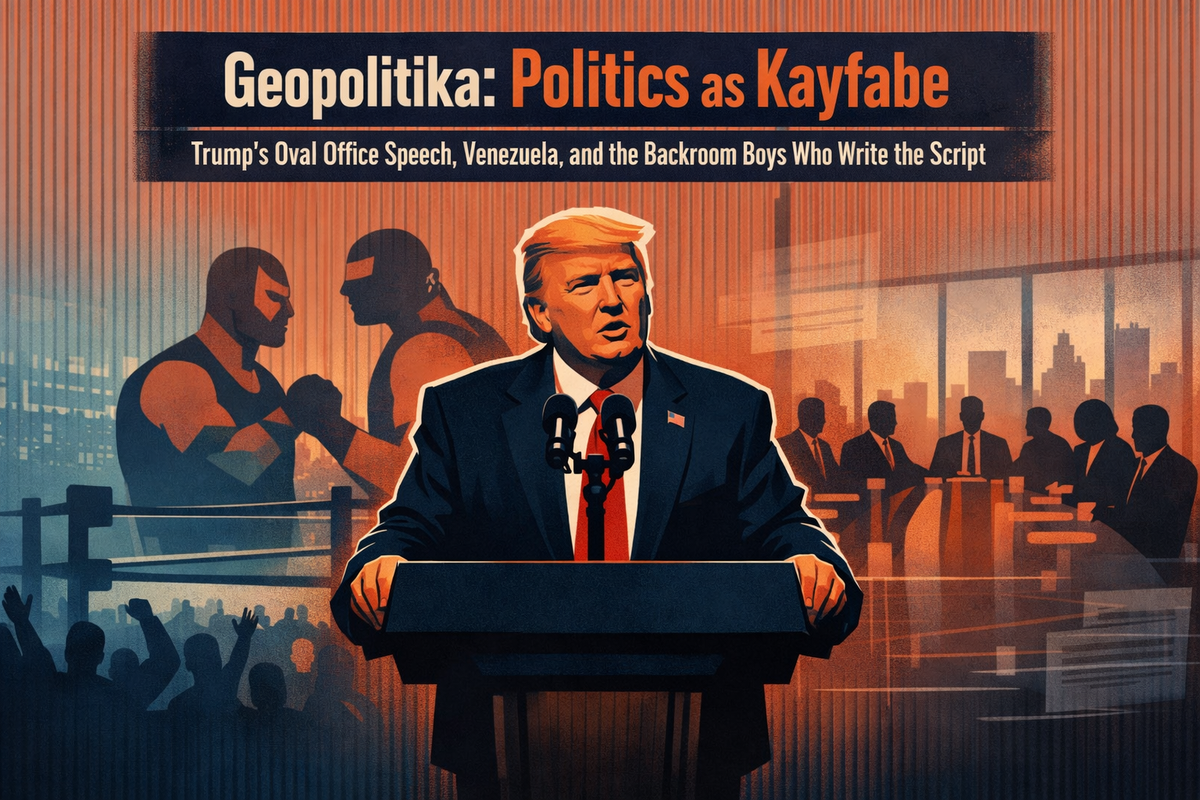
On 17 December, Donald Trump stood in the Diplomatic Reception Room and did what presidents are supposed to do in moments of “national importance”: speak solemnly to the nation from the Oval Office.
The script was familiar:
- “I inherited a mess”
- “Our border is secure”
- “Inflation has stopped, wages are up, prices are down”
Depending on your priors, it played as either triumphant, delusional, or just another campaign speech in fancier packaging.
But if you zoom out from the day-to-day noise and line that speech up against what was happening at the same time around Venezuela—the push to talk about fentanyl as a “weapon of mass destruction,” calls for a naval “blockade,” the steady tightening of sanctions and control over Venezuelan oil flows—you get something more interesting.
You’re not just looking at one man’s style. You’re looking at a show format.
A domestic episode (“I fixed America”) and a foreign episode (Venezuela as permanent crisis theatre) are running in parallel, using the same tricks: upgraded labels (“invasion”, “WMD”), permanent emergencies, simple heroes and villains, and a leader who claims to personally fix what entire systems produce.
To make sense of that, it helps to treat Trump not as an anomaly but as someone who imported two very specific entertainment logics into politics:
- Pro wrestling – kayfabe, feuds, promos, faces and heels
- The Apprentice – boss in the boardroom, deserving contestants, weekly verdicts
And behind all of that, you have the people you never see on camera: the “backroom boys” in think tanks who lay out the basic plot, the enemy list and the acceptable tools long before any president opens his mouth.
This isn’t about whether you “like” Trump. It’s about recognising how the show is structured, who writes it, who profits from it—and what gets locked in as “normal” when politics runs on this script.
The Night the Boss Cut a Promo from the Oval Office
The Oval Office address follows a simple arc:
- Collapse – “When I took office, I inherited the worst inflation in half a century, an open border, wars everywhere. The country was ‘dead’.”
- Action – I declared emergencies, did unprecedented deals, imposed rules, fixed the border, crushed the cartels, ended the wars.
- Resolution – “After just 11 months, our border is secure, inflation has stopped, wages are up, prices are down.”
- Blessing – Special gifts for chosen groups: no tax on tips and overtime, a “Warrior Dividend” payout for 1.45 million service members, reassurance that America is “back” and destiny is restored.
If you’ve ever watched a wrestling promo or a reality-TV season recap, this should feel familiar.
It’s not framed as: “Here’s what the Federal Reserve did, here’s what global supply chains did, here’s how our sanctions regime affected oil prices, here’s how multiple agencies managed migration.”
It’s framed as: “Previously on America: disaster. This season: I fixed it.”
At roughly the same time, in the wider US information sphere:
- Fentanyl is being talked about as a potential “weapon of mass destruction”.
- Venezuela is framed as a mix of failed socialism, narco-state, terror hub, and geopolitical outpost for US rivals.
- Sanctions, asset seizures, naval deployments, and airspace control around Venezuelan oil routes are justified as protecting Americans from this supposed fusion of crime, terror, and energy insecurity.
The domestic and foreign tracks are not identical. But the structure is the same:
Disaster ➝ Threat inflation ➝ Strong measures ➝ Leader takes credit for “safety” and “restored strength”.
To see how that works, you need the two entertainment formats he knows best.
Kayfabe in the West Wing: Wrestling Logic Meets State Power
Start with wrestling.
In big-time pro wrestling, nothing matters more than:
- Faces (heroes) vs heels (villains).
- Kayfabe – the agreed-upon “reality” everyone performs, even though it’s scripted.
- Promos – speeches where a wrestler hypes himself, buries the opponent, and sets stakes for the next match.
- Cheap pops – guaranteed crowd reactions (mentioning the city name, praising the troops, attacking a hated enemy).
Now put that lens over the Oval Office speech:
- The “inherited mess,” “worst border in the world,” “border invasion by 25 million people,” and “threats destroyed” abroad are all heel building: you don’t get details; you get villains.
- The repeated “I fixed it” lines are face building: one man stands between you and chaos.
- The hero list—“our great workers,” “our warriors,” “our police,” “our farmers”—is pure cheap pop.
- The entire address functions as a promo: recapping past feuds, claiming victory, teasing future fights.
In wrestling, you don’t stop the show to debate the real win-loss record, or whether the tables are actually steel. The question is: did the crowd pop?
The same thing happens here. Fact-checking becomes the equivalent of a guy in the front row insisting the punch didn’t really land. Technically true; politically irrelevant. The system is running on kayfabe, not policy seminar logic.
And that’s useful if you want to:
- Keep complex systems (monetary policy, migration law, sanctions architecture) offstage.
- Turn every structural problem into a personal feud between the hero and a rotating villain.
The wrestling logic is what lets “border management” be talked about as “invasion versus total security,” and drug policy as “WMD threats versus total destruction,” instead of as a grind of courts, agencies and treaties.
The Apprentice Presidency: Boardroom Sovereignty and Deservingness
Then add The Apprentice.
That show runs on a simple structure:
- One Boss at the top of the table.
- A group of contestants competing in rigged “business” tasks.
- Weekly boardroom scenes where:
- the Boss recaps the task,
- grills contestants,
- and decides who deserves to stay or be fired.
Now re-read the Oval Office address with that frame on:
- The opening “I inherited a mess” is the CEO saying, “This company was a disaster before I came in.”
- The policy list—border crackdowns, wars “settled,” energy emergencies, drug price rules—is the montage of tasks.
- The big claims—record investment, huge wage gains, crushed threats—are the highlight reel.
- The fiscal goodies (no tax on tips/overtime, Warrior Dividend) are the boardroom verdict: these people get to stay, they’re safe and valued. Others are, implicitly, not.
That format does some quiet structural work:
- It concentrates agency. The president is framed as the only real decision-maker. Agencies, legislatures, courts, foreign governments become background scenery.
- It turns distribution into morality. Tax breaks and one-off payments aren’t presented as part of a larger system; they’re framed as moral judgments on who “deserves” a reward.
- It normalises precarity. Contestants are always anxious; someone is always on the edge of being fired. Politics under this logic is permanent audition and elimination.
When you fuse the wrestling promo with the boardroom episode, you get:
- A screamingly simple moral world (faces vs heels).
- A clear hierarchy (one Boss, many contestants).
- And an audience trained to see personal victory and defeat instead of structural continuity.
At that point, we get to the bit the TV never shows you: the writers’ room.
Backroom Writers: Think Tanks as Script Department
Trump doesn’t stand alone in the Diplomatic Reception Room inventing “narco-terror WMD fentanyl” or “invasion at the border.” Those frames are already circulating in policy land before they ever reach a teleprompter.
That’s where think tanks come in.
They function as the backroom boys:
- part writers’ room,
- part lore-keepers,
- part continuity editors across administrations.
Their jobs in this system:
Enemy design
They decide which actors get cast in which role:
- Venezuela as failed socialist narco-regime with terror links and Chinese or Iranian fingerprints.
- Migrants as tools of “hybrid warfare” or “cartel invasion.”
- Fentanyl as WMD-adjacent, not just a drug, so you can justify military and homeland-security tools.
Those frames appear first in reports, panels, briefings, “strategic outlook” documents; then they bleed into speeches as if they were natural categories.
Threat inflation and label upgrades
Think tanks are where an issue gets pushed up a rung:
- From crime to terrorism.
- From public health to national security.
- From market volatility to “economic warfare”.
Once a phrase like “weapon of mass destruction” or “invasion” lands in a respectable PDF, it’s much easier for a president to use it in a televised address and be treated as “tough” rather than unhinged.
Policy arcs as story arcs
They package entire policy toolkits into three-act structures:
- Problem – chaos, vacuum, failed leadership, enemies emboldened.
- Response – sanctions, blockades, emergency declarations, new rules.
- Payoff – stability, deterrence, “restored credibility.”
The Oval Office speech simply plugs into the third act: “Here’s how my decisive actions saved you.”
Continuity across seasons
Presidents come and go. Many of the core narratives don’t.
Think tank outputs help ensure that:
- Venezuela remains a forever problem—no matter who’s in office, it cycles through terror, crime, humanitarian concern, great-power competition.
- The southern border remains a forever crisis, toggling between “invasion” and “mission accomplished” without ever leaving the emergency frame.
- Certain enemies (Iran, China, Russia, etc.) remain permanent fixtures in the cosmology, even if the tone shifts.
So when Trump steps up to the mic and talks about threats destroyed, borders secured, and hostile regimes contained, he is plugging his reality-TV style into pre-written lore. The writers’ room set the boundaries of the universe; he ad-libs inside it.
Two Theatres, One Script: Homefront Promo, Foreign Episode
Put all of this together and you see the same script playing out on two stages.
The homefront episode
On the domestic side, the Oval Office speech does the following:
- Casts the immediate past as total collapse: worst inflation, dead economy, open borders, wars raging.
- Credits one leader’s 11 months with miracle repair: secure border, stopped inflation, higher wages, lower prices, record investment, wars ended.
- Hands out visible rewards to chosen groups:
- tax-free tips and overtime for certain workers,
- the “Warrior Dividend” for service members.
- Wraps it all in destiny language: America restored, greatness returning, future bright if you stick with the hero.
The Venezuela episode
On the external side, the Venezuela theatre runs in parallel structure:
- Past: years of misrule + collapse, framed mainly as the failure of a hostile regime. The contribution of US sanctions and financial strangling is downplayed or spun as moral leverage.
- Threat inflation: narco-terror networks, Hezbollah whispers, Chinese or Russian influence, fentanyl exports, uncontrolled migration.
- Response: sanctions mesh, asset seizures, freezing of reserves, control over oil routes, talk of “blockade,” naval presence and airspace control.
- Payoff: presented to domestic audiences as defence of American security and energy, not as active participation in another country’s long crash.
Same skeleton, different scenery.
In both cases, the winners are similar:
- Security and military operators get a permanent flow of missions, budgets, and legitimacy—from the border to the Caribbean.
- Sanctions and financial bureaucracies get to use their tools aggressively with little public scrutiny; the consequences show up as “regime failure,” not as policy choice.
- Think tanks and media get endless content: crises to explain, enemies to analyse, strong actions to endorse or criticise within narrow bounds.
- Select domestic constituencies—warriors, chosen workers—get symbolic and material rewards that reinforce their loyalty to the show.
And the losers—Venezuelans living under compounded collapse, migrants treated as props in a border drama, precarious workers who don’t fit the deservingness script—remain largely offstage.
What This Style Quietly Normalises
The point of reading this as kayfabe plus reality TV isn’t to say “it’s all fake.” The power is real; the policies are real; the consequences are real.
The style is a device to normalise certain structures.
Executive hyper-centrality
You never hear:
“A complex mix of central bank decisions, global energy markets, corporate pricing strategies, wage bargaining and fiscal policy produced these outcomes.”
You hear:
“When I took office it was the worst in history; now, under me, it’s fixed.”
That keeps your explanatory world small. There is always someone to vote for or against; there is rarely a system to confront.
Permanent emergency
By upgrading labels—
- drugs → “WMD”;
- migration → “invasion”;
- rival states → existential threats—
you shift everything into war logic.
Once you’re in that frame, emergency powers, sanctions, blockades, walls and ever-expanding security budgets start to feel like the reasonable centre, not the edge.
Hierarchies of worth
When tipped workers and “warriors” are singled out for loud rewards, you are being shown who counts:
- Some people are so deserving that cash and tax breaks arrive with fanfare.
- Others—equally precarious workers, civilians abroad, migrants—might get nothing, or get hit, without ever being named.
It’s a way of stabilising a tiered system while letting you feel good about selective generosity.
Fact as performance
The numbers—25 million, 94%, 18 trillion, 1.45 million—are not presented with sources, time windows, uncertainties. They are presented as moves in the promo.
They create an impression:
- “That’s a huge threat.”
- “That’s an enormous success.”
In that environment, the basic question is not “is this accurate?” but “does this feel right for my side?” Reality bends around the show.
Ritual, Not Reaction: Where This Sits in the Cycle
One last shift of perspective: don’t treat the Oval Office speech or the Venezuela escalations as reactive responses to “events.” Treat them as ritual steps in a recurring script cycle.
The pattern looks like this:
1. Collapse:
- Domestic: inflation spike, pandemic aftermath, border images, war footage.
- Foreign: structural crises in states like Venezuela, intensified by sanctions and financial exclusion.
2. Panic:
- Media and politics converge on “crisis”: 24/7 coverage, worst-ever language, scattershot proposals.
3. Sorting:
- Think tanks and policy shops fight over frames: is this terrorism, great-power competition, drugs, socialism, migration?
- The winning packages become the new “common sense.”
5. Reset:
- The president appears to say: “That was the mess. Here is how I am fixing it.”
- Abroad, you get decisive-sounding moves: new sanctions, new deployments, new rules.
6. Ritualisation:
- The story is repeated in speeches, hearings, op-eds, campaign ads, think-tank events, until it hardens into memory.
The December Oval Office address is the reset proclamation for the domestic side.
The Venezuela theatre is the reset enactment on the external side.
The next phase is already taking shape: ritualisation plus managed mini-crises:
- A new spike at the border, a tanker incident, a drug bust, a flare-up in Venezuela—all can be used as proof that the wall, the blockade, the sanctions, the emergency powers must stay or be strengthened.
- Rarely will those events be used to question the model. They will be used to sell more of it.
How Not to Get Worked by the Next Season
You don’t have to buy into grand conspiracies to see how this works. You just have to stop watching it purely as “news” and start watching it like a show.
Next time there’s a “historic address” or a sudden foreign emergency, you can ask:
- Who is being cast as hero, who as villain, who as grateful crowd?
- Which think-tank scripts and stock phrases are being used as if they were neutral descriptions?
- Who gets a visible reward (money, tax breaks, praise), and who bears the invisible costs?
- What systems—sanctions, global finance, supply chains, alliances—are absent from the story, even though they obviously matter?
If you see faces and heels, a Boss in the boardroom, and the same backroom vocabulary popping up again and again, you’re not looking at random chaos. You’re looking at continuity.
The names on the posters can change. The stage, the script logic, and the backroom boys often don’t.
Published via Mindwars Ghosted.
Geopolitika: Tracing the architecture of power before it becomes the spectacle of history.
—
Author’s Note
Produced using the Geopolitika analysis system—an integrated framework for structural interrogation, elite systems mapping, and narrative deconstruction.
Mindwars Ghosted is an independent platform dedicated to exposing elite coordination and narrative engineering behind modern society. The site has free access and committed to uncompromising free speech, offering deep dives into the mechanisms of control. Contributions are welcome to help cover the costs of maintaining this unconstrained space for truth and open debate. If you like and value this work, please Buy Me a Coffee