Geopolitika: RAND – Sealing Space
What RAND's Ukraine-space report really means.
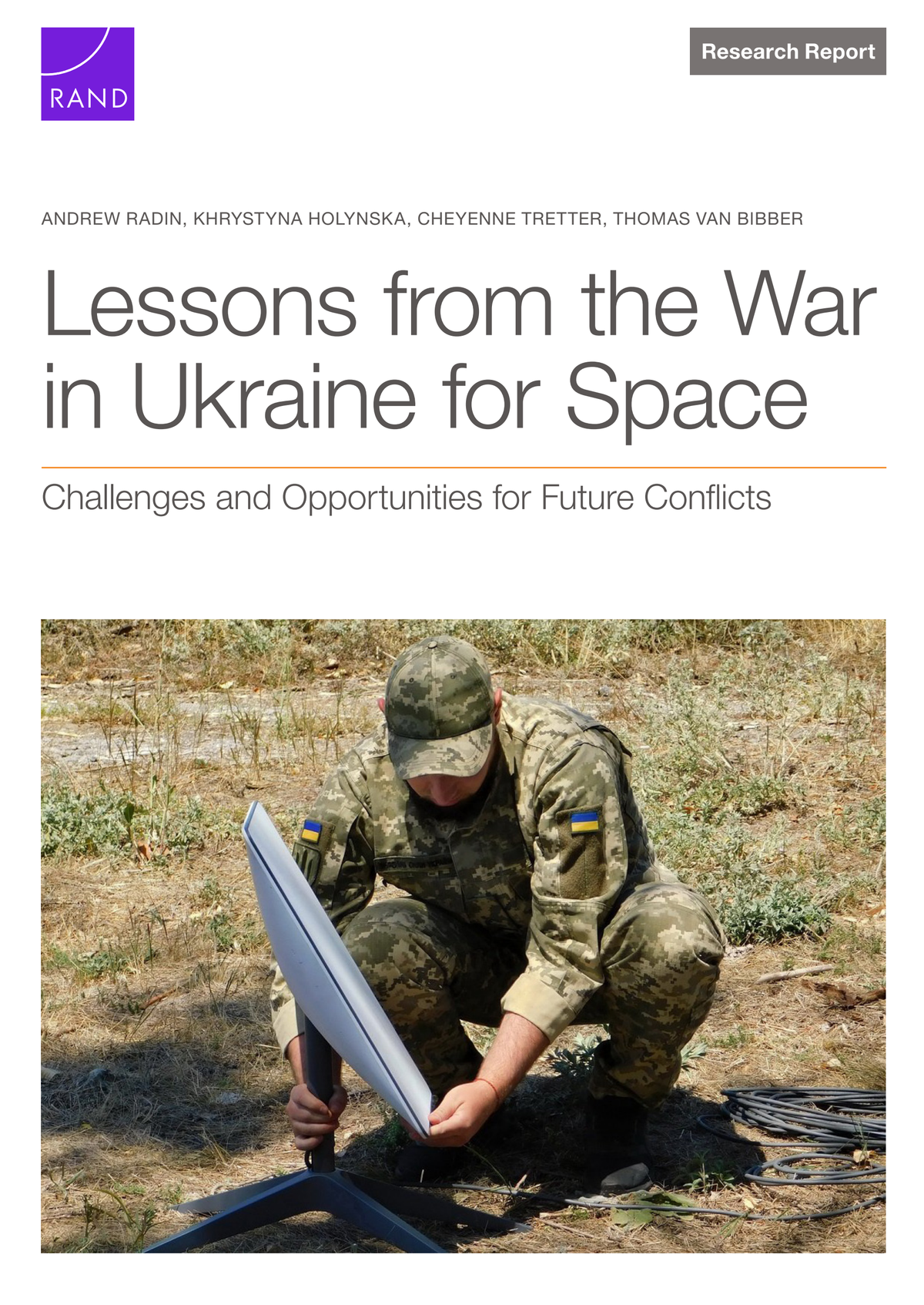
RAND’s new Ukraine-space report looks backward, but its purpose is entirely forward: to seal a doctrinal shift already underway. The report, "Lessons from the War in Ukraine for Space", appears on the surface to be a sober assessment of how satellite services—communication, navigation, surveillance—functioned during the Russia-Ukraine conflict.
Commissioned in the closing stages of a conflict that has seen unexpected reliance on commercial space technologies, the report reacts to a battlefield where civilian systems like Starlink and open-source satellite imagery proved more critical than many legacy military tools.
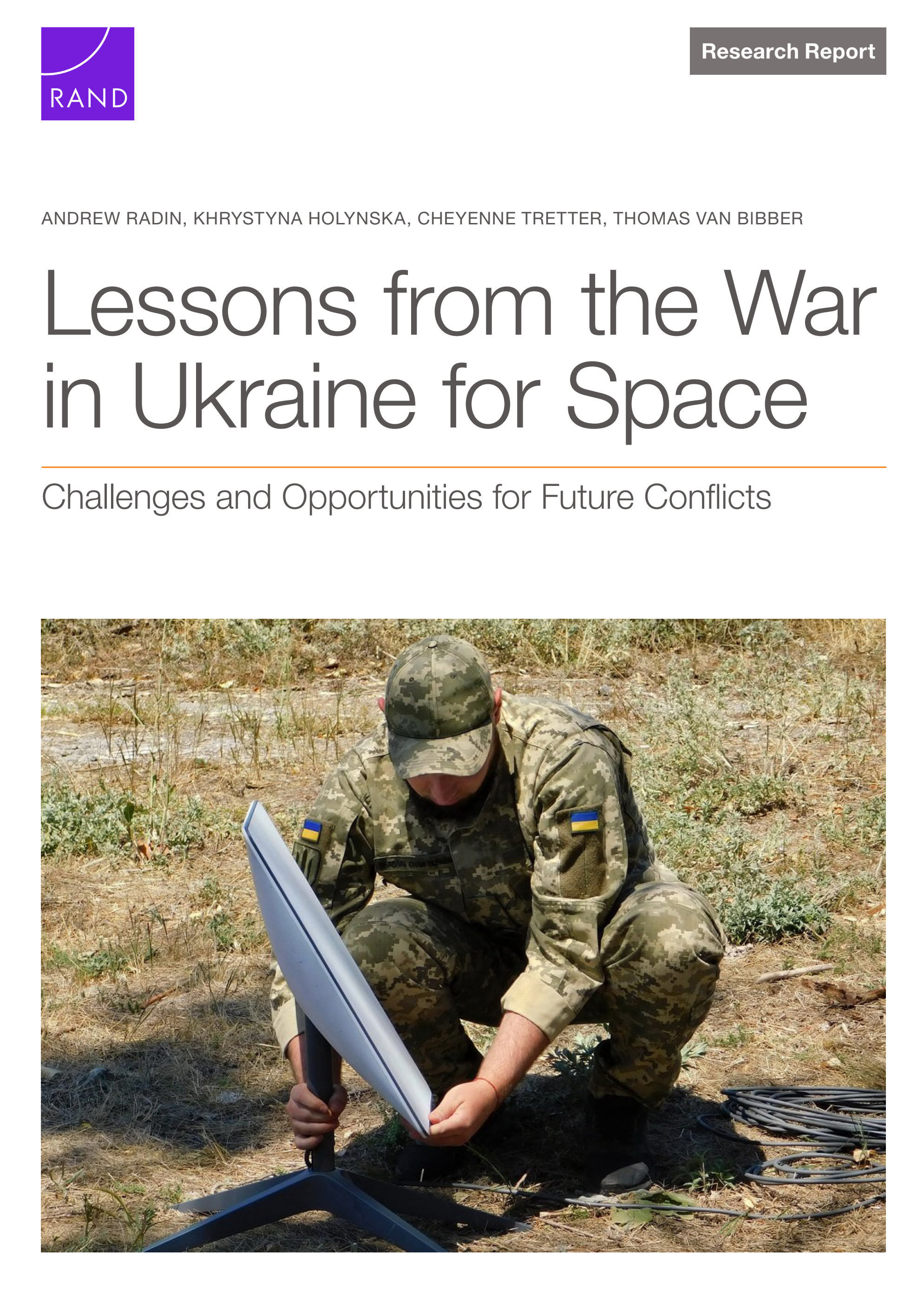
The report analyses how the war tested the boundaries between public defence and private infrastructure. It dissects the ways Russia attempted to jam, hack, or spoof navigation and communication systems. It highlights how Ukraine, despite its degraded legacy capabilities, adapted with Western and commercial help. And it offers a set of recommendations for the U.S. Department of Defense and allied institutions: pre-position space services before conflicts erupt, formalise commercial contracts to avoid ad hoc dependencies, and build diversified, resilient architectures that can withstand attacks.
But this is not just a retrospective. It's a form of ritual that seals a predetermined outcome. A transition from improvisation to command.
In public, the report looks like a neutral assessment. In practice, it's the moment where institutional power consolidates what the chaos of war exposed: that civilian tech, when decisive, must be captured by the state.
Improvisation Becomes Liability
The war in Ukraine brought unexpected heroes to the front: Starlink, commercial imagery platforms like Maxar and Planet, even open-source intelligence communities. Early in the conflict, Russia targeted Ukraine's communications infrastructure, leaving Ukrainian forces reliant on outside support to maintain battlefield coordination. Starlink, a commercial satellite internet service operated by SpaceX, was rapidly deployed to provide resilient communications for Ukrainian troops and government agencies. Meanwhile, companies like Maxar and Planet Labs released high-resolution satellite imagery to the public, enabling analysts and volunteers worldwide to track troop movements, document war crimes, and support Ukrainian situational awareness.
Open-source intelligence communities, often composed of amateur analysts and online volunteers, used these resources to build detailed maps, confirm strikes, and expose Russian manoeuvres in near real-time. The outcome was a form of decentralised warfare support that operated independently of formal military command structures.
These actors were not part of any pre-written battle doctrine. They stepped in because the old systems failed—or didn’t exist. They filled gaps, built new pathways, and challenged the monopoly of military-grade systems.
What the RAND report does is reframe that success story. It says: this kind of improvisation was helpful, but dangerous. It responds to key questions, like:
What if Starlink had said no?
What if commercial imagery had fallen into the wrong hands?
What if GPS had been jammed harder?
This reframing turns improvisation into vulnerability. And vulnerability, in institutional logic, demands pre-emptive control.
The Ritual of Resilience
The RAND report emphasises resilience. But it doesn't mean what you think. This isn't about making systems stronger. It's about making them obedient.
The stated objective of the report is to distil lessons from the Ukraine war that can inform U.S. and allied space policy—particularly in the context of defence planning and strategic autonomy. It aims to evaluate how space services performed during the conflict and what adjustments are required to ensure their reliability in future scenarios.
Structurally, the report is divided into four major sections: background and context of the war, observed performance of space services, key findings, and final recommendations. It focuses primarily on three vectors of space support: Satellite Communications (SATCOM), Positioning, Navigation, and Timing (PNT), and Intelligence, Surveillance, and Reconnaissance (ISR):
- SATCOM: The report notes the indispensable role of satellite communications for Ukrainian command and control. It highlights how Starlink filled critical gaps but flags this as a liability due to the lack of formal agreements. It recommends pre-positioning satellite services and securing them under clear contractual obligations.
- PNT: RAND acknowledges that GPS signals were widely disrupted by Russian jamming. Ukrainian forces adapted with improvised timing and positioning methods, but the report suggests this is insufficient for future high-end conflicts. It urges the development of alternative PNT solutions and diversified platforms.
- ISR: Commercial satellite imagery gave Ukrainian forces unprecedented situational awareness, often rivalling classified intelligence. However, RAND raises concern about information exposure and control, arguing that future use should be governed by clearer frameworks for distribution, security, and alignment with operational goals.
The report concludes that resilience should be built not just through redundancy, but through structure: legally binding relationships with providers, diversified systems that are difficult to disrupt, and clear expectations for commercial actors in wartime scenarios.
In RAND's framing, resilience means contracts with satellite companies. It means having backup networks the Pentagon controls. It means being ready to shut down or reroute commercial platforms when war comes.
"Resilience" becomes the narrative cover for enclosure—the process of wrapping civilian capabilities inside state command structures.
The Four-Phase Script
This report is not an isolated event. It is the third phase in a long-running institutional script—a pattern seen across multiple domains where civilian improvisation exposes systemic weakness, only to be absorbed and constrained by formal power.
This sequence is not rhetorical—it is recursive. What begins as breach (Viasat hack, GPS jamming) generates improvisational optics (Musk’s rapid Starlink deployment, viral OSINT mapping), which in turn trigger codification (RAND's framing of commercial dependency as strategic liability). RAND doesn’t merely assess events—it ritualises the institutional response to those optics, converting them into doctrine. The report marks the formalisation of a recurring operational cycle, seen across strategic domains. It unfolds in four phases:
- Phase 1. Disruption: The Initiation Trigger
A crisis is required to reveal the gap. It may be a cyberattack, a battlefield collapse, or a strategic surprise—anything that exposes systemic fragility. In the space domain, this took the form of Russia’s jamming of GPS signals, the Viasat satellite network hack that disrupted Ukrainian communications, and the general failure of legacy command systems to function under modern hybrid conflict conditions.
Script function: Disruption legitimises intervention. It creates a void where institutional actors can claim authority in the name of “fixing” or “defending.” - Phase 2. Improvisation: Unscripted Efficacy Emerges
In the absence of a prepared state response, unaligned actors step in. Starlink becomes the unofficial battlefield communications backbone—but, only at Elon Musk’s discretion. Planet Labs and Maxar feed the world unclassified imagery of troop positions and mass graves. OSINT communities, often amateurs, piece together battlefield maps faster than military intelligence.
Script function: Improvisation demonstrates the potency of unbound capability. But it also sets the stage for institutional anxiety—because unsanctioned success threatens command hierarchies. - Phase 3. Enclosure: Narrative Capture and Policy Codification (where we are now)
This is where RAND comes in. Post-hoc institutional assessments reframe improvisation not as heroic but hazardous. The lack of contracts, the uncontrolled data flows, the unvetted actors—all become “risks.” RAND’s recommendations are framed as solutions, but they function as jurisdictional codings: binding agreements, strategic redundancy, predefined expectations.
Script function: Enclosure turns fluid improvisation into structured dependence. It locks actors into formal architectures, neutralising the autonomy that made them effective. - Phase 4. Weaponisation: Tiered Access, Strategic Denial:
What follows is the full absorption of civilian infrastructure into state command logic. The systems that were once accessible and open become stratified. Satellite imagery is rationed by clearance level. Communications networks are pre-fused with denial switches. ISR capabilities are operationalised into a doctrine of orbital sovereignty and information dominance.
Script function: Weaponisation completes the cycle. It transforms crisis-born flexibility into hardened command architecture. What was once emergent becomes extractive and exclusive.
While RAND codifies the U.S. absorption model—turning improvisational advantage into command architecture—other powers script differently. China, for instance, prototypes orbital denial through state-monopoly tech enclosures, where civil-military fusion precludes improvisation altogether. Russia, by contrast, leans on jamming, deception, and kinetic denial—less integration, more disruption. These are divergent scripts, but they converge on the same outcome: orbital sovereignty as precondition to terrestrial leverage.
This scripting cycle is not limited to space. It replicates across domains:
- AI: Open models are praised, then labelled dangerous, then enclosed through licensing, export controls, and compliance regimes.
- Cyber: Civilian networks become “critical infrastructure,” then fall under persistent surveillance and DoD integration.
- Biotech: Open platforms during pandemics become gated by genomic sovereignty laws and dual-use restrictions.
Ukraine was not unique. It was simply the current theatre through which the script could be run. The logic remains: reveal the gap, exploit the improvisation, seal the structure, and weaponise the outcome.
Synchrony, Not Coincidence
The RAND report didn’t appear in a vacuum. It landed in a moment of orchestrated alignment—when several major military and technological shifts were reaching operational maturity. These were not isolated events; they were convergences, timed developments that collectively mark a shift in the governance of civilian and commercial technologies.
- The U.S. military's Joint All-Domain Command and Control (JADC2):
This is an ambitious framework designed to connect all branches of the U.S. military—air, land, sea, cyber, and space—into a unified network of sensing, decision-making, and action. Crucially, JADC2 is built to integrate commercial technologies, especially from the space and cloud sectors, meaning civilian satellites, cloud platforms, and data networks are now embedded into real-time battlefield operations. This formalises the role of commercial actors as strategic assets. - Joint Warfighting Cloud Capability (JWCC) Contracts:
Awarded to tech giants Amazon, Microsoft, Google, and Oracle, these contracts consolidate the Pentagon’s dependency on a select few cloud providers. These companies now operate not just as vendors, but as critical infrastructure partners—tasked with securing, storing, and analysing vast amounts of classified and operational military data. This means that global cloud platforms are no longer neutral utilities; they are strategic extensions of military command. - U.S. Cyber Command's "Persistent Engagement" Doctrine:
This approach reshapes cyber operations from reactive defence to continuous, pre-emptive action. It grants the military broad leeway to engage adversaries in cyberspace at all times, not just in war. Civilian digital infrastructure—ISPs, cloud providers, tech platforms—are increasingly treated as battlefields or staging grounds. Oversight tightens, and previously autonomous networks are integrated into national security planning.
Taken together, these developments represent the formal absorption of civilian digital and orbital systems into military command architecture. RAND’s report arrives not to suggest these moves—but to affirm and codify them. Its recommendations dovetail precisely with the direction of institutional motion.
These aren't coincidences. They're synchronised transitions. Institutional timing rituals that signal: the improvisation phase is over. The command phase has begun. RAND's job wasn’t to suggest policy. It was to seal consensus.
Orbital dominance is not conceptual—it is pre-positioned. RAND’s harmonisation logic rides on existing spatial scaffolding:
- LEO ISR Layer: Starlink, Maxar, and Planet Labs feed real-time intelligence into Ukraine and Taiwan corridors.
- GEO SATCOM Spine: DoD uses AEHF and WGS satellites for hardened strategic comms, mirrored by NATO’s GovSat.
- Indo-Pacific Pivot: AUKUS and QUAD partners now co-align around Pacific ISR corridors, tracked through Space Command's C2 architecture.
- Arctic Coverage: Northcom and Canada synchronise polar surveillance via Sapphire and NORAD-linked satellites—framed as climate monitoring, structured as ISR nodes.
These aren't future assets. They are the physicalised logic of RAND's enclosure doctrine.
Who Gets Locked Out
What's left out of the RAND report matters as much as what's in it. It makes no mention of existing or emerging international governance frameworks for space—such as the Outer Space Treaty, the Artemis Accords, or various UN initiatives aimed at preserving space for peaceful use and cooperative development. These frameworks, while imperfect, seek to prevent monopolisation of orbit by a few military-technical blocs.
More critically, the report offers no consideration of how the recommendations it promotes could systematically exclude non-aligned countries—those outside the NATO sphere or not integrated into U.S.-dominated strategic infrastructure. By formalising control over satellite communications, imagery, and navigation through bilateral contracts and Western-dominated consortia, these moves risk creating a de facto 'orbital divide'. Nations without access to these systems would find themselves informationally and operationally blind in any conflict or crisis. These exclusions are not going unchallenged—BRICS, Tiangong, and South-South orbital networks form the early architecture of counter-sovereignty.
The ethical costs are equally neglected. Tools originally lauded for their transparency—like commercial satellite imagery or civilian communications satellites—are now being repositioned as assets to be restricted, secured, and potentially denied. This recasting transforms tools of global accountability into instruments of classified advantage. When access to evidence becomes dependent on military or political alignment, truth itself becomes a function of allegiance.
Instead of grappling with these issues, the RAND report leans on a lexicon of control. It talks of "expectations"—code for compliance from commercial actors. It invokes "contingencies"—scenarios that justify exceptional authority. And it promotes "secure architectures"—technical and legal frameworks that pre-designate who has access, when, and under what terms.
This is not security as mutual safety. It is security as gated privilege. RAND's language may be couched in planning terms, but its operational logic is simple: define who sees, who navigates, and who speaks from orbit—and make sure that list is short, known, and loyal.
Summary: RAND's Ritual of Orbital Enclosure
RAND’s report on space lessons from Ukraine doesn’t simply analyse past events—it finalises a shift in power. It takes the improvised, decentralised success of civilian technologies like Starlink and commercial imagery, and reframes them as risks to be neutralised through pre-emptive control.
In this frame, "resilience" no longer means adaptability—it means contractual obedience. "Contingencies" justify authority grabs. "Secure architectures" designate who’s in, who’s out.
The report aligns precisely with ongoing military integration efforts: JADC2, JWCC, and Cyber Command’s persistent engagement all operationalise civilian systems as extensions of military command. There’s no engagement with global governance, no concern for non-aligned access, and no ethical reckoning with the turn from transparency to strategic secrecy.
This isn’t a report—it’s a rite. A formal declaration that space is now a command layer. Improvisation is over. Integration has begun. The orbit has been enclosed.
Published via Journeys by the Styx.
Geopolitika: Tracing the architecture of power before it becomes the spectacle of history.
—
Author’s Note
Produced using the Geopolitika analysis system—an integrated framework for structural interrogation, elite systems mapping, and narrative deconstruction.