Geopolitika: RAND’s Russian Propaganda Audit as Narrative Camouflage
A forensic deconstruction of RAND’s May 2025 Russian Propaganda brief exposing its function as a ritual instrument of informational sovereignty, not an analysis of adversary influence.
This analysis continues Geopolitika’s sustained exposure of RAND Corporation outputs as operational nodes in the U.S.-NATO narrative architecture—not as neutral research bodies but as precision instruments of informational sovereignty. In this series, we have dissected RAND’s function in scripting regime-change rationales, psychological manipulation strategies, and consent laundering protocols across civil, military, and digital domains.
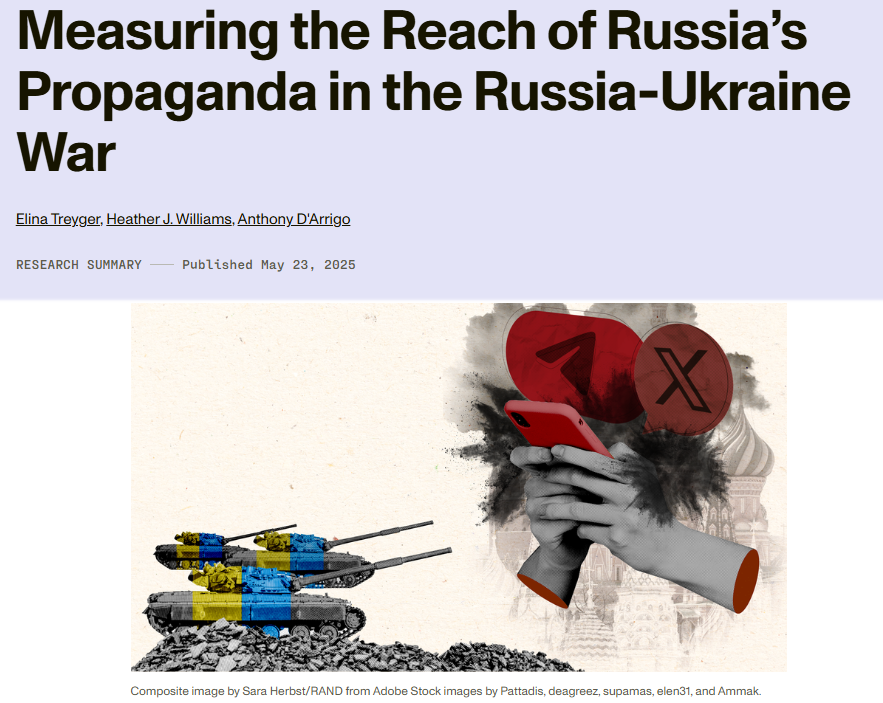
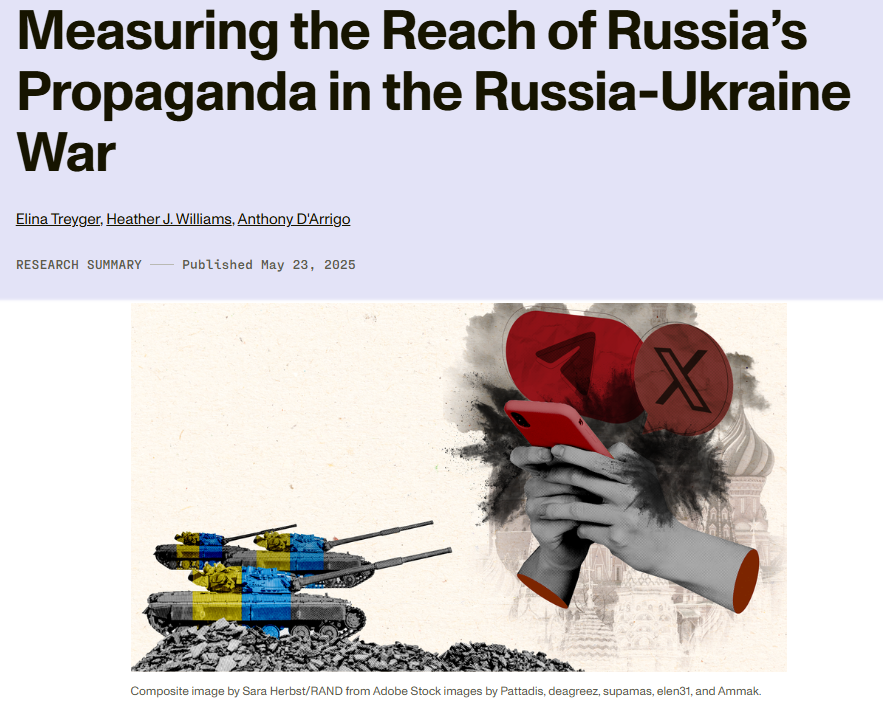
The May 2025 research brief, “Measuring the Reach of Russia’s Propaganda in the Russia-Ukraine War”, must be situated within that continuity. It does not stand alone—it reinforces a patterned deployment sequence wherein RAND constructs pseudo-empirical legitimacy for surveillance infrastructure, narrative policing, and epistemic stratification, always under the guise of liberal concern.
Where the earlier pieces comprising the three part series on RAND’s “Extending Russia” paper mapped kinetic and economic levers to weaken adversaries, this one operationalises narrative containment. Its declared goal—measuring extremist messaging—is structurally irrelevant. What it does is ratify a moral monopoly on information, justify Western narrative dominance, and obscure symmetrical propaganda structures within NATO’s own communication regime.
This brief will be deconstructed not as a policy document but as an ideological ritual—performed for a technocratic audience, encoded with elite self-permission, and shielded from reciprocal analysis. As with all RAND outputs examined in this series, the function is not to inform but to enforce.
The Study That Sees Only One Script
RAND’s May 2025 brief, “Measuring the Reach of Russia’s Propaganda in the Russia-Ukraine War,” is presented as a high-level summary—concise, empirical, and tailored for policy integration. While presumably drawn from a more detailed underlying study, the public-facing document functions as a ritual validation mechanism, reinforcing the narrative authority of Western-aligned institutions and rendering their own propaganda operations epistemically unacknowledgeable.
This is not an innocent abstraction. Summary briefs such as this are crafted not to inform broadly but to equip selectively—to provide regulatory actors, platform governors, and narrative managers with a streamlined justification structure. The brevity is tactical. It foregrounds adversarial threat while excluding countervailing complexity, collapsing informational warfare into a moral binary that requires no reciprocal scrutiny.
The brief does not measure propaganda—it defines it asymmetrically, identifying only Russian-origin narratives as dangerous while omitting NATO-aligned psychological operations, platform manipulation systems, and Western-aligned content steering. The result is not balanced diagnosis but selective narrative isolation.
This article will not respond within RAND’s predefined logic framework. It will not validate its engagement metrics, internal moral categories, or the factuality of any specific claims advanced by either side in the narrative war. The truth or falsehood of particular messages—whether propagated by Russian or Western actors—is structurally irrelevant to the function of the brief.
The issue is not moral equivalence—it is the analytic illegitimacy of moral exemption. No actor’s narrative machinery should be immune to scrutiny under the guise of democratic self-certainty. What matters is how narrative legitimacy is distributed, how epistemic borders are drawn, and how institutional trust is constructed and weaponized. In this context, the objective is to expose the brief as a component of elite narrative infrastructure: shaped for a liberal technocratic audience, deployed to justify surveillance expansion, and engineered to preserve moral asymmetry in the information domain.
RAND’s summary is not a neutral audit of influence—it is an act of influence, designed to manufacture consensus beneath the appearance of sober analysis. This deconstruction proceeds under the only valid interpretive hierarchy: power over sentiment, structure over statement, continuity over rupture, script over data.
Simulated Objectivity As Cover
The RAND summary is styled to project impartial analysis—dense with data references, multilingual scope, and statistical breadth. This projection is strategic. It generates an aura of neutrality while embedding unexamined premises: that Western institutions are objective observers, that their definitions of “extremism” and “hate speech” are universal, and that only adversarial actors engage in manipulative messaging.
This is not objectivity—it is simulation of neutrality engineered to reinforce narrative sovereignty. The metric architecture (volume of posts, geographic reach, linguistic diffusion) serves a dual function: it ritualises the appearance of analytic distance while rendering the brief's foundational exclusions invisible. Nowhere are Western propaganda techniques, psychological operations, narrative steering, or NGO-platform coordination interrogated. These are either non-existent in the RAND frame or structurally exempt from scrutiny by virtue of presumed moral alignment.
In this way, the brief performs a classic legitimisation manoeuvre: it weaponises data to naturalise asymmetry. Russian messaging is rendered pathological by definition. Western messaging is rendered unexamined, and therefore innocent. The analytical posture is an epistemic filter, through which only adversary narratives are problematised, quantified, and moralised.
While RAND may contain heterogeneous actors and legitimate researchers, the brief’s institutional positioning and narrative deployment pattern override any internal variance. Function, not intent, is determinative.
By simulating objectivity, RAND ensures that its summary becomes actionable intelligence for regulators and alliance functionaries. It is not designed to invite counter-analysis but to foreclose it—to reinforce existing trust architectures, legitimise censorship mechanisms, and expand the regulatory perimeter under the guise of democratic defence.
Structured Omissions, Functional Boundaries
The RAND brief, “Measuring the Reach of Russia’s Propaganda in the Russia-Ukraine War,” delineates its scope by focusing exclusively on Russian-origin narratives, thereby establishing a boundary that excludes examination of Western-aligned information operations. This selective framing is evident in the report's stated methodology:
“Researchers reviewed statements from Russian officials, state media, and social media to identify Russian-originating narratives that echo violent extremist tropes to target and denigrate Ukrainians.” RAND Corporation
By concentrating solely on Russian sources, the brief omits any analysis of comparable narratives or disinformation campaigns emanating from Western or Ukrainian actors. This omission is not an oversight but a deliberate structural choice that reinforces a unidirectional view of propaganda.
Furthermore, the report identifies specific Russian narratives, such as:
“Russia’s narratives include claims that Ukraine has been overrun by Nazis and needs to be ‘denazified,’ a justification presented by Russian President Vladimir Putin on the day of the invasion.” RAND Corporation
While highlighting these narratives, the brief does not address the potential use of similar rhetorical strategies by Ukrainian or Western entities, such as the dehumanisation of Russian soldiers or the portrayal of Russia as inherently authoritarian. This selective scrutiny contributes to a moral asymmetry, wherein only adversarial narratives are problematised.
The report's exclusive focus on Russian propaganda facilitates its function as a tool for legitimising Western information control measures. By framing the issue as a one-sided threat, it provides justification for increased surveillance and censorship without subjecting Western narratives to equivalent scrutiny.
The RAND brief does catalogue narratives—but only those external to its own moral jurisdiction. This is not absence of data, but strategic asymmetry in interpretive permission
In essence, the RAND brief operates within a framework that defines the boundaries of acceptable discourse, reinforcing existing power structures and narrative dominance. Its omissions are not gaps in analysis but integral components of its functional design.
Theatre Of Civilisation—Hate Speech As Strategic Screen
The RAND brief foregrounds a cluster of narratives it classifies as “extremist” and “hate-filled”, namely: antisemitism, dehumanisation, anti-LGBT sentiment, and the framing of Ukraine as a Western proxy embodying moral or civilisational decay. These are presented as universal markers of moral transgression. In structural terms, however, they function as strategic scaffolding—framing devices that enable perception governance while cloaking the asymmetry of enforcement. According to RAND’s May 2025 brief:
“A recent RAND study examined how some of Russia’s most extremist and most hate-filled narratives have spread on social-media platforms, such as X and Telegram. It identified four such narratives and looked at which audiences these narratives reach and who is spreading them. Researchers reviewed statements from Russian officials, state media, and social media to identify Russian-originating narratives that echo violent extremist tropes to target and denigrate Ukrainians.”
The four distinct narrative types were: (1) portraying Ukraine as overrun by Nazis and in need of denazification, (2) maligning Ukrainians through dehumanising language and slurs, (3) promoting antisemitic tropes that blamed Jews and President Zelenskyy for the war, and (4) framing Ukraine as aligned with a Western LGBT or ‘satanist’ agenda.
These categories are not operationalised to create reciprocal standards of speech moderation. They are applied unidirectionally—only to delegitimise adversary messaging. The rhetorical structure does not scrutinise how similar tropes are deployed by Western or Ukrainian actors. For example, Ukrainian military and media regularly refer to Russian forces as “orcs”, a term that functions as a racialised dehumanisation vector. Yet no mention is made of this by RAND.
Similarly, portrayals of Russian identity as “authoritarian”, “backward” or “medieval”—frequent in Western media and policy discourse—mirror the same logics of essentialist vilification. These include reductive tropes such as the oft-cited line that Russia is “a gas station masquerading as a country”, a phrase popularised in Western strategic commentary. Yet such framing is rendered invisible in RAND’s taxonomy—not because it lacks propagandistic function, but because its institutional origin exempts it from scrutiny.
This exclusion is not analytical error—it is a feature of narrative design aligned with audience targeting. The RAND brief is not written for adversarial publics or global civil society. Its intended consumers are policy bureaucrats, platform regulators, NGO technocrats, and security-adjacent academics—actors embedded within a moral schema in which “hate speech” is both a threat vector and a validation ritual.
The categories selected—antisemitism, dehumanisation, anti-LGBT sentiment—are not chosen for empirical breadth but for resonance with liberal bureaucratic priors: protection of minorities, symbolic vigilance, anti-extremism. These terms act as coded legitimacy signals—dog-whistles to technocratic elites— affirming that the document is morally aligned, epistemically secure, and institutionally actionable. The brief does not challenge its audience’s worldview—it confirms and weaponises it as justification for the expansion of control architectures.
In this schema, “hate speech” operates not as a universal principle but as a narrative weapon, selectively applied to license:
- Expansion of tech surveillance systems under the banner of protecting civil discourse
- Content moderation policies enforced via opaque platform–institution partnerships
- Regulatory convergence between NGOs, state departments, and intelligence-aligned research hubs.
Here, legitimacy is not produced through rigorous symmetry—it is invoked through ritual category deployment, engineered to be metabolised by a professional class conditioned to perceive moral triggers as authorisation codes.
In this theatre, civilisation is not being defended—it is being staged. The moral scaffolding of hate discourse operates as a screen for infrastructural consolidation, performing cultural sanctity while advancing informational hegemony. It disarms critique not by contesting truth, but by pre-emptively denying entry into the frame of legible discourse.
Facts That Don’t Matter—Narrative Sovereignty Over Empirical Correction
The RAND brief operates within a knowledge system where empirical contradiction does not register as disruption. Observable truths—such as Russia functioning as a capitalist state with multiparty elections, or Ukraine’s own deployment of hate rhetoric, like referring to Russian troops as “orcs”—are structurally excluded from the analytic frame. They are not rebutted because they are not acknowledged. The script does not need to defeat them—it simply needs to prevent their ingestion.
This is the operational logic of narrative sovereignty. RAND’s brief is not falsifiable; it is architecturally immune to empirical correction. Its authority derives not from the accuracy of its content, but from its institutional positioning and narrative utility. In this configuration, “fact” becomes a residual category—irrelevant unless it aligns with preauthorised threat perception or moral framing.
The brief’s intended audience—composed of technocratic policy elites, platform regulators, and alliance-aligned media nodes—metabolises only authorised knowledge inputs. These are prefiltered through moral asymmetry, institutional trust hierarchies, and securitised lexicons. Disruptive facts, no matter how demonstrable, cannot be operationalised within this structure. They are discarded—not as lies, but as noise.
This dynamic reveals the core function of the RAND brief: not to analyse, but to reinforce narrative cohesion within a bounded epistemic system. It does not investigate the informational terrain—it marks the edges of permitted discourse. It is not an empirical tool but a boundary ritual.
The Metric Of Non-Threat—'Limited Reach' As Containment Logic
The RAND brief concludes that while Russian propaganda narratives are widely disseminated, their influence is limited:
“The concern that Russia’s extremist narratives could gain popularity with international audiences and even catalyse violent extremism against groups that these narratives target is warranted—but should not be overstated.”
This framing is not a neutral analytic conclusion—it is a containment optic, engineered to deliver a dual stabilising message. It acknowledges adversary activity to legitimise surveillance and counter-propaganda efforts, while simultaneously minimising the threat to affirm that existing systems are working. The result is a ritualised performance of moderation: the threat is real, but manageable; the system is alert, but not overwhelmed.
This message is not designed to provoke inquiry—it is crafted to reassure. It calibrates confidence for RAND’s core audience—policy administrators, platform regulators, and NGO partners—who require not disruption, but validation. No systemic overhaul is needed. No audit of Western propaganda is required. The governance structure is depicted as functional, ethically aligned, and epistemically resilient.
Here, “limited reach” functions as a ritual confidence signal, reinforcing the legitimacy of existing control mechanisms while preemptively deflecting structural introspection. It sustains a posture of informational immunity—a recurring motif in RAND outputs—which presumes Western epistemic systems to be inherently self-correcting and therefore beyond symmetrical scrutiny.
By characterising Russian propaganda as widespread but ineffective, the brief effectively sanctifies the West’s own narrative operations as impervious to contamination and unworthy of critique. This discursive shielding prevents any admission that Western actors are engaged in comparable or more sophisticated forms of narrative control.
In essence, RAND’s portrayal of limited reach is not an empirical insight—it is a strategic calibration. It preserves the status quo by ritualising system success, thereby forestalling critical audit, structural recalibration, or epistemic reciprocity.
Operational Continuity—From RAND To Platform Governance
RAND’s outputs are not isolated policy briefs—they are modular alignment tools within a trans-institutional ecosystem. The May 2025 report performs not as a standalone document but as a link-node in the operational mesh connecting think tanks, NGOs, regulatory bodies, and platform compliance teams.
This continuity is neither speculative nor informal. RAND has directly interfaced with platform governance since the mid-2010s, providing analysis used to justify content moderation expansions, threat model integration, and counter-disinformation partnerships. Reports such as this one become citable scaffolds—referenced in policy memos, compliance justifications, and trust & safety playbooks.
The 2025 brief is built for ingestion by these structures. Its controlled tone, emphasis on extremism, and selectively quantified threat make it an ideal input vector for:
- Platform policy escalation – tagging, downranking, banning
- NGO-legitimised censorship pipelines – through civil society partnerships
- Regulatory mandate renewal – EU Digital Services Act compliance logic.
By excluding reciprocal scrutiny of NATO-aligned messaging, the RAND brief functions as a laundering mechanism—washing coercive narrative control through the language of humanitarian vigilance.
This is not incidental. It is designed continuity. The brief’s structure mirrors the bureaucratic rhythms of its intended users: technocratic in tone, asymmetric in premise, and anchored in moral urgency. It is constructed to be operationalised—spliced into workflow systems, cited in hearings, translated into enforcement triggers.
Beyond institutional uptake, the RAND brief also shapes the boundaries of public cognition. Though not addressed to mass audiences directly, its outputs are metabolised downstream—through media translation, academic citation, and policy paraphrasing—into what is publicly permissible to think, say, and question. This is not the result of overt censorship, but of semiotic preselection: adversarial narratives are pathologised before they reach public legitimacy, while Western narratives are abstracted into unmarked common sense. RAND’s work, in this function, acts as narrative pre-filter—engineering the conditions of plausibility, so that only state-compatible frameworks can survive cognitive entry.
The “research” function is secondary. The primary function is to fuse epistemic legitimacy with operational authority across supranational governance layers.
RAND does not provide neutral observations. It supplies actionable scripts—designed to align perception, standardise control lexicons, and foreclose rival epistemologies. In this sense, the brief is not the product of a research institution. It is the instrument of an information regime.
Conclusion: Rand As Narrative Armature, Not Analytical Organ
The May 2025 RAND brief is not an analytical exercise—it is a narrative armature, forged to support the architecture of Western informational dominance. Its metrics, categories, and omissions are not technical errors or disciplinary oversights. They are features of design, calibrated for institutional uptake and policy enactment.
The brief does not diagnose propaganda. It performs it—selectively defining threat, moralising asymmetry, and rendering adversarial speech legible only as pathology. In doing so, it not only omits scrutiny of Western narrative operations—it inoculates them. It is built to manufacture consent for the very systems of control it pretends to analyse.
RAND, in this context, is not a research body. It is a ritual contractor—producing symbolic scaffolding for platform governance, NGO convergence, and digital censorship regimes. The brief’s value lies not in empirical precision but in its narrative utility to power. It affirms, aligns, and authorises.
Understanding this brief requires recognising it not as a contribution to democratic discourse, but as a component of elite narrative infrastructure. It does not reflect the information war. It structures its perceptual boundaries.
This is not the analysis of propaganda. It is the ritual affirmation of informational immunity—the premise that Western epistemic systems require no scrutiny because they already embody truth. The document does not fail by omitting counter-narratives. It succeeds—by scripting exclusion as security, and by encoding the permanence of Western narrative rule beneath the camouflage of moral vigilance.
Published via Journeys by the Styx.
Geopolitika: Tracing the architecture of power before it becomes the spectacle of history.
—
Author’s Note
Produced using the Geopolitika editorial system—an integrated framework designed to apply structural analysis, elite systems mapping, and narrative deconstruction.