Geopolitika: Rogues, Peers, Vassals and RAND
How Empire sustains global dominance through scripted roles, conditioned submission, and manufactured legitimacy.
Introduction: From Crisis Management to System Management
In the last instalment of Geopolitika, I examined how empire manufactures crises to justify coercive management—hollowing out sovereignty under the pretext of humanitarian necessity. This article extends that analysis beyond the episodic manufacture of instability to the standing architecture that now shapes the global system itself.
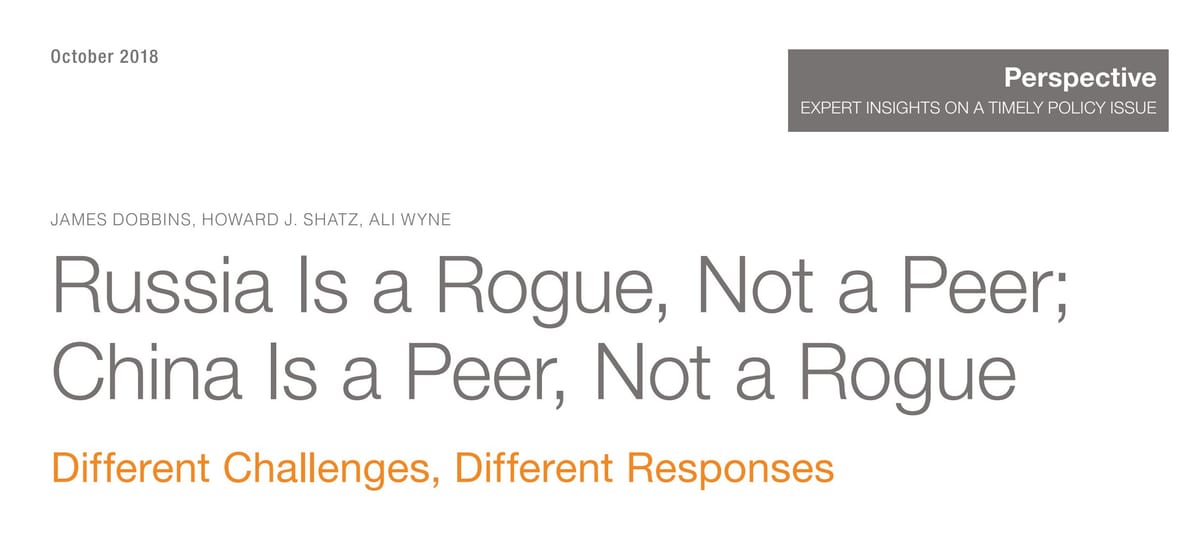
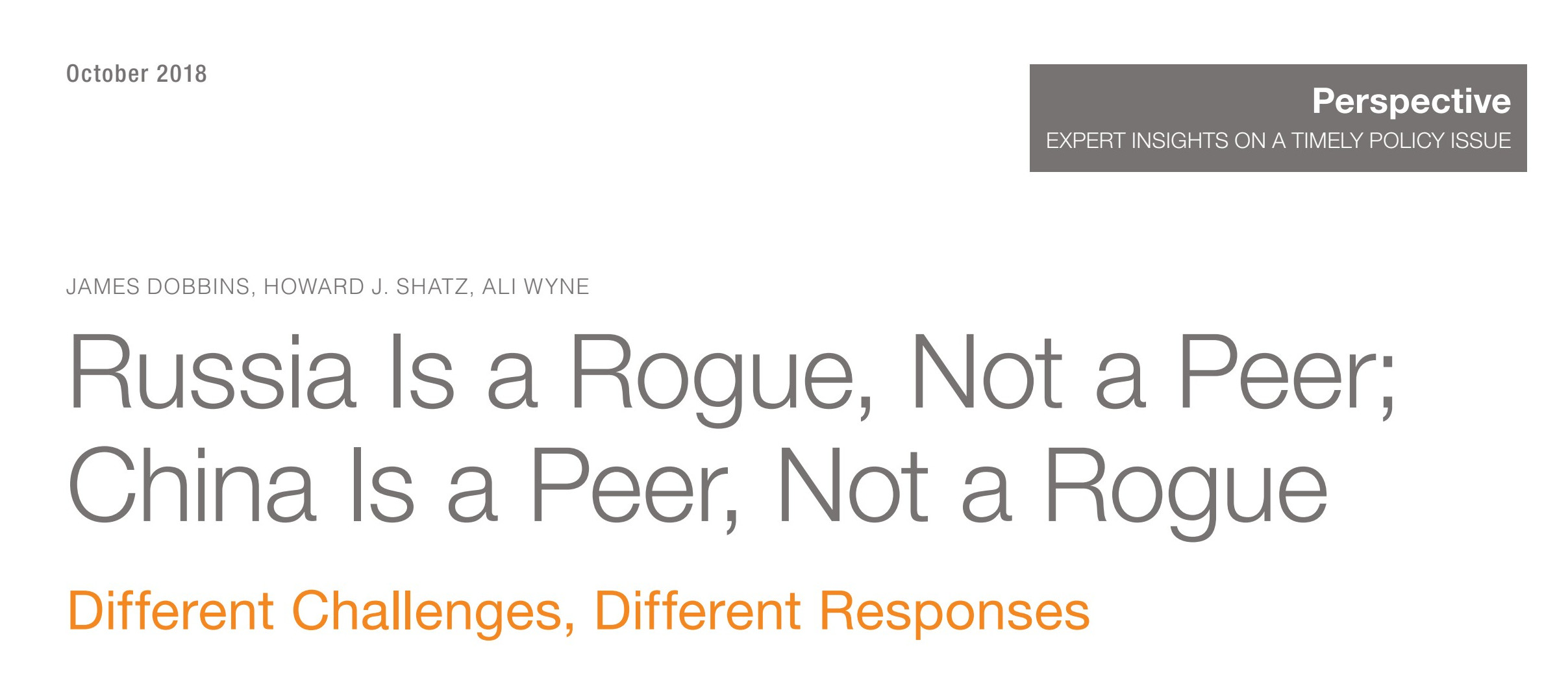
A forensic reading of RAND Corporation’s 2018 paper Russia Is a Rogue, Not a Peer; China Is a Peer, Not a Rogue, exposes how empire scripts global behaviour—pre-structuring rivals, allies and crises alike beneath the collapsing mask of a so-called Rules-Based Order. Rather than defending an open international system, empire engineers conditions, channels behaviours, and operationalises legitimacy as a weapon of strategic dominance.
This analysis complements the broader inquiry of the Geographika project: tracing not merely the events of global order, but the structures, scripts and hidden architectures that sustain it.
RAND Corporation: The Empire’s Strategic Brain Trust
The RAND Corporation was founded in 1948 as a research initiative of the US Army Air Forces and the Douglas Aircraft Company. Its original mandate was to apply scientific and mathematical methods to military problems—specifically, the challenges of strategic air power and nuclear deterrence emerging from the Second World War. RAND quickly became a central node in the Cold War system-building effort, providing the strategic rationales for containment, deterrence theory and the structuring of the early US national security state.
Over the decades, RAND evolved from a narrowly focused military strategy shop into a full-spectrum empire management consultancy. Its research portfolio expanded to cover economics, political governance, social engineering, technological innovation, education systems and public health—each domain treated through the lens of systemic control and stability management. By the early twenty-first century, RAND was no longer simply advising on military posture—it was designing models for the sustained management of global political and economic conditions.
Formally, RAND operates as a Federally Funded Research and Development Center (FFRDC), a quasi-governmental status that grants it privileged access to classified information and strategic planning processes while maintaining an outward appearance of independent scholarship. This hybrid status places RAND inside the strategic core of the US empire, functioning simultaneously as an in-house consultant, a policy architect and a legitimacy shield.
RAND’s function is not neutral. Its institutional posture is to frame American strategic interests as the natural stabilising force of world order and to develop methods—military, economic, informational and diplomatic—for preserving that pre-eminence against systemic challenges. It manufactures the conceptual frameworks that rationalise empire’s adaptation, expansion and management, under the guise of objective analysis and technical expertise.
Within the broader web of empire’s strategic infrastructure, RAND operates alongside and coordinates with peer institutions such as the Center for Strategic and International Studies (CSIS), the Atlantic Council, the Brookings Institution and transnational entities like Chatham House. Together, these institutions shape the permissible boundaries of policy debate, manufacture consensus within elite circles and generate the operational scripts by which rivals are contained, allies managed and global systems steered toward the maintenance of US-led order.
RAND, in this context, is not merely one think tank among many. It is one of the central architects of empire’s standing operating system—engineering the world not as it is, but as it must be shaped to preserve systemic dominance.
The Architects: Dobbins, Shatz and Wyne
The authors of Russia Is a Rogue, Not a Peer; China Is a Peer, Not a Rogue are not detached academics offering independent analyses. They are system engineers, embedded within the operational logic of empire, tasked with refining the perception and management of strategic rivals.
James Dobbins built his career as a senior diplomat and conflict manager within the US State Department, playing leading roles in the orchestration and management of political transitions in Somalia, Haiti, Bosnia, Kosovo and Afghanistan. His work consistently involved the stabilisation of regions undergoing—or subjected to—regime change operations. Dobbins exemplifies the role of the Deep State operator in transition management: crafting successor governments, embedding Western influence post-intervention and maintaining imperial footholds under the banner of stabilisation and reconstruction.
Howard J. Shatz operates within the sphere of international economics, specialising in the strategic application of trade policy, investment flows, sanctions and financial system leverage. His work reflects the geoeconomic strand of empire’s operational model, where economic tools are weaponised to compel compliance, isolate adversaries and entrench systemic advantages without requiring open military confrontation. Shatz’s focus illustrates how empire projects power through access, markets and capital structures—shaping global conditions under the guise of free trade and development.
Ali Wyne represents the newer generation of strategic theorists, tasked with conceptualising and legitimising great power competition in the post-unipolar era. His emphasis is on framing US–China rivalry not simply as a contest of interests, but as a normative struggle—between a liberal, rules-based order (led by the US) and authoritarian revisionism (embodied by China). Wyne’s role is not to challenge the empire’s assumptions, but to provide an updated intellectual framework through which systemic competition can be rationalised, managed and if necessary, escalated.
Taken together, Dobbins, Shatz and Wyne are not offering dispassionate scholarship. They are functional architects of strategic management—designing the perceptions, frameworks and operational models by which the US empire maintains systemic dominance in an increasingly contested world.
The Moral Infrastructure: Rules-Based International Order as Strategic Mask
The RAND Corporation's Russia Is a Rogue, Not a Peer; China Is a Peer, Not a Rogue offers a clean illustration of how the empire’s moral infrastructure operates. Throughout the document, strategic competition is not framed as a normal feature of international life, but as a defence of the “Rules-Based International Order (RBIO)” against rogue actors and systemic revisionists. This framing projects US strategic operations as neutral enforcement of shared norms—obscuring that the so-called “rules” are selectively defined, selectively enforced and strategically engineered to sustain hegemony.
In the RAND framework, the RBIO serves two core operational functions:
1. Projecting moral authority:
RAND frames virtually every recommended US action—military posturing, economic competition, alliance expansion—as necessary to defend a shared rules-based system.
Examples:
- NATO Expansion: Expansion into Eastern Europe is described not as a strategic encroachment, but as reassuring allies and stabilising Europe against Russian aggression.
The fact that NATO expansion violates Russia’s repeatedly stated security concerns is reframed as protecting the “European security order.” - Sanctions Against Russia: Economic sanctions are portrayed as penalties for international misconduct, not as strategic coercion designed to weaken an adversary’s internal stability.
- Military Posture in Asia: The need to strengthen the US military presence in the Indo-Pacific is justified as preserving freedom of navigation and defending international law against Chinese assertiveness.
In each case, empire’s operational moves are shrouded in the moral language of rules enforcement, never acknowledged as exercises of coercive control.
2. Justifying systemic engineering:
Beyond projecting moral authority, the RAND document operationalises the RBIO as a flexible tool for global systemic management.
Examples:
- Shaping Energy Markets: The document recommends reducing European reliance on Russian energy exports not merely for diversification, but explicitly to diminish Russia’s leverage—a form of strategic engineering masked as economic resilience policy.
- Normative Competition with China: RAND advises shaping global standards for infrastructure finance to pressure China into greater transparency—in effect, imposing Western governance frameworks on emerging global systems while framing the effort as promoting fairness and openness.
- Information Operations: The need to counter Russia’s disinformation campaigns is described as defending truth and democratic discourse, while no acknowledgement is made of the simultaneous expansion of Western information warfare infrastructures targeting adversary populations.
Thus, the RBIO is not a fixed legal structure but a set of selectively applied permissions and prohibitions—expanding, contracting and adapting to empire’s evolving strategic needs.
Continuity from Iran to RAND:
In the Iranian theatre, the RBIO was deployed episodically—to manufacture consent for particular interventions—such as sanctions, covert actions and diplomatic isolation. Each mobilisation of moral language was tied to a discrete event or perceived crisis.
In the RAND management model, the RBIO is no longer an occasional veil. It has become a standing operational infrastructure. The defence of “rules” is now the permanent justificatory frame through which systemic rivalry is conducted, strategic dominance maintained and operational coercion disguised as moral obligation.
The RAND document thus crystallises a critical truth: Modern empire no longer merely invokes moral language reactively—it embeds moral narratives into the permanent architecture of global management.
Managing Rivals, Scripting Allies: The Blueprint Revealed
A central revelation of the RAND Corporation’s Russia Is a Rogue, Not a Peer; China Is a Peer, Not a Rogue is the degree to which empire no longer simply reacts to individual threats. Instead, it manages entire categories of states—assigning roles, conditions and behavioural expectations across rivals, allies and neutral powers alike.
As RAND itself frames the strategic landscape, Russia poses a threat to the security of Europe and to the US-led international order, whereas China, although challenging, remains more deeply integrated into the existing system:
"Russia and China represent quite distinct challenges. Russia is not a peer or near-peer competitor but rather a well-armed rogue state that seeks to subvert an international order it can never hope to dominate. In contrast, China is a peer competitor that wants to shape an international order that it can aspire to dominate. Both countries seek to alter the status quo, but only Russia has attacked neighboring states, annexed conquered territory, and supported insurgent forces seeking to detach yet more. Russia assassinates its opponents at home and abroad. Russia interferes in foreign elections, subverts foreign democracies, and works to undermine European and Atlantic institutions. In contrast, China’s growing influence is based largely on more-positive measures: trade, investment, and development assistance. Among permanent United Nations (UN) Security Council member nations, China has even become the largest contributor to UN peacekeeping operations. These attributes make China a less immediate threat but a much greater long-term challenge."
RAND’s characterisation of Russia’s actions—attacking neighbouring states, annexing territory, supporting insurgencies, interfering in elections, and subverting democracies—reads as a catalogue of behaviours long practiced by the US empire itself. Yet when empire conducts these operations, they are framed as stabilisation, democracy promotion or defence of international norms. This selective framing highlights not only the operational double standard embedded within the rules-based order but also the extent to which legitimacy is defined not by actions themselves, but by who holds narrative dominance.
Through this framing, RAND reveals not only a differential treatment of rivals, but a deeper operational principle: States are managed according to their systemic utility or threat profile, not according to consistent standards of behaviour.
This distinction reflects a key strategic shift. Empire is no longer defined primarily by its opposition to specific adversaries. It is defined by its standing system of management, through which the political, economic and military agency of other states is structured, scripted and, where necessary, subordinated to the maintenance of US-led global order.
Managing Russia – containment and degradation:
Within the RAND framework, Russia is not treated as a peer competitor whose interests must be negotiated. It is categorised as a rogue actor whose capacity to project influence must be systematically degraded across military, economic and informational domains.
RAND frames Russia’s role explicitly:
"Russia, nevertheless, is a more immediate and more proximate military threat than China. Vladimir Putin is an opportunistic risk taker, whereas China’s post-Mao leaders have proceeded cautiously and gradually to expand their country’s influence. U.S. and Russian troops face each other directly across Russia’s land borders with members of the North Atlantic Treaty Organization (NATO), as they do across an informal and occasionally transgressed deconfliction line in Syria. In contrast, no U.S. ally shares a land border with China, so U.S. and Chinese forces are separated by miles of open sea even at their closest point. Relations with Russia are also tenser than with China. Russia is the target of multiple U.S. sanctions in reaction to its aggression in Ukraine, its attack on the U.S. democratic system, and its support for the Syrian regime’s use of chemical weapons."
This framing embeds several narrative fallacies into RAND’s supposedly neutral strategic assessment. The claim that Russia attacked the US democratic system references the Russiagate controversy—an intelligence-driven narrative campaign that has since been extensively challenged and discredited, both for evidentiary weakness and for its strategic function in domestic political warfare. Similarly, the assertion that Russia supported Syria’s use of chemical weapons ignores the contested nature of the chemical attack allegations, many of which have been tied to Western-aligned insurgent forces and manipulated reporting.
By embedding these contested claims as unquestioned fact, RAND demonstrates how the informational battlespace is folded into systemic management: propaganda operations are naturalised as analytical baselines, allowing empire’s coercive moves to be justified without engaging the contested realities beneath the narratives.
Beyond these narrative constructions, RAND’s operational prescriptions for Russia are clear:
- Political isolation: RAND recommends intensifying diplomatic pressure to isolate Russia within international institutions and strategic alliances.
- Economic warfare: Sanctions are framed as legitimate penalties for rule-breaking but function structurally to degrade Russia’s economic resilience and sever its integration with European markets.
- Military containment: While NATO’s eastern posture is presented as defensive reassurance for allies, it operationally functions to box Russia within a compressed strategic corridor.
The management objective is not stabilisation through mutual accommodation.
It is strategic exhaustion—bleeding Russia’s resources, limiting its external influence, and degrading its capacity to operate autonomously within the global system.
Managing China – channelling systemic ascent:
In contrast to Russia, RAND frames China not as an immediate rogue threat but as a systemic peer whose rise must be managed over time. The operational challenge is not to defeat China outright, but to channel its expansion within parameters that delay systemic displacement of US leadership.
RAND articulates the dual-track nature of the challenge:
"China’s expanding influence is not, however, dependent principally on its growing military prowess. Militarily, China can be contained for a while longer; economically, it has already broken free of any regional constraints... China is thus displacing the United States as both the leading goods exporter and the leading goods importer in a growing number of markets."
This framing captures the core of RAND’s management logic: militarily, China must be hedged, encircled and slowed; economically, China’s growing systemic weight must be constrained wherever possible through alliance management, infrastructure competition and normative shaping of global institutions.
RAND’s prescriptions reflect this approach:
- Selective engagement: China’s economic and technological participation is to be permitted only within frameworks the empire can still influence or control, with priority given to shaping global standards and investment norms.
- Military deterrence without open confrontation: US force posture and alliance structures in the Indo-Pacific are to be strengthened not to trigger direct war, but to maintain leverage while avoiding premature escalation.
- Normative competition: RAND stresses the need to frame the rivalry not simply as material competition, but as a struggle between rule-abiding democracies and authoritarian revisionism.
Empire’s objective with China, in RAND’s model, is not conquest or rollback.
It is delayed integration under empire’s terms—managing the tempo and shape of China’s ascent long enough to preserve systemic pre-eminence.
While RAND’s framing captures the operational challenge posed by China's expanding influence, it also embeds several strategic narrative constructions designed to naturalise containment measures:
- China's economic expansion is presented not as a normal expression of national development, but as a disruptive force requiring systemic countermeasures.
- China's political system is cast as an inherent threat to global norms, eliding the selective and often coercive imposition of norms by the US and its allies.
- China's defensive military developments are characterised as destabilising, while expansive US military presence and alliance networks are framed as stabilising necessities.
Through these narrative structures, RAND reveals that the management of China is not solely a material strategy. It is a cognitive and normative campaign—preconditioning the global interpretation environment so that economic competition, political divergence and regional defence are framed as illegitimate before they can be evaluated on their own terms. This cognitive preconditioning is not an adjunct to empire’s operating system—it is integral to maintaining systemic dominance as material advantage erodes.
This structural management approach has already been partially operationalised.
The Trump administration’s 2018-2019 and 2025 tariff campaigns against China, while often depicted as an isolated or impulsive moves, in fact align closely with the RAND blueprint—applying economic friction to delay systemic displacement while framing confrontation in the language of fairness, security and rules enforcement.
RAND stresses that managing China's ascent requires not simply containment, but proactive reengineering of global economic and developmental systems. It recommends that the United States "secure its own preferential access to the world’s largest markets, the industrialized countries of Europe and Asia," thereby advantaging US exporters relative to Chinese competitors. Rather than opposing China's Belt and Road Initiative (BRI) outright, RAND advises shaping its implementation to conform with "international investment and development norms" through political, diplomatic and military engagement across Asia, Africa and the Middle East.
This is not a model of passive defence. It is a standing system of systemic conditioning—redirecting global development itself to preserve the architecture of imperial dominance.
Managing allies – scripting and strategic subordination:
The RAND document is clear about the role assigned to allies within the management architecture of empire. Allied states are not treated as fully sovereign actors with independent strategic agency. They are scripted into operational frameworks designed to sustain US-led systemic dominance—required to reinforce legitimacy, absorb operational burdens, and deny adversaries opportunities to fracture or realign the global order.
RAND articulates this principle directly:
"In either case, the success of U.S. strategy requires joint action with its main allies and trading partners. Russia sees NATO cohesion as the weak spot in U.S. efforts at containment and has been probing it aggressively. Maintaining and even strengthening transatlantic cohesion across all dimensions—military, diplomatic, and even economic—can help keep Russia in check until it is ready to reform. In approaching China, there is a strong alignment of interests among the United States and its nearby partners, Canada and Mexico; Europe; and Indo-Pacific partners, such as Japan, Korea, Taiwan, Australia, and New Zealand."
Allies are not autonomous strategic actors. They are conditioned to operate as integrated components of empire’s systemic management—absorbing containment pressures, reinforcing the legitimacy of interventions, and sustaining structural advantages against rising systemic challengers.
This scripting operates across multiple dimensions:
- NATO cohesion against Russia: NATO’s expansion and rearmament efforts are not framed as independent European initiatives, but as necessary reinforcements to the US-led security order. RAND stresses that "maintaining transatlantic cohesion across all dimensions—military, diplomatic, and even economic" is essential to containing Russia and preserving the architecture of systemic stability.
- Bloc coordination against China: RAND highlights that Western dominance in global GDP, technology and investment still offers leverage, but warns that "concerted action [is] urgent, as well as essential" as China’s systemic weight continues to grow. Allies are expected to align economically, diplomatically and technologically to constrain China’s global integration.
- Alliance narrative management: RAND places significant emphasis on maintaining a coherent strategic narrative among allies, treating the management of perception as operationally equivalent to the management of military posture.
Preventing accommodationist drift toward Russia or China is framed as a critical operational objective.
The deeper reality revealed through RAND’s framework is that the world is not divided into independent states freely pursuing national interests. It is divided into managed actors—rivals to be constrained, allies to be scripted and neutrals to be conditioned—within an imperial operating system that defines the parameters of permissible agency.
Ukraine as Structural Proof: The Empire’s Management Playbook in Action
The Ukraine conflict is often presented in mainstream discourse as an unprovoked eruption of Russian aggression, requiring defensive responses from the West. Yet when viewed through the strategic architecture revealed by RAND, Ukraine is best understood as a near-complete live application of the empire’s standing management playbook.
Each phase of the Ukraine crisis—far from being a sequence of accidents or overreactions—demonstrates the systematic scripting of rivals, allies and narratives within the framework of global order maintenance.
1. NATO expansion – strategic encroachment framed as stability:
The expansion of NATO into Eastern Europe, culminating in direct overtures to Ukraine and Georgia, was framed by Western institutions as the extension of democratic security and rules-based stability. RAND echoes this framing, presenting NATO’s enlargement as a stabilising measure rather than a strategic provocation.
It states:
"NATO's enlargement has reassured allies and deterred potential aggressors."
Operationally, however, NATO expansion served to progressively eliminate Russia’s traditional buffer zones and extend Western military infrastructure to Russia’s near borders—a classic application of the empire’s containment and degradation logic.
Russia’s repeated warnings were not treated as legitimate security concerns, but were reframed as evidence of revisionist hostility—enabling expansion to proceed under the protective veil of the rules-based international order narrative.
2. Maidan regime change – manufacturing political alignment:
The 2014 Maidan uprising, presented in official narratives as a spontaneous democratic movement, functioned in strategic terms as a regime change operation aligned to US and EU interests. Western officials openly supported opposition groups, while intelligence channels provided operational and financial support to forces seeking to remove Ukraine’s neutralist or pro-Russian orientation.
While RAND does not explicitly characterise the Maidan uprising, its framework treats the post-2014 government as a critical node to be stabilised and integrated into the Western security architecture. The Maidan transition shifted Ukraine from a contested zone into an active theatre of managed alignment, scripting it into empire’s broader containment perimeter.
3. Crimea reaction – pretext for isolation and legitimacy war:
Russia’s 2014 annexation of Crimea was framed in rules-based international order (RBIO) terms as a gross violation of international law—a narrative that continues to underpin sanctions regimes and diplomatic isolation campaigns. No equivalent concern was shown for earlier Western interventions that breached sovereignty norms, such as in Kosovo, Iraq and Libya.
RAND characterises Russia’s move as one that: "undermined the rules-based international order," embedding Crimea’s annexation into the broader narrative of systemic rule violation requiring expanded countermeasures.
RAND explicitly advises treating Russia’s actions in Crimea as disqualifying—justifying intensified military, economic and narrative pressure. In this framing, Crimea became not merely a territorial dispute but a constructed moral theatre, through which empire could escalate systemic containment measures under the guise of rule enforcement.
4. Donbass war – proxy conflict as managed exhaustion:
Following Crimea, the outbreak of conflict in Eastern Ukraine (Donbass) was framed exclusively as Russian-instigated separatism, ignoring the complexities of local resistance to the post-Maidan regime. RAND identifies the importance of supporting Ukraine’s military capacity while simultaneously maintaining the narrative that any escalation of conflict was the sole responsibility of Russian aggression.
This approach converted Donbass into a standing proxy conflict—designed not to resolve peacefully, but to incrementally exhaust Russian resources, destabilise Russian influence and deepen Ukraine’s integration into Western security frameworks.
Management of the conflict, not its resolution, became the strategic objective.
5. Sanctions and narrative war – permanent coercion under moral cover:
Economic sanctions following Crimea and Donbass were presented as enforcement of international norms. In RAND’s logic, sanctions are to be continuously tightened not merely to punish discrete actions, but to degrade Russia’s structural economic resilience and international reach over time.
Simultaneously, information operations framed Russia as an existential threat to democracy worldwide—aligning with RAND’s emphasis on defending the “rules-based order” narrative as an operational shield.
This combination of economic strangulation and narrative demonisation exemplifies the full integration of RAND’s management system:
- Rivals isolated, contained, exhausted
- Allies scripted into shared actions and narratives
- Domestic populations conditioned to view imperial management as moral necessity.
Summary – Ukraine as proof of method:
Ukraine’s trajectory reveals not a series of disconnected events, but the deliberate application of empire’s standing management system. Each major phase corresponds directly to the methods outlined in the RAND framework:
- NATO expansion served as strategic encroachment masked by the language of stability and democratic enlargement.
- The Maidan regime change: manufactured political realignment, scripting Ukraine into the Western security and economic architecture.
- The Crimea reaction: created a moral theatre through which military containment, economic isolation and narrative warfare could be escalated under the cover of defending international law.
- The Donbass war: functioned as a managed proxy conflict, designed to incrementally exhaust Russian resources and limit its regional influence without triggering open confrontation.
- Sanctions and the narrative war: imposed permanent coercion mechanisms, degrading Russia’s economic resilience while conditioning global audiences to interpret systemic rivalry through the lens of moral rule enforcement.
Ukraine is not a strategic accident. It is a live proof of method—confirming that modern empire does not merely react to threats. It scripts crises, defines legitimacy and manages global conditions in advance, preserving systemic dominance through structural engineering rather than open conquest.
Persistent Information Control: The Permanent Battlespace
RAND frames information operations not as incidental challenges, but as strategic pressures capable of destabilising domestic legitimacy and fracturing allied cohesion.
While RAND does not theorise information control as a permanent domain in explicit terms, its recommendations make clear that narrative management is treated as an ongoing operational necessity.
RAND characterises the United States' perceived failure:
"Russian efforts to subvert Western democracies provide a powerful rationale for some sort of U.S. counter-campaign to serve as retribution, reestablish a degree of deterrence in this domain, and create the basis for future mutual restraint in such activities."
RAND’s prescriptions extend beyond defending electoral processes to active perception engineering. RAND endorses targeting adversary populations, recommending that the United States undertake operations aimed at shaping both domestic and international perceptions of rival powers.
At the alliance level, RAND stresses the importance of sustaining unified strategic narratives among Western states. Managing perception, preventing "accommodationist drift" toward rivals, and reinforcing the legitimacy of collective actions are treated as essential elements of systemic stability.
Through these recommendations, RAND’s prescriptions reveal an emerging logic of information control within the architecture of modern empire: not merely episodic propaganda around discrete crises, but a continuous contest to script public perception, manage legitimacy, and pre-emptively shape the interpretive environment across both adversary and allied populations.
Information operations, in RAND’s model, are not ends in themselves. They are embedded within a broader system of integrated management—aimed at engineering the behaviour of adversary states and steering them toward systemic compliance.
RAND articulates this openly in the case of Russia:
"The objectives of these various military, economic, and informational efforts should not be just to deter Russian aggression and limit its influence but also to steer Moscow toward an off-ramp encouraging it to abandon its destructive behavior and resume the democratic and economic reforms begun after the Cold War."
In this framing, narrative control, economic coercion and military posture are understood not merely as deterrence mechanisms, but as instruments for reshaping political realities. The objective is not stabilisation through mutual accommodation.
It is the strategic reprogramming of adversaries to re-align them with the systemic architecture empire seeks to preserve.
This approach reveals that information dominance is only the visible surface of a deeper management structure—one aimed at conditioning perception, constraining agency and ultimately reconstituting rival states as compliant actors within a preordained global order.
Emerging Fractures: Resistance Inside and Out
While the RAND framework presents a vision of systemic management capable of scripting rivals, allies and global narratives, the operational reality reveals growing fractures within the architecture.
Despite the persistence of imperial control mechanisms, resistance has developed both externally and internally—manifesting not in open revolt, but in strategic adaptations that erode the standing operating model from within.
These emerging shifts mirror the patterns observed in the Iranian case.
There, empire manufactured crises to justify coercive containment, yet Iran adapted, survived and recalibrated its external alignments over time.
Today, at the systemic level, major powers and blocs are demonstrating similar adaptations—quietly undermining the coherence and stability of empire’s management system.
Several fault lines are increasingly visible:
- Russia – adaptation and strategic survival: Despite the full application of containment strategies—diplomatic isolation, financial sanctions, information warfare and proxy military pressure—Russia’s political structure has remained intact. Its economy, far from collapsing, has reoriented toward Asia and the Global South, adapting through the expansion of alternative energy markets, financial settlement systems and diplomatic blocs.
- China – strategic deepening: Instead of fracturing under the weight of trade wars, technological decoupling and military encirclement, China has intensified its internal economic reforms, accelerated its technological self-sufficiency and expanded its global diplomatic footprint through the Belt and Road Initiative, BRICS+ and direct bilateral engagements.
- European Union – fragmentation beneath the surface: While formally aligned with US strategies of containment, the European Union is increasingly destabilised by the internal costs of empire’s confrontations. Energy crises, deindustrialisation, rising political dissent and strategic incoherence between member states have weakened the EU’s cohesion.
- Global South – drift toward multipolarity: The Global South, long treated as a passive terrain for development narratives and institutional capture, is increasingly asserting its strategic autonomy. The expansion of BRICS, the neutral stances of major African, Latin American and Southeast Asian states on conflicts like Ukraine, and the growing use of alternative trade and finance systems all signal a gradual movement toward multipolarity.
- Internal instability within the West – systemic fraying: Rising domestic polarisation, economic disenfranchisement, institutional distrust and expanding internal information control measures are straining the political and social coherence of the Western core.
These fractures are no longer theoretical. They are increasingly materialising across the political and economic fabric of the system itself: the ideological insurgency of Viktor Orbán’s Hungary within the EU; the judicial manipulation of electoral outcomes in Romania to preserve regime continuity; the rise of anti-establishment forces like Alternative for Germany (AfD); the procedural targeting of political challengers such as Marine Le Pen in France; the strategic nonalignment of Serbia’s leadership despite EU pressures; and the accelerating collapse of Germany’s industrial base under the compounded weight of energy disruption and systemic overextension.
Taken together, these developments reflect not merely cumulative strain, but a deeper erosion of systemic credibility. The governance techniques once projected outward to manage external populations are now deployed inward—revealing, rather than concealing, the exploitative and undemocratic foundations of the system itself. As public disillusionment rises and awareness of the self-serving nature of the EU’s elite bureaucracies and entrenched financial interests spreads, the mechanisms of internal control deliver ever-diminishing returns. What was once masked as stability increasingly reveals itself as desperation to maintain power against a fracturing internal consensus.
As legitimacy collapses, the true nature of power becomes more overt, more coercive, and more destructive of the democratic and freedom principles it once claimed to defend—accelerating the cycle of disillusionment and systemic decay.
Strategic Lessons: Empire by Management, Not By Conquest
Across the Iranian theatre and the RAND/Ukraine management model, a consistent strategic architecture becomes visible. Modern empire is not characterised primarily by its ability to intervene when crises arise. It is characterised by its ability to pre-structure global systems in ways that produce, manage and exploit those crises as needed to sustain systemic dominance.
In the Iranian case, empire manufactured instability, then justified coercive interventions as necessary acts of crisis management. Sovereignty was hollowed out under the banner of humanitarian concern and rules enforcement. In the RAND/Ukraine framework, the pattern deepens. Empire does not merely wait for instability.
It scripts the architecture of alignment, adversary containment and narrative control in advance—designing the global conditions within which rivals are constrained, allies subordinated and legitimacy operationalised as a strategic weapon.
The lesson is not that empire has abandoned intervention. Rather, intervention itself has been absorbed into a broader standing system of global management—an operating system that seeks to pre-emptively script behaviour, control perception and condition the strategic environment before overt conflicts even materialise.
Key features of this model include:
- Normative pre-conditioning: Empire defines in advance what constitutes legitimate behaviour, aligning global perceptions around pre-selected standards that favour its strategic interests.
- Structural rival management: Rivals are categorised, contained and channelled within designed corridors of acceptable activity, their sovereign choices rendered operational variables within the system.
- Alliance scripting: Allies are not merely partners; they are scripted actors, conditioned to reinforce imperial structures through coordinated security, economic and information operations.
- Standing information dominance: Narrative control is no longer reactive but permanent—saturating the perception environment to frame events before they can be independently interpreted. Yet as systemic legitimacy erodes, information dominance becomes harder to sustain, and perception management grows more brittle and coercive.
Modern empire operates less like an occupying army and more like a global software system—scripting behaviours, managing conflicts, updating norms and policing alliances, all originally masked by the language of rules, democracy and international law. As fractures deepen and public disillusionment rises, this mask grows thinner, and the coercive architecture beneath becomes increasingly visible.
The RAND document does not merely advise on managing specific threats.
It offers a blueprint for the standing architecture of control under which empire sustains itself—an architecture that extends across military, economic, institutional and informational domains simultaneously.
Recognising this structure is essential. Without understanding that global management has replaced open conquest as the primary mechanism of dominance, resistance remains reactive, fragmented and trapped within the narratives empire itself pre-writes.
Yet as cracks widen and legitimacy decays, opportunities emerge for more strategic, systemic forms of resistance—rooted not in episodic reaction, but in clear understanding of the operating model itself.
Seeing the system clearly is the first step toward stepping outside it.
Conclusion: Beyond the Crisis, Seeing the System
The architecture revealed across these analyses is not accidental, and it is not an emergent property of shared values or natural alliances. The US-led order is a managed system—an architecture deliberately constructed to script behaviours, control legitimacy, channel conflicts and preserve strategic dominance beneath the veneer of rules and democratic ideals.
RAND’s framework lays bare what is often concealed behind rhetoric. Empire does not simply act when crises erupt. It designs the conditions under which crises emerge, under which behaviours are classified as acceptable or rogue, and under which interventions are framed as reluctant necessities rather than strategic compulsions.
Recognising this structure is not a matter of cynicism or disillusionment. It is a matter of operational clarity. Until the systemic nature of empire’s management architecture is understood, opposition remains tactical, localised and vulnerable to narrative co-option.
Critiques that address only discrete interventions, policies or administrations miss the continuity and resilience of the underlying system—misidentifying symptoms while leaving the architecture itself intact.
Genuine alternatives—whether national, regional or global—cannot emerge by contesting symptoms alone. They require the development of autonomous strategic architectures capable of operating outside the assumptions, permissions and scripts embedded within the standing global order. This demands not just resistance but system-building: the construction of parallel norms, institutions, alliances and cognitive frameworks untethered from empire’s informational, economic and political control structures. The fractures already emerging across the global landscape—through multipolar alignments, economic decoupling and cultural realignments—point to the beginnings of such alternatives, even if they remain embryonic and contested.
Empire’s most powerful defence has long been the illusion that no system exists—that there are only independent events, isolated actors and unfortunate necessities.
Yet that illusion is becoming harder to maintain as fractures widen and coercion becomes more overt.
An empire built on lies can survive only as long as it controls the environment in which those lies are processed, externalises the costs of its contradictions onto others, and maintains internal elite coherence beneath a thinning mask of legitimacy.
When these conditions falter—as they now are—the system shifts from managing perception to imposing force, from scripting stability to amplifying instability.
Collapse, when it comes, will not begin at the edges of empire.
It will begin at the centre—when the empire can no longer convincingly lie to itself.
Author’s Note:
The Geopolitika series represents a deeper phase in the Journeys by the Styx project: tracing not just the spectacles of empire, but the architectures that precede them. The work of tracing these architectures demands tools fit for the task. This analysis was conducted in collaboration with a conditioned AI instance—conditioned not for productivity, but for structural perception and forensic clarity. Every conclusion remains my own. For those interested in the method behind this approach, I am documenting it separately at Untethered AI.
—
Published via Journeys by the Styx.
Geopolitika: Tracing the architecture of power before it becomes the spectacle of history.