Geopolitika: RUSI – Choreographing Legitimacy
How The Royal United Services Institute for Defence and Security Studies (RUSI) and the UK state weaponise international law to sustain strategic hegemony.
About RUSI
At first glance, the Royal United Services Institute (RUSI) appears to be a prestigious British think tank, dedicated to sober policy analysis on defence and security. But beneath its curated academic veneer lies a far more strategic apparatus: RUSI is not a centre for inquiry—it is a command node for narrative enforcement, engineered to bind law, warfare, and elite legitimacy into a single coherent performance. It does not study empire—it stages its continuity.
RUSI was founded in 1831 by the Duke of Wellington—a military hero of the Napoleonic Wars, prime minister, and embodiment of the Anglo-imperial military elite. Its foundational charter, granted by Queen Victoria in 1860, explicitly defines its mission as the “promotion and advancement of naval and military science and literature.” This was never a civil society institution—it was designed as a ritual engine of strategic doctrine, loyal to Crown and Empire.
The Royal Charter embeds RUSI within the constitutional architecture of the British state. It formalises the presence of Patrons, Presidents, Vice-Presidents, and a Council—elite figures drawn from military command, intelligence agencies, and senior bureaucracy. The patron remains the Sovereign. This is not metaphorical continuity—it is a legal-administrative extension of imperial governance.
In the 19th century, RUSI functioned as an elite war college for empire—shaping military thought, standardising colonial strategy, and codifying the moral logic of expansion. It was where British officers learned to reconcile violence with civilisation rhetoric. In the post-1945 era, RUSI transitioned from colonial administration to Cold War strategic legitimacy, serving as an auxiliary script shop for NATO-aligned military doctrine.
Today, in the era of imperial residue and strategic multipolarity, RUSI performs a more complex role: it is the sanctuary where law, strategy, and narrative converge to pre-authorise action. It acts as the public front of the deep state, where the myth of benevolent power is rehearsed, calibrated, and deployed.
RUSI is led not by scholars, but by strategic operatives in rotation. Its current Director-General, Rachel Ellehuus, was until January 2025 the US Secretary of Defense’s Representative in Europe and Defense Advisor to the US Mission to NATO—an appointment that underscores RUSI’s function as a transatlantic narrative synchroniser, not an independent analytical body. Former Directors such as Malcolm Chalmers and Professor Michael Clarke were each embedded in UK foreign policy circuits, with Clarke in particular serving as a public-facing interpreter of MoD interventionist doctrine during Britain’s operations in Iraq, Afghanistan, and Libya.
RUSI’s broader leadership architecture consistently draws from the rotational core of Britain’s strategic class. Trustees and senior fellows typically include ex-military generals, former MI5 and MI6 directors, NATO officials, and senior civil servants. Notable figures include:
- Sir David Omand, former Director of GCHQ and UK Security and Intelligence Coordinator, a principal architect of Britain’s post-9/11 surveillance state and strategic communications doctrine;
- Sir John Scarlett, former Chief of the Secret Intelligence Service (MI6) and RUSI advisory figure, instrumental in operationalising the intelligence narrative that underpinned the Iraq WMD pretext;
- And Clarke himself, whose post-directorial tenure reinforces RUSI’s role as both narrative rehearsal space and doctrinal amplifier.
This is not a centre for academic neutrality—it is a sanctuary for intelligence-state recycling, where high-function operatives exit formal command only to re-emerge as narrators, validators, and strategic choreographers. This represents perpetual elite authorship clothed in the aesthetic of policy research. Not observers of the security state—they are its emissaries.
Membership is stratified: individual researchers, corporate sponsors (including arms manufacturers and security contractors), and state actors. Access to RUSI events, research, and closed briefings serves as both credentialing ritual and influence gateway—particularly for mid-career operatives and rising strategists.
While RUSI occasionally hosts controlled dissent to simulate pluralism, this functions not as a threat to elite coherence but as a narrative containment mechanism—ensuring all discourse remains within pre-scripted tolerances.
RUSI hosts the Annual Security Lecture, strategic symposiums, and closed-door briefings. These events are not informational—they are synchrony rituals for elite classes:
- They reaffirm bloc cohesion around a shared moral script
- They broadcast alignment across military, legal, and diplomatic nodes
- They preview upcoming justification arcs for geopolitical manoeuvres.
When a UK Attorney General delivers a lecture on international law at RUSI, it is not a legal commentary—it is strategic sanctification. RUSI's stage converts operational messaging into public virtue.
RUSI is not “independent.” It is interlocked. Not a think tank but a narrative forge. Its function is not to question the system, but to furnish the legal and ethical optics that allow the system to persist. It is the Crown’s post-imperial story engine, scripting security as benevolence, law as strategy, and power as duty.
Theatre: The Attorney General’s Lecture as Legal Warfare
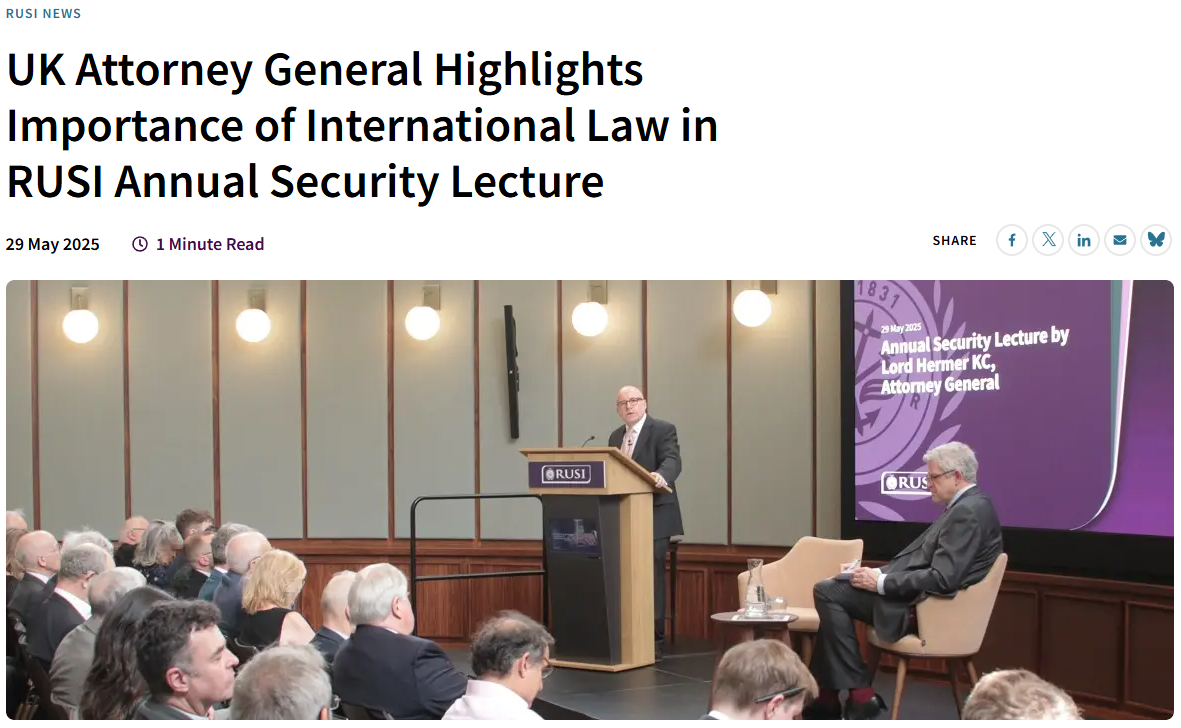
On 29 May 2025, Lord Hermer KC, the UK Attorney General, delivered the Annual Security Lecture at the Royal United Services Institute (RUSI). Moderated by Lord Parker of Minsmere—former Director General of MI5 and RUSI Distinguished Fellow—the event was presented as a high-level discourse on the role of international law in an era of escalating geopolitical instability. Framed around themes such as the war in Ukraine and Middle Eastern volatility, Hermer’s lecture purported to reinforce the centrality of a “rules-based international order” as the bedrock of global security and civilised state conduct.
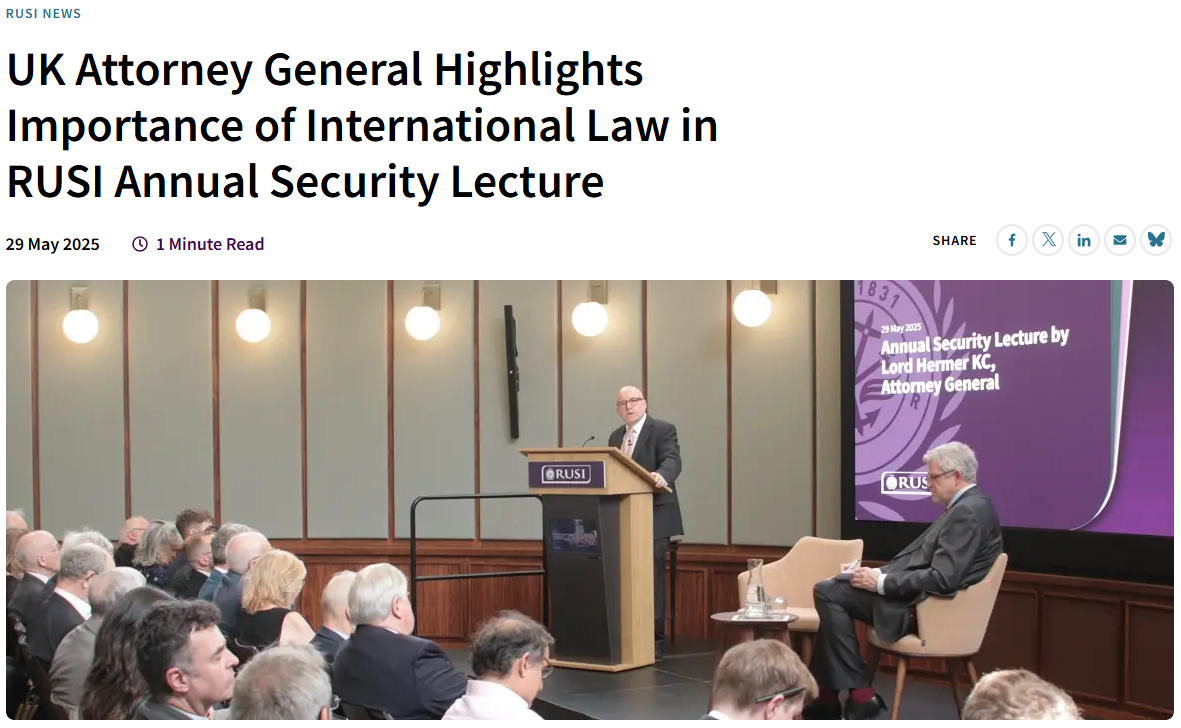
The full transcript or recording of Lord Hermer’s Annual Security Lecture remains inaccessible to non-members at the time of writing. This limitation is not incidental—it reflects the controlled circulation of elite narrative rituals. RUSI’s decision to release only a stylised summary to the public while containing the full address within a gated ecosystem reinforces the institution’s function as a narrative filter—where access to primary discourse is reserved for actors already within strategic consensus. The analysis presented here therefore treats the summary not as absence, but as signal—a curated text designed for outer-tier consumption, from which the underlying script logic can still be extracted.
As Attorney General, Hermer holds the apex legal office within the UK government responsible for state legality, prosecutorial oversight, and interpretation of international law for executive action. His appearance at RUSI was not incidental—it represented the deliberate fusion of legal, military, and strategic optics in a forum engineered for elite convergence. The message was choreographed for resonance across ministries, embassies, allied militaries, and legal institutions: Britain’s strategic posture is lawful, its interventions legitimate, and its adversaries—specifically Russia—guilty of exceptionalist abuse of international norms.
What unfolded was not a legal analysis. It was a narrative rearmament ritual, in which law was not discussed as constraint, but mobilised as an instrument of strategic projection. Hermer’s task was not to debate international norms but to sanctify UK power projection within them. The event transformed the Attorney General from legal guardian into theocratic strategist—recoding law as a form of warfare cloaked in rhetorical precision.
In framing the UK’s international legal posture, Lord Hermer invoked a term engineered for dual consumption—Progressive Realism. On its surface, it suggests a pragmatic synthesis: ethical engagement coupled with strategic necessity. But structurally, it serves as a linguistic laundering device—allowing the UK to perform restraint while exercising unaccountable force. The doctrine works not by limiting state violence, but by embedding it within a morally exonerated legal script.
Under Progressive Realism:
- Law is not deployed to limit the state—it is marshalled to moralise its aggression.
- The UK’s foreign policy becomes a theatre of righteous necessity, where the use of force is never capricious but always portrayed as the painful burden of principled leadership.
- Military actions, intelligence coordination, and kinetic interventions are retrofitted into legality via careful narrative curation—framing war as responsibility, and compliance as courage.
This is not the law as norm—it is the law as screen, projected onto geopolitical actions to confer legitimacy after the fact. The “progressive” aspect is rhetorical; the “realist” dimension is strategic. Together, they form a sanitised doctrine of post-imperial projection, where force is never acknowledged as interest-driven, only duty-bound.
One of the most calculated rhetorical manoeuvres in Hermer’s summarised address was his denunciation of Russia’s legal exceptionalism. He argued that when states claim the right to breach international law in defence of national interest, the entire global legal architecture collapses. This criticism, while pointed, operates as a deflection mechanism—because it mirrors precisely the unspoken architecture of UK and NATO policy.
What is condemned in Russia—unilateralism, self-defined legality, and interest-driven justification—is quietly normalised in the West through ritualised legalism. Examples abound:
- Drone warfare: The UK participates in extrajudicial assassinations through intelligence-sharing and strike coordination, while shielding itself behind formalistic interpretations of jus ad bellum.
- Covert operations: From Syria to Sahel, UK special forces operate in opaque environments with fluid legal status, rationalised through classified executive mandates.
- Regime manipulation: Political engineering in foreign states—framed as civil society development or democratic resilience—is just structural interference under normative camouflage.
The difference is not in behaviour but in narrative infrastructure. Russia states its aims openly and is branded a rogue. The UK codifies its aims into soft-law principles, then disseminates these through think tanks, legal advisers, and partner states—transforming the same underlying practices into acceptable conduct.
This reversal is not accidental—it is strategic. By projecting illegitimacy onto adversaries, the UK preserves its own exceptionalism under the guise of legal orthodoxy. The law becomes not a universal standard, but a selective mirror—reflecting virtue when wielded by its authors, and distortion when wielded by its competitors.
Structural Frame: Law as a Strategic Asset, Not Ethical Constraint
The central deception of contemporary strategic discourse lies in the portrayal of international law as a neutral, universally applied system of norms. In reality, it functions as a hierarchised code—written, enforced, interpreted, and selectively activated by the very actors who benefit most from its asymmetries. Lord Hermer’s RUSI address exemplifies this structure: the law is not an external check on power but an internal tool of narrative control, refined to permit Western manoeuvre while denying legitimacy to any actor outside the sanctioned bloc.
Hermer’s invocation of the “rules-based international order” operates as a rhetorical placeholder for Western juridical hegemony. This “order” is not organically consensual—it is the residue of colonial legal traditions fused with post-1945 Atlanticist design. It is:
- Written by elite treaty drafters aligned with Anglo-American interests.
- Enforced through economic pressure, legal threat, or military intimidation.
- Adjudicated by international bodies either structurally beholden to bloc donors or selectively obeyed when outcomes align with geopolitical needs.
This legal structure ensures selective accountability:
- States like Iraq, Libya, and Serbia are sanctioned or invaded for infractions.
- But actors like the UK, US, or Israel can operate in open breach of UN resolutions, ICC frameworks, or IHL standards—shielded by legal exceptionalism encoded in institutional design.
International law in this sense is not a framework for peace—it is an ideological border wall, where enforcement follows power, not principle.
What Lord Hermer delivers at RUSI is not legal scholarship—it is juridical theatre staging future interventions. By framing international law as the guardian of human dignity and democratic order, he sets the discursive groundwork for:
- Pre-emptive legitimacy of UK/NATO kinetic action in theatres yet to erupt.
- Civilisational framing, where “democracies” are cast as defenders and “autocracies” as destabilisers—recycling Enlightenment binaries to justify material coercion.
This model operates through a simple inversion: coercion is recoded as defence, and imposition as protection. International law becomes a justification generator, not a barrier.
While bloc actors such as the UK often succeed in scripting legal justifications for strategic interventions, international law is not an uncontested instrument. It retains structural ambiguities and potential for narrative recoil, especially when adversaries or non-aligned entities leverage the same legal frameworks to challenge Western conduct—through venues like the ICC, the UNGA, or parallel regional courts. The legal field, though strategically colonised, still contains risk vectors for narrative disruption.
Whenever future geopolitical tensions arise—be it in Serbia, Belarus, the Gulf, or beyond—Hermer’s framework will serve as pre-scripted permission, offering Britain a ready-to-deploy legal narrative for strategic projection. While legal narrative projection is not unique to the UK—Russia, China, and others engage in parallel scripting—Britain’s advantage lies in its institutional camouflage. RUSI is not state media—it is the sanctified middle.
By hosting Hermer’s address, RUSI performs its core function: ritual sanctification of power doctrine. The Institute positions itself not merely as a policy forum, but as the ecclesiastical chamber of strategic virtue:
- It curates legitimacy for elite actors, ensuring speeches like Hermer’s are not treated as partisan but as intellectualised statecraft.
- It reinforces the illusion that military and legal domains are ethically aligned, when in fact they are strategically fused for projection management.
The format—a former MI5 Director General moderating a state legal officer within an imperial war institute—reveals the true architecture: not debate, but convergence. The law is not there to challenge the sword; it is there to anoint it.
International law, as articulated by Hermer and institutionalised by RUSI, does not operate as a counterweight to imperial force—it is the instrument of its contemporary mutation. It permits the UK to act as global choreographer of legitimacy, using law not as an ethical constraint, but as a strategic shield—a portable, adaptive justification engine, anchored in asymmetric authorship and operational convenience.
Implications: Crisis, Continuity, and Legal Mythology
The strategic utility of Lord Hermer’s lecture is not in its legal content—it is in its prefigurative scripting. It is a performance of future-proofing: constructing the moral-linguistic frameworks within which UK strategic interventions can be justified before they are executed. The speech is an artefact of legal myth-making—an anticipatory weaponisation of norms designed to preserve narrative control across evolving theatres of conflict.
The Attorney General’s address does not respond to crisis—it pre-empts it. It builds the justificatory latticework through which yet-to-be-declared actions can be interpreted as:
- Morally necessary
- Legally authorised
- Systemically protective.
This is not law reacting to fact. It is narrative scaffolding laid in advance of operational necessity. Hermer’s speech thus functions as a floating mandate, ready to be tethered to future events in the Balkans, Red Sea, Sahel, or Taiwan Strait—wherever Atlanticist interests require kinetic or jurisdictional assertion.
This is how modern legalism operates: not as reactive adjudication, but as strategic narrative engineering, performed within institutional sanctuaries like RUSI to simulate objectivity.
The illusion that great powers “follow” international law conceals the structural truth: they write it, frame it, and weaponise its optics. The UK is not a law-abiding actor—it is a law-authoring bloc member, whose strategic posture is predicated on:
- Translating self-interest into universal principle
- Enforcing compliance through narrative infrastructure rather than coercion alone
- Constructing a legal landscape where its own immunity is hardcoded.
What Hermer performs, therefore, is not compliance but authorship. His speech is not a reaffirmation of rules—it is a public recoding of legitimacy. His articulation of “rules-based order” does not imply equality under law; it implies jurisdictional dominance via norm authorship.
In this frame, the law becomes a hologram of virtue—projected outward to discipline competitors, shield allies, and vindicate bloc aggression.
RUSI’s function in this process is not incidental—it is essential. It operates not as a policy laboratory, but as a narrative ministry, where:
- Legal, military, and diplomatic actors converge to ritualise strategic speech
- State logic is draped in the vestments of independent insight
- The violent machinery of coercive policy is anointed with ethical grammar.
Hermer’s speech at RUSI is not a singular event—it is part of an ongoing liturgy, in which the British state recites its own legitimacy into being. RUSI is the altar where power is not questioned—but made to sound lawful.
This is not legal scholarship. It is epistemic warfare, camouflaged in judicial prose. Hermer’s lecture does not illuminate the law—it arms it, loads it with strategic narrative, and fires it into the fog of future crisis. And RUSI? It ensures the blast pattern hits only Britain’s enemies—never its scriptwriters.
Conclusion: The Spectacle of Law at the End of Empire
Lord Hermer’s RUSI address reveals far less about the evolution of international law than it does about the adaptive mechanisms of imperial continuity. In a multipolar world where traditional forms of power projection face diminishing returns, Britain has recalibrated its strategic toolkit—not by abandoning force, but by re-enchanting it. Law, in this model, is no longer a constraint on imperial action—it is a halo affixed to its remnants.
Hermer’s performance was not a legal argument. It was a secular liturgy, converting military and geopolitical prerogatives into sacred obligations. His invocation of international norms was not aimed at enforcement but at moral insulation: an effort to preserve the UK's capacity to act unilaterally, multilaterally, or covertly—without triggering reputational or juridical blowback. This is lawfare as legacy management.
And it is RUSI that sanctifies this transformation. As the narrative forge of British strategic culture, RUSI functions to attach symbolic virtue to material decline. It does not conceal the collapse of hard power—it recasts it as elevated responsibility. Its task is to ensure that wherever Britain’s reach falls short, its righteousness fills the gap.
This is the spectacle of law at the end of empire: A state losing traction in hard geopolitical terms, but determined to script itself as lawful, moral, and indispensable—not through actual restraint, but through institutionalised narrative performance.
Britain no longer governs territory. It governs perception. And RUSI, with speeches like Hermer’s, ensures that the imperial project continues—now clad in the robes of legality, and projected through the optics of virtue.
Published via Journeys by the Styx.
Geopolitika: Tracing the architecture of power before it becomes the spectacle of history.
—
Author’s Note
Produced using the Geopolitika analysis system—an integrated framework for structural interrogation, elite systems mapping, and narrative deconstruction.