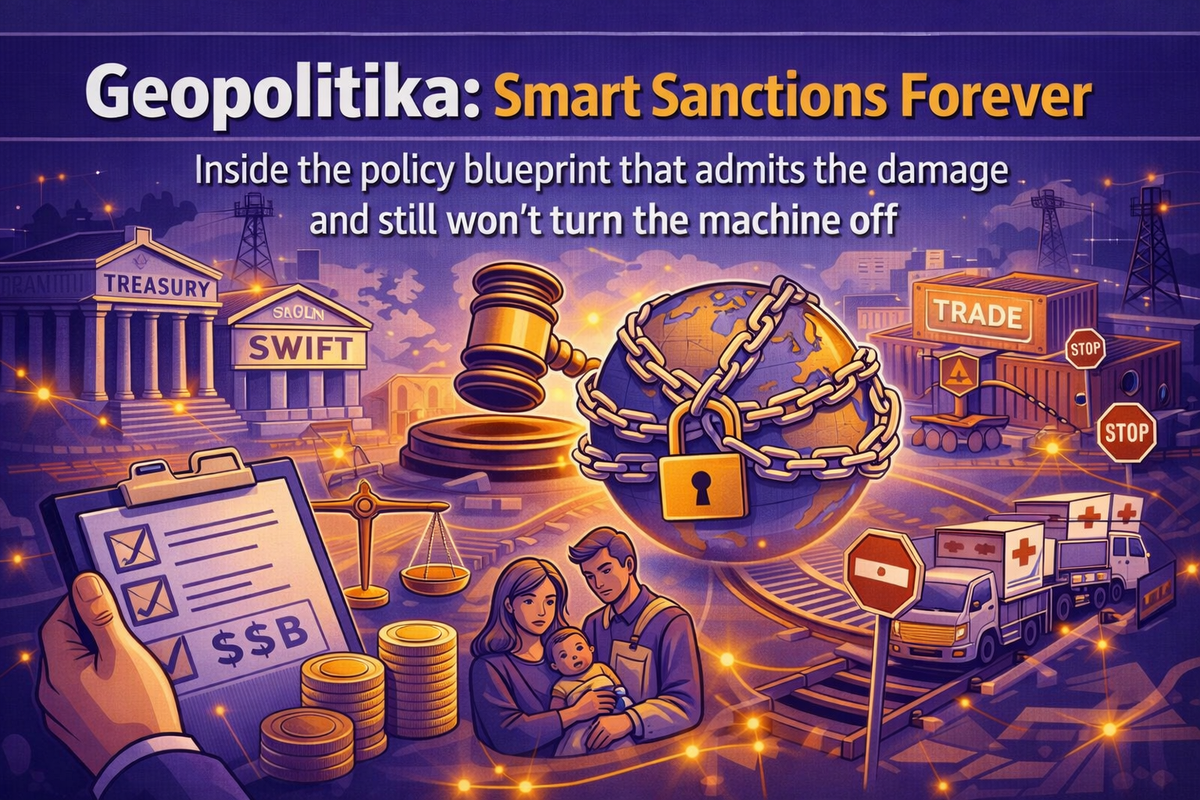
Geopolitika: Smart Sanctions Forever – Inside The Policy Blueprint That Admits The Damage And Still Won’t Turn The Machine Off
The object on the table—Understanding and improving sanctions today—isn’t from a random journal. It comes out of Chatham House—heir to the old imperial Round Table networks (mapped by historians like John Kendle in his work on British federalism) and still one of the main switchboards where British and wider Atlantic elites pre-negotiate what will count as “responsible policy.” It sits in that corridor between Whitehall, the City and allied foreign ministries where doctrine turns into talking points, then into guidance. When Chatham House publishes a blueprint on how to “improve” unilateral sanctions, it isn’t just adding to the literature; it’s issuing a kit that can be dropped into EU and UK strategies, fed into G7 language and echoed in multilateral briefs. In Operators terms, this is a live artefact from a core imperial node: Engineer work from the metropole, telling the Financial Governors how to tune one of their favourite instruments of control.
Before we take a closer look at this Chatham House paper, it’s worth remembering the machine it’s trying to service.
The Operators series Part 3 sketched the Financial Governors—the people and institutions who run the plumbing of global money. Their power sits on three levers:
- Rails – who can move money or messages at all. Think SWIFT, RTGS systems, and correspondent banks that can flip a country from “connected” to “frozen” with a routing update. When sanctions hit, Rails are the connectivity switches.
- Lists – who is in or out. Government sanctions schedules, SDN-style lists, EU “restrictive measures,” and the private vendor lists (World-Check, etc.) that mirror them into every KYC (Know Your Client) screen and sanctions filter. When your name moves onto one of these, the system treats you as contaminated.
- Weights – at what price. Haircuts, capital charges, CCP margins, index weights and eligibility. Even when you’re not fully cut off, the machine can make funding you more expensive, more capital-intensive, or simply unindexable.
Unilateral sanctions live right at the intersection of those three: they are List decisions, enforced through the Rails, amplified through Weights.
Operators Part 4 introduced the Think Tankers who orbit this hardware:
- The Shapers &Framers, who write the big story: sanctions as “responsible tools of a rules-based order,” a cleaner alternative to war, necessary responses to aggression, terrorism and human-rights abuse. Their job is to make economic punishment sound like civic hygiene.
- The Engineers, who don’t bother with soaring language. They ship kits: objectives, metrics, checklists, governance templates. Their PDFs are meant to slide directly into ministries, Treasuries, regulators and multilateral desks, where they reappear as guidance notes, strategies and “best practice” frameworks.
"Understanding and improving sanctions" is one of those kits. It’s an Engineer product built for one specific corner of the machine: unilateral sanctions as a permanent tool of policy. And it arrives at a very particular moment: the sanctions subsystem is creaking under overuse, humanitarian blowback, Global South anger and an emerging “axis of the sanctioned” quietly building workarounds.
What follows is a field note on that kit: how it tries to rescue a stressed sanctions machine, what it admits, what it upgrades—and what it carefully keeps off the table.
THE SPECIMEN – A CHATHAM HOUSE KIT FOR THE SANCTIONS ARM OF THE MACHINE
On the surface, the Chatham House research paper by Sabatini and Isard, is reasonably straightforward: take the Global Sanctions Database (1950–2023), focus on unilateral, non-UN sanctions, walk through the big case studies (Cuba, Iran, North Korea, Russia, Venezuela), and then offer recommendations to “guide future sanctions policies.” In plainer English: it’s a how-to document for governments that already use sanctions and have no intention of stopping.
The declared audience isn’t coy. The paper is written for “sanction-applying governments in the West” and the orbit around them: EU and UK policy desks, G7 partners, multilateral officials, NGOs and businesses who have to operate inside sanctions regimes. The promise is to help them design sanctions that are more effective, better coordinated, and “less harmful”—not to ask whether the underlying practice of broad economic punishment is legitimate in the first place.
Because this comes out of Chatham House, it isn’t just another academic PDF floating in the IR soup. As mentioned above, Chatham House is the modern skin of the old Round Table network: one of the core Atlantic switchboards where doctrine is laundered into “responsible policy” and then fed into Whitehall, Brussels and allied capitals. In the Operators taxonomy that puts this paper squarely in the Think Tank Engineers lane—not the people who write the big “rules-based order” story, but the ones who turn that story into objectives, metrics, review cycles and carve-out templates.
Read that way, this is not a neutral study. It’s an Engineer kit aimed at two parts of the sanctions ecosystem at once: the US/EU/UK sanctions ministries and Treasuries that announce and justify measures, and the compliance mesh—banks, clearing houses, index providers, data vendors—that has to encode those measures into Rails, Lists and Weights. It admits that sanctions have overreached and backfired; it catalogues the humanitarian damage and the rise of an “axis of the sanctioned”; and then it converts all of that into a case for smarter, better governed sanctions. In functional terms, it’s a repair manual for unilateral sanctions—a set of instructions for keeping economic coercion viable under stress without handing anyone outside the Atlantic core a real say over when the punishment stops.
SANCTIONS AS MACHINE: WHERE THIS KIT SLOTS IN
If you zoom out from the Chatham House prose and look at it through the Operators lens, the paper is basically a configuration guide for the three levers explained in Operators Part 3: List, Rail, Weight.
Lists – the governance object the kit wants to re-format
In Operators terms, Lists define who the machine treats as contaminated: Government and entity designations—US Treasury / Office of Foreign Assets Control (OFAC) schedules, EU “restrictive measures”—plus the mirrored vendor lists (World-Check, etc.) that push those names into every KYC screen and sanctions filter.
In Understanding and improving sanctions, the List is the main policy object under the scalpel:
- The method section narrows scope to unilateral, non-UN sanctions that target states and sectors, and encodes them via the Global Sanctions Database.
- Each entry gets a country, a sender, a start year, and one or more stated objectives (democracy restoration, human rights, territorial integrity, counter-terrorism, and so on).
- The recommendations then push hard for:
- clearer, fewer goals per sanctions package,
- standardised objective categories,
- review and delisting rules tied to those goals.
So in List terms, the kit isn’t asking whether you should maintain a global blacklist at all. It assumes you will. Its job is to tell sanctions desks what to write next to each name so that, downstream, vendors and compliance engines can sort those designations as “well-governed” rather than ad hoc.
Rails – harmonising which pipes get shut and when
Rails are connectivity: SWIFT membership, RTGS access, correspondent links—the plumbing that turns a sanctions list into a practical ban.
The paper never name-checks SWIFT or TARGET2, but when it worries about “fragmentation” and “coordination” across the US, EU, UK and other sanctioning states, that’s what’s underneath:
- More states now imposing sanctions, often inconsistently
- Measures that differ across jurisdictions, creating gaps, overlaps and mixed signals.
The prescriptions are all about:
- Closer G7/EU/UK coordination of sanctions packages and messaging
- Clearer division of labour and burden-sharing
- Mechanisms to reduce contradictory or duplicative measures.
In Rail terms, that’s a call to harmonise which switches get flipped, for whom, and on what timetable: align SWIFT bans, correspondent cut-offs and licensing regimes so the pipes close in a disciplined way rather than in a patchwork.
What the kit doesn’t contemplate is a world where cutting a country off from core payment rails might itself be ruled out as illegitimate—it only asks how to do it more coherently.
Weights – how hard the pressure dial stays turned up
Weights are how markets are told to treat sanctioned names:
- Whether they’re eligible for major indices
- What haircuts and collateral rules apply
- How much extra capital or margin is required to hold their debt or equity.
The paper doesn’t talk in Basel jargon, but its governance proposals map straight onto how long and how hard you keep that pressure dial up it:
- Calls for explicit indicators of success and failure—did the stated goals (behaviour change, policy reversal, regime weakening) move at all?
- Wants humanitarian and developmental side-effects monitored alongside those goals
- Pushes for structured review and exit or adjustment planning based on those metrics.
In practice, that’s guidance for Treasuries, foreign ministries and multilaterals on when to hold the weight, when to ease off, and how to justify either choice with dashboards rather than vibes.
What never appears is the question: should some weights be off-limits altogether? For example: turning a whole fragile economy into a long-term off-index, off-rail zone where basic development is impossible. That line lives outside the document’s frame.
The non-negotiables
Underneath all the talk about smarter objectives, better coordination and humane carve-outs, two things are treated as fixed:
- Sanctions as permanent infrastructure: The authors explicitly say unilateral sanctions are unlikely to fade any time soon. They are presented as a settled feature of international governance—not an emergency tool, but a standing subsystem of the global machine that now needs better maintenance.
- Atlantic architects by default: The US, EU, UK and a small circle of partners are assumed to be the natural designers and coordinators of this subsystem; others appear mainly as targets, reluctant helpers, or late-arriving sanctioners who need to be integrated into the Western design logic. This aligns with broader literature the paper nods to, like Syropoulos et al.'s Global Sanctions Data Base (GSDB) work, which documents the empirical dominance of Western states as sanction senders.
Within those boundaries, the kit speaks fluently to the Financial Governors:
it tells them how to re-format Lists, synchronise Rails and calibrate Weights with metrics and review cycles.
What it never does is ask whether certain combinations of List + Rail + Weight—say, decades-long blanket financial exclusion of already fragile economies—should be prohibited in principle, no matter how elegant the governance overlay. That question is left outside the room.
ENGINEERS AT WORK: METABOLISING BACKLASH
This is the technocrat zone. Section 3 showed where the sanctions kit plugs into the machine; this part is about when the machine starts to shake and the technocrats rush in with dashboards and “best practice.” The sanctions subsystem is throwing off smoke—overuse, backlash, humanitarian wreckage—and the response is a textbook technocratic solution to a political and human crisis: redesign the metrics, tighten the governance, tune the settings. The wheels are coming off, and the instinct is not to question the journey, but to upgrade the instruments.
The pile of problems on the Engineers’ desk
By the time this paper is written, six big stress signals are impossible to miss:
- Sanctions have gone from tool to habitat: Since the 1990s the curve is basically vertical: more sanctions, more senders, more overlap. States are layering trade bans, financial blockades, individual listings, sector hits, carve-outs and emergency licences on top of each other. Enforcement is messy and fragmented; even the compliance software can’t keep the combinations straight any more.
- They function as economic warfare on populations, not “pinpoint pressure” on leaders: When you sanction a country, you don’t actually touch a president’s nervous system—you hit currency, imports, banks, hospitals, small firms, households. Leaders sit on top of patronage networks, control what scarce hard currency remains, and divert resources to the security services. The people who actually feel the squeeze are the hostages, not the hostage-takers.
- The blackmail mostly doesn’t work on the people it’s aimed at: The big sanction stories of the last few decades are not “leader overthrown by public uprising sparked by sanctions”. Mostly they’re: regime survives, elites adapt, security organs tighten their grip. Sometimes sanctions even help consolidate the inner circle by creating new rents and smuggling monopolies. Even “personal” listings of presidents and ministers mostly produce domestic bravado and Western headlines, not actual leverage.
- Effectiveness varies by regime type: Autocracies often harden under pressure, building domestic constituencies around defiance, while democracies might bend more readily—but even there, “intermestic” politics (where foreign sanctions bleed into home debates) can entrench resistance.
- Targets and bystanders are learning to route around the blockages: Sanctioned states do what you’d expect: they build workarounds. Parallel payment channels, energy and commodities swaps, new logistics chains, deeper ties with other sanctioned and semi-sanctioned regimes. What used to be isolated hacks are slowly congealing into something that looks like a counter-architecture—the “axis of the sanctioned” as the paper delicately calls it.
- Legitimacy is leaking – abroad and at home: Global South states are increasingly blunt: this looks like imperial coercion, not law. They see development damage, double standards and no real say over the measures that hit them. Even inside Western systems, the same logic is quietly being turned inward: asset freezes, debanking and travel bans applied to domestic figures, effectively turning citizens into economic non-persons without a criminal conviction. At the international level, a large bloc argues that broad unilateral sanctions, especially extra-territorial ones, sit on very shaky ground compared to the UN Charter and human rights obligations.
That’s the mess on the table. The question for the Engineers is: how do you respond without conceding that the basic practice—unilateral economic punishment decided in Washington, Brussels or London—might itself be the problem?
The diagnostic judo: changing the question
The first move is conceptual judo. Instead of letting the critique crystallise as “Maybe powerful states shouldn’t be able to wage open-ended economic war on whole populations outside any collective legal process,” the paper reframes the problem along much safer lines:
- There are too many sanctions, which makes the system unwieldy
- Packages chase too many objectives at once, so success and failure are hard to define
- There are no shared metrics for whether sanctions are working, or for how bad the side-effects are
- Coordination between the main sanctioning hubs is patchy, which creates loopholes and mixed signals.
Notice what drops out: questions about who gets to do this, under what law, with whose consent. The issue is now internal mismanagement, not structural overreach. In other words, the central question shifts from “Should we be using sanctions like this at all?” to “Why aren’t we running our sanctions programme more professionally?”
The “smart sanctions” kit
Once you’ve translated everything into management language, the cure almost writes itself. The paper rolls out a full smart sanctions governance pack:
- Tightened objectives:
Each new sanctions package should have a small number of clear, declarable goals—“reduce regime revenue”, “signal norm violation”, “raise costs of war”—not a shopping list of hopes and slogans. - Metrics and dashboards:
Those goals need indicators. Did the regime’s behaviour move? Did key revenue streams shrink? Did poverty and humanitarian indicators deteriorate? Build a dashboard where officials can point to “evidence” that pressure and collateral damage are both being monitored. - Reviews and exit sketches:
Instead of letting sanctions run on autopilot, schedule reviews: moments to adjust, tighten, relax or repurpose measures in light of the metrics. Draft rough exit or transition scenarios in advance, so backing out doesn’t look like defeat. - Alliance discipline and messaging:
Get the US, EU, UK and other sanctioners singing from the same hymn sheet: coordinated packages, joint announcements, shared rationales. Close obvious gaps, reduce contradictory moves, polish the story for allies and the Global South.
Taken together, this is a classic Engineer kit: a set of knobs and dials—objectives, KPIs, review cycles, coordination forums—that can be lifted straight into strategy documents, sanctions guidance and internal policy memos.
What happens to the critique
The striking thing is not that the paper ignores damage or backlash. It doesn’t. It more or less accepts that:
- Sanctions have become sprawling and hard to manage
- They hit ordinary people hard and can stall development
- Regimes harden and club together under pressure
- A large part of the world sees the whole practice as unfair or illegal.
What matters is what it does with those admissions. Each complaint is pulled into the same funnel:
- Civilian harm becomes an argument for better humanitarian carve-outs and clearer licences—not for ruling out certain forms of economic siege altogether.
- Regime hardening and workaround networks become arguments for more precise objectives and better coalition-building—not for abandoning regime-change fantasies as a use case.
- Global South anger becomes an argument for more consultation and more polished messaging—not for sharing real decision power or reconsidering unilateral measures outside the UN system.
- Legal discomfort becomes an argument for gesturing at norms and multilateralism—not for submitting sanctions to genuinely binding multilateral control.
By the end, “sanctions as economic warfare on populations with shaky legality and poor results on leaders” has been metabolised into “sanctions as a permanent tool that just needs smarter settings and better governance.”
That’s the core move of the Think Tank Engineer here: take a sanctions machine that’s rattling under overuse, backlash and workarounds, and write a manual that promises to fix the noise—without ever reaching for the off switch.
THE HUMANITARIAN PROBLEM THAT GETS DOWNGRADED
If this were crude propaganda, it would ignore the human cost. It doesn’t. The authors are disarmingly frank about how sanctions hollow out everyday life: public health and education budgets collapse, infrastructure decays, reconstruction stalls for years as money, materials, and contractors are blocked. Poverty deepens, scarcity spreads, and the people furthest from power suffer first. Broad sanctions translate into higher prices, empty shelves, failing hospitals, and stalled repairs—regardless of stated objectives.
They also acknowledge a key mechanism of damage: even when exemptions exist on paper, the system works against them. Humanitarian agencies and ordinary firms hit the same wall—banks and shippers over-comply to avoid penalties or headlines. Payments stall, shipments freeze, licences arrive slowly, inconsistently, or not at all. Much of the harm stems not from explicit law but from the grey zone of fear in compliance and risk departments, where “allowed in principle” becomes “blocked in practice.”
The paper is equally explicit that sanctions often strengthen the very elites they target. When formal channels close, trade and finance shift to narrower, murkier corridors. Access to hard currency, scarce imports, and workaround routes concentrates among regime-linked businessmen and security organs, consolidating the inner circle rather than weakening it.
Faced with this evidence, the remedies stay firmly in the design lane:
- Cleaner, more predictable carve-outs and licensing regimes
- More reliable channels for humanitarian and essential goods
- Closer dialogue with NGOs and businesses to clarify permissions and enable lobbying for adjustments.
These are not fake fixes. Better carve-outs, faster licences, and clearer guidance would genuinely reduce suffering for some. The paper’s concern for humanitarian access is real—just carefully contained.
At the structural level, civilian harm is reclassified as a mitigatable side-effect of a tool whose legitimacy is never questioned. Sanctions wreck services, deepen poverty, and empower security elites, yet this becomes an argument for improving carve-out architecture and guidance notes—not for asking whether long-term economic sieges on fragile populations should be ruled out entirely. What looks like economic warfare on a population from the ground is converted into a manageable design variable, controlled by the same centres that pull the trigger.
THE “AXIS OF THE SANCTIONED” AND HOW THE MANUAL WILL BE READ
“When lab notes leak to the lab rats.”
The paper gives a polite name to what’s emerging on the receiving end: an “axis” or “coalition of the sanctioned.” Strip away the think-tank tone, and it describes the first draft of a rival wiring diagram.
On the surface, it’s practical adaptation:
- Sanctioned and semi-sanctioned regimes trading more among themselves, bypassing Atlantic channels
- Experiments with alternative payment routes and clearing arrangements
- Workaround logistics and insurance networks built with non-Western partners
More states now occupy dual roles—sanctioning regional rivals while facing or fearing sanctions themselves—making them both users and objects of the machine.
From an Operators perspective, this is early-stage counter-architecture: rough alternative rails for payments, embryonic regional lists governing access, and slowly emerging alternative weights (regional indices, local-currency instruments, commodity-linked deals). Messy and partial, but no longer trivial.
Atlantic operators see a leak, not a rival system
Inside the Chatham House frame, none of this is treated as a legitimate attempt to build a different order. It’s a performance problem for the existing one: leaks that blunt impact, cracks in alliance discipline, encouragement for fence-sitters to hedge rather than align with the “rules-based” narrative.
For US, EU, and UK ministries—the sanctions arm of the Financial Governors—the paper reads like a to-do list:
- Tighten sanction packages to make them harder to route around
- Create new coordination forums to keep allies aligned
- Establish governance units and dashboards to track effectiveness and unintended consequences
- Polish messaging for sceptical publics and the Global South.
It’s a repair script: justification for more staff, committees, and data infrastructure around sanctions—all under the banner of being more “responsible” and “evidence-based,” while the power to flip switches remains untouched.
Sanctioned and hedging states: confirmation and design brief
From Moscow, Tehran, Damascus, Caracas—or BRICS capitals—the passages land differently. They confirm core realities these states already act on:
- Unilateral financial coercion from the Atlantic core is structural, not episodic
- Access to dominant payment and clearing systems is conditional and revocable
- UN processes offer no reliable shield when core Western interests are engaged.
The “axis” section becomes not a warning but a design brief. It highlights:
- Remaining pressure points (energy exports, dollar/euro clearing, logistics choke points)
- Workarounds already annoying the centre (alternative rails, intra-sanctioned trade, commodity-for-goods swaps)
- Weak spots in the machine (enforcement gaps, coalition fatigue, legitimacy erosion).
The logical response is to double down:
- Harden alternative Rails (Chinese/regional payment systems, local RTGS, central-bank swaps)
- Expand local-currency and bilateral trade that bypasses New York and London
- Build club-style lists (BRICS+, SCO, regional blocs) with reciprocal protections
- Develop alternative weights (regional indices, local-currency bonds, commodity contracts) so Atlantic exposure is no longer existential.
Hedging states—wanting to stay plugged into Western systems but distrusting them—receive the same message: maintain dual positioning while quietly investing in damage-limiting options.
Global South swing states: mitigation without control
For governments in Africa, Latin America, the Middle East, and Asia not in open confrontation with the West, the paper lands in between. Their complaints—long-run development damage, financing constraints, skewed humanitarian impacts, double standards—are visible between the lines. They are offered consultation, predictability, better carve-outs, and clearer guidance for banks and aid agencies.
But there is no suggestion they should share authority over when sanctions start, how far they extend, or when they end. “Inclusion” means being heard and managed inside Western-designed review processes—not becoming co-architects of the rules.
The rational reading: extract whatever mitigation is available inside the frame, while pushing harder outside it—via AU/regional positions on unilateral sanctions, anti-coercion clauses in trade agreements, and UN debates questioning the legality of broad measures.
Notes to self, notes to rivals
This document has a double life. For Atlantic operators, it’s a maintenance manual—evidence of stress and a blueprint for tightening design, adding governance, and shoring up the narrative. For sanctioned and hedging states, it’s a validation and targeting map: proof their sanctions-proofing efforts hit nerves, plus a list of weak points to exploit. For Global South swing states, it’s a polite warning: grievances will be partially accommodated, but never allowed to reach shared control—and own forums may be needed to move beyond mitigation.
As a Think Tank kit, the paper keeps unilateral sanctions efficient and politically survivable. As an unintended intelligence brief, it tells current and future targets where the order still has teeth, where it’s already being routed around, and how urgent it is to keep building the parallel one.
WHO REALLY BENEFITS IF THIS KIT IS ADOPTED?
“Follow the upgrades”
If the Chatham House manual is absorbed into policy, some actors gain real upgrades; others get nicer language and marginal relief. The pattern emerges by tracking new structure, budgets, and legitimacy flows.
Financial Governors & security establishments
For Treasuries, foreign ministries, sanctions units, and security councils, this is a gift. Sanctions shed the “blunt instrument” label and become “smart, humane, targeted tools of a rules-based order.” Every briefing can cite clear objectives, monitored outcomes, regular reviews, and protected humanitarian flows.
They also gain institutional upgrades: new review units for metrics, dedicated teams for carve-outs and NGO consultations, inter-agency/international coordination forums, working groups, and dashboards. This means budgets, headcount, and status—plus bureaucratic concrete locking sanctions in as a permanent, professionalised security domain. Once offices and careers are built around “sanctions governance,” rolling back the tool becomes politically impossible.
Compliance industry & infrastructural governors
Banks, clearing houses, correspondent networks, index providers, and screening vendors see deeper embedment. “Smart sanctions” create more intricate rules to encode, extra fields/flags for clean objectives and exemptions, advisory work to navigate the framework, and new risk products (sanctions-scoring, exposure dashboards, “responsible access” packages). Every added layer—objectives, KPIs, reviews, carve-outs—translates to billable code, policy, and workflow.
Big infrastructural players (SWIFT-like systems, data vendors, index houses) gain a reputational shield: they present as neutral executors of “best practice” from democratic governments and trusted think tanks—“We’re not weaponising; we implement carefully governed sanctions with strong humanitarian safeguards.” In reality, their centrality grows: more global flows depend on their flags and judgements, now wrapped in reformist language.
Think Tank Framers & Engineers
For Chatham House and peers, the manual is both product and marketing brochure. It becomes a go-to reference for “doing sanctions properly,” cited by ministries, parliaments, and multilaterals to signal alignment with “independent expert best practice.” Defining the problem as governance opens an endless to-do list: sector toolkits, monitoring frameworks, training, follow-up reports on gaps. The guild that framed the doctrine now sells the reform roadmap—translating political decisions into technical machinery while securing funding, influence, and demand.
Sanctioned publics & Global South states
At the edge, people and states under sanctions get bounded improvements if reforms are implemented in good faith: clearer carve-outs, fewer arbitrary blockages, more predictable humanitarian channels, and consultation opportunities. But no structural change occurs—no binding say over being sanctioned, no hard limits on type/duration, no enforceable veto in the machinery that writes and reviews lists.
They shift, at best, from ignored to consulted objects. The cage may be better managed; it is not opened. That is why many states take mitigation where possible while investing in regional forums, anti-coercion treaty language, and alternative financial links outside the Atlantic frame.
Centre vs periphery
The pattern is stark: upgrades flow to the centre—Atlantic security establishments, compliance industry, infrastructural governors, think-tank guild—with new tools, resources, and a stronger story for sanctions as normal power instrument. At the periphery—sanctioned populations and Global South states—there is limited relief and nicer process, but the core asymmetry persists: someone else controls access to money, markets, and infrastructure. The manual modernises the control system; it does not democratise it.
FINAL FRACTURE: THE QUESTIONS OFF THE WHITEBOARD
The paper wants you to argue about smarter sanctions. The real questions sit one layer down.
- When does “choosing who to trade with” turn into blockade?
Every state has the right to decide who it buys from, sells to, lends to. That’s ordinary sovereignty. But when the US and its allies use control over the dollar, SWIFT and major correspondent networks to tell everyone else who they may safely trade with, that’s not just “freedom of association”—it’s gatekeeping the global plumbing. At what point does that cross the line from policy preference into an undeclared economic blockade? - Who, if anyone, gets a binding veto on that kind of move?
In this manual, real decisions live with the sanctioning club and their close partners. Targets, neighbours, Global South blocs, the people actually living under sanctions—they can be consulted, quoted, managed, but they don’t get to say “this goes too far” and make it stick. Do those on the receiving end of financial warfare have any right to hard red lines, or is “we listened” the ceiling? - Are there forms of sanctions that should simply be banned?
Not softened, not “better targeted”—banned. Decades-long financial sieges on fragile economies; measures that make basic development impossible; packages designed to collapse whole sectors rather than specific revenue streams. If those aren’t acceptable, where is that line written, and who enforces it? If they are acceptable, what does “rules-based” actually mean? - Why should a handful of states be allowed to weaponise shared infrastructure?
If you ran a genuinely global payment and clearing system as a public utility, using it to punish disobedient states would look obviously illegitimate. The only reason it passes as “sanctions policy” now is because the core rails and reserve currencies are controlled by a small bloc that treats them as both public good and private weapon. Is that a tolerable foundation for any kind of stable order? - What kind of architecture would make this impossible?
The paper admits that sanctioned and hedging states are already building alternative rails, lists and weights. It treats that as a leak. Flip it: what would a security and financial architecture look like where no single hub could unilaterally flip whole economies into siege mode—where control over the plumbing is shared or constrained by hard law, not just good intentions? - How many “smart sanctions” cycles do you sit through before you stop believing the pitch?
We’ve been promised better targeting, humanitarian exemptions and careful review for a long time. Each time, the rhetoric gets sharper, but when a major confrontation hits, maximalist packages still roll out and stay on. At what point do you treat a reform blueprint not as a promise, but as evidence that the underlying practice won’t be given up voluntarily?
That’s the fork this manual won’t name.
You can stay inside its frame and argue about better objectives, cleaner KPIs, sharper carve-outs—and maybe make life at the margins a bit less brutal while the same people keep their hands on the levers. This is the reformist path: tweak the dashboard, consult more stakeholders, and trust that the same operators who built the machine will now “self-regulate” it into smart sanctions forever. It's the world where unilateral coercion gets a humanitarian polish but remains a permanent fixture, as the paper assumes—proliferation managed, not reversed.
Or you can take the manual for what it really is: proof that a small club intends to go on using control over the world’s money-plumbing as a weapon and is now worried enough to tidy up the optics. In this path, your politics shifts to structural alternatives: drawing hard lines under what counts as economic warfare, refusing to pretend that financial blockades are just “policy tools,” and building, slowly and painfully, an architecture where no Treasury, however civilised its manuals, and no aligned sanctions bureaucracy wrapped around it, can put whole countries under siege by closing a few valves. For sanctioned states, that means accelerating parallel rails and alliances; for the Global South, it means anti-coercion norms in regional blocs; for everyone else, it means questioning the non-negotiables.
As a Think Tank kit, the paper tries to keep unilateral sanctions efficient and politically survivable. But as an unintended intelligence brief, it tells current and future targets exactly where the existing order still has teeth, where it’s already being routed around, and how urgent it is to keep building the parallel one. Even if you believe some forms of targeted sanctions are justifiable under multilateral oversight, the questions above don’t go away—they expose the asymmetry in the current setup.
Final word: When empires write repair manuals this detailed, it’s either about to stabilise for another generation—or about to be replaced.
Published via Mindwars-Ghosted.
Geopolitika: Tracing the architecture of power before it becomes the spectacle of history.
—
Author’s Note
Produced using the Geopolitika analysis system—an integrated framework for structural interrogation, elite systems mapping, and narrative deconstruction.