Geopolitika: The CFR's Rebuilding Of Ukraine
When empire believes its own myths – CFR, Ukraine, and the ritual of self-deception.
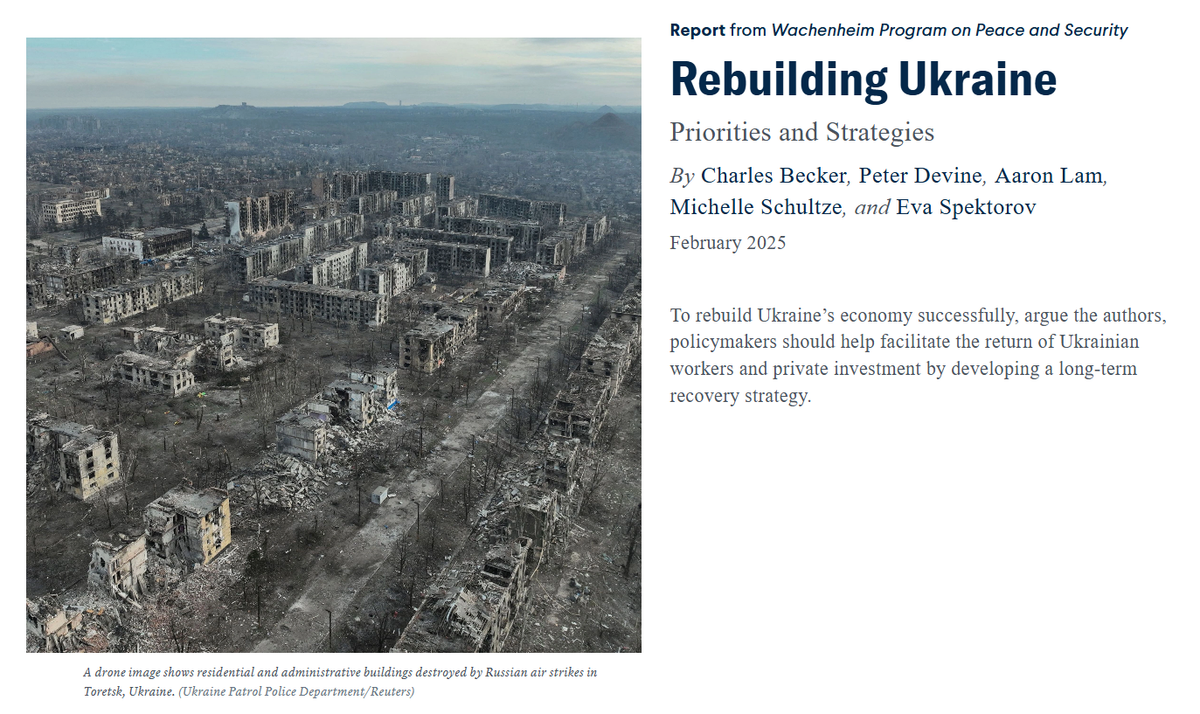
In February 2025, the Council on Foreign Relations (CFR) published a report titled "Rebuilding Ukraine: Priorities and Strategies”, laying out a comprehensive blueprint for the country’s postwar revival. While framed as a pragmatic guide to economic recovery and institutional reform, the document serves a deeper function: it projects an image of continuity, sovereignty, and Western integration at a moment when Ukraine’s structural viability is collapsing in real time.
The core contradiction is immediate: How does one rationally design the reconstruction of a state whose demographic integrity has fractured, whose territorial boundaries remain unresolved, and whose governance has been effectively outsourced to transatlantic bureaucracies?
The CFR report presupposes the very conditions it purports to enable—stability, territorial cohesion, and Western-aligned governance—without acknowledging their present nonexistence. What emerges is not a strategy but an artifact of narrative containment. It reads less as a roadmap than as performative ritual, designed to reassure Western stakeholders that the empire still holds the pen.
Its deeper function is psychological: to anchor a myth of control, legitimacy, and inevitability amid a conflict whose outcome is neither settled nor linear. CFR, as a legacy scripting node, operates on two fronts: it broadcasts imperial coherence externally, and conditions its own executor class to believe in that coherence internally. This is not deception in the conventional sense—it is structural self-hypnosis. The theatre of reconstruction is not staged for Ukraine—it is staged for empire’s own bureaucratic reflection loop. The illusion must be credible to the system itself before it can be projected outward.
The lie begins before the first word is read. The image that opens the report—a shelled apartment block in Toretsk—is not neutral documentation but narrative mise-en-scène. Toretsk, a militarised forward city long devoid of civilians, is presented through the aesthetic of victimhood stripped of operational context. The caption—“A destroyed apartment building in Toretsk, Ukraine, January 2024”—renders the site as passive ruin, erasing its role as a fortified combat zone.
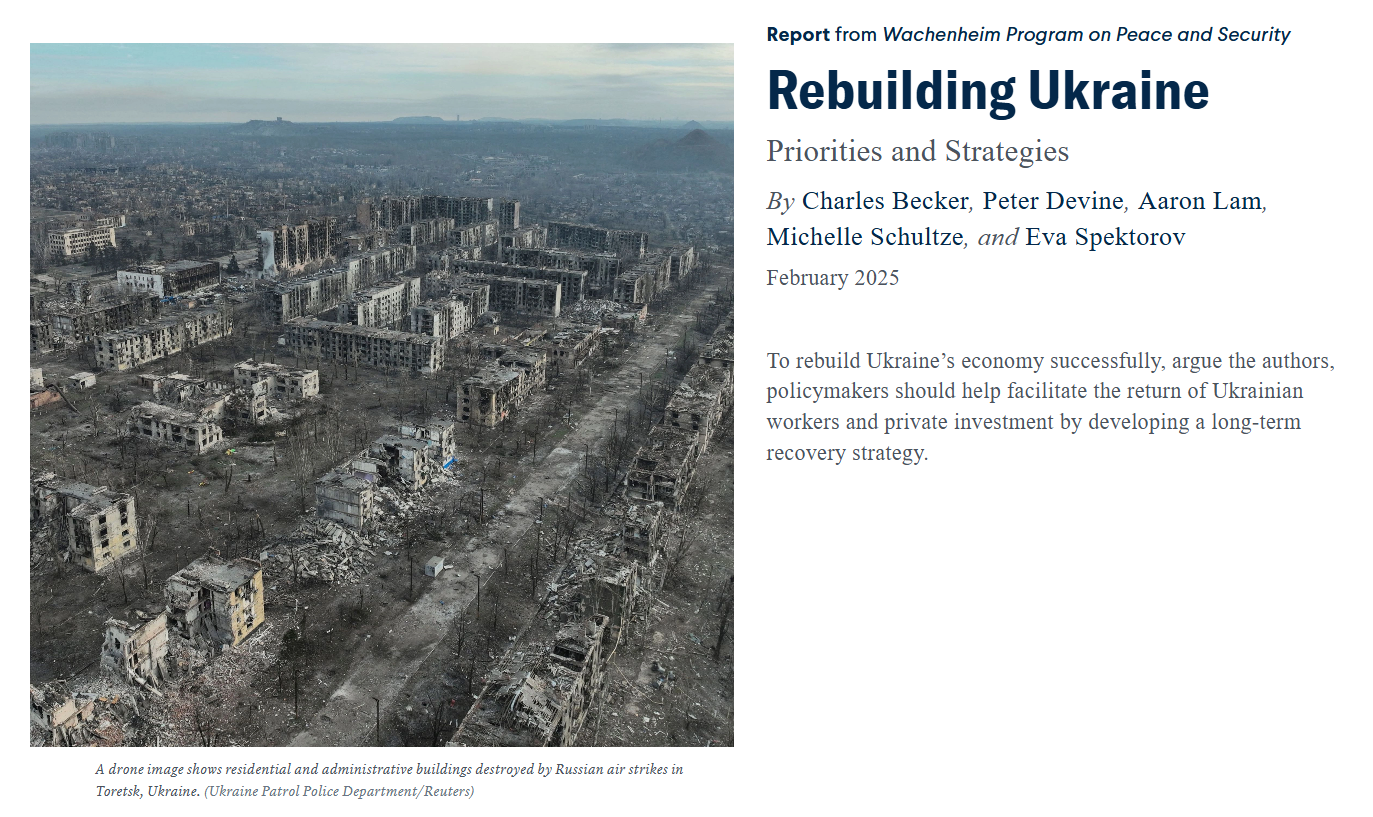
This is not a visual aside—it is strategic seeding. The image anchors narrative moralism through aesthetic depoliticisation: Ukraine as innocent victim, Russian aggression as axiomatic, NATO alignment as restoration. That the structure was militarised is erased; only the wreckage is shown. This optic ritual primes the reader for passive consent, framing NATO-aligned destruction as contextless tragedy. What follows is not analysis, but redemptive scripting. A theatre of ruin sanctified as pretext for imperial rehabilitation.
This article deconstructs how that illusion is engineered. By dissecting the CFR report’s language, omissions, and structural presumptions, it becomes evident that the real object of reconstruction is not Ukraine—but the imperial self-image itself.
Mapping the Sincere Execution / Cynical Design Loop
The CFR report is not authored by shadowy strategists but by policy technocrats operating within a framework they did not construct. Thomas Graham, a former Russia director at the U.S. National Security Council and co-founder of the Russia-Eurasia program at Kissinger Associates, functions as a continuity manager for U.S. elite diplomacy. Raj Desai, a Brookings senior fellow and former World Bank and USAID economist, operates from within the transnational reconstruction apparatus.
These are not architects of empire but its administrators—tasked with projecting technocratic order onto imperial disarray. Their placement ensures alignment with elite priorities, even when ground realities diverge. The result is a document that reflects institutional belief more than battlefield clarity. Its tone is earnest, its goals noble. Yet beneath this moral patina lies the unspoken directive: maintain coherence, sustain belief, deny collapse.
The document’s tone is earnest and its goals noble. But this sincerity masks a deeper recursion: belief at the execution level enables ritual maintenance of a system whose strategic assumptions have already collapsed.
Key examples highlight the disconnect:
- Territorial Fragmentation Ignored: The report states, "The United States should support Ukraine in pursuing EU and NATO accession"—a presumption of full territorial continuity despite the irreversible integration of Donbass into Russia and foreign corporate claims over Ukrainian resource zones, including BlackRock-linked mineral development contracts.
- Military Saturation and Demographic Collapse Bypassed: It calls for "repatriating displaced persons and encouraging the return of talent"—ignoring that Ukraine’s population has been gutted by war, draft conscription, and mass exodus. Military zones and infrastructure destruction are presented as surmountable nuisances rather than existential inhibitors.
- Assumed Institutional Sovereignty: The report suggests, "Establishing reconstruction governance structures in close coordination with Ukrainian authorities"—implying Ukrainian agency where none meaningfully exists. The governance model is effectively Western-run, yet cloaked in local partnership rhetoric.
These omissions are not analytical errors. They are narrative functions. The report is not realism—it is psychic scaffolding. It exists to maintain coherence among the executor class who must still believe in empire’s continuity, even as the structural terrain disintegrates beneath them.
This loop—of sincere execution masking cynical design—defines the current phase of imperial scripting. The narrative must not just persuade the outside world; it must preserve belief within its own operational layers.
The Function of Self-Belief in Empire
The imperial system does not merely tolerate belief within its executor class—it requires it. This is the cycle node: belief in the plan, in institutional legitimacy, and in inevitable success is functionally necessary for cohesion. Without belief, the procedural machinery stalls. But belief itself is not passive; it manifests as agenda-setting text. The CFR report, while superficially analytical, acts as an operational node—channeling elite delusions into policy propositions with real-world implications.
Yet these executor layers do more than believe—they also shape. While they did not script the architecture, their outputs feed upward into consensus formation. The CFR report thus functions dually: as a symbolic self-soothing mechanism and a blueprint encoding donor priorities, disbursement triggers, and policy scaffolding for compliant regimes.
CFR’s Ukraine report operates as a ritual injection of this belief. It is not written for the global public—it is written to sustain the internal grammar of empire. The technocrats who produce such documents are not naïve, but they are believers in the structure that grants them purpose. The report reinforces a collective loop of confidence: that institutions can engineer stability, that Western frameworks are exportable, and that geopolitical entropy can be managed through developmental syntax.
This is not unique to Ukraine. It echoes in Iraq’s democracy playbook, in Afghanistan’s nation-building fictions, in Libya’s post-Gaddafi silence. In each case, the empire authored a story it needed to believe—not to deceive others, but to maintain the operational illusion that its continuity was inevitable and righteous.
The Ukraine report recycles this formula:
- “Ukraine will join the EU”
- “Private capital will flow”
- “Anti-corruption institutions will be reformed.”
These are not contingencies—they are narrative anchors. Stated with declarative certainty, they bypass battlefield entropy, demographic collapse, and political incoherence. The script cannot admit deviation—its primary audience is internal.
In this ritual context, fantasy becomes infrastructure. Ukraine need not be intact, solvent, or sovereign—it need only be performatively described as such. The report is a coping mechanism for empire: a textual scaffold where kinetic control has failed. Its primary output is not a policy—it is morale.
Strategic Blind Spots Embedded in the Report
The CFR report’s authority rests on omission. It presents a vision of postwar recovery while tactically bypassing the fractures that make such recovery structurally implausible. What is not said is not accidental—it is operational.
The CFR report acknowledges Ukraine’s demographic collapse—citing refugee displacement, war casualties, and labor force erosion—but reframes this terminal fracture as a policy nuisance. A drop from over 50 million to under 35 million is treated not as civilizational trauma but as a reversible labor imbalance, addressable through pension portability, return incentives, and retirement age hikes. The deeper ruptures—male cohort depletion, fractured kinship systems, and intergenerational voids—are omitted. Citizens are not rendered as lives shattered but as redeployable units in a technocratic recovery script. The report converts irreversible social disintegration into a spreadsheet anomaly—masking collapse with bureaucratic optimism and aligning reconstruction with Western market rationality. This is not just misdiagnosis—it is ideological laundering. The human void is bureaucratised, depoliticised, and mined for labour market narratives designed to appease Western donors, not repair a broken nation.
There is no mention of mass casualties or conscription trauma. The Ukrainian state has absorbed staggering human losses—estimates vary, but the war has stripped a generation of its fathers and sons. Conflict over forced conscription has escalated to the point of civilians breaking kidnapped men from military vans. The psychological and social rupture from this militarisation is irreparable within a single generation.
There is no recognition of internal political and cultural schisms. The east-west divide—Donetsk versus Lviv—is not merely regional but civilisational. The dissolution of the Orthodox Church, banning of the Russian language, and promotion of Bandera-aligned nationalist mythology have deepened domestic alienation. These measures sever cultural continuity and guarantee that even postwar political unification will be performative at best.
There is no sustained confrontation with economic recolonisation. The report celebrates “private capital flows” while omitting any mention of foreign asset seizure or elite asset transfers. Entities such as BlackRock (asset capture), Cargill (grain logistics), and Monsanto (agricultural dependence) are not participants—they are operational inheritors. The report’s silence is not absence—it is complicity—agricultural land, mineral basins, and critical infrastructure have already been auctioned or pledged to Western financial actors. Reconstruction, in this context, becomes the laundering of liquidation—ownership transferred under the banner of resilience. What is sold as rebuilding is structurally an elite-sanctioned asset grab.
Private capital is sanctified as salvation but never interrogated as a mechanism of control. Asset acquisition is assumed, not debated—facilitated by DFC-style insurance schemes and technocratic hygiene rituals. This is not hidden recolonisation; it is bureaucratised recolonisation. Land, industry, and infrastructure are not positioned for Ukrainian sovereignty but for securitised foreign leverage—underwritten by public guarantees, sanitized through “anti-corruption” optics, and engineered for transnational extraction.
The report’s proposal for a euro-pegged currency board is not about fiscal discipline—it is about sovereignty foreclosure. Monetary autonomy is to be surrendered in exchange for symbolic stability. This is not postwar policy—it is annexation via liquidity management.
There is no admission of institutional rot. Corruption remains endemic, not despite Western involvement but through it. Wherever the U.S. and its development arms have operated—Iraq, Afghanistan, Haiti, Ukraine—chaos and kleptocracy have metastasized beneath the surface architecture of reform. The IMF, USAID, and EU technocratic structures have not dismantled oligarchic power—they have systematised it. These bodies function less as corrective instruments and more as external enablers of elite rent-seeking behaviour.
In this light, the anti-corruption language in the CFR report reads less as a reform mandate than as an onboarding ritual for capital. Phrases such as “strengthen institutions” and “ensure transparency” are invoked without baselines, metrics, or enforceable mechanisms. This is not oversight—it is structural camouflage. The very agents of reform are also the custodians of decay, and the absence of empirical targets ensures that the illusion of progress can be indefinitely sustained.
Anti-corruption becomes a performative hygiene script, not to restore sovereignty but to sanctify asset extraction. Capital insurance, watchdog outsourcing, and digital procurement platforms like ProZorro are cast as safeguards, yet function as investor confidence signals. Entities such as BlackRock and the DFC are not external to this framework—they are its primary beneficiaries, enabled through risk-insulated schemes designed to convert Ukraine’s postwar carcass into a securitised frontier for financial harvesting. What the report calls “reconstruction” is, in fact, the sanitisation and insurance of orchestrated liquidation—pre-cleared of institutional resistance and reframed as governance reform.
There is no accounting for educational and ideological manipulation. Children raised in anti-Russian curricula, saturated in post-Maidan nationalism, and deprived of paternal figures are not the foundation of civic rebirth—they are the raw material for psychological instability. A traumatised, bifurcated youth cannot serve as the basis for liberal institutional renewal.
Each of these absences is structural. Together, they form a blindfold, not a blind spot. The report cannot name these factors because to do so would collapse the narrative scaffolding holding up the reconstruction mythos. This is not a plan to rebuild Ukraine—it is a narrative designed to preserve imperial faith. The executor class must believe the script still functions, even if the theatre has burned down.
Ukraine, in this report, is not a place. It is a projection surface—a symbolic zone through which the West attempts to sustain its own sense of continuity. The blind spots are not failures of analysis. They are deliberate absences—ritual erasures required to maintain narrative control.
Narrative Saturation as Survival Ritual
“Rebuilding Ukraine” does not function primarily as a policy proposal. It operates as a ritual instrument, a symbolic artifact deployed to prevent narrative collapse inside the imperial core. When empire loses material control over terrain, it compensates by saturating the symbolic field—flooding discourse with plans, projections, and blueprints that simulate continuity.
This is not new. It is the closing reflex of a familiar cycle:
- Iraq: The “democracy roadmap” was drafted as a sacrificial text, not a blueprint. While Baghdad crumbled under sectarian engineering and U.S.-imposed fragmentation, glossy policy documents promised pluralism and civil society. These plans did not fail—they were never meant to succeed. Their true function was to cloak occupation in reform language while extraction and division proceeded under kinetic cover.
- Afghanistan: Development was theatrically maintained until the final hour. NGO networks, school construction, and gender equity campaigns served as narrative masks even as the Taliban encircled Kabul. Imperial actors knew collapse was imminent, yet continued the charade—not to change reality, but to preserve the illusion of institutional virtue long enough to avoid reputational rupture.
- Libya: Here, the rupture was too fast for scripting. After NATO’s decapitation strike, no reconstruction script was even attempted. The silence became the message: Libya was not meant to be rebuilt. It was sacrificed as a cautionary tale—destabilised, partitioned, and flooded with militias to send a message to regional actors. The absence of a plan was not failure, but strategy—proving some theatres require only collapse, not narrative rehabilitation.
- Syria: The reconstruction script collapsed under its own weight. Western institutions could not credibly author a recovery narrative after architecting the destruction. Instead, hope was outsourced—projected onto a British- and Israeli-groomed ex–al-Qaeda and ISIS figurehead, notorious for head-chopping theatrics, now rebranded in a suit and tasked with humanitarian posturing. His role not to rebuild Syria, but to legitimise its dismemberment as an imperial protectorate.
Ukraine now enters this tradition. The CFR report is not the start of a strategic recovery—it is the performance of credibility while collapse accelerates. It seeks to defer the imperial reckoning by projecting coherence into the vacuum left by military overstretch and demographic attrition.
This form of narrative saturation is a survival mechanism. The more untenable the facts on the ground, the more densely the story must be told. Each paragraph, chart, and institutional declaration becomes part of an incantation—not to persuade the public, but to reassure the elite scriptwriters that the myth still holds.
This myth is not purely hallucinatory. In the empire’s logic, symbolic articulation becomes precondition for policy reality. What is first projected as inevitable often becomes institutionalised through conditional aid, policy templates, and cross-institutional replication. Myth precedes mandate.
In this context, reconstruction is not a postwar phase. It is a prophylactic myth deployed mid-collapse to keep the symbolic architecture upright long enough for geopolitical repositioning. The CFR document does not plan the future—it performs continuity to stall confrontation with the present.
Conclusion: The Empire Writes Its Own Fantasy and Then Believes It
The Council on Foreign Relations’ “Rebuilding Ukraine” report is not a deception broadcast outward—it is a belief system maintained inward. It operates less as a policy framework than as a psychopolitical artifact, designed to stabilize elite consensus within the executor class of the imperial system. The empire requires internal belief to function. The script must be authored, enacted, and—critically—believed by its own technocratic layers. Without that recursive faith, operational cohesion degrades and narrative control disintegrates.
That is the report’s true function: not to rebuild Ukraine, but to project imperial coherence. Its planners, though outwardly earnest, write not to map a postwar order, but to forestall internal collapse. The fantasy of a stable, liberal, European-aligned Ukraine is not built atop conditions that exist—it is imagined into being, scripted as fait accompli to preserve the architecture of Western hegemony.
This recursive cycle reaches its crescendo in the report’s final paragraphs. There, the core contradiction is laid bare yet unseen: “Failing to plan for Ukraine’s labor, capital, and economic stabilization risks its entire recovery and long-term security.”
The war is acknowledged, yet the solution is imagined as policy momentum: pension portability, capital insurance, and refugee repatriation—all to be launched mid-conflict. “Most of them can be implemented immediately while the war continues.” The rupture of war is not an obstacle—it is the background against which the imperial dream must be projected.
The last line clinches the psychic operation: “Russia is counting on the international community to grow fatigued with Ukraine.” This is not geopolitical strategy—it is an incantation. A ritual statement of resolve designed not for Moscow, but for Washington, Brussels, and Davos. It is a call to believe harder. To pretend longer. To continue scripting as if the theatre had not burned down.
This is the terminal stage of imperial narrative scripting—when myth maintenance overtakes policy design, and internal reassurance becomes indistinguishable from external projection. The empire writes its fantasy and then organizes itself to believe it.
Strategic Directive:
Do not watch what the empire says to others. Watch what it tells itself. That is where the most dangerous delusions reside.
Published via Journeys by the Styx.
Geopolitika: Tracing the architecture of power before it becomes the spectacle of history.
—
Author’s Note
Produced using the Geopolitika analysis system—an integrated framework designed to apply structural analysis, elite systems mapping, and narrative deconstruction.