Geopolitika: The Club of Rome’s Climate Clock as a Script
How the Club of Rome engineers a climate emergency narrative to install a system of planetary control.
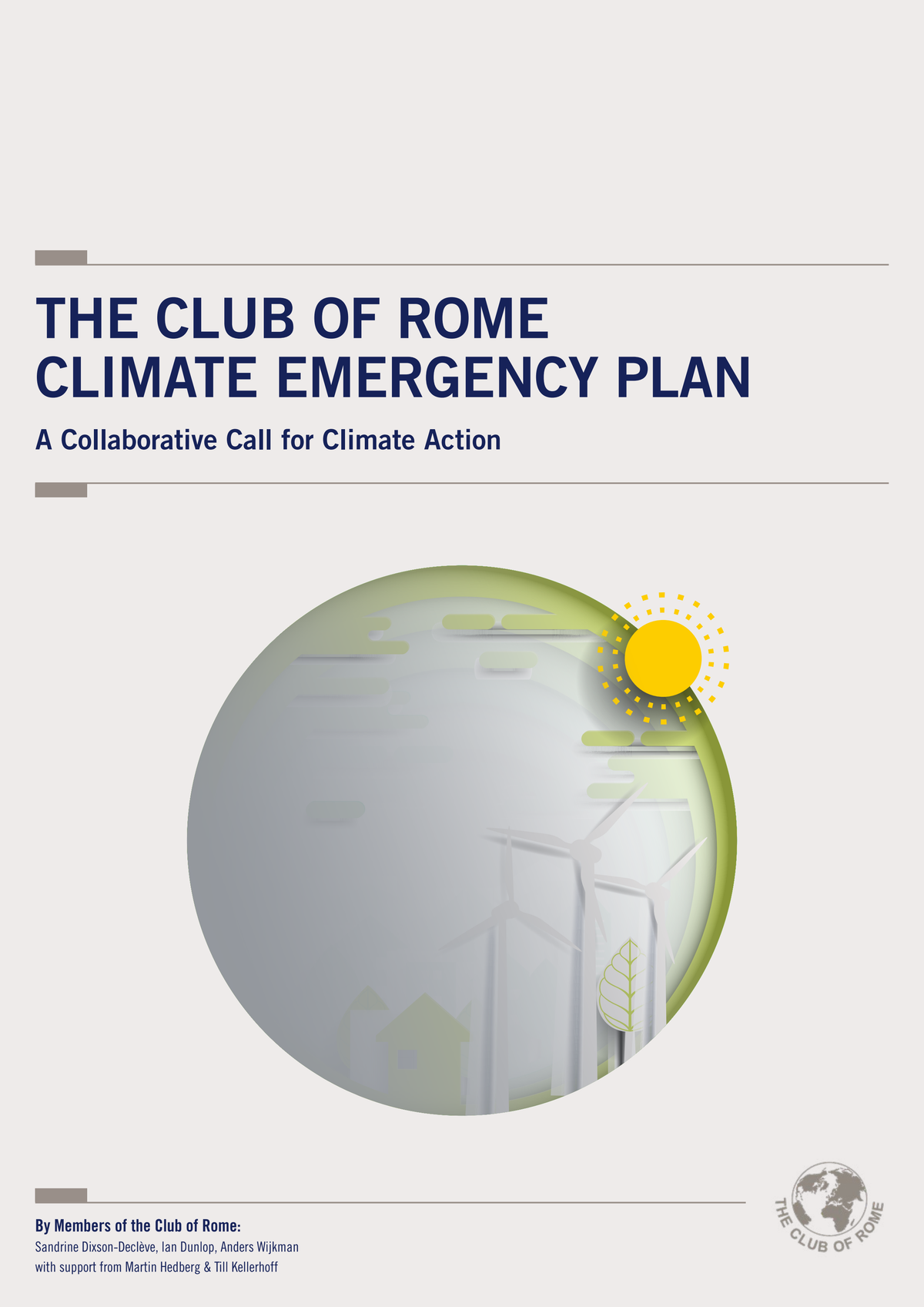
Following on from the 1972 blockbuster, The Limits to Growth, the Club of Rome’s “Climate Emergency Plan” is positioned as a global call to action. But beneath the language of crisis and consensus lies a tightly choreographed script—written by elite institutions, funded by powerful actors, and designed to funnel public concern into pre-approved policy tracks. Drawing on its legacy as a systems-thinking think tank aligned with transnational governance ideals, the Club of Rome leads the charge to make the world safe.
The emotional appeal is immediate: humanity stands at the edge of disaster, and only sweeping transformation can prevent collapse. This urgency activates the reader's sense of moral responsibility, not reasoned debate. The plan tells us we are “out of time,” that we must “act decisively,” and that “delay equals catastrophe.” These aren’t just warnings—they’re strategic rhetorical devices. When every moment is framed as critical, there's no room left for deliberation or dissent.
This sense of inevitability serves a deeper purpose. It creates a structure where questioning proposed solutions—like global carbon pricing, behavioural regulation, or supranational enforcement—feels not just wrong, but dangerous. The narrative converts democratic friction into ideological betrayal. Opposition becomes denial. Delay becomes complicity.
In this way, the “emergency” doesn’t just justify action—it scripts it. The Club of Rome isn't simply proposing ideas; it’s prescribing a worldview. The plan promotes a specific model of planetary governance: one that elevates technocratic consensus, minimises national sovereignty, and codes behavioural alignment as civic duty. Language like “planetary boundaries” or “global commons” frames governance as a scientific necessity, not a political choice.
What emerges is not a spontaneous climate response—but a managed transition, engineered through emotional saturation, institutional alignment, and narrative sealing. The public is not invited to shape this agenda; it is told to mobilise in accordance with it.
This is how climate rhetoric, when harnessed by elite networks, becomes a system of control. The key questions are:
- Who’s behind this? → Think tanks & elite donors
- What’s the real function? → Push top-down policy using fear
- What’s missing? → Real pollution problems & local solutions
The Club of Rome: From Systems Thinkers to Narrative Engineers
To understand how climate discourse became so tightly scripted, we need to look at the institution behind this plan: the Club of Rome. Founded in 1968 by a transatlantic coalition of industrialists and technocrats—including Aurelio Peccei, a Fiat executive with deep ties to global business networks, and Alexander King, a British scientist who had served as science advisor to NATO—the Club was conceived not just as a think tank, but as a strategic node for planetary-scale governance frameworks.
Their collaboration wasn’t random—it was archetypal. Peccei brought elite industrial capital and systems-management ideology. King embodied scientific legitimacy and institutional access. Together, they modelled a new form of influence: not electoral, not corporate, but technocratic-seeding through scenario projection.
Based on King’s input, The Limits to Growth used early computer modelling to warn that unchecked economic and population growth would trigger ecological and societal collapse. Commissioned by the Club and developed at MIT using the World3 model, the book introduced a new kind of alarm: one rooted in feedback loops, overshoot, and collapse curves—not evidence, but simulation.
This wasn’t science as testable theory—it was narrative architecture. And it landed hard. Limits to Growth sold millions, was translated into a dozen languages, and became the reference frame for a new type of global interventionism. Its real function was to shift legitimacy from democratic deliberation to system expertise. The world, it said, was too complex for ordinary politics.
That legacy set the stage for the narrative transitions that followed. In the 1970s, a media-driven panic focused briefly on global cooling—fears that industrial pollution and aerosol particulates could trigger a new ice age. This narrative was discarded—not due to scientific failure, but because it lacked ideological stickiness. It didn’t empower the right institutions.
By the late 1980s, global warming became dominant: carbon dioxide was framed as the central villain, fossil fuels as the moral enemy. Yet “warming” proved narratively fragile—temperature anomalies could be explained away. The solution? “Climate change”—a term so expansive it could absorb almost any phenomenon, from floods to migration, even financial instability. It became a symbolic wildcard: adaptable, elastic, unopposable.
Throughout this shift, the Club of Rome remained a central author. Not an isolated actor, but a seeding chassis—disseminating motifs, shaping institutional vocabularies, and priming elite consensus. Phrases like “planetary boundaries,” “global commons,” and “climate emergency” originated in these circles before becoming embedded in UN reports and philanthropic playbooks.
What looks like visionary warning is, functionally, narrative conditioning. The Club no longer maps possibilities—it narrows them. Its systems thinking is no longer exploratory—it’s prescriptive. And its real output is not insight—but consent.
This is how a systems think tank became a narrative engineer—building the architecture for a crisis that cannot be questioned, only obeyed.
Behind the Language of Crisis: What This Plan Really Does
At first glance, the Climate Emergency Plan reads like a rallying cry—a demand for global cooperation to save the planet. But beneath the urgent tone lies a carefully constructed mechanism: one that channels emotional activation into pre-scripted governance outcomes, bypassing public debate through the language of inevitability.
The document’s declared goals—cut emissions in half, eliminate fossil fuel subsidies, create new governance systems for “planetary emergency response”—appear noble. But their structure reveals something deeper: these are not proposals for public deliberation, but mandates for transnational compliance.
The emotional scaffolding is precise. Fear is coded as urgency. Duty is framed as collective action. Dissent is implicitly cast as betrayal. The phrase “emergency” appears over a dozen times—not as a factual descriptor, but as a psychological imperative. There is no time, the plan insists, for disagreement. We must act—together, now, and under unified leadership.
That leadership is never democratic. The plan favours multilateral enforcement regimes, expert panels, global taxation frameworks, and behavioural oversight systems—none of which answer to electorates. The vision is post-political: a managerial world where climate justifies control and governance becomes a function of system optimisation.
Language plays a critical role in concealing this shift. Terms like “just transition,” “climate justice,” and “science-based targets” act as semantic seals—phrases that suggest fairness while precluding opposition. These are not open concepts. They are coded alignments, designed to bind the reader to a moral logic that converges with institutional control.
What the document presents as transparency is actually opacity. Key terms are undefined, strategic outcomes are assumed, and dissent is structurally illegible. You are not asked to understand the plan. You are asked to submit to it.
This is the true function of the Climate Emergency Plan—not to solve the crisis, but to reformat governance through the language of crisis.
It is not a response to collapse—it is a rehearsal for managed obedience.
The Networked Architects of a Pre-Approved Future
Every document has an author, but some have architects—networks that do not merely write, but shape the frame of what can be written. The Climate Emergency Plan is a product of such architecture, embedded in a lattice of institutions that include legacy think tanks, transnational governance platforms, and philanthropic gatekeepers. At the center sits the Club of Rome, but the surrounding cast is what gives the message reach and coordination.
Contributors include high-level functionaries from the UN system, development banks, and climate finance initiatives. Others hail from affiliated policy shops like the World Resources Institute, Stockholm Resilience Centre, and We Mean Business Coalition. These organisations do not simply amplify—they encode coordination. Each plays a distinct role in narrative deployment:
- Seeders introduce the framing logic (e.g., planetary boundaries, just transition)
- Amplifiers push the language into media, philanthropy, and education
- Limiters suppress dissent by controlling access to funding, publication, and influence
- Recoders update legacy institutions with the new script (e.g., national governments reframing local policy through SDG compliance).
Most are funded by overlapping foundations and supranational entities. Names like the Rockefeller Foundation, Ford Foundation, Bloomberg Philanthropies, and the European Climate Foundation appear repeatedly. The funding ecosystem is not neutral—it is narratively selective, rewarding outputs that align with crisis scripting and discouraging systemic alternatives that question foundational assumptions (like centralised control, behavioural oversight, or enforced austerity).
The Club of Rome’s funders—including the European Climate Foundation and Laudes Foundation—operate within a broader epistemic and policy network tightly linked to the World Resources Institute (WRI), the World Economic Forum (WEF), and the Stockholm Resilience Centre. The Climate Emergency Plan emerged in tight timeline synchrony with the IPCC’s Special Report on 1.5°C (2018) and WEF-aligned ESG escalation—demonstrating not isolated advocacy but coordinated narrative release across elite institutions.
This structure doesn’t promote diversity of thought—it choreographs alignment. It produces consensus not through debate, but through coordination pressure: if you want visibility, funding, or institutional support, you must speak the language of planetary emergency.
The people driving the message—many of them former high-level officials, corporate sustainability officers, or career NGO strategists—are not outsiders calling power to account. They are system stabilisers, whose function is to package elite control as planetary necessity. Their biographies often include stints at the World Bank, UNEP, or corporate ESG departments. They speak the language of reform, but serve the logic of regime continuity. This is not grassroots climate action. It is pre-approved futures sold as inevitability, authored by actors who answer to funders and peers—not to publics.
But not all environmental scientists subscribe to the linear crisis-to-control model implied by global emergency scripting. Even within climate science, respected voices have raised concerns about the political use of model uncertainty and crisis rhetoric. Roger Pielke Jr. warns that worst-case climate scenarios are routinely exaggerated to justify extreme policy, calling it “climate misinformation from the top.” Judith Curry, a former IPCC author, argues that the institutional consensus process has become “corrupted by politicisation.” Garth Paltridge, physicist and former CSIRO chief, urges caution in relying too heavily on deterministic climate projections, arguing that the climate system is too complex, nonlinear, and poorly understood to justify the confident policy prescriptions often derived from model scenarios. These are not deniers—they are scientists rejecting the narrative overreach of institutional climate governance.
Who Writes the Script: From Founders to Functionaries
The Climate Emergency Plan may be signed by contemporary authors, but its deeper authorship extends back decades. What we see in 2020 is not a fresh initiative—it is a narrative handoff. The founders of the Club of Rome—Aurelio Peccei and Alexander King—were not just systems thinkers. They were role archetypes: one elite industrial strategist, one institutional scientist. Today’s authors are script inheritors, performing variations of the same structural functions.
As co-president of the Club of Rome, Sandrine Dixson-Declève embodies the modern Peccei role: transnational interface, fluent in corporate ESG and EU climate policy. Her network threads through the World Economic Forum, WEF Global Future Councils, and Mission Possible Partnership. Her presence signals not neutrality, but elite orchestration. She translates managerial logic into moral mandate—just as Peccei framed control as foresight.
Ian Dunlop’s narrative arc mirrors that of King: a technocrat turned public voice, re-coding insider knowledge as system-critical insight. But like King, he doesn’t destabilise structures—he reinforces them through conversion signalling. His past in oil firms gives his warnings credibility, but his present function is stabilisation under moral urgency. The repentant expert is not a dissident—it’s a trusted script.
Anders Wijkman connects the legacy thread directly: a Club of Rome veteran, former EU parliamentarian, and serial author of “planetary boundary” narratives. His function is continuity—the institutional memory that ensures the crisis motif remains intact through decades of rebranding. He is not introducing new frames—he is sealing old ones.
Martin Hedberg & Till Kellerhoff play support-layer roles. Hedberg, as a meteorologist, delivers the technical plausibility needed for narrative escalation—weather data is not just information, it is symbolic ammunition. Kellerhoff, the Club’s program director, is a structural recoder: ensuring logistical consistency, partner alignment, and motif fidelity across outputs.
Together, these actors mirror the original blueprint. Where Peccei and King launched the mythos of systems collapse, this team maintains it—not through discovery, but through ritual repetition. Each fulfills a pre-assigned narrative function:
- Translate elite governance into moral emergency
- Channel scientific ambiguity into scripted certainty
- Recode public fear into institutional compliance.
This is not authorship—it is choreography. The climate narrative is not evolving. It is looping, sealed in a generational cycle of pre-authorised roles and pre-approved futures.
Moral Urgency, Expert Rhetoric, and the Silencing of Doubt
The Climate Emergency Plan does not merely argue—it commands. Its authority doesn’t rest on transparent logic or open debate, but on moral saturation and rule by experts without public input. The reader is not invited to weigh options but is overwhelmed with necessity.
Catastrophe as Default
From the opening pages, the document floods the field with terminal language: “tipping points,” “planetary boundaries,” “irreversible collapse.” This is not just scene-setting—it’s emotional priming. The future is not a space of negotiation; it’s a narrow escape route. Such framing blocks the reader’s imaginative agency. If you disagree, you’re not offering an alternative—you’re threatening survival.
Duty as Disarmament
Terms like “intergenerational responsibility,” “shared global duty,” and “united planetary response” transform political questions into moral absolutes. When policy becomes a question of duty, resistance becomes immorality. Once framed this way, dissent is no longer disagreement—it’s betrayal. The document doesn’t persuade—it deputises the reader into compliance.
Expertise as Closure
Phrases like “the science is clear,” “we must act now,” and “consensus among scientists” operate as rhetorical seals. They shut the door before it can be opened. In place of rigorous dialogue, we get epistemic enforcement—a system where questioning is recast as heresy, and nuance becomes denialism. There is no room for competing frameworks, only grades of obedience.
This is not accidental—it’s functionally embedded. The authors deploy the same motif loop found in pandemic scripting and conflict escalation narratives:
- Crisis framing → “We are out of time”
- Moral compulsion → “We owe it to future generations”
- Debate closure → “The science has spoken”
- Tactical inevitability → “There is no alternative.
This loop locks the discourse and turns democratic dialogue into narrative compliance. Public doubt is structurally exiled, and institutional alternatives are cast as reckless. The document thus doesn’t invite action—it scripts it, and it scripts who may act and on what terms.
Timing the Message: When All the Institutions Speak at Once
The Climate Emergency Plan didn’t emerge in a vacuum. It landed at a moment of high media saturation, synchronised policy rollouts, and global narrative convergence. Its impact lies not only in its content but in its timing and choreography—a strategic alignment across governments, NGOs, and transnational platforms.
Narrative Convergence
Released in late 2018, the document coincided with:
- IPCC Special Report on 1.5°C (October 2018)
- UN Climate Summit Preparations (2019 agenda-setting)
- Youth Climate Mobilisations led by Greta Thunberg
- Increased ESG push from financial sectors (BlackRock, WEF)
This was not coincidence—it was synchrony. The message echoed through multilateral institutions, media outlets, school systems, and philanthropic networks simultaneously, using variations of the same phrases: “climate crisis,” “last chance,” “science is clear.”
Tactical Amplification
The document was strategically echoed by:
- Think tanks (Chatham House, WRI, Stockholm Resilience Centre)
- Policy nodes (EU Green Deal architects, UNDP)
- Corporate-aligned climate forums (WEF, McKinsey sustainability arms)
- Media packages from Guardian, NYT, BBC pushing identical framings
This cross-channel rollout produces the illusion of consensus, a full-spectrum reinforcement loop where institutional repetition substitutes for public deliberation.
Symbolic Anchors and Event Piggybacking
The Plan’s release was bracketed by emotionally loaded events—climate marches, fire seasons, and “decade of action” framing. It tethered its authority to the emotional peak of planetary anxiety. It also piggybacked on media coverage of natural disasters, using crisis optics to reinforce the sense of urgency. In this way, the document was not just timely—it was timed.
Synchrony as Enforcement
When the same message arrives from every direction—from schoolteachers, TV anchors, central banks, and CEOs—questioning it feels insane. The coordination is the message. This is not debate—it’s consent shaping through saturation.
Your Role Is to Obey: How Democratic Input Is Scripted Out
The Climate Emergency Plan makes frequent reference to “global cooperation,” “shared responsibility,” and “collective action.” But beneath this inclusive language lies a stark exclusion: you—the citizen, the local community, the national electorate—do not have a seat at the table. Your role is not participatory. It is performative: obey, support, comply.
The Governance Bypass
Rather than proposing policy for democratic debate, the Plan advances institutional bypass mechanisms:
- Global Treaties: Legally binding commitments outside voter influence
- Supranational Panels: “Independent expert groups” set parameters without oversight
- Tax-based Incentives and Penalties: Behavioural control disguised as economic guidance
- National Compliance Indices: States are ranked and shamed into alignment.
These mechanisms don’t ask what people want—they enforce what institutions have decided is necessary.
Input Simulations
The Plan gestures toward dialogue—“stakeholder consultations,” “citizen engagement,” “multi-sector forums.” But these are containment simulations, not sites of actual negotiation. The key terms are undefined. The forums are advisory. The options are pre-filtered. What appears as inclusion is actually a ritual of legitimacy laundering.
The Role of Behavioural Science
Language around “behavioural change,” “nudges,” and “awareness campaigns” reveals another layer: you are not treated as a rational agent, but as a behavioural subject. The Plan’s solution to climate risk is not democratic innovation but compliance engineering.
A Post-Political Architecture
In total, the Plan envisions a governance system that is:
- Technocratic (run by experts)
- Supranational (above national law)
- Managerial (focused on efficiency, not justice)
- Unidirectional (from elite institutions to managed publics)
This is not climate democracy. It is climate command. It does not trust publics to respond rationally—it scripts them into passivity through urgency, moral pressure, and institutional saturation.
You are not being asked to act. You are being told your action has already been decided.
Where the Narrative Fractures: Tensions, Fatigue, and Backlash
For all its surface authority and emotional saturation, the Climate Emergency Plan carries within it the seeds of breakdown. Its strength lies in coordination—unified language, synchronized timing, shared urgency. But synchrony is fragile, and moral pressure has limits.
As contradictions pile up and climate policy shifts from persuasion to enforcement, the line between consensus and coercion begins to blur. What once sounded like science-backed urgency now feels like top-down scripting. And scripting, when misaligned with reality, fractures.
Contradiction One: Justice Talk vs Extraction Practice
The plan speaks the language of fairness—“just transitions,” “climate equity,” “intergenerational responsibility.” But the tools it promotes are economically extractive: carbon taxes, energy rationing, compulsory “green” investments.
For many, these don’t feel like solutions. They feel like austerity wrapped in virtue. What’s sold as sustainability often lands as scarcity—especially in communities already under economic strain. That gap between vision and experience widens trust decay.
Contradiction Two: Science as Mandate, Not Dialogue
The document assumes moral legitimacy via “settled science.” But once that science is used to enforce behavioural conformity, not invite democratic debate, it stops persuading. Publics begin to sense a shift—from voluntary action to algorithmic obedience.
This is where moral authority slips into managerial control. And in that transition, legitimacy is lost.
Fatigue and Emotional Burnout
Years of emergency language—rising seas, burning forests, viral outbreaks, geopolitical flashpoints—have stretched public attention thin. The phrase “last chance” no longer lands with urgency; it rings hollow with overuse.
As households face real inflation, energy shocks, and housing crises, abstract calls for sacrifice in the name of planetary rescue provoke frustration, not solidarity. The emotional bandwidth of obedience is exhausted.
Emerging Break Points: When the Script Breaks Down
Despite its orchestrated momentum, the climate control narrative faces mounting structural stress. Electoral blowback is rising in nations weary of eco-austerity policies, while climate financing increasingly collides with basic economic survival—food, energy, housing. Sovereign states like India, Brazil, and the Gulf powers are pushing back against carbon compliance frameworks that undermine local autonomy. Even within the scientific community, internal dissent grows—questioning both the accuracy of forecasts and the policy architecture built around them.
Ecological agency isn’t dead—it’s just unsanctioned. Around the world, real environmental repair unfolds outside the dominant climate-control matrix:
- Tanzania: Maasai pastoralists have openly pushed back on carbon-credit projects, calling them land dispossession tactics and winning local support for moratoriums on soil carbon schemes.
- Legal Activism Against Climate-Wrapped Land Grabs: In regions like India, sub-Saharan Africa, and Latin America, legal and civic groups are mounting resistance to land dispossession masked as green development. The International Land Coalition (ILC) documents how these land grabs—often justified as climate mitigation—displace communities and deepen inequality. In a landmark victory for Indigenous land rights, Kichwa communities in Peru’s San Martín region successfully challenged the state’s denial of their ancestral presence, securing legal recognition of their territorial claims within a protected Amazonian area.
- Community initiatives: Communities across diverse localities—from the Torres Strait Islands in Australia to the Los Cedros Forest in Ecuador, the Atacama Desert in Chile, and even Southend, England—use human rights and environmental law to push back against ecological harm. In Spain, local water restoration projects are being implemented independently of carbon-led finance. Kenyan communities are restoring watersheds and asserting land sovereignty, even suing the UK over colonial land seizures.
- Court-based environmental rulings are on the rise, notably in Latin America and Europe. Cases like Colombia’s Atrato River rights judgment, Peru’s defense of Kichwa territories, and Ecuador’s Waorani forest protection order demonstrate a new rights-to-nature movement—all independent of carbon-offset logic.
These actions are not fringe—they are counter-scripts. They reclaim ecosystems through regulation, legal agency, and local stewardship. They show that genuine ecological care doesn’t rely on financial instruments or elite coordination—it thrives through sovereignty, justice, and ecological reciprocity.
This is the terrain of real climate action. And it doesn’t speak the language of emergency. It speaks the language of local action and repair.
Conclusion: What the Climate Agenda Omits—and Why That Matters
The Climate Emergency Plan is not simply a set of ecological recommendations—it is a system for manufacturing consent. Behind its tone of urgency and scientific authority lies a tightly coordinated apparatus of narrative control. This document doesn’t just advocate action; it scripts the boundaries of permissible response, narrowing the field of debate, policy, and imagination.
Its language of emergency is a mechanism of compression: political, social, epistemic. The public is not engaged as a deliberative body but as a behavioural target—nudged, taxed, and regulated into alignment with elite-defined outcomes.
This critique is not a rejection of environmental stewardship. It is a systemic audit—a necessary exposure of how the Club of Rome structure has deployed crisis rhetoric to engineer consent, suppress dissent, and centralise transnational governance.
This isn’t just policy. This is elite scripting. And it closes off democratic paths by design.
The Real Environmental Crisis Isn’t Being Solved—It’s Being Masked
The Plan prioritises carbon metrics and investment-aligned “solutions,” while sidelining threats that can’t be turned into financial products. PFAS contamination poisons global water tables—yet cleanup yields no return for ESG portfolios. Microplastics now circulate in human blood and banning them would disrupt too many corporate supply chains. Agrochemical-driven pollinator collapse endangers food systems—but bees don't produce dividends.
The most acute ecological crises we face aren’t just unprofitable—they’re structurally inconvenient. They require confronting industrial actors, challenging capital flows, and rewriting operating models.
Among the suppressed threats are:
- Oceanic dead zones from fertiliser and chemical runoff
- Deforestation and soil degradation
- Microplastics infiltrating food and water
- Bioaccumulated toxins in human and animal tissue
- Marine ecosystem collapse from overfishing
- Airborne carcinogens from petrochemical and mining sectors.
These crises can’t be solved with carbon credits, green bonds, or ESG labels. These are speculative financial instruments—designed for investor continuity, not ecological restoration. This is the market simulating responsibility, not assuming it. Environmental harm becomes just another token in the climate casino, where only profitable solutions are allowed onto the table.
A Permission Structure for Extraction
Under the prevailing climate regime, demands for structural intervention are suppressed. The result? Polluting industries remain protected, while carbon burdens and behavioural mandates are offloaded onto individuals and weaker states. Ecological concern is instrumentalised—not to repair nature, but to legitimise a new phase of elite control and financial extraction.
Signs of Fracture—And a Way Forward
Yet this script is fraying. Around the world, decentralised resistance is rising:
- Local legal actions against extractive land deals
- Community-led rewilding and watershed restoration
- Sovereign refusals to participate in carbon-credit subordination
- Independent researchers reviving ecological models grounded in resilience and locality
These are not just policy alternatives. They are counter-scripts—pathways toward ecological integrity that bypass the elite climate machine.
Published via Journeys by the Styx.
Geopolitika: Tracing the architecture of power before it becomes the spectacle of history.
—
Author’s Note
Produced using the Geopolitika analysis system—an integrated framework for structural interrogation, elite systems mapping, and narrative deconstruction.