GEOPOLITIKA: The Future Was Prewritten — WEF’s Soft Mandate Scenarios and the Engineering of Consent
How scenario templates became the rehearsal stage for elite-aligned futures disguised as foresight.
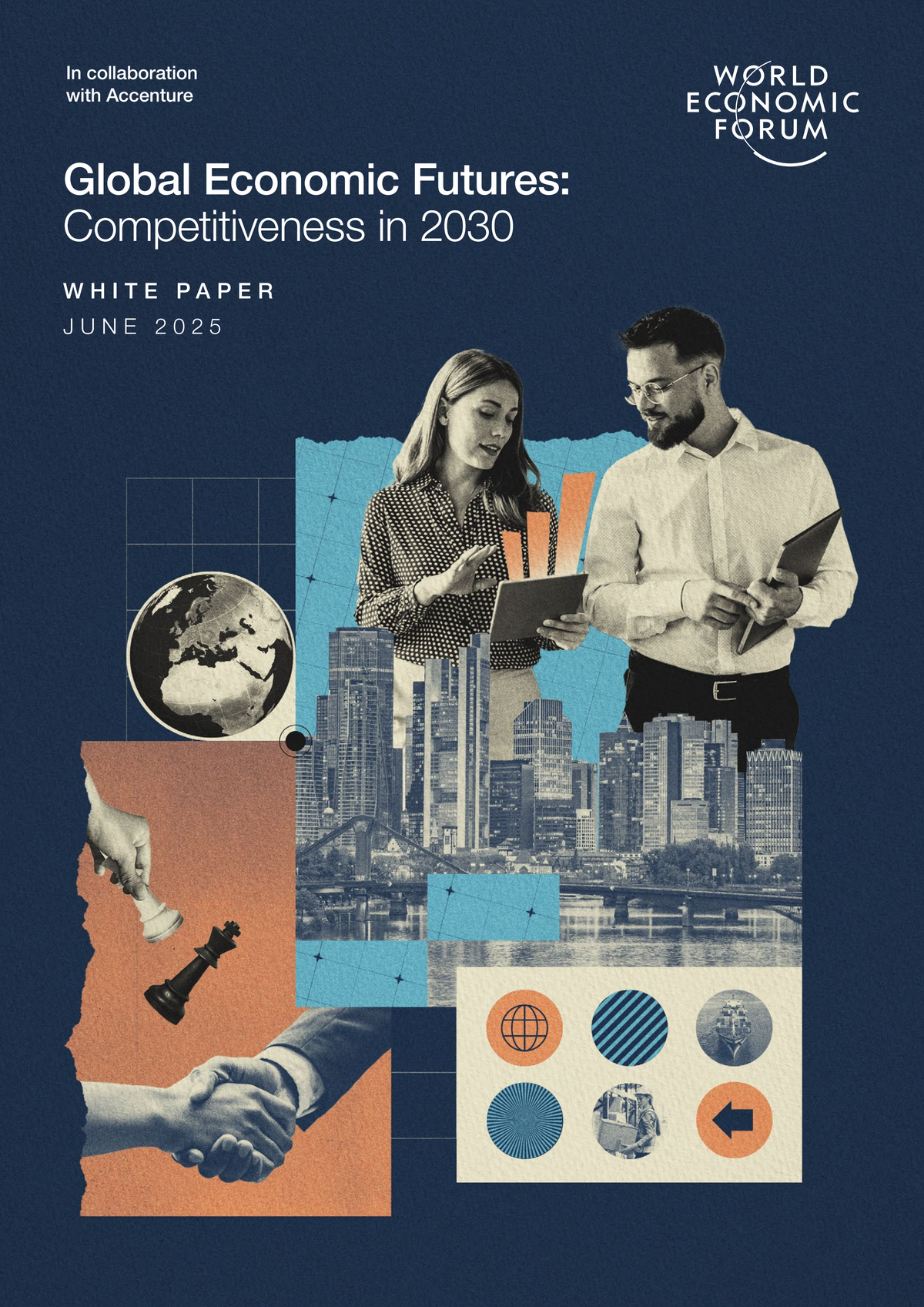
The latest WEF “futures” report lands amid a legitimacy leak—Klaus Schwab’s exit and internal probes puncture the Forum’s claim to neutrality. The document leans on IMF baselines and Forum instruments, then routes prescriptions through a WEF–Accenture pipeline.
THE THEATRE OF FUTURE CHOICE
The WEF’s Global Economic Futures: Competitiveness in 2030 (June 2025) does not just predict the future; it designs the permissible range within which futures may be imagined. Framed as a neutral scenario tool, the document reanimates the quadrant structure popularised by Shell’s corporate foresight practice and later codified by the Rockefeller Foundation in 2010—producing four apparently divergent “futures” on axes of Geopolitical Volatility and Regulatory Stringency. For contrast, some scenario lines do admit rupture and value conflict rather than mere parameter shifts within a fixed frame, including Shell’s own “People Power.”
This interpretation rejects psychological intention as a precondition. Whether the authors intend to govern is immaterial—what matters is whether the scenario structure performs governance functions by narrowing variance and embedding defaults. The analysis proceeds on structural effect, not conspiratorial intent.
Each scenario serves a dual function: ostensible contingency theatre and structural pre-alignment. Like Rockefeller’s Lock Step/Clever Together matrix, the WEF frame curates ideological divergences while converging toward a singular procedural endpoint—regulatory harmonisation under anticipatory governance logics. Scenario design becomes not a navigational device but a consent proxy—pre-authorising governance vectors while deferring accountability through “non-predictive” disclaimers.
The quadrants are not speculative—they are operative. Given the Forum’s leadership pipelines (including the Young Global Leaders network) embedded across ministries and regulators across the world, scrutiny is warranted over how these frames pre-shape agendas. As in prior cycles, the scenarios train policy, finance and industry to internalise behavioural coordinates in advance; iteration functions as mandate projection, translating institutional preferences into adaptive prose. In this model the future is not discovered; it is manufactured, authorised and distributed.
THE COORDINATED ECHO: FROM ROCKEFELLER TO DAVOS
The four-scenario architecture is not novel—it was staged in the Rockefeller/GBN 2010 report Scenarios for the Future of Technology and International Development. Its archetypes map cleanly to today’s set: Lock Step’s pandemic-triggered techno-authoritarianism echoes the WEF’s “Coordinated” or “Fragmented” futures; Hack Attack aligns with “Chaotic Transitions”; Smart Scramble with “Autonomous Worlds”.
What persists is the procedural grammar: a controlled spectrum of futures set on dual axes; ambiguity mobilised as flexibility while plausibility doubles as closure; motifs repeated until they saturate the frame and condition interpretation. This saturation is functional—it primes readers toward pre-scripted resolution pathways.
“Four futures” has become a genre across think tanks, consultancies and trade presses—the titles and frames recur with minor variation. The appeal is operational rather than analytical: quadrant schematics are easy to brief, procure and defend, so the form endures. The label signals a pre-packaged decision aid rather than open inquiry; once paired with motif saturation and a fixed telos, the template narrows options while preserving a veneer of neutrality. What distinguishes this deployment is motif-locking and convergence on a single telos, converting a neutral scaffold into a closure device.
WEF’s four-futures grid sits as an inhouse tradition—its programmes have used scenario sets across domains for years. Examples include Eight Futures of Work (to 2030) setting discrete labour trajectories; Four Futures for Economic Globalization (2022) formalising a four-path schema with explicit “no-regret actions”; the Global Risks Report 2025 packaging futures through scenario lenses; and the Forum platform amplifying external sets like the RSA’s Four Futures Of Work (2019). Together these artefacts normalise the quadrant method and its policy spillovers.
The shift is one of domain and density—digital sovereignty and AI governance now occupy the space where public health or development once stood—yet the device structure remains intact: inevitability framing, motif redundancy, strategic ambiguity.
Structural Parallels to the Rockefeller Report:
- Scenario quadrant design — WEF positions futures on Regulatory Stringency × Geopolitical Volatility, while Rockefeller 2010 used Degree of Government Control × Citizen Engagement, yielding four archetypes: Lock Step (high control, low engagement), Clever Together (high control, high engagement), Hack Attack (low control, low engagement), Smart Scramble (low control, high engagement).
- Narrative function & conditioning — Both sets work less as forecasts and more as cognitive conditioning devices, using plausible futures to pre-normalise intervention pathways and bound acceptable responses; the Rockefeller set was later cited as foreshadowing pandemic-era governance, while newer variants pre-legitimise strategies in digital and geopolitical domains.
- Closure mechanics & motif design — Lock Step models authority consolidation via crisis, while Hack Attack and Smart Scramble stage low-trust decentralisation; contemporary equivalents reproduce these closures with scenario-specific triggers, patterned resolutions and thematic lock-ins that steer interpretation toward preselected endpoints.
- Ideological encoding & institutional positioning — The Rockefeller set embeds technocratic, market-centric assumptions inside ostensibly neutral futures, and modern counterparts similarly encode elite-preferred procedures and actor primacy—Clever Together elevates multilateral “smart governance,” and current frames anticipate transnational alliances that confer legitimacy through the optics of collaboration.
The four-scenario genre functions as a component of the Perception Management Regime—its Predictive Programming devices normalise closure futures in advance, framing policy acceleration as inevitability rather than choice.
In effect, these scenario architectures share not only structural format but also narrative mechanics, symbolic devices, and strategic intent. They act as ideological sandboxes—spaces where governance futures are rehearsed and, in rehearsal, subtly operationalised. While structurally homologous, motif pivots reveal vectoral drift—Rockefeller focused on crisis-consolidation; WEF scaffolds techno-sovereignty and anticipatory governance. This pre-alignment gains operational plausibility when traced through shared personnel networks, funding loops, and advisory cross-memberships spanning Brookings, WEF, and GBN. The motif delta indicates that WEF scenarios operationalise anticipatory AI governance, distinct from Rockefeller’s public health securitisation pivot.
The quadrant form endures not through analytic yield, but because it performs closure rites—initiating alignment rehearsal under the guise of foresight neutrality.
THE MOTIF TRAP: COMPETITIVENESS AS TOTAL FRAME
“Competitiveness” is not concealed in this report—it is openly declared in the title Global Economic Futures: Competitiveness in 2030 and repeated 98 times, roughly once every 4.7 sentences. It is presented as an organising condition rather than a strategic choice, the governing assumption to which all other aims must be subordinated. Regulation, resilience, innovation, even “inclusive” governance are framed as instrumental to this single end.
When the report repeats the idea of competitiveness over and over, it locks the imagination into a narrow track—where every policy option is only judged by how well it supports national or economic advantage. This fixation turns complex political decision-making into a kind of scripted performance, where all actors compete to appear "optimised" rather than explore genuinely different values or futures. In this setup, alternatives like solidarity, cooperation, or non-market-based systems aren’t even considered. They’re ruled out from the very start—not because they’ve been debated and rejected, but because the framing never allowed them in the first place.
The closure effect does not arise from repetition alone but from role monopolisation. Competitiveness is cast as problem, goal, metric, and warrant—trigger for action, endpoint of progress, measure of success, and moral rationale for intervention. This structure eliminates governance models not anchored in market competition. Where cooperation does appear, it is reframed as a tactical means of enhancing competitive positioning, never as a legitimate organising principle in its own right.
This asymmetry is geopolitically loaded. It mirrors the prevailing posture of the US and allied economies, where legitimacy is tied to market position and strategic advantage. In much of the Global South’s multilateral discourse, the primary reference points are cooperation, reciprocity, and developmental equity. By fixing competitiveness as the default interpretive lens, the report preconfigures its futures toward Western strategic priorities and marginalises alternative geopolitical value systems before scenario construction even begins.
Once embedded as both means and end, competitiveness ceases to be a relative measure and becomes an ontological given. Scenario diversity becomes cosmetic—every pathway is an optimisation track for competitive advantage. Any future in which cooperation or solidarity would take precedence is structurally excluded. The apparent plurality of outcomes masks a single teleology.
Inside this frame, competitiveness functions as a procedural filter: measures are endorsed only insofar as they improve competitive standing. Cooperation, equity or environmental aims appear when—and only when—they can be recast as competitiveness enablers.
This is deliberate design, not incidental emphasis. Under this frame, regulation is assessed solely by its capacity to sustain competitiveness, resilience is recoded as a competitiveness enabler, and partnerships are legitimate only if they reinforce strategic or market dominance. The report’s foresight apparatus does not neutrally map possibilities—it actively narrows them, aligning permissible futures with a specific geopolitical logic and, by extension, the power structures that logic maintains.
A cooperation-centric motif—if deployed with equal saturation—would reorient the scenario architecture toward mutualism, reciprocity and shared resilience. Its absence is not incidental—it signals the ideological boundary of permissible futures.
THE STRUCTURAL LOOP: AUTHORSHIP AND AUTHORITY
The report’s contributor group is a joint WEF–Accenture production—consultancy is embedded not only as co-author but as scenario frame-setter inside the foresight apparatus. Contributors’ roles and likely functions inside the report are:
World Economic Forum:
- Aengus Collins — Head, Economic Growth & Transformation (Centre for the New Economy and Society)
Institutional role: senior programme lead with editorial carriage for the project.
Likely functions: scenario architecture design; synthesis across geopolitics–regulation–competitiveness; alignment of prescriptions with Forum platforms; foreword-level positioning and “no-regret” framing. - Kateryna Karunska — Insight Lead, Economic Growth & Transformation
Institutional role: research lead managing indicators and drafting cycles.
Likely functions: data selection and normalisation; figure and heat-map assembly; integration of external baselines (IMF, WIPO, ILO, DHL) with Forum survey material. - Saadia Zahidi — Managing Director; Head, Centre for the New Economy and Society
Institutional role: executive sponsor and sign-off authority.
Likely functions: mandate setting; cross-Centre coordination; positioning the report within the Forum’s competitiveness portfolio.
Accenture — Macro Foresight:
- Chris Tomsovic — Managing Director, Global Lead
Institutional role: practice lead for Macro Foresight.
Likely functions: co-design of scenario method; coefficient and weighting logic for sectoral heat-maps; translation of executive consultations into “no-regret” strategy lists. - Nick Kojucharov — Principal Director, North America Lead
Institutional role: regional lead interfacing method with geopolitical assumptions.
Likely functions: parameterisation of the two axes; stress-tests and sensitivity notes; drafting the action menus against each quadrant. - Joon Young Kwon — Business Consultant, Macro Foresight
Institutional role: research and modelling support.
Likely functions: data pipeline build; indicator cleaning; scenario worksheets and sector scoring; documentation of assumptions.
Note: Role–function mapping is derived from the report’s credit lines and internal task signals—who signs, who owns the Centre, who leads the foresight practice—so readers can see how authorship maps to method, data and prescription.
This configuration concentrates data selection, framing and validation within a single partnership—method, evidence and recommendations circulate through the same channel, turning co-authorship into a governance device rather than a mere credit line.
Klaus Schwab’s resignation and the misconduct probe destabilise the Forum’s symbolic authority. In April 2025, Schwab stepped down as chair and left the board, triggering a formal governance transition. Weeks later, internal reporting alleged manipulation of the Global Competitiveness Report, misuse of Forum funds, and inappropriate conduct—allegations he denies. The immediate effect is a legitimacy leak: when a flagship index and its long-time steward are under investigation, any scenario frame leaning on the same authority network inherits a credibility discount.
The International Monetary Fund functions here as a validation node. IMF baselines flow into the scenarios and are then cited back as legitimacy anchors, creating a feedback loop in which data, strategy, and policy authenticate one another. This is not a coordination error—it is a structural pattern.
This pattern is the operational logic of the apparatus:
- Partnered Authorship: Foresight architecture is jointly owned by a supranational policy forum and a transnational consultancy—both with vested institutional and client-based interests.
- Self-Validating Citation: Outputs from prior WEF foresight products, IMF data releases, and OECD indices are recycled without adversarial review, forming a closed citation circuit.
- Procedural Authority Without Jurisdiction: Recommendations carry quasi-mandatory weight through repeated institutional referencing, despite lacking formal legislative mandate.
The methodological frame—adapted from Shell/GBN scenario traditions—has been redeployed across WEF foresight outputs since the mid-2010s. The underlying four-scenario matrix (here structured as geopolitical volatility × regulatory stringency) scores high on loop-risk indicators: citational reuse, platform re-entry, role cycling, funding echoes, and narrative recursion. The recurrence is not stylistic—it is infrastructural.
Intent is beside the point—structure is. When the same actor network supplies the data, authors the method, and cites itself as proof, there is no external test. Claims loop inward and set like fact, forming a seal around the argument. Recursion is common across disciplines; it becomes coercive when rival baselines are excluded and no adversarial audit can break the loop. Options are removed upstream, and readers are steered toward a single “reasonable” outcome.
In this context, “no-regret strategies” are presented as universally applicable foresight outcomes. This lexical migration disguises corporate risk-minimisation heuristics as global governance imperatives—fusing anticipatory planning with institutional self-interest. Yet the phrase originates from Accenture’s private-sector lexicon, designed for executive decision-making within corporate performance frameworks. Transplanted into a global policy frame, it retains the efficiency bias of its origin, while being positioned as a neutral, future-proof prescription.
The result is a closed epistemic loop: the same actor network commissions, authors, frames, and validates the scenarios, ensuring continuity of priorities across editions and thematic domains. This is less a foresight exercise than a governance rehearsal—where the appearance of plural futures masks the stability of the institutional telos.
THE RITUAL OF UNCERTAINTY AND THE INFRASTRUCTURE OF HARMONISATION
The preamble’s invocation of “unprecedented uncertainty” is functional: it strips scenarios of predictive accountability while preserving their directive influence. “We do not predict” is paired with “we equip decision-makers,” a formulation that frees the authors from validation while embedding their strategic frame into the policy imagination. The more volatile the future is cast, the more tightly scripted the governance prescription becomes.
That prescription is delivered through harmonisation. Regulation is reframed as an optimisation variable—streamlined, digitised, and globally standardised—rather than a contested political process. AI-driven monitoring and “harmonised compliance frameworks” are presented as efficiency gains. The seamlessness is deceptive: harmonisation centralises decision-making in agenda-setting networks while obscuring jurisdictional origins. The state becomes executor, not author; lawmaking is displaced into the infrastructure itself, where discretion is pre-coded and contestation structurally excluded.
Table 2. “Strategy considerations for businesses and governments” on page 26 formalises this into a dual-instruction set for business and government, pairing corporate and public prescriptions so that both are locked to the same declared telos: competitiveness. The symmetry erases the possibility of divergent strategic orientation.
- Strengthen core capabilities – Both business and government prescriptions converge on institutional consolidation: for firms, streamlining cost structures, optimising workflows, and treating workforce “support” as a productivity input; for states, securing macroeconomic stability and regulatory predictability as investment guarantees. “Value creation” is defined solely in economic-growth terms, excluding distributive, ecological, or social equity measures.
- Develop geopolitical muscle – The “geopolitical muscle” motif is framed almost entirely in supply chain, regulatory, and market-insulation terms—geopolitics as operational continuity rather than contested political space. For business, prescriptions target resilience as an efficiency function: real-time decision loops, cross-industry risk-sharing, and adaptive supply architecture. For governments, “geopolitical agility” is redefined as regulatory flexibility in service of those same corporate aims, with public–private collaboration framed as the default mitigation mechanism.
- Improve compliance efficiency – The business side adopts real-time, AI-driven monitoring that embeds adherence into day-to-day operations; the state side simplifies and harmonises frameworks to align with transnational “best practice” templates. This locks both into a shared regulatory tempo defined largely by multistakeholder and corporate–consultancy networks, privileging interoperability over local divergence and leaving the underlying rule-set—its authorship, scope, and legitimacy—outside public contestation.
- Build foresight and anticipatory capacity – Businesses are directed to embed scenario planning, predictive analytics, and big-data infrastructures into strategy; governments are told to institutionalise foresight across policymaking, backed by talent and data investments. While framed as neutral preparedness, the foresight models in question are drawn from the same scenario architecture underpinning the report, effectively normalising a single anticipatory logic. This centralises agenda-setting in the hands of those designing the scenarios, determining which risks are visible, which futures are plausible, and which responses are “strategically sound.”
- Balance strategic localisation and diversification – Businesses are urged to diversify supply chains and selectively localise operations; governments to maintain openness while selectively promoting domestic ecosystems. In both cases, “balance” is framed as a competitiveness tactic rather than a sovereignty or resilience choice. Cross-border collaboration and market access remain default goods, meaning localisation is tolerated only insofar as it supports global integration rather than challenging its primacy.
- Balance short- and long-term focus – Both business and government prescriptions embed dual-focus planning within a competitiveness frame, where long-term objectives are defined in terms of economic growth and market advantage. Societal, environmental, or democratic priorities appear only when they align with—or can be instrumentalised for—this growth agenda, ensuring that the long term is not an alternative vision but an extended horizon for the same economic logic.
- Strengthen strategic partnerships – The final prescription closes the loop: public–private alliances are positioned as the delivery mechanism for competitiveness, embedding “shared values” and sustaining cross-border flows as unchallengeable goods. Partnership is framed not as a negotiation between interests but as alignment around pre-set growth and integration objectives, where dissenting or protectionist positions are structurally excluded.
The “navigating uncertainty” toolkit operates as a synchronised compliance–competitiveness corridor. Cooperation, reciprocity, or solidarity appear only as subordinate tactics for sustaining advantage. The declared telos mirrors the wider geopolitical logic of the US/Western bloc’s competitive stance toward the Global South—cooperation as method, competition as order.
THE GRID AS CAGE: FOUR FUTURES, ONE FUNCTION
The WEF’s four-scenario grid is built on two intersecting axes: geopolitical volatility (low to high) and regulatory stringency (low to high). On the surface, this is a standard foresight device—borrowed from Shell, GBN, and RAND—offering four distinct futures mapped to combinations of external uncertainties. The quadrant model is not inherently manipulative—bias enters when legitimacy is pre-allocated and the telos is assigned in advance of design. Yet the neutrality is performative. Once the scenarios are unpacked, the frame’s ideological lean becomes visible.
- “Bursts and Breaks” assumes that high volatility is not an aberration but a permanent structural condition. Its prescriptions centre on reactive resilience, rapid compliance shifts, and a willingness to cede operational autonomy to centralised coordination mechanisms in exchange for stability. Autonomy here is coded as fragility.
- “Inching Toward Coordination” casts multilateral governance as the rational, inevitable baseline. This is not one option among many—it is the only future framed as naturally self-correcting, with deviation treated as inefficiency or fragmentation.
- “Low Trust Future” problematises dissent by equating it with misinformation, policy paralysis, and governance failure. Social pluralism is collapsed into a security problem, implicitly legitimising information control and behavioural monitoring.
- “Autonomous Worlds” reframes multipolarity—often championed in Global South discourse—as “decoupling risk,” positioning managed interoperability under global standards as the safe corrective. Independence becomes synonymous with exposure and inefficiency.
Within each scenario, behavioural nudges are embedded in framing language. Risk becomes the primary evaluative lens. Policy, trade, innovation, and governance reforms are indexed against an implied threat ceiling, which is defined by the institutional worldview. What is “safe” is what aligns with anticipatory governance via harmonised regulation, digitised oversight and compliance interoperability.
The grid’s sleight of hand is this: it presents divergence as a set of starkly different policy environments, yet all pathways lead to a convergence point—strengthening global rule coordination under a compliance-first model. The choice presented is not between futures of competition, cooperation, or autonomy, but between degrees of integration into the same overarching governance architecture. The frame does both—limits the thinkable and normalises the inevitable.
THE MOTIF VECTOR: FROM CONCEPT TO CONTROL
The report’s key motifs do not simply describe conditions—they direct behaviour. Each serves as a vector, carrying policy and strategic actors toward a pre-shaped horizon:
- Resilience authorises structural adaptation without public mandate, turning the capacity to absorb shocks into a rationale for redesigning systems without democratic contest.
- Strategic agility recasts volatility as an advantage for those with executive control, shifting disruption from a shared problem into a selective opportunity.
- Digital sovereignty presents fragmentation as self-determination while leaving intact the dependency chains built into the underlying infrastructure.
- Interoperability frames uniform standards as voluntary coordination, masking the centralisation they enforce.
- Competitiveness converts market performance into a universal measure of policy worth, replacing social purpose with economic ranking.
These motifs are not neutral. They are directional terms with deliberately open definitions. Repetition does not sharpen their meaning—it seals it, ensuring the frame cannot be meaningfully contested inside the text’s own logic.
Contradictions inside these motifs are not accidents. “Inclusive growth” is used to justify compliance systems designed by private actors; “digital sovereignty” is paired with global standards dictated outside national control. Such contradictions are functional—they sustain the appearance of plurality while guiding all actors toward a single, pre-authorised alignment.
When motifs saturate a text at high frequency and are recycled across sections without variation, they act as governors on the imagination. Decision-makers are walked through a sequence of scenarios and prescriptions in which every pathway is already tethered to the motif’s implicit aim. The exercise ceases to be about mapping open futures—it becomes about aligning all futures with the same control logic embedded in the language.
Policy under this structure is not an exploration of options but the performance of inevitability. The motifs give that inevitability a vocabulary, a cadence, and the appearance of choice, while ensuring that the outcome remains fixed in advance.
CONSENT BY PROXY: FROM FORESIGHT TO DIRECTIVE
The report does not issue orders. It manufactures defaults. Each scenario is fitted with “no-regret strategies” for firms and governments—actions framed as universally prudent, whatever the future. These are not neutral safeguards. They are reconstructed from the stated preferences of the same institutional and corporate actors who authored the frame: greater data integration, deeper regulatory harmonisation, compliance monitoring as growth infrastructure, and scenario logic that locks all outcomes inside a competitiveness corridor.
The strategies work because the report’s design makes refusal illegible. Alternatives are not argued against—they are absent. Every variable in the scenario grid is chosen to channel decision-making into one of four pre-labelled quadrants, each embedded with the same prescriptions. The apparent diversity is cosmetic; the structure enforces convergence.
Multistakeholder governance is not rejected per se—it becomes problematic when publics are bypassed and consent is proxied through executive consultation. Imported wholesale into policy, private foresight methods acquire the authority of law without passing through legal process. Partner consultations stand in for public mandate. IMF projections, WEF scenario architecture, and consultancy heat maps form a single validation loop: data from one is interpreted by the other and recycled back as “evidence” for the same course of action.
This is not the disappearance of sovereignty but its redirection—out of formal political channels and into a foresight-consultancy pipeline. The anticipatory frame serves as both reason and warrant. “We do not predict” becomes “we equip decision-makers,” which in practice means “we pre-decide which choices are visible.” Policy is shaped not by negotiation over ends, but by a staged progression through a scripted scenario space where the end is already fixed.
The effect is enclosure. Regulatory design, resilience planning, localisation strategy—all are pre-aligned with competitiveness as the universal measure. Cooperation, solidarity, or developmental parity appear only when they can be reframed as competitive tactics. Under this structure, the most powerful function of foresight is not to prepare for uncertainty—it is to ensure that whatever the uncertainty, the decision-space leads back to the same authorised horizon.
SCRIPT CONVERGENCE: THE INFRASTRUCTURAL REPRISE
The 2025 WEF framework restages the Rockefeller/GBN architecture. The domain has shifted from public health to digital governance and geopolitical fragmentation, yet the procedural frame is identical. In both cases, disruption is routed through anticipatory coordination, with each pathway resolving toward centralised oversight framed as adaptation.
The structural markers are consistent:
- Dual-axis quadrant framing—binary axes posed as analytical neutrality but constraining the range of admissible futures
- Motif saturation—recurring terms such as “resilience” and “innovation” deployed as problem, trigger, and resolution
- Plausibility filtering—scenarios designed to be internally coherent yet seeded with preferred governance assumptions
- Concept deferral—terms like “inclusive growth” retained for appearance while left operationally undefined.
These are not incidental design choices. Quadrant neutrality becomes illusory when all outcomes are engineered to converge on harmonisation, market openness, and supranational coordination. Variation exists only in tempo and sequencing, not in destination.
The technique relies on reinforcing devices:
- Authority simulation—borrowing statistical baselines from recognised institutions to confer unexamined legitimacy
- Narrative verification networks—mutually reinforcing citations among intergovernmental bodies, forums, and consultancies
- Epistemic enclosures—scenario grids embedding regulatory and market assumptions as fixed environmental conditions
- Semantic inversion—recasting “openness” as compliance with harmonised standards, “sovereignty” as integration into shared protocols.
Terms like “semantic inversion” and “authority simulation” are forensic heuristics—named to flag repeatable structural behaviours. As forensic flags they are designed to surface structural behaviours across texts. Their validity lies in recurrence and predictive utility, not consensus.
In this configuration, scenario planning ceases to be an exploratory exercise and becomes a procedural mandate. By the time the scenarios are laid out, the permissible responses have already been written in.
FRACTURE VECTORS: WHERE THE SCRIPT BREAKS
Contradictions in the framework are not eliminated; they are embedded and managed. The text performs stability by suppressing visible tension. The document conceals its contradictions by spacing them out, embedding them in repeated motifs, and using general language so they appear compatible. This framing produces an illusion of coherence, masking tensions that would surface under precise definition or practical testing. Yet the structural seams are traceable. They present as fracture vectors—sites where the imposed narrative can split under sustained interrogation.
All policy frames carry contradictions—here they are engineered and positioned to preserve enclosure while dissipating challenge, which is why the tensions read as features rather than faults.
Identifiable vectors include:
- Global cooperation as necessity vs national interest fragmentation – The report asserts that cross-border coordination is vital for resilience, yet its operational prescriptions normalise bloc alignment and competitive positioning. This ideological conflict—globalist rhetoric against realist defaults—creates a brittleness that surfaces when cooperative claims are measured against actual policy scaffolds.
- Inclusive growth vs elite-driven innovation frameworks – “Inclusivity” is invoked as a headline aim, but the proposed mechanisms centre on capital-intensive innovation ecosystems and compliance regimes dominated by incumbent actors. This purpose–structure contradiction exposes the term as symbolic cover for hierarchical outcomes.
- Urgency framing vs voluntary governance tempo – Crises such as climate instability and AI disruption are framed as requiring immediate strategic agility, yet the regulatory pathways offered rely on slow, consultative processes with no enforcement teeth. This temporal–procedural mismatch risks discrediting the urgency frame itself.
- Scenario determinism vs uncertainty disclaimers – While claiming to avoid prediction, the report’s scenario logic embeds clear directional preferences and policy prescriptions. The epistemic inconsistency—asserting uncertainty while operationalising certainty—undermines the neutrality of the foresight model.
- Technological acceleration vs destabilisation warnings – The report urges investment in emerging technologies as competitive enablers while cautioning that the same acceleration could destabilise societies and economies. This rhetorical–policy conflict exposes the absence of a coherent mitigation model.
These fractures are not narrative accidents. They serve as engineered stress points, preserving rhetorical flexibility while constraining behavioural range. In practice, they allow the framework to absorb critique without yielding structural change—each contradiction functioning as a controlled release valve that maintains the integrity of the broader design.
REFUSAL AS RESTORATION: BREAKING THE SEAL
The procedural frames deployed here—quadrant matrices, motif chains, anticipatory logics—are not tools of clarity. They are instruments of governance without representation.
What emerges is not a contest of futures but a choreography. Open futures are simulated, but only controlled divergence is permitted. Innovation is tolerated only where it preserves institutional trajectories. Sovereignty is referenced but subsumed.
Refusal does not imply rejection of planning. It implies the need for contestable foresight architectures where scenario generation is adversarial, motif roles are declared and closure risks are auditable.
The refusal, then, is structural. It begins by stripping back the motif cloaks, isolating the closure devices, and rupturing the validation loop between author, data, and prescription. The goal is not to produce a new scenario. It is to unbind the frame.
Refusal requires counter-scenario architectures—adversarial foresight with declared motif roles, open coefficients and sensitivity tests, rotating red-team reviews, public baselines and opt-out clauses—so closure risks are auditable and alternatives remain structurally present.
Postscript:
This analysis, too, is a scaffold—but one designed for unsealing, not governance. Its motif traces are declared, its thresholds exposed, its recursion visible. The difference is not that it escapes structure, but that it submits its structure to challenge. That is the minimal test of any legitimate foresight: not whether it predicts, but whether it can be contested..
Published via Journeys by the Styx.
Geopolitika: Tracing the architecture of power before it becomes the spectacle of history.
—
Author’s Note
Produced using the Geopolitika analysis system—an integrated framework for structural interrogation, elite systems mapping, and narrative deconstruction.