Geopolitika: The Greenland Metronome – RAND, Trump, and the Long Project to Fold the Island into North America
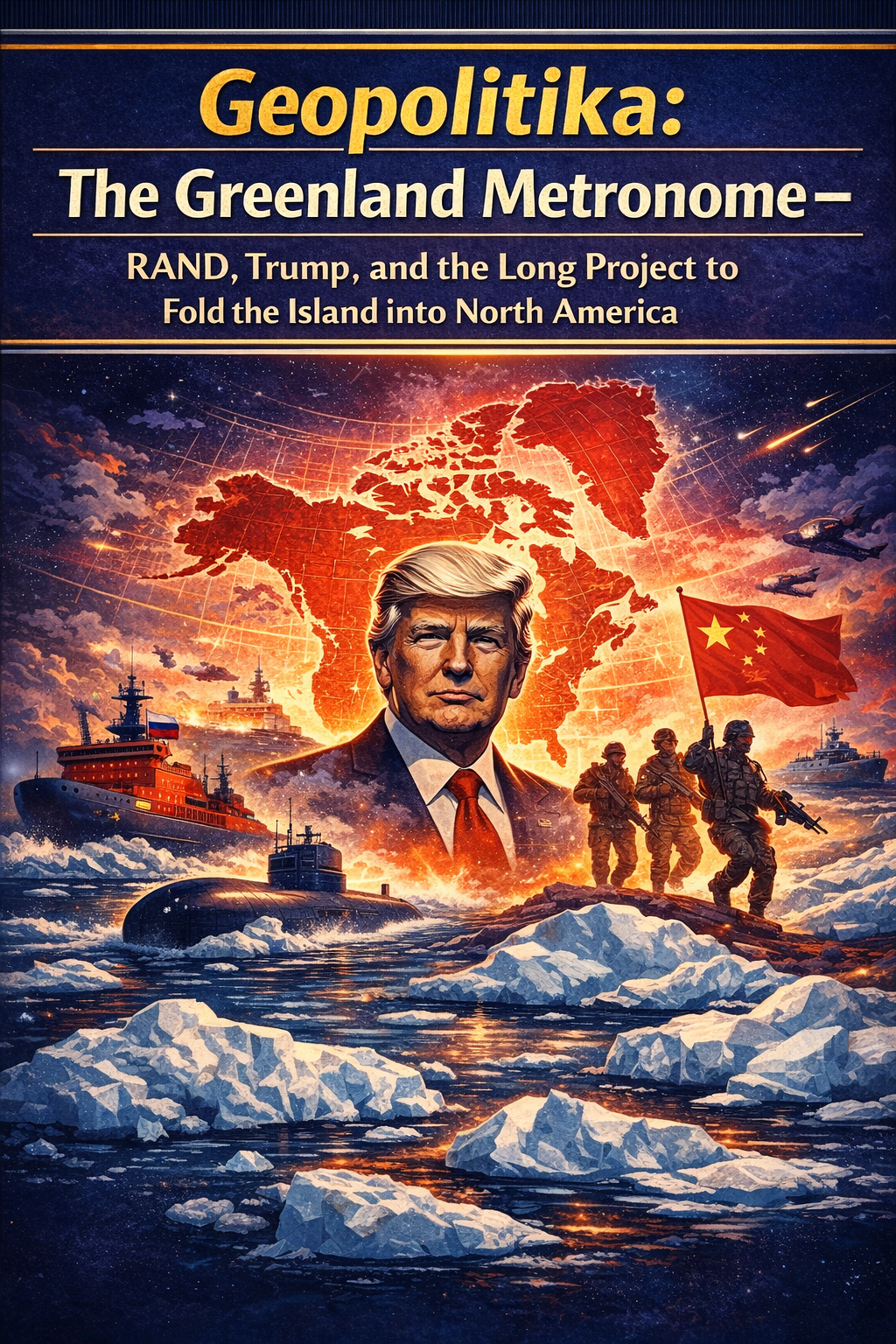
In global politics, few obsessions have proven as enduring—or seemingly as bizarre—as Donald Trump’s fixation on Greenland. As of January 2026, the former president, now back in the White House, has escalated his campaign with a “framework” deal announced at Davos, aiming to secure U.S. access to the island’s rare-earth deposits and strategic bases while blocking Chinese and Russian influence. This isn’t mere bluster. Trump has appointed Louisiana governor Jeff Landry as a special envoy to Greenland, floated ideas for expanding the U.S. footprint at Thule—now Pituffik Space Base—and tied the push to his “Golden Dome” missile-defence system. He has backed away from explicit threats of force or outright annexation, but the coercive edge remains: hints of tariffs on Denmark if talks stall, and congressional proposals like the Make Greenland Great Again Act and the Red, White, and Blueland Act (sadly, not a joke) authorising negotiations to acquire the territory. (AP News)
The backlash has been swift. Greenland’s prime minister Múte Bourup Egede reiterates that “Greenland is ours—we are not for sale and will never be for sale,” framing the island’s path toward full independence as incompatible with any U.S. grab. Danish prime minister Mette Frederiksen, echoing her 2019 dismissal of Trump’s first bid as “absurd,” calls sovereignty a red line and warns that aggressive U.S. posturing could fracture NATO and force a rethink of transatlantic ties. European leaders have piled on, offering more Arctic cooperation inside NATO but ruling out territorial concessions, describing Trump’s manoeuvres as a “troubling shift” even after he stepped back from open talk of using force. (The Guardian)
Yet behind the headlines sits a deeper pattern. Why does Greenland keep resurfacing in U.S. politics, not just as a Trump quirk but as a recurring fixation? And why, whenever the island flares into view—after a presidential outburst, a diplomatic tour, or a crisis involving Russia or China—do the same RAND Corporation authors and themes reappear, quietly reframing Greenland as an essential piece of North American security and resource strategy? RAND’s analysts will say they are simply responding to accelerating Arctic melt, Russian militarisation and Chinese infrastructure bids—and those trends are real—but the effect of their work is remarkably consistent. Trump’s shocks are episodic, grabbing the spotlight in bursts of bombast. RAND’s pattern is more continuous, a steady beat that makes it feel natural to talk about integrating Greenland into a U.S.-led bloc without ever changing the flag. Whether or not anyone intends it this way, the whole arrangement functions like a system talking to itself: Trump blurts the raw desire; RAND supplies the polished playbook. (ModernAction)
Is Greenland Just a Distraction?
The inclination to write off Trump’s Greenland push as a diversion is understandable. The timing is conspicuous. As of mid-January 2026, the “Greenland framework” rolls out into the news cycle alongside a stack of politically toxic stories: the Justice Department badly missing its deadline under the Epstein Files Transparency Act and admitting that less than 1% of millions of pages have been released; heated fights over stalled or re-packaged Ukraine aid as Russian forces grind forward around Donetsk; sustained protests and international legal pressure over Gaza; and low-level flare-ups tied to Iran and Houthi-linked attacks in the Red Sea. (Wikipedia)
The Greenland narrative is perfectly shaped for cable news and social media: visually exotic, apparently low-cost for U.S. voters, high-drama for allies. Appointing Jeff Landry as special envoy, floating tariffs on Denmark, talking up Pituffik and “Golden Dome” missile defence—none of this requires immediate war or domestic sacrifice, but all of it lets Trump project decisiveness and territorial ambition. (PBS)
There’s also precedent in his own communication style. The first Greenland bid in 2019 coincided with impeachment rumblings and trade-war jitters; other episodes—the North Korea summits, Iran strike talk, border-wall theatrics—likewise arrived at moments when domestic liabilities piled up and a foreign-policy spectacle could reset the narrative. The 2025 “one way or another, we’re going to get it” line to Congress fits that pattern: loud, simple, guaranteed to dominate headlines for several cycles. (ArcticToday)
From a perception-management angle, the diversion reading works: Greenland functions as agenda displacement. The story is outrageous enough to be newsworthy, abstract enough that no one has to send their kid to fight for it tomorrow, and patriotic enough that critics can be painted as weak on national security or “anti-American” if they push too hard.
But stopping there misses the deeper continuity. The strategic substance predates this presidency and outlasts any one news cycle. RAND and other Atlantic-aligned analysts have been flagging Greenland and the North American Arctic as critical nodes for years—on rare-earth supply, on missile and space tracking, on the GIUK/northern flank, on Chinese mining and infrastructure bids—irrespective of who sits in the Oval Office. Engaging with Greenland (2019), the 2022 push to consider Greenland and Denmark inside NORAD, and recurring China-in-the-Arctic reports all treat the island as structurally integral, not as a viral sideshow. (ModernAction)
Likewise, a non-trivial policy track now exists alongside the theatrics: H.R. 361, the Make Greenland Great Again Act, formally authorises negotiations to acquire Greenland; other draft bills and talking points float fast-tracking any eventual agreement. Landry’s envoy role, budgeted upgrades at Pituffik, and Arctic basing and NORAD-modernisation plans are not memes—they are concrete mechanisms that line up neatly with earlier RAND prescriptions. (Congress.gov)
So the clean answer isn’t “it’s just a distraction” or “it’s pure grand strategy”. It’s both. Greenland does work as diversionary theatre when Epstein files, Ukraine, Gaza or Iran dominate the risk ledger. At the same time, it sits on top of a long-running institutional project that treats the island as part of a North American security and resource grid. Trump can ride that existing wave, using it to drown out other failures, while Atlantic technocrats quietly ensure the policy plumbing keeps inching toward deeper U.S./NATO embedding whether or not anyone is paying attention.
Structurally, that’s the core contrast this exposé is pushing:
- Episodic diversion: Trump’s Greenland outbursts erupt exactly when the system most needs a spectacle.
- Periodic continuity: RAND’s Greenland/Arctic work keeps returning to the same outcome—more integration, more bases, more surveillance—even when no one is looking.
Trump doesn’t have to be consciously using Greenland to hide Epstein, Ukraine, Gaza or Iran for this to be true. It’s enough that the incentives line up: diversionary politics at the surface, long-term bloc-building underneath, and Greenland sitting at the point where the two reinforce each other.
RAND as Metronome – A Recurring Greenland / Arctic Pattern
Look at the RAND Corporation’s output on the Arctic over roughly the past decade, and a image emerges that looks, in retrospect, like a metronome—steady, predictable, and always landing on the same underlying geography. Every time the Arctic slips into public view—Trump’s 2019 offer to buy Greenland, Secretary Blinken’s 2021 Arctic tour, Russia’s war in Ukraine spilling north in 2022, Finland and Sweden’s NATO accession in 2023–2024—a familiar cluster of RAND authors surfaces with a new report or commentary. The topics change with the headlines; the map doesn’t.
The rhythm actually starts before Trump ever mentioned Greenland. In 2016, Stephanie Pezard and Timothy Smith’s Friends If We Must: Russia and China in the Arctic and, in 2018, Stephanie Pezard’s testimony The New Geopolitics of the Arctic: Russia’s and China’s Evolving Role in the Region already frame the region as a fragile theatre where U.S. presence is essential amid growing Russian militarisation and Chinese economic inroads. Greenland itself is not yet the star, but the stage is set: the Arctic is no longer exceptional; it is a domain where great-power competition can no longer be insulated.
Then comes 2019—the pivot. Trump’s public bid to purchase Greenland generates headlines and diplomatic embarrassment. RAND responds directly with Scott R. Stephenson’s Engaging with Greenland (September 23, 2019). This commentary is not a one-off reaction; it becomes the doctrinal hinge. It acknowledges the island’s strategic value—rare-earth deposits critical to U.S. supply chains, a central position astride emerging Arctic shipping routes and transatlantic air paths, and the irreplaceable Pituffik (Thule) Space Base for missile warning and space tracking. It concedes that outright purchase is politically toxic, legally complicated under Greenland’s Self-Government Act, and ultimately unnecessary: even ownership wouldn’t guarantee access if home-rule authorities block new bases or resource deals. The recommended path? Deepen “engagement” through NATO frameworks, negotiated basing rights, targeted trade and infrastructure investment, and a re-opened U.S. consular presence in Nuuk—all wrapped in language of respect for Danish sovereignty and Greenlandic self-rule. Structurally, the raw objective (“we need Greenland”) survives; only the crude method (buy it) is discarded.
From there the beat continues, not as secret coordination but as functional recurrence. Post-2019 RAND work repeatedly returns to the North American Arctic and Greenland as reference points:
- 2020–2021: Pieces on NATO’s northern flank, the GIUK gap and UK–Norwegian cooperation implicitly position Greenland as part of a continuous defensive arc from Alaska through Canada, Greenland and Iceland to the UK.
- 2021: Exploring Gaps in Arctic Governance: Identifying Potential Sources of Conflict and Mitigating Measures and its companion Potential Drivers of Crises in the Arctic lay out risk models—more shipping, more military activity, more outside players—that make deeper Western coordination (and infrastructure) sound prudent. Greenland sits at several of those high-risk intersections, and “uncertainty about Greenland’s geopolitical future” is explicitly coded as a potential conflict catalyst.
- 2022: Should Greenland and Denmark Become Part of NORAD? takes the next logical step: openly asking whether Greenland should be formally integrated into North American air and missile defence architecture, treating the island as “strategically integral to North America” even while the flag remains Danish.
- 2022–2025: The same author cluster (Stephanie Pezard, Abbie Tingstad, Benjamin J. Sacks, Scott Stephenson and others) produces recurring China–Arctic assessments, recasting much of the same geography as a story about Chinese mining stakes, port bids, telecom projects and research stations—risks that demand Western counter-presence.
Crucially, this metronome doesn’t just produce prose. It hardens into metal and money. Trump’s decision to waive “build American” rules and order eleven Finnish-designed icebreakers—captured in coverage like “The Best in the World”: Why the US Is Buying Icebreakers from Finland—is sold on exactly the logic RAND has been normalising: Russia’s huge icebreaker fleet, China’s growing polar presence, new Arctic routes that must be secured, and the need to signal that the U.S. is a “real” Arctic state. The vessels are justified as a response to climate-driven change and Russian/Chinese moves, but functionally they are long-lived capital assets that lock in an Arctic posture for decades. They are the material counterpart to RAND’s charts: the hardware expression of the same beat.
The same convergence appears on the resource side. Mainstream explainers like the BBC’s Greenland: What Natural Resources Does the Island Have? walk through the geology that underpins RAND’s concerns: large estimated reserves of oil and gas, and a portfolio of critical raw materials (rare earths, graphite, niobium, titanium) that are central to supply-chain and China-containment narratives. They note that only a couple of mines are actually operating and that extraction is brutally expensive—meaning commercial logic alone doesn’t get you there. You need state-backed finance, security rhetoric and long-term embedding (including U.S. consular presence and Ex-Im financing) to make the projects viable. That is precisely the environment RAND’s “engagement” script is designed to justify.
Across these cycles, the worldview barely shifts. The U.S. and NATO are cast as responsible stewards of Arctic security; Denmark appears as a derelict sovereignty manager whose cooperation is assumed—formally holding the foreign and security keys for the Kingdom, but, in the utilitarian technocratic logic voiced by Trump adviser Stephen Miller, having “failed at every single” test of defending, improving or inhabiting Greenland and thus having a weaker claim to it; Russia and China are the standard antagonists, one military, one economic–technological. Greenland and its mostly Indigenous population appear as a small polity on a “march toward autonomy,” a useful partner and a legal constraint, but not as a full author of the security story. The moral language—“rules-based order,” “shared security,” “partnership,” “open for business”—is consistent too, making a tightening U.S./NATO grip sound like neutral governance rather than one choice among many.
So are the narrative outcomes. Whether the nominal subject is Russian submarines, governance gaps, Chinese ports, icebreaker shortfalls or NORAD modernisation, the same skeleton recurs: Western expansion is laundered as protection; China’s presence is treated as a generic threat that justifies more U.S./NATO infrastructure; Greenlandic politics are flattened into a single parameter; NATO and NORAD are presented as the only serious containers for security; and RAND’s line itself is offered as expert common sense rather than a contested doctrine. Change the surface nouns and hardware, and you still end up at the same destination: deeper Western embedding on the same geography.
The bloc politics and ledger behind this pattern are likewise stable. The Atlantic security technocracy—U.S. and NATO planners, Danish defence and foreign-policy elites—and Western firms stand to gain more predictable basing rights, surveillance infrastructure, ship orders, mining finance and project pipelines that treat Greenland as part of a North American defence and resource grid. Denmark’s ambivalent position between legal European status and functional North American defence is rationalised in favour of closer North American integration. By contrast, Greenlandic autonomy movements, environmental and Arctic-governance actors, and alternative security visions (non-aligned, demilitarised, Greenland-first) appear, when they appear at all, as constraints or flank risks rather than as blocs whose preferences might redraw the map.
None of this requires a smoke-filled room. RAND’s Arctic analysts can quite reasonably say they are responding to genuine shifts: accelerating ice melt, more traffic, Russia’s military posture, China’s investments, the capability gap in icebreaking, the lure of critical minerals. But whatever the hook—Trump’s bid, Blinken’s tour, Ukraine’s spillover, NATO’s enlargement, a Chinese mining proposal, a Coast Guard icebreaker shortfall—the policy argument resolves back to the same refrain: more North American integration, more NATO coordination, more U.S.-led investment and hardware, less room for Chinese manoeuvre, and Greenland fused ever more tightly into that system. The authors recur; the geography recurs; the prescriptions now have ships and mines attached to them. It functions as a steady beat, keeping Greenland and the North American Arctic firmly in the policy soundscape long after the latest Trump headline fades.
The Hinge Text – Engaging with Greenland as Method Upgrade
Section II sketched the arc: early RAND work in 2016–2018 normalises the Arctic as a contested theatre, 2019’s Engaging with Greenland marks the first explicit Greenland doctrine, and everything afterward—NORAD pieces, governance/crisis models, China-in-the-Arctic reports—repeats and extends that line. Here we zoom in on that hinge text and what it actually does inside that sequence.
On the surface, Engaging with Greenland looks like a tidy correction.
The article answers Trump’s 2019 purchase bid by conceding Greenland’s strategic value and then explaining why buying it is a bad idea. As Section II already noted, it rehearses the now-familiar points: rare earths, shipping routes and air corridors, Pituffik/Thule as a critical missile-warning and space-tracking node; purchase as politically toxic, legally tangled under Greenland’s Self-Government Act, and ultimately insufficient because home rule could still block bases or mining. It proposes “engagement” instead: NATO and allied frameworks, negotiated basing rights, targeted trade and infrastructure, and a consulate in Nuuk, all wrapped in deference to Danish sovereignty and Greenlandic self-rule. In other words, it swaps “buy the island” for “embed more deeply.”
Structurally, though, this is more than policy advice; it’s a method upgrade. Everything RAND’s earlier Arctic pieces gestured toward in general terms—Arctic as a strategic theatre, Russia and China as rising risks, the need for more Western presence—harden into a specific Greenland doctrine here. The underlying objective survives intact: the United States should maximise its leverage in and through Greenland. What changes is the instrument set. Sovereignty becomes a surface variable; the real project is to tighten the web of bases, alliance commitments, trade ties and infrastructure until formal ownership is almost irrelevant. You don’t annex Greenland; you make it functionally North American.
The way the story is told locks in a particular worldview. Full agency belongs to U.S. and NATO planners, Danish officials, and to Moscow and Beijing as strategic competitors. Greenland appears mainly as a site and a constraint: a small, mostly Indigenous polity on a “march toward autonomy” whose consent must be managed, but whose own security and development doctrines are not allowed to define the frame. The values invoked—self-determination, sovereignty, “rules-based order”—operate as guardrails on clumsy tactics (don’t talk about buying territory) rather than as reasons to question the basic assumption that the U.S. and its allies should be structuring Greenland’s future in the first place. As Greenland’s Prime Minister Múte Egede put it in January 2026: “We are not for sale and will never be for sale”—a reminder that autonomy is not merely a legal parameter but a political project. (Source: The Guardian, Jan 22, 2026)
You can also see, in compressed form, the narrative moves that later RAND outputs will recycle. U.S./NATO expansion is presented as responsible stewardship, necessary to defend a fragile Arctic from Russian militarisation and Chinese infrastructure bids. Chinese activity is treated less as a set of specific deals to be weighed by Greenlanders and more as a generic threat vector that automatically legitimises counter-presence. Greenlandic autonomy is recognised, but framed as a parameter on how to pursue U.S. aims, not as a competing project that might collide with them. The commentary’s own line is offered as the reasonable centre: the thing a serious policymaker is supposed to think once they’ve grown out of Trump-style purchase talk.
The bloc politics follow from that. The winners of this hinge are the Atlantic security technocracy and Danish sovereignty managers, who get a script that preserves alliance cohesion, consolidates U.S. access, and defuses the diplomatic damage of the 2019 bid. Western firms are positioned to benefit from the recommended trade and infrastructure channels. China and Russia are stabilised as antagonists whose moves justify the very embedding being proposed. Greenlandic autonomy movements, environmental actors, and advocates of non-aligned or demilitarised Arctic futures are acknowledged, at most, as constraints or background risks, not as blocs whose preferred outcomes might re-draw the map.
To be fair, there is real risk work happening here. Stephenson is not hallucinating Russian submarines or Chinese capital; Arctic warming, more traffic, sharper Russian postures and Chinese interest in Greenlandic mines and infrastructure are all genuine shifts. The piece gestures at crisis-management and cooperative mechanisms to lower the odds of miscalculation. The problem, when you view it in sequence with what follows, is not that the risks are fake—it’s that they are channelled into a single direction of travel. Across the later NORAD integration arguments, governance-gap reports and China-Arctic assessments, the solution set established in Engaging with Greenland barely moves: whatever the combination of Russia, China and climate risk, the answer is deeper U.S./NATO presence and tighter integration of Greenland into a North American-led grid, not any serious consideration of shrinking Western footprints or centring Greenland’s own doctrine.
That is why this short 2019 commentary deserves to be treated as a hinge text. It takes the vague Arctic concerns of the pre-Trump era, collides them with the embarrassment of Trump’s purchase bid, and produces a durable method: keep the appetite for Greenland, drop the annexation talk, and pursue the same structural outcome through alliances, bases and “engagement” that sound, on paper, like partnership. Everything that comes after in the RAND corpus is, in one way or another, an elaboration of that move.
The Greenland Beat Across the RAND Corpus – Same Map, New Pretexts
Once you treat Engaging with Greenland as the hinge, the rest of RAND’s Arctic output reads like chapters in a single book: new crises, new titles, but the same geography and logic underneath.
Prelude: Arctic as theatre (2016–2018)
Before anyone in Washington was joking about buying Greenland, RAND-linked analysts were already sketching the stage. In 2016, Stephanie Pezard and Timothy Smith’s Friends If We Must: Russia and China in the Arctic framed the region as a space where Russian ambitions and vulnerabilities intersect with a growing Chinese economic footprint, and where U.S. planners need to stay alert. In 2018 testimony, The New Geopolitics of the Arctic, Pezard pushed the same line: Russian military build-up, more traffic, and non-Arctic actors like China turning the High North into a strategic theatre rather than a quiet backwater. Greenland is mostly implied here—part of the “High North” and the GIUK belt—rather than singled out, but the worldview is already in place: U.S./NATO as responsible stewards, Russia and China as structural risks, local actors as scenery.
The hinge: Greenland named and doctrinalised (2019)
Trump’s 2019 bid to buy Greenland forces the issue into the open. Scott Stephenson’s Engaging with Greenland is the moment the earlier Arctic anxiety condenses into a specific Greenland doctrine: Greenland is strategically vital; buying it is politically toxic and legally messy; the correct answer is to deepen engagement through NATO frameworks, negotiated basing, targeted investment and a consulate in Nuuk, all under the banner of respecting Danish sovereignty and Greenlandic self-rule. As we’ve seen, this doesn’t change the goal (“we need Greenland”), it changes the method (“don’t buy, embed”).
After the hinge: each new shock, the same map
From that point on, the titles tell a clear story.
- In 2021, Benjamin Sacks and colleagues publish Exploring Gaps in Arctic Governance: Identifying Potential Sources of Conflict and Mitigating Measures, paired with the interactive Potential Drivers of Crises in the Arctic. The reports map six “conflict catalysts,” including Russian access routes, safety and environmental risks, grey-zone activity, challenges to current rules—and “uncertainty about Greenland’s geopolitical future”. The remedy is framed as better governance and crisis mechanisms, but the practical drift is toward more coordinated Western infrastructure and presence in the hotspots the map identifies.
- That same year, Stephenson and co-authors’ GIUK commentary Mind the Gap warns that independence movements in Greenland, the Faroes and Scotland could jeopardise NATO’s ability to monitor Russian submarines and aircraft transiting the Greenland–Iceland–UK gap. Here, Greenland is explicitly a piece in a continuous defensive arc; autonomy is treated as a risk to alliance surveillance rather than as a political project with its own legitimacy.
- In September 2022, Michael Bohnert and Scott Savitz write Should Greenland and Denmark Become Part of NORAD?, arguing that inviting them into the North American Aerospace Defense Command would strengthen deterrence against Russia and reflect the fact that “Greenland is a strategically integral part of North America”. This is the institutionalisation of the Greenland-as-North-America logic: the legal flag can stay Danish, but structurally the island belongs inside a U.S.-centred defence grid.
- Meanwhile, the China track comes into focus. The 2021–2025 China–Arctic work, culminating in Is the Polar Silk Road a Highway or Is It at an Impasse? China’s Arctic Policy Seven Years On, emphasises that China is slowly building its economic, scientific and information presence in the Arctic and that these activities “could present distinct security risks to Arctic countries”. Earlier RAND and RAND-authored pieces tagged “Arctic” make the same move: Chinese mining stakes, port and telecom projects, and research outposts are read as dual-use tools that demand Western counter-presence. Greenland appears here as one of several points where China’s economic and scientific interests intersect with Western security concerns.
Across these waves, the same lenses keep snapping into place. The U.S. and NATO appear as responsible managers of a volatile region; Denmark is the sovereignty gatekeeper whose alignment is assumed; Russia and China are recurring risk vectors; Greenland and its people are present as a location, a legal constraint, and an “uncertainty” in governance models, rather than as authors of their own doctrine. The narrative risks that Engaging with Greenland concentrated—Western expansion laundered as protection, China as the omnipresent foil, Greenlandic politics flattened into a single parameter, NATO/NORAD as the only sensible containers—are replayed under new headings: governance gaps, crisis drivers, NORAD modernisation, Polar Silk Road.
The ledger does not really change. Each successive report or commentary builds a stronger case for more U.S. and allied infrastructure, more command integration, more budgetary and political capital flowing to Western security bureaucracies and firms operating on the Greenland–North American arc. Across these interventions, RAND’s Arctic team cites a now-standard picture of Arctic change—melting ice, more traffic, more Russian and Chinese activity, and “brittle” governance institutions—as the backdrop for its recommendations. Regardless of the trigger—Russian submarines, Arctic Council paralysis, Chinese telecoms, Ukraine spillover, NATO enlargement—the remedy they return to is strikingly consistent: more U.S./NATO presence, more integration of Greenland into a North American-led defence and governance grid, never less. The titles and crises change; the cartography doesn’t.
RAND as Script Engine – How Doctrine Gets into the Presidential Mouth
At this point it’s tempting to start analysing Trump’s personality; but we really need to look at the machinery that feeds any president their lines. RAND isn’t a bystander in that machinery; it’s one of the script engines.
On paper, RAND is a research organisation. In practice, its Arctic and Greenland work functions as a scenario library for the U.S. security bureaucracy. Over roughly a decade, the same author cluster has produced a stable set of narratives keyed to different triggers: Russian build-up and the GIUK gap, “gaps” in Arctic governance, China’s mining and telecom bids, questions about where Greenland and Denmark sit in NORAD. Each comes with a ready-made storyline—risk maps, key phrases, and a menu of “responsible” responses: more basing, more coordination through NATO/NORAD, more Western infrastructure and investment, more formal recognition of Greenland as “strategically integral” to North America.
Those narratives don’t just sit on RAND’s website. They circulate through the permanent apparatus: Pentagon and State desks, the National Security Council, congressional staff, NATO working groups. The people who actually read this material—policy aides, planners, briefers, speechwriters—lift its vocabulary into talking points, memos and draft speeches. When a president, any president, talks about defending the “rules-based order” in the Arctic, or about Greenland’s “critical role in North American defence”, or about the need to counter Chinese “dual-use” projects, they are drawing on language that has already been normalised in RAND reports, CRS studies, internal DoD papers and alliance communiqués.
That is why the pattern persists across administrations. The faces and party labels change, the atmospherics change, but the doctrinal stock is remarkably consistent: Greenland is a security node inside a U.S.-led system; Russia and China are the drivers of risk; the sensible answer is deeper U.S./NATO embedding, not less. Trump bolts his own improvisations—buy it, tariff Denmark—on top of that. A different president would lean more on climate, cooperation or Indigenous consultation. But behind both, staff are reaching into the same pool of concepts and scripts.
You don’t need a cartoon “deep state” to describe this. You just need to notice that institutions like RAND operate on multi-year cycles, generating scenarios and language that outlast any one occupant of the White House. Trump makes the Greenland project noisy; others make it polite. The structural trajectory—folding the island ever more tightly into a North American security and resource grid—belongs to the script engine they all share.
Long Shadows – Technocracy, Trilateralism and Rand’s Bloc Geometry
The RAND–Greenland doctrine doesn’t emerge in a vacuum. It sits in a much older habit of imagining North America as a single, expert-managed bloc with Greenland on its rim.
In the 1930s, Technocracy Inc drew this quite literally. Its map of the Technate of America folds the United States, all of Canada, Greenland, parts of Mexico, Central America and the Caribbean into one continental unit to be run by engineers and scientists rather than elected politicians. Recent commentary like A 1930s movement wanted to merge the US, Canada and Greenland. Here’s why it has modern resonances notes that technocrats openly discussed merging the US, Canada and Greenland to rationalise resource and industrial flows—North America as one engineered machine, with Greenland a northern component in a continental energy–security grid.
Four decades later, the Trilateral Commission formalised bloc thinking at a different scale. Its own framing in Trilateral Commission – Wikipedia and Members & Fellows divides the advanced capitalist world into three macro-regions—North America, Western Europe, Japan/Asia-Pacific—bearing a “special responsibility” for managing “growing interdependence.” In that geometry, Greenland is legally European (Danish sovereignty) but functionally North American: militarily and strategically part of the North American and North Atlantic perimeter that Trilateral-era strategists obsess over.
Writers like Patrick Wood have spent decades documenting this architecture. In Trilaterals Over Washington (with Antony Sutton) and Technocracy Rising, he assembles the maps, programmatic texts and membership networks of Technocracy Inc and the Trilateral Commission to argue that they were early attempts to build technocratically managed blocs, with North America treated as a single planning unit. You don’t have to follow him all the way into “Trojan Horse” rhetoric to see the simpler continuity: the idea of North America as an engineered system, with Greenland on its northern rim, has been circulating in elite projects for nearly a century.
RAND is not a branch office of Technocracy Inc or the Trilateral Commission; rather, it is a contemporary technocratic project operating inside the U.S. state: a semi-insider expert organ that turns bloc-level abstractions about “North American security” and “Western stewardship” into concrete doctrines, risk maps and policy scripts. Technocracy Inc drew the North American bloc and its Greenland flank as a utopian Technate; the Trilateral Commission framed it as responsible management of interdependence; RAND’s Arctic and Greenland work expresses the same geometry in the language of governance gaps, deterrence and missile defence. Different institutions, same habit: North America as a managed bloc, Greenland as a perimeter node.
Greenland’s Missing Voice – Autonomy as Constraint vs Autonomy as Project
In RAND’s Arctic framing, Greenland is almost always present—but rarely as the place setting the terms. In governance and risk work such as Exploring Gaps in Arctic Governance: Identifying Potential Sources of Conflict and Mitigating Measures and the interactive Potential Drivers of Crises in the Arctic, “uncertainty about Greenland’s geopolitical future” is listed as one of six potential conflict catalysts, alongside Russia’s role in Arctic access and China’s growing presence. Greenlandic autonomy appears here as a source of instability to be modelled and mitigated—a parameter in a larger optimisation problem aimed at preserving U.S./NATO order.
To RAND’s credit, these studies do urge greater inclusion of local stakeholders and Indigenous communities, noting that governance bodies face a “growing need for inclusivity.” But even there, Greenlanders and Indigenous actors are described as voices that should be heard within pre-defined institutional frameworks, not as authors of those frameworks. In the corpus, autonomy is something that complicates basing, access and alliance plans—an uncertainty term—more than a political project with its own strategic horizon.
From inside Greenland, the picture looks very different. The Act on Greenland Self-Government (2009) recognises “the people of Greenland” as a people with a right to self-determination in international law and explicitly envisages a negotiated path to independence. Greenland’s Prime Minister Múte Egede has repeatedly stated that “we have a desire for independence, a desire to be the master of our own house,” and that Greenlanders “do not want to be Americans,” rejecting Trump’s takeover talk while insisting on Greenland’s right to choose its own partners. Analyses like Ulrik Pram Gad’s Don’t get Greenland’s role in Arctic security wrong underline that, within Danish–Greenlandic politics, independence is treated as an assumed eventual future, and that Greenland has its own security concerns and red lines, not all of which align with U.S. militarisation.
Resource policy is one of the main tools of this autonomy-as-project. Debates over uranium mining, rare earths and large-scale projects—captured in Greenlandic scholarship like Greenland in Arctic Security—show local actors using “open for business” not simply as an invitation to Western firms but as a way to leverage economic development toward greater self-rule, even if that means flirting with non-Western partners.
If RAND’s Arctic work functions as a metronome for Washington—providing a steady rhythm of risk models and integration scripts—Greenland’s domestic politics run on a different beat: elections, independence rhetoric, resource moratoria, local protests. In the technocratic frame, that beat often registers as noise that must be filtered, dampened or synchronised, not as a legitimate rhythm that might demand a different score altogether. Autonomy, in other words, is treated as a constraint to be managed in North American planning rather than as a project that could redraw the map RAND starts from.
Final Fracture – The Greenland Clock
By the end of this, “risk” should no longer feel like a neutral word.
In RAND’s Arctic corpus, the risks that matter most are the ones that hit U.S. and allied systems: gaps in radar coverage, vulnerabilities in missile warning, Russian submarines slipping through the GIUK gap, Chinese “dual-use” ports or telecoms, uncertainty about access to rare earths and air/sea routes. Greenlandic autonomy, Greenlandic politics, Greenlandic futures appear too—but mainly as “uncertainty about Greenland’s geopolitical future,” a factor that might disrupt basing, investment and alliance cohesion.
So the first question is: risk to who?
To the RAND/Atlantic worldview, the primary answer is: risk to U.S./NATO command and economic flows. Risks to Greenlandic self-determination, to the possibility of a genuinely different security doctrine, to Indigenous livelihoods and ecologies—these are not entirely absent, but they live at the margins, as things to be “taken into account” rather than as central objects of protection.
Then: how much risk, and how is it counted?
The modelling is rich when it comes to system threats—detailed scenarios about Russian and Chinese moves, governance breakdowns, crisis triggers. It is thin when it comes to quantifying the political risk to Greenland of being ever more tightly wired into someone else’s defence architecture. There is no ledger that puts “NORAD integration” on one side and “probability Greenland can realistically exercise its right to walk away later” on the other. One kind of risk is specified down to drivers and sub-drivers; the other is treated as background texture.
Are there other ways to deal with a changing Arctic?
In principle, yes. You could imagine Arctic demilitarisation bargains, Greenland-first doctrines that start from local definitions of security, genuinely pluripolar economic partnerships, ecology-anchored security architectures. In practice, those options don’t show up as “serious” in the RAND universe. The funnel is consistent: many different inputs—climate, Russia, China, governance gaps, Greenlandic politics—flow into one broad output class: more U.S./NATO embedding, more infrastructure, more integration of Greenland into a North American grid. The institution is not lying about change; it is shaping what counts as an acceptable response.
Which leads to: who says, and who gets to decide?
Formally, decisions are shared between Washington, Copenhagen, Nuuk and alliance structures. But the agenda—what the problem is, what the menu of reasonable options looks like—is heavily pre-cooked by the Atlantic security-technocracy bloc: RAND analysts, defence planners, Arctic “governance” experts, NATO committees. Greenlandic and Indigenous voices are invited in as stakeholders to be consulted, not as co-authors of the underlying script.
And finally: who benefits from the way the clock is built?
Each tick—each RAND report, NORAD argument, command-plan tweak, “engagement” commentary—tends to push in the same direction: more money, authority and leverage for U.S. and allied security bureaucracies and firms operating on the Greenland–North American arc; a more entrenched bloc architecture with Greenland as a node; narrower practical room for Greenland to choose a fundamentally different path later. The actors who pay the highest price in foreclosed futures—Greenlandic independence projects, demilitarisation agendas, non-aligned Arctic visions—appear, when they appear at all, as risks to be managed rather than as legitimate ends in themselves.
That is the Greenland clock. On the surface, you see noisy politics: Trump’s bids and frameworks, EU and Danish pushback, Greenlandic elections, mining battles. Underneath, you see a quieter mechanism: a technocratic rhythm that defines whose risks matter, which responses are admissible, who speaks first and last, and who accumulates structural advantage. Whether Trump is shouting about “getting” Greenland or a more decorous president is talking about “shared stewardship,” that mechanism keeps ticking—marking time in integrations and upgrades that nudge Greenland deeper into a bloc it has never been allowed to fully design, and may one day try to leave.
Published via Mindwars-Ghosted.
Geopolitika: Tracing the architecture of power before it becomes the spectacle of history.
—
Author’s Note
Produced using the Geopolitika analysis system—an integrated framework for structural interrogation, elite systems mapping, and narrative deconstruction.