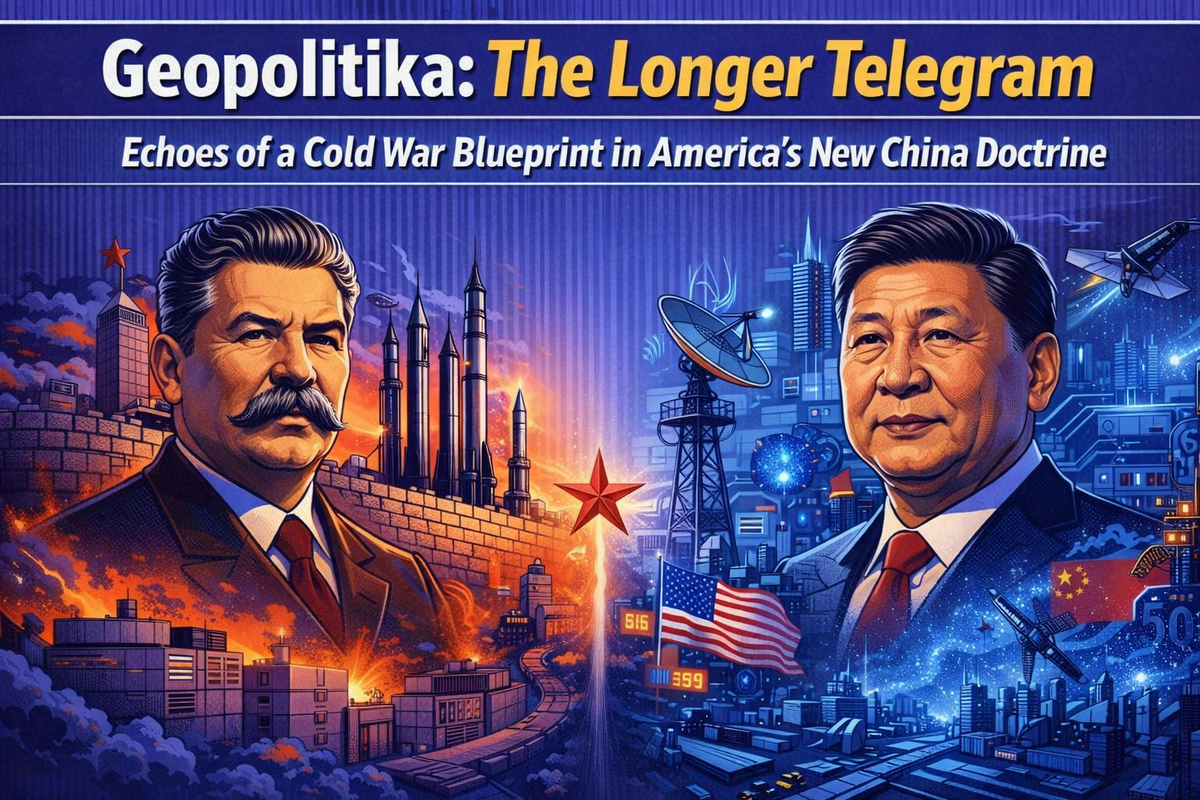
Geopolitika: The Longer Telegram – Echoes of a Cold War Blueprint in America's New China Doctrine
If you’ve been following the headlines in early 2026—from Hong Kong’s national security trial against former vigil organisers, to Beijing brushing off UN concerns over forced labour in Xinjiang, to rescue ops near Scarborough Shoal and fresh U.S.–China friction over TikTok’s joint-venture workaround—you can feel a kind of built-in inevitability to the rivalry. While Xi talks up a “shared future” with Vietnam the region simmers and your news feed is full of tariff fights, rerouted oil and reheated Arctic/Greenland drama. It all stacks up as an escalating clash of superpowers, with China slotted in as the aggressive authoritarian challenger by default.
What I want to poke at here is the framing behind that: the threat-personalisation, the red lines, the idea of a permanent, managed confrontation. That framing doesn’t just grow organically out of “facts on the ground”; narratives like this are quite literally scripted. In the current China story, we can trace this scripting through a pair of obscure diplomatic memos which form the spine for a pivot from one Cold War to another: one from 1946 and another from 2021— both written in a way that makes a long rivalry feel natural and necessary.
The original template is George Kennan’s 1946 Long Telegram, a 5400 word cable from the U.S. embassy in Moscow. In the post–WW2 wreckage, with Stalin’s USSR stonewalling Western institutions, Kennan sketched a worldview in which the Soviet Union saw itself encircled by hostile capitalism, believed long-term peace was impossible, expected capitalist crises to trigger wars and treated moderate socialists as “false friends.” For Kennan, this was less pure Marxism than deep Russian insecurity dressed up as theory. His recommendation was “containment”: patient, firm resistance to Soviet expansion without direct war, built on alliance cohesion, public education and shoring up Western societies at home. That memo becomes one of the intellectual seeds of the Cold War: Truman Doctrine, NATO and the whole decades-long Western posture.
Seventy-five years later, an anonymously authored 80-page Atlantic Council paper—The Longer Telegram: Toward A New American China Strategy—deliberately riffs on Kennan’s long telegram. Against the backdrop of tariffs, COVID fallout, and tech panic, it announces that “the single most important challenge” facing the U.S. is “an increasingly authoritarian China under… Xi Jinping.” The paper dissects CCP vulnerabilities, Xi’s centralisation, and a “technology war” over AI and semiconductors, then offers an updated containment playbook: red lines around Taiwan and the region, export controls and entity lists, supply-chain rewiring and a lined-up bloc of allies.
This piece takes the position that The Longer Telegram isn’t just “learning from history.” It evolves Kennan’s script—personalising threats (Stalin → Xi), moralising rivalry (freedom vs authoritarianism), and prescribing open-ended pressure—even though the eras couldn’t be more different. That continuity matters because it shows how such reports manufacture rivalry as common sense while most readers simply absorb the framing via the drip-feed of daily news. But, to see how The Longer Telegram is built, we need to start with its Cold War ancestor.
The Original Blueprint: Kennan's Long Telegram and the Birth of Containment
To see what The Longer Telegram is really doing, you need the original blueprint.
In 1946 Europe lies in ruins, colonial empires are fraying, and the United States stands alone as the only major power with its industrial base intact—plus the atomic bomb. The Soviet Union, having borne the brunt of the war against Hitler, has shifted from wartime ally to something deeply unnerving. Washington is trying to read Moscow: is Stalin mainly paranoid and wounded, or is he gearing up to overturn the global system?
George Kennan, the U.S. chargé d’affaires in Moscow, has been watching this up close for years. A fluent Russian-speaker with deep historical instincts, he’s asked a deceptively simple question: why is the USSR refusing to cooperate with Western-led institutions like the World Bank and the IMF? His response isn’t a short memo; it’s a sprawling five and a half thousand word cable sent on 22 February 1946—the document that becomes known as the “Long Telegram.”
Kennan doesn’t reduce the Soviets to “they’re communists.” He sketches their worldview in five deliberate moves.
First, he outlines the official Soviet outlook as presented by the propaganda machine: the USSR is permanently encircled by hostile capitalism; peaceful coexistence is impossible in the long run; capitalist crises will inevitably produce wars; and moderate socialists are the most dangerous “false friends” who must be discredited. “‘Democratic-progressive’ elements abroad are to be utilized to maximum to bring pressure to bear on capitalist governments along lines agreeable to Soviet interests,” he writes. Second, he roots this outlook not in Marxist scripture alone but in a deeper Russian historical insecurity—a centuries-long fear of invasion and backwardness. “At bottom of Kremlin’s neurotic view of world affairs is traditional and instinctive Russian sense of insecurity,” Kennan explains. Marxism, he argues, “became a perfect vehicle for sense of insecurity with which Bolsheviks… were afflicted,” providing justification for dictatorship, isolation and the destruction of rivals. Third, he maps the official policy tools: relentless military-industrial build-up, opportunistic territorial advances, tactical manipulation of the UN as a power arena rather than a rules-based body, and economic autarky disguised as selective trade. Fourth, he exposes the “unofficial or subterranean plane”—a layered apparatus of front organisations, captured unions, youth groups, churches and proxy movements designed to erode Western cohesion by inflaming social divisions and preparing colonial transitions for communist advantage. Finally, Kennan turns to U.S. deductions. The famous line: “Soviet power… is highly sensitive to logic of force. For this reason it can easily withdraw—and usually does—when strong resistance is encountered at any point.” This doesn’t mean brute military conquest; it means the Kremlin respects clear, credible limits more than friendly overtures. His prescription becomes the foundation of containment: no grand crusade to overthrow the regime, no illusions of stable partnership, but patient, consistent resistance to expansion. Hold ground where it matters. Keep alliances tight. Strengthen your own society so it’s the more attractive model. Educate the public so fear doesn’t spiral into hysteria.
Structurally, the cable achieves three critical things. It personalises the threat around a small, insecure leadership circle in the Kremlin while officially “respecting the Russian people.” It transforms a messy, traumatised Soviet state into a coherent, readable antagonist with predictable patterns. And it gives U.S. elites a long-horizon strategy that stops short of open war but justifies permanent vigilance, permanent budgets and permanent global positioning.
It also simplifies. Kennan barely mentions that the U.S. holds a nuclear monopoly at that moment, or that much of the non-Western world remains under colonial rule—factors that inevitably shape Soviet paranoia from the other side. Those omissions externalise grievances onto the regime and downplay how Western actions might feed the insecurity he describes.
Still, the Long Telegram travels. It gets reworked into articles, folded into the Truman Doctrine’s call for aid to nations resisting “subversion,” and woven into NATO’s founding logic. Over time, “patient but firm containment of Russian expansive tendencies” stops being one diplomat’s analysis and becomes the common sense of an entire era.
Fast-forward 75 years: a new “Longer Telegram,” this time about China, lifts Kennan’s structure almost beat for beat—just swapping Stalin’s Moscow for Xi’s Beijing.
The Modern Echo: The Longer Telegram and the "Xi Challenge"
Fast-forward seventy-five years to 2021. The backdrop is familiar in a different key: Trump-era tariff wars and “China stole our jobs” rallies, Huawei and 5G scares, COVID blame games over Wuhan and lab leaks, talk of “decoupling” and “strategic competition,” and rolling fights over TikTok, chips, and rare earths. The war-on-terror script is exhausted; everyone in Washington is already saying “China is the pacing challenge,” but the story is still messy and reactive.
Into all that drops an 80-page Atlantic Council paper, written by a “former senior government official”: The Longer Telegram: Toward a New American China Strategy. The branding isn’t subtle. In the foreword, Atlantic Council president Frederick Kempe calls it “an extraordinary new strategy paper” and says it is written “in terms that will invite comparison with George Kennan’s historic 1946 “long telegram” on Soviet grand strategy.” They even keep the author’s preferred title—The Longer Telegram—to signal the ambition: this is meant to be a Kennan-style text for the China age.
The focus is explicit: “China’s leader and his behavior.” The foreword quotes the paper’s core claim that “the single most important challenge facing the United States in the twenty-first century is the rise of an increasingly authoritarian China under President and General Secretary Xi Jinping,” and that “US strategy must remain laser focused on Xi, his inner circle, and the Chinese political context in which they rule.” Inside the document, the author goes further: “All US political and policy responses to China therefore should be focused through the principal lens of Xi himself… All US policy aimed at altering China’s behavior should revolve around this fact, or it is likely to prove ineffectual.” The analysis of the paper underscores this as a deliberate personalization tactic, turning the adversary into a single, legible variable—Xi as the “architect” of a hard authoritarian turn.
Structurally, The Longer Telegram mirrors Kennan’s cable: it opens by laying out Xi’s China as a strategic problem, then moves through China’s strengths and vulnerabilities, before landing in a seven-part strategy prescription. Xi is cast as the architect of a hard authoritarian turn after 2013; the CCP’s priorities are described as a survival hierarchy, with “Keeping the Chinese Communist Party in power” at the top. China’s goals are summarised as technological leapfrogging, regional military preponderance, dollar erosion, and institutional influence. A whole section stresses “the centrality of the technology war”: AI, semiconductors, data, and critical supply chains are labelled the decisive front, with Xi seeing “artificial intelligence as China’s most important strategic industry in the emerging competition.” The toolbox is updated containment: red lines around Taiwan and the region, coordinated export controls and sanctions, supply-chain rewiring, and a disciplined bloc of allies.
Like Kennan, the author draws a distinction between regime and people. The Chinese public is “rightly admired” for talent and hard work; the problem is Xi and the party’s strategic line. And like Kennan, the memo ends with an ideological pitch. One late section argues that China has already launched an “ideological Cold War” against liberal democracy and concludes with a challenge: let “the battle for ideas begin once again” and “may the best side win.” Unsurprisingly, Chinese and regional commentators read it exactly that way: a Cold War containment reboot with Xi as the new villain
The Longer Telegram offers a kind of salvational narrative: the U.S. as a humbled hegemon awakening to Xi’s threat, justifying generational rivalry through worldview bundles that treat Xi-led authoritarianism as the central long-term challenge, even as contradictions emerge—for example, a “values-based” competition that keeps slipping into a civilizational clash. If you’ve absorbed years of headlines about Hong Kong crackdowns, Xinjiang camps, wolf-warrior diplomacy, or the South China Sea, much of this will feel intuitive: of course Xi is a problem, of course tech is a battlefield, of course democracies need to coordinate. None of this is coincidence. The Longer Telegram doesn’t just nod to Kennan for style points; it lifts his basic structure and moral frame, swaps in Xi and semiconductors, and offers it back to a much bigger security machine. At that point we’re not just talking about two clever memos. We’re looking at a script that survives across eras by changing costumes.
Heritage and Evolution: How The Longer Telegram Builds on Kennan’s Foundations
Put Kennan’s Long Telegram next to The Longer Telegram and the family resemblance is hard to miss.
Kennan’s cable is built in five moves:
- Spell out the official Soviet outlook.
- Dig into its deeper background (a long, historically rooted Russian insecurity).
- List the regime’s official tools.
- Map the “subterranean” tools (fronts, unions, colonial movements).
- Draw U.S. conclusions.
Although The Longer Telegram is indeed longer (and more polished too), it does something very similar. It opens by defining “China under Xi” as the central strategic problem. Early on, the author writes that “the single most important challenge facing the United States in the twenty-first century is the rise of an increasingly authoritarian China under President and General Secretary Xi Jinping,” and that China’s rise “now profoundly impacts every major US national interest.” From there, the memo walks through China’s strengths and vulnerabilities, lays out what it calls the Chinese Communist Party’s hierarchy of survival priorities (with “keeping the Party in power” explicitly at the top), and then lands in a seven-part strategy stack: rebuild U.S. domestic strength, draw and enforce red lines, tighten alliances, run a technology and geo-economic campaign, manage regional crises, cooperate selectively where interests overlap, and re-enter a global “battle of ideas.”
In my earlier analysis I treated that as a worldview in text: a bundle of assumptions about how the world works and who drives events. In Kennan’s case, the bundle is: an insecure Kremlin leadership, hiding behind Marxist dogma, locked into a zero-sum struggle with capitalism. In The Longer Telegram, the bundle is: an insecure party-state, now personified through Xi, running a long-term project to displace U.S. leadership. Different era, similar move: turn many moving parts into one coherent “problem” that demands an integrated response.
The personalisation also evolves, but the logic doesn’t. Kennan locates the core problem in a small, brittle ruling circle in Moscow, with Marxism as the “perfect vehicle” for their sense of siege and a “traditional and instinctive Russian sense of insecurity” at the bottom of it all. The Longer Telegram puts Xi where Kennan put “the Kremlin.” The Atlantic Council foreword sums it up as “China’s leader and his behavior,” and inside the paper we’re told that “all US political and policy responses to China… should be focused through the principal lens of Xi himself.” Kennan famously wrote that “Soviet power… is highly sensitive to logic of force” and tends to retreat when confronted with firm limits; The Longer Telegram builds an explicit architecture of red lines, deterrent deployments, and sanctions designed to condition Xi’s choices in the same way. In both cases, the adversary is reduced to a tiny, insecure core whose behaviour becomes the organising principle for everyone else.
The battlefield shifts more visibly. In 1946, Kennan centres ideology, police-state methods, and organisational fronts: parties, unions, youth groups, colonial movements. The conflict space is propaganda, repression, and social movements in Europe and the “colonial and dependent areas.” In the 2020s version, the conflict is re-anchored in techno-nationalism: one section of The Longer Telegram is literally headed “The Centrality of the Technology War,” describing artificial intelligence, semiconductors, data infrastructure, and critical supply chains as the decisive front. Containment adapts accordingly. Kennan’s firm military-political posture and front-organisation wars become export controls, entity lists, chip bans, investment screening, supply-chain rewiring, and a pan-allied sanctions regime.
The context has shifted from a wrecked, bipolarising world with a U.S. nuclear monopoly to a crowded, entangled system of nuclear states, global finance, and planetary limits. Yet the underlying lens stays remarkably U.S.-centric. Kennan presents Soviet “divide-and-rule” tactics and agitation in colonial regions as the main source of instability, with Western empires and the bomb barely mentioned. The Longer Telegram presents China’s regional expansion, Belt and Road, tech platforms, and institutional pushes as the driver of disorder, while U.S. bases, past interventions, financial leverage, and surveillance architectures appear mostly as background. In both, the rival’s behaviour is the organising problem; the home system’s footprint is scenery.
That evolutionary move matters. The Longer Telegram doesn’t just tip its hat to Kennan for style points; it borrows his authority to sell a new, China-centred containment script in a post-Iraq, post-Afghanistan era where elite judgement is suspect. It keeps the core moves—turn a complex rival into a single coherent antagonist, propose a long, mostly non-kinetic struggle, wrap it in a moral story about “ideas”—and swaps in Xi, chips, and platforms for Stalin, steel, and unions. At that point we’re not looking at two isolated strategy papers. We’re looking at one persistent script that survives across eras by changing costumes.
Script Continuity: The Enduring Playbook of Threat and Containment
If you strip both texts down to their bones, what you’re left with isn’t just “insightful analysis.” It’s a reusable script.
The basic formula looks like this:
- Personalise the villain – identify a small circle (Stalin’s Kremlin, Xi and his inner circle) as the real driver of a hostile system.
- Moralise the contest – cast your side as flawed-but-fundamentally-liberal, the other as structurally deceptive and repressive.
- Prescribe pressure without declaring war – a long game of containment, red lines, sanctions, tech denial, political warfare.
- Coordinate elites and publics around it – alliances, budgets, messaging, and ongoing “education” to normalise permanent vigilance.
Kennan runs this pattern in 1946; The Longer Telegram runs the same pattern in 2021 with updated props. And it’s not just these two texts. You can trace a century of Western threat politics by watching the “villain” slot change nameplate: the Kaiser, then Hitler and Mussolini, then the Kim family (in dynastic rotation), Qaddafi, Saddam Hussein, Assad, and, more recently, Vladimir Putin. Each time, a system-level conflict—imperial rivalry, fascism, nuclear stand-offs, energy politics, regime-change wars, NATO expansion—gets distilled into a single face and personality. Once the leader is framed as irrational, expansionist, or uniquely cruel, pressure starts to feel less like a political choice and more like self-defence. In my earlier read of The Longer Telegram, this is where the internal tension showed up: the memo insists the contest is not “civilisational,” but its own logic pushes toward a personalised, regime-engineering strategy centred on Xi.
The backgrounds under that surface swap have shifted wildly. Kennan is writing in the hangover of World War II: Europe in ruins, empires tottering, the U.S. holding the bomb and feeling out its new role as system-manager. The Longer Telegram arrives in a post-Iraq, post-2008, post-COVID world of financial fragility, climate stress and tightly coupled supply chains. But the script persists. Kennan wants Western publics to move from a vague “fear of the unknown” to a steady, informed suspicion of Soviet power, held in place by a positive sense of what Western order can offer. The Longer Telegram calls for a renewed “battle of ideas,” aimed not just at domestic audiences but at allies and the Global South: present Xi’s China as the core long-term threat, present a U.S.-led bloc as the natural alternative, and treat wavering as naivety or appeasement. One late passage literally invites the West to “let the battle for ideas begin once again, and may the best argument win.”
If you’ve spent years marinating in headlines about tech theft, influence campaigns, debt traps and “weaponised interdependence,” the echo is hard to miss. During the 1950s, ’60s and ’70s, generations were told to see communist parties, unions, student groups or anti-colonial movements as potential Soviet fronts; now it’s platforms, ports, standards bodies and chip fabs as potential Chinese leverage. In both cases there is something real underneath. But the script’s function is to collapse a messy web of trade patterns, inequality, and Western corporate choices into a cleaner story: a cunning adversary infiltrating an otherwise benign system, led by a single dangerous man. From the point of view of people in colonised or dependent regions, that often meant being reduced to a “battleground” where their own grievances were blamed on Moscow; today, many parts of the Global South experience a similar treatment when their infrastructure and debt are read only through the lens of Beijing’s grand design.
The reason this playbook endures is that it’s so adaptable. You can swap Marxism for nationalism and techno-statism, front groups for apps and infrastructure, the Kaiser or Saddam for Putin or Xi, and still keep the same skeleton: a central villain, a moral frame, a long campaign of pressure, and a coordinated ecosystem of officials, contractors, pundits and donors who live off managing the threat. That’s why The Longer Telegram leans so hard on Kennan’s shadow. It doesn’t just borrow a famous format; it plugs a new cast and new technologies into an old script that has already proven it can organise an entire era. The remaining question is how documents like this stop being PDFs and start shaping budgets, alliances and everyday life. In other words: how do these memos make the script real?
How These Pieces Work: Mechanisms of Influence and Power
By the time they’re written, neither Kennan’s Long Telegram nor The Longer Telegram is just “one more memo.” They function as doctrine-seeds.
Kennan’s cable is now taught and archived as one of the core founding texts of containment. Teaching American History explicitly tells students that reading the Long Telegram, the Truman Doctrine speech, and NSC-68 together is “an excellent way to trace the creation and rapid evolution of containment.” Other summaries describe the Long Telegram and Kennan’s follow-up “X” article as providing the “philosophical framework” for containment, which then becomes the basis of US policy toward the USSR for decades. Once that triad hardens, “containment” stops being one diplomat’s idea and becomes the organising concept of the new national security state: it defines NATO’s role, justifies a permanent National Security Council and covert-action machinery, and gives every budget or basing request a ready-made rationale.
The Longer Telegram is rolled out quite openly as a successor. In the foreword, the Atlantic Council calls it “an extraordinary new strategy paper” and says it is written “in terms that will invite comparison with George Kennan’s historic 1946 ‘long telegram’,” adding that they kept the title The Longer Telegram to match the author’s aspiration for a similarly “durable and actionable” strategy. Days later, the Council is boasting that the paper has triggered a “fierce global debate” over how to frame a long-term China approach from Washington to Asia in its own “[world reacts]” coverage and follow-up essay on why it “triggered such a fierce… China debate.”
The vocabulary it packages then shows up downstream. The CHIPS and Science Act is officially described as an industrial policy move to “reestablish United States’ leadership in semiconductor manufacturing, shoring up global supply chains, and strengthening national and economic security,” and is widely framed as part of competition with China in semiconductors and AI. At the same time, the 2022 National Defense Strategy identifies the PRC as “our most consequential strategic competitor and the pacing challenge for the Department,” language echoed in defense commentary and China briefings. In other words: think-tank framing → shared buzzwords → laws, budgets, posture.
On the narrative side, both texts also psychologise the adversary. Kennan famously describes the Kremlin’s view of world affairs as “neurotic” and rooted in a “traditional and instinctive Russian sense of insecurity,” turning Soviet power into something to be analysed and managed like a psychological condition rather than treated as a normal peer government. The Longer Telegram does the same with Xi, declaring “the single most important challenge facing the United States in the twenty-first century is the rise of an increasingly authoritarian China under President and General Secretary Xi Jinping” and insisting that “all US political and policy responses to China… should be focused through the principal lens of Xi himself.” That clinical, leader-centric tone then feeds into media loops: the Atlantic Council’s own “[world reacts]” roundup showcases journalists and former officials immediately reusing its Xi-centric framing and red-line logic as a template for interpreting South China Sea incidents, Taiwan scenarios, and beyond.
The blind spots rhyme as well. Kennan’s framework says little about the US nuclear monopoly or the colonial order that might make Soviet paranoia understandable from the other side, even as later teaching notes explicitly point out how his flexible political containment was quickly “militarized by NSC-68” into a massive build-up. The Longer Telegram, for its part, barely touches Iraq, Libya, US surveillance exports, or the West’s own role in constructing the supply chains and dependencies it now wants to weaponise—while critics in places like the South China Morning Post and elsewhere warn that it “exaggerates” China’s ambitions and effectively revives Cold War-style containment logic for a far more integrated world.
Finally, there’s timing. These pieces appear at reset moments—just after World War II, and just after the long “war on terror” era plus the COVID shock—when older scripts have lost some of their grip. Histories and teaching sites now describe the Long Telegram as providing the conceptual basis for containment and “the basis of US foreign policy… for the next several decades.” Atlantic Council commentary describes The Longer Telegram as an attempt to do something similar for China, framing a “durable and actionable” strategy to guide US policy “for the next three decades” and emphasising the urgency of a long-term approach. From there, the script slides into ritual: annual “pacing challenge” reports, chip-war debates, summit communiqués, hearings and op-eds that all assume the same threat frame. What began life as long, dense diagnostic documents ends up as the background reality everyone else is expected to treat as given.
Breaking the Script—Why It Matters Today
Put Kennan’s cable and The Longer Telegram together and you don’t just get two clever memos; you get a single, long-running rivalry script. Each takes a messy world and turns it into a story about a dangerous leader, a fragile “free world,” and a long, necessary struggle. It’s a script that’s been very good to certain elites—security bureaucracies, defence contractors, parts of the tech sector, big media—but pretty brutal for everyone who has to live under its budgets and crises.
What’s most striking in The Longer Telegram is how little space there is for anything else. The author nods at “strategic cooperation” with China on climate, pandemics and other “megathreats,” but only as tactical carve-outs inside a zero-sum frame. Xi’s talk of a “community with a shared future for mankind” is treated as an ideological gambit, and the proposed answer is another “battle for ideas… may the best argument win.” Multipolar power-sharing, messy coexistence, or putting food systems, health and basic economic security at the centre aren’t explored as real futures; they sit offstage as things only the naive would talk about.
Once rivalry is coded as the horizon, multipolar bargaining looks like appeasement and coexistence looks like weakness. The rest of the world gets treated as a “hearts and minds” marketplace to be won over, not as co-authors of any different order. The script doesn’t just describe a problem; it narrows what you’re allowed to imagine as an ending.
There’s no guarantee the script can be rewritten; too many careers and contracts run on it. But fracture starts with refusal: refusal to take every “Longer Telegram” at face value, refusal to let “great power competition” be the only story on offer. Even asking these questions is usually framed as naive, dangerous, or “not serious” about security. Why is it that we always have to regard other nations through a with-us-or-against-us lens? What if the unthinkable alternative is simply this: co-exist, trade, relate as humans—not as props in someone else’s containment plot?
Published via Mindwars-Ghosted.
Geopolitika: Tracing the architecture of power before it becomes the spectacle of history.
—
Author’s Note
Produced using the Geopolitika analysis system—an integrated framework for structural interrogation, elite systems mapping, and narrative deconstruction.