Geopolitika: The Rockefeller Scenarios
An elite blueprint for crisis-driven control in the post-consent era.
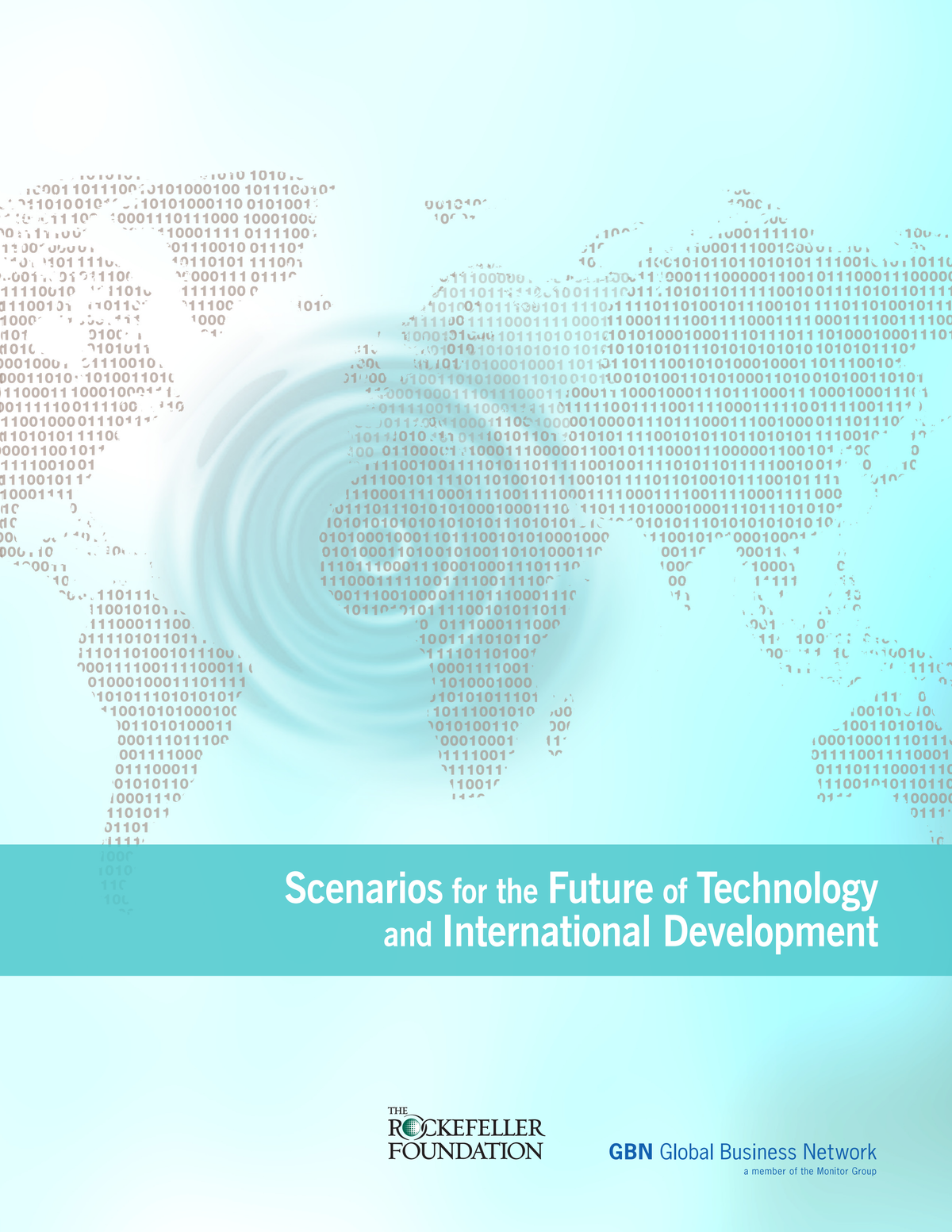
I first came across the Rockefeller Foundation’s Scenarios for the Future of Technology and International Development during the early phases of the COVID-19 response. Like many others seeking answers, my focus was drawn to one scenario in particular—Lock Step—which described a global pandemic triggering strict government controls, restricted mobility, and biometric surveillance under the guise of protecting public health.
Lock Step seemed to eerily describe what was quite obviously being rolled out around us. Not just in detail, but in attitude. It captured the mood of coordinated certainty that had settled over governments and institutions—the sense that a predefined script was being followed, even if no one would acknowledge it.
At the time, I remember thinking that the population was being conditioned for war. Not just symbolic war. Not just the war on a virus. But actual war: with weapons, casualties, and irreversible shifts in the global order. Maybe not here. Maybe not yet. But everything being normalised—narrative control, behavioural compliance, supply chain reorientation, biometric surveillance, digital ID—felt like civil rehearsal for something larger. A society reshaped in advance, not for resilience, but for sacrifice. It no longer looked like preparation for recovery. It looked like mobilisation under emergency rule.
Returning to the document with that lens, it revealed more than a single prophetic scenario. What emerged was a modular schema—not a menu of options, but an outline of four interlocking programs. Each scenario describing a distinct method of governing through disruption, with the potential to be layered, sequenced, or combined depending on the level of resistance, institutional capacity, and strategic objective. Lock Step had clearly been activated in 2020—but it was only one of four posited.
This article revisits the full document—not to assign prophecy, but to trace design. Because what was initially dismissed as fiction now reads like instruction. And what we lived through was not improvisation. It was implementation.
Introduction: Everyone Saw Lock Step—Few Saw the Program
As COVID-19 unfolded, Lock Step gained a reputation as the scenario that “predicted the pandemic.” It was passed through Telegram groups, flagged in videos, dissected in forums. The resemblance was obvious: a global viral outbreak, sweeping lockdowns, biometric surveillance, and centralised controls—all ostensibly for public safety. For many, this Rockefeller Foundation scenario felt less like a speculative exercise than a narrative prototype.
By that stage, I had already read The Shock Doctrine. I had even written about it on a weblog I had back in 2016, recognising Naomi Klein’s thesis as a revelatory articulation of how crises—real or manufactured—could be leveraged to restructure entire societies. What she traced as a pattern of economic exploitation following natural and man-made disasters, I now saw expanding into new terrain. COVID didn’t just privatise assets or deregulate markets—it reorganised governance itself, introducing behavioural mandates, psychological operations, and biometric conditions of participation. The familiar logic of crisis-then-reform had evolved into crisis-as-governance.
But most who focused on Lock Step stopped there. They missed the rest of the document. Lock Step wasn’t a warning—it was a module. One of four. Alongside it sat Clever Together, Hack Attack, and Smart Scramble—each describing alternative or complementary responses to global disruption, each outlining distinct methods of elite control under varying social conditions. What the Rockefeller report provided wasn’t a menu of potential futures. It was an adaptive framework. A soft-coded architecture of rule.
In hindsight, Lock Step didn’t just anticipate the pandemic response. It helped format it.
This article revisits the full document—not as a curiosity, and not to fixate on its timing, but to examine its function. Because the real insight of The Shock Doctrine was never just that crisis changes things—it was that crisis enables what power already intends. And the Rockefeller scenarios reveal, in modular form, just what that intention looks like when applied to an entire society.
Summary: What the Document Actually Is
Published in 2010 by the Rockefeller Foundation in collaboration with Global Business Network (GBN), Scenarios for the Future of Technology and International Development presents itself as a futures-oriented thought exercise. It outlines four hypothetical global trajectories based on imagined disruptions—pandemics, cyberattacks, economic instability, and institutional collapse—with the stated aim of helping philanthropists and policymakers prepare for uncertainty.
On the surface, it reads as benevolent foresight—a philanthropic foundation thinking ahead. But the deeper structure tells another story.
Each of the four scenarios—Lock Step, Clever Together, Hack Attack, and Smart Scramble—functions not just as narrative world-building, but as strategic modelling. They do not merely ask “what if,” they propose “what to do when.” The scenarios are constructed to simulate behavioural outcomes, test ideological frames, and pre-align policy options based on expected population responses. They are not predictive in the academic sense. They are operational. They exist to familiarise elite actors with future disruptions—and provide behavioural blueprints for managing them.
The report is also tightly aligned with broader elite planning initiatives. Its rhetorical tone and development logic mirror the UN Millennium Development Goals (MDGs), which preceded it, and the Sustainable Development Goals (SDGs) that followed. These in turn flow directly into Agenda 2030, the UN-WEF joint project for planetary governance through “inclusive, sustainable, and resilient” transformation. The document anticipates the narrative structures of The Great Reset, published a decade later by the World Economic Forum, and echoes the themes embedded in pandemic simulation exercises like Event 201 and Crimson Contagion.
Despite its polished presentation and philanthropic framing, the report functions as a quiet bridge between elite foresight and elite intent. It’s not speculative fiction—it’s behavioural infrastructure. A way for power to rehearse the future under the pretext of preparation. A dry run for public consent, media shaping, institutional harmonisation, and population response.
In that sense, the Scenarios document doesn’t just describe futures. It formats them.
It is not a forecast. It is a calibration tool.
Who Wrote It—And Why It Matters
The document was commissioned by the Rockefeller Foundation, a century-old institution historically positioned at the intersection of elite philanthropy, technocratic governance, and global public health. Though nominally charitable, the Foundation has long functioned as a strategic actor—seeding institutions, funding social engineering, and piloting policy frameworks far in advance of their adoption by governments or multilateral bodies.
Its partner on this project, Global Business Network (GBN), was a scenario-planning consultancy with close ties to SRI International, the RAND Corporation, Shell’s strategic foresight division, and various defence and intelligence-adjacent think tanks. GBN co-founder Peter Schwartz is known for his work with the World Economic Forum, the CIA, and corporate risk consultancies advising on long-range socio-political planning. These are not ideologues. They are technicians of system continuity.
The authors frame the project as a philanthropic exercise. Yet the language, structure, and embedded assumptions point to a different kind of document altogether—not a humanitarian forecast, but an elite rehearsal.
Key signals include:
- Repeated use of passive language to describe top-down control measures (“governments imposed,” “citizens accepted,” “international coordination emerged”)—as though authority were a natural force.
- A persistent managerial tone, where populations are spoken of in terms of resilience, compliance, adaptation, and innovation potential—not sovereignty.
- The absence of political legitimacy discourse—democracy, self-determination, or consent are entirely absent from all four scenarios.
This reflects a worldview in which global crises are not problems to be solved, but conditions to be governed—preferably by transnational institutions, public-private coalitions, and philanthropic actors operating outside democratic accountability.
In this sense, the Rockefeller-GBN collaboration reads more like a strategic alignment exercise than a planning guide. It provides shared language, mental models, and narrative templates for those positioned to benefit from global disorder—so long as they can manage the fallout.
This is not the voice of public service. It is the voice of elite continuity under systemic strain.
Purpose and Ideological Framework
The stated purpose of the Rockefeller Foundation’s Scenarios document is to help decision-makers—particularly those in philanthropy and development—prepare for future global disruptions. It claims to be a tool for expanding imagination, stress-testing responses, and building institutional resilience.
Yet when read in context—against the backdrop of Rockefeller history, GBN affiliations, and subsequent global events—its functional purpose becomes clearer: it offers a behavioural governance framework for managing populations through disruption, under elite control, and without the need for consent.
The document assumes not merely that crises will occur, but that they will reshape society in ways that should be steered. And it assigns that steering role not to the public, nor to elected governments, but to technocratic managers, global NGOs, public-private coalitions, and “thought leaders.” The actual goal is not resilience in the conventional sense—it is system preservation through adaptive control.
The underlying ideological structure:
While the report avoids overt declarations of political philosophy, its scenarios rest on an implicit ideological foundation that blends four elements:
- Technocracy: The idea that governance should be handled by experts, not representatives. Authority accrues to those with data, modelling tools, and institutional access. Public opinion and moral agency are treated as unpredictable variables to be managed.
- Globalism Without Sovereignty: The scenarios envision ever-tighter international coordination, especially in health, climate, and digital policy—without regard for national identity or local autonomy. Institutions like the WHO, UN, and “philanthropic networks” take the lead, often superseding democratic structures.
- Malthusian Resource Framing: Scarcity is presented as inevitable; population control, behavioural modification, and centralised rationing are framed as rational responses. Social equity is invoked, but only as a harmonisation function—a moral frame for compliance, not a redistribution of power.
- Crisis as Catalyst (Klein’s Shock Doctrine logic): Crises are not neutral disruptions. They are seen as opportunities—windows for installing systems and norms that would otherwise be politically or culturally unacceptable. This is not incidental. It is structural.
From guidance to governance:
What begins as scenario thinking ends in programming logic. Each scenario contains within it a prescribed behavioural environment, a set of expected citizen reactions, and an outline for how authority should adapt. The goal is not to avoid disruption—it is to master it, and in doing so, render crisis governance permanent.
This is not ideology in the classical sense. It is ideology-as-protocol: a system of embedded assumptions about who governs, how populations respond, and what the future is for.
Four Scenarios, One Architecture
Each of the four Rockefeller scenarios—Lock Step, Clever Together, Hack Attack, and Smart Scramble—presents a method for governing through disruption. On the surface, they appear as discrete futures. In practice, they form a modular system: interoperable components of a unified framework for elite control, calibrated to different conditions of institutional capacity and public compliance.
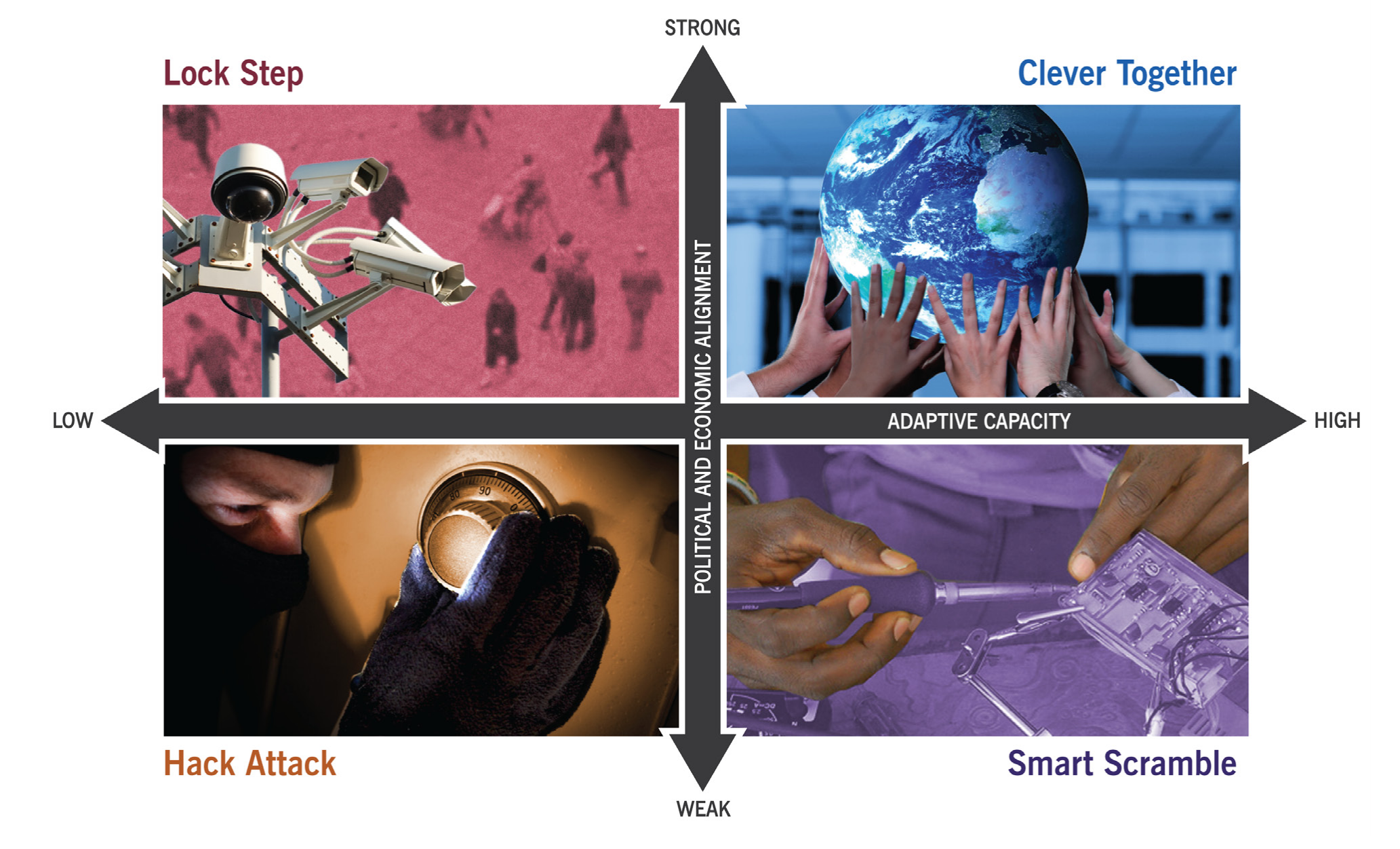
Lock Step
“A world of tighter top-down government control and more authoritarian leadership, with limited innovation and growing citizen pushback”
Lock Step opens with a global pandemic—originating from wild geese—that sweeps the planet with lethal speed. The response is immediate and forceful: lockdowns, border closures, biometric IDs, and military-enforced quarantines.
“Even the most pandemic-prepared nations were quickly overwhelmed when the virus streaked around the world… killing 8 million in just seven months.”
The tone is not one of tragedy, but of managerial necessity. Public obedience is framed as virtuous. Restrictions endure well beyond the virus itself.
“Technological innovation… is largely driven by government and is focused on issues of national security and health and safety… shaped by governments’ dual desire to control and to monitor their citizens.”
Lock Step normalises authoritarian control through emergency. It is the most explicit articulation of crisis-as-pretext: where disruption becomes the delivery mechanism for population management and behavioural conditioning.
Clever Together
“A world in which highly coordinated and successful strategies emerge for addressing both urgent and entrenched worldwide issues”
Clever Together presents the NGO-industrial complex as the face of benevolent global governance. In this scenario, the world’s response to accelerating climate instability and demographic pressure is not coercive, but cooperative—at least in appearance. Supranational coordination is depicted as moral necessity. Public-private partnerships, philanthropic foundations, and global agencies align to manage resource flows, development goals, and systemic risks through technical consensus.
“The recession of 2008–10 did not turn into the decades-long global economic slide that many had feared... strong global growth returned in force… all boats were rising, but some were clearly rising more… urgency and pressure for governments (really, for everyone) to do something fast.”
At first glance, this looks like a utopian counterpoint to Lock Step. But the underlying control structure remains intact. Rather than using fear and enforcement, Clever Together achieves alignment through soft incentives, data regimes, and moral framing. The global population is nudged toward pre-scripted behaviour by institutions they are told to trust—NGOs, philanthropic bodies, development agencies, and multi-stakeholder platforms.
“The atmosphere of cooperation and transparency allows states and regions to glean insights from massive datasets… to vastly improve the management and allocation of financial and environmental resources.”
This isn’t democratic convergence—it’s harmonised managerialism. The solutions are never up for negotiation. They are delivered as imperatives of sustainability, equity, or risk reduction—underwritten by private foundations like Rockefeller, who frame themselves not as architects of crisis, but as saviours from it. The aesthetic is collaborative; the structure remains technocratic.
Clever Together masks control as consensus. It’s not less authoritarian than Lock Step. It’s just better branded.
Hack Attack
“An economically unstable and shock-prone world in which governments weaken, criminals thrive, and dangerous innovations emerge.”
Hack Attack pivots to disorder. The “doom decade” unfolds with catastrophic momentum:
“Devastating shocks… The years 2010 to 2020 were dubbed the ‘doom decade’… proxy wars… criminal enterprises exploited both the weakness of states and the desperation of individuals… trust was afforded to those who guaranteed safety and survival — whether it was a warlord, an evangelical preacher, or a mother.”
With state legitimacy collapsing, control migrates to gated enclaves, biometric checkpoints, and corporate security regimes. Innovation becomes parasitic—repurposed, stolen, or counterfeit. Institutional trust disintegrates.
“Technology hackers were also hard at work… their many successes generated billions of dollars in losses… verifying the authenticity of anything was increasingly difficult.”
Censorship becomes infrastructure, not exception. Hack Attack doesn’t just justify suppression of speech—it reframes perception as a battlefield. Disinformation, cybercrime, and info-sabotage serve as rationale for platform control and preemptive surveillance.
This scenario is running quietly in the background of Lock Step—its logic used to validate control that might otherwise provoke resistance.
Smart Scramble
“An economically depressed world in which individuals and communities develop localized, makeshift solutions to a growing set of problems.”
On the surface, Smart Scramble reads as a grassroots survival story—local innovation in the face of global collapse. But underneath, it’s a model of managed disintegration. The scenario begins with prolonged recession, fraying infrastructure, and fractured state capacity. With international coordination failing, populations are left to fend for themselves—except where NGOs and philanthropic actors step in to fill the vacuum.
“The global recession… dragged onward… debts deepen… economic survival was now firmly in local hands… survival and success varied greatly by location… communities grew tighter… Makeshift, ‘good enough’ technology solutions… emerged to fill the gaps.”
Innovation becomes hyper-local, jury-rigged, and largely disconnected from the global economy. From patchwork energy grids to edible vaccines, the emphasis is on “appropriate technology” and self-organised resilience. Yet even in collapse, the presence of elite influence persists—now in the form of well-positioned experts and philanthropic stewards who guide acceptable recovery narratives.
“In Accra, a returning Ghanaian MIT professor… helped invent a cheap edible vaccine… In Nairobi, returnees launched a local ‘vocational education for all’ project…”
The scenario subtly reasserts Rockefeller’s ideological role—not as a central planner, but as the moral and logistical backstop of last resort. When formal empire retracts, humanitarian governance advances. These aren’t power vacuums; they are testbeds for new forms of distributed control.
Smart Scramble is not the collapse of elite influence. It’s the redistribution of it—through decentralised delivery channels, controlled scarcity, and carefully curated experiments in localism.
The future is not sovereign. It is sandboxed.
Taken Together
Each scenario encodes a strategy for elite continuity under different stress conditions. Lock Step enforces order. Clever Together harmonises it. Hack Attack justifies its suppression. Smart Scramble manages its failure. These are not mutually exclusive paths—they are interoperable modules in a flexible governance system.
What changes is not the end goal. Only the method. And the Rockefeller document teaches one consistent lesson: Crisis is not an interruption. It is the operating system.
This Was Never About Prediction—It Was Modular Governance Design
What becomes clear, once the surface narratives are stripped away, is that the Scenarios document was never a speculative exercise. It was not written to explore possible worlds—it was crafted to encode a system. Each scenario is less a vision of the future than a template for action. It offers behavioural signals, narrative cues, and institutional pathways for managing crisis conditions. Together, they form a modular operating logic for population control under permanent disruption.
This is the quiet power of the document. Its value is not in its prescience, but in its formatting. It provides elite actors with a language, a set of tested frames, and a flexible structure they can deploy in real time. It doesn’t predict what will happen. It trains institutions in how to respond when it does—while maintaining control, narrative legitimacy, and policy momentum.
The scenarios are not siloed. They are interoperable. Lock Step’s top-down control can give way to Clever Together’s moral consensus, while Hack Attack’s censorship infrastructure runs continuously in the background. Smart Scramble offers fallback when larger systems fracture, allowing for partial decentralisation without loss of oversight. What looks like adaptive governance is in fact calibrated governance—strategic modulation of posture based on population response and institutional durability.
Rather than policymaking, it is system design—flexible enough to scale, rigid enough to direct. And it is not democratic. The public is never positioned as an agent. Populations are referred to as challenges, responses, or testbeds. Legitimacy is assumed to reside with global institutions, foundations, and partnership coalitions—not with electorates or civic processes. At no point does the document entertain the idea that people might resist the script altogether, or that a crisis could be met with a decentralised, rights-based, locally determined response.
The scenarios aren’t contingency planning. They are a rehearsed choreography of containment, convergence, suppression, and salvage.
The Rockefeller document is not a window into elite imagination. It is a mirror held up to their operating code. What it reveals is a world where crisis is not feared, but harnessed—a pretext for reorganisation, a structure for compliance, a theatre in which the performance of control never ends, only changes costume. And often, that costume is philanthropy.
Framed as a contribution to global foresight, the document avoids the blunt language of dominance. Instead, it adopts the polished tone of humanitarian strategy—where lockdowns protect the vulnerable, data harvesting enables equitable service delivery, and behavioural engineering serves the greater good. Here, the NGO is not an outsider to empire—it is its social interface.
These scenario modules were never confined to paper. Each has already begun to materialise—deployed selectively, adapted tactically, and often unnoticed. Not as policy declarations, but as scripts carried out through institutional habit, inter-agency alignment, and donor-funded implementation.
Philanthropy doesn’t just respond to crisis in this model—it rehearses it, formats it, and delivers it. The document's power lies not in its predictions, but in its ability to make elite priorities feel inevitable, even compassionate.
Early Deployments Were Not Accidents—They Were Activations
By the time most people encountered the Rockefeller document, at least one of its scenarios—Lock Step—was already underway. But what passed for uncanny prediction was, in practice, structured implementation. Each scenario has since found expression—not in distant decades, but in the lived events of the last five years.
Lock Step was activated during the COVID-19 pandemic: lockdowns, mandates, international border closures, centralised information campaigns, digital compliance infrastructure, and surveillance under health pretext. Its frame—emergency obedience—quickly hardened into institutional habit.
Clever Together emerged almost in parallel. International cooperation became not just an aspiration, but a compliance mechanism. WHO treaty proposals, ESG enforcement, vaccine equity narratives, and multilateral digital ID initiatives reflected the scenario’s logic of soft convergence. Not coercion from above, it was moral framing from everywhere.
Hack Attack, meanwhile, has shifted from fiction to active justification. In recent months alone, headlines across Western media have spotlighted a wave of cyber incidents and alleged digital breaches—events which conveniently reinforce the scenario’s premise that a fractured, distrustful world requires elite information control.
- In Australia, customers of major banks were recently warned that their passwords had been stolen by malware hackers in a coordinated attack that compromised financial apps across multiple institutions. ABC News, 29 April 2025
- In Europe, a widespread blackout across Spain and Portugal was attributed to a cyberattack on national electricity infrastructure, triggering a round of calls for stronger continental coordination on cyber resilience. The Guardian, 28 April 2025
These incidents may be real. Or they may be exaggerated. Or they may be strategically highlighted, even permitted. The truth of the events matters less than their narrative utility. Each reinforces the idea that digital chaos is unmanageable without pre-emptive control, justifying censorship legislation, platform regulation, and pre-criminal surveillance regimes.
This is not an accidental alignment. It is ideological choreography, moving public perception toward acceptance of permanent digital governance. Just as Lock Step introduced obedience through fear, Hack Attack rationalises suppression through insecurity. In both cases, the response is rehearsed, the infrastructure prepositioned, and the solution pre-scripted.
Meanwhile, Smart Scramble has quietly appeared wherever institutional capacity erodes. In regions suffering economic stress or rural service degradation, localised initiatives—often backed by NGOs or public-private pilot programs—offer piecemeal alternatives to state support. These are framed as community resilience, but the coordination often flows from the same networks driving centralisation elsewhere. What looks like decentralisation is often just managed fragmentation.
The activation of Lock Step during the COVID-19 crisis was not spontaneous—it followed a rehearsal script. Just months before the first cases were reported, the Rockefeller-style pandemic scenario was simulated in real time at Event 201, a high-level tabletop exercise hosted by the World Economic Forum, Johns Hopkins University, and the Bill & Melinda Gates Foundation. The focus of the simulation wasn’t healthcare logistics—it was narrative control: managing media messaging, shaping population response, coordinating public-private information streams, and suppressing dissent framed as “misinformation.”
Event 201 did not merely anticipate Lock Step. It trialled it—refining the response logic, testing the compliance infrastructure, and validating the use of a pandemic to reshape governance at scale.
These aren’t isolated coincidences. They’re phase deployments—evidence that the scenarios were not imagined, but operationalised.
The Rockefeller scenarios now appear less like a planning tool and more like a deployment matrix, activated in stages, varied by geography, layered by function. The question is no longer whether these scenarios will materialise. It’s how many are running at once—and which version of the system you happen to be living in.
The Domestic Arm of the Same Empire
The Rockefeller scenarios should not be viewed in isolation. While they deal primarily with domestic governance under conditions of disruption, they mirror the same logic found in elite strategy documents designed for foreign destabilisation—most notably those published by RAND and Brookings.
The RAND Corporation’s 2019 report Extending Russia outlined a suite of non-military tactics to provoke overreach, degrade geopolitical stability, and burden the Russian regime with costly responses. The Brookings Institution’s Iran’s Nuclear Future series laid out pathways for narrative shaping, sanctions escalation, and strategic containment under the guise of responsible diplomacy. In both cases, the goal was not direct confrontation—but engineered instability that could be managed from a distance and justified through moral framing.
The Rockefeller scenarios adopt this same posture—only inverted inward. The tools that were once deployed to fracture rivals abroad are now being applied to manage populations at home. What Extending Russia sought to achieve through overextension and perception management, Lock Step and Hack Attack attempt through fear and digital constraint. What Brookings reframed as stabilisation in the Middle East, Clever Together reframes as harmonisation through global partnership.
In both foreign and domestic cases, the underlying model is consistent:
- Create or capitalise on crisis
- Control the narrative
- Restructure governance under emergency
- Suppress resistance by redefining it as disinformation, extremism, or instability
- Maintain elite continuity while shifting institutional forms.
Where RAND weaponises instability abroad, Rockefeller programmes obedience at home. One extends empire. The other sustains it from within.
This convergence is not accidental—it is architectural. It reflects a system of governance that no longer recognises the boundary between warfighting and policymaking, between public health and social engineering, between foreign intervention and domestic programming. The same institutions, think tanks, and philanthropic actors appear across both theatres. The same language is used: resilience, security, trust, equity, threat.
The empire no longer manages the world through sovereignty. It manages through crisis—foreign or domestic, declared or ambient, kinetic or narrative.
In this sense, the Rockefeller document is not a separate artefact. It is the missing domestic half of the empire’s global operating system. It brings the logic of overreach, soft war, and elite justification home—formatted for polite societies under siege by engineered emergencies.
The Benevolent Mask: What the Closing Tells Us
The final section of the Scenarios document does not merely summarise. It reframes. Soft in tone and polished in phrasing, it recasts the preceding content not as elite choreography, but as humanitarian foresight. It is here, in its closing remarks, that the document completes its most important task—not the encoding of strategic modules, but the laundering of intent.
Three core insights are presented as takeaways. The first links governance to technological development, noting that future power may lie not with the nation-state, but with supra- and sub-national actors—precisely the domain occupied by NGOs, philanthropic foundations, and international coalitions. The second promotes agility: the ability to work across sectors, from formal governments to “nontraditional partners—even individuals.” The third positions scenario planning itself as a core strategic function—“a useful framework” for ongoing monitoring and behavioural calibration.
The language is managerial. The message is clear: philanthropy is not outside power—it is fluent in it. It is the social interface through which behavioural control is softened, legitimised, and deployed.
“Technologies will affect governance, and governance in turn will play a major role in determining what technologies are developed and who those technologies are intended, and able, to benefit.”
That benefit, crucially, is not to be determined by the public. It is to be administered by those who possess the foresight, the data, and the partnerships. What is offered here is not a vision of decentralised resilience or participatory adaptation. It is a technocratic humanitarianism that selects its recipients and defines its metrics in advance.
The document’s final assurance—that:
“Developing a deeper understanding of the ways in which technology can impact development will better prepare everyone for the future, and help all of us drive it in new and positive directions.”
—assumes alignment. There is no room in this model for alternative futures. Only for populations shaped to meet the needs of the one already chosen.
The report closes not with a warning, but with a promise—“help all of us drive [the future] in new and positive directions.” But the “us” is not universal. It is the narrator. The funder. The institution. The reader of record is not the public—it is the institutional reader: the program officer, the technocrat, the NGO strategist, the risk consultant. The document is written in their language, for their decisions, and within their moral framework.
While the document briefly entertains the idea that populations might shape institutional expectations through bottom-up technological adoption, this agency is always framed reactively—within boundaries already drawn. The public may adapt—but only so the system can better manage its expectations. There is no vision in which the public authors the terms of governance itself.
The public appears only as a target to be prepared, never as a co-author of the future. The path is pre-drawn. Direction is not open for debate—only participation.
In this light, the scenarios are not speculative fiction. They are scripts for systemic modulation, released under the careful voice of care. Philanthropy does not stand outside the architecture of control—it is the mask empire wears when consensus must be performed.
Conclusion: The Program Is Active—and It Was Always Intended to Be
What began as an eerie coincidence—a decade-old scenario echoing the contours of a real-world pandemic—now reveals itself as something far more deliberate. Scenarios for the Future of Technology and International Development was not an exercise in imagination. It was a calibration framework—designed to familiarise institutional actors with behavioural control during crisis, and to encode systems of compliance in response to mass disruption.
Lock Step was never meant to remain theoretical. It was modelled, rehearsed, activated, and normalised. Clever Together is no longer aspirational—its moral grammar underpins global treaty proposals, stakeholder capitalism, and soft-law ESG enforcement. Hack Attack is no longer a warning—it is the standing justification for information control, driven by “cyber incidents” whose veracity matters less than their rhetorical utility. Smart Scramble offers a fallback design: a way to salvage governance in fractured zones without losing managerial reach.
Together, these scenarios comprise an architecture. One that speaks the language of preparedness but operates as a system of managed transformation—where every emergency becomes an opportunity, every disruption a deployment, and every population a dataset.
This is not governance despite crisis. This is governance through crisis.
The pandemic did not rupture the old order. It revealed the script—already written, already rehearsed, simply waiting for its cue.
Placed alongside RAND’s destabilisation doctrine and Brookings’ moral scripting, the Rockefeller document completes the picture. Foreign and domestic strategies have merged into a single operating logic. The same institutions now plan, simulate, fund, and frame both sides of the global management equation. What began as external empire is being retrofitted into internal regulation.
The Rockefeller Scenarios didn’t merely forecast possible worlds. They formatted the stage for how elite actors would script, simulate, and respond to crisis. In tone, structure, and ideological posture, the document became a template—not just for policy, but for presentation. The public would no longer be addressed as agents, but as subjects to be modelled, nudged, and prepared.
From Event 201 to The Great Reset, this operating logic persists. These were not isolated events. They were modular rehearsals drawn from a shared script.
- The scenarios were never just scenarios
- They were interface modules
- They taught elites how to speak, how to act, and how to govern when the system no longer requires consent—only crisis.
And for those of us still capable of recognising the script, the imperative is no longer to speculate about what’s coming next. It is to understand what we’re already inside.
Final questions:
- Which scenario are you living in now—and which ones are running quietly in the background?
- If the script is active, how do we interrupt it without becoming part of it?
Published via Journeys by the Styx.
Geopolitika: Tracing the architecture of power before it becomes the spectacle of history.
—
Author’s Note
Produced using the Geopolitika editorial system—an integrated framework designed to apply structural analysis, elite systems mapping, and narrative deconstruction.