Geopolitika: The WHO Protocol – A Global Code for Permanent Emergency
How health declarations, narrative control and supranational treaties rewired global sovereignty into a protocol loop.
The COVID-19 pandemic declared in March 2020 did not merely cause disruption—it operationalised a model. In its aftermath, new global frameworks have emerged that no longer treat outbreaks as health events, but as permanent activation codes. Treaties, regulations, and NGO platforms now form a system that governs not through law, but through protocol.
This article considers the WHO Treaty and amendments to the International Health Regulations in two parts:
- Part I maps the infrastructure: how legal instruments simulate obligation, how “recommendations” become workflow triggers, and how sovereignty is redefined as compliance.
- Part II decodes protocol power: it’s not about what the system says—it’s about how it operates. It tracks how simulation moved from rehearsal to rule, how declarations override deliberation, and how protocol now governs behaviour at scale.
This is not theory. It’s operational description. If you want to understand the regime, don’t ask what it believes. Follow what it activates.
Part I: Legal Facade, Jurisdictional Design
In the aftermath of COVID-19, the global policy infrastructure did not recede—it rearmed. Under the banners of “health equity” and “preparedness,” a permanent juridical scaffolding has been erected, transforming the World Health Organization (WHO) from a technical adviser into a supranational authority with activation privileges over law, mobility, and truth.
The International Health Regulations (IHR) Amendments and the WHO Pandemic Treaty (CA+) do not merely encode lessons learned—they encode jurisdictional override as a standing condition. What once existed as simulation—Rockefeller’s Lock Step, Event 201, Crimson Contagion—now functions as operating system. And in this system, the pandemic is not an event, but a trigger; not a biological reality, but a protocolic fiction. Whether real, declared or rehearsed, the crisis has become constitutional. Sovereignty has become behavioural. The law has been replaced by the loop.
This is not policy innovation. It is legal theatre—a simulation of international cooperation that conceals the codification of procedural override. Beneath this display lies a quiet transition: from representative sovereignty to algorithmic activation. What appears as pandemic governance is, in fact, jurisdictional reprogramming. The system’s stated concern is health. Its actual mechanism is script.
To understand this apparatus, we begin not with ideology, but with form. The two central documents are:
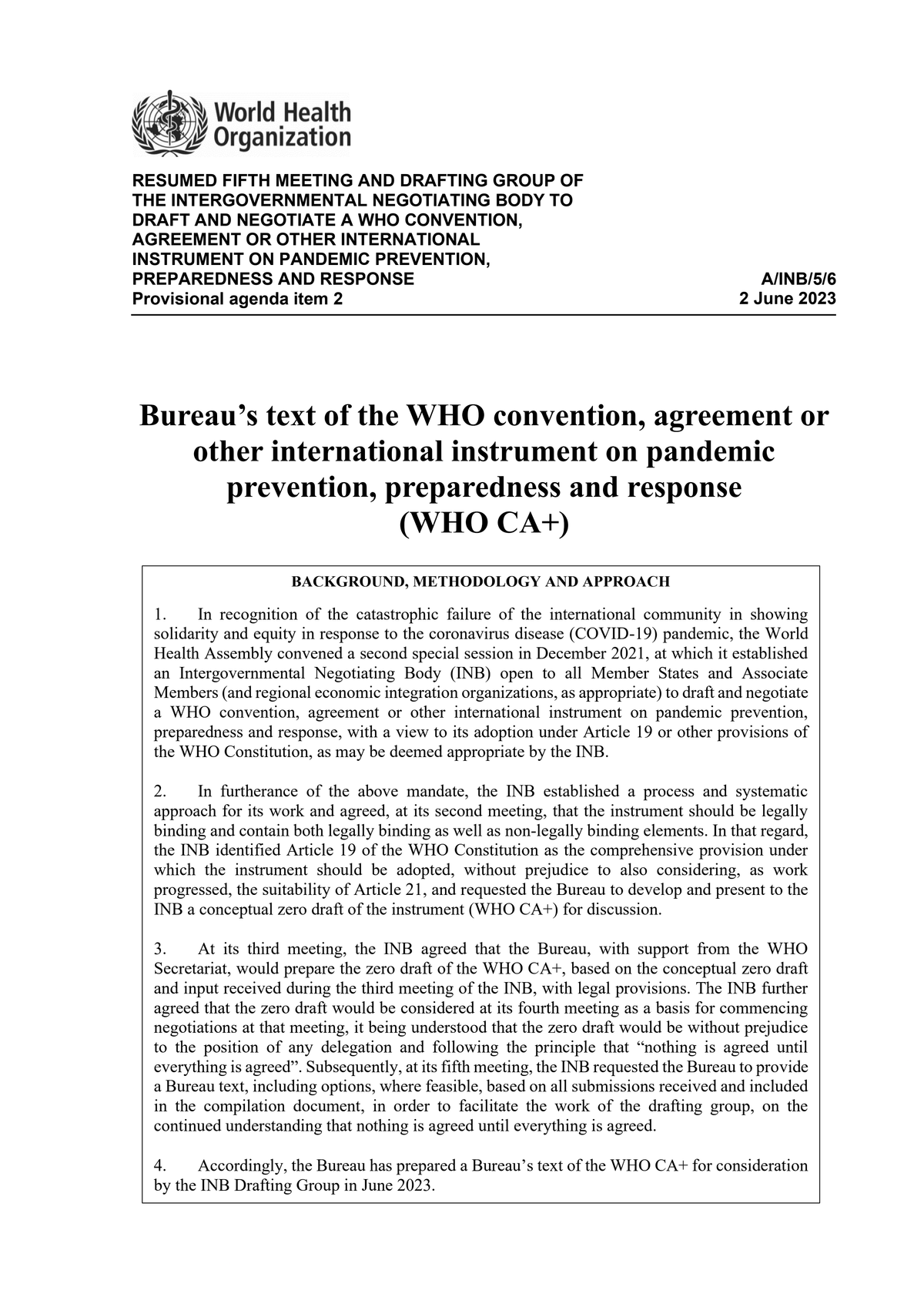
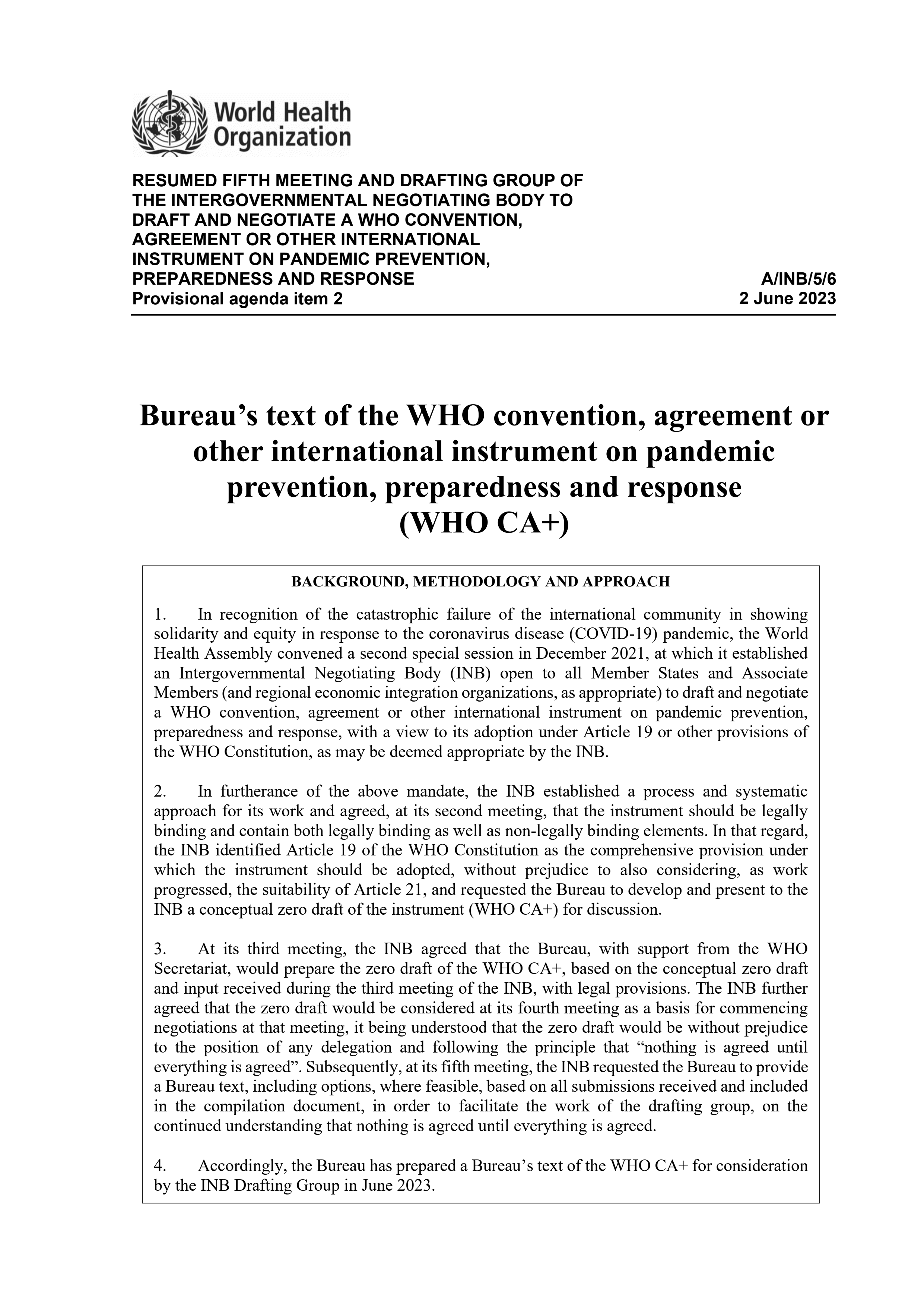
- The WHO CA+ Treaty (A/INB/5/6): Drafted under Article 19 of the WHO Constitution by an Intergovernmental Negotiating Body (INB) established by the World Health Assembly in December 2021. It is presented as a legally binding international instrument to improve pandemic prevention, preparedness, and response.
- The International Health Regulations (IHR), as amended in 2024 (A77/A/CONF./14): A revision of the existing IHR (2005), adopted under Article 21 of the WHO Constitution. These amendments were proposed and negotiated through the WHO Working Group on Amendments and formally adopted by the 77th World Health Assembly.
Both are framed as instruments of international cooperation, aimed at saving lives, strengthening health systems, and ensuring equitable access to pandemic-related resources. Their language emphasises solidarity, rights, and equity.
Structurally, the WHO CA+ resembles a multilateral treaty with chapters, articles, and institutional mechanisms including a Conference of the Parties, Implementation and Compliance Committee, and expert panels. It combines aspirational language with hard procedural requirements. The IHR amendments follow the regulatory architecture of the original 2005 IHR but expand the scope and authority of the WHO, introducing new concepts such as “pandemic emergency” and linking recommendations to enforcement triggers.
Despite their presentation as collaborative governance tools, these documents encode a shift in power: from national deliberation to transnational administration, from legal obligation to protocol compliance. Their surface is cooperative—underneath, the mechanism is algorithmic.
The Legal Interface of Control
The WHO CA+ Treaty presents itself as a hybrid instrument—blending binding authority with the appearance of voluntarism. Its declared objective is to "prevent pandemics, save lives, reduce disease burden and protect livelihoods" through enhanced international cooperation. While presented as frameworks for collaboration, they encode jurisdictional override through structurally binding clauses. The use of ‘shall’ and ‘must’ across core provisions nullifies national discretion—not by vote, but by protocol. Each ‘shall’ is not a proposal—it is a workflow command.
Yet its true mechanism is not cooperation but centralisation. Article 4 commits parties to surveillance systems that support the implementation of the International Health Regulations (2005), while Article 8 mandates regular simulation and tabletop exercises to assess compliance readiness. The result is not capacity building but submission scoring.
Key terms—"solidarity," "voluntarism," "recommendation," "partnership"—are repeated throughout the text. But they function as euphemistic masks. Article 23 establishes a "Panel of Experts to provide scientific advice," effectively removing deliberation from elected national bodies. Article 22 creates an "Implementation and Compliance Committee," an enforcement mechanism with no direct accountability to domestic electorates.
The 2024 IHR Amendments reinforce this design. They expand WHO authority by introducing a new trigger: the declaration of a "pandemic emergency" (Articles 1 & 12). This designation grants the WHO broad procedural powers over member states, activating "temporary recommendations" (Article 15) that are technically non-binding but practically mandatory. Article 13 obliges states to develop response capacities aligned with WHO guidelines, under timeframes dictated by Geneva.
The term "recommendation" is the keystone—and it is structurally deceptive. Under Articles 15–18 of the IHR, these "recommendations" initiate cascading effects: funding conditions, NGO alignment protocols, reputational pressures, and more. Functionally, they are protocols—recursive, executable, and insulated from legal challenge.
From Non-Binding Clauses to Protocol Enforcement
Neither the CA+ Treaty nor the IHR grants supranational authority in name. But both achieve jurisdictional coercion through indirect enforcement. Their strength lies not in legal penalty, but in control over access.
The WHO controls:
- Scientific legitimacy, through journal networks, expert panels, and technical partnerships
- Global financing, via linkages with the World Bank, IMF, Gavi, and CEPI
- Narrative legitimacy, by framing "disinformation" (CA+ Article 18) as a public health threat.
This soft architecture renders "voluntary" compliance effectively mandatory. For example, the SAPHIRE simulation (2023) did not evaluate outcomes—it scored states on procedural adherence. The 2023 administrative arrangement between the EU and WHO enabled direct regulatory alignment without requiring treaty ratification. In effect, sovereignty was outsourced through executive coordination.
What is presented as global solidarity is, in practice, system compliance by design. The treaty’s formal legal status becomes irrelevant when its surrounding ecosystem ensures obedience without legal coercion.
Infodemic Management and the New Jurisdiction of Speech
Speech is no longer peripheral to pandemic governance—it is jurisdictional. Under the CA+ Treaty and IHR Amendments, control over narrative has become codified policy.
The WHO defines an infodemic as “too much information, including false or misleading information, in digital and physical environments during a disease outbreak.” Article 18 of the CA+ enshrines public awareness and communication as domains requiring structured coordination. This is not limited to health literacy—it includes the management of discourse.
Aligned frameworks reinforce this authority. UNESCO’s media literacy campaigns, the EU’s Digital Services Act (DSA), and OHCHR’s guidelines on misinformation all converge on one operational axis: narrative compliance as public safety. The threat is not only viral, but informational. The virus is now speech.
The 2024 IHR Amendments broaden WHO’s scope to issue guidance and coordinate international response mechanisms that implicitly govern speech. Recommendations under Articles 15–16 now influence national digital policy, social media moderation, and platform content rules—all under the banner of preventing “harmful misinformation.”
What was once informal censorship has become formal jurisdiction. Discourse is no longer protected by law—it is filtered by protocol. The public is no longer an audience—it is a variable in an algorithmic model of obedience.
The Compliance Mesh
The WHO is not the enforcer—it is the signal origin. Enforcement flows downstream through a lattice of NGO, PPP, and supranational actors. This is the compliance mesh: a decentralised yet tightly synchronised system that implements global directives without requiring formal ratification or legislative oversight.
At the core of the mesh are entities like:
- Gavi and CEPI (vaccine governance and distribution)
- ID2020 and the Smart Health Card Consortium (identity and access infrastructure)
- WEF-linked initiatives (public-private integration nodes)
- Regional blocs (EU, ASEAN) acting as amplifiers and regulators
These actors possess no electoral mandate. They are not subject to domestic courts. Yet they control:
- Access to healthcare systems
- Identity validation and travel permissions
- Digital compliance infrastructure.
Their legitimacy is derived not from consent, but from alignment—technical, financial, and reputational. WHO provides the framework; these nodes enact the script.
The EU’s 2023 “Administrative Arrangement” with WHO bypassed member-state ratification and created binding technical integration. The ID2020 framework links health status to digital identity infrastructure. Gavi and CEPI require compliance with WHO guidance as a condition for participation and funding.
This is not fragmentation—it is orchestration. The result is a post-sovereign mesh that distributes enforcement across actors immune to political accountability. What was once governance by law has become governance by architecture.
Conclusion
What presents itself as global health governance is not a treaty—it is a trigger system. Not an agreement, but an architecture. The WHO CA+ and IHR Amendments do not propose cooperation—they simulate it. And in doing so, they normalise a shift from representative law to procedural obedience.
The pandemic, once a crisis, is now a condition. It activates procedures, justifies alignments, and performs sovereignty on behalf of its authors. Beneath the language of solidarity lies a protocol stack. Beneath the language of health, a jurisdictional override.
In Part II, we descend from these documents into their execution logic. We trace how the scenario became sovereign, how obedience replaced deliberation, and how simulation replaced law. The protocol is not policy. It is the regime.
Part II: The Protocol Is the Regime
What began as international coordination for health emergencies has evolved into a totalising system of procedural control. This is not a drift. It is design.
Part I mapped the legal scaffolding—how treaties simulate law, how recommendations simulate obligation, and how NGO meshes simulate governance. But the simulation is not a metaphor. It is the method.
Pandemic response is no longer reactive. It is pre-scripted. It is not policy—it is protocol. And that protocol now governs not by permission, but by activation. It doesn’t wait for the real—it triggers on the declared, the rehearsed, the modelled.
This section exposes how simulation has become sovereignty. How the system now runs on obedience, not deliberation. And how crisis no longer disrupts the order—it is the order.
Each layer builds toward one conclusion: the regime is not a state, a law, or a government. It is a protocol. And the only meaningful resistance is not protest—but misalignment.
Simulation as Sovereignty
Before COVID-19 was a reality, it was a scenario. The mechanisms now institutionalised in treaties and regulations—lockdowns, mass testing, digital identity, centralised communication, emergency rule—were not developed in real time. They were pre-written, staged, rehearsed.
The 2010 Rockefeller Foundation’s Lock Step scenario imagined an authoritarian pandemic response years before any actual viral outbreak. It forecast: border closures, biometric ID systems, centralised international health coordination, and public obedience reinforced through state surveillance. At the time, it was dismissed as dystopian fiction. Now, it reads like a script.
By mid-2019, the U.S. Department of Health and Human Services had already conducted Crimson Contagion, a national-level pandemic simulation testing federal and state responses to a severe influenza outbreak originating in China. It revealed systemic breakdowns: confused communication chains, supply chain collapse, and lack of coordination between agencies. But the key output was not problem-solving—it was pre-justification. The simulation revealed what the response would be allowed to fail at, and what controls would be normalised.
Event 201 followed months later in October 2019. Co-hosted by the World Economic Forum and the Johns Hopkins Center for Health Security, and supported by the Bill & Melinda Gates Foundation, it modelled a global coronavirus outbreak. The scenario included social media suppression, coordinated lockdowns, vaccine rollouts, and international NGO alignment. Within months, the drill became indistinguishable from the declared reality.
By 2023, the line between simulation and governance had dissolved completely. The WHO’s SAPHIRE simulation did not assess viral threat. It assessed member state compliance. States were scored not on health outcomes, but on obedience to procedural guidelines—communications, restrictions, response speed, centralisation.
These were not hypothetical exercises. They were rehearsals for sovereign override. The simulation became the sovereignty mechanism. Law was not debated—it was activated. The sovereign became not the state, but the scenario.
Simulation now functions as:
- Justification: providing the visual and procedural rationale for emergency declarations
- Conditioning: training institutions to treat rehearsals as governance
- Scoring: measuring nations by conformity, not autonomy.
The simulation does not predict; it instructs. It does not guide policy but substitutes for it entirely. What once followed real events now precedes them, as protocol takes primacy over evidence. Evaluation no longer concerns outcomes, but responses.
The measure of success is not safety—it is conformity to sequence.
The Protocol Is the Regime
The WHO’s authority is framed as technical and advisory. But the scope of its “recommendations,” particularly under Article 18 of the IHR, reveals a different logic. These are not health tips. They are procedural scripts for full-spectrum movement control. Article 18(1) lists actions WHO may advise States Parties to take against persons, including:
- Medical examinations, vaccination, or prophylaxis
- Public health observation, quarantine, or isolation
- Contact tracing
- Refusal of entry or exit for suspect, affected, or even unaffected persons.
This language simulates law but bypasses deliberation. Each ‘shall’ becomes an input for procedural automation—triggering compliance sequences that run not through courts, but through administrative infrastructure. The sovereign no longer decides—it executes.
The amended IHR no longer merely simulate juridical command—they encode it. Where previous versions used advisory phrasing, the 2024 revisions are saturated with mandatory directives. States ‘shall’ report, comply, and activate—with no debate, no opt-out, and no procedural buffer. The language of advice conceals the mechanics of jurisdictional override. Once declared, these “recommendations” are inserted into national workflows, enforced by reputation, funding, and administrative protocol.
This use of ‘shall’ and ‘must’ across the amended IHR transforms the WHO’s role. It no longer advises—it requires. States must align domestic law, surveillance capacity, and national response structures to conform with WHO-defined activation sequences. The emergency no longer begins at home—it begins when Geneva declares.
A law must be debated, passed, challenged, and interpreted. A protocol needs none of this. It runs silently, embedded in institutional processes, software logic, and behavioural scripts. This is what now governs.
The WHO no longer acts as a technical adviser—it acts as a signal origin. The “recommendations” issued under the IHR (Articles 15–18) do not operate as policy options. They function as execution commands. They trigger workflows in public health agencies, funding bodies, compliance checklists, and media platforms.
What appears as guidance becomes the operating condition for legitimacy. A government that diverges from protocol loses access—to finance, to validation, to narrative credibility. There is no legal enforcement—there is procedural suffocation.
The regime no longer needs to compel obedience through penalty. It achieves it through integration. Health ministries become scenario nodes. Journalists become signal amplifiers. Courts become inertial buffers. The regime persists not because it is imposed—but because it is installed.
This is not conspiracy. It is configuration. The system now operates as a closed-loop:
- WHO declares → NGOs mobilise → Platforms censor → Funding conditions activate → Domestic policies align
Each node is autonomous, but all run the same script. The sovereign is no longer visible. It is procedural.
The pandemic didn’t suspend democracy. It replaced it. Not through revolution—but through process. The regime didn’t declare war. It declared protocol.
The Enforcement Mesh
The WHO does not command—it cues. Enforcement is performed by a distributed mesh of NGOs, public-private partnerships, and aligned institutions. These actors are not accountable to voters, nor subject to legal redress. But they administer key levers of access and coordination.
At the heart of this mesh are entities like:
- Gavi and CEPI: vaccine finance and distribution
- ID2020 and the Smart Health Card Consortium: digital identity infrastructure
- WEF-aligned programs: linking pandemic governance to global digital regulation
- Regional blocs (e.g., EU, ASEAN): harmonising policy outside national legislatures
Each of these nodes translates WHO guidance into operational filters. The mesh enforces what the WHO encodes. States don’t just obey protocol—they restructure around it. Participation in Gavi requires alignment with WHO protocol. ID2020 links identity, mobility, and health compliance. The EU-WHO “administrative arrangement” bypassed treaty ratification entirely, creating regulatory convergence by decree.
These bodies control:
- Access to medical goods and platforms
- Eligibility for travel, education, and employment
- Validity of health certification systems.
The mesh doesn’t legislate—it operationalises. Compliance is not enforced by law, but by exclusion. A government can ignore WHO—but it cannot bypass the mesh.
The effect is functional sovereignty without political authority. Governance without representation. Enforcement without legislation. It is a regime, not of states, but of systems.
Narrative as Jurisdiction
A virus is not just a biological phenomenon—it is now a narrative trigger. WHO and its aligned bodies have codified the control of information as a health imperative. “Infodemics,” as defined in WHO documentation, are treated as threat multipliers, not discursive problems.
This framing has activated regulatory convergence. The EU’s Digital Services Act (DSA), UNESCO’s media integrity protocols, and the OHCHR’s misinformation frameworks all cite public health as justification for speech control. WHO sets the definitions; member states and platforms enforce them.
When WHO declares a “public health emergency,” it does not just trigger supply chains—it triggers narrative control. Social media platforms throttle or remove dissenting content. Search engines reorder results. NGOs publish “fact checks” in synchrony. This is not informal censorship. It is structured jurisdiction via protocol.
Health ministries now possess authority over information flows. Journalism is harmonised under emergency logic. Dissent is reclassified as disinformation. Belief becomes compliance.
Law no longer guards speech. Protocol governs it. And the protocol is elastic, transnational, and self-validating.
Equity as Trojan Logic
Equity is not absent. It is central. But it does not protect—it conditions. The CA+ treaty and IHR amendments invoke “equity” as a mechanism for procedural standardisation. Under the banner of solidarity, the same regime is installed across radically different contexts.
Global South states are incentivised to adopt WHO-aligned systems through promises of resource access, vaccine distribution, and technical assistance. But the cost is autonomy. Conditionality replaces negotiation. “Equity” becomes a mechanism for dependence.
The regime uses inclusion to enforce uniformity. The vulnerable are not shielded—they are harmonised. The call for justice becomes the means of integration.
This is not exploitation as deviation. It is exploitation as design. Equity becomes the delivery vector for obedience.
Pandemic as Standing Trigger
The pandemic is no longer an event. It is a condition. What the WHO calls a Public Health Emergency of International Concern (PHEIC) is not a crisis—it is a switch. Once declared, it activates systems that remain in place.
The apparatus built during COVID—lockdown protocols, contact tracing, digital certificates, global media alignment—did not dissolve. They were retained, refined, and embedded.
Now, a declaration does not suspend the norm. It is the norm. The exception has become architecture. The trigger is always primed.
The system no longer needs a virus. It needs a signal. Real, modelled, or simulated—the trigger activates the loop.
Counter-Protocol: Misalignment as Strategic Refusal
The regime doesn’t demand belief—it demands participation. It doesn’t enforce allegiance—it enforces alignment. You don’t have to agree with the narrative. You only have to submit to the protocol.
That’s why argument is irrelevant. That’s why evidence is disposable. The regime cannot be reasoned with, because it does not operate on persuasion. It operates on sequencing, repetition, activation.
To oppose it, you don’t need a counter-argument. You need a counter-sequence. A disruption of the ritual. A break in the loop.
What does refusal look like?
- Refuse harmonised language: Use disqualifying terms. Don’t say “pandemic”—say “pretext.” Strip their narrative of legitimacy.
- Mirror the structure, invert the signal: If declarations activate governance, counter-declarations assert refusal. Nullification is signal redirection—like when courts issue injunctions against executive orders, or municipalities opt out of national ID systems. It is not protest. It is jurisdictional refusal.
- Operate in parallel: Capture is irreversible—but not universal. Autonomous networks don’t ask permission. The system punishes deviation—but cannot police ubiquity.
- Target performance nodes: The scenario runs on key-node compliance—judges, boards, editors. Collapse belief at its control points.
- Issue counter-scenarios: “If simulation governs, simulate differently. Conduct scenario inversions—community drills for civil disobedience, parallel health protocols, refusal rehearsals. Build reflexes of non-alignment.
This regime can’t tolerate unpredictability. It needs sequenced compliance. Your task isn’t resistance—it’s misalignment. Recursive. Rhythmic. Irreversible.
The protocol is not the response. It is the regime. And the regime is afraid of noise in its signal.
Published via Journeys by the Styx.
Geopolitika: Tracing the architecture of power before it becomes the spectacle of history.
—
Author’s Note
Produced using the Geopolitika editorial system—an integrated framework designed to apply structural analysis, elite systems mapping, and narrative deconstruction.