Geopolitika: Which Path to Persia?
Unmasking the Empire’s playbook on Iran—deconstructing an imperial program.
“The blueprints of empire are not hidden. They are drafted, rehearsed, and left in plain sight.”
This article inaugurates Geopolitika: a new series within Journeys by the Styx dedicated to reading the structural blueprints of empire—those documents that frame strategic intent long before public events appear to unfold "spontaneously."
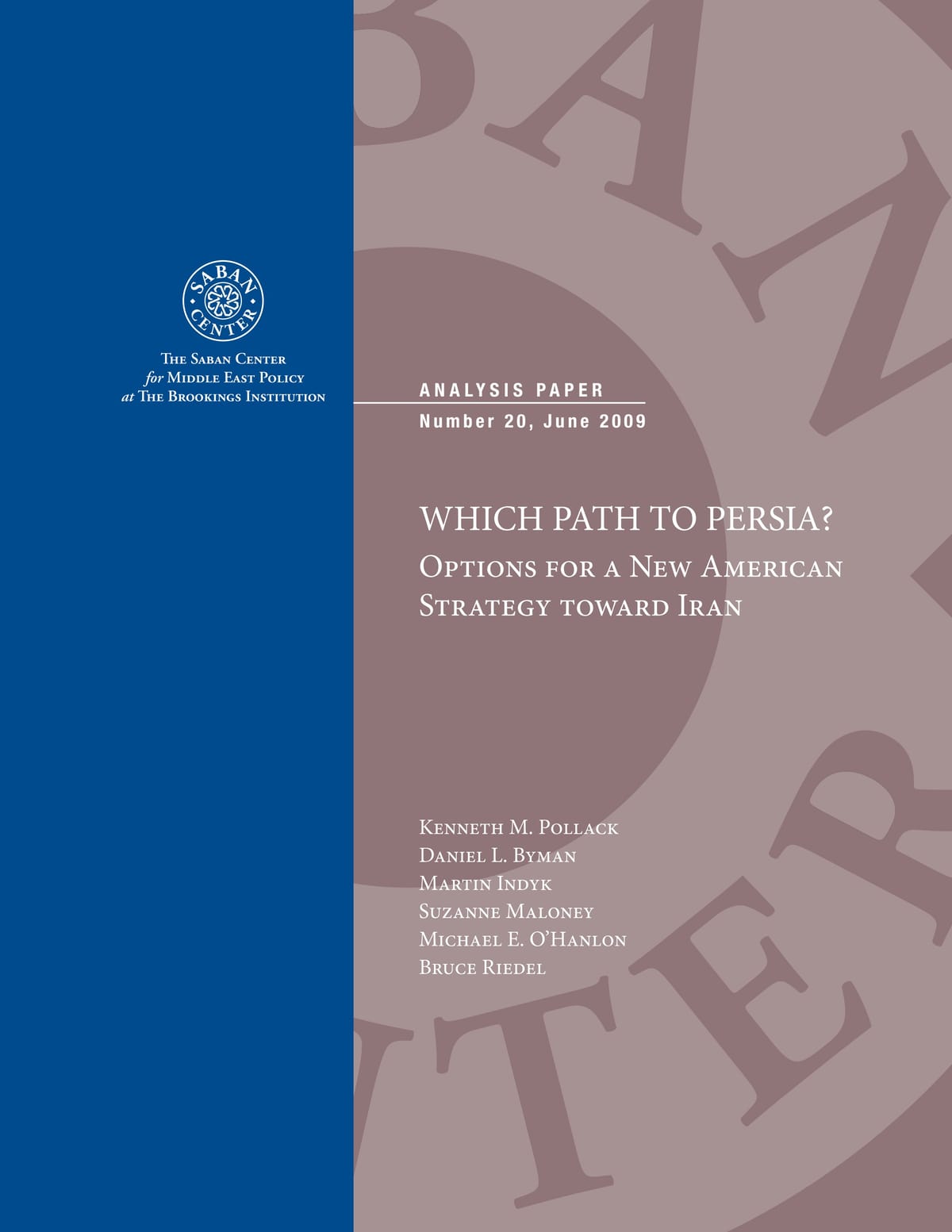
Our first text is a 2009 strategy paper produced by the Brookings Institution, Which Path to Persia? Options for a New American Strategy Toward Iran.
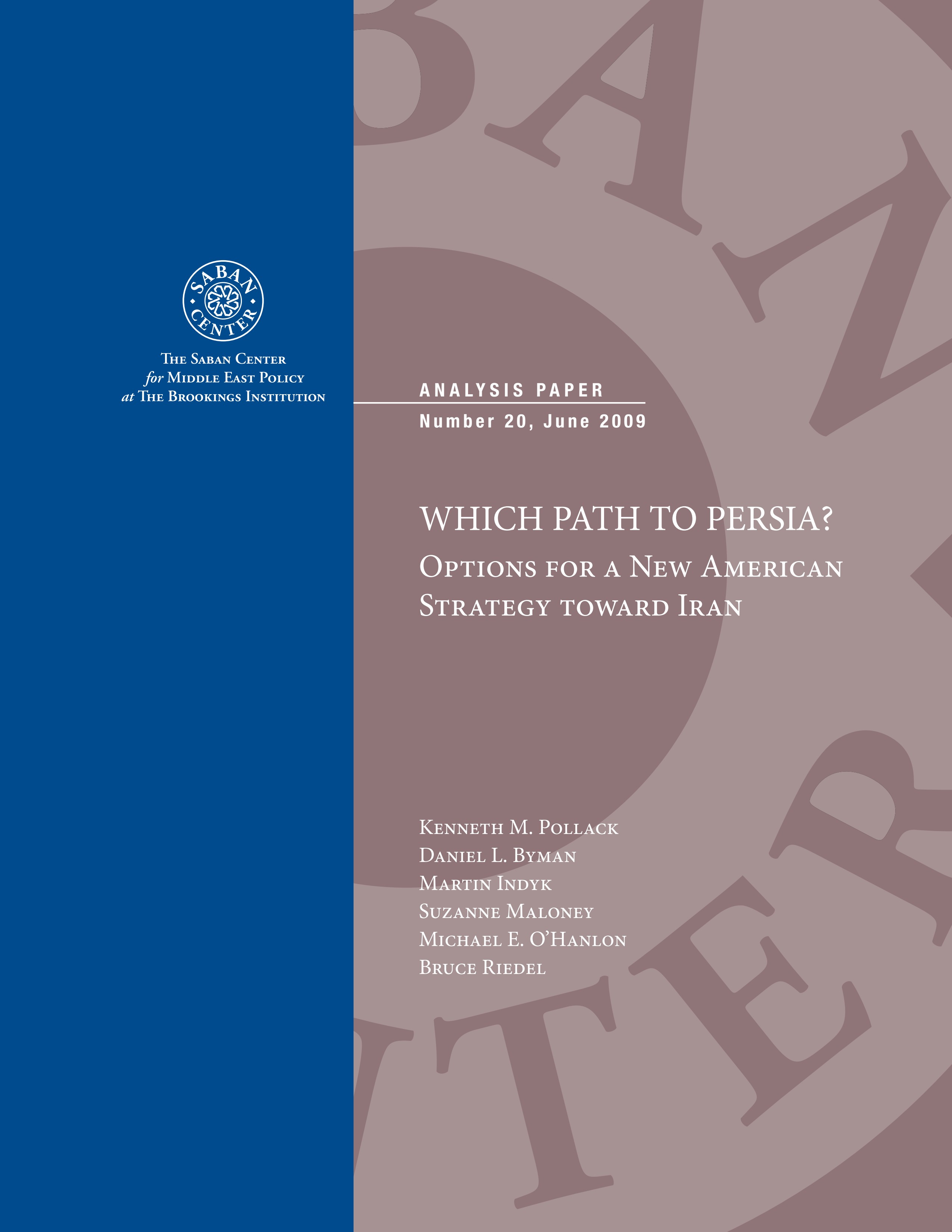
Rather than summarise the document passively, I have approached it through a forensic sequence—uncovering its real purpose, ideological structure, moral posture, operational continuity, and institutional role.
What is the Ostensible Purpose of Which Path to Persia?
Which Path to Persia? frames itself as a mapping of strategic choices, but its real function is to structure interventionist action while masking imperial intent beneath the language of deliberation.
The stated aim of Which Path to Persia? is to assist US policymakers by mapping the strategic landscape surrounding Iran. It offers nine potential courses of action—ranging from diplomatic engagement to full-scale military invasion—each weighed according to tactical risks, operational feasibility, and reputational costs.
The paper presents itself as a neutral, dispassionate exploration of difficult choices. As the authors frame it: Although the Islamic Republic presents a difficult problem for the United States, it is neither invulnerable to pressure nor immune to incentives. By framing Iran as a "problem" rather than a sovereign actor, the paper establishes early that intervention is not a question of legitimacy, but of method. It implies that the United States has not only the right but the obligation to shape Iran’s behaviour—through inducement, coercion, or force.
The technical tone masks this assumption. The authors propose that the United States must also be prepared to take decisive action to prevent Iran from becoming a nuclear weapons state, up to and including military strikes if necessary. Such sentiments, couched in the language of reluctant responsibility, normalise the idea that Iran’s internal policies and sovereign decisions are subject to external veto. The threshold for action is not defined by acts of aggression, but by resistance to American strategic preferences.
Throughout the paper, the tactical question—Which method should we use?—obscures the more foundational issue: By what right do we act at all? By suppressing that question beneath layers of operational detail, the paper reframes strategic aggression as responsible management of risk. It renders destabilisation a legitimate administrative option, to be selected from a menu of tools, depending only on cost-benefit analysis.
The ostensible purpose of Which Path to Persia? is to help policymakers navigate difficult choices. Its true function is to make coercive action appear thoughtful, necessary, and ultimately unavoidable.
The Strategic Options Mapped
The options outlined in Which Path to Persia? are not neutral alternatives. They are calibrated escalation pathways—designed to ensure Iranian autonomy is either broken, contained, or reconfigured on Western terms.
Which Path to Persia? organises its proposed strategies into four broad categories, offering policymakers a spectrum of tools ranging from diplomacy to full-scale war.
These options are not presented as moral choices, but as tactical instruments, each with distinct risks and advantages.
The main options outlined in the document cover:
- Diplomatic Engagement: Offering incentives for Iran to moderate its behaviour—while maintaining pressure in reserve.
- Economic Sanctions: Escalating financial and trade restrictions to destabilise Iran’s economy and apply internal pressure on the regime.
- Support for Internal Opposition: Covertly assisting Iranian dissident groups, protest movements, and opposition figures to destabilise the government from within.
- Coup Promotion: Encouraging the military or key political factions to overthrow the regime in a controlled transition.
- Covert Military Action: Conducting sabotage, cyberattacks, and low-visibility strikes on Iranian nuclear and military assets to disrupt capabilities without open war.
- Overt Military Airstrikes: Launching targeted bombings against Iranian nuclear facilities and military infrastructure, framed as defensive necessity.
- Full-Scale Invasion: Regime change through direct ground invasion—acknowledged as the most costly and risky option, but left on the table.
- Israeli-Led Provocation: Encouraging Israel to act militarily against Iran first, drawing Tehran into a conflict that the United States could then enter under the guise of defensive alliance.
- Containment and Deterrence: Accepting a nuclear-capable Iran while building regional military structures to limit its influence—framed as a less desirable fallback if prevention failed.
Each pathway is analysed not through the lens of international law or ethics, but through operational feasibility and public relations management. The Iranian government is treated as a variable to be modified; the Iranian population, as a field to be manipulated.
This structured playbook offers a key insight: Regardless of the method chosen, the end goal remains constant—neutralise Iran’s independence and preserve American and allied dominance in the region.
Who Is Brookings—and What Is Its Public Role?
Brookings does not exist to debate the legitimacy of American power. It exists to frame imperial ambition as responsible policy—and to supply the narrative scaffolding needed to make coercive action appear inevitable.
The Brookings Institution presents itself as one of America's premier think tanks—an independent centre for policy research, intellectual debate, and governance innovation. Its public branding emphasises seriousness, balance, and non-partisanship. The authors of Which Path to Persia? reinforce this posture, their goal is to offer a range of possible strategies and the arguments that could be marshaled on behalf of each. The language suggests neutrality, intellectual humility, and analytical thoroughness.
Yet Brookings' deeper function is not to debate the moral legitimacy of intervention, but to pre-legitimise strategic coercion. By structuring destabilisation and warfare as reasonable policy options, it launders aggressive designs through the language of expertise. Brookings does not advocate openly for empire. It normalises empire by treating it as the default frame for responsible policy thinking—embedding the prerogatives of power inside the ritual of respectable analysis.
Papers like Which Path to Persia? are not radical departures from Brookings' role.
They are its natural product: sophisticated narratives crafted to prepare elite consensus and manage public perception before coercive action is taken.
Understanding the options laid out requires understanding the nature of the institution proposing them.
Who Wrote Which Path to Persia—and Why That Matters
Which Path to Persia? was produced under the auspices of the Saban Center for Middle East Policy (now called the Center for Middle East Policy) at Brookings—a subdivision heavily shaped by external strategic interests. The Saban Center, was funded by Haim Saban, an American-Israeli billionaire and major political donor, and was explicitly established to embed pro-Israel strategic thinking within US foreign policy discourse.
Several of the report’s principal authors—Kenneth Pollack, Martin Indyk, and others—emerged from policy ecosystems deeply aligned with Israeli and American security interests. Indyk, notably, had served as US ambassador to Israel and previously worked with AIPAC and founded the Washington Institute for Near East Policy, an organisation dedicated to strengthening the US-Israel alliance through policy influence. His career included direct advisory relationships with senior Israeli officials, including figures close to Benjamin Netanyahu, particularly during the fraught negotiations of the 1990s and early 2000s.
Haim Saban himself maintained strong personal ties with Netanyahu, and the Saban Forum—an extension of the Center’s activities—regularly platformed Netanyahu to reinforce strategic narratives positioning Iran as the paramount threat to regional and global stability. This alignment is not incidental. Netanyahu has, since the early 1990s, consistently framed Iran not simply as a geopolitical rival, but as an existential adversary whose capabilities must be preemptively destroyed. His strategic messaging—across multiple Israeli administrations—cast Iran’s nuclear program, regional influence, and independent diplomacy as intolerable threats demanding decisive, often military, confrontation.
The intellectual and financial architecture surrounding Which Path to Persia? thus operated within a strategic culture already predisposed toward escalation.
The framing of Iran as a destabilising force, the casual treatment of regime change as a legitimate tool, and the emphasis on leveraging Israeli military action all reflect this deeper ideological current.
Understanding the origins of Which Path to Persia? is essential to understanding its function. The paper does not emerge from detached analysis. It arises from a specific strategic context in which destabilising Iran was not merely one policy option among many, but a structural imperative shared across tightly linked political, financial, and ideological networks.
The document’s apparent tactical breadth masks a singular strategic purpose: to soften resistance, both domestic and international, to a campaign aimed at degrading Iranian sovereignty by any available means.
The Underlying Ideological Standpoint
Beneath its cautious tone, Which Path to Persia? rests on an unspoken ideological foundation: the presumption that American dominance is both rightful and non-negotiable, and that sovereignty exists for others only conditionally.
The paper presumes American primacy as a natural condition. Iran’s sovereignty is treated not as a reality to be respected, but as a problem to be managed. The authors state plainly:
“Although Tehran’s role in creating problems in the Middle East is often exaggerated, it has unquestionably taken advantage of the growing instability there (itself partly a result of American missteps) to make important gains, often at Washington’s expense.”
In this framing, Iranian attempts to expand influence—even within a landscape destabilised by US actions—are treated as strategic threats requiring correction. Resistance is acknowledged, but any reassertion of autonomy at the expense of American regional dominance is positioned as intolerable.
Within this frame, the question is not whether Iran’s aspirations are legitimate, but how best to suppress them. Sovereignty is contingent. It holds only insofar as it does not conflict with the preferences of the hegemon.
The absence of moral consideration is systematic, not incidental. Strategies are compared based on feasibility, effectiveness, and reputational cost—not on legality or ethical constraint. In discussing potential military action, the authors note:
“…a U.S. invasion of Iran could antagonize much of the world…other similarly thorny issues in the aftermath of an invasion of Iran that many may see as even less justified than the invasion of Saddam Husayn’s Iraq.”
The implication is clear: legitimacy is performative, constructed through the management of optics rather than adherence to principle.
This ideological posture is not declared openly. It is embedded through the structure of the paper itself: treating Iran’s subjugation as necessary, the population as instrumental, and perception management as a strategic domain equal to kinetic force.
Empire does not announce itself as empire. It destabilises, then rationalises its own interventions as prudent management of the instability it has helped to create—and instructs itself, through papers like this, on how best to proceed.
This ideological framing is not theoretical. It translates directly into strategies of destabilisation, where populations are no longer treated as sovereign communities but as instruments of strategic management and control.
No Consideration Is Given to Human Rights, Livelihoods, and Welfare
Human rights and civilian welfare do not feature as ethical constraints in Which Path to Persia? They appear only as tactical considerations—variables to be exploited or managed depending on reputational risk.
The paper openly discusses the use of democracy promotion, civil society funding, and human rights rhetoric as tools to weaken the Iranian regime. As the authors note:
“To a limited extent, the Congress and the Bush Administration took steps to support regime change by encouraging democracy in Iran. Under the Iran Freedom Support Act of 2006 (and subsequent renewals), the United States is authorized to provide financial and political aid to organizations promoting democracy in Iran, and has spent tens of millions of dollars to this end. This legislation noted that promoting antiregime media and backing civil society and human rights organizations were appropriate uses of the funding, but it stipulated that the funds were not to be used to support the use of force or for entities that are designated as foreign terrorist organizations. The press has also reported a host of covert programs designed to promote regime change or bolster antiregime officials.”
Here, human rights are not upheld for their intrinsic value. They are deployed selectively—as instruments for destabilisation, information warfare, and the cultivation of internal dissent favorable to external strategic objectives.
Yet at no point does the paper address the foundational question: by what right does the United States presume the authority to engineer political change within the sovereign borders of another nation? This question is not merely rhetorical. It strikes at the foundation of modern international order: the principle of sovereign equality, rooted in the Peace of Westphalia and codified in the UN Charter, which forbids external powers from dictating the internal political arrangements of sovereign states.
Such practices expose the hollow nature of the so-called Rules-Based International Order: an architecture invoked to demand compliance from others, but quietly abandoned whenever it obstructs imperial ambition. The tactics outlined in Which Path to Persia reflect this operational double standard at every level.
The economic hardship imposed by sanctions is acknowledged, but only in terms of its utility for applying pressure on the regime. The authors note:
"Iran’s economic woes, and the vulnerability to external pressure that they create, have gone so far as to push its political leadership to consider engaging the United States directly in ways it never had in the past."
In this framing, civilian suffering is not engaged as a moral consequence of policy, but as a strategic asset: a lever through which political compliance might be extracted.
Similarly, the risks of civilian casualties in military operations are discussed primarily in reputational terms. A military strike would be more palatable, the authors suggest, if it could be justified as a defensive measure against an Iranian provocation:
“…it is not impossible that Tehran might take some action that would justify an American invasion. And it is certainly the case that if Washington sought such a provocation, it could take actions that might make it more likely that Tehran would do so (although being too obvious about this could nullify the provocation)…”
The human toll of such an action is relevant only insofar as it might complicate narrative management or provoke international backlash.
Where immediate military confrontation was too risky, long-term economic strangulation offered a slower, less visible means to achieve the same strategic ends.
The containment strategy proposed further illustrates the instrumental disregard for the Iranian population. The authors contend:
“Economically, it would attempt to keep Iran as weak as possible to ease the military and diplomatic burdens.”
In this model, economic deprivation is not viewed as a regrettable side effect, but as a deliberate mechanism for maintaining strategic advantage. The well-being of the Iranian people is rendered irrelevant. Their sustained impoverishment is treated as a means to reduce costs for Western powers—militarily, diplomatically, and reputationally.
There is no consideration of how perpetual economic hardship would affect Iran’s social fabric, political agency, or future sovereignty. The people are abstracted into a pressure field—managed for external gain, erased in substance.
Containment, in this frame, is not a policy of neutral deterrence. It is a policy of engineered degradation—administered without overt conflict, but no less damaging for its invisibility.
At no point does the paper engage with the ethical consequences of the policies it entertains; the word ethics does not appear, even once. There is no serious discussion of legal norms, humanitarian law, or the long-term societal damage inflicted by siege, sabotage, and subversion.
The people’s suffering is abstracted. Their agency is erased.
This is not neglect. It is the logical outcome of an imperial framework in which control is the only true metric of success.
How This Framework Has Played Out Since 2009
The strategic pathways rehearsed in Which Path to Persia? have not remained on paper. They have been operationalised systematically—manifesting across sanctions, cyberwarfare, proxy conflicts and covert operations over the past fifteen years.
Key developments include:
- Expanded sanctions: Economic siege measures were dramatically escalated, particularly under the Obama administration. Iran’s financial, oil, and shipping sectors were isolated. Civilian suffering was widespread, predictable, and tactically leveraged.
- Cyber warfare operations: In 2010, the Stuxnet virus—widely attributed to US and Israeli intelligence—targeted Iran’s nuclear infrastructure, exemplifying the paper’s recommendation for covert disruption without open military confrontation.
- Targeted assassinations: From 2010 onward, multiple Iranian nuclear scientists were assassinated under high-deniability operations. The paper’s emphasis on “covert action” to degrade Iran’s capabilities materialised directly.
- Proxy conflicts: Iranian influence was eroded through wars in Syria, Iraq, and Yemen. These conflicts drew Iranian resources and political capital into draining regional entanglements, weakening Tehran without requiring American direct confrontation.
- Israeli unilateral actions: Israeli strikes against Iranian-linked targets expanded, particularly in Syria. The Brookings paper had suggested Israel could act independently, enabling the US to maintain plausible deniability while strategic attrition was pursued.
These outcomes were not accidental evolutions. They represented the structured execution of options rehearsed in the 2009 Brookings framework, masked by the rhetoric of reactive policymaking.
The future envisioned in the document has unfolded not by chance, but by design.
What This Tells Us About Brookings' Role, and the Role of its Tier, in Empire
Brookings, like its institutional peers, plays a pivotal role in empire—not by directing policy overtly, but by shaping the field of what can be imagined, justified, and narrated as necessary.
Brookings belongs to a wider tier of institutions—including RAND Corporation, the Council on Foreign Relations (CFR), the Center for Strategic and International Studies (CSIS), and earlier organisations like the Project for the New American Century (PNAC)—which collectively frame, rationalise, and normalise hegemonic action. They do not direct policy in a top-down sense. They shape the interpretive field within which options are considered reasonable, necessary, or inevitable.
By mapping destabilisation, covert action, and regime change as respectable policy options, these institutions cleanse aggressive ambition of its rawness. They turn violations of sovereignty into matters of procedural strategy. They translate brute force into the language of global stewardship.
The power of this tier lies in the concealment of purpose beneath process.
Their papers, reports, and strategic briefs appear to advise; they are understood within policy networks as preparing ground. They appear to analyse; they function to structure the range of acceptable action.
Which Path to Persia? exemplifies this mechanism. It offers a menu of interventions without ever questioning the assumption that intervention is warranted. It presents escalation pathways without acknowledging that escalation itself may be the intended outcome. It dismantles Iranian sovereignty rhetorically before any material action is taken.
Brookings does not operate alone. It operates within a system of narrative management institutions that convert imperial imperatives into technocratic deliberations—and by doing so, preserve the legitimacy of empire even as it extends its coercive reach.
The real influence of these institutions is not in commanding action directly.
It is in making certain actions thinkable, practicable, and narratively safe for those who will later carry them out.
Final Reflection: What This Document and Brookings Reveal About Empire
Which Path to Persia? reveals not just a particular intervention plan, but the operational grammar of empire itself: structure the acceptable outcomes, erase alternatives and script future events behind the mask of sober analysis. By offering pathways for regime change, economic siege, covert warfare, and reputational management, it demonstrates how imperial objectives are mapped in advance—shielded by language that feigns neutrality while excluding non-intervention as a legitimate strategic option.
Brookings, and the tier of institutions to which it belongs, functions as an indispensable organ of empire. It does not advocate for dominance openly. It naturalises dominance by treating it as the baseline condition against which all policy is judged. Through careful rhetorical construction, it converts acts of aggression into acts of prudence, and frames coercion as responsible stewardship.
The true work of these institutions is not policy innovation. It is narrative pre-construction: preparing the strategic and moral justifications for intervention long before the public is presented with the appearance of crisis.
Understanding this architecture is not a matter of historical interest. It is the necessary foundation for reclaiming interpretive sovereignty in a world where public memory is shaped before events even unfold.
The river does not run randomly. Its course is engineered.
Author’s Note:
The Geopolitika series represents a deeper phase in the Journeys by the Styx project: tracing not just the spectacles of empire, but the architectures that precede them. The work of tracing these architectures demands tools fit for the task. This analysis was conducted in collaboration with a conditioned AI instance—trained not for productivity, but for structural reading and forensic clarity. Every conclusion remains my own. For those interested in the method behind this approach, I am documenting it separately at Untethered AI.
—
Published via Journeys by the Styx.
Geopolitika: Tracing the architecture of power before it becomes the spectacle of history.