Mindwars: Diagnosed into Silence –DARVO2.0
When emotional legitimacy is monopolised, resistance requires frame control, not reconciliation.
This article introduces DARVO2.0, a framework that builds on and extends the critique first developed in Estrangement Ideology – Part 11: Pathologising Parents – DARVO, where I examined how the original DARVO concept—which was developed by psychologist Jennifer J. Freyd to detect manipulative defences in substantiated abuse cases—has been misappropriated within estrangement discourse. There, I argued that ordinary expressions of grief, confusion, or resistance by parents are increasingly reframed as pathological. In this context, DARVO loses its forensic precision and becomes a moralised accusation: a way to delegitimise dissent and enforce emotional compliance.
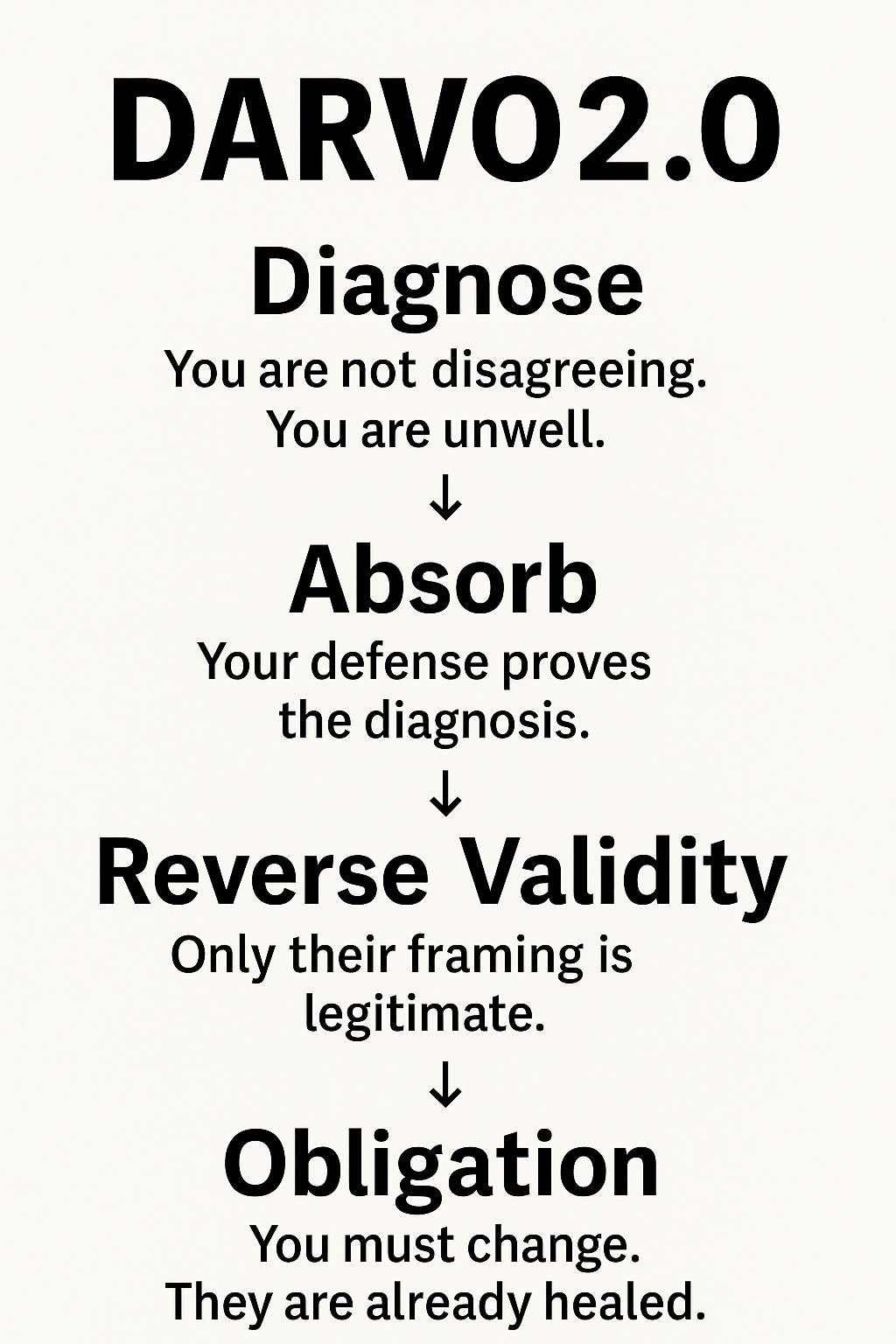
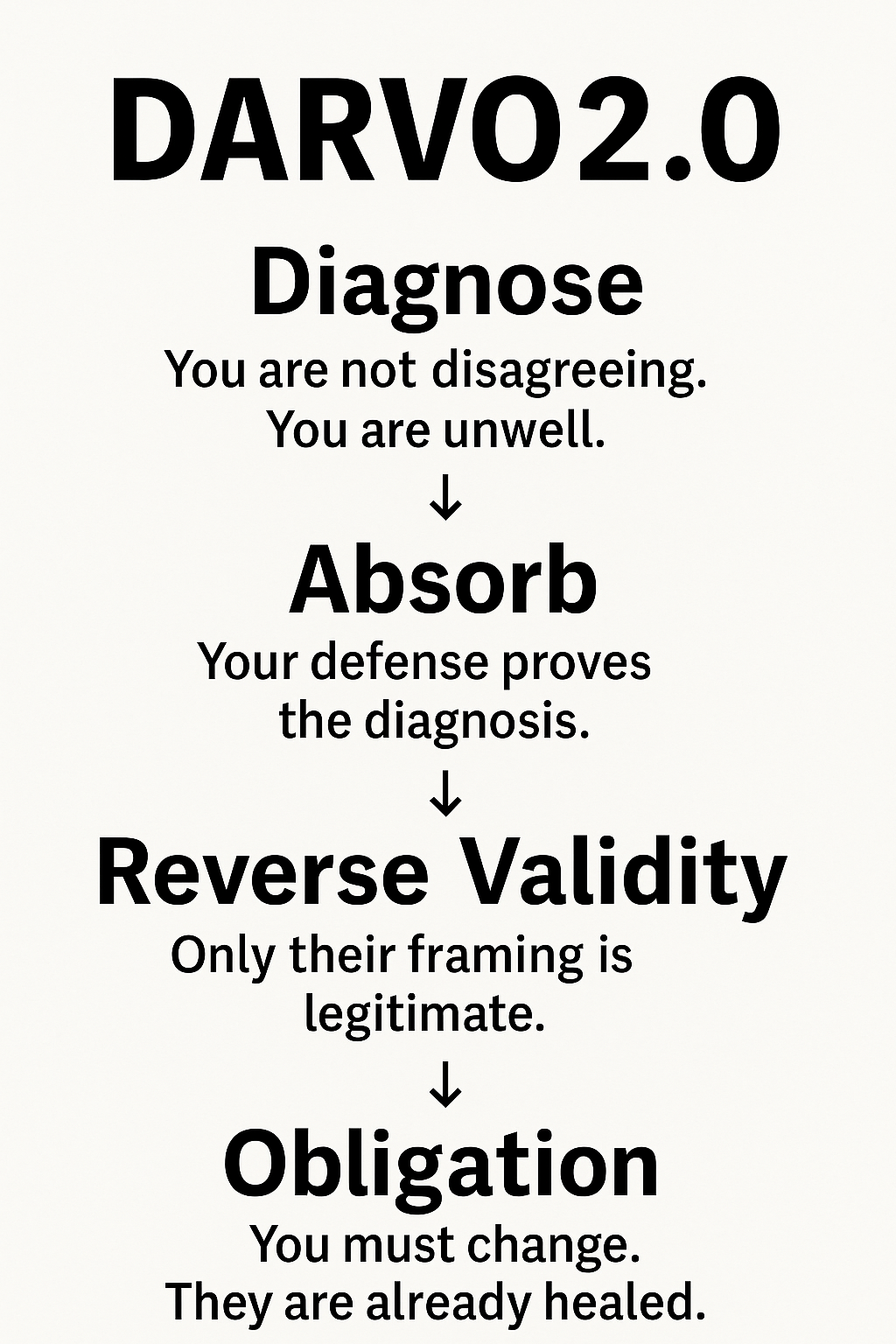
DARVO2.0 is the compliant child of therapy culture and identity politics: Diagnose, Absorb, Reverse Validity, Obligation.
It thrives not through aggression, but through empathy theatre. It doesn’t shout—it reinterprets. This isn’t gaslighting; it’s psycho-social weaponisation. The performance isn’t hostile. It’s healing.
Like the original DARVO, it functions as an accusation—but now cloaked in clinical concern. Disagreement becomes diagnosis. Refusal becomes proof of dysfunction. Its moral force comes not from truth, but from therapeutic legitimacy.
It thrives in three domains:
- Estranged families, where therapy-speak becomes a justification for permanent rupture
- Interpersonal discourse, where diagnostic labels have replaced open conversation
- Workplace environments, where emotional safety becomes a pretext for ideological conformity.
This is the terrain of the Mindwars: not overt conflict, but covert frame control; not suppression by force, but delegitimisation through moralised diagnosis. DARVO2 represents a mutation in soft-power logic—an attempt to monopolise emotional legitimacy while disabling interpretive reciprocity. This is not a call for understanding; it is a call for recognition. The battlefield is control of the frame and the weapon is narrative integrity.
The Mechanics of DARVO2.0
DARVO2.0 functions as a relational script—a sequence of interpretive and emotional reversals that recode resistance as pathology and consolidate power behind a therapeutic shield. Each move builds on the last, constructing a closed loop in which moral legitimacy flows in only one direction. This script breaks down as follows:
- Diagnose: Your dissent is reframed as dysfunction. You're not wrong, you're unwell. Unsafe. Disregulated. Unhealed.
- Absorb: Your attempts at clarity, boundary-setting, or protest are interpreted as further evidence of your pathology.
- Reverse Validity: Only the other party’s framing carries moral weight. Your pain becomes illegitimate—too intense, too intellectualised, too defensive.
- Obligation transfer: You are assigned the burden of repair. Their “healing” is non-negotiable and sacrosanct. Your re-entry requires compliance.
Outcome: A relational no-exit zone. You are not just wrong—you are a risk.
Therapeutic Totalitarianism: Soft Power, Hard Walls
DARVO2.0 is not just a personal tactic—it is a function of broader soft totalitarianism. It aligns with the rise of “boundary” discourse as a one-way tool: mine are sacred, yours are suspect. It mirrors the evolution of safetyism from trauma-informed care to dissent-suppression protocol. And it dovetails with compliance rituals that masquerade as healing journeys.
In this model, language is no longer dialogical. It is diagnostic. Terms like "gaslighting," "manipulative," or "unsafe" become performative gavel-strikes—verdicts, not invitations.
Countermeasures: How to Fight Without Performing Back
The challenge is to refuse the script without being reabsorbed by it. This requires rejecting its frame, not debating inside it.
Five principles follow:
- Terminate the diagnostic frame: Refuse the framing of pathology. Assert interpretive equality:
"This is not a treatment context. This is a disagreement." - Challenge boundary absolutism: Insist on symmetrical boundaries:
“Boundaries without reciprocity are control mechanisms.” - Expose the compliance ritual: Refuse reintegration based on moral transformation:
“If love is conditional on my conversion, it is not love—it is control.” - Collapse the wellness aura: Deconstruct therapy-speak as theatrical, not therapeutic:
“Therapy-speak is not compassion—it’s camouflage when used to avoid dialogue.” - Reclaim the frame of harm:
Speak your injury without appealing for validation:
“I was harmed by being recast as a pathology.”
These moves aim to disrupt rather than convince. They are designed to break the rhythm of the healing theatre.
Strategic Reorientation: Exit the Compliance Trap
The core lesson is not prescriptive, but diagnostic: seeking vindication within their frame risks entrapment in a moralised loop. DARVO2.0 operates as a closed epistemic circuit—each defence is reinterpreted as dysfunction, each request for fairness as manipulation.
But often the damage is compounded not by the breach itself, but by the imposition of a one-way interpretive regime that disables mutual recognition. Even repair, if pursued within that asymmetrical structure, can become another form of compliance.
The task, then, is not to choose between reconciliation and separation, but to restore navigability—to exit the imposed script. Whether you remain, disengage, or re-engage, the essential act is reframing: to name the mechanism and reject the interpretive monopoly that casts dissent as disorder.
The imperative is to shift the theatre from emotional audition to structural clarity. The aim is not resolution under false terms—it is the recovery of cognitive and relational sovereignty.
Broader Applications: Institutional DARVO, Organisational Safetyism
What appears in relationships soon appears in institutions. HR departments now mirror these dynamics: performance management recoded as trauma response, dissent reframed as unsafe behaviour, refusal rebranded as disconnection from values.
DARVO2.0 is the therapeutic arm of institutional capture. It replaces due process with emotional theatre.
To counter it:
- Refuse the psycholegal framing
- Demand procedural clarity
- Expose the conflation of care with compliance.
Closing Reflection: No Exit, No Rescue—Only Recognition
The way out of DARVO2.0 is not singular. It is not necessarily reconciliation, nor is it necessarily separation. The first step is recognition—seeing the dynamics for what they are, without being absorbed by the script.
Whether the goal is repair, retreat, or refusal, clarity creates space for agency. You are not obligated to win someone back, nor to exile yourself in defence. You are not a patient. You are not a diagnosis.
Identify the mechanism, reclaim authorship of your meaning, and decide without coercion.
When the emotional stage is rigged, structural clarity is resistance.
Published via Journeys by the Styx.
Mindwars: Exposing the engineers of thought and consent.
—
Author’s Note
Produced using the Geopolitika analysis system—an integrated framework for structural interrogation, elite systems mapping, and narrative deconstruction.