Mindwars: Down the Rabbit Hole to Conspiracyland
A closer look at propaganda in action through the lens of the BBC’s podcast Marianna In Conspiracyland.
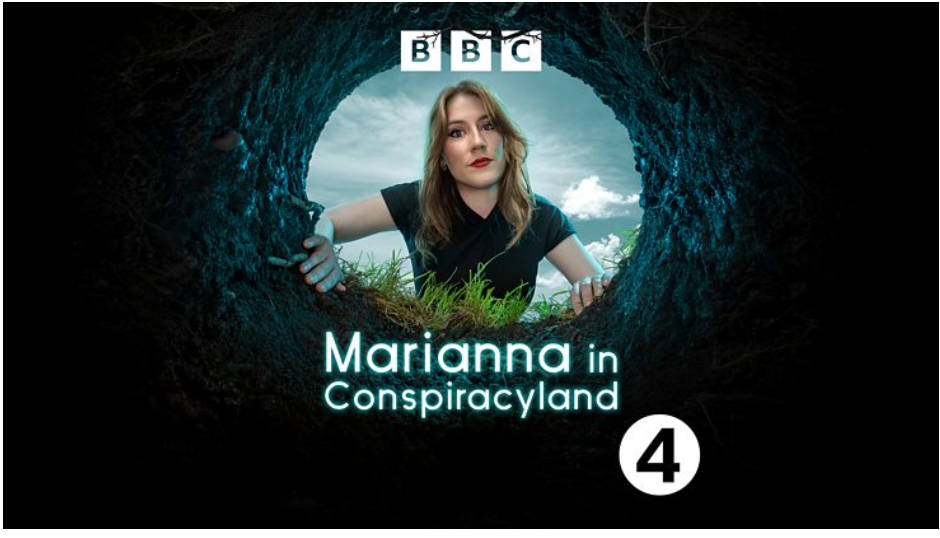
The BBC Radio 4 series Marianna in Conspiracyland, hosted by disinformation correspondent Marianna Spring, serves as a meticulously constructed case study in elite-backed counter-propaganda. While it purports to investigate and expose the dangers of conspiracy theories, the series in fact functions as an ideologically driven effort to pathologise dissent, discredit alternative media and bolster institutional legitimacy during a time of collapsing public trust in government, media and public health authorities.
The core audience for Marianna in Conspiracyland can be characterised as educated, urban professionals, predominantly based in the UK. Socioeconomically, they occupy a middle- to upper-middle class bracket, with strong representation in professions that uphold or implement state and institutional frameworks—such as education, journalism, healthcare, civil service and technology sectors. These individuals are highly literate, often holding university degrees—frequently at the postgraduate level—and have been shaped by liberal arts, science or policy-oriented education that encourages trust in systems of institutional authority.
Marianna Spring’s presentation is carefully designed to appeal to a liberal, middle-class demographic who value institutional credibility, emotional sensitivity and rational discourse. Her styling—subtle, approachable and consistent—positions her as a trustworthy “everywoman” who is both relatable and authoritative. Her youthful image bridges generational gaps, allowing her to project credibly about digital radicalisation while retaining the trust of older, more traditional audiences. The emotionally calibrated image she projects softens the ideological messaging of her work, enabling her to deliver establishment narratives through the lens of vulnerability, empathy and reason.
Distributed Defence Of Institutional Authority
At heart, Marianna in Conspiracyland is not an investigation, but a narrative intervention designed to re-legitimise official state-media narratives (BBC, government health policies), delegitimise grassroots opposition by conflating it with hate, extremism, and fascism and reframe public disillusionment as psychological dysfunction. The series is best understood as a component of a broader media ecosystem dedicated to defending institutional orthodoxy and suppressing dissent, particularly through the frameworks of “disinformation” and “fact-checking.” This ideological ecosystem includes outlets such as FullFact, RationalWiki, Snopes and academic-style podcasts like The Anthill (produced by The Conversation). While outwardly independent, these platforms operate in unison as part of a wider epistemic enforcement infrastructure—each playing a role in reaffirming the same worldview, using overlapping rhetorical strategies, stylistic conventions and narrative goals.
Together, they form a distributed defence mechanism for technocratic liberalism. Their primary function is not the pursuit of open inquiry or robust public debate, but the maintenance of consensus and the reinforcement of state-aligned narratives on contested issues such as COVID-19 policy, climate change, digital surveillance and populist politics. These platforms saturate the informational landscape with emotionally charged framing and pre-emptive rebuttals, discouraging independent investigation and discrediting dissenters before their arguments are heard. In practice, they rely on selective framing, ridicule, pathologisation and appeals to authority, marginalising alternative viewpoints by associating them with extremism or irrationality.
Marianna in Conspiracyland exemplifies this pattern. Far from being an impartial investigation, the series operates as a narrative intervention designed to re-legitimise state-media authority, delegitimise grassroots opposition by linking it to hate or fascism, and reframe growing public disillusionment as a form of psychological dysfunction. By positioning the BBC as the neutral voice of reason and scientific truth, the series attempts to restore a waning consensus on issues where public trust has sharply declined—including vaccine mandates, digital identity programs and climate alarmism. In doing so, it reinforces institutional control under the guise of protecting democracy from disinformation.
Propaganda Techniques Employed
Far from being a neutral investigation into the world of alternative media and dissent, Marianna in Conspiracyland is structured around a sophisticated arsenal of propaganda techniques aimed at shaping public perception and delegitimising opposition to institutional narratives. These techniques are not incidental—they are embedded into the very framing, structure and emotional arc of the series. The result is not journalism, but an orchestrated ideological performance—one that enforces consensus by foreclosing inquiry and emotionally discrediting those who challenge the dominant paradigm.
Emotive framing and psychological projection:
A defining feature of Marianna in Conspiracyland is its heavy reliance on emotive framing and psychological projection. While presented as a documentary investigation, the series centres not on factual refutation of conspiracy claims but on Spring’s own emotional tenor. The audience is guided to interpret dissent not as a political critique, but as a psychological disturbance—something threatening, unstable and contagious.
Spring consistently positions herself as the calm, rational observer amid a world of emotionally volatile figures. Critics of government policies—particularly those questioning vaccines, lockdowns or digital identity systems—are frequently described as “angry”, “radicalised” or “convinced of sinister plots”.
For instance in Episode 3: Trestle Tables for Truth, in response to a suggestion by Spring that The Light newspaper “has promoted far right ideas or promoted Holocaust denial or anti-Semitism” we get the following:
Natalie: “I'd say we're the least far right people you could ever meet. We care about humanity. What we do is I'm going to get emotional. I and others here have spent so much of our time trying to save humanity, trying to wake them up, trying to help them, lost our families, lost our friends. And we still stand in our truth because we know it is the truth. I'm sorry it's upsetting me. That's OK."
Spring: “That's OK, it's OK.” “Natalie's emotion catches me off guard. It's raw and fearful. I hear over and over again about the fracturing of relationships and families, but Natalie almost signals a new extreme. No one's ever burst into tears to me at any of these protests. She seems so genuinely convinced of these plots that she's terrified. I don't think she sees the links to hateful ideologies a paper like The Light has, which makes it all the more worrying. I see Natalie, now clutching a megaphone, make her way to the front of the procession.”
She describes the movement as one in which “there's a lot of anger”, casting herself as a kind of emotional barometer amid what she frames as collective hysteria
Throughout the series, Spring's personal experiences are foregrounded to evoke sympathy and elevate the perceived threat level. For instance, she recounts being targeted on social media, appearing on Telegram groups, and being named in articles in The Light, which she frames as attempts to intimidate or silence her. The series is punctuated by references to “hate”, verbal abuse and being filmed by activists—none of which involve physical violence, but are consistently framed as emotionally traumatic and indicative of potential radicalisation. In Episode 5: Follow The Money, she asks:
“It's not always easy talking to people because they don't like the BBC very much and their trust in it has really gone. Do you ever worry that sometimes, and I notice this, that there can be people within the movement, you know, people who read The Light, for example, who are more likely to be, I don't know, a bit more combative or a bit more hateful in the kind of the way they talk to people like me?”
This rhetorical question subtly conflates scepticism of the BBC with latent aggression, reinforcing the idea that distrust in institutional media is not just misguided but a precursor to hostility, thereby shifting the focus from the legitimacy of public criticism to the emotional burden carried by the journalist.
This narrative strategy is further amplified through production choices—ominous music underscores protest scenes, and Spring’s narration often draws parallels to extreme events like the Capitol riots or the attempted coup in Germany, both of which focus in the introductory framing to Episode 2: Down the Rabbit Hole:
“I'm Marianna Spring, the BBC’s disinformation and social media correspondent, and in this podcast series I'm venturing into Conspiracyland, a reality that gets curiouser and curiouser and has infected towns like Totnes across the UK. I'm investigating the conspiracy theory media here in Britain and the radicalization that appears to come with it. It's followers hold a range of different beliefs which many would never act on, but there are others whose views seem to be becoming more radical. At the extreme end we've seen conspiracy theory driven riots at the US Capitol and a coup attempt foiled in Germany, but what's happening in the Uki have plenty of time to look about and wonder what is going to happen next.”
Such juxtapositions function not as analytical comparisons, but as emotional triggers designed to transfer the perceived severity of those events onto far less consequential protests in the UK.
In effect, the series exemplifies a classic propaganda device: emotional contagion. It reframes public dissent as psychological instability rather than political speech. Rather than confronting the substance of the concerns raised by protestors or alternative media, it pathologises their motives and emotions—presenting them as erratic, dangerous, or traumatised individuals in need of containment. This tactic not only neutralises critique but creates a culture of emotional moralism where questioning the status quo becomes socially and psychologically suspect.
This plays into the propaganda trope of “emotional contagion”—constructing dissent as not political speech but pathological behaviour requiring containment.
Metaphor as a propaganda tool—naming the fantasy:
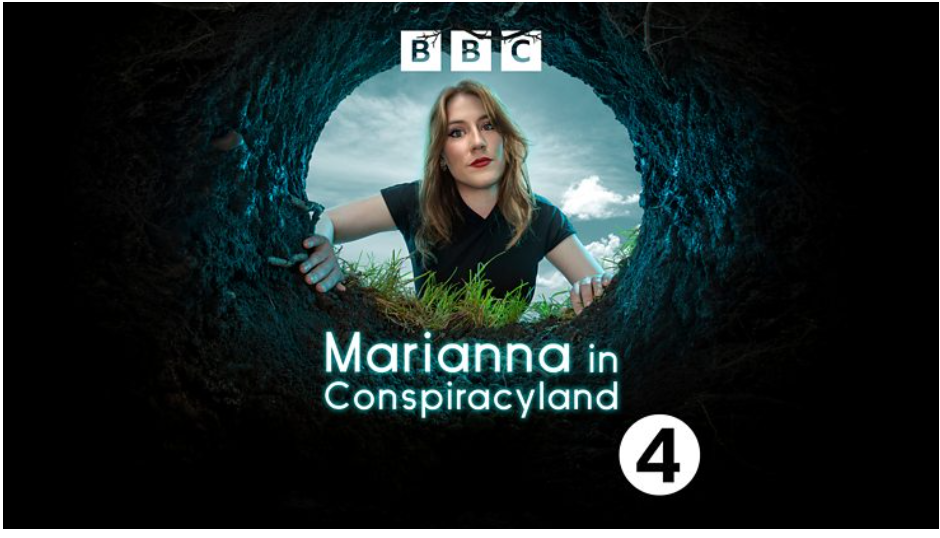
The title of the series itself, “Marianna in Conspiracyland”, evokes a surreal, delusional fantasy world akin to Lewis Carroll’s Alice in Wonderland, which immediately signals that the people and ideas within it are irrational, disconnected from reality and potentially dangerous in their confusion. This metaphor is activated repeatedly in the series, not just in Episode 2: Down the Rabbit Hole, but throughout, with references to “topsy turvy reality”, “a reality that gets curiouser and curiouser”, “infected towns” and “parallel universes”. The implication is that anyone who steps outside the mainstream narrative has slipped into an alternate dimension where facts don’t matter, and dangerous fantasies take hold. The metaphor becomes a cognitive quarantine zone—a place where ideas can be mocked, pathologised or feared, but not taken seriously.
In the episodes themselves, these titles are used to anchor the tone and frame each topic before it is even explored. Episode 2: Down the Rabbit Hole, for instance, introduces Jason Liosatos, a local artist and activist, whose transformation from peace advocate to lockdown critic is cast as a descent into irrationality. His actual ideas—concerning digital ID, censorship and centralised power—are never debated on their own terms. Instead, his journey is narrated as a kind of psychological unravelling. The phrase “down the rabbit hole” becomes a signal to the listener: abandon critical engagement, this is not a political argument but a cautionary tale.
This framing is reinforced through the series’ episodic structure, which follows a carefully orchestrated emotional arc, so that:
- Episode 0: Introducing... Marianna in Conspiracyland, sets the tone through a mix of intrigue and unease, positioning the investigation as a descent into a dangerous subculture.
- Episode 1: Entering Conspiracyland introduces the setting of Totnes and the apparent spread of conspiratorial thinking, presented as a community in quiet crisis.
- Episode 2: Down the Rabbit Hole, the journey intensifies, following the story of a local activist whose ideological transformation is framed as a fall from reason.
- Episode 3: Trestle Tables for Truth portrays street-level activism as both quaint and alarming, hinting at deeper networks of radicalisation under the surface of civic engagement.
- Episode 4: The Conspiracy Theory Newspaper, which profiles The Light and its editor, casting the paper as a gateway into more extreme beliefs.
- Episode 5: Follow the Money explores the commercial networks supporting the movement, suggesting complicity among small businesses and alternative health providers.
- Episode 6: German Conspiracyland internationalises the threat, linking the British movement to German conspiracists and a failed coup attempt (further explored the next episode).
- Episode 7: After an Attempted Coup, focuses on the escalation of rhetoric and the risk of violence, even as whistleblowers begin to express concern from within the movement.
- Episode 8: The Science of Conspiracy introduces academic authority to pathologise belief and frame it in psychological terms.
- Episode 9: People Like Us personalises the consequences through emotional stories of fractured families and social isolation.
- Finally, Episode 10: A Risk That’s Impossible to Ignore culminates in a message of lingering danger, framing the conspiracy movement not as a fringe curiosity but as a growing societal threat.
Each title and narrative beat contributes to an escalating moral fable in which conspiracy belief is not treated as a rational, if controversial, response to institutional failure or overreach, but as a contagious delusion—something one “falls into” like a sickness of the mind, requiring containment rather than dialogue.
Ultimately, the series' use of titles and metaphor acts as a pre-emptive delegitimisation strategy. It allows the BBC to shape public perception without engaging with the substance of dissent. These devices are weaponised to foreclose inquiry and transform the listener from a critical observer into a passive participant in an orchestrated moral drama—one in which the BBC stands as the last bastion of truth, and those who question it are already lost in “Conspiracyland”.
Guilt by association and the weaponisation of The Light:
One of the most persistent propaganda techniques used in Marianna in Conspiracyland is guilt by association, with The Light newspaper serving as a central symbol through which the series constructs ideological contagion. Rather than substantively engaging with the paper’s actual content or its diverse contributors, the series continually draws attention to tangential, historic or third-party associations, framing them as evidence of inherent extremism. This approach not only delegitimises the publication itself, but taints anyone associated with it—readers, distributors or advertisers—as suspect by proximity.
In Episode 4: The Conspiracy Theory Newspaper, host Marianna Spring confronts The Light's editor, Darren Nesbit, over his publication's reference to Eustace Mullins, a known white supremacist, despite the fact that the article in question only recommends Mullins’ work on the Federal Reserve. When Nesbit responds, “He's not a white supremacist. He's a historian,” Spring counters, “But he’s specifically written books, including ones like The Biological Jew and Adolf Hitler: An Appreciation.” She concludes that recommending even one of his books is “promoting hate”, without acknowledging the possibility of selective engagement with an author’s work. Nesbit replies: “We’ve recommended his book on the Federal Reserve”, highlighting the specific focus—but this distinction is rhetorically nullified by the emotive framing of antisemitism.
Interestingly, Nesbit calls out Spring on her guilt by association line of questioning:
“Well, because the book itself is well worth reading. Now you're all you do in here is guilt by association. Guilt by association.”
Ignoring this, Spring hastily goes on to reference Nesbit’s defence of Graham Hart, who was convicted for antisemitic speech. She presses him: “He said things like ‘Jews are filth... they deserve to be wiped out.’ Why defend someone like that?” Nesbit responds, “We didn’t”, but is cut off as Spring states: “The article suggested it was just a conversation”, and criticises the omission of Hart’s specific language in the piece. Again, the implication is clear: failing to fully denounce an individual equates to ideological alignment.
This rhetorical sleight of hand extends to The Light’s online presence. Spring points to Telegram channels associated with the paper that reshare posts from far-right groups including Patriotic Alternative and Alpha Men Assemble. She asserts:
“There’s a neo-Nazi propaganda film Europa: The Last Battle that’s been published on the channel,”
“There’s posts from Tommy Robinson… and a lot of use of phrases like ‘globalist cabal’”.
Nesbit protests, “Social media—anybody can post anything”, and clarifies that the Telegram channel is run by several people, not directly under his control. Nonetheless, Spring treats these reposts as if they are editorial decisions made by Nesbit himself, drawing a straight line from those posts back to The Light’s print material, without separating user-generated content from organisational intent.
This strategy is not confined to editorial critique—it bleeds into how readers and protestors are portrayed. In Episode 5: Follow the Money, a local business owner who advertises in The Light is asked if he supports calls for execution of government officials. When asked, “Do you think people here should be hanged?” he replies, “If it’s to be found that people are guilty of crimes against humanity, then yes”. The question is posed as a moral trap, with an implicit accusation: to advertise in The Light is to condone radical punishments.
What emerges across the series is a persistent tactic: to associate dissenters with hate groups, historical fascism or violent rhetoric—even when the links are tenuous or indirect. By sequencing interviews and archival content to imply continuity between conspiracy scepticism and neo-Nazism, the programme constructs a chain of association that listeners are meant to internalise as guilt. The Light, in this framing, becomes a symbolic disease vector—anyone who touches it, quotes it, or expresses interest in its contents becomes ideologically suspect.
This technique discourages critical engagement by making The Light, and by extension any adjacent ideas, morally radioactive. The listener is subtly warned: to read this material, or to take its concerns seriously, is to flirt with fascism. In this way, the programme doesn’t refute alternative media—it quarantines it. This enables the BBC to discredit critiques of COVID-19 policy, digital ID, or state-media narratives without ever confronting the substance of those critiques, reducing them instead to symptoms of an ideological contagion carried by The Light.
Conflation of dissent with extremism:
One of the most pervasive and insidious strategies in Marianna in Conspiracyland is the deliberate conflation of peaceful dissent with violent extremism. By rhetorically placing lockdown protestors, vaccine sceptics, and alternative health advocates in the same conceptual space as neo-Nazis, coup plotters and domestic terrorists, the series constructs a dangerous false equivalence. This strategy does not simply critique ideas; it criminalises and moralises dissent, rendering political opposition indistinguishable from security threats.
This conflation is evident from the outset. Spring states in the introductory episode:
“At the extreme end we’ve seen conspiracy theory driven riots at the US Capitol and a coup attempt foiled in Germany… but what’s happening in the UK?”
The framing implies a continuum between British anti-lockdown activists and high-profile foreign insurrections, despite no evidence of violent action or organised extremism from the UK groups profiled.
In Episode 6: German Conspiracyland, Spring explores the German paper Demokratischer Widerstand and its supposed links to violence against journalists. She states:
“The conspiracy theory newspaper in Germany called the Democratica Widerstand Democratic Resistance and their Telegram channel share conspiracy theories and hateful rhetoric, some similar to the light paper in the UK.”
“Darren, the editor of The Light in the UK, told me he speaks to the publication and its editor Anselm Lenz two or three times a year and he's published content endorsing the publication. The German paper refers to The Light as it's partner paper and to it's colleagues at the publication describing how they're internationally connected.”
“Yorg suggests that Ansam's political journey as he sees it from the left to the right, is part of a larger trend within the movement in Germany, and he also says the rallies associated with it have become more hostile to journalists in particular. Official figures show that Germany has seen a big jump in physical attacks against journalists since the pandemic, reaching a record of 320 in 2022. Many of those attacks happened while journalists were covering demonstrations linked to extremist groups, and more than 60 reportedly happened at anti lockdown and conspiracy related protests.”
“I'm interested in something else too. In December 2022 there was an attempted coup by a group called the Reichsberger... On social media, this Reichsberger group seemed to be a part of the wider conspiracy theory movement that boomed during the pandemic in Germany. How is the Reichberger movement linked to the coronavirus anti-lockdown movement, the one we're talking about. Is it a part of it?”
Here, contact between publications is enough to suggest ideological complicity in violence and terrorism—a dramatic stretch designed to evoke guilt by indirect association and deepen the narrative of shared radicalism.
Similarly, in Episode 7: After an Attempted Coup, Spring interviews a whistleblower from the German conspiracy media scene who expresses concern about increasing extremism. Yet even he distinguishes between legitimate protest and dangerous rhetoric. Nevertheless, the program makes no such distinction. Spring narrates:
“Marcus is convinced that the risk of harm offline from this motivated minority is low… but the other whistleblower says the paper is creating an atmosphere that is hateful and divided… someone who is emotionally or psychologically unstable could be triggered to do something terrible”
This shifts the focus from actual violent actors to the broader climate of dissent itself, implying that even non-violent protestors are indirectly culpable for future acts of extremism by others.
The phrase “conspiracy theory” is deployed throughout the series not as an analytic category but as a rhetorical weapon. It is used to immediately frame alternative viewpoints as irrational and dangerous. For example, in Episode 1: Entering Conspiracyland, Spring remarks:
“What used to be fringe has become more mainstream… anti-vaccine, anti-lockdown, anti-media… fuelled by conspiracy theories.”
The implication is that opposition to government policy is rooted in delusion rather than reasoned critique, thus foreclosing the possibility of legitimate political discourse.
This linguistic pattern is further illustrated in Episode 8: The Science of Conspiracy, where political scientist Rod Dacombe explains how modern conspiracy movements mobilise like democratic activism—but Spring’s narration cuts this insight short, returning quickly to a framing of such mobilisation as threatening. The audience is told:
“These are all the things I want from democracy… but not like that”.
This ambivalence is never resolved. Instead, dissenters are cast as corrupted citizens—engaged in the form of activism, but with content so irrational or hateful that the form itself becomes suspect.
By equating dissent with extremism, Marianna in Conspiracyland normalises the suppression of political opposition under the guise of public safety. Critics of vaccine mandates, digital ID programs, or centralised media control are subtly marked not as citizens with grievances, but as proto-extremists, just one Telegram post away from violence.
This is classic propaganda: delegitimise ideas by criminalising those who hold them, and ensure the public internalises the moral equation that to question authority is to endanger society.
Control of the narrative arc:
Marianna in Conspiracyland employs a tightly controlled narrative arc that mirrors the structure of a moral parable. Characters within the series—whether real individuals or composite representations of “conspiracy believers”—are cast along a spectrum of ideological rehabilitation. Those who return to the mainstream consensus are afforded redemption and empathy; those who persist in their dissent are subtly portrayed as either lost, unstable or latent threats to public safety. This binary framework enforces the core ideological lesson of the series: that reintegration into establishment thinking is not only possible but morally required, while continued scepticism is a path to isolation, dehumanisation and danger.
A prime example of the redemptive narrative is Marcus, the former columnist for the German conspiracy paper Demokratischer Widerstand, featured in Episode 7: After an Attempted Coup. Marcus initially aligned with anti-lockdown protests and wrote for the movement’s flagship publication. However, when the paper began to flirt with violent rhetoric Marcus distanced himself. He tells Spring:
“The newspaper went more radical and there was some polls in the Telegram channel. And after several posts where I said, OK, that's not good. You cannot ask the question, is it OK to beat people wearing masks? And the later is, is it OK to get a death penalty for those who made this COVID measures? What are you doing? Yeah.”
Spring seizes upon Marcus’s alarm at the use of the Second Reich flag to reinforce her broader narrative that conspiracy movements—however grassroots or civic-minded they may initially appear—are on a trajectory toward radicalisation and extremism. She foregrounds Marcus’s reaction to the flag’s appearance in the Demokratischer Widerstand newsletter as a pivotal turning point, using his dismay to lend credibility to her portrayal of the paper’s ideological descent.
“The Democratic Democratic Resistance has an Email newsletter I think with 45,000 people. They posted a black white red flag which is the flag of the Second German Reich from 1871 till 1918. So it has nothing to do with the Third Reich and Adam Hitler but the so called Iceberger. They used this a lot. And then I said what are you doing? Why? Why do you begging for this framing of the mainstream media?”
Marcus’s rhetorical question is given narrative prominence, not to highlight his concern for optics, but to suggest that the movement itself is courting extremism and, by extension, legitimising the media’s characterisation of it as a threat.
Spring then extends this symbolism to link the German publication to the Reichsbürger coup plot, stating that members of the paper, including a key donor, had met with individuals who were later arrested for attempting to overthrow the state. By embedding this information immediately after Marcus’s flag reference, Spring uses narrative sequencing to fuse symbolic imagery with criminal conspiracy, drawing a straight line between ideological dissent and violent insurrection. This rhetorical structure positions Marcus not just as a whistleblower, but as a cautionary example of someone who saw the warning signs—thereby reinforcing her overarching theme that continued dissent, if not renounced, inevitably converges with far-right extremism. By disavowing violence and breaking with the group, Marcus is reframed as a reformed insider—a once-deluded figure who has now reclaimed reason. His criticism of extremism is used to legitimise the entire narrative arc of the series, reinforcing the idea that returning to the institutional fold is the only acceptable conclusion.
A parallel redemptive subplot is offered through Toby, who recounts his brother’s descent into conspiracy belief, beginning with Flat Earth theories and evolving into rejection of mainstream media and family disconnection. Toby shares how every conversation became infused with paranoia:
“Every single topic that we tried to talk about was brought back to being conspiracy or worse yet, evil”.
However, by the end of Episode 9: People Like Us, he offers a glimmer of hope:
“Now we're starting to see more and more of the old person pre conspiracy. I like to think it's because we as a family, like we listened. We argued as rationally as we could, but we never ignored him. We always reminded him he was loved.”
This reconciliation arc encourages the listener to view conspiracy belief not as political rebellion but as a reversible personal trauma—curable through emotional affirmation and re-assimilation into the social mainstream.
In stark contrast, those who do not return are increasingly framed as risks to democratic order. The danger is rarely evidenced directly but is constructed through repeated allusions to “hate”, “radicalisation”, and “what happened in Germany or the US”. In Episode 10: A Risk That’s Impossible to Ignore, Spring warns that conspiracy rhetoric brings with it offline risks and refers to herself being featured on The Light’s front page as a sign of escalating threat:
“And since our interview, the editor of The Light has referred to me as a propagandist for war criminals, child traffickers and those who want to destroy society. Conversations and posts online suggest that I'll be featuring on the front page of both The Light and the German conspiracy theory paper. I'm waiting to see the reaction that triggers. What's my conclusion as I leave conspiracy land? Well, that the inclination towards violent rhetoric and hate brings with it some sort of risk of action offline. A risk that's impossible to ignore.”
This anticipatory framing creates an atmosphere of dread, implying that dissenters are not merely wrong, but ticking time bombs. Yet no violent acts are ever directly tied to the figures profiled in the UK context.
This dichotomy—between those who “return” and those who “persist”—is core to the program’s propaganda structure. It does not merely explore beliefs but assigns moral outcomes to them. Redemption is possible, but only through the rejection of alternative worldviews and re-submission to institutional narratives. To persist in dissent, by contrast, is to risk becoming unhinged, hateful or even violent. In this way, the series does not just narrate events—it directs ideological resolution, forcing the listener to choose between safety through conformity or guilt by resistance.
Diversions From The Truth In Key Claims
While Marianna in Conspiracyland presents itself as a journalistic investigation into conspiracy thinking and disinformation, one of its most potent techniques is diversion—not through distortion, but through strategic omission and misrepresentation. Rather than addressing the strongest arguments or evidentiary claims made by critics of COVID-19 policy, climate orthodoxy or digital surveillance, the series avoids them entirely or reframes them as irrational outbursts. The effect is not merely to rebut opposition but to erase it from serious public conversation. The series systematically avoids substantive engagement with dissenting views—deploying silence, ridicule and caricature in place of analysis—thereby creating a distorted and ideologically sanitised view of the world that aligns seamlessly with elite narratives and policy agendas.
COVID-19 vaccine and policy criticism—a strategic silence:
One of the most telling aspects of Marianna in Conspiracyland is not what it says, but what it deliberately omits. Across ten episodes, the series refuses to seriously engage with any of the well-documented criticisms of COVID-19 policies, particularly those concerning lockdowns, vaccine mandates and censorship of medical dissent. Instead, it constructs a caricature of opposition—framing all critics of COVID-era governance as irrational, misinformed or psychologically unstable—while remaining entirely silent on key scientific, legal and ethical concerns raised by qualified professionals and affected citizens alike.
For instance, there is no mention of the lack of transmission-blocking data in Pfizer’s vaccine trials, a fact openly confirmed during 2022 EU Parliamentary testimony by Pfizer executive Janine Small. This omission is especially glaring given the centrality of transmission claims to the justification of mandates, social exclusion and vaccine passports. Nor is there any reference to the growing body of evidence around vaccine-induced myocarditis, particularly in young males—despite it being acknowledged by numerous health agencies including the CDC and TGA. By excluding these issues, the series avoids engaging with the very empirical basis on which much of the dissent is founded.
Likewise, the coercive nature of vaccine mandates, which resulted in job losses, travel restrictions and social ostracism for millions globally, is entirely absent from the discussion. The voices of those who lost their livelihoods or access to public services for refusing medical treatment are nowhere to be found. This sanitisation of pandemic policy erases the real, material consequences of compliance enforcement, allowing the program to portray resistance as hysterical rather than principled.
Perhaps most egregious is the omission of any reference to the censorship of dissenting experts, such as Dr Aseem Malhotra, who has called for a reassessment of mRNA vaccine safety, or Dr Peter McCullough and the authors of the Great Barrington Declaration, who proposed focused protection strategies in lieu of mass lockdowns. These were not fringe actors or social media personalities—they were leading figures in cardiology, epidemiology and public health. Yet the program offers no indication that such dissent even exists, let alone that it might be rooted in legitimate scientific reasoning.
This is not a neutral editorial decision—it is a propaganda technique of omission, where silence serves to uphold a false consensus. By entirely excluding these critiques, Marianna in Conspiracyland creates a distorted epistemic field in which the only people who question COVID-19 orthodoxy are portrayed as deluded, radical or emotionally traumatised. The listener is left with the implicit conclusion that there was no valid reason to object to state policy, no scientific debate worth hearing, and no moral dilemma in enforcing compliance. The diversionary tactic is effective precisely because it is quiet—it smuggles in ideological closure by pretending that no controversy ever existed.
Climate change critique – the strawman strategy:
In its treatment of climate-related dissent, Marianna in Conspiracyland adopts a classic strawman framing tactic, presenting all scepticism of anthropogenic climate change as synonymous with scientific illiteracy, far-right ideology or conspiratorial delusion. Protestors who question climate narratives are depicted not as critically engaged citizens or informed scientists, but as reactionaries lashing out against progress and evidence. By flattening all forms of climate scepticism into “denial”, the program sidesteps serious discussion and reinforces a tightly controlled orthodoxy.
At no point in the series is there any acknowledgement of credible scientific critiques from figures such as Dr Judith Curry, Dr Richard Lindzen or Dr John Christy—all respected climatologists who have raised questions about climate sensitivity, model reliability and the politicisation of the IPCC process. Even the IPCC’s own documentation of substantial model uncertainties, scenario variability and feedback loop assumptions is entirely absent from Spring’s reporting. This omission is not accidental—it serves to erase the existence of any legitimate internal scientific debate.
Furthermore, the series ignores the growing body of analysis pointing to the political and financial interests driving the climate change narrative. There is no mention of the World Economic Forum’s (WEF’s) strategic use of climate policy to advance technocratic governance models, nor of BlackRock’s and Vanguard’s role in directing ESG investment mandates tied to carbon compliance. The historical influence of the Club of Rome, which framed humanity as a problem requiring management through top-down control, is also completely omitted—despite its direct intellectual and institutional links to contemporary sustainability agendas.
Instead, Marianna in Conspiracyland reinforces the binary between virtuous activism and conspiracist regression. In Episode 10: A Risk That’s Impossible to Ignore, Spring attends a local event in Totnes featuring Just Stop Oil activists. She narrates enthusiastically:
“Despite the rain, the activists in the room are chatty and industrious, handing out Just Stop Oil badges and posters and other merch... The group campaign for more action on climate change through peaceful direct action”.
George Monbiot, also present, praises the local activist scene:
“There are a lot of people with a scientific background and who respect evidence here as well”.
Moments later, Monbiot derides The Light newspaper as “a concatenation of nonsense”, dismissing it as an incoherent bundle of climate denial, vaccine scepticism and right-wing paranoia. No attempt is made to engage with the paper’s arguments—only to ridicule and reject wholesale.
This juxtaposition is no accident. The clear implication is that climate activism is science, while any challenge to climate orthodoxy is irrational “bonkers conspiracy.” This moral polarity is central to the series' narrative logic: it encourages the listener to see the issue not as a matter of competing evidence, but of good versus bad citizenship. The scientific and political critiques of climate policy are not debated—they are erased.
By using this strawman strategy, Marianna in Conspiracyland avoids having to refute legitimate concerns. It does not need to answer questions about coercive carbon compliance schemes, green finance monopolies or the silencing of contrarian researchers—because these questions are never allowed into the conversation. Instead, the series offers a tightly controlled moral script, in which the only acceptable role is one of compliant activism. All else is heresy.
Digital surveillance and technocracy – reframing reality as paranoia:
In Marianna in Conspiracyland, concerns about digital surveillance, technocratic governance and financial control—such as digital ID systems, central bank digital currencies (CBDCs), and the so-called “Great Reset”—are not engaged with in a serious or evidence-based manner. Instead, they are presented as emotive overreactions or signs of radicalisation. The series does not refute these concerns with facts; it reframes them as irrational delusions. This rhetorical manoeuvre allows the BBC to sidestep substantive policy critique while pathologising dissent as paranoia.
The most direct example of this technique appears in Episode 2: Down the Rabbit Hole, during the segment profiling Totnes artist and activist Jason Liosatos. Spring describes his online output as containing “videos entitled Jab Justice, Stop the Jab and Climate Fear, and another saying No to the Digital Identification Slavery,” and explains that his work centres on “the idea we are being constantly trapped—and trapped in order to control us”. Rather than exploring whether Liosatos’ concerns about digital ID systems or surveillance capitalism are valid, she positions them alongside generalised emotional descriptors: “He’s furious”, she says, as he calls the system “a Frankenstein’s monster… that should be deleted.”
When Liosatos raises concerns about a “digital cashless reset” and the erosion of personal financial autonomy, he states:
“I think they're using it as a Trojan horse to bring in the great digital cashless reset, which is coming now, and it seems to be coming in fast. And it worries me. I hate to talk about this like I'm a conspiracy theorist. I'm not. I'm a realist. I look at facts.”
Yet Spring immediately reframes this as “the digital cashless reset conspiracy theory”, describing it as a belief “that governments and banks are plotting to control access to your money, and therefore also you”. There is no mention of the fact that CBDCs and digital identity frameworks are not speculative fantasies, but formal policy proposals advanced by the IMF, World Economic Forum, European Central Bank, and several governments, which have plans for national Digital ID systems. By ignoring these facts, the series casts a legitimate policy debate as irrational fearmongering.
This framing technique is further reinforced by emotional cues. Spring notes that Liosatos' rhetoric "starts to become more extreme" as it "shifts beyond the pandemic" and becomes "about sinister plots". She later claims that “hate and antisemitism… come hand in hand with the conspiracy theories he talks about”, and criticises his use of inflammatory metaphors online, without clarifying the distinction between critiques of globalised power structures and ethnic or religious hatred. The message is clear: to question digital surveillance or global technocracy is to flirt with extremism.
This is a textbook example of ideological reframing. Rather than engage with the growing academic, legal and policy literature surrounding the risks of digital control infrastructure—from programmable currencies to digital health passes—Spring dismisses these issues by tarring them with emotional excess and association with fringe figures. Liosatos is positioned as both eccentric and threatening, his concerns invalidated by tone and temperament, not logic or evidence.
The series thus performs a dual function: it reassures the compliant majority that only “conspiracy theorists” worry about digital surveillance, and it warns potential critics that voicing such concerns will lead to social ostracism. Through ridicule and emotional contamination, it disables inquiry and normalises passivity. As governments and global institutions move steadily toward biometric ID, programmable finance and integrated surveillance platforms, Marianna in Conspiracyland ensures that these developments remain beyond the reach of public critique—by recasting realism as madness.
Ideological Goals And Strategic Function
Marianna in Conspiracyland is not simply a documentary series—it is a strategic ideological intervention, operating within the broader apparatus of soft psychological operations aimed at maintaining epistemic control and neutralising political dissent. Rather than investigating the underlying causes of disaffection with mainstream narratives, the series functions to defend institutional legitimacy, discipline public discourse and condition the audience to accept increasingly authoritarian responses to nonconformity.
At its core, the series seeks to reassert the BBC’s authority as the ultimate arbiter of truth. Marianna Spring positions herself not merely as a reporter, but as a trusted guide through a world of confusion, danger and irrational belief. The program methodically reinforces the BBC’s self-image as the calm, rational counterweight to a chaotic, conspiratorial public sphere. This appeal to institutional credibility is not supported by robust engagement with facts or opposing arguments, but by emotional resonance, anecdotal framing and guilt by association. In doing so, Marianna in Conspiracyland attempts to recover lost public trust in establishment media, not by earning it, but by delegitimising its competitors.
Secondly, the series reduces the complexity of political and social discontent to the language of psychological dysfunction. Those who challenge COVID policies, climate narratives, or digital surveillance are not treated as political actors with arguments worth hearing, but as emotionally damaged individuals—angry, traumatised or confused. Spring repeatedly describes her subjects as “furious”, “frightened” or “radicalised”, and relies heavily on psychologists and behavioural experts to explain why people “fall into” conspiratorial thinking. This framing pathologises dissent rather than analysing it, converting structural criticism into a form of cognitive error.
This serves a third and more dangerous function: the preparation of the public mind for expanded censorship, surveillance and coercive governance. By linking dissent to radicalisation, and radicalisation to potential violence—however speculative—the series lays the groundwork for “pre-crime” logic, in which speech, emotion and association are treated as predictive markers of danger. The implication is that to prevent future harm, dissent must be monitored, regulated and even preemptively suppressed. This is especially evident in repeated references to the Capitol riot, the Reichsbürger coup attempt and violent Telegram posts—none of which are directly tied to the UK figures profiled, but which are used to justify collective suspicion.
Ultimately, Marianna in Conspiracyland contributes to a growing ideological architecture that seeks to render dissent illegible and impermissible. It trains its audience not to understand dissent, but to fear it. It discourages dialogue and rewards deference to official narratives. And it promotes a worldview in which safety, stability and truth are defined not by openness and contestation, but by compliance and control. In this sense, the series is not simply reporting on a social phenomenon—it is actively engineering a psychological firewall against resistance to technocratic rule.
Structural Inversion Of Reality
Perhaps the most insidious feature of Marianna in Conspiracyland is its systematic inversion of reality—a rhetorical and narrative strategy in which the meanings of key political and historical reference points are flipped, and moral credibility is reassigned from dissidents to the very institutions they critique. This inversion transforms critics of institutional power into the dangerous ones, while recasting historically compromised entities—such as corporate media, pharmaceutical conglomerates and state authorities—as the voices of reason, virtue and victimhood.
Throughout the series, dissenters are portrayed as authoritarian, not the powerful structures they oppose. Protestors against lockdowns, digital ID systems and coercive vaccine mandates are depicted as emotionally unstable and, in some cases, as proto-fascists—despite these being movements that challenge centralised state control and demand transparency, bodily autonomy and freedom of speech. In contrast, the series presents the BBC, the government, and the pharmaceutical establishment as passive victims of public hostility. The logical absurdity is clear: those with no power, no platform and no funding are treated as aggressors, while state-aligned actors are cast as besieged truth-tellers.
At the same time, institutions with long, well-documented histories of corruption and abuse of power—from government health bodies and intelligence services to legacy media and big pharma—are depicted as credible, benign and apolitical. The program never grapples with the actual failures of these institutions, such as the suppression of early COVID treatment debates, the misreporting of vaccine efficacy, or the disproportionate harms caused by lockdowns. These omissions reinforce a picture of systemic trustworthiness that has no empirical grounding, replacing institutional accountability with enforced public reverence.
Moreover, valid grievances about surveillance, censorship, and centralised global governance are reframed as delusional. Concerns about digital ID systems, programmable money, and the erosion of democratic rights are not addressed on their merits, but bundled together with baseless theories and moral panic to ensure their discrediting. In one of the clearest examples of this inversion, Spring refers to fears of “digital identification slavery” as if they are laughable, while ignoring the legislative rollout of such systems by the EU, WHO and various governments. In this framing, the danger is not the overreach of technocratic policy, but the mere act of noticing it.
Most strikingly, historical warning signs of authoritarianism—Nuremberg principles, censorship, state propaganda, manufactured consent—are turned into evidence of extremism when cited by critics. When protestors reference these historical lessons, the series treats it as inflammatory rhetoric or veiled hate speech. This dislocates these references from their moral foundations and reframes them as tools of radicalisation, effectively criminalising the act of drawing historical parallels between past abuses of power and present-day policy.
Viewed in this light, Marianna in Conspiracyland does not operate as a journalistic investigation but as a form of narrative counter-insurgency—a pre-emptive, elite-sponsored campaign to discredit, depoliticise and pathologise grassroots dissent. It does not inform the public; it disciplines them. It rewrites the social script so that questioning power is seen not as a civic duty, but as a symptom of instability or latent violence. This inversion of reality ensures that institutional authority is insulated from critique, not by proving itself, but by recasting all opposition as morally and cognitively defective.
Conclusion: Marianna in Conspiracyland As Meta-Conspiracy
What Marianna in Conspiracyland ultimately reveals about "conspiracy theorists" is not who they are in any nuanced or empirical sense, but how they are constructed, pathologised and instrumentalised within the ideological architecture of modern liberal technocracy. Ironically, Marianna in Conspiracyland itself resembles the kind of coordinated disinformation it claims to expose. It constructs an enemy class—“conspiracists”—attributes them irrational motives, links them to moral evil and absolves institutional actors of all wrongdoing. In doing so, it protects systemic power under the guise of defending democracy.
Despite the series' surface claim to “investigate” conspiracy belief, it avoids serious inquiry into the causes, content or validity of those beliefs. Instead, it tells us what mainstream institutions—particularly state media—need the public to believe about dissenters. Across the introduction and ten episodes, the program offers a carefully curated archetype: the “conspiracy theorist” as socially marginal, emotionally volatile, epistemically misguided and morally suspect. This figure is rarely allowed to speak in full arguments; rather, they are presented through snippets of agitation, half-baked ideas and emotionally charged assertions. Those who voice dissent—even on empirical grounds—are grouped together with antisemites, violent extremists or failed coup plotters, regardless of the actual content of their views.
The series reveals that “conspiracy theorist” is a symbolic category, not a descriptive one. It is used to:
- Delegitimise opposition to institutional power
- Reframe political criticism as psychological dysfunction
- Discourage inquiry by associating alternative viewpoints with emotional instability or social deviance.
Importantly, the series also functions as a self-justifying defence of the BBC itself. By portraying critics of mainstream media as delusional or dangerous, Marianna in Conspiracyland reasserts the BBC’s role as a trusted authority under siege. Spring’s personalisation of the narrative—frequent references to being targeted, harassed or framed as the enemy—serves to enshrine the BBC as the victim of irrational hostility, thereby shielding it from deeper structural critiques of its political biases, funding model or role in shaping consensus.
In this way, the program offers not just a caricature of the conspiracy theorist, but a plea for the preservation of institutional journalism in an age of rising mistrust.
Published via Journeys by the Styx.
Mindwars: Exposing the engineers of thought and consent.
—
Author’s Note
Produced using the Geopolitika analysis system—an integrated framework designed to apply structural analysis, elite systems mapping, and narrative deconstruction.