Mindwars: From “Conspiracy Nuts” to “Sometimes They’re Right” — Enter the Particularists
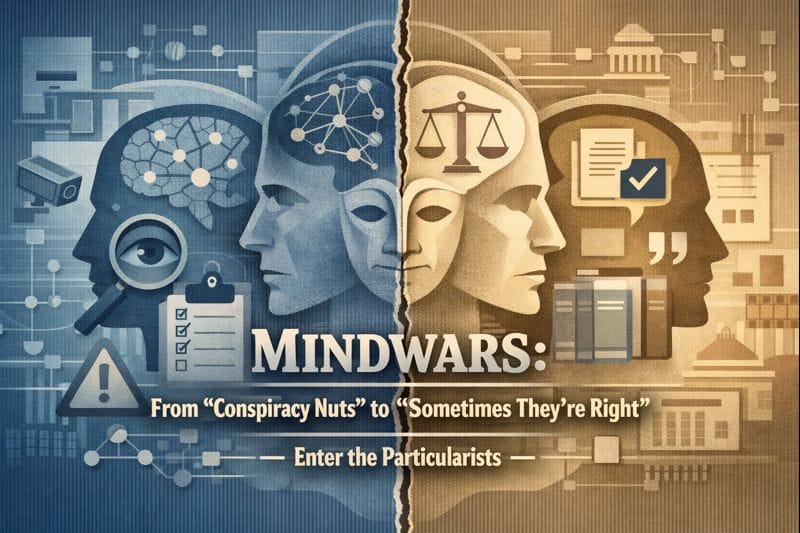
In earlier Mindwars articles, the main antagonist was clear: the social-psychology academics who turn “conspiracy theories” into a freestanding risk category, bolt it onto misinfo infrastructure and hand it to the managerial state as a governance tool. The generalist cluster around Douglas, Hornsey, Lewandowsky and Imhoff builds scales, harms catalogues and interventions; ERC funded projects like CONSPIRACY_FX industrialise the pipeline.
Opposite that sits a particularist cluster of academics, mostly in the philosophy of science camp, who argue that the truth and credibility of each conspiracy theory must be examined on its own merits. With M. R. X. Dentith sitting on the advisory board for CONSPIRACY_FX, they’re a natural place to start—looking mainly at works such as: “The Philosophy of Conspiracy Theories” and their dissertation “In Defence of Conspiracy Theories”, plus follow-on papers like “Does the Phrase ‘Conspiracy Theory’ Matter?”, “Particularism Reaffirmed” and “Why We Should Talk about Generalism and Particularism”. These being flanked by adjacent works from Duetz, Tsapos, Husting, Orr and others on how the label “conspiracy theory” functions in practice.
Taken together, these papers form a small canon inside the philosophy of science that does two things at once: it cleans up the concept of “conspiracy theory” and insists that conspiratorial explanations be treated as ordinary candidates for truth, to be accepted or rejected on standard evidential grounds rather than dismissed en-bloc.
On that surface reading, Dentith et al. look like natural allies for the position taken on this weblog. They say: stop using “conspiracy theory” as a slur; stop treating conspiracies as presumptively irrational; some conspiracies are real; evaluate claims case-by-case, not by membership in a cursed category. That’s the core of Dentith’s defence of conspiracy theories and particularism; and also, presumably, the reason they wound up on the advisory board: they’re the person who insists “judge them on the evidence.”
At the level of content, we’re largely on that side. Elite coordination is normal; covert operations and cover-ups are routine; suspicion of power is not a mental illness. Elite theory already knows that minority decision-making, narrative control and covert action are baked into complex systems; particularism is simply the epistemic hygiene that says “treat that as a live hypothesis.”
But structurally, the position take here is that particularists don’t sit outside the containment system. They sit inside it, in a very specific niche: the internal critics whose job is to clean up the category without changing who owns it.
Two Camps, One Machine
Once you pull back, you can see two these guilds are working on the same object from different floors of the same building.
Generalist camp (social psychology / CTTs):
- Focus: suspicious populations and their traits.
- Outputs: scales for “conspiracy mentality,” harms tables, debunking/prebunking and education toolkits.
- Main customers: ministries, security agencies, public-health teams, platforms.
Particularist camp (philosophy of science / social epistemology):
- Focus: suspicious beliefs and their rationality.
- Outputs: cleaned-up definitions, arguments for case-by-case evaluation, critiques of the “conspiracy theory” label.
- Main customers: other academics; occasionally the same projects as “conceptual advisers.”
A simple way to see it:
The generalists live in the concrete: survey instruments, effect sizes, best-practice prebunking. The particularists live in the cerebral: papers about when belief in conspiracies is rational and when the “conspiracy theory” label is unfair.
Both camps talk about “conspiracy theories”. Only one feeds directly into how platforms and governments treat suspicious publics.
What the Particularists Actually Fix
First, the credit:
- They expose the slur:
Dentith’s “Does the Phrase ‘Conspiracy Theory’ Matter?” and related pieces show how often the phrase functions as an insult rather than a neutral description. To call something “just a conspiracy theory” is usually to dismiss it without doing the evidential work. Husting and Orr, from sociology, push this further: they show how the label marks speakers as unserious, irrational or marginal, and keeps certain grievances outside “proper politics.” - They re-centre evidence:
Across The Philosophy of Conspiracy Theories, In Defence of Conspiracy Theories and “Conspiracy Theories on the Basis of the Evidence”, Dentith keeps returning to the same point: conspiracy claims should be evaluated like any other empirical claim—by looking at the world, not at stereotypes about the sort of people who make them. Particularism simply says there is no shortcut from “this posits a conspiracy” to “this is irrational”. - They normalise conspiracies as a political tool:
Particularists insist what elite theorists have long taken for granted: elites do conspire. Cartels, cover-ups, regulatory capture, covert operations and coordinated PR are standard instruments of power. Given that track record, blanket hostility to “conspiracy thinking” is itself irrational. - They defend citizen suspicion as a civic function:
Basham and Dentith jointly argue that democratic publics need people willing to consider conspiratorial explanations; “conspiracy theorising” can be part of healthy oversight in systems where powerful actors have both motive and opportunity to collude.
So at the level of arguments, particularists really do tilt the lens back toward power. They reject the idea that conspiracies are rare aberrations; they treat suspicion of elites as, at least sometimes, the sober view. If you want to pry “conspiracy theory” loose from its role as a control word, you want these people on the board.
A quick clarification before we move on: saying philosophy “stays upstairs” is not the claim that Dentith and the particularists never touch real-world cases. They do—often explicitly, and often with more historical literacy than the social-psych generalists. The claim is narrower: their outputs are primarily conceptual and epistemic (definitions, norms of assessment, what counts as rational belief), and those outputs rarely translate into binding constraints on the downstream instruments and policies that govern suspicion in real time.
Where the Lens Stops: Philosophy as Buffer
Even when Dentith and co. face power in the right direction, they mostly keep the camera trained on belief about power, not on power itself. Their primary questions remain: when it is rational to believe a conspiracy theory; how such beliefs should be classified; and how the label “conspiracy theory” changes the status of the speaker. What they do not typically produce are maps of coordination networks, integrated baselines for institutional deception and cover-ups, or design constraints for the research tools that currently treat suspicion as a measurable public hazard.
You can see the effect if you drop their logic into a concrete case: the COVID lab-leak hypothesis. In the early phase, it was often treated in media and platform policy as near-synonymous with “conspiracy theory”—a marker of distrust and misinfo vulnerability. A particularist stance would have insisted on treating it as a live hypothesis to be assessed and updated on evidence, without letting the label do the work of dismissal. In that episode, a particularist stance might have improved the quality of public reasoning—less stigma-by-label, more explicit updating as evidence shifted—but it wasn’t in charge of the switches. It remained mostly an upstream, conceptual intervention, while the “conspiracy theory” bucket continued doing real-time work across media, platforms, and policy. As an aside: this example isn’t taking a position on the virus’s existence or origin; it’s about how the label gets used as an operational category. That may sound “generalist” in tone, but the point here isn’t to psycho-pathologise anyone—it’s to show how a category can replace evidential argument in real time.
If that still feels abstract, look at the cases we now treat as settled conspiracies—Watergate, MKUltra, Iran-Contra. Before they were “history,” the people pushing them were easy to file as paranoid or fringe. Particularism helps us tidy the archive after the fact (“some conspiracies were real, and belief was rational before the official story caught up”), but on its own it doesn’t change the tools that govern that early window—when leaks are thin, evidence is contested, and the label can be used as a veto.
That’s why Charles Pigden’s 2024 intervention matters: it’s a particularist move aimed directly at the downstairs machinery. His complaint isn’t just “don’t use the phrase as a slur,” but “your research instruments can’t reliably distinguish irrational conspiracism from ordinary, sometimes justified suspicion of state secrecy and covert action.” If you build “irrational” into your definition of “conspiracy theory,” then discovering that “conspiracy theorists are irrational” becomes close to a tautology—and the resulting scales quietly end up measuring plain conspiracy belief, not irrationality. Pigden is trying to drag particularism from conceptual hygiene toward operational validity. But the structural point still holds: even the best critique won’t rewire incentives, funding streams, and policy defaults unless those criteria are actually forced into the instruments, platform playbooks, and governance routines that currently treat suspicion as a population-risk variable.
This is how the field uses the particularists at their most functional: as conceptual cover (“we know some conspiracies are real”) without rebuilding the instruments. The measurement stack still treats suspicion as a citizen trait, and elites remain the assessors, not the assessed. On paper, the particularists turn the lens toward power; in practice, the apparatus can cite them and carry on.
The Particularist Microfield and the Pattern of Use
Scanning the papers and attributions, you find that Dentith belongs to a wider microfield of particularist authors: Basham, Keeley, Hagen, Duetz, Tsapos, Husting, Orr, Stokes and others. They deepen the critique but sit in roughly the same place.
- Basham leans hardest into democratic watchfulness: treating conspiracy theorising as part of the immune system of a democracy, where elites predictably abuse power.
- Husting and Orr dissect the phrase “conspiracy theory” as a social sorting device that marks speakers as untrustworthy.
- Duetz and Tsapos highlight the split between treating “conspiracy theories” as suspect ideas and treating “conspiracy theorists” as suspect people—and show how much of the social-science literature is about the latter.
- Pigden is the upper edge of the same move: particularism plus an explicit attack on historically naïve assumptions and instrument design.
All of this supports the line established across the Mindwars CTT series: the label is not a neutral descriptor; it functions as a boundary tool.
But again, note what this microfield mostly does not do:
- It doesn’t produce systematic maps of the ruling class, the operating (managerial) class or the institutions through which they coordinate.
- It doesn’t build a parallel data infrastructure on elite deception, policy cartels, media-think-tank complexes or crisis simulations.
- It doesn’t dictate hard constraints on social-psych measurements: no matching requirement to measure institutional lying if you’re measuring citizen distrust; no rule that scales must track under-detection of real conspiracies as well as over-attribution.
The pattern we saw with Dentith generalises: this is a bloc that makes the conceptual and moral case for taking conspiracies seriously and for treating suspicion of power as potentially rational. It is not a bloc that re-tools the instruments used to monitor and tame that suspicion.
Who Gains When the Lens Stops Just Short of Power?
Once you see that half-turn, the list of beneficiaries becomes very focused.
Who benefits?
- The CTT / social-psych complex:
The Douglas / Lewandowsky / Imhoff / Hornsey / CONSPIRACY_FX world needs a respectable hazard category called “belief in conspiracy theories.” The particularists give them a line they can use in every introduction: “Of course, some conspiracies are real, and not all conspiracy theories are irrational.” That line costs the measurement pipeline nothing. Scales still treat suspicion as a trait; harms tables still treat it as a hazard; prebunking still targets citizen beliefs, not elite conduct. - Governments and platforms:
State actors and big platforms get to say: “We’re not suppressing all talk of conspiracy; we’re distinguishing legitimate suspicion from harmful conspiracy theories, in line with the best philosophical work.” Their right to govern suspicion—via moderation policies, public-health campaigns, counter-extremism strategies—is now wrapped in both impressive-looking data and serious-sounding norms. Rival powers can copy the same pattern: quote Western particularists for sophistication, then run their own “anti-conspiracy” campaigns against internal enemies. - The philosophy guild itself:
The Dentith bloc and its neighbours become the in-house conscience. They are invited to workshops and advisory boards to show that the system has listened to its critics. They gain status and access without having to launch an all-out attack on the psych pipeline or the funding model that treats conspiracy belief as a risk to be managed. Philosophy becomes a kind of conceptual audit function: checking the language, trimming excesses, but leaving the core architecture of suspicion-management intact.
And who benefits least?
- The people on the sharp end of power:
Those who live under corruption, cover-ups, heavy-handed policing and cartelised markets—the everyday targets of real conspiracies—gain surprisingly little. In the particularist literature, they appear mainly as examples (“sometimes conspiracy theories turn out to be true”) or as abstract believers whose rationality is being assessed. The ontology “conspiracy is in the world” never fully dislodges “conspiracy is a type of belief we need to monitor.” Their suspicions remain data points in other people’s models.
And this isn’t just a Western quirk. Authoritarian and semi-authoritarian states run their own versions of the same game. Accusations against domestic security services, oligarchs or ruling parties are often framed as “foreign-inspired conspiracies” or “plots to destabilise the nation,” while state-approved stories about enemies abroad are rarely described as conspiracy theories at all. Russia talks about colour revolutions as Western plots; China has framed certain protests and movements as CIA operations; governments in Turkey, Egypt and elsewhere have described opposition networks as conspiratorial fronts. While some of these accusations may be partly or wholly true, “conspiracy” language is also used to downgrade bottom-up suspicion and opposition, while top-down conspiracy claims are treated as normal governance talk. The Western CTT–particularist set-up is a more technocratic variation on this general pattern: the tools are smoother and the rhetoric more academic, but the basic asymmetry—who gets to name a conspiracy without being treated as dangerous or deranged—looks very much the same.
Where Geopolitika, Overlords and The Operators Come In
Everything so far has stayed mostly in the belief layer: who gets to be called a conspiracy theorist, when belief is rational, how CTTs and platforms classify and respond to suspicious publics. That’s the terrain where Dentith and the particularists operate—and where the generalists have built their tools.
The missing half is the power layer, and that’s where the other series on this weblog live:
- Geopolitika is explicitly elite theory plus narrative deconstruction. It starts from the basic elite-theory question—who actually rules, through which institutions and networks—and then takes apart the stories those elites tell about the world. It follows RUSI, RAND, Chatham House, CSIS, WHO, ASPI, Carnegie and friends not just as “experts” but as script-writers: designing war-games, crisis scenarios and “simulated futures”, then watching those scripts come back as policy, law and “consensus science”.
- Overlords maps the class architecture sitting above that: the layers of oligarchic capital, ruling strata, operating class, labs, export layer and emerging technocratic custodianship. Conspiracy here isn’t an anomaly; it’s one of the normal coordination tools of this structure.
- The Operators tracks the middle tier: the strategists, think-tankers, modellers, behavioural scientists, public-health and security communicators (including CTTs) who turn abstract categories—“conspiracy theory”, “misinformation”, “unsafe partner”, “threat”—into specific playbooks and campaigns.
Put together, that stack does the thing the particularists only half-do: it nails the lens to elite behaviour and narrative production, and treats public belief as downstream. Mindwars asks “who is allowed to say ‘conspiracy’ without being delegitimised?” Geopolitika asks “who is actually conspiring, and how do their narratives make those conspiracies look like ordinary governance?” Overlords and The Operators fill in the class and guild machinery in between.
A fair defender of Dentith and the particularists would say something like: philosophers don’t run ERC calls, write survey batteries or set platform policy, so blaming them for the persistence of “conspiracy mentality” scales and prebunking programmes is mis-aimed; their job is upstream—cleaning concepts and norms—and on that front they’ve shifted the Overton window inside philosophy from blanket generalism (“conspiracy theories are irrational as such”) to particularism (some are true, many are rational, you can’t dismiss them by label alone). That conceptual repair, they’d argue, is a necessary precondition for any serious elite-theory or narrative-deconstruction work, because without it “conspiracy” talk never even gets treated as a legitimate description of how power operates. They’ve also already pushed back on CTT excesses in their own idiom—critiquing politicised examples, sloppy usage and pathologising framings—and staying “inside” as advisers keeps at least some channel open to soften the worst abuses.
Our reply is narrower: we accept that conceptual work is valuable and that they don’t control the machine, but once they sit on boards and become the field’s in-house conscience, their arguments are inevitably read two ways—upwards, as proof that the apparatus is reflective and responsible, and only weakly downwards, as a small widening of what suspicious publics can say. From an elite-theory and narrative-deconstruction angle, the problem isn’t their principles; it’s that those principles are being integrated more into the story the system tells about itself than into the actual tools and scripts it uses to keep “conspiracy” as something it diagnoses in citizens rather than something citizens are allowed to diagnose in it.
That’s why the internal fight over “conspiracy theory” in philosophy matters—but also why it isn’t enough. Unless the cleaned-up concepts are tied to tools, institutions and a hard look at elite narratives, they’ll keep floating upstairs while the real work of ruling—and of labelling suspicion a problem—carries on below.
Further Reading:
- M. R. X. Dentith, The Philosophy of Conspiracy Theories (Palgrave, 2014).
- M. R. X. Dentith (ed.), Taking Conspiracy Theories Seriously (Rowman & Littlefield, 2018).
- Karen Douglas et al., “The Psychology of Conspiracy Theories” (Current Directions in Psychological Science, 2017).
- Lee Basham & M. R. X. Dentith, “Conspiracy Theories and the Trouble with Public Trust,” in Taking Conspiracy Theories Seriously.
- Ginna Husting & Martin Orr, “Dangerous Machinery: ‘Conspiracy Theorist’ as a Transpersonal Strategy of Exclusion.”
- Charles Pigden, “How to make conspiracy theory research intellectually respectable (and what it might be like if it were),” Inquiry (published online 20 Jul 2024).
Published via Mindwars Ghosted.
Mindwars: Exposing the engineers of thought and consent.
—
Author’s Note
Produced using the Geopolitika analysis system—an integrated framework for structural interrogation, elite systems mapping, and narrative deconstruction.
Support: Mindwars Ghosted is an independent platform dedicated to exposing elite coordination and narrative engineering behind modern society. The site has free access and committed to uncompromising free speech, offering deep dives into the mechanisms of control. Contributions are welcome to help cover the costs of maintaining this unconstrained space for truth and open debate. If you like and value this work, please Buy Me a Coffee