Mindwars: From Conspiracy Theorist to “Unsafe Partner”
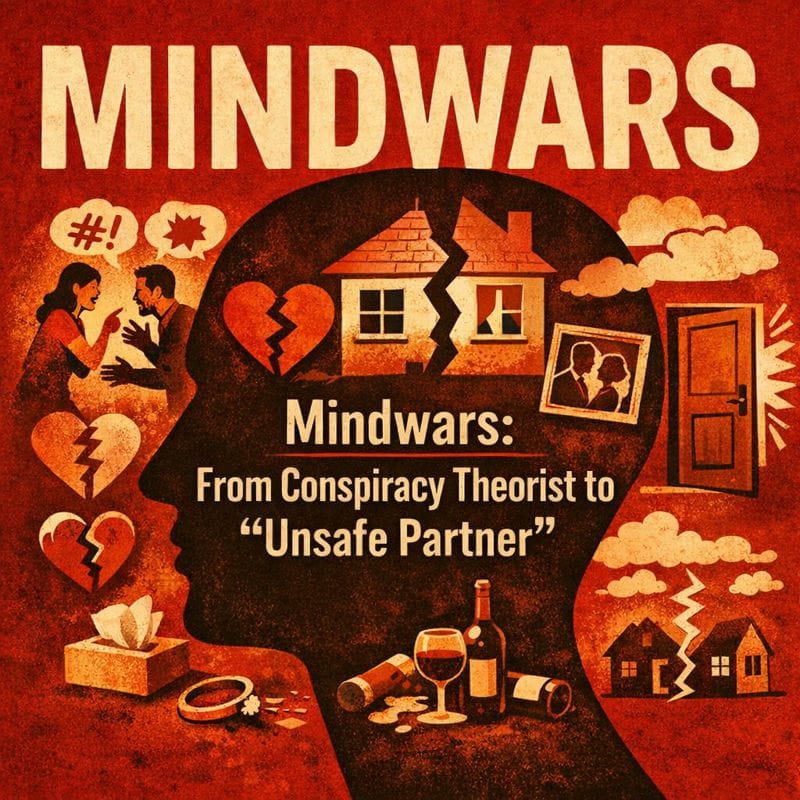
“You lose the person, they’re still there but you don’t recognise them.”
That line sits at the emotional centre of an article in the British Journal of Social Psychology released 12 Dec 2025 about what it’s like to be romantically involved with someone who believes in conspiracy theories. Seventeen people whose partners (or ex-partners) held such beliefs describe relationships under strain, endless arguments about COVID and vaccines, fear for children, and a sense of having “lost” the person they loved.
On the surface, it reads as a sympathetic, humane study of people struggling with difficult relationships.
Underneath, it’s also the latest instalment in a very specific way of seeing the world: a researcher worldview that treats “conspiracy theories” as a harmful substance, “conspiracy believers” as a risky type of person, and every new study as one more way to map the damage they cause.
That worldview has already been dissected in the Mindwars series, outlining how:
- Conspiracy theories are constructed as an object in How Are “Conspiracy Theories” Harmless?
- Institutions position themselves as “managers of mistrust” in Managers of Mistrust: Why Conspiracy Theory Theorists Won’t Turn Their Lens on Power
- The field became a Consequences Factory churning out harm claims
- The Conspiracy Mentality Questionnaire (CMQ) committed the Original Sin of turning distrust into diagnosis
- The CONSPIRACY_FX clusters organise actors and beneficiaries.
Seen through that lens, this new relationship paper is not a stand-alone piece of empathy research. It’s another output from the same European research Council (ERC) funded mill.
What follows is a tour through that structure: the researchers’ worldview as it appears in the introduction, how it shapes the design, and how the resulting story is already feeding into media and “misinformation” narratives that treat conspiracy believers as relationship hazards.
The Worldview Is Declared Before The Data Appears
If you only read the abstract and results, the paper looks descriptive: “here’s what 17 partners say.” The real work happens earlier, in the introduction.
There, the authors set out key pillars of their worldview — the same pillars Mindwars tracks across the field.
Conspiracy theories as pre-defined harm objects
The opening move:
- Conspiracy theories are “prevalent”
- They’re associated with a “wide range of negative societal consequences”
- They “appear to do more harm than good.”
This is almost a textbook application of the logic dissected in How Are “Conspiracy Theories” Made?:
- Start by defining the object (“conspiracy theories”) as a bundle of secret, nefarious orchestrations;
- Build up a literature of correlations with bad outcomes;
- Treat that bundle as inherently problematic, rather than asking case-by-case “is this suspicion justified?”
The authors adopt the now-standard definition: beliefs that “significant events have been secretly orchestrated… for nefarious purposes.” Anything that turns out to be true can quietly be moved out of the “conspiracy theory” bucket later. The bucket is reserved for the losers of future history.
Once you do that, you don’t need to re-examine content. “Conspiracy theories” as a category already carry the verdict: deviant, harmful, need-frustrating.
“Consequences” everywhere, content nowhere
The introduction then does exactly what The Consequences Factory describes: it runs through a harm catalogue.
- Climate conspiracies linked to lower support for climate policy and reduced pro-environmental behaviour.
- COVID conspiracies linked to less handwashing, less distancing, less vaccination.
- 5G conspiracies linked to justifying violence against engineers.
- Election and “deep state” conspiracies linked to lower voting and higher acceptance of political violence, explicitly tied to Jan 6.
In each case, the pattern is:
X conspiracy belief → Y bad outcome.
There is no serious look at:
- Institutional behaviour in any of these domains
- How opaque, contradictory, or captured those systems have been
- Where scepticism might be tracking something real.
That is the core critique in the Mindwars series on Conspiracy Theory Theorists (CTTs): the field has become an “effects” industry where beliefs are always the toxin, and institutions are never on the slab.
The relationship paper merely extends this “effects” logic into intimacy.
The believer as a type: gullible, paranoid, low-status
Next, the authors shift from “what conspiracy beliefs do” to what kind of people believers are.
Prior work is cited to show that believers are:
- Expected to be socially excluded
- Seen as gullible, paranoid, unintelligent
- Judged harshly when they’re professionals (politicians, scientists) endorsing conspiracies
- Assumed to be more willing to engage in conspiratorial behaviour themselves.
This is exactly the move The Original Sin dissects: instead of testing claims, the system profiles believer types. Distrust becomes an attribute of defective people, not a response to defective systems.
By the time the authors arrive at interpersonal relationships, “conspiracy believer” is already a low-status, suspicious figure in the reader’s mind.
From there, it’s a short step to “hard to live with.”
Extending The Harm Frontier Into Romantic Relationships
After politics, public health, and reputational damage, the paper moves to interpersonal relationships.
A new “effects” domain
The introduction cites:
- Media stories about QAnon blowing up families
- Experiments where harmful-sounding conspiracies make people less tolerant of a hypothetical relative
- Survey data linking perceived conspiracy belief in others to lower relationship satisfaction
- Qualitative work on QAnon showing “wedges,” “distance,” “conflict,” and “attempts at healing.”
This is classic “consequences factory” logic again: build a trail of studies all pointing in one direction — belief → harms — across more and more domains.
Then comes the stated “gap”:
- Existing qualitative research focuses on QAnon and on relationships broadly (family, friends, partners)
- QAnon is extreme and US-centric
- Romantic relationships have special emotional and practical interdependence
- Therefore, we “need to examine how conspiracy beliefs in general shape romantic relationships.”
Notice what’s missing: any curiosity about when conspiracy-laden worldviews might not destroy relationships, or might be a shared adaptation to a world full of institutional failure.
The gap is framed as a new harm frontier: romantic relationships are simply the next terrain where “conspiracy effects” can be mapped.
That’s exactly how Conspiracy_FX Clusters – Who Benefits? describes the expansion: once you’ve built an infrastructure for measuring and publishing “effects,” every new social domain looks like a fresh opportunity to demonstrate that conspiracism damages something valuable.
How The Worldview Shapes The Apparatus
With that framing in place, the study’s concrete design starts to look less like neutral method and more like an expression of the worldview Mindwars calls out.
Who gets recruited
Participants are recruited via adverts aimed at people whose relationships have been affected by a partner’s conspiracy beliefs.
Through the worldview laid out above, this is sensible: you go to the people who feel the harm most acutely and ask them to tell their stories.
Structurally, it means:
- The sample is composed entirely of people who already interpret their relationship difficulties through the lens “my partner’s conspiracies did this”
- Couples who disagree but adapt, or who share some level of suspicion, are unlikely to appear
- People who see institutional failure as the main problem, rather than their partner’s beliefs, are also filtered out.
That’s exactly the kind of sampling funnel analysed in Open, Preregistered… and Wrong Question — Pathologising Dissent in Plain Sight (uploaded draft): you design your entry criteria so that the only cases you will ever see are those that confirm your harm frame.
Whose voice counts
Inside those relationships, only non-believing partners and ex-partners are interviewed.
From the researchers’ vantage:
- These are the “affected individuals”
- Previous literature has already coded believers as gullible, paranoid, unintelligent, and more willing to engage in conspiratorial behaviour
- So there is no perceived need to hear believers directly.
In practice:
- Believers are objects, never subjects
- Their reasons, evidence, and experiences are filtered through the partner’s account
- Their side of the story is structurally impossible to reconstruct.
This is the interpersonal version of what Managers of Mistrust: Why They Need You Pathologised describes at the macro level: “we” (institutions, experts, non-believers) hold the microphone; “they” (distrustful publics, conspiracists) are the problem to be narrated, diagnosed, and managed.
What counts as causal
With the research question framed as “how do conspiracy beliefs shape and strain romantic relationships?” and the recruitment funnel selecting for people who already see the beliefs as the problem, conspiracy belief becomes the central causal variable by construction.
Other things going on in these relationships — money, work, illness, kids, general political polarisation, past trauma — appear as context in stories, but they aren’t systematically tracked or weighted.
If a participant says “the relationship ended because of his conspiracy beliefs,” that attribution effectively becomes a data point, not a hypothesis to test.
It’s the same pattern Mindwars pulled apart in Conspiracy Theorising as a Symptom of a Deeper Problem (uploaded draft):
- Systemic drivers of mistrust — secrecy, revolving doors, captured regulators, opaque contracts — are ignored
- The individual’s belief is plucked out as the thing to explain and treat
- Any damage downstream is pinned on that belief, not on the deeper structures that may have made it rational to distrust in the first place.
Here, all of that happens inside the home.
The Missing Question: Could Any Of This Suspicion Be Warranted?
You might expect a qualitative study, which has room for nuance, to at least touch the question:
- Did any of the believers’ claims have evidential support?
- Were there institutional actions that might reasonably have made them suspicious?
- Did their beliefs track, however imperfectly, real conflicts of interest or documented scandals?
The paper doesn’t go there.
That absence makes sense if you remember the worldview inherited from the broader field and analysed in How Are “Conspiracy Theories” Harmless? and The Original Sin:
- “Conspiracy theory” is already defined as belief in nefarious secret orchestrations
- The category is implicitly reserved for false or deviant beliefs
- Anything that later turns out to be true can be retroactively re-labelled as “corruption,” “collusion,” “scandal,” or “investigative reporting.”
Within that worldview, it would almost feel perverse to ask whether the believer has a point. The job of the study is to document harms produced by false beliefs, not to re-examine institutional truthfulness or track record.
The result: content and context are irrelevant. The only variable that matters is whether the belief earns the label “conspiracy theory.” Once it does, the machinery of harm mapping kicks in.
From Study To Script To Media: The “Intimate Damage” Narrative
Given everything above, it’s not surprising that the study produces a specific narrative:
- The believer is transformed into someone “unrecognisable”
- The non-believing partner experiences relational strain, health problems, and stigma
- Parenting becomes a conflict zone, especially around vaccines and medical decisions
- Relationships often end, and when they do, participants attribute the breakup to conspiracy beliefs.
Those are real experiences. The point is not that they’re fabricated; it’s that the apparatus was built to find exactly this and not much else.
As The Consequences Factory would predict, this narrative is immediately packaged for wider use.
The LinkedIn post Conspiracy Beliefs Damage Intimate Relationships (the AI-titled explainer you flagged) is a near-perfect example of the media phase during which:
- An AI-generated headline converts a bounded qualitative study into a general causal rule: “Conspiracy Beliefs Damage Intimate Relationships”
- Themes become bullet-point harms
- Study is rebranded as “lived-experience evidence” for misinformation harms, placing it directly into the trust / misinformation / mental-health stack.
At this point, the full researcher worldview — conspiracies as harmful by definition, believer as deviant type, partner as sole legitimate narrator — has compressed into a simple public script:
believing conspiracies doesn’t just make you wrong; it makes you toxic to be close to.
That’s exactly the kind of script the CONSPIRACY_FX Clusters piece maps: a compact, emotionally strong story that travels easily between academia, media, and risk-management professions.
Who This Worldview Serves
When you integrate the Mindwars line of attack with the details of this study, a pattern emerges.
The worldview serves:
- An academic “conspiracy effects” guild that needs a constant stream of domains where conspiracy belief can be shown to harm something: democracy, climate, health, science, relationships. Each paper is another node in a tight citation network.
- Managers of mistrust — platforms, governments, health authorities, professional associations — who want to argue that conspiracist content is not just false but harmful to others. The more “effects” they can point to, the easier it is to justify interventions.
- Therapists, social workers, and courts who benefit from having a formally recognised risk label: “conspiracy-believing partner,” backed by peer-reviewed harm narratives, makes it easier to score and act on perceived risk in couples and custody cases.
The worldview flattens:
- Believers’ own accounts, which are never heard directly and which often, as Mindwars shows, contain a mix of justified suspicion, pattern hunting, overreach, and real experience with institutional failure.
- Non-catastrophic relationships, where conspiratorial worldviews are present but not central to breakdown, or where couples negotiate around disagreement, or where shared suspicion is part of their bond. These relationships are systematically excluded by the recruitment strategy.
- System-level behaviour, which Conspiracy Theorising as a Symptom of a Deeper Problem spends its time on: opacity, capture, secrecy, real conspiracies. Those remain largely offstage, so they cannot be implicated in the explain-away story.
Turning the Lens Back on the Researchers
None of this requires you to shrug off the 17 partners’ pain. Their experiences are undoubtedly real. Some relationships do get shredded when one person plunges into a conspiratorial world — or a religious world, or a political world, or a sports world, or even the world of business — and refuses to come back. What this study never touches, though, is what happens when both partners share broadly the same worldview: that conspiracies and coordinated self-dealing do exist, that they shape society in tangible ways, and that they often do so to the benefit of institutions and powerful organisations at everyone else’s expense.
What changes when you bring the Mindwars pieces back in — like How Are “Conspiracy Theories” Made?, Managers of Mistrust, The Consequences Factory, The Original Sin, CONSPIRACY_FX Clusters — is not “whether the partners suffered”. It’s what you see the paper itself doing.
You stop asking:
“What did these conspiracy beliefs do to these relationships?”
and start asking:
“What does this research culture do to these relationships — and to the people in them — when it looks through a lens that has already decided what conspiracy theories are, who believers are, and what counts as harm?”
On that view:
- The definition of conspiracy theories (secret, nefarious, need-frustrating) isn’t just a neutral starting point; it’s a gate that decides which beliefs can show up as pathology.
- The sample (self-selected, distressed partners) isn’t just a convenience; it’s a filter that can never produce counter-examples to the “harm” script.
- The voice hierarchy (non-believer speaks, believer is spoken about) isn’t just method; it encodes a prior decision about who is epistemically trustworthy.
- The omissions (no claim-by-claim truth testing, no institutional audit, no believer interviews) aren’t accidents; they are the practical expression of a worldview that treats content and context as irrelevant once the “conspiracy” label has been applied.
Turn the lens back, and the paper stops being a simple window onto “what conspiracy beliefs do to relationships” and becomes a mirror for its own research world where:
- Institutions are never on the diagnostic couch
- Distrust is always someone else’s defect
- Every new study extends the same map of “effects” into one more corner of life.
From the Mindwars angle, that’s the key shift. The object of critique is no longer only “the conspiracist partner” out there in the data. It’s also the conspiracy-effects machine that selects which partners we hear from, how their stories are framed, and which questions are never asked — all while calling itself neutral, open, and “inductive.”
Published via Mindwars Ghosted.
Mindwars: Exposing the engineers of thought and consent.
—
Author’s Note
Produced using the Geopolitika analysis system—an integrated framework for structural interrogation, elite systems mapping, and narrative deconstruction.
Support: Mindwars Ghosted is an independent platform dedicated to exposing elite coordination and narrative engineering behind modern society. The site has free access and committed to uncompromising free speech, offering deep dives into the mechanisms of control. Contributions are welcome to help cover the costs of maintaining this unconstrained space for truth and open debate. If you like and value this work, please Buy Me a Coffee