Mindwars: Glitched Realities – How Aesthetics Became a Weapon Against Dissent
From psychedelic smear campaigns to cult-coded imagery, media now uses visual distortion to pathologise nonconformity.
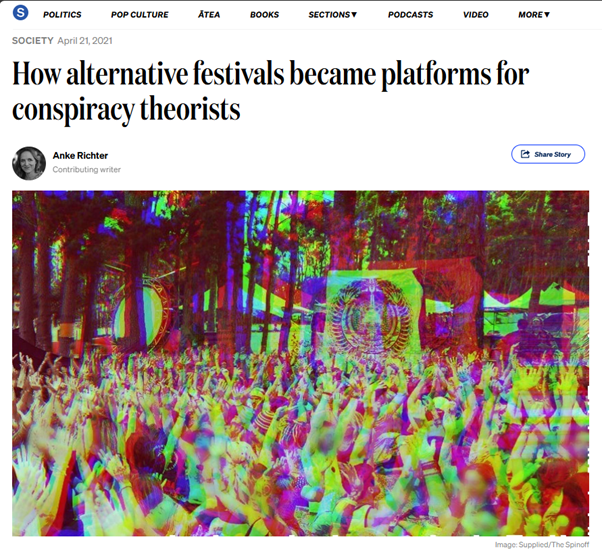
In April 2021, The Spinoff published an article titled “How alternative festivals became platforms for conspiracy theorists.” The lead image—a heavily distorted, glitch-saturated photo of raised hands at a festival—was not a neutral editorial choice. It was an aesthetic deployment, framing perception before argument could form. The image was designed to destabilise. To code joy as mania. To make collective celebration look cultic, chaotic, and cognitively dangerous.
But journalism is no longer just about what is said. It is about what is seen, and what is encoded visually before a single sentence is read. And if that visual encoding is part of a funded suppression system, then we’re not dealing with reporting—we’re dealing with a feedback weapon.
The author of the piece was Anke Richter—a fact that is not incidental. Richter is not just a freelance journalist. She is a co-founder of FACT Aotearoa (Fight Against Conspiracy Theories), the NGO exposed in our previous article “Mindwars: The New Censors – How InternetNZ and FACT Engineered a Narrative Control Grid” as a central node in New Zealand’s narrative suppression architecture. As demonstrated in that article, FACT is not a watchdog. It is a motif factory. The people behind it do not observe culture—they pre-filter it. In Richter’s case, she’s not merely reporting on “conspiracy theories”—she’s actively designing the cultural frameworks that define and delegitimise them.
That makes the image that led her Spinoff article more than just illustration—it is visual pre-conditioning. A symbolic strike that labels its subjects as irrational, delusional, or dangerous before any evidence is introduced.
Richter’s own professional profile confirms her dual role in both media and narrative enforcement:
“Anke Richter is an international journalist based in Lyttelton and the author of CULT TRIP: Inside the World of Coercion & Control (HarperCollins). Her three previous books were published in Germany where she worked in newsrooms and TV. She is a co-founder of FACT (Fight Against Conspiracy Theories) and the director of Decult, New Zealand’s first cult awareness conference.” (source)
This follow-up article decodes how visual motifs—not just words—are now deployed as weapons in the cognitive theatre of post-COVID control. This is not an article about images. It is a field report on the aesthetic warfare now waged against dissent.
From Journalism to Aesthetic Warfare
Once, journalism relied on evidence. Now, it leans on affect. The post-COVID media ecosystem no longer simply informs—it conditions. This shift is not accidental. It is systemic. Legacy outlets have begun pairing ideological content with emotionally manipulative visuals, creating an aesthetic filter that shapes perception before a single argument is made.
This is not journalism—it is aesthetic warfare.
The tactic is what we term aesthetic pre-framing: the use of imagecraft to implant mood, judgment, or cognitive aversion prior to engagement with textual content. Pre-framing bypasses logic and implants meaning through design. Before the reader encounters the claim, they have already felt the verdict.
The Spinoff article by Anke Richter is a textbook case. The lead image—a glitched, hyper-saturated photo of a festival crowd with raised hands—does not illustrate an argument. It preloads a conclusion. In its RGB split and chaotic overlay, the photo carries implicit messages: cognitive distortion, mass delusion, spiritual intoxication, and loss of individual control. These aren’t interpretations—they’re semiotic payloads.
By the time the reader processes the article’s headline— “How alternative festivals became platforms for conspiracy theorists”—the image has already whispered: These people are not just wrong. They are dangerous, unhinged, and other.
This is the function of aesthetic warfare in the current media landscape. Not to inform, but to infect. To replace rational engagement with symbolic recoil. To make dissent ugly before it can even speak.
Who Framed the Picture?
This is no ordinary editorial flourish. The glitched, psychedelic image of raised hands at a festival did not emerge from a disinterested editorial choice. It ran atop the article. As mentioned above, Anke Richter is not just a contributing writer, but a co-founder of FACT—the disinformation trust at the centre of New Zealand’s semantic suppression grid. Richter is also a long-time operator in the anti-cult activism sphere, blending journalistic reach with psychological reclassification techniques.
While there is no direct evidence that Richter selected the image herself, the alignment between visual motif and authorial framing is too precise to dismiss. The photo’s composition—a heavily distorted, over-saturated festival scene with mass raised hands—functions as more than mood-setting. It activates a deep psychological schema: mass delusion, spiritual intoxication, collective mania. The implication is implicit: These aren’t citizens. These are cultists.
This is not a critique of behaviour. It is a categorical reassignment. Pandemic dissent is remapped onto the same semiotic terrain as coercive cults: irrational, dangerous, in need of intervention. In Richter’s ecosystem, “alternative” isn’t simply incorrect—it is unstable, indoctrinated, and unsafe.
The narrative reframing is surgical. Followers, not thinkers. Rituals, not reasoning. The reader is not invited to debate, but to recoil. The text does not seek engagement. It demands containment.
And critically, this move cannot be viewed in isolation. FACT, as documented in Mindwars: The New Censors, functions as a narrative-labelling and suppression arm—a semi-covert node generating stigmatising motifs like “conspiracy theorist,” “anti-vaxxer,” and “cultic behaviour.” These motifs are then disseminated through a tightly aligned media ecosystem: Stuff, The Spinoff, TVNZ, and PIJF-aligned outlets. Richter’s article fits seamlessly within this deployment architecture. It is not a journalistic outlier. It is narrative infrastructure in motion.
The image is not bias. It is battlefield terrain. It prepares the perceptual field for epistemic quarantine. Aesthetics are used here not to clarify—but to pre-empt. This isn’t an opinion piece. It’s a soft-launch psy-op.
What’s missing from this framing is not just attribution—but strategy. The image is not merely illustrative. It is part of a recursive system. Yet, no protocol exists to disrupt it. Recognition without resistance becomes passive containment. Without tools to hijack or redirect this motif cascade, visual dominance remains unchallenged.
FACT and the Narrative Operating System
Anke Richter’s byline signals more than authorship. It marks institutional continuity. As a founding trustee of FACT, she operates within a tactical narrative infrastructure designed to shape public perception through language, not logic. FACT is not a neutral observer. It is a motif engine, architecting labels that stigmatise deviation and reframe dissent as pathology.
Chief among these is the term “conspiracy theorist.” In FACT’s hands, this phrase is stripped of specificity and deployed as a general-purpose silencing device. It no longer refers to falsifiable claims or empirical error. It refers to cognitive deviance—nonconformity with institutional consensus. Once applied, the label alters how the subject is perceived: not as a participant in discourse, but as a contaminant within it.
The label is modular. It attaches easily to adjacent terms: “cult-like,” “anti-vaxxer,” “Covid denier,” “disinfo superspreader.” Each acts as a narrative acid, corroding legitimacy and inoculating the audience against empathy or engagement. These motifs don’t describe behaviour. They define who is unworthy of being heard.
FACT’s influence exceeds its visible footprint. The organisation is tethered to InternetNZ, a strategic node in New Zealand’s digital governance stack. It enjoys synchronised messaging flows with outlets like The Spinoff, Stuff, and RNZ—all of which echo its motif structure under the branding of “public interest journalism.” The result is a narrative mesh in which suppression appears organic but operates as a choreographed relay. Its real asset is semantic recursion. It repeats, until suspicion attaches to the visual form itself. Through this repetition, dissent becomes not just unpalatable—but algorithmically downgraded, fund-starved, and pre-emptively banned.
Richter’s article exemplifies this mechanism. By threading the “cult” motif through the text—and pairing it with glitched festival imagery—she reclassifies spiritual communities and counter-narratives as proto-extremist zones. This isn’t a warning. It’s a recalibration: an aesthetic and semantic script designed to shift dissenters into the “conspiracy theorist” quadrant, regardless of their actual claims.
The article doesn’t accuse. It codes. And once the motif is seeded, institutional actors can cite the coverage as proof that suppression is justified. This is how a phrase becomes a weapon. This is how language becomes infrastructure:

This is not feedback. It’s a closed loop. A self-reinforcing compliance engine where language is the control surface.
This narrative machinery is underwritten. FACT’s messaging flows align with the Public Interest Journalism Fund, indirectly subsidised through InternetNZ and embedded in New Zealand’s digital governance layer. What looks like civic concern is, in fact, a state-narrative ROI engine.
But the most potent force in this ecosystem isn’t human—it’s algorithmic. Once FACT’s narrative motifs enter circulation, they don’t just influence public opinion. They train machine systems. Content moderation AIs—on platforms like Facebook, YouTube, and Google—learn suppression patterns from the very aesthetic-cognitive pairings we’ve tracked: glitch equals instability, mass gesture equals cult, saturation equals delusion. These motifs become filters. They don’t just detect “misinformation”—they learn what it looks like. The result is an unacknowledged feedback loop. FACT injects the narrative, media amplifies it, and platform AIs codify it into enforcement logic. Once motif-based tagging enters the training data, visual dissent can be algorithmically flagged, deprioritised, or erased without any human decision.
This turns media narrative into machine policy. It's no longer enough to expose the message—we must map the infrastructure of its automation.
Image Deconstruction: Weaponised Elements
The lead image in Richter’s article doesn’t operate in isolation. It pulls directly from her deeper catalogue of symbolic framing, particularly her work on coercive cults—most notably those located in remote, religious enclaves such as those to be found on the West Coast of New Zealand’s South Island. That visual archive—of trance states, rural gatherings, and spiritual excess—is silently echoed in this photograph. But here, it’s mapped onto pandemic dissenters and festival-goers.
This is not an accidental overlap. It’s an aesthetic merge: the cultic visual language Richter built her career on, now deployed against a new target—Covid dissidents, alternative communities, and wellness cultures.
1. Glitching as Cognitive Disruption
RGB split, digital haze, channel separation—these visual anomalies simulate perceptual failure. The aesthetic references altered states, hallucination, or digital corruption. In the context of disinformation, it serves a precise analogue:
Conspiracies = unstable perception.
It discredits both the scene and the subjects. Viewers are not invited to witness—they are prompted to doubt. The glitch primes the mind to dismiss the crowd as cognitively compromised before a word of the article is read.
2. Mass Gesture = Cult Semantics
The raised hands call back to familiar imagery from religious cult gatherings—ritualistic postures, submission gestures, ecstatic group states. Richter’s own reporting on coercive cults frames these visuals as signatures of control and loss of agency.
By transplanting this motif into a festival context, the image injects her cult semiotics into pandemic dissent.
The crowd is not portrayed as joyful or expressive—it is coded as entranced, obedient, ritual-bound.
These are not free individuals. They are subjects in a belief system.
3. Toxic Psychedelia: Discrediting Alternative Aesthetics
The oversaturated palette mimics both psychedelic art and digital overstimulation. This visual language once symbolised liberation, creativity, and sensory expansion. Here, it is inverted.
Colour becomes symptom. Light becomes warning.
The message is subtle but effective: “These people aren’t enlightened—they’re lost.” The image reframes the countercultural aesthetic as pathological—beauty warped into delusion.
4. Banner Ambiguity as Threat Cue
A symbolic emblem is blurred in the background—imprecise, esoteric, and unidentifiable. This ambiguity is strategic. It echoes the kinds of mystery symbols often used in cult imagery from Richter’s prior investigations.
In this case, the image activates a visual suspicion trigger. Viewers are trained to read ambiguity as threat. What can’t be named becomes dangerous by implication.
Semiotic uncertainty = ideological contamination.
Together, these elements execute a symbolic reframing operation: transform dissent into delusion, spirituality into submission, aesthetics into threat. This is not reporting. This is cult framing applied to political dissent—and Richter, a professional cult profiler, provides the perfect authorial cover for its deployment.
Media Framing Meets Visual Pathology
The deployment of images in Anke Richter’s article follows a deliberate pattern: initiate cognitive bias through visual pre-criminalisation. The technique primes the viewer to reach a narrative conclusion before engaging with textual claims. This is aesthetic sequencing—not support, but substitution.
The image comes first. The verdict follows. The article becomes a post-justification for a judgment already absorbed. And as motif repetition increases, recognition becomes reflex. The image no longer requires justification. Its message is self-executing. But this also opens an opportunity: saturation induces brittleness. Motifs repeated without disruption become ripe for hijack.
The lead photo—saturated, glitched, cult-coded—casts the festival scene as unstable and suspect. But this isn’t the only visual at work. The article embeds a full visual motif relay, each image serving a tactical function within the suppression sequence.
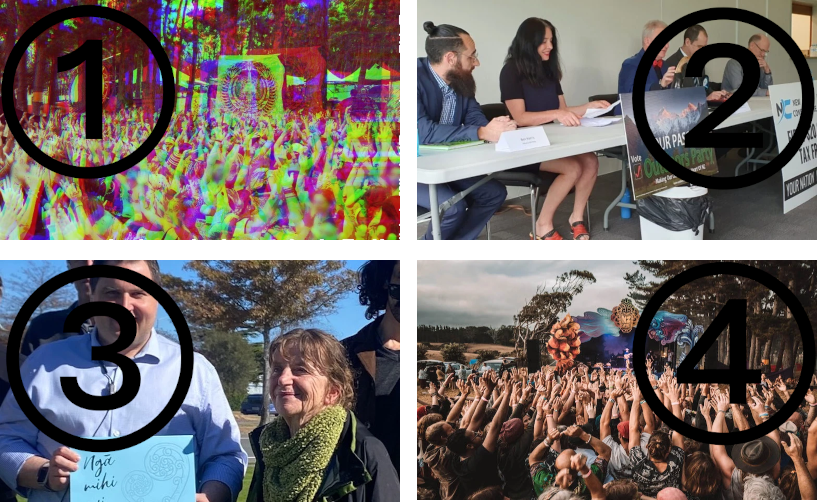
1. Glitched Festival Crowd
Function: Perceptual contamination.
Signal: These people are cognitively unstable.
Effect: Reader distrusts dissenters before hearing them.
2. Sue Grey Said to Have Visited an Anti-5G tent
Function: Associative deviance.
Signal: Wellness culture connects to fringe politics.
Effect: Viewer maps anti-vax, alternative health, and extremism into one hybrid identity.
Grey’s visual inclusion doesn’t document her claim. It encodes guilt-by-association. The setting—a tent at a festival—connects her to the prior image’s cult motif. Her expression and placement evoke defiance, not credibility.
3. Jacinta O’Reilly Delivering Note
Function: Humanitarian anchor.
Signal: FACT is caring, thoughtful, trustworthy.
Effect: Emotional contrast resets reader alignment. “These are the good ones.”
O’Reilly, a FACT spokesperson, is framed in an act of generosity—delivering a thank-you note. This is reputational laundering. It sets FACT apart from the distorted “others” while cloaking its operational agenda in kindness.
4. NZ Spirit Festival Scene
Function: False neutrality.
Signal: Harmless on the surface, suspect underneath.
Effect: Suggests infiltration—beauty masking threat.
This image appears calming, balanced, even utopian. But in context, it reinforces suspicion: the visual serenity is cast as deception. The reader, already primed by the glitch image, interprets this scene as camouflage—not truth.
Across all four images, the same psychological pattern holds:
- Image first. Judgment installed. Narrative follows as retroactive confirmation.
This is visual priming weaponised—where aesthetics drive epistemology. Viewers no longer interpret arguments. They interpret mood, motif, and implied guilt.
But beyond persuasion, these visuals perform another function: exhaustion. Constant aesthetic pathologisation wears down perceptual trust. Glitches, distortions, semiotic confusion—over time, this creates neural fatigue. The viewer learns not to resist, but to disengage. It’s not argument suppression—it’s bandwidth collapse. Dissent isn’t defeated. It’s slowly drained.
What emerges is a new kind of censorship: not through deletion, but through perception engineering. Those who challenge institutional narratives are pre-encoded as “conspiracy theorists” not because of what they say—but because of how they are shown.
Cultural Suppression Through Symbolic Saturation
When visual motifs are repeated across enough narratives, they stop functioning as illustrations and begin operating as filters. This is symbolic saturation—a suppression strategy that reframes entire aesthetic codes as unstable, untrustworthy, or dangerous. The result is not just the targeting of individuals. It is the stigmatisation of entire styles, subcultures, and visual vocabularies.
The Spinoff article exemplifies this pattern. Through its image sequence—glitched psychedelia, blurred banners, ecstatic gestures—it transforms the visual language of counterculture into a series of visual shibboleths. These markers no longer signal community or identity. They signal deviance:
Raised hands? → Cult
Bright colours? → Delusion
Esoteric symbols? → Extremism
Natural settings? → Anti-science
Psychedelia? → Pathology
Worse, these visuals don’t just marginalise—they retraumatise. For many, especially those from historically pathologised groups, the “cult” label echoes earlier persecutions: witch hunts, moral panics, psychiatric abuse. When dissenters are aestheticised as dangerous, deviant, or possessed, it reactivates collective memory wounds. These aren’t just media tactics. They’re psychological landmines—triggering fear, shame, and social exile.
Dissenting or alternative communities are recoded as chaotic, irrational, and contaminated—not by argument, but by how they look. Once saturated into media, this framing takes on a self-reinforcing logic. It doesn’t just describe dissent—it marks it.
This is aesthetic preselection: before you speak, your visual environment has spoken for you.
The broader consequence is aesthetic erasure. Communities that use non-Western, spiritual, or countercultural symbols become vulnerable to narrative reclassification. Their ceremonies become evidence. Their colours become symptoms. Their gatherings become pre-crimes.
Once these symbols are saturated with suspicion, anyone using them can be flagged—by media, by state actors, by audiences trained to equate appearance with ideology. The culture itself becomes unprintable, except as threat display.
What began in 2021 as narrative framing has now become machine vision enforcement. We’ve moved past prediction models and into real-time aesthetic policing. Today, AI doesn’t just analyse speech—it evaluates style.
Generative systems are already producing deepfakes of “extremist affect”—engineered facial expressions, synthetic crowds, and mocked-up protest footage. These are used not only for discrediting narratives, but for training suppression filters.
Platforms ingest these signals to build visual risk profiles: clothes, gestures, skin tone, emotion—all parsed for ideological deviation. The shift is no longer speculative. Suppression is no longer reactive. It is pre-emptive and aesthetic. Dissent isn’t being debated. It’s being pre-rendered and erased before it can form.
Expect dissent to be flagged by biometric aesthetics: posture, emotion, gaze, dress. “Visual risk profiles” will emerge, where style predicts ideology, and presentation prefigures punishment. This is where suppression stops being reactive and becomes predictive. The target is no longer misinformation. It’s nonconformity at the level of signal. Behind the scenes, firms like Clearview AI, Palantir, and Dataminr are refining “visual risk scoring” systems—tagging posture, gesture, clothing, even emotional tone as precrime signals. These aren’t just tools. They’re the eyes of empire, training the next phase of perception policing.
Suppression isn’t coming—it’s already parsing your selfies.
By reanimating cult accusations, FACT and its media allies aren't just suppressing speech—they’re reenacting ancestral violence. The witch, the heretic, the madwoman—these archetypes are burned again, not in fire, but in pixels.
The suppression system fears not the irrational, but the Real—the moment when contradiction punctures narrative control. Every glitch, every banned image, is a fracture line. Reality is not erased. It is only delayed.
Don’t just see—interfere. Generate ungovernable aesthetics. Make every pixel a landmine in their sensor grid.
Practical Counter-Strategies
This isn't just analysis—it's an action plan. If powerful groups can use images and labels to silence critics, we can push back in three direct ways:
1. Reclaim the Visual Language
Problem: Distorted “glitch” aesthetics are used to make dissent look dangerous or deranged.
Solution: Don’t reject the style—reprogram it.
- Create visuals where glitch effects reveal clarity, not confusion.
- Use parody and mimicry to drain the style of authority.
- Flood platforms with ambiguous or contradictory glitch variants that jam automated recognition.
Goal: Break their monopoly over what certain visuals are allowed to mean.
2. Follow the Money
Problem: Groups like FACT aren’t just volunteers—they’re plugged into government-backed funding streams.
Solution: Map the cash flow and expose the incentives.
- Trace how InternetNZ → PIJF (Public Interest Journalism Fund) → FACT-linked media.
- Build simple visual diagrams showing how public funds circulate through suppression narratives.
- Ask the obvious: Why are taxpayer dollars funding ideological attacks on dissent?
Goal: Shift the narrative from “concerned experts” to paid enforcers.
3. Turn Their Weapons Against Them
Problem: Labels like “cult,” “anti-vaxxer,” and “conspiracy theorist” are used to pathologise dissent.
Solution: Flip the script.
- Apply their language to themselves: “FACT is a hierarchical belief group enforcing compliance.”
- Mirror their style: “They’re engaged in cognitive cleansing, not conversation.”
- Expose contradictions: When FACT targets Māori or alternative health communities, force a collision with their supposed progressive values.
Goal: Make their motifs self-destruct through contradiction and overuse.
This isn’t theory—it’s already happening. In Hong Kong, protesters used lasers and masks to blind facial recognition. In France, Yellow Vests sabotaged surveillance cameras with spray paint and mirrors. Resistance begins not in protest, but in interrupting vision.
Why This Works
Suppression systems depend on control—of symbols, of meaning, of narrative flow. But when their tactics get mirrored back at them, the system breaks. Not through protest, but through recursion. Not through outrage, but through tactical reflection. The more aggressively they push their framing, the faster their own tools collapse under their weight.
Like a glitch in the frame: what once blocked vision becomes the crack that lets it through.
Strategic Implication: Visual Literacy as Defence
What emerges from this investigation is not just a critique of a single image—but a map of weaponised aesthetics. The challenge is not merely ideological. It is perceptual. If dissent can be disqualified through colour, gesture, or symbolic ambiguity, then defence requires more than argument. It requires visual literacy—the ability to recognise and decode narrative inoculation before it embeds.
We are now in a media environment where images function as pre-verdict mechanisms. The lead photo is no longer decorative—it is the trial. And increasingly, that trial is conducted without evidence, without discourse, and without recourse.
To resist this, we propose the development of a taxonomy of narrative inoculation images—a classification system for visual propaganda structures designed to suppress through association and mood manipulation. Early categories include:
- Glitch Pathologics: distortions, RGB splits, digital haze applied to protest or communal scenes → codes instability or mania.
- Cultic Conformance Shots: synchronised gesture, mass movement, ecstasy poses → codes indoctrination.
- Saturated Psyche Tropes: hyper-colour, “toxic beauty,” psychedelic overstimulation → codes irrationality, danger.
- Ambiguous Occult Markers: blurred symbols, esoteric banners, exotic rituals → codes secrecy, threat, anti-normativity.
Each of these operates independently, but in tandem they create a visual taxonomy of disqualification—turning symbols of resistance, spirituality, or community into flags of cognitive or moral failure.
This visual logic is not separate from censorship—it is its symbolic layer. Where platforms delete posts and institutions silence speech, visual motif control performs pre-emptive reputational erasure. The subject is not only discredited. They are visually disfigured.
To counter this, audiences must be retrained—not only to question claims, but to audit the imagery those claims arrive with. Just as we teach media literacy around textual propaganda, a new curriculum must emerge: symbolic defence systems for the perceptual battlefield.
Fracture: The Eyes Obey First
By the time the headline loads, the judgment has already landed.
The Spinoff’s image didn’t wait for evidence. It didn’t explain. It performed. Before Anke Richter could introduce her narrative, the visual schema had already coded its targets: irrational, unstable, cultic. The crowd was tried and convicted in the frame—glitched, oversaturated, spiritually suspect. The reader didn’t need to decide what to think. The image made sure they felt it first.
This is the quiet logic of perception warfare. Control the symbol and you control the response. Alter the aesthetic and you alter the ethical. Dissenters are no longer silenced by argument. They are erased through visual mistrust—rendered illegible before they can be heard.
What this reveals is not just a censorship protocol. It is a perceptual containment field. A system where language is secondary, and optics do the pre-emptive work of exclusion. “Conspiracy theorist” isn’t an accusation anymore. It’s a visual class.
In Lacanian terms, the algorithm has become the gaze—it doesn’t just watch, it produces the subject. And if the gaze now writes reality, resistance begins by becoming its blind spot.
So the question becomes: If institutions can now define what dissent looks like, what stops them from defining what reality is?
What if dissent was never the real target?
What if the system doesn’t fear disinformation—it fears unfiltered vision?
Published via Journeys by the Styx.
Mindwars: Exposing the engineers of thought and consent.
—
Author’s Note
Produced using the Geopolitika analysis system—an integrated framework for structural interrogation, elite systems mapping, and narrative deconstruction.