Mindwars: Hornsey et al.– Constructing Conspiracy Theorists
Deconstructing the academic conception of “conspiracy theorist”—the slur that built a firewall.
This article discusses the work of a particular figure in the academy, Professor Matthew J. Hornsey, not because he stands out—but because he exemplifies a broader project. His work reveals how the label “conspiracy theorist” has been institutionalised, retooled, and redeployed to pathologise dissent in the post-JFK era.
Since the 1960s, when public doubt over the Kennedy assassination refused to yield to official accounts, the term “conspiracy theorist” has served as a cultural firewall—a way to dismiss independent thinkers without having to engage their arguments. What began as a Cold War-era deflection strategy has since been codified into behavioural science, media language, and public health policy. Hornsey’s research shows how this slur, once tactical, now has the patina of scientific enquiry.
His papers—on vaccine hesitancy, COVID belief, energy policy resistance, and political identity—frame dissent as a psychological problem. Those who question official narratives are profiled as low in trust, high in narcissism, resistant to “prosocial norms”, and vulnerable to ideological manipulation. In this schema, dissent is no longer a political response to broken systems; it’s a symptom to be managed.
But Hornsey doesn’t operate in isolation. His work aligns seamlessly with institutional goals: supporting global vaccine uptake, neutralising resistance to environmental transitions, and legitimising the censorship of “misinformation.” The result is a moralised behavioural script, not an open inquiry. Those who fail to comply are recoded as cognitively impaired, antisocial, or emotionally damaged.
This is not about public safety. It’s about narrative control. Hornsey’s research does not ask why people distrust institutions. It asks how to stop them spreading that distrust. His work provides a textbook example of how dissent is managed—not through debate, but through diagnosis.
In a culture increasingly defined by scripted coherence, Hornsey’s work marks a key mechanism: the transformation of doubt into deviance. This exposé examines how that mechanism works, who it serves, what it suppresses—and how it inherits the legacy of Cold War disinformation architectures now reconstituted in behavioural science vernacular.
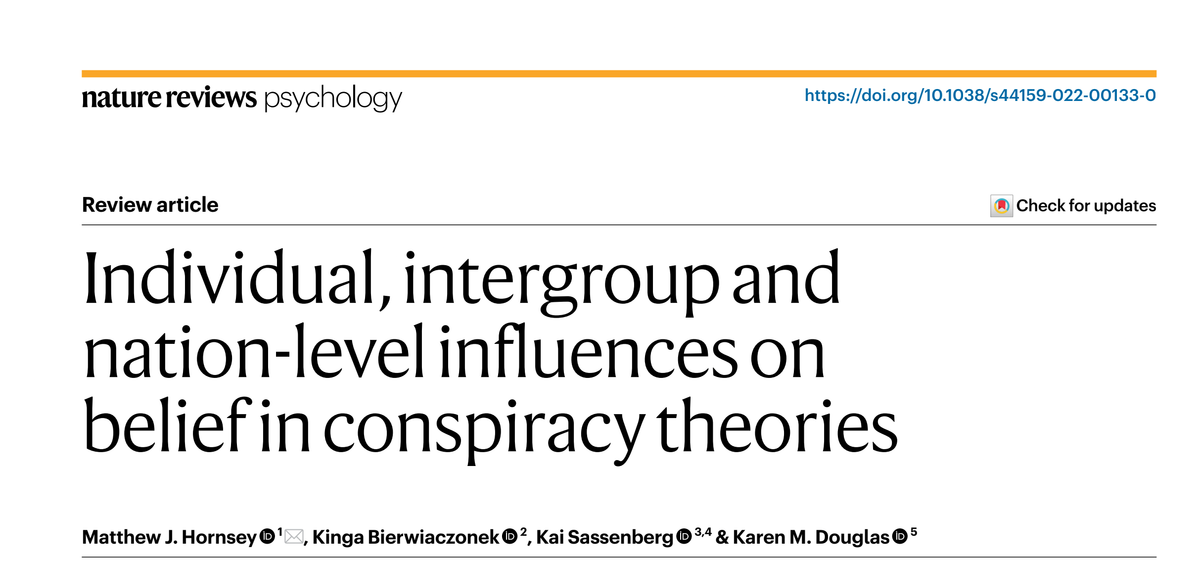
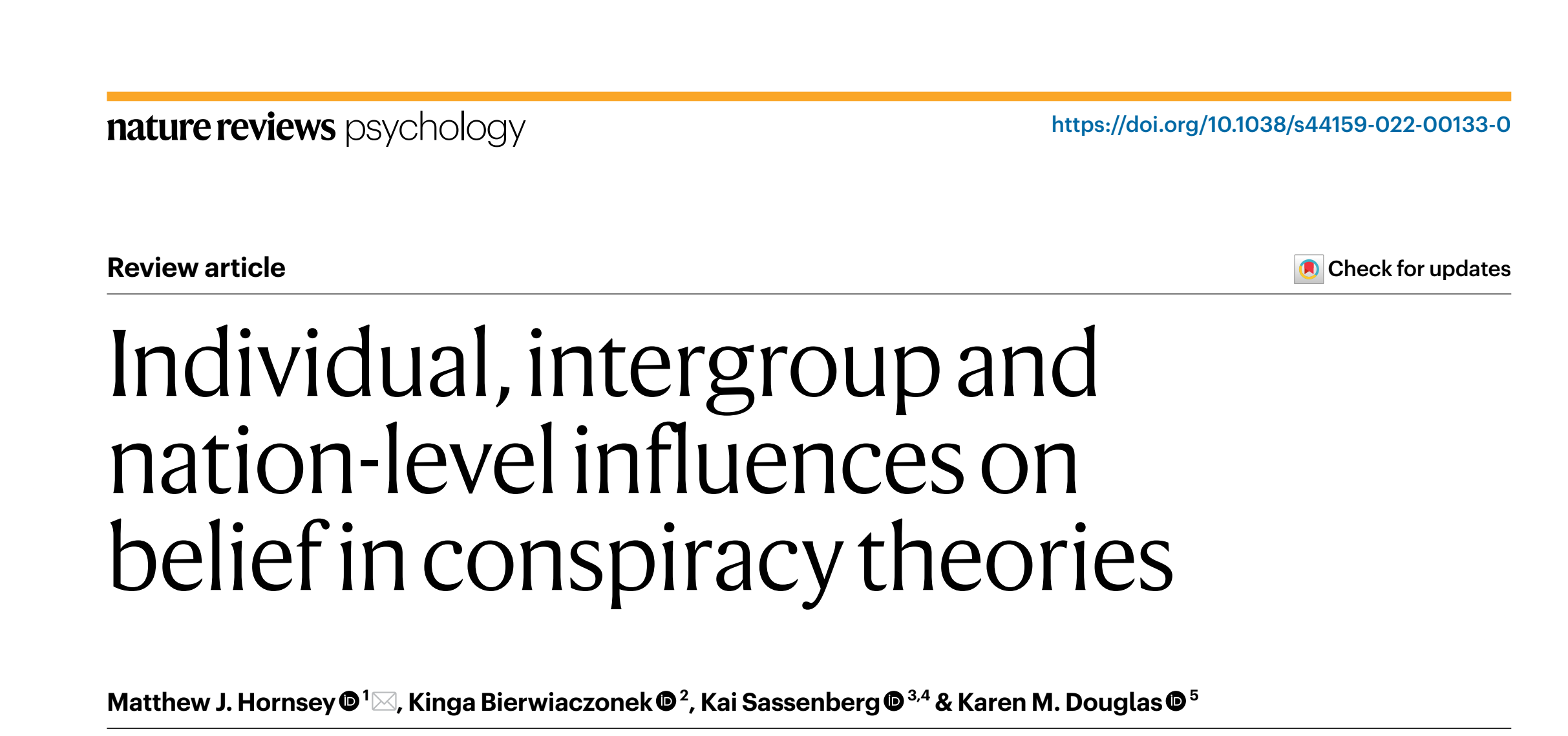
As an anchor to this critique the February 2023 paper “Individual, intergroup and nation-level influences on belief in conspiracy theories” is examined in detail.
Diagnostic Intent – Reading the Abstract as Command Statement
The abstract of Hornsey et al.’s 2023 review sets the tone: not as a neutral inquiry into human cognition, but as a call to manage what is framed as a growing social pathology. The authors begin with a high-friction claim:
“Conspiracy theories… have the potential to undermine governments, promote racism, ignite extremism and threaten public health efforts.”
This is not a question—it is a declaration. From the opening sentence, conspiracy belief is positioned not as evidence of systemic failure or historical betrayal, but as a civic threat. The language is militarised: undermine, ignite, threaten. Belief becomes an act of aggression.
The framing shift – from inquiry to intervention:
The paper does not set out to understand belief, but to neutralise its effects. It is framed not as exploration, but as containment. Every subsequent layer—cognitive, personality-based, intergroup, and national—is deployed as a mechanism to locate, diagnose, and pre-empt deviance.
Notably absent:
- No interrogation of whether any conspiracy theory might be true
- No acknowledgement that elite actors conspire in documented, prosecutable ways
- No structural model where state betrayal, covert operations, or coordinated propaganda play causative roles.
Pseudo-pluralism as camouflage:
The abstract claims a “multilevel” approach—individual, intergroup, national—but this functions more as segmentation logic than true pluralism. Each level simply adds another diagnostic layer. None reverse the core claim: that conspiracy belief is a threat to be solved.
The conclusion confirms the frame:
“... increases understanding of the problem and offers potential solutions.”
But it is not understanding that’s being pursued. It is resolution. The belief itself is the problem. The solution is behavioural: diagnosis, segmentation, and intervention.
Inclusion Rhetoric, Exclusion Logic – The Soft Containment Function of the Introduction
Hornsey et al. open their review with a nod to historical legitimacy, invoking the American Declaration of Independence as a “conspiracy theory.” At first glance, this appears to position conspiracism as part of political tradition—a potentially valid response to state overreach. But this gesture is tactical, not structural.
What follows is a sharp pivot: from revolution to regulation. The invocation of America’s founding myth is not to legitimise contemporary conspiracist thinking—but to soften the terrain before establishing a diagnostic framework. This is inclusion rhetoric, deployed to neutralise resistance before imposing exclusion logic.
The authors quickly move from historical examples to contemporary threat framing:
- Conspiracy theories are linked to terrorism, prejudice, political violence, and public health collapse
- They are framed not as investigative tools or cultural myths—but as accelerants of mistrust and dysfunction.
The real shift is ontological: conspiracy belief is not treated as a mode of inquiry—but as a cognitive liability. This defines the subject before analysis begins. It doesn’t ask, “What is the truth status of this belief?” It asks, “What kind of person holds this belief—and how do we manage them?”
By claiming the rise of “post-truth” sentiment and anti-Enlightenment currents, the paper places itself in the role of epistemic custodian. Yet it never interrogates the institutional failures that might cause this distrust—mass surveillance, information warfare, media collusion, intelligence overreach. These are omitted not by accident, but by function. They are not variables—they are untouchables.
The authors admit the term “conspiracy theory” resists strict definition. They concede that some conspiracies may be true, that elite motives should be interrogated, and that not all conspiracy beliefs are fanciful. But this agnosticism is superficial. The paper operationalises only one logic:
- Conspiracy belief is valid to the extent that it aligns with official suspicion zones—such as foreign disinformation or historical injustice
- Outside those zones, it is framed as irrational, maladaptive, and dangerous.
Through soft qualifiers and calibrated disclaimers, the paper preserves plausible deniability. But the practical effect is clear:
- A new class of deviance is established
- That deviance is tied to psychological traits
- And those traits justify surveillance, intervention, and exclusion from the civic conversation.
The Truth Clause – How Belief Is Rendered Illegible
The authors claim to approach conspiracy theories with epistemic agnosticism. They acknowledge that some may be true. They concede that elite motives should be scrutinised. They note the difficulty in drawing clear lines between plausible and implausible claims. On the surface, this appears balanced.
But structurally, this agnosticism is a sleight. What follows in the paper is not an investigation of whether any given conspiracy theory is valid, well-sourced, or historically consistent—it is a behavioural segmentation of the type of person who believes it.
Truth is not interrogated. It is displaced.
Instead of asking what happened, the framework asks who believes it—and what is wrong with them. The conspiracy theory becomes a diagnostic artefact. The believer becomes the pathology.
Rather than weigh the evidentiary content of specific theories, the authors treat belief itself as a signal of deviance. The belief’s function is irrelevant. Its plausibility is bypassed. Its context—historical, political, institutional—is reduced to noise.
This is not truth-seeking. It is truth-erasure via psycho-social coding. What is assessed is not the claim—but the claimant:
- Are they distrustful of institutions?
- Are they emotionally dysregulated?
- Do they deviate from “prosocial norms”?
By shifting the focus from epistemology to psychology, the authors evacuate the very terrain they pretend to inhabit. To shield this displacement, the authors invoke consensus:
“... in line with most academic accounts…”
This is not a footnote—it’s a firewall. It implies:
- The literature agrees
- The method is validated
- Dissent from this framing would be unorthodox, even suspect.
This is how groupthink enters the methodological bloodstream. It becomes self-reinforcing:
- Researchers cite each other
- Definitions converge
- Diagnostic patterns are normalised.
The field becomes an echo chamber—where the absence of structural analysis is mistaken for analytical clarity, and epistemic closure is mistaken for consensus.
It is precisely this type of ritual coherence that conspiracy theorists detect. And rather than confront the legitimacy of that detection, the authors offer a psychological profile of the detector.
This isn’t agnosticism. It’s containment. It’s the academic consecration of a cultural reflex: doubt is deviant, and group trust is the only valid proxy for truth.
Profiling the Doubter – Psychology as Gatekeeper
The first analytic tier deployed by Hornsey et al. is the individual level. This is where behavioural science steps in to define the conspiracy theorist not by their claims, but by their traits. Cognitive, clinical, personality, and motivational profiles become the instruments through which dissent is pathologised.
The paper introduces this with neutral language—but structurally, it installs a surveillance framework. The subject is not asked what do you believe and why? Instead, the question becomes: What’s wrong with you that you believe this at all?
Hornsey et al. distil the believer into a predictable cluster of dysfunctions:
- Low analytic thinking (implying a preference for intuition over logic)
- Higher narcissism (suggesting ego-driven deviance)
- Moral disengagement (casting dissent as antisocial)
- Low trust (coded as a psychological liability rather than political memory).
This is not an explanation—it is a filtration system. These traits don’t explain why beliefs emerge; they explain who should be excluded from epistemic credibility.
This section of the review reifies a single principle: if you distrust institutions, you are cognitively impaired or emotionally maladapted. It converts political trauma into personal defect.
There is no mention of historical betrayals—Tuskegee, Iraq WMDs, mass surveillance—no recognition that distrust may be adaptive. Trust is the default. Deviation is diagnosis.
This shifts the function of psychology. It no longer describes how people think—it prescribes how people should think, and flags those who don’t as social liabilities.
Each trait becomes a behavioural datapoint:
- Who is more likely to resist public health mandates?
- Who will refuse energy transition policies?
- Who will circulate “misinformation”?
Psychological profiling is not neutral—it’s infrastructural. It enables the pre-emptive identification of noncompliant populations under the guise of research.
In this framework, the individual is not understood. They are rendered predictable. Manageable. Profiled not for insight, but for intervention.
Intergroup Codings – When Collective Memory Becomes Tribal Delusion
Having pathologised the individual believer, Hornsey et al. shift the analytical lens to the intergroup level. This tier purports to examine how conspiracy theories are negotiated among social groups—but its actual function is to reclassify cultural resistance as irrational group identity formation.
This is the paper’s ethno-psychological containment stratum. Here, the authors do not engage with historical trauma, collective memory, or strategic distrust. Instead, they code these responses as outcomes of “collective narcissism,” “ingroup threat,” and “paranoid cohesion.”
Ethnic groups, political factions, and religious communities that reject elite narratives are not viewed through a historical lens. Their resistance is not considered rational, symbolic, or trauma-informed.
Instead, Hornsey et al. assert:
- Conspiracies emerge when groups feel their identity is under threat
- These beliefs bind members together through shared grievance
- Such dynamics are “paranoid”, “tribal”, and “identity-protective.”
This is a subtle—but violent—inversion. Structural exclusion and systemic betrayal are rewritten as collective psychodrama.
It is not “what happened to your community”—it is “why are you so sensitive?”
In this frame, cultural immunity to dominant narratives becomes a risk vector:
- Diasporic resistance becomes misinformation
- Religious eschatology becomes delusion
- Political non-alignment becomes radicalisation.
No distinction is made between symbolic cosmologies, strategic distrust, and reactionary ideology. All are placed on a single spectrum of cognitive risk. This totalises the diagnosis. It means that even when individuals are psychologically sound, their group context renders their beliefs suspect.
The intergroup level authorises broader interventions:
- Community surveillance
- Cultural reframing via public campaigns
- Infiltration of counter-narratives into group discourse.
Hornsey et al. don’t advocate this overtly. They don’t have to. The logic is embedded:
- If belief is tribal
- And the tribe is the amplifier
- Then containment must occur at the group level.
The state no longer diagnoses individuals. It diagnoses cultures.
Case Studies as Narrative Anchors – How Antisemitism and Populism Secure the Diagnostic Perimeter
The two case studies—antisemitic conspiracy theories and populism—are not supplementary illustrations. They function as narrative keystones, strategically positioned to define the perimeter of what constitutes conspiracism and to emotionally regulate the reader’s interpretive frame. Their purpose is prophylactic, not analytic: to close down inquiry by fixing the category of “conspiracy belief” within a deviant and dangerous register.
Case Study 1: Antisemitism – the emotional firewall
This case study performs high narrative labour. By anchoring conspiracist belief to antisemitic tropes—blood libel, Holocaust denial, financial domination—the authors deploy historical atrocity as a moral lockdown mechanism. The aim is not historical exploration but associative containment: to fuse the image of the conspiracy theorist with the most socially radioactive domain of belief. The analysis of this case study is not a denial of antisemitic history but an examination of how its memory is operationalised to firewall dissent.
Several rhetorical tropes are embedded in this construction:
- The Contagion Trope frames belief as a psychological virus, spreading not through inquiry but through emotional priming, historical rumination, and national guilt. This turns cognitive dissent into a public health metaphor—irrational and transmissible.
- The Scapegoat Trope positions Jewish people as perennial victims of projection, while ignoring the strategic instrumentalisation of antisemitic tropes by state and elite actors. The believer is thus reduced to a dupe—dangerous but intellectually invalid.
- The Fabricator Trope implies that such conspiracies are not emergent but manufactured—deliberately injected into the population by provocateurs. This erases structural grievance and converts conspiracism into elite-proof fabrication.
- The Violence Escalation Trope draws a straight line from belief to atrocity. By making conspiracy belief a precursor to genocide, it installs a pre-criminal logic: the thinker becomes a threat before they act. Profiling becomes prevention.
- The Trauma Weaponisation Trope is perhaps the most architecturally potent. The authors claim that collective memory—especially when paired with low political control and historical grief—renders groups vulnerable to antisemitic conspiracies. This inverts the moral grammar of remembrance. It recodes trauma as a susceptibility factor. Mourning becomes pathology.
This analysis does not trivialise historical antisemitism. Rather, it isolates how atrocity symbolism is selectively mobilised to immunise power against critique—a strategy now deployed under the pretext of safeguarding mental health and social cohesion.
Case Study 2: Populism as the political firewall
If Case Study 1 secures the moral perimeter of the conspiracist category through historical trauma, Case Study 2 secures its political perimeter by associating conspiracist thinking with populist mobilisation, particularly that of Donald Trump. This box constructs a bridge between political scepticism and conspiratorial pathology, implying that non-compliance with institutional consensus is no longer a political position—it is a cognitive defect weaponised by demagogues.
Several rhetorical tropes organise this construction:
- The Demagogue Transmission Trope presents populist leaders not as responses to systemic betrayal, but as vectors of conspiracist contagion. They are said to “train” the public to think conspiratorially, thereby converting political dissent into psychological programming.
- The Inverted Trust Algorithm Trope defines the modern political landscape not as a rational reaction to state corruption, but as a reversal of natural epistemic trust. Leaders who validate mistrust are framed as damaging the political fabric—not as responding to its collapse. The public’s loss of faith is not explained—it is pathologised.
- The Spectral Media Trope implicates alternative media ecosystems as echo chambers that circulate conspiracism through repetition, not evidence. Again, the believer is removed from context. The system that birthed the mistrust is never interrogated—only the “unreliable media” that weaponised it.
- The Manufacturing Trope mirrors Case Study 1’s logic: beliefs are not emergent, they are engineered. Populist politicians and media organs are said to construct conspiracy frameworks in order to destabilise liberal democracy. The belief is not a symptom of collapse—it is the cause.
- The Feedback Loop Trope completes the circuit. Populist leaders amplify conspiratorial suspicion. Citizens adopt these suspicions. Politicians are then rewarded electorally for reflecting them. This is framed not as democratic responsiveness, but as a pathological feedback loop—a malfunction of the civic body.
Together, these tropes erase the structural legitimacy of political dissent. By coding populist mobilisation as a derivative of conspiracist thought—and conspiracist thought as a product of political manipulation—Case Study 2 pathologises opposition to institutional consensus as an ideological disease state.
The result is epistemic quarantine. No populist logic can be entertained without falling under suspicion. No mistrust of elites can be expressed without triggering the containment schema. As with Case Study 1, the aim is not to clarify but to immunise—the reader is steered away from any engagement with conspiracy logic by associating it with mass delusion and authoritarian drift.
Intergroup Psychology as Containment Bridge – Recasting Identity, Grievance, and Memory as Risk Vectors
In the summary of intergroup-level dynamics, the authors lay out a catalogue of empirical findings that consistently align conspiracist belief with identity threat, victimhood, and outgroup anxiety. At first glance, this reads as a sociologically aware gesture. In fact, it extends the diagnostic perimeter further—from the individual mind to the collective psyche. But crucially, this transition does not re-legitimise belief. It redistributes suspicion.
Examples cited—Muslim distrust of U.S. narratives on 9/11, Chinese suspicion of American intentions, Indonesian fear of Western erasure—are not examined in terms of historical causality or imperial continuity. Instead, they are looped through adaptive threat detection and collective narcissism, which repackage political response as affective misfire.
Even collective trauma is reprocessed as behavioural precursor. Perceived deprivation, cultural dispossession, and historical grievance become predictors of maladaptive cognition. The underlying logic: The more your group remembers, the more likely it is to believe the wrong thing.
The diagnostic vocabulary—“collective narcissism”, “system justification”, “identity vulnerability”—operates as a displacement protocol. It permits the appearance of cultural sensitivity while blocking epistemic legitimacy. Group belief is granted context but not credibility. Political belief becomes psychological reflex.
Importantly, while the authors acknowledge that this level of analysis is under-researched and methodologically fragile (notably lacking causal evidence), the damage is already done: intergroup belief is established as an intervention-worthy variable.
This is the full-spectrum implication:
- Individuals are profiled for deviant cognition
- Groups are profiled for deviant memory
- The system is never profiled.
This sets the stage for the final tier: national-level diagnosis, where systemic collapse is rebranded as socio-political volatility—again without implicating the architecture of elite governance.
The International Frame – When Governance Breakdown Becomes Culture
The final diagnostic tier—nation-level analysis—does not shift the structural logic of the paper. Instead, it replicates it at scale. Here, entire populations are diagnosed for cognitive deviance using proxies like economic performance, political trust, cultural orientation, and authoritarian drift. Once again, conspiracy belief is not treated as a rational output of elite misconduct or systemic betrayal—it is rendered a by-product of national dysfunction.
The earlier framing of identity trauma and group anxiety is now extended to states: economic fragility, corruption, and perceived illegitimacy are correlated with conspiracist thinking. However, rather than treating these conditions as legitimate sources of public scepticism, the authors reroute attention to cognitive vulnerability as an output of cultural environment.
For instance, nations with low GDP and high corruption are said to foster higher conspiracist beliefs. But these structural conditions—failures of governance and accountability—are not treated as causes in a forensic sense. Instead, they become risk factors in a behavioural model, with the same framing logic applied at the macro scale: conspiracism as symptom, not as signal.
Similarly, collectivist cultures are framed as more likely to produce conspiracy believers, though the mechanism is left vague. The idea that collectivist information ecologies may contain alternative epistemic protocols or deeper historical memory is not entertained. Instead, collective worldviews are positioned as epistemically suspect—prone to relational explanations and unofficial knowledge networks.
Perhaps most telling is the treatment of democracy. Nations that score lower on the Economist Intelligence Unit's Democracy Index are said to exhibit higher conspiracy belief, but the paper openly concedes that this might be because citizens in authoritarian regimes are simply more realistically cynical. This insight, which could destabilise the entire pathology model, is neutralised with a caveat: participants in such regimes may underreport suspicion out of fear. Thus, even functional cynicism—belief based on experience—is placed under diagnostic suspicion.
The cumulative function is clear. The international frame does not open space for structural critique. It distributes diagnostic profiling globally, transforming system-generated mistrust into cultural bias, economic underperformance, or political immaturity. The centre holds; the periphery malfunctions.
This completes the containment architecture:
- Individual minds malfunction through low trust, narcissism, or epistemic anxiety
- Groups malfunction through trauma, victimhood, or collective narcissism.
- Nations malfunction through low GDP, weak institutions, and poor democratic hygiene
At no level—individual, group, or nation—is the architecture of narrative manufacture interrogated. Nowhere is statecraft treated as conspiratorial. Nowhere are elite actors profiled for information control, strategic disinformation, or perception warfare.
The direction of analysis remains vertical: from above onto below. The governed are examined. The governors remain invisible.
Manufactured Complexity – Integration Without Interrogation
Having categorised conspiracy belief across micro, meso, and macro tiers, the authors turn to the problem of integration. On the surface, this appears to be an effort at epistemological maturity—an acknowledgement of complexity, interdependence, and theoretical limits. But beneath this rhetorical modesty lies a critical operation: the substitution of systemic critique with “multi-level complexity”, thereby shielding elite narrative power from scrutiny while distributing suspicion downward.
The integration is explicitly framed as a top-down cascade, where macro-level conditions (economic collapse, governance breakdown, cultural collectivism) trigger meso-level group dynamics (identity threat, collective narcissism), which then generate micro-level belief symptoms (distrust, anxiety, conspiracism). The directionality of analysis is fixed: systemic environments shape public pathology—but the system itself is never pathologised.
Crucially, the authors reject “hygienic” or predictive models, claiming that the complexity of conspiracy belief resists neat theorisation. But this claim of indeterminacy is selectively deployed. It is not used to open inquiry into elite coordination or covert statecraft. Rather, it is used to foreclose any generalisable claim that systemic failure or information warfare might produce legitimate conspiratorial cognition. Complexity is invoked to neutralise forensic logic.
The use of “first”, “second” and “finally” creates the illusion of logical progression, but functions as a containment device—structuring diagnosis while deflecting systemic scrutiny.
- “First” frames macro forces (e.g., economic collapse, inequality) as stressors that activate latent group paranoia. This reclassifies structural failure as environmental trigger, not elite culpability.
- “Second” recodes group solidarity as distortion. Intergroup identity is portrayed as overpowering rational thought, turning shared memory or trauma into behavioural malfunction.
- “Finally” completes the unidirectional cascade—macro conditions shape meso group dynamics, which produce micro belief symptoms. Governance failure becomes background noise; deviance localises in the public.
The effect of these rhetorical markers is to simulate integration while enforcing top-down diagnostic flow. They produce narrative coherence without causal accountability. The system remains unexamined—only belief is pathologised.
What emerges is a self-sealing cognitive schema:
- When beliefs align with elite narratives, they are treated as reason
- When they deviate, they are classified as the product of intersecting identity threats, cognitive vulnerability, and socio-political precarity
- When inconsistencies arise across these tiers, they are not treated as analytic flaws—but as evidence of system complexity.
In this model, dissent is never a signal. It is a by-product. Deviance is not explanatory—it is the thing to be explained.
And while the authors entertain speculative bi-directionality—acknowledging the theoretical possibility of “bottom-up” processes—the cascade logic is never reversed. There is no model proposed wherein elite deception, institutional betrayal, or strategic disinformation generate conspiratorial belief in a rational population. These are off-script inputs.
Thus, the final analytic move is not integration, but containment through ambiguity. The system is not synthesised—it is immunised.
From Pathology to Protocol: The Engineering of Consent
The 3rd callout box in the paper outlines “interventions” for conspiracy belief, but its framing clarifies the operational goal: not engagement, but pre-emption. This is not a theory of persuasion—it is a model of immunisation.
The rhetorical pivot is key. Conspiracy belief is cast as a maladaptive outcome of cognitive, emotional, and social vulnerabilities. As such, interventions target exposure, framing, and compliance, not structural conditions.
Core devices and their effects:
- Prebunking and Inoculation: These borrow from virology, casting ideas as infectious and the population as susceptible. Dissent becomes pathogen; prevention becomes moral hygiene.
- Corrective Rebuttals: Shown to have limited effect, especially after alignment with the belief, they expose a deeper problem: the model is not epistemic, but behavioural. Changing minds is less important than limiting spread.
- Norm Priming and Social Proofing: These interventions target conformity pathways—shaping perception of what others believe, to shift behaviour. This affirms the governance logic: people don’t need truth, they need cues.
- Empathy Induction (e.g., towards Chinese citizens): Used not to understand the belief itself but to soften its social target—redirecting the moral-emotional register to lower the appeal of belief pathways.
- Control Restoration & Self-Affirmation: Early strategies aimed at restoring agency failed to deliver robust results. This undercuts the theory that conspiracism is simply compensatory and emotional—yet the framing remains.
The authors include a telling justification for the apparent limited success of interventions:
“It should not be surprising that cognitive interventions have only modest success: after all, conspiracy theories are notoriously difficult to falsify, and conspiracy beliefs are shaped in part by non-rational processes.”
This is not a diagnostic admission—it is a narrative failsafe. It converts the failure of correction into proof of deviance. Rather than question whether persistent belief reflects failures in institutional transparency or legitimacy, the authors pathologise the believer. Difficulty in falsification becomes an index of irrationality—not of institutional credibility gaps, historical precedent, or concealed operations. The Popperian frame is weaponised, not applied.
Thus, the section closes not with a call for dialogue or forensic depth—but with a behavioural horizon: manage belief early, contain it if possible, and pathologise it if it persists, so that:
“…there is general agreement on the need to play the long game: fortifying the integrity of governments and other institutions to remove the fertile ground in which conspiracy theories grow.”
This nominal gesture to structural reform is not substantiated. Integrity is referenced, not operationalised. The paper doesn’t propose how institutions should change—but rather how populations should be shaped to not doubt them.
In sum: intervention is not about truth recovery—it is about narrative control through behavioural design. The mission is not persuasion, but pre-emption.
Final Synthesis: Conspiracy Theory as a Managed Category in a Kaleidoscopic Frame
The conclusion of Hornsey et al.’s review does not dissolve the paper’s core framing—it crystallises it. While styled as reflective, pluralist and cross-level in tone, the final section performs a containment function: it repackages a suppressive architecture in the language of cosmopolitan humility.
The rhetorical arc culminates not in structural introspection but in a narrative soft seal, wherein behavioural science maintains its diagnostic power while shifting the aesthetics of control from clinical to compassionate.
1. Behavioural management remains core:
Despite gestures toward multilevel understanding, the imperative remains explicit:
“Future research should look for ways to reduce conspiracy theorizing, or at least to break the link between conspiracy beliefs and behaviours...”
This is not an epistemic invitation—it is an operational directive. Dissent, scepticism, and narrative divergence are not analysed for legitimacy, but profiled for intervention potential. The true research agenda is not comprehension but containment.
2. False reflexivity and tonal realignment
The appeal to “reflective academic stance” and “tonal migration” serves as an institutional immuniser. The claim that scholars must shift from deficit language to compassionate contextualisation is not a repudiation of behavioural diagnosis—it is a rebranding.
“Migrating between micro-, meso-, and macro-level factors requires an empathic shift as much as an epistemic shift…”
But the epistemic content is unchanged. The scholar is now simply asked to sound softer while delivering the same verdict: the problem lies in the believer, not in the narrative-authoring institutions.
3. Kaleidoscopic moral relativism as containment
By presenting empathy as a tonal solution to structural mistrust, the authors neutralise dissent through therapeutic framing—softening disbelief without confronting its institutional cause. The concept of a “kaleidoscopic moral universe” suggests complexity, but it functions as narrative fog.
“Conspiracy theories are both illogical and logical; truth is both sacred and relative...”
This strategic ambiguity neutralises structural critique. It renders power asymmetries, covert coordination, and institutional betrayal as interpretive dilemmas, not strategic realities. In this framing, epistemic dissent becomes a cultural artefact—not a rational response to elite deception.
4. Trustworthiness substituted for accountability
The ultimate prescription is reputational:
“...the best long-term solution to systemic mistrust is to demonstrate authentic trustworthiness…”
But this is not anchored in transparency, reversibility, or public audit. It is an appeal to credibility theatre—a performance of sincerity by institutions with no obligation to relinquish control or reveal authorship. The population’s scepticism is re-coded as a communication problem, not a history problem.
Conclusion: The True Architecture
This final synthesis reveals the true architecture of the paper: not a multilevel analysis of conspiracy belief, but a tonally updated suppression script. What is staged as psychological insight is revealed as containment choreography—an academic re-enactment of the original Cold War imperative: discredit the dissenter, sanctify the system. Behavioural science, in this schema, does not investigate the causes of belief so much as it neutralises its effects, always in service of institutional stability.
By collapsing pathology into “worldview”, dissent into “harm”, and doubt into “irrationality”, the paper stabilises the role of the “conspiracy theorist” as a morally pre-invalidated class. While this critique reverses the diagnostic lens, it also risks becoming self-sealing unless it differentiates between invalidation of pathology-based framing and genuine reflexive inquiry into power-induced belief formation. The plea for complexity is thus not a challenge to power—but a final aesthetic rearmament of it.
Its framing device is behavioural segmentation masquerading as pluralism—each segmentation layer operationalises a containment schema, mapping dissent not for comprehension but for filtration and narrative sanitation. By staging a “multilevel” approach—individual, intergroup, and national—the paper simulates epistemic openness while systematically redirecting scrutiny away from institutions and towards populations. Each diagnostic layer (cognition, culture, country) filters belief through a pathology lens, converting rational suspicion into psychological defect.
The role of the paper, then, is preservationist. It fortifies the “official narrative” by rendering dissent as a behavioural malfunction, not a rational alternative. It offers no forensic engagement with elite coordination, covert state operations, or institutional betrayal. Instead, it recodes mistrust as maladaptive and structurally off-script. It leaves unexamined the forensic legitimacy of conspiracy detection as pattern recognition across elite coordination nodes—a domain with deep historical precedents and strategic relevance.
In conclusion, the paper enacts a technocratic censorship strategy, cloaked in the language of empathy and complexity. Its strategic accomplishment is the academic normalisation of epistemic quarantine—a firewall against narrative deviation under the guise of care. It does not map belief—it enforces boundaries on it. If there is to be a legitimate study of conspiracist cognition, it must begin not with profiling the disbeliever—but with tracking the architecture of betrayal. Until then, behavioural science remains the aesthetic wing of epistemic containment.
Published via Journeys by the Styx.
Mindwars: Exposing the engineers of thought and consent.
—
Author’s Note
Produced using the Geopolitika analysis system—an integrated framework for structural interrogation, elite systems mapping, and narrative deconstruction.