Mindwars: The Climate “Conspiracy” Paper That Isn’t Really About Climate At All
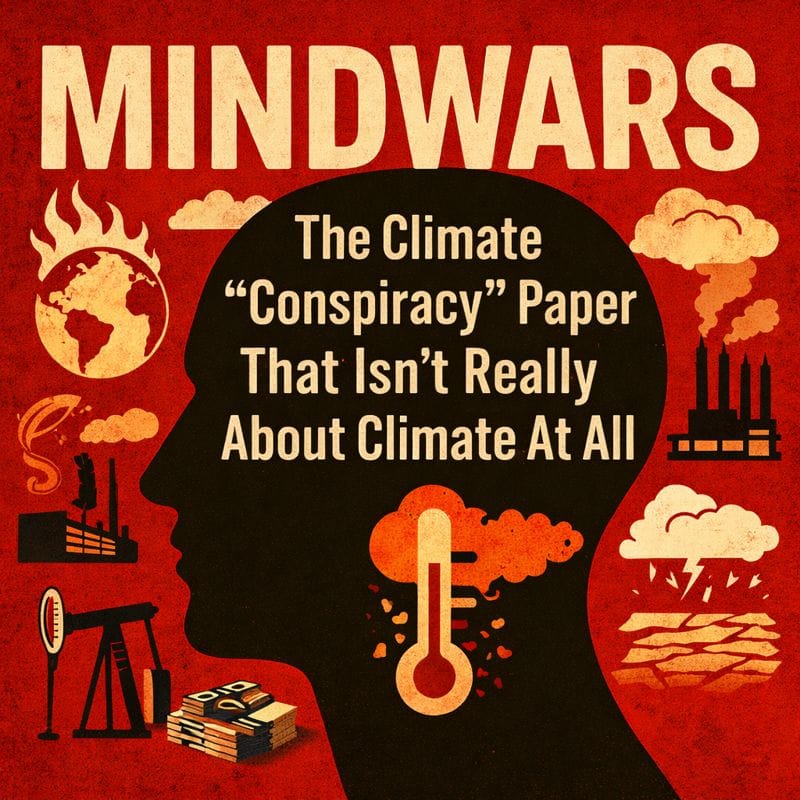
How a “neutral” psychology study quietly turns climate distrust into a mental problem instead of a political one.
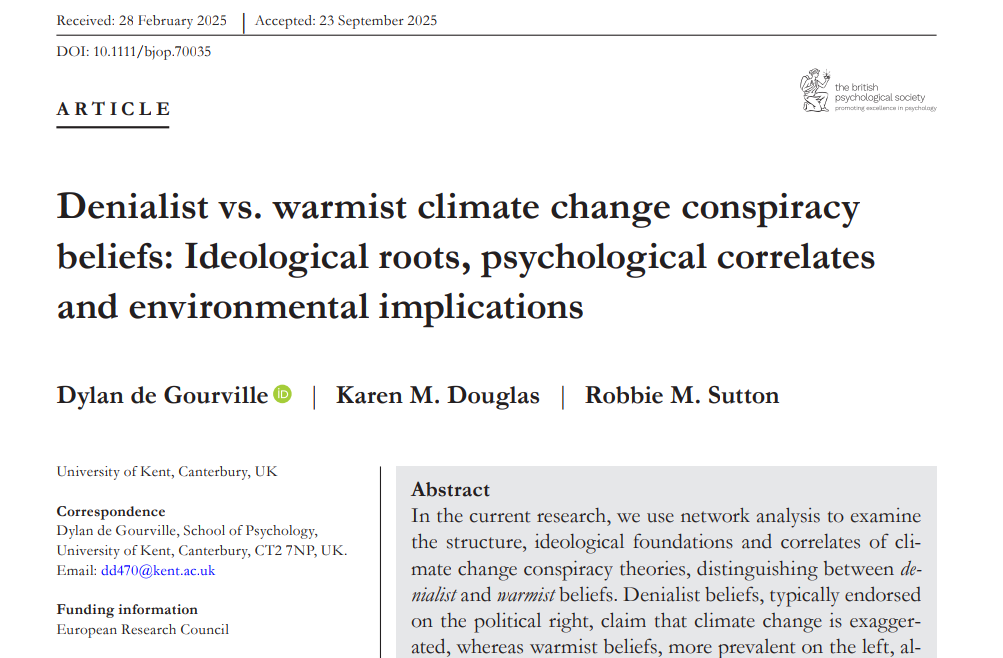
In the last series of Mindwars instalments, we parked on the ERC project CONSPIRACY_FX as one of Europe’s central command nodes for “conspiracy-theory management”: a five-year Advanced Grant whose job is to map the “effects” of conspiracy talk on politics, health and climate. The new British Journal of Psychology paper by Dylan de Gourville, Karen Douglas and Robbie Sutton – “Denialist vs warmist climate change conspiracy beliefs: Ideological roots, psychological correlates and environmental implications” – is one of the climate-facing tiles in that mosaic. (Research at Kent)
This piece connects the grant machine to that specific article and asks a simple structural question: what is this apparatus actually doing in the climate field, and for whom?
The ERC lab for “conspiracy effects”
Start with the infrastructure. The University of Kent’s project page describes the ERC grant like this:
“The project is named CONSPIRACY_FX reflecting its focus on the ‘effects’ of conspiracy theories.” (Research at Kent)
Officially, it will track those effects “across… politics, vaccination, and climate change”. (Research at Kent)
Douglas’s own public-facing materials repeat the same frame: a 2022 interview with the Association for Psychological Science has her say,
“I am about to embark on a 5-year project funded by the European Research Council.” (psychologicalscience.org)
The UK Parliament has already been briefed on the output pipeline. In written evidence titled Consequences of conspiracy theories, Douglas and co-authors open with:
“A growing body of research has shown that conspiracy theories can negatively impact individuals and society in a variety of areas.” (UK Parliament Committees)
Taken together, the grant page, the interview and the parliamentary evidence show the same conceptual skeleton:
- Conspiracy theories are framed as a societal hazard whose “effects” must be mapped and, implicitly, mitigated.
- The project is explicitly plugged into policy: producing material for legislatures and advisory bodies, not just internal academic debates. (CORDIS)
- Climate change is one of the key theatres in which this hazard is being characterised.
At the same time, an Annual Review article by Douglas and Sutton – also explicitly acknowledging the ERC grant – builds the definitional spine for this whole operation:
“The first author acknowledges the support of the European Research Council Advanced Grant ‘Consequences of conspiracy theories – CONSPIRACY_FX’.” (ResearchGate)
That paper does doctrinal work: defining “what conspiracy theories are”, which correlates matter, and which consequences are worth tracking. (ResearchGate)
So before we even get to climate, we have:
- A funded infrastructure (ERC, University of Kent).
- A lead lab (Douglas’s social-psychology group).
- A doctrine: conspiracy theories are a general cognitive–social risk category with broadly negative consequences.
The climate tile: denialist vs warmist conspiracies
Into that infrastructure slots the Gourville–Douglas–Sutton paper.
The abstract states that the authors “use network analysis to examine the structure, ideological foundations, and correlates of climate change conspiracy theories, distinguishing between denialist and warmist beliefs.” (Kent Academic Repository)
They define two clusters:
- Denialist beliefs – which, in their words, are “typically endorsed on the political right” and “claim climate change is exaggerated.” (CoLab)
- Warmist beliefs – more common on the left, which allege that climate science is being suppressed or downplayed. (Kent Academic Repository)
Across four studies they then:
- Measure general conspiracy beliefs (classic Diana / JFK-style items).
- Measure climate-specific conspiracies, split into denialist and warmist.
- Add denial of anthropogenic climate change, ideology, and (in some studies) non-rational thinking indices.
- Run regularised network models: which variables sit in the middle; which edges remain once you control for everything else; which beliefs “bridge” between general conspiracism and climate outcomes. (Kent Academic Repository)
The summary pattern, from their own abstract:
- Denialist and warmist beliefs have a weak, unstable positive correlation with each other.
- They link into a central general-conspiracism node.
- General conspiracism and denial of anthropogenic climate change are not directly connected; instead, the path runs through climate-specific conspiracies. (CoLab)
And crucially: they report that they “found no evidence… for an association between climate change conspiracy beliefs and indices of non-rational thinking” – a direct hit on one of the field’s favourite risk frames. (CoLab)
On environmental outcomes, they find a clean ideological split:
- Denialist conspiracies correlate with lower environmental concern, weaker pro-environmental intentions, less policy support, lower collective guilt.
- Warmist conspiracies correlate with higher intentions, greater policy support, and more collective guilt (environmental concern itself is more ambiguous). (CoLab)
So the surface message is: same structural grammar, opposite political direction of travel.
What the machine is doing
Strip away the statistics and we get three structural moves.
Converting heterogeneous distrust into a single risk category
Across Douglas’s portfolio, the move is consistent: diverse narratives are collected under the general heading “conspiracy theories”, and then treated as instances of a single kind of thing with largely negative consequences. (ScienceDirect)
Conspiracy_FX is explicit about this: it is organised around the “effects” of conspiracy theories, not around whether any of the suspicions are correct. (Research at Kent)
The climate paper extends that logic:
- Denialist climate conspiracies: “the scientists are faking it”, “global warming is a hoax”.
- Warmist climate conspiracies: “governments and fossil companies are hiding the damage”, “the system is underplaying the risk”.
One side clearly shields fossil-fuel incumbents; the other aligns with decades of documented evidence that the fossil industry ran a “multi-billion-dollar disinformation campaign” to cast doubt on climate science and block action. (Wikipedia)
Yet both become instances of “climate change conspiracy beliefs”, a single analytical class to be explained by general conspiracism, ideology and (in most of the wider literature) non-rational thinking.
Structurally: the apparatus is performing category work. It takes very different distrust stories and pins them to one diagnostic label, which then travels across policy briefs, media interviews, and commission reports.
Installing a behavioural dashboard for climate governance
The second move is to hook that category directly into a climate-governance dashboard:
- Do these beliefs increase or decrease acceptance of human-caused climate change?
- Do they help or harm pro-environmental behaviour and policy support?
Those are exactly the outcome variables in the Gourville–Douglas–Sutton paper, and they match the concerns laid out in the parliamentary evidence about conspiracy theories harming “work life, medical choices and political engagement.” (Kent Academic Repository)
In other words:
- Institutional climate science and policy are treated as fixed points.
- Public belief configurations are evaluated by how much they threaten or support that system.
That is not a criticism; it is a description of function. The Conspiracy_FX cluster is acting as a behavioural sensor array for climate governance: feeding in where distrust lives, which side of the spectrum it inhabits, and what it does to compliance.
Maintaining a “both extremes are risky” symmetry
On paper, the climate article acknowledges asymmetry: denialist conspiracies on the right undermine climate action; warmist conspiracies on the left often enhance it.
But the framing keeps pulling them back together as two versions of the same underlying problem: “climate change conspiracy beliefs” linked to the same general conspiracist worldview.
The effect is a familiar triangle:
- Right-wing denialist bloc – conspiracies that climate change is exaggerated, hoax, elitist plot.
- Left/green warmist bloc – conspiracies that fossil firms and governments are hiding the severity of warming.
- Implied reasonable centre – accepts climate science, distrusts “conspiracy theories” on both sides, and is therefore coded as rational.
The centre is never named as an actor, but it is the silent beneficiary: the position that does not appear on any of the risk graphs.
Blocs, sub-trades and positioning
If we name the blocs in plain language, the map looks like this.
Bloc 1: The Kent conspiracism lab + ERC
- Who: Douglas’s group and collaborators at Kent; the wider social-psychology of conspiracy network; ERC as principal funder.
- Mandate: build definitions, measures and effect estimates for conspiracy beliefs across domains, with explicit focus on politics, health and climate. (Research at Kent)
- Sub-trades:
- Scale designers: people who write and validate the conspiracy belief scales.
- Network technicians: those running and interpreting LASSO networks, centrality metrics, edge stability.
- Policy translators: authors of parliamentary evidence and popular summaries.
Inside this bloc there is a micro-fracture:
- On one side, the generalist camp: conspiracy beliefs are one big system; general conspiracism sits at the centre; domain differences are cosmetic.
- On the other, a quiet content-sensitive edge: papers like the climate one show that denialist and warmist beliefs behave differently depending on ideology and outcome, and that non-rational thinking doesn’t always play the role predicted.
The climate paper manages this fracture by reaffirming the generalist doctrine in the introduction but letting the results section show a messier, more context-dependent reality.
Bloc 2: Climate-governance institutions
- Who: national environment ministries, EU climate directorates, IPCC-adjacent expert networks, science-advice bodies.
- Objectives:
- Keep the scientific consensus on human-caused warming as the uncontested baseline. (Bohrium)
- Increase public support for mitigation policies.
- Identify belief structures that undermine that support.
For this bloc, work like Gourville–Douglas–Sutton is useful because it labels specific clusters of citizens as behavioural risks:
- Right-wing denialist conspiracists: less likely to accept science, less likely to support policy.
- Left-wing warmist conspiracists: more likely to act, but still coded as “conspiracists” whose distrust of institutions may be a long-term liability.
Bloc 3: Fossil-capital and the denial industry
- Who: major oil, gas and coal firms; their trade associations; political allies; media outlets that sell denial as a product.
- Documented behaviour: running long-term campaigns “denying climate change and spreading doubt on climate science… aimed at blocking climate action and phasing out fossil fuels.” (Wikipedia)
In the climate paper, this bloc appears only indirectly: as the implied villain in warmist items. There is no structural analysis of how this industry manufactures the very denialist narratives that then show up as “beliefs” in the survey battery.
That omission is part of the pattern: the production side of denial is kept offstage; the focus is on consumption (what individual citizens believe).
Bloc 4: Conservative denialist publics
- Who: respondents on the political right, in the US/UK context, endorsing denialist climate conspiracies.
- Positioning: portrayed as endorsing beliefs that exaggeration is the norm, climate science is alarmist, climate policy is a tool of control. (Kent Academic Repository)
- Behavioural profile: lower climate concern and lower support for mitigation.
The apparatus treats them almost entirely as targets for correction, not as agents embedded in a media–party–industry information system.
Bloc 5: Left/green warmist publics
- Who: people who accept anthropogenic climate change but suspect that governments and corporations are hiding or downplaying the severity.
- Behavioural profile: higher climate concern and stronger policy support, at least in the short term. (CoLab)
Here the structural complication appears:
- Their behaviour aligns with climate-governance objectives.
- Their framing (talk of cover-ups, suppression, captured regulators) aligns with the language of conspiracy.
The Conspiracy_FX lens responds by keeping them inside the “conspiracist” category, even while acknowledging their pro-climate actions. That maintains a discursive boundary: criticism of corporate/state behaviour is permitted as long as it doesn’t claim coordinated deception.
Microfield fractures: where the cracks are showing
Three intra-guild tensions are visible.
Doctrine vs data on monological conspiracism
The field’s core story has been: people who believe one conspiracy theory tend to believe others; conspiracism is monological. That story underpins many Douglas-linked outputs and is key to the ERC project’s generalist scope. (ScienceDirect)
The climate paper, however, repeatedly finds:
- Denialist and warmist beliefs are only weakly correlated.
- Once you account for general conspiracism and ideology, the direct link between the two can vanish or wobble. (Kent Academic Repository)
This doesn’t make the doctrine collapse, but it downgrades its explanatory power: the interesting structure is in the content (who is suspected of what, in which domain) and in the ideological alignment, not just in the general conspiracist disposition.
The way the article writes around this – keeping the generalist language while reporting domain-contingent dynamics – is classic microfield behaviour when a core doctrine is under strain but still institutionally useful.
Cognitive-deficit framing vs null results
A second tension is more direct.
The ERC architecture and much of the surrounding literature lean heavily on non-rational thinking – magical ideation, intuitive thinking styles – as a key driver of conspiracy beliefs. (CORDIS)
The climate article finds no association between those non-rational indices and climate conspiracy beliefs, across four studies. (CoLab)
Structurally, that does two things:
- It weakens the cognitive-deficit story for this domain: climate conspiracism here is not just a function of “how irrational you are”.
- It pushes responsibility back towards ideology and content: which side of the spectrum you’re on; whether you think the system is exaggerating or hiding.
This is the kind of null result that, if taken seriously, would shift the field away from treating conspiracy beliefs primarily as a psychological defect.
Symmetry story vs asymmetric power
A third fracture is between the symmetry story – “two kinds of climate conspiracy, one on each side” – and the underlying power asymmetry.
On one side:
- Denialist narratives are tightly coupled to known fossil-industry disinformation strategies and partisan media ecosystems. (Wikipedia)
On the other:
- Warmist narratives point at actors (oil majors, governments slow-walking action) whose history of downplaying climate risk is well documented.
Put bluntly: one side protects incumbents; the other accuses them of doing exactly what historical records show they’ve done. Yet both get parked in the same conceptual bucket.
The climate paper’s symmetry is quite careful – it doesn’t pretend the two clusters are equally helpful – but by sticking with “climate change conspiracy beliefs” as one class, it keeps warmist suspicion half-inside the pathology tent.
Where this sits in the wider Mindwars script
Seen from above, this is how the script currently runs:
- Brussels funds an expert network (Conspiracy_FX) to map the consequences of conspiracy theories across politically sensitive domains. (CORDIS)
- That network defines conspiracy theories as a general category with largely harmful effects and builds the measurement tools. (ScienceDirect)
- In the climate arena, it splits public distrust into two named clusters – denialist and warmist – but keeps both under the same risk label.
- It then quantifies how each cluster affects climate engagement, producing neat tables and network graphs ready for policy slides. (Kent Academic Repository)
- Along the way, it quietly records anomalies (no non-rational link; warmist conspiracies often boosting policy support) without letting them rewrite the overarching story.
The beneficiaries are straightforward:
- Academic psychology in the Atlantic core gains centrality as the guild that diagnoses and classifies “conspiracist” publics.
- Climate-governance institutions gain a behavioural map of which segments are obstacles or partial allies.
- Fossil-capital and allied elites are rarely named as active manufacturers of narratives; their role is mostly backgrounded, especially on the denialist side.
Those on the losing side are equally clear, structurally:
- Right-wing denialist publics are treated purely as misinformed, with almost no analysis of the upstream media-industrial machinery that manufactured their beliefs.
- Left/green warmist publics are pushed into an ambiguous bucket: behaviourally helpful, discursively suspect, and always one step away from being problematised if their suspicion of institutions becomes too pointed.
None of this requires hidden malice. It’s what happens when you hand a large, well-funded behavioural guild a mandate to study “the effects of conspiracy theories” and plug its output straight into governance channels: the power to define what counts as justified suspicion vs pathological conspiracy quietly migrates to the lab.
Published via Mindwars Ghosted.
Mindwars: Exposing the engineers of thought and consent.
—
Author’s Note
Produced using the Geopolitika Ai analysis system—an integrated framework for structural interrogation, elite systems mapping and narrative deconstruction.