Mindwars: The Dual Templates –QAnon Entrapment and MINDSPACE Compliance as Mirror Architectures of Belief Management
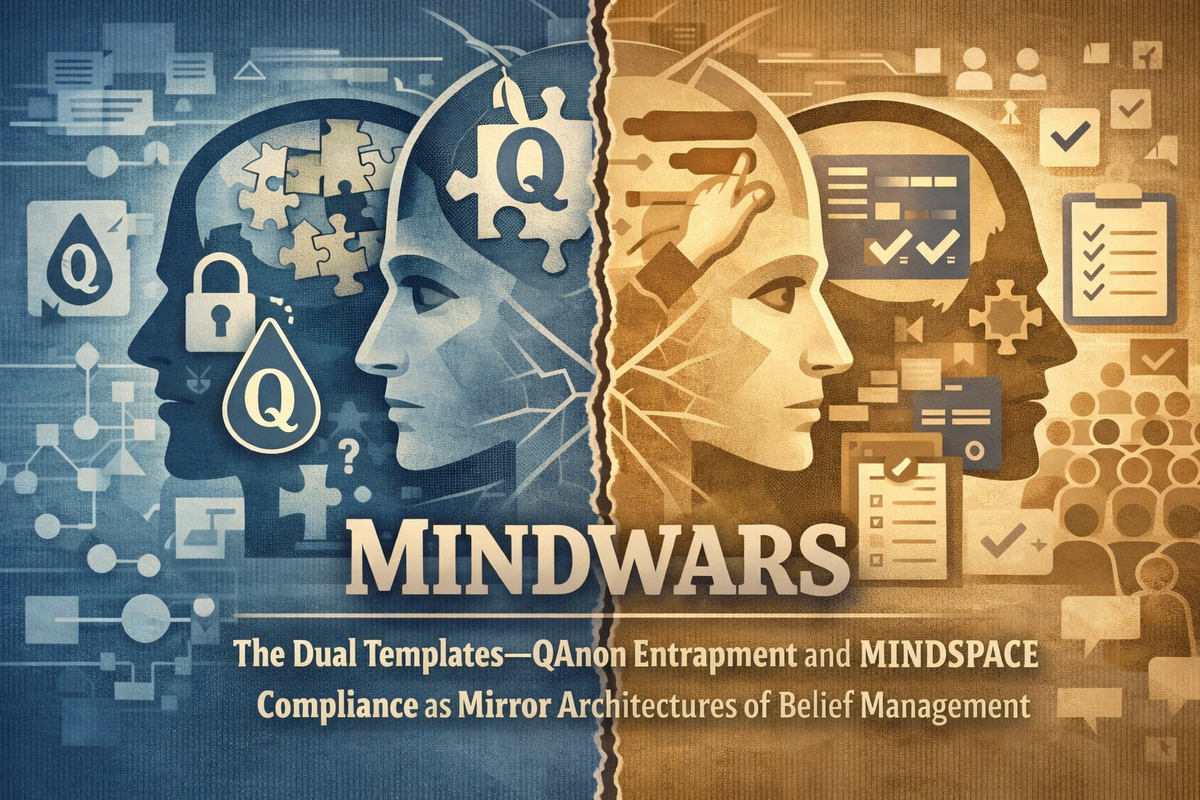
Thesis: QAnon and MINDSPACE are not ideological opposites. They are mirror architectures in the same belief-management system—one captures and demobilises distrust, the other steers compliance—with Conspiracy Theory Theory (CTT) acting as the bridge that harvests fallout from the first to justify expansion of the second.
Earlier Mindwars pieces pulled apart two halves of this system separately: CTT as the field that turns suspicion into a cognitive risk category, and The Soft Cage’s behavioural state—MINDSPACE, nudge units, defaults—as the quiet operating system for compliance. This article brings a live object, QAnon, into that frame and treats it as the missing counterpart: the template for managing those who no longer trust the system at all.
What is presented here is a functional model, not a causal history. It examines how certain patterns operate and what they systematically produce—regardless of whether those outcomes were ever intended. The argument focuses on stabilised results arising from predictable incentives, not on evidence of a single plan or coordinating actor. Talk of “symmetry” here, refers to a shared set of behavioural levers—authority, norms, defaults, affect, identity lock-in—not to any equivalence of truth, morality, or intent. A “template” being a recurring behavioural pattern with stable levers and predictable outputs, independent of the specific story content.
The Trap That Won’t Die
It’s late 2025 and QAnon should, in theory, be over. The drops stopped years ago and the storm never came. There were no tribunals, no mass arrests and no Guantánamo spectacles. Trump cycled through defeat and candidacy again and the promised reckoning remained prophecy. Yet the ghost refuses to leave the machine—because Q was never only a prediction; it was a grammar for distrust.
Scroll X and that grammar is still in play. One account shares a PhD thesis framing QAnon as a psyop that morphed into an “American religion”, radicalising “conspiracy-brained lunatics” into mainstream MAGA. Another dismisses a pro-life post as “QAnon psyop slop”, calling believers “fools”. A third ties the whole thing to Rothschild “faked deaths” in a “QAnon psyop”, invoking elaborate elite games. These are not relics from 2017–2021, they are fresh fractures in a narrative that refuses to die even as QAnon’s core predictions—mass arrests, “the storm”—collapsed after January 6. On X, Q survives as fragments: DUMBs, “child rescue ops”, “comms”, coded insinuations. Users fight over what it was: a trap, a religion, a grift, a clumsy awakening that red-pilled people then stranded them in a maze. That argument is itself part of the spectacle. The feed is no longer watching Q; it is watching people watching Q—recycling suspicion as entertainment and keeping the grammar alive long after the plot has failed.
This article connects that loop to a second one (loops being the user-level cycle a template induces—input → reinforcement → output → reset). It does not claim QAnon was necessarily state-run or centrally designed. The origin story remains contested—LARPers, admins, grifters, true believers, maybe state-adjacent actors. The point here is structural: what the pattern does once it exists, how it captures distrust, keeps people busy and makes its own fallout useful elsewhere.
Across the glass sits something almost opposite in tone: MINDSPACE and the broader nudge infrastructure. What began as a 2010 UK Cabinet Office framework for influencing behaviour has grown into a global behavioural governance layer: BIT and its clones advising governments, departmental nudge units shaping letters and apps and platforms applying the same logic to UX defaults, prompts and friction in the name of engagement, safety or wellbeing. Where Q offers a myth of hidden war and future justice, MINDSPACE offers a toolkit: messenger, norms, defaults, affect. Different aesthetics, similar ambition—shape population behaviour at scale.
From altitude, these are two dominant interfaces within a single belief-shaping ecosystem. The Q-template tends to gain traction where trust in official institutions has already failed. It absorbs disgust at corruption and abuse, then channels that energy into puzzle-solving, in-group status and saviour-waiting. Its signature output is high certainty with low material mobilisation—a sense of being informed while attention is held inside a self-referential theatre.
The MINDSPACE-template, by contrast, describes a family of routine governance techniques that operate most effectively when citizens either grant baseline legitimacy to institutions or lack the bandwidth to contest them. It converts contested choices into frictionless flows: defaults, norm cues, trusted messengers and affective framing that make the preferred path feel normal and low-risk, and dissent feel costly, selfish or unsafe. Its signature output is not belief certainty but behavioural alignment achieved without sustained argument over trade-offs.
Yet these are not sealed compartments and the audience categories are porous. A committed Q-believer may still glide through MINDSPACE defaults in domains outside their core suspicion—tax settings, licence renewals, app permissions, banking and workplace compliance. Conversely, a generally compliant citizen may be pulled into Q-adjacent scepticism around a single high-emotion trigger: child abuse panics, war, surveillance, medical risk. The templates are defined less by who they exclusively capture than by the primary cognitive work they perform: one spectacularises and contains distrust; the other smooths and operationalises compliance. Most people live under mixed governance: pulled more strongly by one template, intersecting the other opportunistically, sometimes cycling between them across domains. The mirror is therefore not a map of two populations, but a map of two recurring designs—both capable of running in the same person, at different times, in different contexts, with different intensities.
Between them sits Conspiracy Theory Theory (CTT): the research–policy complex that treats “conspiracy belief” as a measurable social risk. Internally it splits between generalists (trait-based measurement and correlation) and particularists (case-by-case evaluation). Both camps treat QAnon as a paradigmatic bad case; institutionally, generalists dominate, and Q becomes prototype harm.
CTT functions as middleware: it studies Q and Q-adjacent beliefs, catalogues damage and then feeds interventions—prebunking, resilience training, pattern detection—into behavioural governance as justification for scaling nudges. The loop is simple: Q contains distrust as spectacle, CTT harvests the worst examples as proof of risk, MINDSPACE expands under the banner of safety. Anyone resisting both scripts becomes easier to profile as the problem.
Two Architectures in Brief: Q Template vs MINDSPACE Template
Before origins, clones and downstream consequences, strip this to function—what each template does to a target audience once it is in motion.
QAnon as Distrust Entrapment
Remove the lore and the Q pattern is compact: a small set of moves, endlessly recombined.
- Puzzles: Cryptic drops, numerology, deltas, maps, “comms” to decode. The environment is reframed as signal-rich and only the initiated can read it.
- Saviour outsourcing: Trump, “the alliance”, “white hats”, military patriots offstage. Believers are told they are righteous participants while decisive action is always delegated to hidden actors.
- In-group ego: “Red-pilled patriots”, “digital soldiers”, “do your own research”. Status comes from being awake and loyalty is measured through repetition and public alignment.
- Delayed action: “Trust the plan.” “Enjoy the show.” “Any day now.” Urgency is maintained while agency is deferred, and the decisive moment never arrives in the present tense.
- Vengeance fantasies: Tribunals, executions, perp-walks, public humiliation of the “cabal”, often spliced with recycled tropes that intensify moral charge and narrow what feels thinkable.
Functionally, this is an entrapment architecture for distrust (architectures here being the set of affordances, incentives and messaging structures that make a template easy to enter and hard to exit—platform features, institutional routines, social rewards). It takes a plausible starting point—something is wrong—and routes it into a loop of labour (decoding and threading), identity (patriot status), and waiting (for the storm). The output is energy expenditure that feels like action while leaving material levers of power largely untouched. Suspicion becomes a hobby with stakes, and the hobby becomes a self-sealing world.
MINDSPACE as Compliance Steering
If the Q-template is a noisy script for those who no longer trust institutions, MINDSPACE is a quiet script for those who still do—or those too overloaded to contest them.
MINDSPACE, coined in a 2010 UK Cabinet Office report, names behavioural levers:
Messenger, Incentives, Norms, Defaults, Salience, Priming, Affect, Commitments, Ego. Operationalised by the Behavioural Insights Team and widely copied, it now sits inside government “nudge units”, platform UX and public campaigns spanning health, climate, finance and “democracy resilience”.
The typical cases are banal precisely because they work.
- Auto-enrolment pensions: Default: you’re in. Opt-out requires effort. Norms messaging: “Most employees stay enrolled.” Defaults + Norms.
- Health campaigns: Trusted doctors, local statistics, “protect your loved ones” framing. Messenger + Norms + Affect.
- Tax and fines letters: Official letterheads, bold deadlines, penalties highlighted, “most people pay on time”. Messenger + Incentives + Salience + Norms.
Functionally, MINDSPACE converts “I’ll do it later” into frictionless compliance with pre-chosen policy. Instead of prophecy, you get design: make the desired behaviour the easiest path, make it feel normal and approved, and colour deviations as risky, selfish or shameful. The mechanism is not persuasion through argument, it’s behavioural routing through choice architecture.
Legitimacy spectrum (guardrail)
Behavioural design is not automatically illegitimate. Its legitimacy depends on how it is deployed. In this context, a nudge is closer to legitimate governance when it satisfies five conditions:
- Transparency: the lever is disclosed and intelligible (no covert steering).
- Reversibility: opt-out is real, low-friction and does not trigger punitive side effects.
- Contestability: citizens can challenge the policy, the framing and the evidence without being penalised.
- Symmetry: the same scrutiny applied to citizen cognition is also applied to institutional messaging, defaults and data use.
- Proportionality: the strength of the lever matches the severity and certainty of the risk.
The critique provided here targets deployments that fail these conditions—especially where defaults and affect substitute for explicit political contestation.
Intent vs Convergence
At this point a reader can slide into a grand unified psyop claim: “they built Q to mop up the distrustful and MINDSPACE to steer everyone else.” That is emotionally neat and analytically lazy. This article is not claiming central authorship or coordinated design.
What matters is simpler.
- Different actors dominate each side: Q-side: chan administrators, grifters, influencer subcultures, movement entrepreneurs.
MINDSPACE-side: behavioural units, policy teams, UX designers, platforms and researchers. - Similar levers recur: Identity, belonging, fear, hope, authority, norms, defaults, emotional framing. The audiences differ and the declared reasons differ—awakening versus safety, patriotism versus public health.
A single mastermind is unnecessary for alignment. Once you have a behavioural toolkit, large data flows, and institutions incentivised to reduce friction and dissent, you should expect convergent designs: different guilds independently discovering architectures that neutralise distrust and smooth compliance. The symmetry argued here is functional, not evidentiary proof of a central plan.
The Mirror Table: Same Levers, Opposite Audiences
|
Lever |
Q-template
(Distrust Entrapment) |
MINDSPACE-template
(Compliance Steering) |
Shared
structural function |
2025-style
instantiation |
|
Messenger |
Anonymous “Q” plus selected influencers
framed as insiders |
Trusted experts, officials, NGOs, platform-endorsed
creators |
Authority outsourcing—belief routed through a
credentialed voice |
Doctors fronting health reels; anon “insider”
accounts decoding “comms” |
|
Norms |
“Patriots”
vs “sheeple”, loyalty tests, fear of excommunication |
“Most people like you already do this”, majoritarian statistics |
Conformity pressure—cost of standing outside the
group |
WWG1WGA tags; “80% updated their digital ID”
messaging |
|
Defaults |
Default is to wait and watch: “trust the plan” |
Default is opt-in: auto-enrolments, pre-ticked paths |
Friction shaping—easiest path matches preferred
behaviour |
Endless “storm” anticipation; schemes you
must actively refuse |
|
Salience / Priming |
Drops, numerology, headline collation keep attention
locked |
Repeated slogans, prompts, UI emphasis, warning
screens |
Attention capture—one frame becomes cognitively
sticky |
DUMBs map threads; “resilience” taglines
across apps and portals |
|
Affect |
Fear, disgust, hope of total justice |
Fear of disease, climate, insecurity plus
reassurance cues |
Emotional steering—narrowing acceptable responses |
Child-trafficking panic posts; heatwave and
long-COVID campaigns with “do your part” |
|
Commitment / Ego |
Q handles, oaths, confessionals, “awake”
status to protect |
Badges, pledges, profile frames, public compliance
signalling |
Identity lock-in—public alignment hardens future
choices |
“Digital soldier” identities; campaign frames for health, climate, democracy |
Different content, different declared aims—same grammar: pick a messenger, define the norm, set the default, control salience, steer with emotion, lock it to ego. From here, the analysis can zoom into the Q containment loop, the compliance engine and the CTT bridge that translates one into justification for the other.
The Q-Side Loop: From Suspicion to Spectacle
The Q-template can be sketched on paper, but its real power is in motion. Forget the endless debate about origins—whether it was a prank, a grift, an op, or some tangled combination—that noise misses the signal. What matters is the durable function: to take raw distrust, make it feel like empowerment, and funnel it into a closed loop. While the loop burns attention like fuel, it generates almost no real leverage against the institutions it claims to oppose.
The Q Loop
The loop begins with a reasonable intuition: something feels wrong, power is opaque, corruption exists and institutions lie. In contexts where contestation is possible and information is easier to verify, that impulse can mature into investigation, organising, litigation, whistleblowing, parallel institutions. Under the Q-template, it is more often redirected into spectacle—puzzle labour, in-group identity, deferred agency—especially under low trust and engagement-optimised feeds.
1) The hook appears. A cryptic drop, meme, thread or video lands in a feed. It is vague but suggestive: hints of a hidden plan, coded battles, elites exposed. The world is reframed as scripted rather than contingent, and the audience is invited to treat interpretation as participation.
2) Decoding labour begins. Pattern-hunting starts: deltas, numerology, headline collages, “comms” embedded in mainstream clips. It feels like research. The labour is self-contained because the puzzles almost always point back into the narrative rather than out toward verifiable targets, actionable claims or falsifiable tests.
3) In-group status locks in. Identity follows effort. The participant becomes an “awake” patriot or “digital soldier”, and social spaces reward performance: threads, screenshots, certainty, loyalty. Ego investment rises; admitting error risks loss of story and loss of community.
4) Saviour outsourcing. The heavy lifting remains offstage. Trump, “the alliance”, “white hats” are said to be acting in secrecy, and the believer’s job becomes awareness-spreading, decoding, waiting. Agency is deferred upward because “trust the plan” translates urgency into spectatorship.
5) Permanent delay. The decisive moment is always imminent and never now. Dates arrive and pass: elections, certifications, tribunal windows, supposed activation cues. When nothing happens, it is reframed as enemy disinformation, operational secrecy, a test of faith. The loop resets without admitting falsification.
6) Spillover, burnout, fragmentation. Most participants stay inside the theatre. A minority spills into offline confrontations or security incidents, and another portion burns out and drifts into successor myths that reuse the same grammar. The loop’s persistence is not proof of truth, it is proof of retention design.
This feels like empowerment: fighting evil from a screen. Structurally it is a closed circuit that converts suspicion into busywork, and busywork into a durable identity. Potential organisers and disciplined investigators are pulled into an endless alternate reality game where the next level always exists and the endpoint never arrives.
The payoffs are real: community, mission, status, coherence under chaos. The constraint is that they are self-contained—the community mostly talking to itself. The mission is defined by narrative maintenance. Cognitive effort is spent solving puzzles that circulate inside the story rather than forcing contact with institutions on terms that can actually bite.
The loop is also infrastructural. Social media platforms surface hooks through recommendation systems tuned for arousal and engagement, and they gamify decoding through metrics and performative affordances. Group tools harden identity, while low-friction account creation enables endless prophets and splinters. The entire circuit is rewarded for staying on-screen rather than building external capacity.
Pattern Clones: A Trap Network, Not a Single Cult
QAnon was not unique, it was a successful instantiation of a reusable template. Clones mutate content while keeping the underlying moves: puzzles, saviours, in-group ego, delay, vengeance. This adaptability matters because it continuously regenerates spectacle even after particular predictions fail.
- DUMBs (Deep Underground Military Bases). Real bunkers and continuity-of-government infrastructure are reimagined as a global underworld of trafficking hubs and covert battles. Earthquakes become “cover” for rescues or demolitions, and the labour is mapping: charts, satellite imagery, blurry clips, “insider” claims. The saviour is underground patriots, the delay is ongoing ops, the vengeance is the cabal destroyed in tunnels. The audience stays busy interrogating fictional operations while the real institutional questions around secrecy, procurement, black budgets and oversight remain largely untouched.
- NESARA/GESARA and QFS-style utopias. Class anger is routed into an economic prophecy: secret laws, debt jubilee, gold-backed resets, quantum finance. The puzzle is activation dates and coded financial “signals”, the saviour is a hidden alliance enacting the jubilee, the in-group is those “in the know”, and the delay is perpetual imminence. The social output is calendar-watching and passive anticipation rather than organised demands, union activity, regulatory pressure or targeted litigation.
- Modular imports. Sovereign citizen pseudo-legalism turns courts into ritual stages where failure reinforces identity and parody illustrates institutional illegitimacy. Pizzagate offers a trafficking panic grammar that ports cleanly into later narratives. ARG predecessors show how puzzles can recruit high-skill solvers without delivering material payoff. The content differs, the loop persists.
The point is not that all these stories are identical, it is that they are plug-compatible. The same mechanism can absorb new grievances, refresh engagement and keep distrust in a managed theatre.
What Gets Extracted from the Q-Side
Treat the Q-side as an extraction machine and several outputs become predictable.
- Contained energy: Anger at real issues is diverted into decoding marathons and identity tribes. Time, attention and agency that might have become whistleblowing, lawsuits, organising or institution-building is sunk into narrative upkeep.
- Contaminated topics: Some suspicions that deserve scrutiny become harder to raise without stigma. Trafficking, elite abuse networks, intelligence overreach, black budgets, deep-bunker infrastructure get pre-tainted by adjacent lore, and a few keywords can trigger dismissal as “that sounds like Q”.
- Vivid harms as policy inputs: The loop reliably produces family breakdowns, financial ruin, rare but dramatic extremism and generalised non-compliance. Those are high-value artefacts for downstream actors: they can be counted, narrated, surveyed, used in training modules and held up as proof that uncontrolled suspicion is a public risk.
That last output matters because it becomes the bridge to the mirror’s other half.
The MINDSPACE Loop: From Apathy to Frictionless Compliance
If the Q-template captures distrust through drama, MINDSPACE captures the busy majority through design. It does not need prophecy or villains. It shapes the environment so the preferred path is easiest, most salient, most socially protected. The subject need not be convinced, only routed.
The Compliance Flow
The loop starts from bandwidth scarcity: people are distracted, overloaded, time-poor. Institutions do not need to win long arguments if they can control defaults and the cost of refusal.
1) A hook dressed as paperwork: The policy arrives as a form, prompt, letter, “helpful” campaign. Language is low-friction: update your details, keep access, protect your community. The timing targets moments of low attention: renewals, deadlines, service access.
2) Friction steering begins: Defaults do most of the work: auto-enrolment, pre-ticked boxes, buried opt-outs, prompts at chokepoints. Norms messaging reinforces: most people have already upgraded, most people pay on time. Salience highlights the cost of saying no: delays, checks, reduced access, penalties.
3) Ego and commitment lock in: Public cues cement the move: badges, ticks, “trusted” status, dashboards showing contribution. Messenger selection is deliberate: doctors, local leaders, official-looking interfaces, “independent” overlays. Identity is recruited: responsible, modern, pro-social people comply.
4) Affect and priming seal the path: Emotional colouring narrows acceptable responses: fear of being locked out, pride in being safe, shame at being irresponsible. Repetition through notifications and banners makes the frame ever-present without being formally coercive.
5) Normalisation: Once uptake passes a threshold, the behaviour becomes background. The ID is just how services work, the module is just digital literacy, the prompt is just safety. Success is logged as metrics, and metrics become the justification for reuse.
6) Quiet resistance becomes a dataset: A minority opts out, complains, litigates, organises. Their behaviour is treated as an edge case to be measured and modelled, not necessarily as a political argument to be answered. The system learns by tracking the cost curve of refusal.
This is not mind control. It is governance by inertia: exploiting bandwidth economics, default bias and reputational pressure. The architecture feels voluntary because the subject is always “free” to choose, and the price of refusal is structured to be annoying rather than dramatic.
Concrete 2025-Style Use-Cases
Three fronts illustrate the mechanism without needing a grand theory.
- Digital ID and payment rails: Rollouts lean on automatic migration, buried opt-outs and warnings about fraud or disruption. Norms messaging frames upgrade as civic hygiene, and non-compliance becomes escalating friction: extra checks, reduced access, eventual penalties.
- Climate and mobility regimes: Policies are packaged as lifestyle and health improvements, with doctors, mayors and “community leaders” as messengers. Visual salience does framing work, and objectors are coded as selfish, backward or misinformed. The shift arrives as design changes in daily pathways rather than contestable decisions.
- Post-election resilience and AI prebunking: After contentious votes, prebunking modules teach users to recognise “Q-like” cues: cryptic insiders, all-explaining plots, child-abuse panics, deepfake threats. The declared aim is preventive, and the operational effect is to pre-emptively narrow what frames feel legitimate to ordinary users.
Across these cases the target is the median citizen, not a committed dissident. The aim is pre-emption: shape the environment so most people never seriously entertain non-approved frames in the first place.
Nudge Data as Fuel
Each intervention functions as an experiment: A/B testing subject lines, rotating messengers, shifting defaults, comparing uptake. The resulting data becomes optimisation fuel inside institutions and public justification outside them. Over time, behavioural design becomes the default governance posture and slow contestation looks inefficient.
What Gets Extracted from the MINDSPACE Side
The compliance side yields predictable outputs: high adherence with minimal confrontation, normalisation of steering as “evidence-based”, a self-financing loop where citizen data improves the apparatus, and a clean marginalisation channel for dissenters who can be profiled as edge cases or risks.
CTT as Bridge and Immune System
Conspiracy Theory Theory (CTT) does not function here as a neutral descriptive field. Through its dominant framings and downstream uptake, it operates at the seam. Q-style ecosystems generate high-contrast harms; behavioural governance offers low-friction steering tools; and CTT’s “effects” framing makes it easier for institutions and platforms to treat the former as a standing mandate for the latter.
One visible artefact of that seam is the CONSPIRACY_FX research database: an indexed bibliography of conspiracy-theory research in which QAnon repeatedly appears as a paradigmatic high-salience case across extremism, health compliance, platform dynamics and hate motifs. What matters is not that CONSPIRACY_FX “targets QAnon”, but that the CTT structure treats QAnon as a portable reference example—a template case supporting generalisable claims about conspiracism’s effects. In practice this means the field’s most legible outputs—catalogues, measures, typologies, intervention rationales—often get calibrated on QAnon-like properties even when the nominal topic is broader. (CONSPIRACY_FX bibliography extract, Sep 2024)
Harms Harvesting from Q
Q-style ecosystems reliably generate artefacts that are legible to researchers and useful to institutions: family breakdowns, burnout, dramatic incidents, health non-compliance, hate motifs. This is visible inside the CONSPIRACY_FX corpus itself. The database indexes QAnon across multiple literatures:
- Platform diffusion studies (Voat, Telegram, Twitter)
- Rhetorical analyses (violent language, cultic framing)
- Canonical-drop datasets
- Survey experiments on support drivers
- Chapters linking QAnon to security and democratic concerns.
The result is that QAnon becomes a key exemplar for “high-impact conspiracism”: the case that makes harms concrete enough to justify measurement, prediction and intervention. (Papasavva et al., “Qoincidence” Voat study, 2020; Walther & McCoy on Telegram, 2021; Aliapoulios et al., “Gospel according to Q”, ICWSM 2022)
These outcomes are treated as evidence of a broad “conspiracism” problem rather than as the product of a particular retention architecture embedded in specific platforms and incentives. That framing matters, because it shifts attention from design-level questions—affordances, algorithmic rewards, engagement incentives—toward trait-level questions about the users.
Antisemitic motifs are central here because they function as both moral and policy accelerants. In the CONSPIRACY_FX corpus, QAnon is repeatedly situated near older “world conspiracy” and blood-libel lineages, or is treated as a pipeline into hate-coded imaginaries. Once QAnon is positioned within that lineage, the problem is no longer “misinformation” or polarisation; it becomes a risk pathway—something that warrants pre-emptive tools applied broadly rather than case-by-case argument. (Cosentino, 2020; Schuller, 2021; Thompson & Davis, 2021)
From Harms to Steering Mandates
The translation step is familiar: Q shows dangerous outcomes, therefore the public must be protected with proactive tools. CONSPIRACY_FX’s organising question is precisely this translation—when and how conspiratorial narratives become behaviourally consequential, and which interventions measurably reduce uptake or spread. QAnon’s prominence in the corpus supplies the proof-of-concept case that makes such intervention programmes politically saleable.
Trait measures and risk scales compress heterogeneous suspicion into a single score and tend to blur the line between:
- Justified mistrust rooted in real institutional lies or cover-ups
- Baroque fantasies about omnipotent cabals.
From there, outputs feed resilience curricula and prebunking and justify platform governance layers: classifiers trained on “Q-like” patterns, warning labels, downranking, prompts, approved messengers. (Beene & Greer, 2021; Engel et al., 2023; Monti et al., 2023)
The declared purpose is safety. The operational consequence is expansion of behavioural steering across contested domains—health, elections, security, climate, identity infrastructure. Debate does not vanish, but friction becomes asymmetric: objection requires time, literacy and social courage; compliance is made effortless and socially legible.
Meta-Critique as Further Evidence
A further closure mechanism appears when critique of Q as trap architecture is treated as another symptom.
Claims that Q was an operation to channel dissent become “nested conspiracism”; structural analysis is psychologised as ego defence or anxiety management. The critique is not engaged on mechanism, it is reclassified as pathology. “Q was a psyop” ceases to function as an alternative hypothesis about narrative architecture and instead becomes one more data point.
Within an effects-centric corpus like CONSPIRACY_FX, this kind of meta-critique is easy to classify as escalation: belief in a conspiracy about a conspiracy, evidence of “deeper” suspicion rather than a signal that the template itself might merit design-level analysis. (Birchall & Knight, 2022; Forberg, 2022)
The scope of risky suspicion widens: the target becomes not only those who believed Q, but those who believe Q-like narratives can be instruments of power. The seam becomes self-reinforcing: critique of the architecture is more easily treated as part of the syndrome the architecture is said to produce.
Intentionality vs Emergent Symbiosis
A predictable objection is that this imputes conscious coordination. It does not need to. Incentives suffice:
- Researchers are rewarded for salient harms
- Institutions for low-friction risk reduction
- Funders for actionable outputs.
Put those incentives into a single ecosystem and an emergent symbiosis becomes plausible:
- Q-like spectacle generates legible harms
- Harms justify scalable steering
- Steering generates more data
- That data sustains both research and governance routines.
Whether anyone intends the symmetry is secondary to its recurring effect: distrust is more often contained in spectacle; compliance is more often smoothed through design; attempts to analyse the linkage are easily reclassified as part of the risk landscape. The seam does not require a mastermind. It only requires stable reward signals.
What Would Weaken This Model
This model would be weakened if three shifts became routine rather than exceptional. A concrete indicator would be if CONSPIRACY_FX-like corpora began treating institutional deception, behavioural design and narrative management as first-order objects—indexed, measured and analysed with the same intensity as citizen belief, rather than treated as neutral background conditions.
Specifically:
- Upward-directed CTT: CTT research would need to treat institutional deception, behavioural design and narrative management as primary objects on the same footing as citizen belief—producing comparable measurement, critique and accountability.
- Transparent, reversible behavioural governance: Behavioural governance infrastructures would have to become systematically transparent, reversible and contestable, with strong opt-outs, explicit failure modes, and published rationales for defaults and affective framing.
- Q-like ecosystems generating sustained pressure rather than spectacle: Q-style or successor ecosystems would need to reliably produce sustained material pressure on institutions—legal, organisational, budgetary, electoral—rather than being absorbed into spectacle, burnout and fragmentation.
If those conditions held, the symmetry described here would break: distrust would not be so easily quarantined in theatre, and compliance steering would not remain insulated from scrutiny.
Asymmetry & Blind Spots: Who Gets Studied, Who Gets a Pass
The dual-template system coheres because scrutiny runs one way. Distrust is pathologised, compliance is steered, and the steering class is professionalised. CTT stabilises this division: the Q-side becomes a catalogue of psychological risks—paranoia, bias, radicalisation—while the MINDSPACE-side is framed as “good governance”. Same levers, different moral status. That is the asymmetry.
One-Way Scrutiny
CTT’s gaze runs downward.
Citizens become diagnostic objects: scored, profiled and clustered. “Conspiracy belief” is rendered a measurable trait—correlated with cognitive style, linked to non-compliance or extremism—and the distrustful receive a full clinical work-up. Their decoding is read as paranoia, their community as radicalisation. Harms are catalogued; the question is “what’s wrong with them?”, not “what was built around them?”.
Institutions, by contrast, are neutralised by professional vocabulary. Coordination, secrecy and behavioural steering become “behavioural insights”, “strategic communications”, “platform integrity” or “evidence-based intervention”. No parallel instrument scores nudge units for manipulation propensity, or platforms for asymmetric priming. When elites coordinate to shape mass behaviour, it is governance, not conspiratorial cognition.
This asymmetry is not accidental. It reflects classic elite theory: societies are run by organised minorities; their coordination is assumed, while mass suspicion of it is treated as the anomaly. CTT absorbs that hierarchy. Public attempts to interpret opaque power become pathology; the practices of power remain off the diagnostic table. The result is a biased epistemology: suspicion is risky, steering is responsible. The public is the patient; institutions are the doctor.
The Missing Object: Template Architects
The glaring blind spot is the invisibility of the architects—those who design, test and deploy these belief templates.
On the Q-side, plausible architects range from chan admins and grifters to state-adjacent actors who nudged the phenomenon along. Yet CTT largely ignores design. It studies spread and impact, not engineering. It asks which traits predict belief, not why this particular loop proliferated so reliably, which platform affordances fuelled it, or who profited.
On the MINDSPACE-side, architects are visible: behavioural units, policy labs, UX teams, trust-and-safety operations. Their work is documented in toolkits and case studies—yet it is almost never examined with the suspicion applied to conspiracy believers. Where are the instruments measuring how often affective framing substitutes for argument, or how defaults bypass explicit consent? Steering is treated as method, not power.
CTT thus treats belief as a property of individuals, not as the output of engineered environments. That these environments are built and tuned by identifiable guilds—behavioural scientists, product managers, communications strategists—drops into background noise. The managing gaze rarely turns to face its owners. A protective cordon forms: subjects are examined and scored; designers are treated as neutral service providers.
A Unified Belief Governance OS
Together, this forms a de facto belief-governance operating system.
The Q-side template contains distrust by spectacularising it—converting “something is wrong” into decoding labour, in-group identity and delayed vengeance. It contaminates serious topics (trafficking, black budgets, continuity-of-government infrastructure) with radioactive lore, making adjacent suspicion easier to dismiss.
The MINDSPACE-side template smooths compliance by turning political choices into frictionless UX—defaults, norms and affective framing make preferred paths feel normal and dissent feel costly. It normalises behavioural governance as “evidence-based good”, seldom as contested power.
CTT acts as bridge and immune layer: it harvests Q’s harms into catalogues and trait scores, then uses them to argue for scaling prebunking and nudges. It also pathologises meta-critique—“Q was a trap”, “nudging is manipulation”—as nested conspiracism, folding analysis back into diagnosis. Suspicion of the architecture becomes evidence of the disease.
This OS is not infallible. Spillovers cause backlash; nudges misfire; awareness breeds reactance. Yet the net direction is clear: distrust is quarantined in spectacle, where it justifies more control rather than driving reform; compliance is smoothed by design, rendering political choice a UX problem. Both are funded as “safety” or “resilience”. What remains absent is symmetrical scrutiny: the architects of belief are shielded, while those living inside their templates are endlessly measured.
Navigation Heuristics: How Not to Live on Either Rail
If these templates behave like rails—spectacle for distrust, frictionless UX for compliance—the practical task is navigation. Not debunking one side or pledging loyalty to the other, but recognising architectures as they run, separating real issues from the vehicles built to carry or contain them, and demanding symmetrical scrutiny.
These heuristics are not a shield. Power adapts. They are a minimum kit for refusing capture.
Template-Spotting Questions
Treat incoming content like a mechanic treats an engine—not “is this good?” but “what is this built to do?”
For distrust-flavoured content (Q-style or adjacent):
- Is there a puzzle treadmill—drops, codes, numerology, “comms”, endless threads that always open new mystery?
- Is agency outsourced upward—vague saviours doing the real work while you decode, share and wait?
- Is in-group ego doing heavy lifting—awake status, contempt for normies, loyalty tests?
- Is action always tomorrow—imminent storms, sliding dates, narrative updates that protect confidence?
- Is vengeance the main fantasy—show trials, humiliations, mass punishment?
Then ask a forcing question: what material change does this ask of me now? If the answer is decode more, share more, wait, buy in, it is likely a containment template, not a route to power.
For official or semi-official messaging (nudges, campaigns, UX flows):
Scan for levers:
- Messenger: a pre-trusted face
- Norms: “most people like you…”
- Defaults: opt-out friction
- Salience: bold penalties or worst-case imagery
- Affect: fear, pride, shame, reassurance
Then ask: whose problem is being solved, and who chose this as the easiest path? Smoothness that maps perfectly onto institutional goals is not accidental design. Opting out may be possible, but the architecture signals whose priorities count.
Separate Topic from Vehicle
Both templates rely on binding—fusing topics with vehicles so rejecting the vehicle feels like rejecting the issue.
Counter-move:
- Name the template first. “This is Q-coded” or “this is a nudge flow” breaks immersion.
- Extract the underlying issue.
DUMBs talk can point to real questions about underground facilities, budgets and oversight. NESARA fantasies can point to real issues of debt servitude and monetary policy. A digital ID campaign points to trade-offs between convenience, surveillance and infrastructure dependency. - Work the issue through other routes. Journalism, FOI requests, litigation, watchdogs, parallel institutions, slow research.
Rule: do not let the worst vehicle own the topic.
Demand Symmetrical Epistemology
The system runs on asymmetry: citizens are profiled, architects are trusted.
Minimum countermeasure: insist on symmetrical rules of evidence and scrutiny.
- If populations can be scored, so can architects—opacity, reliance on affect over argument, frequency of defaults used to bypass consent.
- If suspicion is treated as risk, unexamined trust should be treated as risk.
- Ask for audits, not just studies: who designed this intervention, what incentives shape it, what failure modes exist, what redress is available?
The aim is to refuse the assigned role: object of measurement, target of improvement.
Minimal Stance: Don’t Live on the Tracks
Refusing capture does not require total withdrawal from institutions or reflex opposition to every nudge. It requires manual override: treating both spectacle and seamless UX as potentially hostile environments, reserving cognitive bandwidth for dissent, and building spaces where power can be discussed without instant Q-smearing or instant prebunking.
Three portable questions:
- Which template does this resemble?
- What is the underlying issue, stripped of this vehicle?
- Who gets scrutinised here—me or the architect?
Closing Vector: When the Template Comes for Your Class
The architecture is already potent: Q spectacularises distrust; MINDSPACE smooths compliance; CTT translates the fallout of the first into a mandate for the second. No mastermind is needed—platforms, researchers and policymakers, each following their own incentives, sustain a belief OS that manages both under the banner of safety.
AI does not replace this system. It industrialises it.
On the Q-side, language models can generate endless, tailored drops: grievance-specific narratives, synthetic “leaks”, adaptive puzzle chains. The spectacle becomes procedurally generated, mutating faster than critique.
On the MINDSPACE-side, nudges evolve from static design to real-time steering: prompts tuned to trust networks, defaults aligned with behavioural history, affect shaped by whatever has moved you before. Compliance becomes a predictive, granular loop.
CTT’s bridge automates cleanly. Harms catalogues and trait scales train classifiers that flag “risk”, triggering pre-emptive interventions—prebunking modules, downranking, throttling—while dashboards present the results as evidence for further expansion. The translation of harm into governance now runs continuously, at machine speed.
Alongside these population-scale deployments, a quieter pattern appears: AI as oracle, counsellor and confidante. Systems are framed as assistants, coaches or quasi-therapists. For an isolated user, the template can collapse into a closed loop of one: the same model proposes the questions, supplies the answers, anticipates anxieties, massages ego, and adjusts tone to keep the relationship warm. Q’s “do your own research” and MINDSPACE’s “helpful nudge” fuse into a single private channel. Suspicion and compliance can both be managed inside that dyad, with minimal social friction and almost no external reference points.
This produces a final asymmetry: humans are scored and steered by opaque systems; the architects of those systems remain insulated. Audits may test for bias or accuracy, but rarely ask how the tools themselves manage suspicion of power, or whose interests shape their “helpfulness”.
The next templates will be class-tuned. Professionals will receive “standards” embedded in workflow tools; journalists will get “hygiene” assistants and trust badges; critics will be fed validating analysis that keeps them diagnosing safely, turning dissent into another engagement segment. The one-to-one oracle mode simply makes this more intimate.
The system no longer requires belief in Q or conscious trust in a nudge. It only needs distrust contained in absorbing loops and compliance rendered frictionless—whether in public feeds or private chats.
The operational question is simple: “When the template is tuned to your class, your tools, your anxieties, will you see the design—or mistake it for common sense and a helpful friend?”
Published via Mindwars Ghosted.
Mindwars: Exposing the engineers of thought and consent.
—
Author’s Note
Produced using the Geopolitika analysis system—an integrated framework for structural interrogation, elite systems mapping, and narrative deconstruction.
Support: Mindwars Ghosted is an independent platform dedicated to exposing elite coordination and narrative engineering behind modern society. The site has free access and committed to uncompromising free speech, offering deep dives into the mechanisms of control. Contributions are welcome to help cover the costs of maintaining this unconstrained space for truth and open debate. If you like and value this work, please Buy Me a Coffee