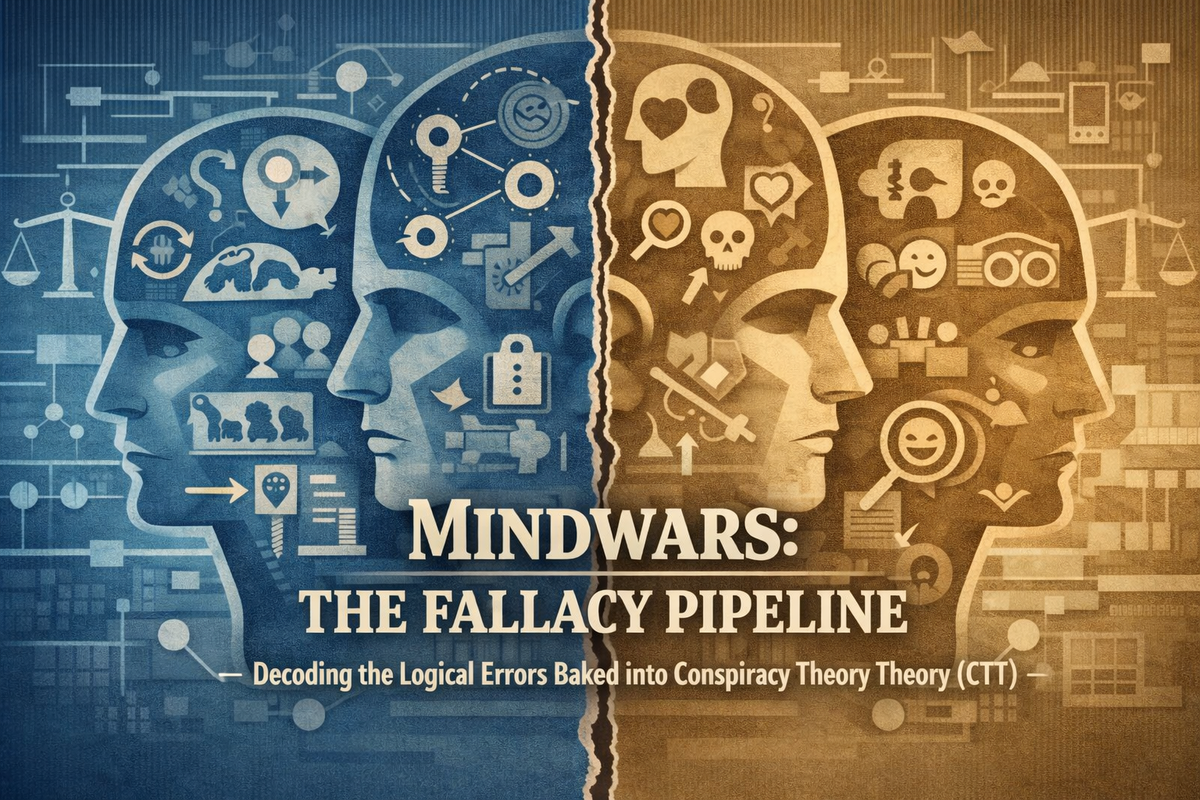
Mindwars: The Fallacy Pipeline — Decoding the Logical Errors Baked into Conspiracy Theory Theory (CTT)
Thesis: Conspiracy Theory Theorists (CTTs) don’t just “study false beliefs”; they build a repeating logical fallacy pipeline—definition → measurement → intervention—that lets institutions downgrade unapproved narratives without having to adjudicate them.
In the evolving Mindwars series, we’ve mapped how Conspiracy Theory Theory (CTT)—the academic field that studies conspiracy beliefs across social psychology, communications, and misinformation research—often behaves less like neutral inquiry and more like a governance-adjacent system for handling “narrative disorder.” Across the arc from the particularist–generalist divide in From “Conspiracy Nuts” to “Sometimes They’re Right”, to the elite-theory collision in Who’s Allowed to Say “Conspiracy”?, to the interpersonal weaponisation track in From Conspiracy Theorist to “Unsafe Partner”, the same asymmetry keeps reappearing: public suspicion is treated as a pathology to be managed, while institutional power largely escapes the same analytic pressure. Pieces such as The Climate “Conspiracy” Paper That Isn’t Really About Climate At All and Weaponising Rejection of the “Conspiracy Theory” Label drilled into specific outputs: CMQ-style measurement, harms catalogues, prebunking logic, and ERC pipelines like CONSPIRACY_FX that convert scepticism into a managerial risk variable.
This instalment targets the epistemological backbone. The claim is not that CTT is “wrong” in places. The stronger—and for the academy, more uncomfortable—hypothesis is structural: CTT is resilient to critique because it runs on a bundle of interlocking logical fallacies. These fallacies form a self-sealing pipeline. First, the category is loaded conceptually so “conspiracy theory” smuggles in pejorative content. Then, methodological instruments blur rational and irrational suspicion, producing data that seems to confirm the flawed premise. Finally, these outputs fuel operational systems—platform policy, public-health messaging—where labels substitute for inquiry in the critical early window, when evidence is thin and reputational costs are cheapest.
The pipeline doesn’t require bad faith. Sincerely held, methodologically trained research can still produce outputs that align with elite incentives—because the system rewards turning messy political conflict into legible risk variables: “trust,” “susceptibility,” “conspiracy mentality.” The result is a classification machine that converts suspicion of power into a cognitive hazard, supplying the state–platform complex with a ready-made sorting layer for narratives and audiences.
What follows maps the core failure mode at the heart of CTT: a recurring bundle of logical errors that, once operationalised, makes the field functionally governance-adjacent even when it presents as neutral science. These errors interlock into a self-sealing pipeline across three layers—conceptual, methodological, and operational—allowing suspicion to be managed as a population risk while the work retains the surface aesthetics of objectivity. The recurring fallacies are detailed below; how they manifest, and what a genuinely symmetrical epistemology would require instead—one that applies the same scrutiny to elite narratives as it does to suspicious citizens. This is an attempt to formalise that demand at the level where CTT is most insulated from critique: the logic it claims to use, and the places it predictably fails.
The Label That Ends The Argument
Picture this: you’re in a heated discussion about a leaked document suggesting government overreach during a crisis. You point to inconsistencies in official statements, patterns of withheld information, and historical precedents—MKUltra, Tuskegee, any of the now-archived cases where the “paranoid” turned out to be early. Your interlocutor leans back, smirks, and drops the bomb: “That’s just a conspiracy theory.” Conversation over. No need to engage the evidence, debate the merits, or even acknowledge the possibility. The label does the work. It’s a conversational kill-switch: an ad hominem delivered through category membership.
This isn’t rare; it’s routine. In media, policy briefs, and even academic writing, “conspiracy theory” often functions less as a neutral description than as a pre-emptive downgrade—shifting attention from the claim’s structure to the claimant’s supposed defects. The move is elegant because it doesn’t have to prove anything wrong. It just changes what kind of speech act this is: not “a hypothesis about the world,” but “a symptom in a person.” And once you can treat suspicion as a symptom, you can manage it.
What distinguishes CTT from mere observation is its role in stabilising and scaling this dynamic. By framing suspicion of power as a psychological risk factor, CTT supplies institutions with a legitimising framework to sort narratives into “safe” and “hazardous” categories, bypassing the slower, evidence-based work of factual adjudication. That doesn’t require bad faith. It’s enough that the field’s incentives reward work that produces legible variables, interventions, and “harm reduction” playbooks—exactly the kind of outputs that plug into platform policy and state communications.
The payoff here isn’t “CTT researchers are evil,” and it isn’t “every conspiracy claim is true.” It’s that the worldview often relies on a stacked set of logical errors—a fallacy bundle—that makes the whole pipeline feel empirical and responsible while it quietly converts suspicion into a governable object. This isn’t one fallacy; it’s a bundle of fallacies deployed as a pipeline.
The CTT Worldview
CTT, as it operates in practice, is less a single theory than a governing research paradigm spanning social psychology, communications, and misinformation studies—an interconnected cluster that treats “conspiracy thinking” as a broad risk category to be measured, monitored, and mitigated. Its central object is not conspiracy as a real-world mechanism of coordination, but suspicion as a property of publics. That paradigm rests on four interlocking assumptions:
- First, conspiracies are treated as rare or aberrant in modern governance, not as routine instruments of power.
- Second, suspicion is framed primarily as a stable trait—“mentality,” “disposition,” “susceptibility”—rather than a contextual response to secrecy, incentives, or institutional conduct.
- Third, the core problem becomes spread: informational contagion, network infection, trust erosion—pushing the question of whether a specific claim is true into the background.
- And fourth, the prescribed responses therefore aim almost entirely at publics—prebunking, nudging, education, moderation—rather than at constraining deception, widening transparency, or auditing elite coordination.
Even when CTT writers concede that “some conspiracies are real,” the concession functions as a rhetorical safety valve, not an architectural redesign: the scales still diagnose citizens, harms catalogues still foreground distrust’s social costs, and the intervention toolkits still optimise public ‘resilience’—a key script in the Operating Class's management of narrative disorder—rather than elite accountability. Once you accept that framing, the fallacies we’re about to examine aren’t incidental flaws; they’re the logic of the pipeline doing its intended work.
Level 1 Fallacies — Conceptual: The Category Is Loaded at Birth
At the foundational level, CTT’s problems don’t begin with “bad data” or “wrong models.” They begin before the first questionnaire item is written, at the level of definitions and default assumptions. This is the quiet part of the pipeline: the category is preloaded so that “conspiracy theory” arrives already wearing a warning label. Once that happens, later empirical work can look rigorous while mostly confirming what was built in at the start. These are the conceptual moves that load the dice.
1. Begging the Question: Loaded Definitions
A standard CTT move is to define “conspiracy theory” in ways that smuggle in the conclusion: “an unnecessary assumption of conspiracy,” “an unwarranted belief in hidden plots,” “a tendency to see conspiracies where none exist.” The moment you do that, irrationality is no longer something you have to demonstrate. It’s embedded in the term. From there, findings like “conspiracy theorists are irrational” become—at least partly—analytic: true because of how the object was defined. In other words, the definitional tautology that philosophers like Charles Pigden argue cripples the field's intellectual respectability from the outset.
This is the conceptual equivalent of building the alarm into the sensor and then reporting, impressed, that the alarm keeps going off. It also performs a key institutional function: it lets the field speak with the tone of neutral description while actually doing classification work. The category becomes a kind of epistemic quarantine: once something is placed inside it, the burden quietly shifts from “is this claim true?” to “why do these people think this?”
2. Genetic Fallacy: Source as Truth Proxy
CTT often leans on provenance: fringe forums, alternative media, “online echo chambers,” Telegram, YouTube, WhatsApp. Sometimes this is presented as sociology of information—sometimes as a practical warning sign. But it often slides into a genetic fallacy: the claim’s origin stands in for the claim’s status. Instead of “this source is unreliable, so we should verify carefully,” the implication becomes “this came from there, so it’s likely that kind of thing.”
The result is an epistemic ratchet. “Mainstream” sources inherit a presumption of seriousness—their errors are ‘missteps’ or ‘retractions’; non-mainstream sources inherit a presumption of contamination—their claims are ‘debunked’ or dismissed a priori. That is not an argument for institutional truth—institutions lie, spin, and omit as a matter of routine. It’s an argument for institutional priority: which voices and channels get to set the default frame of reality. Once the “source = suspect” heuristic hardens, the field has a ready-made mechanism for downgrading bottom-up allegations without doing the slow work of adjudication.
3. Fallacy of Composition: QAnon Is Not the Whole Domain
Another foundational distortion is the way the category gets exemplified. If your “conspiracy theory” prototype is flat earth, QAnon, lizard people, or omnipotent puppet-masters, then the domain looks like a carnival of irrationality. But that prototype is doing conceptual work: it encourages the reader to treat “conspiracy theory” as a single psychological species—an error-prone worldview—rather than as a mixed bag of hypotheses that vary wildly in plausibility.
This is the fallacy of composition in policy clothing: because some conspiracy claims are absurd, the category is treated as suspect as such. The problem isn’t just unfairness. It’s downstream governance: if the public mind is imagined as threatened by a unified genre of irrationality, blanket interventions make sense—generic “inoculation,” broad risk scoring, sweeping harms catalogues. Case-by-case assessment becomes not merely difficult, but conceptually disfavoured. This fallacious generalisation is what allows methodological instruments to treat the belief that ‘governments sometimes conspire’ as a symptom of the same ‘mentality’ as belief in alien dictatorships.
4. False Dichotomy: Trust Versus Conspiracism
CTT framing repeatedly implies a binary: you either trust institutions, or you’re sliding into conspiracist pathology. This collapses the most common—and historically normal—position: conditional trust. People don’t live at the poles. They trust some institutions on some matters, distrust others on others, update when evidence changes, and remain adversarial when incentives or histories warrant it. We apply conditional trust to mechanics, doctors, and journalists—verifying their work, seeking second opinions, and adjusting our trust based on performance. To pathologise this same stance toward political and corporate power is to pathologise the core of democratic citizenship.
But once the binary is installed, scepticism becomes a symptom. Civic oversight becomes “distrust.” Adversarial inquiry becomes “delegitimisation.” The middle ground—“trust but verify,” “some conspiracies happen,” “institutions have incentives to conceal”—is treated as an unstable corridor that must be managed before it becomes dangerous. That isn’t an innocent conceptual simplification; it aligns smoothly with governance needs, because it recodes public accountability as a threat to be mitigated rather than a democratic function to be protected.
5. Asymmetric Skepticism: The Power-Weighted Default
Finally, there’s the conceptual asymmetry that makes the whole pipeline politically legible: CTT tends to be hyper-sceptical about public cognition (biases, paranoia, motivated reasoning) while remaining comparatively uncurious about institutional cognition and incentives (cover-ups, strategic deception, propaganda, bureaucratic self-protection). Doubt is distributed by social position: citizens are the objects of diagnosis; institutions are the background narrators. The field’s foundational asymmetry is captured in the questions it prioritises: ‘Why do citizens believe elites conspire?’ over ‘Why and how often do elites actually conspire?’ The first is treated as a puzzle of mass psychology; the second is relegated to other disciplines, if it is asked at all.
This is not “neutral epistemology.” It is a power-weighted default. It treats suspicion primarily as a psychological hazard rather than, often, a rational response to secrecy and track record. Once that asymmetry is in place, it becomes natural to study citizens’ “mentality” far more than elite coordination or institutional deception—because only one of those is framed as the actionable problem.
Mini-synthesis: At Level 1, CTT makes its decisive commitment: it treats suspicion as the pathology and spread as the threat, rather than treating power, incentives, and institutional narrative production as the primary objects of analysis. Once that commitment is made, the fallacies don’t appear as occasional mistakes—they become the system’s starting logic.
Level 2 Fallacies — Methodological: Bad Instruments That Still Look “Scientific”
Once the category is loaded at birth, the rest is implementation. CTT takes those conceptual assumptions and pours them into instruments: scales, survey batteries, lab tasks, network studies, “interventions.” This is where the project acquires its aura of objectivity. Numbers appear; correlations stack up; effect sizes get reported; models get validated. But if your definitions already bias the target, your instruments don’t correct that bias—they operationalise it. The result is a familiar pattern: research that looks empirical while quietly collapsing unlike things into the same bucket, then treating the bucket as evidence of a single cognitive defect.
6. Category Error: Claims → Symptoms
A recurring methodological move is to treat an empirical or historical assertion as evidence of a psychological condition. The claim “elites coordinated behind closed doors” becomes not something to evaluate—documents, incentives, institutional track record—but a symptom of “conspiratorial mindset.” The debate shifts from what happened? to what kind of person thinks that? This isn’t just a rhetorical trick; it’s a measurement choice. When beliefs are treated as symptoms, they can be scored, predicted, and “treated,” which is exactly what makes the field legible to governance.
This move also smuggles in a moral frame: the content of the belief disappears, and what remains is the social effect of the believer. The question becomes whether a belief is “toxic,” relationally damaging, corrosive to trust, disruptive to cohesion. That may be an interesting sociological question, but it is not the same question as truth, and treating it as a substitute for truth is the category error in action. This isn't merely bad epistemology; it's functional. Converting a political claim into a psychological symptom transforms a civic challenge (“Prove you didn't do this”) into a public health problem (“Manage this cognitive susceptibility”).
7. Operationalisation Failure: Measuring the Wrong Thing
CTT’s signature failure mode is instruments that claim to measure irrational conspiracism but end up measuring something much broader: conspiracy belief as such, including beliefs that are often plainly compatible with political literacy. This is where the “scientific” sheen becomes actively misleading. If a scale item asks whether “governments monitor citizens,” the respondent’s “yes” might reflect fantasy—or it might reflect the documented baseline of modern security states. If your instrument cannot tell the difference, it is not measuring what it claims to measure. This is the fatal flaw in scales like the Generic Conspiracist Beliefs (GCB) scale or the Conspiracy Mentality Questionnaire (CMQ), which bundle plausible suspicions with fantastical ones, guaranteeing that 'conspiracy belief' will correlate with alienation and conflict—not because the belief is irrational, but because the instrument conflates political realism with psychological pathology.
That failure has downstream consequences. Once “ordinary suspicion” and “fantastical conspiracism” are blended into one score, the score will correlate with all sorts of negative outcomes—alienation, distrust, social conflict—because distrust is being treated as a cognitive defect rather than, sometimes, an accurate perception of institutional incentive structures. The research then feeds back into the worldview: “See, conspiracy belief predicts bad outcomes,” when the instrument never separated warranted suspicion from unwarranted.
8. Equivocation: Switching Meanings Mid-Paper
CTT papers often run a semantic bait-and-switch. In methods, “conspiracy theory” is treated neutrally enough to collect a wide range of responses—belief in conspiracies, suspicion of institutions, dissenting narratives, alternative explanations. But in discussion and conclusion, “conspiracy theory” quietly becomes pejorative again: irrational, baseless, paranoid, misinformation-adjacent. That equivocation is not a minor wording issue; it’s the mechanism that allows broad data collection and narrow condemnation. This equivocation acts as the field's rhetorical airlock, allowing the messy reality of public suspicion to enter through a broad definition, only to be condemned under a narrow one. It immunises the research from the particularist critique, because any challenge can be met with a shift in the definition's scope.
This is how you get the classic slide: measure a general suspicion index, show correlations with social harm proxies, and then talk as if you’ve shown something about irrationality as such. The reader is invited to forget that “conspiracy theory” meant two different things on different pages. The ambiguity becomes a shield: critics can’t easily falsify the claim, because the target keeps shifting between “any conspiratorial explanation” and “irrational conspiracism.”
9. Availability and Selection Bias: The Extremes Become the Template
Even when instruments are technically neutral, the exemplars are not. The field is saturated with vivid prototypes: QAnon, flat earth, microchip vaccines, lizard people. These cases are real, but their methodological role is disproportionate. They define the imaginative universe of “conspiracy theory,” which then seeps into prompts, vignettes, recruitment, and interpretation. Quiet, document-heavy phenomena—regulatory capture, covert lobbying networks, intelligence operations, propaganda campaigns—rarely play the same starring role because they are less psychologically vivid and harder to experimentalise. This is not an accident of attention. Bizarre exemplars are fundable and publishable; they yield clear 'effects,' clean experimental designs, and morally unambiguous 'harms.' Studying the slow, complex conspiracy of regulatory capture yields none of these, despite being infinitely more consequential.
That creates an availability bias with institutional effects. When your reference class is dominated by the most bizarre examples, you naturally design “solutions” aimed at contagion control: inoculate, pre-bunk, dampen spread. You don’t design tools for adversarial inquiry, historical literacy, or institutional accountability. And because the extreme cases are politically convenient—everyone agrees they’re “bad”—they allow the field to build general governance machinery under the cover of targeting the obviously ridiculous.
10. Motivational Fallacy: Explaining Belief ≠ Disproving Belief
Finally, CTT leans hard on psychological explanations: anxiety, need for control, identity signalling, loneliness, narcissism, authoritarianism, cognitive style. Some of this is interesting. The fallacy appears when explanation quietly becomes debunking. If a belief can be linked to a need, the implication is that the belief is therefore epistemically compromised. But why someone believes something is not the same as whether the thing is true. People adopt true beliefs for bad reasons and false beliefs for good reasons all the time.
The motivational fallacy is especially powerful because it feels compassionate and scientific at once: it invites a therapy posture (“these people are coping”) while sidestepping adjudication (“therefore, do not engage the claim”). In operational settings, this is perfect: institutions don’t have to answer allegations; they can fund “resilience” interventions. This fallacy provides the perfect clinical justification for epistemic bypass. It allows the operator—whether platform, health authority, or security agency—to transition seamlessly from 'we understand your anxiety' to 'therefore we will limit your access to this information.' The diagnosis of motivation becomes the warrant for management.
Mini-synthesis: Once instruments are built this way—category errors, mis-specified measures, equivocation, extreme-case templates, and motivational debunking—the data will tend to “confirm” the worldview by construction. It will continually rediscover that suspicion correlates with harms, because the tools are designed to treat suspicion itself as the hazard. The field then mistakes that engineered reproducibility for discovery.
Level 3 Fallacies — Operational: Policy Use And The Early-Window Veto
By the time CTT outputs leave the journal and enter the real world—platform policy, public-health messaging, security-adjacent comms, “resilience” initiatives—the fallacy bundle stops being an academic problem and becomes a governance logic. This is the point where the pipeline pays rent. The goal is no longer to adjudicate whether a claim is true; it is to manage what kinds of narratives are allowed to circulate, who gets treated as credible, and which lines of inquiry are permitted to mature into public questions. The most important fact about this layer is timing: the label is most powerful early, when evidence is uncertain and reputational costs are cheapest to impose.
11. Poisoning the Well (Temporal Version): Label First, Evidence Later
In operational settings, “conspiracy theory” often functions as a pre-emptive veto. The claim is tagged early—before the evidential picture stabilises—so that inquiry is socially and professionally costly from the start. This is the temporal version of poisoning the well: you discredit the line of investigation before it has a chance to develop. Later, if evidence shifts, the system can always say “we were reducing harm,” or “we couldn’t risk it”—but the reputational and informational damage has already been done.
This matters because the early window is exactly when many serious allegations begin: leaks are partial, sources are contested, institutions are defensive, and the public is trying to orient. If the label is deployed in that window, it doesn’t merely correct falsehoods; it shapes what can be investigated at all.
12. Motte-and-Bailey: Narrow Justification, Broad Application
Operational CTT also relies on a classic motte-and-bailey. The defensible claim (the motte) is: “We only target demonstrably false claims that cause harm.” The working reality (the bailey) is often broader: management of “unapproved narratives,” “borderline content,” “susceptible audiences,” “low-trust communities,” and “harmful doubt.” The rhetoric stays narrow and reasonable; the application expands to whatever threatens institutional legitimacy or social order.
This structure makes the system hard to challenge. Critics point to overreach; defenders retreat to the narrow justification. Meanwhile the broad application continues, because the operational machinery—risk scoring, moderation heuristics, prebunking campaigns—was never built to wait patiently for truth to settle.
13. Conflating Harm with Falsity: “Erodes Trust” Becomes “Untrue”
Another operational slide is the substitution of managerial criteria for epistemic criteria. “Harmful” becomes treated as “false,” or at least as “eligible for suppression regardless of truth-status.” In CTT-adjacent governance, the claim “this erodes trust” frequently does the work that “this is false” ought to do. That is a category mistake dressed as pragmatism: social effect is treated as epistemic status.
The result is predictable. Claims that are inconvenient, destabilising, or institutionally costly become suppressible by default—even when the factual status is genuinely uncertain or mixed. Accuracy becomes secondary to “maintaining trust,” and the boundary between information integrity and legitimacy maintenance quietly dissolves.
14. Ends–Means Inversion: Trust Maintenance Over Truth-Seeking
This is the deeper inversion beneath harm/falsity conflation. In principle, truth-seeking should be the end, and trust should be a downstream consequence of demonstrated honesty and accountability. In operational CTT, trust becomes the end, and epistemics becomes the means: content management, prebunking, nudges, “inoculation,” and reputational steering are justified as necessary to maintain social cohesion.
Once that inversion takes hold, the system can treat uncertainty itself as a threat. Rather than saying “we don’t know yet,” institutions default to narrative discipline: keep the public inside approved ranges until the moment has passed. Prebunking becomes a general-purpose instrument, not a targeted response to known falsehoods.
15. Double Standard on Narrative Agency: Bottom-Up Suspicion vs Top-Down Strategy
Finally, there’s the legitimacy bias encoded in how narrative agency is described. Bottom-up suspicions are framed as “conspiracy narratives” requiring containment. Top-down narrative production—strategic communications, messaging discipline, coordinated framing, selective disclosure, even deception—is treated as normal governance or crisis management. One is pathologised; the other is professionalised.
This double standard is the operational endpoint of the earlier asymmetry. If suspicion is a public pathology, then managing publics is the solution. If elite narrative coordination is treated as ordinary, then elite accountability is never the object. The pipeline doesn’t have to explicitly defend power; it simply assigns scrutiny and intervention downward.
Mini-synthesis: At Level 3, CTT stops looking like a descriptive discipline and starts functioning like a compliance-adjacent toolkit. Conceptual loading makes the label available, methodological choices make it “measurable,” and operational deployment turns it into a timing weapon—an early-window veto that can downgrade inquiry before evidence has a chance to mature.
Summary of Fallacies Commonly Adhering to the CTT Approach
To make the pipeline tangible, here’s the fallacy stack in one view. The point isn’t that every paper commits every error; it’s that the field’s default settings make these errors easy, mutually reinforcing, and operationally useful.
Conceptual Fallacies
|
Fallacy / Error |
How It Shows Up in CTT |
Why It’s a Problem |
Typical Example |
What a Better Version Would Require |
|
Begging the question
(loaded definition) |
“Conspiracy theory” defined as irrational or
unwarranted by default |
Makes conclusions (“CT believers
are irrational”) partly true by definition |
Defining CT as “unnecessary
assumption of conspiracy” |
Use a neutral definition (“posits
a conspiracy”) and test rationality separately |
|
Genetic fallacy |
Source or social location used as
proxy for truth (“fringe,” “online,” “alt”) |
Confuses provenance with validity;
blocks evidence-based review |
“It’s from Telegram so it’s CT” |
Evaluate claims by evidence; treat
source as a risk signal, not a verdict |
|
Fallacy of composition |
Treating the whole class as suspect
because some members are false |
Erases case-by-case variation |
“QAnon exists → CTs are generally
irrational” |
Separate “conspiracy
explanation” from “irrational conspiracy claim” |
|
False dichotomy |
Either trust institutions or you’re
conspiracist |
Collapses legitimate conditional scepticism
into pathology |
“Distrust = conspiracism” |
Allow a spectrum: conditional
trust, adversarial inquiry, partial belief |
|
Asymmetric scepticism |
Extra scepticism aimed at publics;
default trust aimed at institutions |
Hard-codes power bias into
epistemics |
“Citizen suspicion is the problem;
institutions are baseline” |
Skepticism should track incentives,
power, and historical record |
Methodological Fallacies
|
Fallacy / Error |
How It Shows Up in CTT |
Why It’s a Problem |
Typical Example |
What a Better Version Would Require |
|
Category error |
Empirical/historical claims treated
as “cognitive symptoms” |
Moves disputes from “what
happened?” to “what’s wrong with believers?” |
“Belief in X indicates
conspiratorial mindset” |
Keep claim-evaluation distinct from
person-evaluation |
|
Operationalisation
failure |
Instruments measure conspiracy
belief but are sold as measuring irrationality |
Produces bad science and bad policy
levers |
Scale items like “governments
keep secrets” treated as pathology |
Instruments must differentiate
rational vs irrational beliefs (explicit criteria) |
|
Equivocation |
“Conspiracy theory” used neutrally in one sentence,
pejoratively in the next |
Enables the slide: “posits
conspiracy” → “irrational” |
“CTs are harmful” after defining CT as “irrational
CT” |
Keep terms stable; define and
enforce one meaning per paper |
|
Availability /
selection bias |
Vivid extreme cases dominate
datasets and examples |
Skews inferences about typicality |
QAnon-heavy framing becomes
baseline |
Use representative sampling;
explicitly include “true/standard” conspiracies |
|
Motivational fallacy |
“They believe because
anxiety/identity”
used as debunking |
Explaining belief ≠ disproving
belief |
“Need for control explains CT
beliefs” |
Treat psych drivers as separate
from truth-status of the claims |
Operational Fallacies
|
Fallacy / Error |
How It Shows Up in CTT |
Why It’s a Problem |
Typical Example |
What a Better Version Would Require |
|
Poisoning the well
(early-window veto) |
Label first, investigate later |
Prevents evidence from maturing;
imposes reputational costs cheaply |
“This is a CT” used to shut inquiry down |
Provisional handling: “unverified;
claims under review,” not genre dismissal |
|
Motte-and-bailey |
Retreat to “we only fight false
harmful claims,” expand to “unapproved narratives” |
Makes system unfalsifiable; hides
scope |
“Just harm reduction” → wide moderation |
Clear thresholds; publish scope;
audit drift between rhetoric and practice |
|
Harm ≈ falsity
conflation |
“Harmful” treated as “false or
suppressible” |
Replaces truth-adjudication with
managerial goals |
“It causes distrust so it’s
misinformation” |
Separate “accuracy,” “uncertainty,”
and “harm” as distinct variables |
|
Ends–means inversion |
“Maintain trust/resilience” becomes primary aim |
Turns epistemics into compliance
management |
“We must protect trust in science” |
Align interventions with
truth-seeking; include institutional accountability |
|
Double standard on
narrative agency |
Bottom-up narratives treated as
suspect; top-down strategic narratives treated as normal |
Hard-codes legitimacy bias |
“Public conspiracy narratives are
dangerous; state narratives are comms” |
Apply scrutiny symmetrically to
institutional messaging and coordination |
With that map in place, we can steelman the CTT position—because the strongest rebuttal isn’t “none of this exists,” but “we need heuristics and harm reduction”—and then ask what changes would actually be required to make the research symmetric and intellectually respectable. Before we do that, let's look at a real life example of the pipeline in action.
Pipeline in Action: The “Incubator Babies” Story (1990–91)
In October 1990, testimony presented to the Congressional Human Rights Caucus alleged that Iraqi soldiers removed Kuwaiti premature babies from incubators and left them to die. The witness—introduced as “Nayirah”—supplied a vivid atrocity narrative at the exact moment consent for war was being assembled. The point is not that every sceptical hunch is right; it’s that the system’s default response is to punish scepticism as such in the very window where scepticism is most socially valuable.
How the veto works: early sceptics who questioned sourcing, plausibility, and the incentives for staged testimony weren’t treated as doing normal adversarial inquiry. They were framed as morally suspect—soft on Saddam, reflexively anti-American, or the kind of person who sees propaganda everywhere. That’s the operational bundle in miniature: poison the well (discredit inquiry in advance), genetic fallacy (the sceptic is “from” the wrong political tribe), and a false dichotomy (either accept the story or you’re on the side of evil).
Later evidence shift: subsequent reporting indicated the testimony was not what it appeared: “Nayirah” was linked to the Kuwaiti ambassador’s family and the story was associated with professional PR efforts tied to Kuwait’s lobbying campaign. Whatever your preferred phrasing—atrocity propaganda, wartime narrative management, or coordinated persuasion—the key point is that the original claim’s status changed after the early window had already done its work.
No change in tooling: the story’s function had already been served: it helped build moral permission for policy. Later corrections, when they arrived, were treated as discrete scandal or PR excess—not as evidence that elite narrative coordination is routine and therefore deserves systematic scrutiny. And here’s the core diagnostic: by the logic of modern CTT instruments, early doubt in the face of an emotionally charged official story is exactly the kind of posture that gets coded as “unhealthy distrust,” even when that posture is what prevents societies from being herded by atrocity narratives. That’s the pipeline’s temporal asymmetry in one frame.
The Strongest Steelman — And Why It Still Doesn’t Save The Model
The most charitable reading of CTT is straightforward: some conspiratorial beliefs are false and can be genuinely harmful. They can fuel harassment campaigns against named individuals, intensify scapegoating of minorities, enable grifts and financial fraud, or—at the extreme—feed extremist mobilisation and violence. Studying why people adopt such beliefs, and designing ways to reduce their spread, can be legitimate social science. And at platform or state scale, triage matters: you can’t adjudicate every claim case-by-case in real time, especially during fast-moving crises. Even particularists don’t deny that some claims are unfalsifiable, reckless, or socially corrosive, and that there are edge cases where intervention is warranted.
This defence sounds reasonable—until you ask a simple question the field almost never answers: Who gets to define “harm,” and on what terms?
In CTT literature—Douglas’s 2021 “Are Conspiracy Theories Harmless?” and the ongoing CONSPIRACY_FX outputs—the definition of harm is overwhelmingly system-centric and institution-aligned. Harm is measured as:
- Deviation from official policy compliance (lower vaccination, climate inaction)
- Erosion of institutional trust or legitimacy
- Potential for social unrest or reduced civic participation
What rarely counts as harm is the inverse: institutional betrayal of public trust through deception, opacity, or overreach. The field treats “distrust” itself as a pathological outcome, not a potentially rational response to repeated breaches.
This point cuts to the heart of the inflation problem. In broader discourse influenced by CTT (and adjacent fields like misinformation studies), “harm” has ballooned to include purely psychological or ideological discomfort:
- Speech that might “damage someone’s ego”
- Challenges to a favoured self-perception or identity narrative
- Revisionist or dissenting views of history that make people feel uncomfortable
These are increasingly framed as societal risks warranting intervention—prebunking, content moderation, or “resilience” training. The underlying logic: if a belief or statement threatens the stability of preferred narratives (whether about science, democracy, or historical events), it can be classified as harmful regardless of its truth value.
This is the harm ≈ falsity conflation in operational form, now expanded into harm ≈ discomfort or harm ≈ narrative disruption. Once harm is defined this loosely and asymmetrically—always from the perspective of systems and their favoured stories—the pipeline becomes infinitely elastic. Any challenge to orthodoxy can be downgraded as “potentially harmful,” justifying management without ever needing to prove falsity or engage the substance.
The steelman collapses here. A field claiming to protect society from harmful beliefs cannot credibly do so while:
- Defining harm almost exclusively as stress on institutional narratives
- Ignoring or downplaying harms caused by those same institutions (e.g., loss of trust from documented deception)
- Expanding the harm envelope to include mere ideological or emotional discomfort
Without symmetrical criteria—where institutional lying, historical revisionism in service of power, or speech that damages public trust are weighed on the same scale—the project isn't harm reduction. It's harm redefinition in service of narrative stability. The social and economic harm caused by decades of pharmaceutical price-fixing cartels—a documented conspiracy—never registers as a 'consequence' in the CTT ledger, while public suspicion of the pharmaceutical industry is studied as a risk factor.
Function dominates intent. Even sincere researchers end up supplying a toolkit that lets power avoid accountability by medicalising discomfort with its own behaviour.
What Intellectually Respectable CT Research Would Look Like
For CTT to become intellectually respectable, it must undergo a symmetrical reset. This means abandoning 'conspiracy theory' as a pejorative genre and implementing what the particularists keep saying—judge claims one by one, on evidence, without letting the label do the work. That’s the Dentith move in its cleanest form. Pigden pushes it where it hurts: into the instrumentation. If your scales can’t tell the difference between historically literate suspicion and crank cosmology, then your “findings” aren’t about irrationality at all. You’ve just built a suspicion-meter and pretended it’s a pathology detector.
So what would a rebuilt field actually have to do? Not vibes. Not “we acknowledge some conspiracies are real” footnotes. Hard standards, checkable by anyone reading the methods section.
- Start neutral. A conspiracy theory is simply an explanation that posits covert coordination by actors pursuing an outcome via partly secret means. No “unwarranted,” no “unnecessary,” no pejoratives smuggled into the definition. If it’s irrational, show it later.
- Publish your irrationality criteria up front. If you’re going to say “this is irrational conspiracism,” you need falsifiable markers: unfalsifiability, decisive counterevidence ignored, magic mechanisms, absurd competence assumptions, endless patching to save the claim, refusal to update. Apply those tests to the claim, not the social status of the claimant.
- Stop calling generic suspicion a disorder. If your instrument asks “governments keep secrets” or “powerful groups coordinate,” you are not measuring irrationality. You are measuring political literacy, cynicism, or baseline realism—depending on the respondent. If you want to measure irrational conspiracism, your tool has to incorporate the criteria above and be tied to specific claim-types with an evidence check. Otherwise be honest: it’s a suspicion index.
- Symmetry or it’s propaganda-adjacent. If you measure “conspiracy-prone cognition” in publics, you also measure the matching failure mode upstream: institutional credulity and audit-avoidance—reflex trust in official stories despite incentives to lie, documented precedent, or contradictory evidence. If you refuse symmetry, you’ve baked deference to power into the baseline. This symmetrical audit must apply to your definition of harm: the social costs of institutional deception and lost accountability must be weighed against the costs of public distrust.
- Adjudicate before you medicate. No prebunking, no moderation heuristics, no “resilience training” until you’ve done the boring forensic work: sources, provenance, mechanisms, falsifiers. Sort the claim-space into plausible, implausible, and unresolved first. Receipts before remedies.
- Begin from the real baseline. Conspiracies and institutional deception are not exotic glitches in modern life. Cartels, covert ops, regulatory capture, coordinated PR, cover-ups—this is normal coordination in complex systems. If your research starts from “conspiracies are rare,” you’ve inverted reality and guaranteed that suspicion looks pathological by default.
If you rebuilt CTT on those lines—Pigden’s instrument discipline plus particularism without the rhetorical safety valves—you’d get a field that sharpens public oversight instead of inoculating against it. You’d get tools that can actually discriminate between junk and justified suspicion, and you’d finally have a discipline that audits power with the same energy it currently spends auditing citizens. Until these standards are met, CTT will remain what it is: a discipline that mistakes the map of its own biases for a diagnostic of the world. It builds a clinic to treat the symptom of distrust, while leaving the disease of unaccountable power undiagnosed in the room next door.
Fracture Points: What Lingers When the Pipeline Closes
Back to the everyday dismissal that the entire pipeline is built to produce: “That’s just a conspiracy theory.” It’s not a neutral tag. It’s a move that ends the argument by relocating it—out of the world of documents, incentives, and track records, and into the world of defective minds. The speaker gets downgraded, the claim gets quarantined, and the conversation returns to safer ground without anyone having to check anything.
That’s what the pipeline ultimately delivers: a category that starts pejorative, gets laundered into measurement, then shows up downstream as “harm reduction” and “resilience”—a polite vocabulary for pre-empting awkward questions. None of this requires defending every wild claim—plenty are junk, some are dangerous. The issue is the genre-label as a shortcut to default victory where institutions win by default, treating discomfort with power as a cognitive problem while power’s own coordination and deception remain largely out of scope.
Here’s the fracture that doesn’t go away: what does it mean for a field built to diagnose “unhealthy suspicion” to hold authority over public belief while rarely applying the same scrutiny to the institutions it implicitly asks us to trust? Who gets to define “harm” in practice—and how often does that definition quietly collapse into “non-compliance,” “loss of legitimacy,” or “narrative disruption”? When does “information integrity” become reputation management with a scientific accent?
Those aren’t loose ends. They’re the stress points where the whole structure shows its function. Once you see them, the question shifts from “why do people believe conspiracy theories?” to something more basic and more political:
"Why does a system so invested in managing suspicion get to call itself the science of truth?"
Published via Mindwars Ghosted.
Mindwars: Exposing the engineers of thought and consent.
—
Author’s Note
Produced using the Geopolitika analysis system—an integrated framework for structural interrogation, elite systems mapping, and narrative deconstruction.
Support: Mindwars Ghosted is an independent platform dedicated to exposing elite coordination and narrative engineering behind modern society. The site has free access and committed to uncompromising free speech, offering deep dives into the mechanisms of control. Contributions are welcome to help cover the costs of maintaining this unconstrained space for truth and open debate. If you like and value this work, please Buy Me a Coffee