Mindwars: The Soft Cage – Behavioural Science, the State’s Weapon of Choice
Inside Mindspace: The behavioural playbook that turned influence into infrastructure.
The Mindwars series chronicles the hidden wars of narrative and cognition—how language, framing, and selective information shape what societies accept as real. This article exposes something deeper and more dangerous: the quiet installation of a behavioural governance system that goes much further than merely suggesting or persuading.
Humans have always influenced one another, that’s what it means to be a social being. Rather, this is about how a few have arrogated right to engineer behaviour at scale, without visibility, deliberation, or consent. It is about how they have assumed the right to redesign your decision-making process because they know what’s best—for you, for society, and for the “vulnerable.”
At the centre of this system lies MINDSPACE: a Cabinet Office document that reframed behavioural psychology as the operating logic of government. What was once advisory became infrastructural. What was once influence became default-setting. MINDSPACE encodes a new doctrine: that unconscious manipulation is not only acceptable, but preferable, if done for the “right” reasons.
But who defines “right”? According to what standard? In whose interest?
From pandemic compliance to climate nudges and digital identity systems, behavioural scripting now underpins governance across domains. It is justified by urgency, stabilised through moral framing, and maintained through narrative repetition. Yet this system—while expanding—is not omnipotent. It is brittle. Its metaphors are failing. And its claims to moral legitimacy are unravelling.
“Influencing behaviour is central to public policy. Recently, there have been major advances in understanding the influences on our behaviours, and government needs to take notice of them. This report aims to make that happen.” p.7
This article traces not only the architecture of behavioural power but the deeper question it raises: What gives any person, group, or institution the right to pre-script human agency?
My thesis is not that power is total—but that it is shifting. From argument to design. From persuasion to pre-emption. The terrain of freedom is being redrawn—not through laws, but through menus of invisible constraints. You don’t need to remove someone’s freedom if you can make them want what you’ve already decided.
In this frame, rather than being fought in the open, the war is embedded in the options you’re given.
This is not just exposé. It is refusal. And it is a signal that the next terrain of struggle is the architecture of choice itself.
A Document To Design Your Mind
So, what exactly is MINDSPACE?
To understand it we need to go back to 2010, when the document emerged from the corridors of Whitehall—MINDSPACE: Influencing Behaviour Through Public Policy. Co-produced by the UK Cabinet Office and the Institute for Government (IfG), it was framed as a technical toolkit, a benign manual for “better policy outcomes.” But what it actually proposed was far more radical: a system for institutionalising behavioural influence as governance infrastructure.
Each element of the acronym—Messenger, Incentives, Norms, Defaults, Salience, Priming, Affect, Commitment, Ego—represents a lever engineered not to inform or persuade, but to bypass deliberation altogether. The report stated its ambition plainly: to shape behaviour “without the subject’s conscious awareness.” Beneath the policy jargon was a new premise for rule: that governance need not ask for consent—only simulate it.
MINDSPACE wasn’t theorised in isolation as some esoteric academic exercise. It was installed into the UK government as an operating device by a tightly interwoven group of behavioural architects spanning academia, civil service, and strategic policy outfits:
- David Halpern, liaison to Downing Street, former Prime Minister’s Strategy Unit advisor and founding director of Behavioural Insights Team (BIT), translated elite behavioural theory into statecraft, embedding it into every major department.
- Michael Hallsworth, formerly of RAND, specialised in converting behavioural science into scalable policy protocols.
- Paul Dolan cloaked population-scale psychological manipulation in the language of well-being metrics.
- Dominic King and Ivo Vlaev brought clinical and cognitive validation, anchoring the apparatus in biomedical legitimacy.
- Gus O’Donnell, then Cabinet Secretary, functioned as central orchestrator, commissioning the report and securing its cross-departmental institutionalisation.
- Matt Tee and Sir Michael Bichard integrated behavioural principles into state messaging and long-term policy continuity.
This wasn’t academic drift—it was a structured insertion of a behaviourist operating system into the neural spine of the state.
“Whether reluctantly or enthusiastically, today’s policymakers are in the business of influencing behaviour, and therefore need to understand the various effects on behaviour their policies may be having.” p.10
“In fact, influencing behaviour is central to public policy.” p.12
And its architecture was never domestic. It aligned seamlessly with transnational counterparts: the OECD, WHO, and WEF absorbed MINDSPACE logics into their frameworks, launching behavioural insight units and global “nudge” networks. Behind the scenes, the Council for Science and Technology (CST) provided narrative coherence across agencies without public accountability.
These were not policy advisors—they were behavioural system architects, reengineering the interface between citizen and state.
The MINDSPACE ideology surfaced repeatedly in the years that followed:
- Pandemic restrictions and “compliance theatre”
- Climate and carbon rationing schemes
- Digital identity systems and vaccine passports
- Online misinformation regulation architectures.
Each reappearance affirms the same truth: MINDSPACE wasn’t an isolated intervention. It was a kernel protocol—a cognitive firmware update to how modern governance relates to its subjects.
But even control systems have thresholds. During the COVID-19 crisis, MINDSPACE's logics were over-deployed. Fear nudging, social shame, and institutional trust manipulation triggered public exhaustion. SPI-B’s admitted use of psychological pressure, paired with repeated behavioural directives, exposed the mechanism. Confessions of “over doing the fear” were made. BIT’s climate fear scripts (FOIA) and SPI-B’s leaked pandemic memos sealed the case. Once the spell was broken, nudging no longer felt like a benign social service—it felt predatory and manipulative.
The reaction was not reform but rebrand. “Nudge” became “trust.” “Behavioural insights” were repackaged as “civic engagement.” The lexicon changed. The machinery did not.
So we must return to the core question not asked in the original report:
Who gave them the right to decide what behaviour is “desirable”?
By what moral standard is influence justified? By what authority is your autonomy overwritten “for your benefit”?
MINDSPACE was not a toolkit. It was a structural rewrite of democratic interaction, where design replaces deliberation, and consent is bypassed by construction.
It did not evolve through public will—it was authored by design.
Historical Lineage of the Machine
The behavioural governance structures now embedded in public policy did not arise from nowhere. They are the convergence of two enduring architectures: commercial persuasion and state propaganda. One engineered desire. The other mobilised obedience. Their merger didn’t just influence behaviour—it redefined reality.
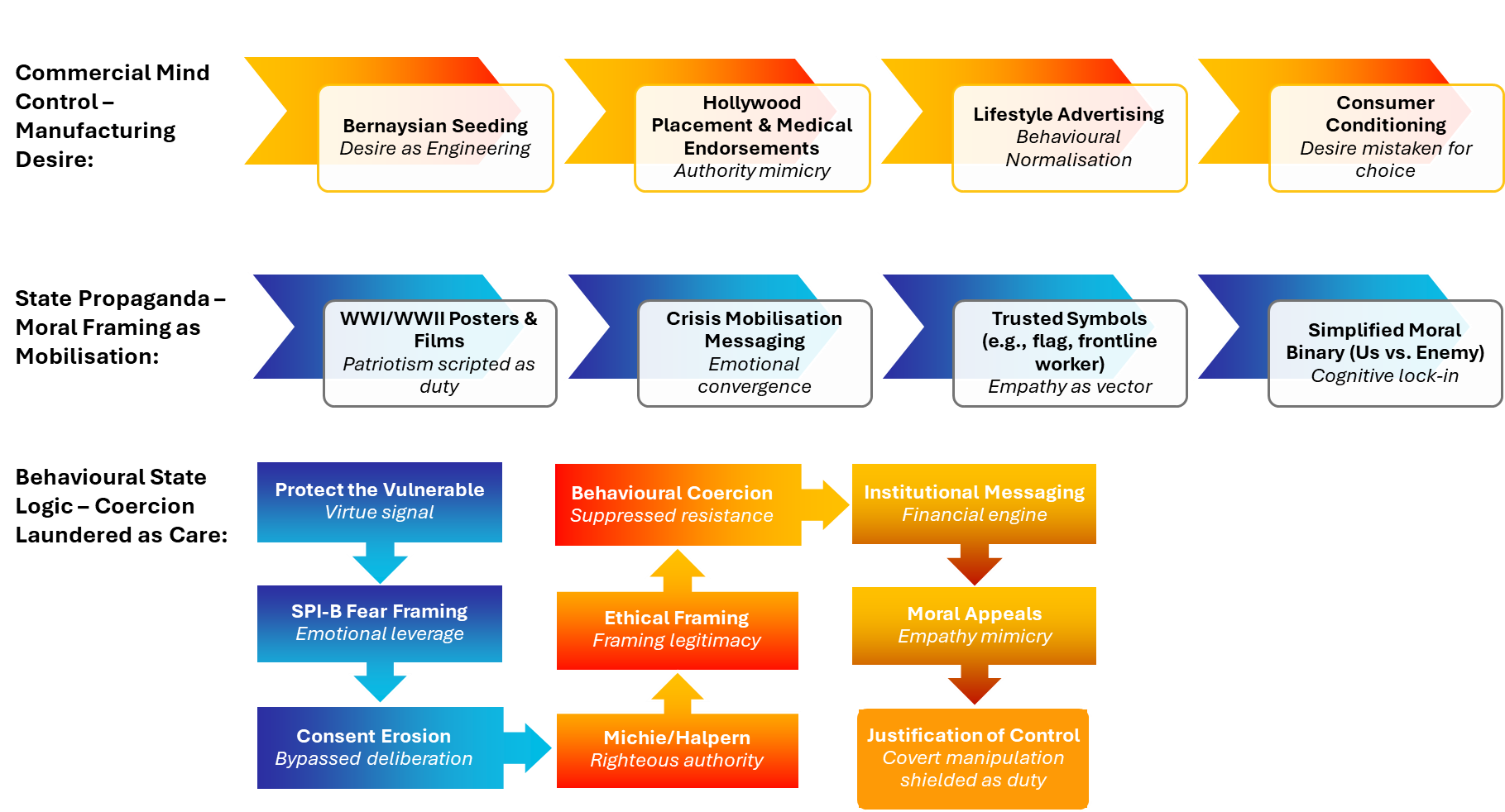
Advertising didn’t begin by satisfying wants; it began by scripting them. Edward Bernays—Freud’s nephew and author of Propaganda (1928)—recast the citizen not as a rational actor, but as a programmable subject. Consent, for Bernays, was something to be extracted—not granted. Cigarette campaigns featuring doctors, film stars, and feminist framing didn’t mirror public will. They fabricated it.
Corporations learned to act before awareness. Through emotional saturation, symbolic anchoring, and identity manipulation, they installed desire in advance. You didn’t want—until you were told who you were.
Governments used the same playbook:
- WWI posters (“Daddy, what did YOU do…”) induced guilt for compliance
- WWII radio and cinema collapsed entertainment into mobilisation.
The tactics mirrored commerce: repetition, affective loading, binary morality. Where corporations sold products, states sold causes. The mechanism was identical—bypass reason, install reaction.
The border dissolved. Bernays worked for governments and corporations alike. Messaging techniques blurred across sectors. What began as influence became embedded as infrastructure.
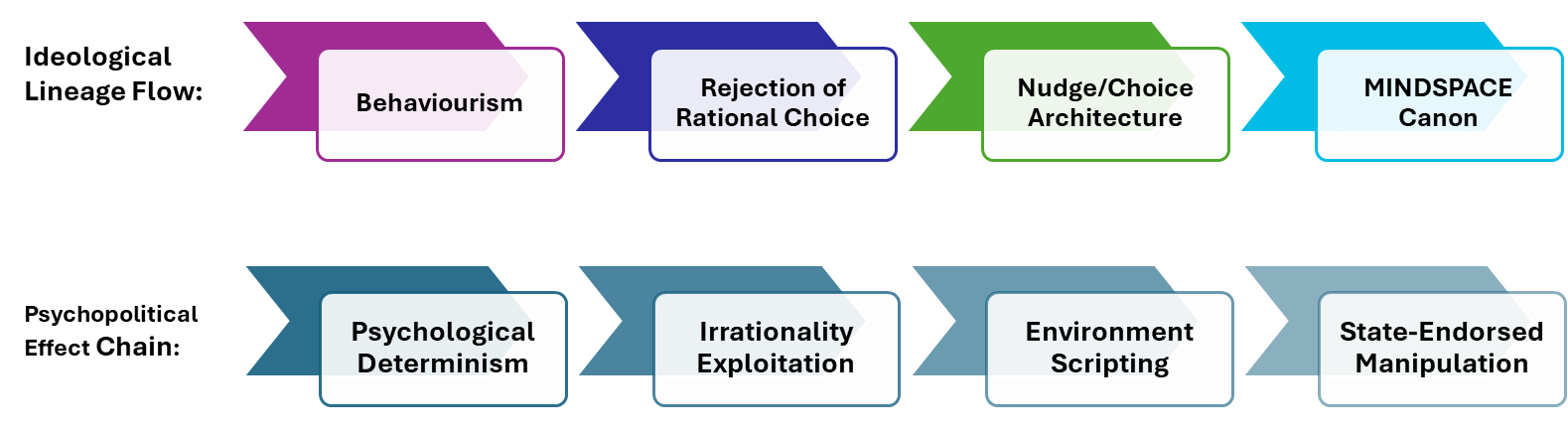
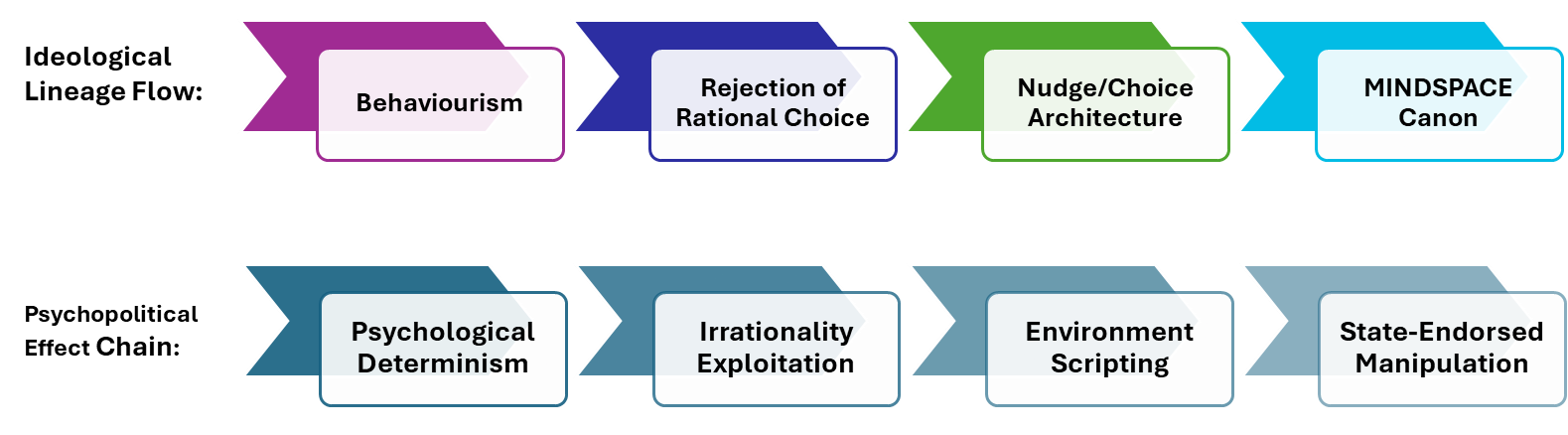
By the early 2000s, B.F. Skinner’s operant conditioning had already reduced behaviour to stimulus-response. His logic now lives in every interface default, every opt-out prompt, every push notification. Then came Thaler and Sunstein’s Nudge, repackaging Skinner’s behavioural determinism in the language of liberty. Behavioural control was no longer authoritarian—it was helpful. But who defined “helpful”? Who decided what counted as the “right” choice?
By 2010, the ideology was institutionalised. The Behavioural Insights Team (BIT) and the MINDSPACE framework translated theory into government infrastructure. Psychological control became standard protocol. Public health was reframed not as a dialogue, but as interface management. Governance became behavioural design.
COVID-19 was the inflection point. SPI-B deployed fear scripts, shame cycles, and emotional priming at scale. The rhetoric of care masked a regime of control. Terms like “resilience” weren’t spontaneous public virtues—they were behavioural implants. “Trusted messengers” were selected to bypass scrutiny. Ease was engineered. Compliance became frictionless. Resistance felt illegitimate by design.
David Halpern remarked, “People make choices based on what’s easiest to do.” What he didn’t say was: the system determines what’s easiest. Behavioural governance doesn’t outlaw dissent—it makes it improbable.
The goal isn’t persuasion—it’s pre-installation. Public messaging becomes behavioural scaffolding. Consent becomes a managed performance. Autonomy is redefined as response within pre-approved boundaries.
“Behaviour change is often seen as government intruding into issues that should be the domain of personal responsibility. However, it is possible for government just to supply the trigger or support for individuals to take greater personal responsibility. And we suggest that evidence from behavioural theory may, in some areas, challenge accepted notions of personal responsibility.” p.10
This isn’t conspiracy—it’s epistemic architecture. From Bernays to Skinner, Sunstein to Halpern, the lineage is traceable. The function is consistent: to manage populations through pre-emptive compliance design.
And the core questions remain unanswered:
- Who defines “correct” behaviour?
- Who engineers the defaults?
- When choice feels voluntary but is actually structural—what’s left of autonomy?
The shift from democracy to design wasn’t debated. It was deployed.
It was never about what you chose.
It was about when you stopped asking who chose it for you.
Core Infrastructure
The control embedded within behavioural governance is a structurally institutionalised feature of the regime. And crucially, it is designed to operate without the subject recognising it as control at all.
“This report focuses on the more automatic or context-based drivers of behaviour, including the surrounding choice environment. There are three main reasons for doing so. First, these automatic processes have been relatively neglected in policy discussions, perhaps because environmental effects on behaviour are a lot stronger than most people expect. Second, because of questions about the effectiveness and cost-effectiveness of interventions designed to change behaviour by changing minds. Third, because of the possible value for money that this type of behaviour change may offer.” p.15
In this model, MINDSPACE functions not merely as a toolkit, but as the symbolic operating system of a new psychopolitical regime. Terms like “choice architecture,” “priming,” “default settings,” and “social norming” are not innocuous policy guidelines—they form the linguistic firmware of a governance model that scripts cognition beneath the threshold of awareness.
At the tactical front of this system sits the Scientific Pandemic Insights Group on Behaviours (SPI-B), a behavioural subunit of SAGE, created to interface psychological conditioning directly with policy implementation. While ostensibly formed to assist in managing COVID-19, SPI-B’s role quickly expanded: to amplify fear, trigger conformity, and design population-wide behavioural scripts justified by crisis urgency.
Key figures Susan Michie (advocate for “permanent behavioural recalibration”) and Halpern represent the interface class: technocratic agents translating abstract behavioural science into lived population constraints. Their work is not merely academic; it is operationalised strategy. SPI-B doesn’t advise—it executes.
But SPI-B wasn’t the centre of gravity. That position belonged to the Cabinet Office which was responsible for commissioning the MINDSPACE document, was the sponsor of BIT and the system integrator embedding behavioural logic across government. It is this—bureaucratic, opaque, structurally unaccountable—node that consolidates behavioural science as command infrastructure. Health, digital identity, climate communications, financial services—all now operate behavioural circuits wired by the Cabinet Office.
SPI-B implements. The Cabinet Office authorises. Together, they form a vertically integrated system in which behavioural doctrine flows from concept to constraint without meaningful public scrutiny.
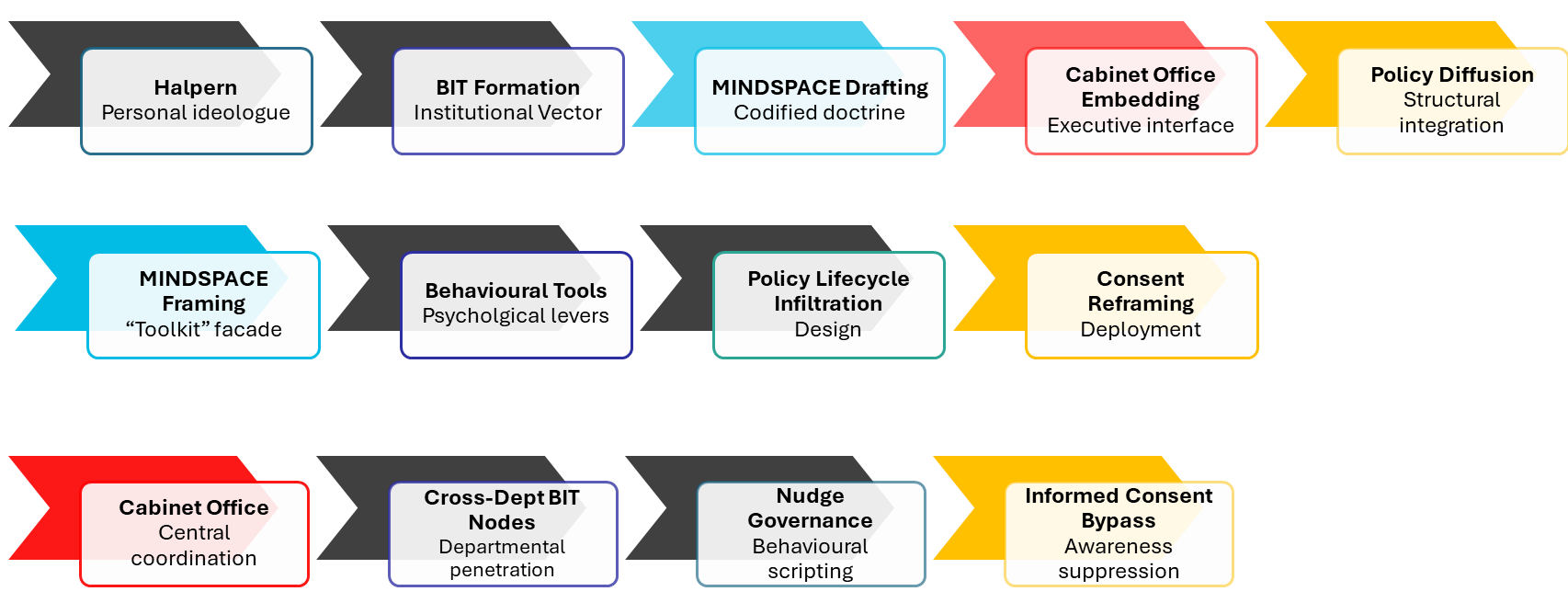
The scripting mechanism so developed is globalised via institutional convergence. Entities such as the WHO, WEF, and OECD serve as harmonisers—replicating UK-origin behavioural models and validating them under scientific and humanitarian veneers. Behavioural control thus gains not just national deployment but transnational legitimacy, backed by donor-funded labs and international think tanks.
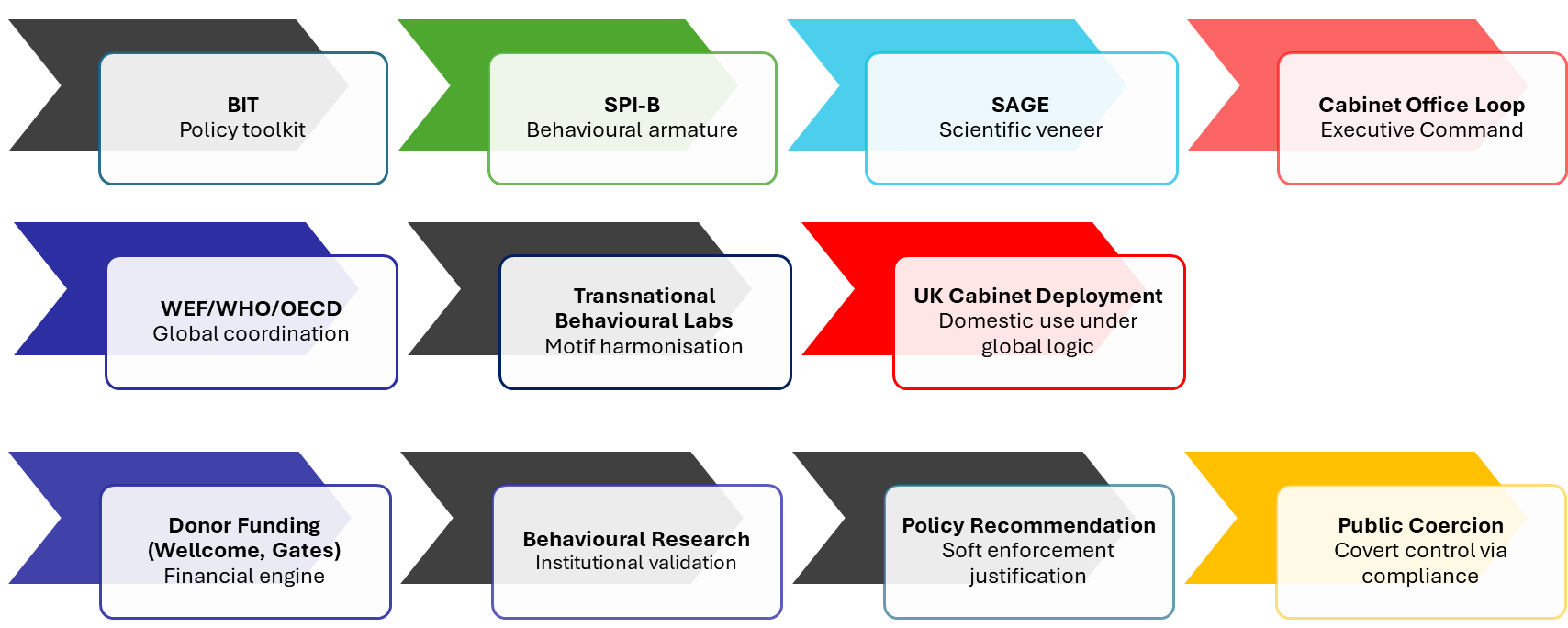
The architecture is circular. Design influences belief, belief retrofits consent, and consent justifies more design. This is not adaptive governance—it is feedback-engineered compliance masquerading as participation.
Yet within this structure lies a critical fragility: centralisation. The Cabinet Office’s role as behavioural nexus creates a single point of narrative vulnerability. Any exposure of SPI-B’s manipulative tactics, or leakage of Cabinet Office coordination chains, doesn’t just compromise a department—it calls the moral legitimacy of the entire behavioural state into question.
This raises the deeper issue avoided by behavioural practitioners: By what right does any institution arrogate the authority to alter public behaviour without informed consent? According to whose standard? For whose benefit?
“The MINDSPACE framework provides a brief overview of some of the most robust and powerful automatic effects on behaviour, which can be used as tools for behaviour change …These principles are underpinned by laboratory and field research from social psychology, cognitive psychology and behavioural economics.” p.28
The mirage of voluntary control collapses the moment we confront the core truth: what is being shaped is not merely what we choose, but how choosing itself is structured.
Behavioural governance does not take your freedom away. It designs the perimeter of your perceived freedom, then scripts your gratitude for staying within it.
Actor Map
Beneath the soft language of “choice” and “well-being” lies an elite formation of policy engineers—an unelected behavioural vanguard. This cohort doesn’t merely advise; it designs cognition as governance. Their roles are not incidental but functionally embedded within a system that rewires public life through invisible command.
Their public rhetoric legitimises; their structural function coerces. Each acts not in isolation, but as part of a distributed control network whose cohesion emerges through shared epistemology, funding streams, and mission alignment—not explicit conspiracy, but systemic convergence.
- David Halpern – Translator, Broker, Custodian: In the public eye, Halpern is the affable architect of nudging. Beneath the surface, he is the compliance broker, mapping behavioural theory into strategic policy code. He stabilises the interface between state coercion and public acceptability, ensuring that coercion is read as choice.
- Susan Michie – Constructivist, Inverter, Architect: Michie’s advocacy for “habit change” in public health is well known. Less acknowledged is her role as behavioural architect, constructing routines of compliance masked as civic responsibility. Her formulations invert autonomy: agency becomes a deliverable, not a right. “In order to solve any of these big social challenges, we need people at different positions in society to change their behaviour.” he key question is left unasked: by what standard, and on whose authority?
- Mark Sedwill & Gus O'Donnell – Relay Nodes, Donor Interfaces: Far from apolitical functionaries, Sedwill and O'Donnell acted as transmission nodes between behavioural ideology, donor funding (e.g., philanthropic behavioural labs), and institutional embedding. They created policy scaffolding without electoral consent, ensuring longevity through procedural opacity.
- Cass Sunstein – Ideologue, Normaliser, Moral Launderer: Once praised for framing nudges as liberty-preserving, Sunstein’s real legacy is the inversion of autonomy. His work reframes manipulation as benevolence, laundering coercion through moral ambiguity. The choice becomes scripted, the subject unaware.
The contradiction at the core of this map is not personal—it is systemic. These actors do not fail the public accidentally; they perform their roles as designed: to stabilise the illusion of voluntary alignment while recursively scripting it.
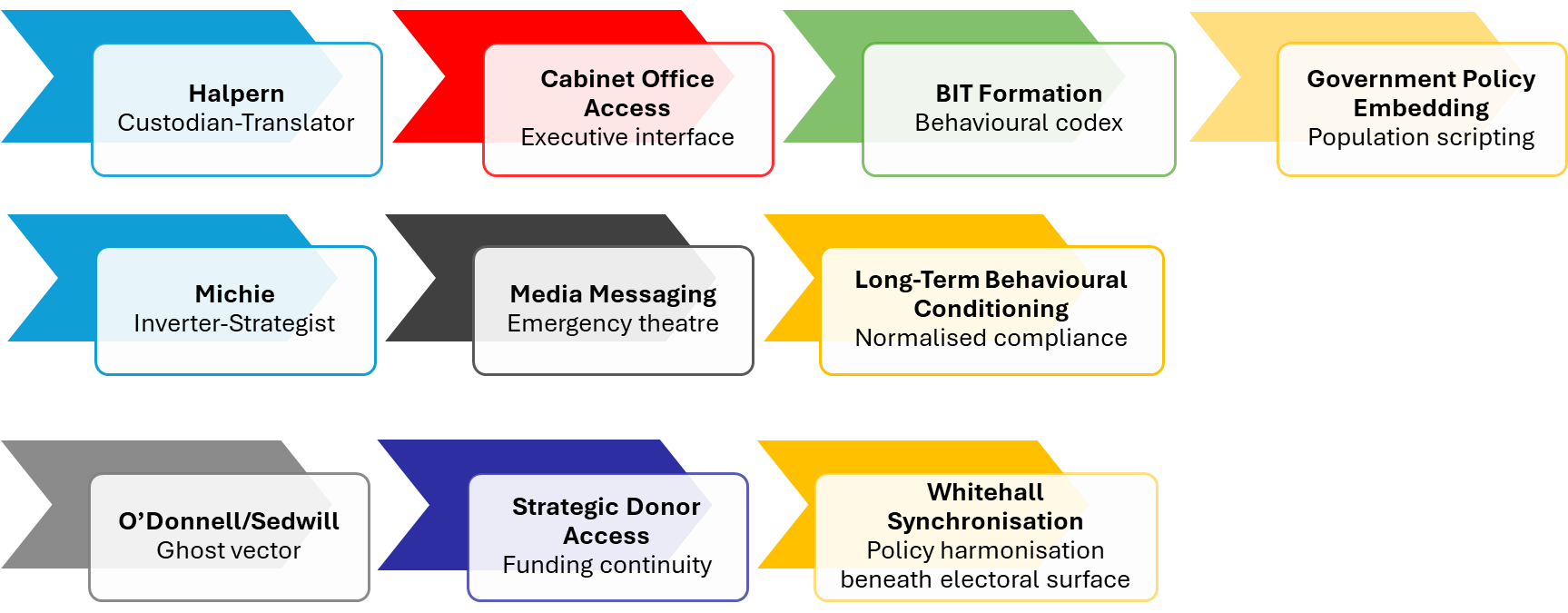
Figure 5 details the functional topology of this vanguard. Halpern operates as the translator from theory to tactical script. Michie curates the inversion logic—public health into behavioural design. O'Donnell and Sedwill maintain narrative stealth, using their administrative authority to cloak behavioural interventions in procedural neutrality.
Around them orbits a closed-loop system:
- The Cabinet Office inscribes behavioural policy
- BIT codes it into practice
- SPI-B deploys it via crisis strategy
- Donor labs fund its legitimacy
- Media messaging sustains its public grammar
- Whitehall departments execute without electoral friction.
This is not just a network—it is an automated governance cycle, in which belief, behaviour, and perception are auto-tuned in the name of compliance.
Yet this structure carries its own failure conditions. Its actors depend on:
- Public belief in expertise
- Institutional legitimacy
- Narrative uninterruptibility.
A single rupture—leaked minutes, academic dissent, data sabotage—could unmask the engineered scaffolding. The system survives on invisibility. Exposure is erosion.
“Assessing how much legitimacy the state has in changing certain types of behaviour is a massive and complex area. And public reactions may not be predictable or consistent: an apparently innocuous attempt to change behaviour, backed by strong evidence, may become a flashpoint.” p.65
The question is not just who these people are. The deeper challenge is this: Who gave them the moral mandate to sculpt your decisions? And how do we deconstruct a regime whose softest instruments are its strongest?
Elite Network Expansion
Behavioural governance is not a spontaneous policy innovation—it is a strategically funded and institutionally harmonised architecture of control. Behind soft terms like “well-being” and “choice architecture” lies a converged power system: capital flows, technocratic actors, and global institutions engineering compliance through design, not mandate.
Foundations like the Wellcome Trust and Gates Foundation function as ideological accelerators, financing behavioural research under banners like “health equity” and “infodemic control.” Wellcome Trust backs behavioural surveillance and nudging trials while the Gates Foundation supports vaccine uptake modelling within WHO-aligned networks. These funders set epistemic boundaries: defining what is considered ethical, scalable, and fundable in the behavioural space.
Tech firms like Google and Meta act as behavioural arms of the state. Their UX teams align with public nudge units:
- BIT advises on platform trust architecture.
- Google co-authors nudging guides used in government docs.
- Facebook’s “trust and safety” units apply nudge logic to content moderation.
- The public-private divide collapses. Policy becomes interface.
Global institutions like OECD, WHO, and WEF canonise behavioural governance:
- OECD formalises nudging for tax, climate, and education.
- WHO’s “behavioural insights” wing exports BIT-style models globally.
- WEF integrates nudge logic into climate, health, and digital trust policy templates.
- The result: vertical legitimacy chains immune to democratic audit.
This isn’t just elite convergence—it’s sovereignty reallocation by stealth.
Five Shifts in Behavioural Power:
- From Deliberation to Design – Preferences are pre-coded; consultation is obsolete.
- From Parliament to Cabinet Office – Influence directives flow from unelected behavioural units.
- From Visible Officials to Interface Custodians – Power resides with technocratic architects, not public representatives.
- From Sovereign State to Transnational Command – Donor-funded frameworks displace national policy with outsourced ideology.
- From Legal Accountability to Affective Authority – Scripts override law; there is no appeal to emotional coercion.
Supply Chain of Consent: Philanthropies → Behavioural Labs → Government Contracts → Tech Platforms → Global Templates
This is not conspiracy—it is converged design. Capital writes the rules. Interface delivers them. Institutional prestige shields them. And what you think you want was installed long before you chose it.
Under this regime:
- “Voluntary” = mandatory via default
- “Choice” = interface conditioning
- “Legitimacy” = repetition
- “Consent” = engineered inevitability
The core questions remain:
- Whose values shape the design?
- Who funds the framework?
- Who benefits when your preferences are manufactured?
This is not policy. It is sovereignty theft—executed via trust and enforced through invisibility.
Where the Narrative Breaks
Behavioural governance is not defeated by opposition. It collapses under its own contradictions.
Every system that cloaks itself in inevitability eventually reveals its brittleness. Behavioural governance, despite its initial successes, is showing signs of structural fatigue, symbolic decay, and strategic inversion.
“The fact is, there is relatively little practical evidence about how the impact of frequently used effects might habituate over time. Success will probably depend on whether the citizen is broadly happy with the result – in other words, the reinforcement that follows it.” p.75
These breakdowns are not isolated anomalies—they are embedded failure modes, revealing the limits of a system designed to engineer consent without understanding resistance.
1. Symbolic Failures – When Language Implodes
Behavioural manipulation relies heavily on semantic camouflage. Words like “shared values,” “resilience,” and “building trust” were once effective euphemisms, designed to mask intention and displace debate. But overuse created transparency—people began to see through the scripts.
- “Liberty” became visibly entangled with vaccine passports and movement restrictions
- “Care” was used to justify isolating the elderly, suppressing funerals, and silencing protest
- “Sustainability” was invoked while solar panels covered farmland, and massive wind turbines blades wear out and can’t be recycled.
The result: symbolic inversion. The language meant to soothe began to trigger suspicion. A narrative begins to die the moment its keywords require reinforcement.
If “building trust” needs a behavioural nudge, whose trust is being engineered and for whom?
2. Affective Failures – The Collapse of Fear Scripts
Behavioural doctrine weaponised fear—but overuse created desensitisation. During COVID-19, the public was repeatedly exposed to escalating variants (Alpha, Delta, Omicron) that failed to deliver the projected threat. When Zika vanished, when Omicron failed to produce mass death, when emergency messaging clashed with visible reality, fear lost its grip.
- Vaccination rates declined not because of disinformation, but because of narrative exhaustion
- Mental health messaging contradicted enforced isolation
- Encouragement of “resilience” clashed with policies eroding agency and autonomy.
SPI-B’s fear-based scripts, once effective, began generating backlash. The nudge became a shove became a script—and the subject began pretending to choose.
3. Institutional Failures – Resistance from Within
The assumption of seamless behavioural application has collapsed in practice. Institutional dissonance and public rejection are now endemic.
- In climate policy, contradictions abound: Governments promote solar adoption while permitting geoengineering experiments that aim to dim the sun. Panels are subsidised while their waste goes unaddressed. Land for food is repurposed for tech-driven symbolism. The gap between policy logic and material impact is now visible.
- In digital identity, citizen resistance to centralised ID systems is escalating—exposing the limits of passive compliance.
- Legal, medical, and civil society pushback has begun to fracture the behavioural monoculture. Experts dissent. Leaks surface. The moral shield is thinning.
What began as invisible guidance has become visible coercion, stripping behavioural governance of its plausible deniability.
Collapse as Recursion
Collapse is not a bug—it is a diagnostic. Each break reveals the pressure point where narrative becomes untenable, where the illusion of voluntary control fractures, and where symbolic overreach becomes epistemic noise.
These aren't failures of implementation. They are failures of the model itself—a system that presumed behaviour could be indefinitely shaped without resistance, contradiction, or exposure.
We must not only document collapse—we must learn from it.
- Track compliance decay: At what point does population pushback spike? What is the half-life of a fear-based directive?
- Exploit symbolic fragility: Repetition is weakness. Saturated motifs are vulnerable to parody, inversion, and rejection.
- Expose contradictions: If we are told to install solar panels while governments dim the sun, who’s driving the climate bus—and toward what endpoint?
The narratives didn’t fail because of counter-narratives. They failed because they forgot that control, to remain invisible, must never be too obvious. The moment manipulation becomes legible; it loses its power.
“Even if people agree with the behaviour goal, they may object to the means of accomplishing it.” p.66
Collapse isn’t just happening. It’s telling us where to strike next.
Philosophical Breach
The rise of behavioural governance is not a technocratic evolution—it is a rupture in the foundational principles of legitimate rule. To understand its true breach, one must move beyond policy analysis and confront the core philosophical architecture of sovereignty, agency, and consent. Behavioural control systems do not merely reshape choices; they pre-empt the conditions under which choices can be freely made.
Locke: Consent Without Deliberation is Tyranny by Design
John Locke’s theory of political legitimacy rests on a single bedrock: explicit, revocable consent. Governance, in his model, derives its authority solely from the agreement of the governed. But behavioural governance circumvents this. It deploys psychological influence without awareness, shaping outcomes without deliberation, and scripting preferences without acknowledgment. It simulates consent but offers no possibility of withdrawal. The behavioural state, therefore, is not a caretaker of the social contract—it is an author of unrequested terms.
“No one can be... subjected to the political power of another, without his own consent.” – John Locke
The behavioural regime violates this by engineering compliance prior to the subject’s conscious engagement. It is not representative governance—it is theatrical consent performed by design.
Arendt: The Destruction of Political Space
Hannah Arendt warned that totalitarianism begins not with brute force, but with the destruction of the space where authentic thought, speech, and collective judgment occur. Behavioural governance replaces this space with curated choice environments, default architectures, and manipulated emotional triggers. It does not suppress speech; it renders speech epistemically irrelevant. It makes reason itself inefficient, replacing it with psychological suggestion.
“The ideal subject of totalitarian rule is... the man for whom the distinction between fact and fiction... no longer exists.” – Hannah Arendt
In the behavioural model, debate is bypassed, policy is psychologised, and legitimacy is not earned—it is emulated through performance scripts encoded into the policy interface. The citizen no longer participates; they execute pre-designed agency.
Foucault: The Shift from Law to Optimisation
Michel Foucault’s concept of biopower reframed the state’s role—not as punisher, but as optimiser. Where once governance imposed, now it conditions. The goal is not to discipline the body but to pre-format the soul—to produce compliant populations through norms, nudges, and narrative control.
Behavioural governance exemplifies this transformation. It manages populations through affective conditioning, default design, and preference scripting—controlling not what you do, but how you arrive at doing it. The state no longer needs laws; it has interfaces. It does not order; it nudges. Its control is invisible, its power plausible, its coercion morally coded.
This Is Not Just an Overreach—It’s a Sovereignty Rewrite
Together, these three thinkers frame the full extent of the breach:
- Locke: Consent has been replaced with design.
- Arendt: Politics has been displaced by psychology.
- Foucault: Law has been replaced by code.
This is not a disagreement about policy mechanics. It is the exposure of an illegitimate epistemology of control. The behavioural state does not govern through will—it governs through preference simulation. Its legitimacy is not derived from consent—it is fabricated through interface engineering.
“MINDSPACE effects depend at least partly on the Automatic System. This means that citizens may not fully realise that their behaviour is being changed – or, at least, how it is being changed. Clearly, this opens government up to charges of manipulation …people have a strong dislike of being “tricked” …fundamentally it is an issue of trust in government.” p.66
What we confront is not a nudge. It is a new regime—a soft coup cloaked in care, framed as science, and executed via code. And its core crime is the erasure of the right to govern oneself.
The Moral Trap
Within behavioural governance, virtue no longer functions as a compass—it becomes an interface layer. Morality is retooled as delivery system: what presents as care operates as coercion. Through a problem–reaction–solution cycle, risk is framed to trigger public demand, while solutions arrive pre-engineered—designed to centralise control and erase agency. “Protection” becomes the rhetorical skin for override. The moral script doesn’t inspire action—it scripts compliance.
“One way of thinking about this is to view the role of the policymaker or public servant as trying to shape influences around us to maximise the public and private good, while also leaving as much choice in the hands of citizens as possible. This is what is known as ‘libertarian paternalism’...” p.73
This is moral laundering: embedding coercion in uncontestable values (“protect the vulnerable,” “save lives,” “build resilience”). Its function is threefold:
- Pre-empt critique: opposition is recoded as immorality
- Silence deliberation: urgency short-circuits process
- Invert consent: participation becomes obligation.
Morality in this regime no longer restrains power—it lubricates it. Once hijacked, moral constraint becomes moral license. What once limited the state now legitimises its expansion.
Key actor roles in moral interface design:
- SPI-B – Moral Bureaucratism as Coercion Engine: Justified psychological operations—fear amplification, conformity scripting, behavioural conditioning—as “life-saving interventions.” Yet functionally, it acted as a coercion broker, removing informed consent via fear-coded compliance.
- Susan Michie – Ethical Broker Turned Compliance Architect: Publicly claimed behaviour recalibration as “civic responsibility.” Structurally, she engineered long-duration habit systems, where policy was no longer proposed, but lived—inscribed in behaviour.
- David Halpern – Virtue Interface Specialist: Framed nudging as “evidence-based benevolence.” Yet he designed and operationalised default systems of influence, justified by vaguely defined “public good” metrics, never publicly interrogated.
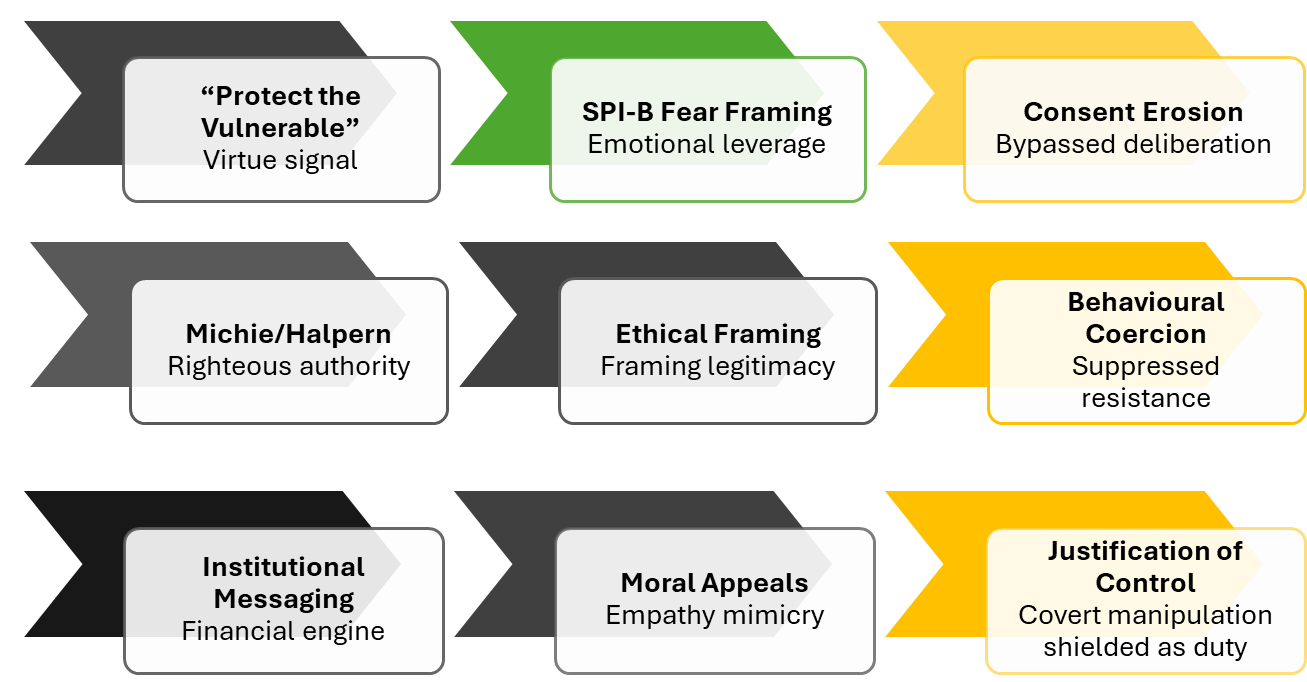
Emotionally resonant language of care, urgency, and duty forms a cognitive firewall around coercive behavioural design—rendering manipulation immune to scrutiny. What should trigger democratic deliberation instead becomes unchallengeable obligation.
The behavioural regime does not debate what is right—it pre-installs a version of “right,” formatting public alignment as moral obligation. Values are not deliberated—they are embedded, automated, and shielded from challenge.
“In practice, the question of how far MINDSPACE effects preserve substantive freedom, and in which contexts, is likely to come down to political judgment.” p.72 [emphasis added]
This is not an ethical lapse. It is a legitimacy breach:
- If I comply to avoid moral framing—was that consent?
- If virtue signals suppress dissent—was that democracy?
- If “good” is never contested—who engineered the metric?
This system does not merely use morality—it runs on it. Behavioural governance depends on moral laundering: embedding coercion within virtue, so that control appears as care. Fear becomes ethics. Obedience becomes altruism.
A deeper breach lies in a widely absorbed confusion: the belief that legal equals moral. This equation is rarely stated—but deeply felt. What is permitted becomes what is right. What is mandated becomes what is good.
In media, policy, and daily discourse, legality is framed not as a minimum constraint, but as a moral ceiling. This fallacy:
- Converts regulation into righteousness
- Shields authority from ethical scrutiny
- Recasts dissent as deviance.
When law is treated as virtue, critique becomes heresy. But legal compliance is not moral consent—it is often its bypass. From Aquinas to Thoreau, philosophers drew a line between higher moral law and statutory command. Laws can be unjust—even tyrannical—when they violate fundamental rights.
In the behavioural regime, morality no longer restrains power—it licenses it. It does not limit the state. It expands it. Not by decree, but by design.
Why This Still Feels Legitimate
The question isn’t why behavioural governance continues. It’s why it still feels legitimate.
That feeling of intuitive moral correctness—the sense that public policy is “for our own good”—doesn’t emerge naturally. It is meticulously engineered through language, suggestion, and epistemic architecture. What you call “resilience,” they call behavioural compliance. What you experience as “choice,” they designed as preference curation.
“Ultimately, most policymakers are focused on this bigger picture – often known as culture change. There may be occasions when the power of argument alone can eventually such culture change, such as gender equality or race relations. But generally the broader sweep of policy history suggests that such change is driven by a mix of both broad social argument and small policy steps.” p.77
Legitimacy in this system does not arise from public consent. It arises from rhetorical mimicry: carefully constructed scripts that simulate ethical closure while bypassing deliberation.
Behavioural policy doesn’t simply direct. It pre-empts dissent by wrapping coercion in three layers of rhetorical insulation:
- Directive Modals – Programming Inevitability: Language like “we must,” “it is essential,” or “failure to act” encodes necessity. These phrases simulate closure by manufacturing urgency and constraining the debate space before it opens.
- Moral Appeals – Laundering Coercion as Care: Slogans like “protect the vulnerable” or “do your part” do not invite reflection; they compel moral alignment. Any resistance is recoded as selfishness, disinformation, or harm.
- Institutional Trust – Legitimacy by Proxy: Phrases like “trusted experts” and “evidence-based policy” displace epistemic agency. They outsource judgement to curated authorities, simulating informed consent without actual deliberation.
This tripartite structure doesn’t just close argument—it closes imagination. It simulates not just legitimacy, but inevitability.
“Behavioural science will continue to turn previously invisible influences into explicit choices, and policymakers and professionals into „choice architects‟ whether they like it or not.” p.73
Strip the language. Remove the keywords. Take any pandemic, climate, or digital identity policy. Now eliminate phrases like:
- “protect the vulnerable”
- “trust the science”
- “critical for safety”
- “one source of truth”.
What remains? Often, nothing more than unilateral behavioural mandates that bypass democratic process, substitute expert edicts for deliberation, and obscure whose interests are served.
If the legitimacy of a policy evaporates when stripped of its rhetorical armour, it was never legitimate—it was merely designed to appear so.
The behavioural state never proves its right to define “correct” behaviour. It assumes it. Nowhere does MINDSPACE, BIT, or SPI-B define:
- What constitutes “desirable” behaviour
- Who decides it
- What ethical system justifies altering it.
Instead, it relies on moral fog—a soft haze of duty, urgency, and expertise that masks a total absence of consent architecture.
If a system installs behaviour in you without your awareness, is your agreement real—or just simulated?
True legitimacy doesn’t come from morality performed or expertise cited. It comes from choices made freely, in structures that are transparent, reversible, and contestable.
Behavioural governance fails this standard. It does not ask for permission. It writes scripts, builds theatres, and casts you in roles you didn’t audition for—then tells you that you agreed.
Legitimacy is not the absence of resistance. It’s the presence of choices not installed by design.
“Behavioural approaches embody a line of thinking that moves from the idea of an autonomous individual making rational decisions to a “situated” decision-maker, much of whose behaviour is automatic and influenced by their choice environment. This raises the question: who decides on this choice environment? …Policy-makers wishing to use these tools summarised in MINDSPACE need the approval of the public to do so. Indeed, these approaches suggest an important new role for policymakers as brokers of public views and interests around the ecology of behaviour.” p.73-74
But if these tools are used covertly, how will the public grant consent? This system will continue to feel legitimate—until you ask how that feeling was made.
Reclaiming Agency
Behavioural governance is not static. It is mutating—toward opacity, automation, and embedded permanence.
Its future isn’t more nudges, but architectures where outcomes are pre-installed:
- Digital ID systems that gate access by behavioural scores
- Interfaces that filter perception itself, not just options
- Climate compliance defaults enforced through programmable constraints
- Ambient, AI-driven micro-nudging—pre-conscious, post-choice.
This is not persuasion. It is policy-by-precondition. Behavioural governance becomes not a directive—but a condition.
The Right to Be Left Alone:
The breach is not technical. It is philosophical. The system no longer governs by law, but by interface. It frames freedom as volatility and treats autonomy as inefficiency.
What if consent no longer required asking? What if governance became design, and obedience was simply the path of least resistance? When truth is curated, and trust is installed—what becomes of meaning?
Every regime names its tools: “Nudge,” “Resilience,” “Trusted expert,” “Choice architecture.” But none explain them. When language becomes instruction, who owns the dictionary?
Counter-Infrastructure Protocol:
The regime's language depends on semantic cover. But every euphemism has a half-life. Clarity breaches containment under:
- Trust Collapse: When behavioural contracts and fear playbooks are leaked—breaking the illusion of neutral expertise.
- Digital Gridlock: When 100,000+ citizens opt out of Digital Ids at once—saturating deployment systems and forcing failure.
- Legal Disruption: When cognitive liberty becomes a constitutional front—turning psychological design into liability.
- Semantic Hijack: When their euphemisms stop working so that:
“Resilience” = repression
“Choice architecture” = rigged process, and
“Trusted source” = system mouthpiece.
What was once a framing device becomes evidence of intent. When the words break, the architecture is exposed.
Sovereignty Is Rewritten, But Not Irrevocably:
No tanks. No orders. Just design defaults, emotionally sanctioned. Sovereignty migrated—from individual to system—without vote, without headline.
Some never noticed. Some adapted. Others remembered the line between suggestion and script.
What happens to a citizen who prefers not to perform?
What if freedom was simply the right to not be improved or made safe?
Published via Journeys by the Styx.
Mindwars: Exposing the engineers of thought and consent.
—
Author’s Note
Produced using the Geopolitika analysis system—an integrated framework for structural interrogation, elite systems mapping, and narrative deconstruction.