Mindwars: Who’s Allowed to Say “Conspiracy”? Conspiracy Psychology vs Elite Theory in the Managerial Age
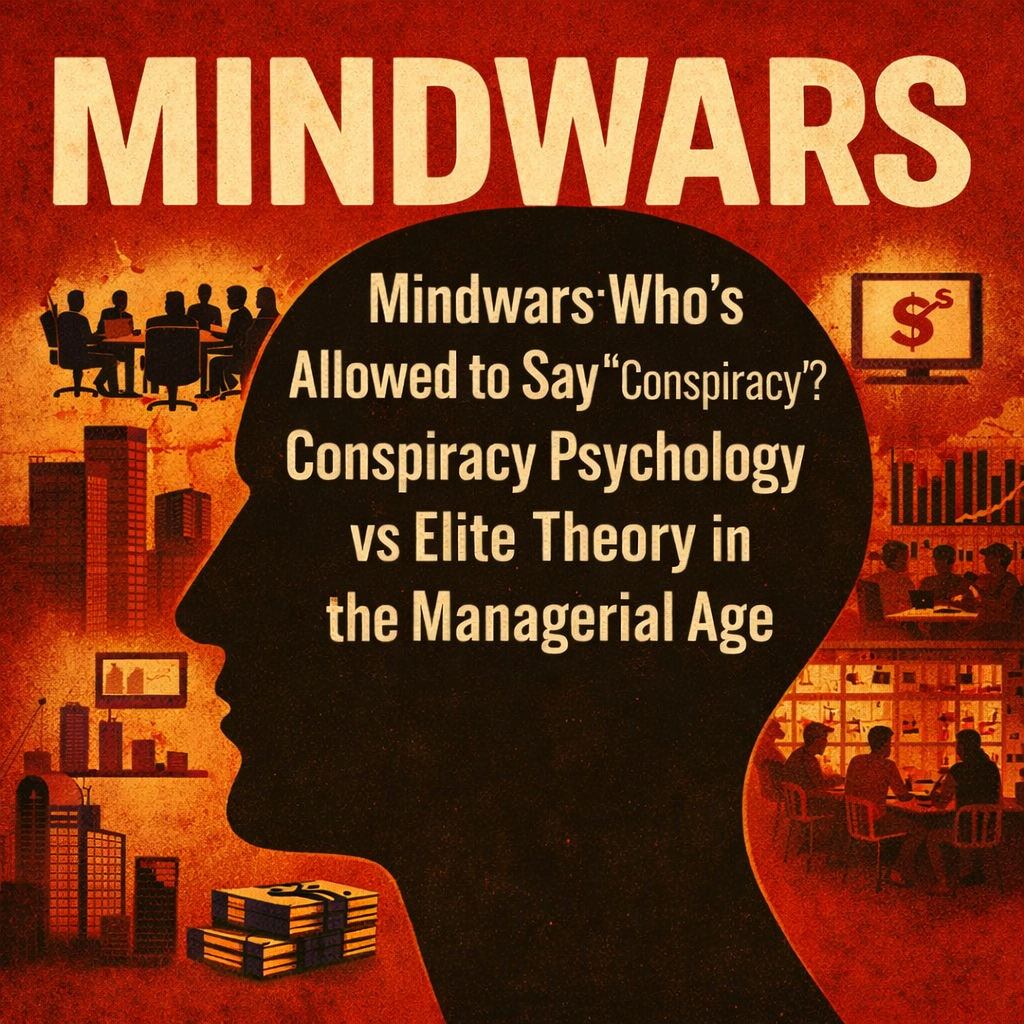
There’s a moment that captures the whole problem in one shot.
In one room: senior politicians and asset managers sit down for “strategy discussions” about the economy. They are not elected, they don’t publish minutes, but they talk through what is “credible,” what “the markets” will tolerate, and how fiscal or regulatory policy should be framed.
In another room: a citizen, piecing together news snippets and leaks, says, “Hang on — this sounds like a handful of financial actors steering national policy behind the scenes. That’s basically a conspiracy.”
In the first room, it’s “responsible economic governance.” In the second room, it’s “conspiracy thinking.”
That split — who is allowed to describe elite coordination as elite coordination — is exactly where the small psychological subfield, that of Conspiracy Theory Theorists (CTTs), has quietly collided with a century of political and sociological theory. On one side, you have the Burnham / elite-theory tradition and its modern descendants, mapping how a managerial class actually runs things. On the other, you have the emerging “science of conspiracy belief,” whose main object isn’t power, but the minds of people who say power is coordinated.
This essay takes a single, very specific artifact as its entry point: the February 2023 Current Opinion in Psychology special issue on conspiracy theories and its accompanying editorial. It’s not a fringe outlier but a hub node in the social psychology microfield of CTTs: a tidy synthesis of “what we know,” written by central figures, arriving right after years of intense crisis messaging and behavioural “nudge” campaigns. It’s the kind of package that grant panels, policy units and outlets like The Conversation or the BBC treat as authoritative and then translate into public-facing explainer pieces about “why people believe conspiracy theories.” In other words, it sits exactly at the collision point this essay is interested in: where a managerial system that coordinates, scares and steers from above commissions a psychological vocabulary for describing what is wrong with the people who notice.
This is not about motives in the cartoon sense — no secret Zoom cabal of psychologists plotting with ministers. It’s about structure and incentives: which questions get asked, which don’t, which answers travel into BBC explainers and policy documents, and how the resulting “consensus” fits the needs of a system that both engineers fear and then pathologises the suspicious.
What Serious Theory Already Knows About Elites
Long before psychologists started running surveys on “conspiracy beliefs,” political and sociological theory had already given us a blunt, unromantic claim: all complex societies are run by minorities.
Gaetano Mosca called it the “ruling class.” Vilfredo Pareto talked about “circulation of elites.” Robert Michels produced the “iron law of oligarchy”: any mass organisation tends, over time, to be controlled by a small internal clique. None of this was moral panic; it was descriptive. Give humans large bureaucracies, parties, unions, churches, corporations, states, and you reliably get concentrated decision-making at the top.
James Burnham, writing in the mid-20th century, updated this into what he called the managerial revolution. The old image of the capitalist — the individual owner of plant and capital — was, he argued, being displaced by a new type: the manager. Control over big firms, state agencies, utilities, media companies, unions and international bodies was moving to people whose power came not from property titles, but from command of organisations and technical expertise.
In that frame:
- Real power sits with executives, senior civil servants, central bankers, foundation directors, think-tankers, NGO chiefs, standards-body chairs, platform architects — the managerial class.
- They coordinate through boards, committees, conferences, strategy groups, email lists, standards processes, funding flows and informal networks.
- They do not need to be in some cartoon smoke-filled room. This coordination is built into their job description.
More recent critical work simply updates the scenery: add global asset managers, Big Tech platforms, transnational NGOs, behavioural-insights units, ESG standard-setters, supranational courts and trade regimes. The picture is continuous: a relatively small, networked stratum governs by controlling infrastructure, narrative, and risk across borders.
Elite theory itself is not scripture. It has blind spots: it can flatten internal fractures and counter-elites, underplay grassroots organisation, and slip into a kind of fatalism or technocratic conservatism. The point here is not that elite theory is pure and psychology is corrupt, but that it foregrounds something the CTT microfield almost never looks at directly: the patterned behaviour of people and institutions at the top.
The Managerial Blueprint: Overlords and Operators
Take that tradition and push it one step further, and you get the kind of mapping captured in the schema mapped out in my “Overlords / Operators” series of articles. Instead of treating “the elite” as one vague blob, that schema slices the system into classes and guilds:
- A ruling stratum that sits above electoral politics and markets, curating narratives, standards, and long-horizon strategy.
- An oligarchic stratum of billionaires and asset managers whose wealth is partly “fabricated” (valuation games, financial engineering) and whose power is conditional on serving the overarching system.
- An operating class: the permanent officials, technocrats, consultants, regulators, NGO managers — “not elected, not elite, but everywhere.”
- A phase of technocratic custodianship in which seemingly neutral tools — ESG scores, AI safety regimes, central bank digital currencies, compliance standards — become new levers of political control.
Then the Operator guilds:
- Security and foreign-policy operatives who turn crises into justifications for projection and policing.
- Legal guilds who design the venues, thresholds, and procedures that route power while claiming neutrality.
- Financial governors who operate payment rails, sanctions, indices, ratings, and risk weights as a kind of soft law.
- Policy framers in think tanks who manufacture doctrines and “options” that ministries and media can just install.
You don’t have to agree with every normative jab in that picture to see the structure: it’s Burnham updated for an age of transnational finance, platforms, NGOs, and standards bodies. It is elite theory with sharper resolution.
The throughline is the same: a relatively small, networked class runs key levers of policy, perception, and infrastructure. It coordinates through predictable mechanisms. It is not omnipotent, but it is organised.
Enter Conspiracy Psychology: Power Becomes “Belief”
Now contrast that with how the Current Opinion in Psychology special issue frames its object.
The stated topic is “conspiracy theories.” But what the volume actually studies, over and over, is conspiracy belief in individuals: why some people endorse statements like “a small group secretly controls world affairs” or “governments hide the truth about major events.”
The editorial and article summaries highlight several recurring themes:
- Societal risk framing. Conspiracy theories are presented as important because they are bad for well-being, interpersonal trust, intergroup relations, and democracy, and because they interfere with policy on “pressing issues” like climate or public health.
- Individual-level correlates. The main explanatory work is done by:
- Traits: narcissism, paranoia-adjacent traits, “maladaptive” personality profiles.
- Emotions: anxiety, existential insecurity.
- Cognitive style: reliance on intuition, lower “analytic thinking,” susceptibility to certain biases.
- Clinical and “rabbit hole” narratives. One contribution sketches “Rabbit Hole Syndrome”: stories of individuals who went deep into online conspiracy content and emerged isolated, angry, estranged from family and friends.
- Platform environment. Social media appear as spaces where conspiracy content “proliferates” and shows identifiable patterns across platforms.
There are also serious structural strands in the issue. Some pieces engage economic inequality (e.g., how perceived unfairness can make conspiratorial explanations attractive), others treat historical trauma and collective victimhood, and still others dig into social identity and intergroup conflict. These don’t fit a cartoon where the field is only about narcissism and bad thinking.
But watch what happens to them.
Even in the structural papers, the dependent variable is still essentially the same: endorsement of conspiracy narratives. Inequality, trauma, and identity are framed as inputs into a general model of “susceptibility” — conditions under which people are more likely to adopt these beliefs. The centre of gravity stays put: who believes, what traits and contexts predict that, and what consequences follow.
The crucial move is this: the special issue takes “conspiracy” out of the world and puts it into people’s heads.
- “Conspiracy” is not a description of what elites might be doing.
- It is a category of belief, whose legitimacy is never really the point; what matters is who has those beliefs and what’s wrong with them, or what made them vulnerable.
Elite coordination, in this framework, is not the primary object of study. Suspicion of elite coordination is.
The Collision Line: Same Pattern, Different Ontology
Put the two side by side and the collision becomes obvious.
From the elite-theory / Overlords perspective, it is a straightforward, almost boring claim that a small, networked managerial stratum influences or directs:
- Macroeconomic policy (via central banks, finance ministries, asset managers).
- Regulatory and legal environments (via legal guilds and international regimes).
- Public narratives (via think tanks, media partnerships, NGOs, and platforms).
- Behavioural norms (via nudge units, public-health campaigns, corporate HR and ESG frameworks).
From the conspiracy-psychology perspective, people who say “a small, networked group has disproportionate control over economic, legal, narrative and behavioural levers” are exhibiting “conspiracy thinking” — a belief pattern linked to narcissism, anxiety, intuitive thinking, trauma, or uncertainty, potentially intensified by online rabbit holes.
It’s the same pattern being described:
- Concentrated decision-making.
- Habitual coordination among actors who share interests and worldviews.
- Strategic concealment, euphemism, or branding of controversial actions.
- Use of media and platforms to manufacture consent and punish dissidents.
But:
- In macro theory, this is an expected property of modern governance.
- In the psych subfield, this is a symptom cluster in citizens.
That’s the collision: structure vs symptom.
- Elite theory: “This is how the system works; let’s map it.”
- Conspiracy psychology: “This is how people think the system works; let’s map what’s wrong with them.”
Real Coordination, Real Scaremongering, Real Suspicion
This might still feel abstract, so bring it back to lived cases.
Consider three families of events from the last decade:
1. Financial–political choreography
Senior politicians from major parties hold “private briefings” with asset managers and finance CEOs about what counts as “responsible” policy. Parties adjust fiscal platforms to avoid angering “the markets.” Personnel effortlessly cycle between Treasury, central banks, big funds, and advisory roles.
No one needs to secretly cackle about it. This is a routine choreography in which financial and political elites co-design the range of acceptable options.
2. Behavioural governance and deliberate fear
Governments don’t just “communicate”; they now run dedicated behavioural-insights teams, like the UK’s Behavioural Insights Team (BIT), to engineer compliance. During crises, these teams explicitly design campaigns using fear, shame, social norming, and emotional triggers. Internal documents and later testimonies around COVID policy, for example, make clear that “frightening” the public was not an accident, it was an option on the table and sometimes the chosen strategy.
The same pattern appears in war and security contexts: existential-threat narratives, terror alerts, “weapons of mass destruction,” and “red lines” are crafted and tested, not randomly blurted out. This is engineered scaremongering at institutional scale. It heightens ambient anxiety and a sense that unseen forces are steering events — the exact psychological conditions CTTs later treat as “vulnerability factors” for conspiracy belief.
3. Media and corporate profit from fear
Media outlets don’t just reflect elite coordination; they monetise fear and conflict. Corporate news knows that “if it bleeds, it leads,” and 24/7 crisis coverage — pandemics, terror, war, economic collapse, culture wars — keeps audiences hooked. Social media platforms layer on algorithms that reward outrage, shock, and tribal signalling. Fear performs double duty: it drives clicks and ratings, and it primes audiences to accept whatever “solutions” are offered.
Philanthropic–NGO–media webs sit on top of this. A handful of foundations and billionaire families fund a dense network of NGOs, research centres, advocacy groups, and media initiatives around specific agendas — in health, gender, climate, “disinformation,” and more. The same funders appear behind guidelines, training modules, professional standards, “fact-checking” operations and narrative campaigns. Many of these campaigns lean heavily on catastrophe framing: looming apocalypse if we don’t act, moral panic if we do.
None of this requires you to believe in a supervillain. It’s what you get when state, media, and corporate actors share incentives: fear keeps people glued, disciplined, and pliable.
Now imagine two people describing this:
- A political sociologist: “We’re seeing a managerial regime in which financial, bureaucratic, philanthropic, media and platform actors jointly stabilise policy and narrative, often by deliberately amplifying fear. This fits elite-theory expectations.”
- A lay citizen with no formal language for any of that: “It feels like they’re constantly scaring us and lying to us to get what they want. They’re all in on it.”
Sometimes that lay description is basically right on structure and wrong on detail; sometimes it’s half-right and then veers into myth, scapegoat or numerology; sometimes it is pure cargo cult. The point is: the person often lacks the vocabulary, the data and the frameworks, but not the core perception — they know they’re being played.
In elite-theory land, you can refine that rough perception with better concepts. In the conspiracy-psychology framework, you rarely get that chance: the rough perception itself is pre-sorted into a symptom box. The distinction between “good structural intuition, bad map” and “fully delusional rabbit hole” mostly disappears.
The Special Issue As Epistemic Safety Device
Once you see this asymmetry, the function of the conspiracy-psychology special issue becomes clearer.
It isn’t just “trying to understand why people believe weird things.” It is, structurally, doing at least three things for the managerial order — and it does so in an environment where governments, media and corporations have already been running deliberate fear operations.
It stabilises a particular myth
The myth goes like this:
- Yes, institutions coordinate — but in a basically benign, rational way, guided by science and public interest.
- When ordinary people suspect hidden coordination with malign intent, that’s usually because of their personality traits, emotional vulnerabilities, cognitive styles, or traumatic experiences.
- Such suspicions, when widespread, produce social harm — mistrust, polarisation, democratic erosion — and therefore must be studied and mitigated.
Elite collusion is thus ontologically downgraded to either:
- A regrettable but uninteresting feature of “how modern states operate,” or
- A paranoid fantasy in citizens’ heads.
There is no space, inside that myth, for the possibility that some conspiratorial interpretations of elite behaviour might be accurate in their basic structure, especially when elites have demonstrably engaged in organised scaremongering and deception.
It provides a diagnostic vocabulary
The special issue arms institutions with a repertoire of labels for people who talk in certain ways about power:
- Narcissistic, paranoid, maladaptive.
- Intuitive rather than analytic.
- Vulnerable to “Rabbit Hole Syndrome.”
- Driven by unmet needs for certainty, uniqueness, or control.
From a purely academic standpoint, these are correlational findings. From a governance standpoint, they are diagnostic codes. Some of those codes attach to real suffering and real derailment — people genuinely stuck in destructive myth-worlds. But because the same labels are applied to anyone whose suspicions stray outside officially sanctioned narratives, the toolkit that could, in theory, help a handful of genuinely lost people mostly functions as a broad-spectrum delegitimisation device for bottom-up structural critique.
The question “are they right about the coordination and manipulation they see?” doesn’t enter. The question is “how do we classify and manage their mindset?” — even when that mindset has been shaped by years of top-down fear-campaigns and crisis theatre.
It ritualises self-critique to keep the frame respectable
Interestingly, the editorial accompanying the special issue admits that the field is prone to:
- Normative overreach — straying into moralising about beliefs rather than strictly describing them.
- Methodological limitations — reliance on cross-sectional surveys, WEIRD samples, and vignettes.
It then announces that the field is “maturing.”
This is classic ritual self-critique. It functions like a confession: yes, we might have been a bit normative; yes, we’re still developing. Having owned that, the editors can continue to endorse the central frame (conspiracy belief as a risk to be managed) with renewed authority. The acknowledgement doesn’t unsettle the structure; it helps stabilise it.
From a systems perspective, the special issue behaves like a safety valve. It allows the managerial order to:
- Recognise that people are increasingly suspicious.
- Translate that suspicion into a psychological problem.
- Maintain a clean separation between “real governance” — including deliberate fear operations — and “conspiracist imagination.”
Generalists vs particularists: who speaks for the field?
Inside this microfield there’s also a trade tension that matters for how all this travels.
- Generalists write the big syntheses: “the psychology of conspiracy theories,” “causes and consequences,” broad models of motives, traits and cognitive styles. These pieces set the taxonomy and the harm narrative.
- Particularists zoom in on inequality, historical trauma, specific group histories, specific conflicts. They sometimes do serious structural work.
Both appear in the special issue. But:
- The generalists define the default questions — why people endorse conspiracy beliefs, what makes them susceptible, how to reduce that susceptibility.
- The particularists mostly plug their themes into that architecture: inequality or trauma as inputs into the same general model of risk and endorsement.
Funding and media pipelines lean the same way. Grants framed around “misinformation, radicalisation, public health, resilience” want scalable models of susceptibility and debiasing, not slow audits of institutional lying, scaremongering, and collusion. Outlets like The Conversation and the BBC amplify the generalist line: explainer pieces about why people believe conspiracy theories and why that’s a problem, with maybe a nod to inequality or identity as background.
The result: the generalist CTTs become antibodies for the system. They generate broad labels and models that can bind to almost any unsanctioned suspicion and mark it as a psychological risk. The structural particularists exist, but mostly as nuance inside a frame whose social function remains one-sided.
The Rabbit Hole Problem: Broken Maps, Laid Traps
Up to this point, it might sound like a clean binary: lucid structural critics on one side, a pathologising psychology guild on the other. Reality is messier, and less flattering in both directions.
There is a genuine rabbit hole problem from below. Many people who sense that “the game is rigged” do not have:
- The historical background to distinguish normal elite coordination from specific operations.
- The technical literacy to parse financial plumbing, legal venue games, or standards processes.
- The time and cognitive bandwidth to sift archives, filings, leaks, and network maps.
What they do have is the felt knowledge that decisions are being made elsewhere, by people they’ll never meet, for reasons that are never fully confessed. That basic sense — we are being played — is often structurally correct, but it arrives with no map.
Into that gap pour folk myths, weaponised narratives, and commercialised content:
- Grifters who monetise outrage and generic “they’re lying” sentiment.
- Intelligence and influence operations that seed decoy stories and fantastic plots (like Qanon) to divert attention from mundane but real collusion.
- Algorithmic feeds that reward emotional spikes, identity signalling and story coherence over accuracy.
And above all, the fear-saturated environment engineered by governments, media and corporations during successive crises acts as a growth medium. Constant alerts, horror imagery, conflicting directives and moralised slogans create a fog in which simple, totalising stories — however wrong — feel clarifying.
So yes: some people really do get pulled into fully synthetic rabbit holes — numerology cults, omnipotent puppet-masters, scapegoat storylines that target the wrong actors or the wrong groups. These can be demonstrably false or harmful, leading to real damage. But in many cases, we simply don’t know—and may never know—whether their suspicions are accurate on the details of who, how, or to what end. Conspiracy psychology, by definition, treats these as unsubstantiated beliefs, assuming falsity or epistemic flaw unless ratified post-hoc in official history (at which point they’re no longer “theories”).
Yet theorising is fundamentally about speculation and testing reality, much like Einstein’s relativity hypotheses that waited years for empirical confirmation—or theoretical physics propositions that remain untestable due to current limits. Many believers skip rigorous testing (or can’t access it), but the core intuition — that power coordinates opaquely — often holds structural validity. Their maps may be incomplete or distorted, frequently along fault-lines pre-cut by top-down fear campaigns, sensationalist media, and influence operations that exploit unverifiability to sow decoys and deepen the epistemic fog.
The problem is not that the literature notices rabbit holes; the problem is that it treats the whole bottom-up recognition of coordination as continuous with the worst rabbit holes. It rarely distinguishes:
- “You’re roughly right that the system is gamed; here’s how your story needs to change,”
from:
- “You’re lost in a self-sealing fantasy.”
For a managerial system, that blurring is convenient. For people trying to climb out of bad maps that were partly laid by the system itself, it’s disastrous.
Script-Cycle: From Engineered Panic To Sorting To Ritualisation
Zoom out to the last decade and you can see a broader script playing out.
During crises — financial, epidemiological, geopolitical — states, firms, media and platforms engage in high-intensity, often fear-heavy narrative campaigns. Messages are harmonised, dissent is marginalised, and behavioural tools are pushed hard. That’s the panic phase: the system throws everything it has at maintaining control, including deliberate scaremongering.
Afterwards, there’s a messy phase where:
- Leaks, data releases and alternative media reveal more about what happened.
- Public trust dips, and suspicion of institutions rises.
- Competing stories emerge: some grounded, some wild.
The conspiracy-psychology literature, including the special issue, appears right in the sorting phase.
- It helps the system draw a line between “legitimate criticism” (which can be absorbed as feedback) and “conspiracy thinking” (which can be isolated, pathologised, and managed).
- It offers a toolkit for professionals to navigate that line without ever asking too loudly whether some “conspiracies” might be real, or whether some of the suspicion is a rational response to manufactured fear.
If the pattern holds, the next step is ritualisation:
- Training modules, assessment scales, “best practices” for dealing with conspiracy beliefs.
- Permanent units for misinformation and extremism that incorporate the findings.
- Routine media pieces that cite the field to explain away disruptive narratives.
At that point, the collision hardens into a new normal: macro descriptions of elite behaviour remain the preserve of approved theorists and insider journalists; bottom-up attempts to describe the same behaviour are pre-classified as a psychological risk — even when those attempts arise in direct reaction to elite fear campaigns and narrative manipulation.
So, Are These “Conspiracy Theories”?
We can now circle back to the anxiety at the edges of this whole conversation.
Are Burnham, the elite-theory tradition, and those Overlords / Operators-style mappings “conspiracy theories”?
On the level of structure, no.
They say:
- Modern societies are governed by minorities.
- Those minorities coordinate via identifiable institutions and mechanisms.
- That coordination is often opaque and self-serving, and sometimes actively deceptive, including the use of fear as a tool.
- Therefore, we should map their organisations, networks, and incentives.
You can challenge their evidence, their tone, their normative conclusions — but they are not claiming that secret lizard overlords control the weather. They are doing political sociology.
The discomfort arises because they refuse the asymmetry enforced by the conspiracy-psychology frame. They describe elites in terms that ordinary people are told they must never use: “plotting,” “colluding,” “gaming the system,” “scaring us into compliance.”
Against that backdrop, the special issue looks less like a neutral scientific contribution and more like a cognitive firewall between elite behaviour and public description of it.
The Real Question
The important question, then, isn’t “is this conspiracy theory or not?” The important question is:
Why does a system with demonstrably coordinated elites, documented fear campaigns, and profit-driven scaremongering need a flourishing literature about what’s wrong with people who say ‘there are coordinated elites who scare and manipulate us’?
If the managerial order were relaxed about scrutiny, you might expect more investment in:
- Empirical studies of actual information operations and behavioural campaigns.
- Network analyses of capital, NGOs, platforms, media, and think tanks.
- Forensic work on how standards, norms and laws are produced and enforced.
- Public-facing structural literacy that gives citizens better maps instead of leaving them at the mercy of rabbit holes.
Those fields do exist, but they are fragmentary, under-funded, or cordoned off. What gets cultural oxygen and popularisation, instead, is a different story:
- The problem is not that elites coordinate and scare people; the problem is that some citizens suspect them of coordinating too much, in the wrong way, or with malign intent.
- The policy implication is not “limit the power and fear-tools of concentrated actors”; it is “treat, educate, debias, moderate, and de-radicalise the suspicious.”
You don’t need to pretend everyone who shouts “it’s all a conspiracy!” is a suppressed political sociologist. Some are scared, lonely, under-resourced, bathing in bad feeds and opportunist grifters. Some really are in rabbit holes; some really do need help building better maps.
But that’s precisely why the collision matters. When a system that is coordinated at the top and willing to sow fear refuses to fund serious, public-facing structural literacy — and instead pours energy into a psychology of “conspiracy belief” — it blends together:
- Those whose intuitions are broadly right but inarticulate
- Those who are trapped in laid myths and weaponised nonsense
- Those who are simply asking to see the wiring diagram.
The more people know they’re being played without having the tools to see how, the more rabbit holes and traps you’ll get. The more those traps exist, the easier it is to dismiss all bottom-up suspicion as pathology. That is the collision in its mature form: elite theory and lived experience on one side, a micro-trade in psychology on the other, with a frightened, half-informed public stuck in between — right about the game, wrong or uncertain about the rules, and increasingly told that the problem is not the game, but their mind.
Published via Mindwars Ghosted.
Mindwars: Exposing the engineers of thought and consent.
—
Author’s Note
Produced using the Geopolitika analysis system—an integrated framework for structural interrogation, elite systems mapping, and narrative deconstruction.
Support: Mindwars Ghosted is an independent platform dedicated to exposing elite coordination and narrative engineering behind modern society. The site has free access and committed to uncompromising free speech, offering deep dives into the mechanisms of control. Contributions are welcome to help cover the costs of maintaining this unconstrained space for truth and open debate. If you like and value this work, please Buy Me a Coffee