Overlords: Addendum 4a. Case Studies in Dynastic Rule
Dynastic custodianship as the hidden architecture of power – seen, obscured and hidden from view.
This addendum presents a series of illustrative—not exhaustive—profiles intended to decode the structural role of the ruling stratum, as introduced in Overlords: Part 10. The Ruling Class – Custodians of Schema. These case studies are not concerned with personality, charm, or public drama—they are analytic instruments designed to map the deep architecture through which dynastic and institutional custodians maintain continuity, legitimacy, and schema custody.
Whereas Overlords: Part 9 located oligarchs as conditional placeholders—faces attached to capital vectors that could be absorbed or discarded—this part examines the stratum above them. The ruling class is not merely wealthy; it is dynastic, shielded by sacral legitimacy, constitutional prerogatives, and institutional immunity. Its visibility is staged or obscured, and its endurance rests on mechanisms that outlast revolutions, regime change, and market collapse.
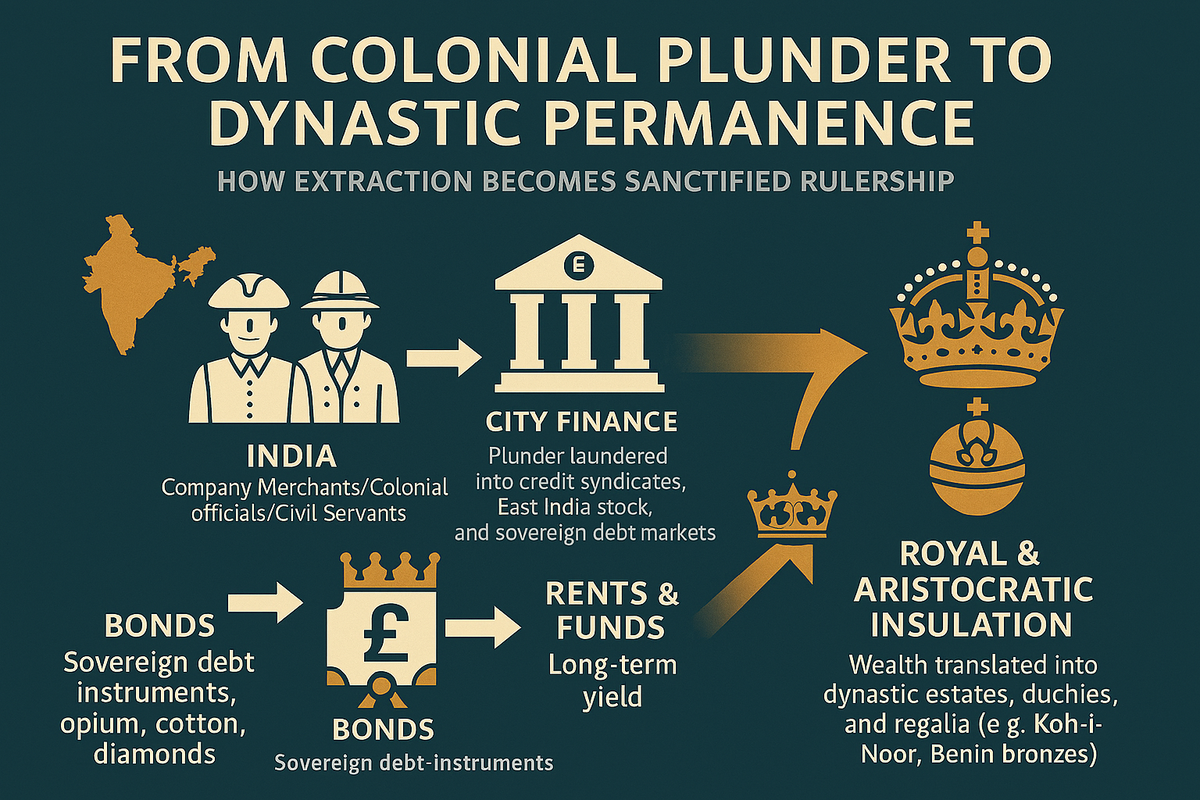
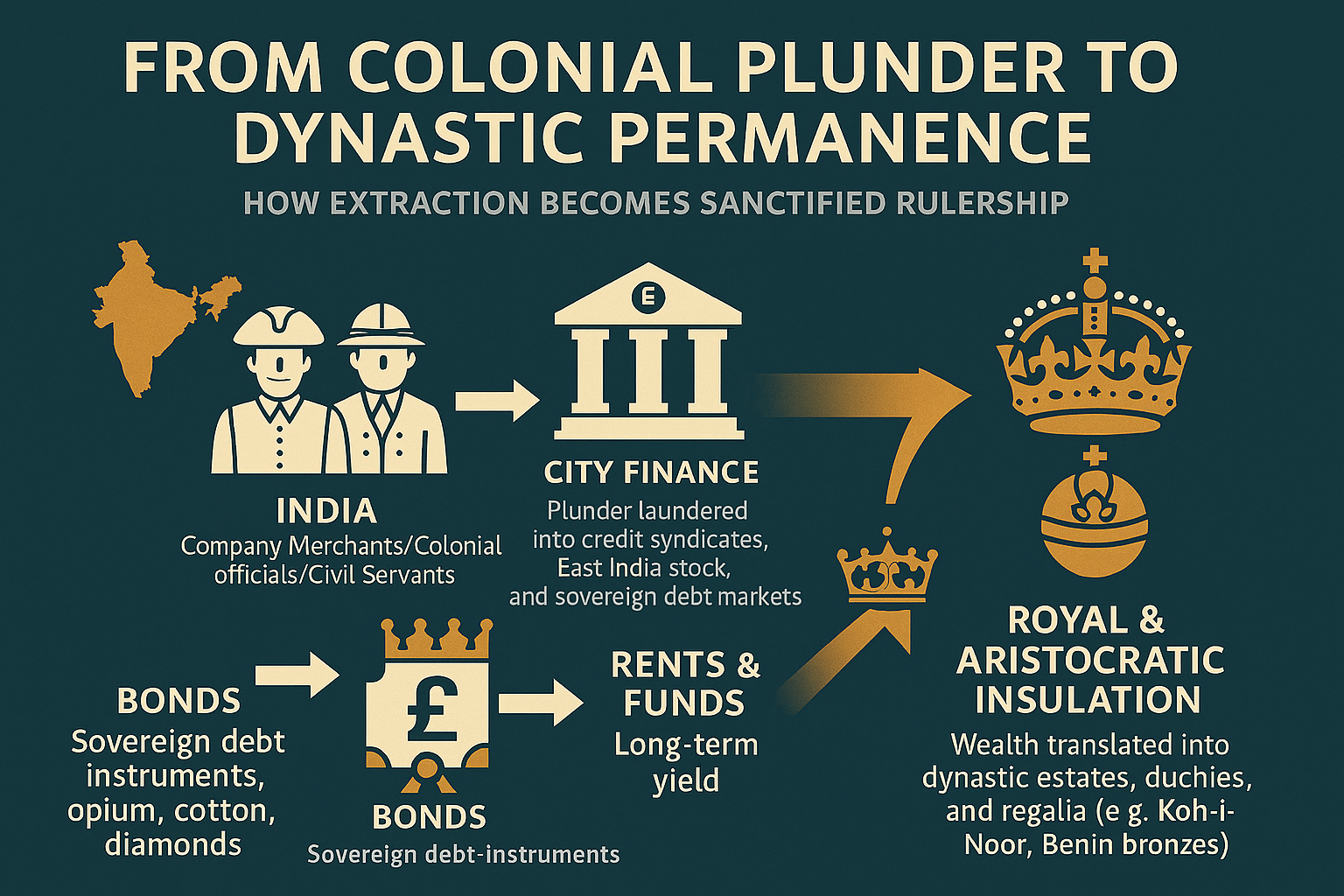
Defined by custody of the schema—the power to set the rules of legitimacy, accumulation, sovereignty—the ruling class sits at the capstone. Its standing is not measured by Forbes lists but by its authority to decide what counts as law, property, or sovereignty itself. Colonial tribute, plunder, and rents were never left as merchant spoil: rulers curated them into permanence. Jewels became crowns and sceptres, bronzes became museum pieces, spoils became estates and trusts. Extraction was elevated into sanctity, conquest translated into civilisation. Oligarchs dig and rise, but they fall when the system shifts. Rulers persist—because they transmute extraction into order, laundering violence into continuity, and embedding their authority beyond reach of market or revolution.
Each profile follows the Ruling Class Case Study Framework developed in Part 10: origin mechanism → integration pathway → functional role → methods of maintenance → visibility gradient → immunity and exceptions → durability horizon. This template is used not to narrate dynastic gossip but to demonstrate how schema custody is preserved and translated over centuries.
Index of Case Studies
Addendum 4a. Dynastic–Sovereign Custodians
- I. British Crown (Windsor) – Commonwealth, City, offshore web
- II. House of Orange-Nassau (Netherlands) – Energy–finance dynastic bridge
- III. House of Saud (Saudi Arabia) – British-installed, petrodollar anchor
- IV. Japanese Imperial House – Oldest continuous dynasty, US-protected
- V. French Custodianship – Not crowned, but continuity through Fifth Republic empire, Françafrique as postcolonial fief
Addendum 4b. continues the survey looking at: Religious–Diplomatic Custodians (Vatican + Italian “Black Nobility”, European Black Nobility), Hybrid Custodians (Rockefeller–Rothschild Dyad, Anglo-Atlantic Custodianship via Canada), and Institutional Dynasty (Chinese Communist Party).
Together, these case studies show that ruling authority is neither incidental nor reducible to financial power. Pharaohs, emperors, monarchies, papal aristocracies, and modern hybrids all illustrate the same structural logic: even when individual dynasties fall, the schema persists by transferring assets, legitimacy, and control into new custodians.
Dynastic–Sovereign Custodians (sacral descent, continuity through crown and land)
I. British Crown (Windsor) – Commonwealth, City, offshore web
Origin Mechanism
The legitimacy of the British Crown was forged through a dual foundation of conquest and sacral sanction. The Norman invasion of 1066 imposed martial supremacy, while coronation rites fused kingship to divine authority through the Church. Unlike continental dynasties extinguished by revolution, the English monarchy survived repeated ruptures — regicide and Cromwell’s republican interlude (1649–1660), the Glorious Revolution (1688), and the wartime rebranding of Hanover as Windsor in 191Each shock revealed the monarchy’s vulnerability, but also its unique adaptability. The dynasty mutated from feudal landlord to constitutional sovereign, from imperial overlord to symbolic head of the Commonwealth, without relinquishing continuity of title or prerogative.
Integration Pathway
The Crown’s interface with merchants and oligarchs crystallised in the Elizabethan era. Sir Francis Drake epitomised this mechanism: pirate and slaver turned royal privateer, whose raids against Spain were retroactively sanctified by charter and rewarded with knighthood. This set the pattern whereby private risk and violence were legalised as Crown service. The East India Company and Hudson’s Bay Company expanded the model, transforming piracy and trade into corporate sovereignty under royal patents. In this formula, rulers did not sully themselves as merchants; they authorised, taxed, and ritualised extraction. Spoils of conquest were laundered into dynastic grandeur — jewels set into crowns, “gifts” displayed in museums, estates accumulated under royal titles.
Over centuries the pathway widened into institutional embedding. The monarchy fused into the constitutional doctrine of the “Crown in Parliament,” preserving the fiction that sovereign power rests in the monarch, and into the Privy Council, which retains prerogatives insulated from democratic oversight. Economically, dynastic wealth was stabilised in the Duchies of Lancaster and Cornwall, the Crown Estate, and seabed mineral rights — rents that could not be eroded by market exposure. These were bound into the City of London Corporation, a medieval enclave of autonomy that today anchors a global offshore empire spanning the Channel Islands, Caribbean territories, and Asian hubs. Outward integration extended through the Commonwealth, where royal symbolism preserved postcolonial ties, and across the Atlantic, where Canadian Round Table networks reasserted British influence over the United States in the twentieth century.
Functional Role
The British Crown functions as schema custodian for the empire. It provides the imprimatur of legitimacy — recognising states, granting charters, sanctifying laws — while delegating extraction to oligarchs, merchants, or corporations. It stages legitimacy theatre through coronations, jubilees, and royal weddings, sustaining the sense of dynastic continuity above politics. At the same time, the monarchy secures continuity by insulating assets in trusts and Duchies and by presiding, symbolically and structurally, over the City’s financial web. Globally, the Crown acts as an emblematic anchor of the Commonwealth and a symbolic bridge between finance, empire, and sovereignty.
Methods of Maintenance
The British monarchy maintains its position through asset insulation (dynastic trusts, Duchies, offshore webs), legitimacy theatre (rituals broadcast globally), and embedding (prerogatives like Crown consent over legislation affecting royal interests). Institutional secrecy remains central: Privy Council proceedings are opaque, and royal finances escape full audit. Sovereign immunity guarantees protection from prosecution, while the City of London operates as a quasi-independent jurisdiction immune from parliamentary intrusion. Within Parliament itself, the Crown is represented by the Remembrancer — a unique official tasked with monitoring legislation for impacts on the City, ensuring that dynastic–financial prerogatives remain safeguarded. The ceremonial separation of Crown and City — the monarch requesting entry, the Lord Mayor granting permission — is theatre. It stages the City as independent while obscuring their functional fusion. In practice, Crown charters protect the City’s privileges, and the City launders imperial rents into dynastic permanence. What is visible is deference; what is hidden is interlock.
Visibility Gradient
The monarchy is hyper-visible at the level of ritual and scandal. Coronations, jubilees, and royal weddings are staged as civilisational theatre, while media sustains the soap opera of dynastic drama — from Edward VIII’s abdication to the Charles–Diana rupture, the Andrew–Fergie scandal, and the Harry–Meghan feud. This dramaturgy ensures constant presence, but always as spectacle. Beneath the noise, the deeper custodianship — Duchies, seabed rents, Crown consent prerogatives, and the offshore web — remains obscured. The City of London is presented as technical finance, never as dynastic privilege.
In the streaming era, this dramaturgy has been industrialised and globalised. Netflix’s The Crown, endless royal documentaries, and curated palace-sanctioned docu-soaps convert monarchy into a bingeable franchise. Here visibility is no longer editorial but algorithmic: dynastic power is packaged as entertainment content, fed into recommendation engines, and consumed worldwide as drama rather than governance. What the public sees is ritualised continuity and family melodrama; what remains hidden is the schema of prerogatives and rents that secure permanence. Visibility becomes theatre — and now industrialised theatre — while authority continues in obscurity.
Immunity & Exceptions
The monarch is shielded by sovereign immunity, tax exemptions, and prerogatives allowing quiet veto of legislation. The City retains treaty-like exceptions, immune from democratic oversight, while Crown dependencies provide secrecy jurisdictions critical to global finance.
Durability Horizon
The British Crown’s durability lies in adaptive mutation. From piracy and conquest to offshore finance and postcolonial symbolism, it has continuously repurposed its legitimacy. Today under Charles III, it projects itself as planetary custodian through the “Green King” model — embedding monarchy within climate governance and sustainability frameworks. Its future trajectory rests less on territorial empire than on financial webs, constitutional prerogatives, and cultural ritual — ensuring survival at the capstone of schema custody.
II. House of Orange-Nassau (Netherlands) – Energy–finance dynastic bridge
Origin Mechanism
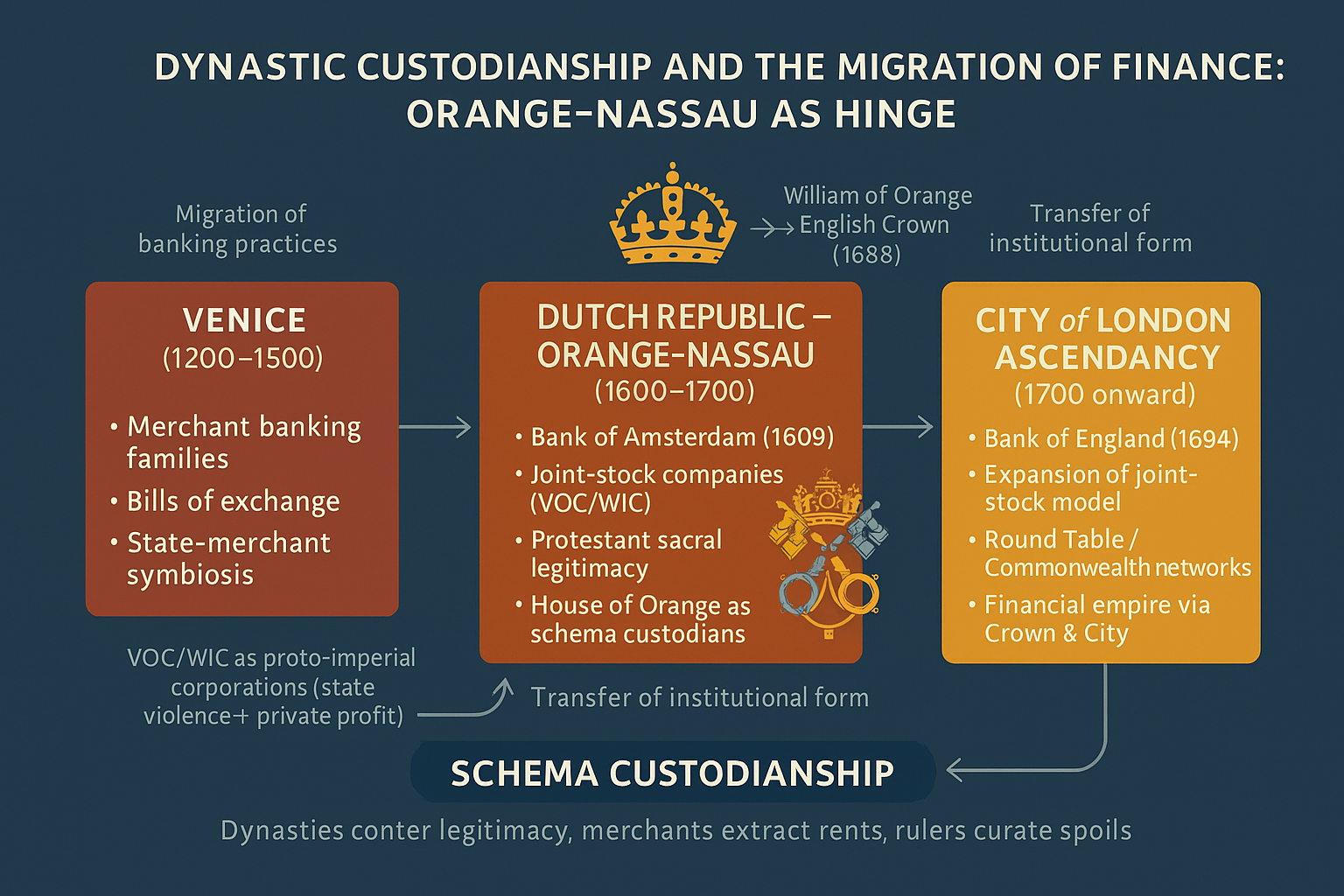
The House of Orange-Nassau rose in the 16th century as stadtholders of the Dutch Republic, claiming legitimacy through Protestant sacral authority and mercantile sponsorship. Their authority crystallised during revolt against Spain, where Protestant identity fused with maritime-commercial expansion. Crucially, their position was tied to Amsterdam’s ascent as financial hub. The founding of the Bank of Amsterdam in 1609 institutionalised sovereign credit, transferable shares, and clearing houses, embedding dynastic power in the very instruments of global finance. Protestantism itself functioned as a legitimating ideology, framing Orange rule as divinely mandated guardianship of liberty in contrast to Catholic absolutism, and sanctifying commercial expansion as a providential mission.
Integration Pathway
The dynasty integrated into Europe’s ruling stratum through marriage alliances and by exporting its financial and colonial models. William of Orange’s installation on the English throne in 1688 transferred more than sovereignty: it transplanted Amsterdam’s architecture of credit-clearing, joint-stock corporations (VOC, WIC), and debt-finance into England. The Bank of England (1694) was a direct adaptation of the Bank of Amsterdam’s stabilising logic, modified for permanent war finance.
The Dutch East India Company (VOC) and West India Company (WIC) had already demonstrated how corporate charters could fuse private profit with sovereign prerogative. VOC control over the East Indies—spice monopolies, coerced labour, and naval enforcement—functioned as a laboratory for systemic extraction, where dynastic legitimacy sanctified commercial violence as lawful empire. These mechanisms were not discarded when Dutch dominance waned: they were exported and retooled in London, giving Britain an institutional template for its own global empire.
Thus Orange-Nassau acted as a vector of systemic transmission — bridging Venetian–Genoese banking legacies into Dutch civic-financial practice, embedding them in colonial exploitation across Asia and the Americas, and then projecting them into London’s imperial ascendancy. The dynasty itself was the hinge: its bloodline linked European courts, while its financiers embedded the colonial-fiscal architecture that underwrote empire.
Functional Role
Orange-Nassau functioned as schema custodian during the birth of financial sovereignty. Venice had pioneered mercantile finance tied to oligarchic city-states, but Amsterdam transformed these instruments into systemic engines of empire: public debt, joint-stock equity, and transferable bills of exchange institutionalised within the civic framework of the Dutch Republic. Dynastic legitimacy sanctified this arrangement, converting VOC extraction and maritime violence into sovereign acts rather than piracy.
William’s accession in 1688 embedded these mechanisms into the English monarchy: what had been municipal in Amsterdam became imperial in London. Orange custodianship thus guaranteed the survival of Dutch innovations, veiled beneath English royal pageantry and Commonwealth ritual.
This custodial role continued into the modern era through convening structures. The Netherlands was the birthplace of Bilderberg (1954), hosted at Oosterbeek under Prince Bernhard of Orange—providing a discreet transatlantic forum where financial, political, and dynastic elites aligned schema custody after World War II. In parallel, the Dutch monarchy and corporate-financial elite became consistent anchors of the World Economic Forum, embedding themselves in the globalisation script that reframed mercantile custodianship as “stakeholder capitalism.” These convenings are not incidental but proof of continuity: the dynasty once instrumental in transmitting Venetian methods into Amsterdam and London now curates transnational platforms that manage the visibility and alignment of ruling strata.
Methods of Maintenance
Asset insulation rested on the joint-stock form and Amsterdam’s clearing monopoly, which converted merchant risk into dynasticised profit. Even as colonial monopolies faltered, the mechanism of financial intermediation outlasted empire. Protestant guardianship of liberty against Catholic absolutism reinforced legitimacy at home and abroad.
Embedding was secured by institutional export: William III’s reign imported Dutch financial logic into London, powering Britain’s rise as the Netherlands’ direct empire contracted. Merchant boards, dynastic privileges, and semi-private governance provided secrecy and immunity. Later, this logic was industrialised in corporate form: Royal Dutch Shell epitomised the shift from spice monopolies to oil rents, anchoring Dutch capital inside the Anglo-Dutch order. Through such structures, mercantile profits were laundered into dynastic permanence. This insulation was reinforced by Dutch Caribbean jurisdictions such as Curaçao and Aruba, which operated as early offshore nodes and later evolved into key secrecy havens under continued royal sovereignty.
Visibility Gradient
The Dutch monarchy projects modest visibility—King’s Day, royal marriages, funerals—unlike the global spectacle of the Windsors. This understatement conceals deeper custodianship: Dutch royals anchor financial architecture, energy corporations, and offshore webs, yet appear folkloric in media depictions. Parades and bicycles obscure continuities in finance, oil, and global governance.
Immunity & Exceptions
The Dutch monarch enjoys constitutional immunity and protection through opaque trusts and dynastic foundations. Corporate heirs of Dutch custodianship benefit likewise: Shell’s hybrid governance insulated it from oversight, while Dutch Caribbean jurisdictions offer secrecy for global capital. The monarchy’s neutrality—“above politics”—functions as political immunity, deflecting scrutiny from dynastic–financial entanglement.
Durability Horizon
Orange durability lies in being a conduit of financial migration: Venetian mercantile forms → Amsterdam’s joint-stock system → London’s financial empire. Even as territorial holdings collapsed, Dutch custodianship survived in transnational finance and corporate forms. Shell epitomised this adaptation, with energy rents replacing spice and slavery as dynastic anchors.
Today, Orange-Nassau endures as guardian of a transnational order: tied to NATO and the EU, embedded in offshore webs, legitimising Dutch influence through ceremony. The dynasty has shifted from land to finance, ships to oil, colonies to corporations—a continuous custodial function across centuries.
III. House of Saud (Saudi Arabia) – British-installed, petrodollar anchor
Origin Mechanism
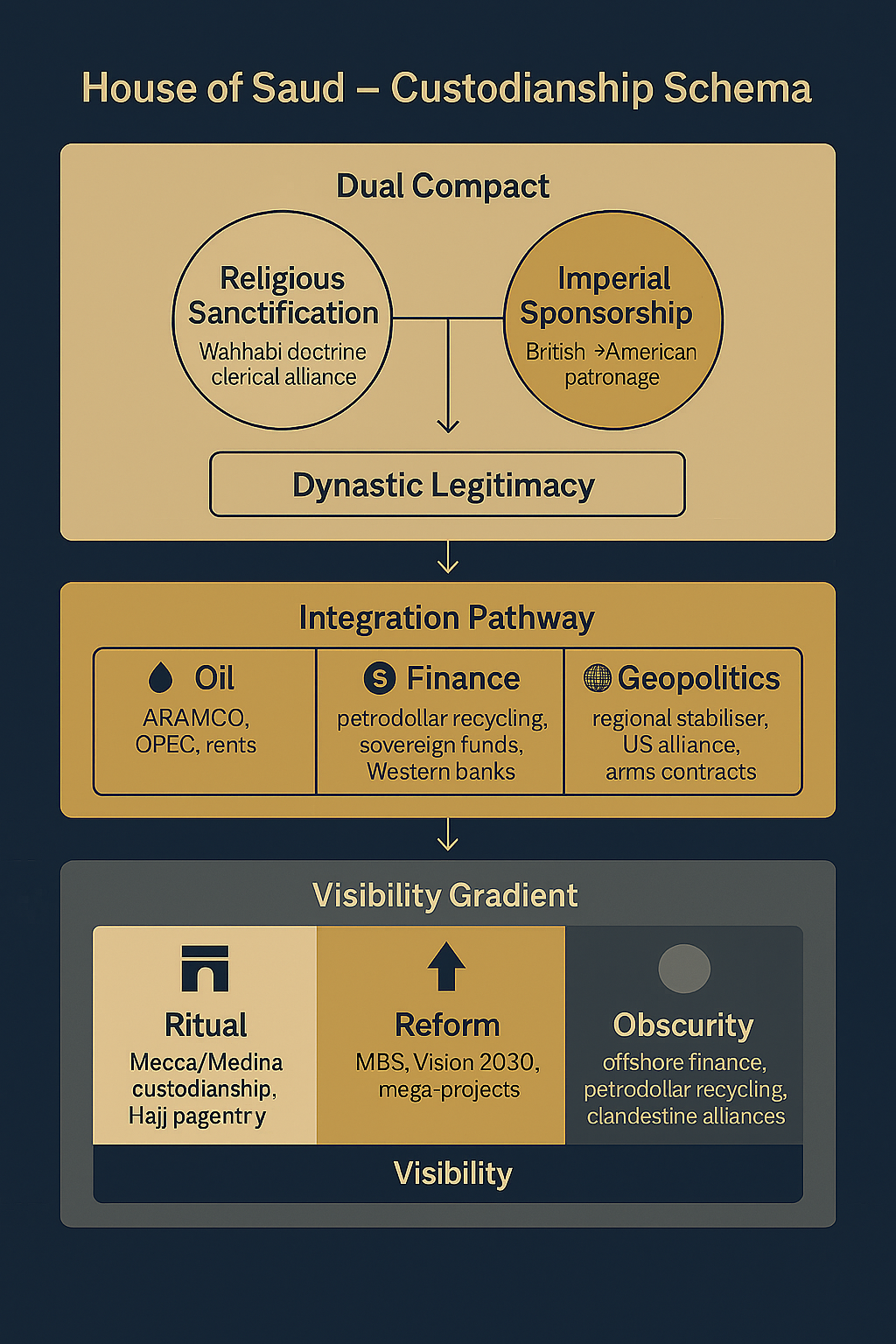
The House of Saud’s authority rests on a dual compact: religious sanctification and imperial sponsorship. In 1744, Muhammad ibn Saud allied with reformer Muhammad ibn Abd al-Wahhab, fusing tribal rule with strict Wahhabi doctrine. Wahhabism’s austere theology legitimised conquest, while the dynasty enforced clerical authority through raids and wars. This pact endured disruption under Ottoman and Egyptian campaigns but re-emerged under Abdulaziz Ibn Saud in the early 20th century, with Ikhwan militias embodying Wahhabi zeal militarily. The second pillar was imperial sponsorship: the 1915 Treaty of Darin formalised Ibn Saud as a British protectorate, securing subsidies and arms. While Hashemite allies dominated propaganda, British officials judged the Saud–Wahhabi alliance more dependable for imperial strategy. Dynastic legitimacy was thus sacralised internally through clerical endorsement and consecrated externally through British support, creating a hybrid authority that tied sacral guardianship to imperial calculation — a custodial form that endures today.
Integration Pathway
The House of Saud integrated into global custodianship through oil. After conquering the Hejaz, British interests in Anglo-Persian Oil loomed, but the key shift came in 1933 with a concession to Standard Oil of California, cementing US ties. By 1945, Roosevelt’s USS Quincy meeting with Ibn Saud anchored the kingdom in the US security–energy order. Institutionally, integration occurred via ARAMCO (nationalised by the 1980s), OPEC leadership, petrodollar recycling through Western treasuries, and discreet roles in policy clubs like Davos and Bilderberg. Internally, dynastic endogamy secured tribal loyalties, while externally, capital and legitimacy were absorbed into the Anglo-American system. Since the 1970s, custodianship has hinged on the petrodollar compact: oil priced in dollars, surpluses recycled into US treasuries, and protection guaranteed through massive arms purchases. These weapons often serve as tribute more than defence — demonstrated in defeated Saudi struggles in Yemen in recent years and the 2019 failure of US Patriot systems in defending Saudi oil facilities from Yemeni missile attack.
Functional Role
The House of Saud functions as custodian of religious authority, energy markets, and Middle Eastern stability, making it the dominant dynasty of the Islamic world. Control of Mecca and Medina grants unrivalled legitimacy, enabling it to project guardianship of Islam and discipline challengers across the Sunni sphere. Oil production anchors global markets, tying Western stability to dynastic survival. Equally, the dynasty has acted as regional enforcer of Anglo-American interests: suppressing Arab nationalism and socialism, funding jihadist networks against the Soviet Union, and counterbalancing Iran after 1979. In this role, the Saudis serve as a dynastic instrument through which Britain and later the US maintained influence across the Middle East. Yet clerical legitimacy is not static. Post-9/11, tensions with Wahhabi clerics intensified, and under MBS’s reforms they sharpen further, showing sacral endorsement is negotiated continually, not guaranteed. Custodianship therefore rests on constant adaptation to both domestic and imperial demands.
Methods of Maintenance
The House of Saud maintains power through sacral legitimacy, oil rents, and imperial sponsorship. Religious theatre is central: styling themselves as “Custodians of the Two Holy Mosques” grants symbolic authority no rival Muslim dynasty can match. Oil wealth finances sovereign funds like the Public Investment Fund, while offshore accounts and entanglement with Western banks embed Saudi capital in transnational secrecy webs, making destabilisation costly for allies. Security is guaranteed through defence treaties with the US and UK, expressed in arms contracts, training, and basing rights, binding Western military-industrial interests to dynastic survival. Patronage networks and opaque charitable fronts secure loyalty domestically and project Wahhabi influence abroad, ensuring clerical sanction doubles as geopolitical instrument. These mechanisms converge into a durable architecture: sacred legitimacy sanctifies rule, oil revenues fund its perpetuation, financial insulation shields assets, and imperial protection guarantees survival even in the face of crises that might destabilise less embedded regimes.
Visibility Gradient
The House of Saud projects selective visibility. Royal decrees, grandiose mega-projects like Neom, and publicised reforms under Mohammed bin Salman create a narrative of modernisation and excess. At the same time, their religious role as guardians of pilgrimage ensures visibility through ritual, giving them a global Muslim stage. Yet their financial machinery, offshore holdings, and geopolitical alignments are kept obscure. Western media often dramatises scandals — assassinations, corruption, luxury excess — while leaving the deeper custodianship of oil markets and imperial security unexamined. Unlike European monarchs, their dramaturgy is functional spectacle rather than folklore: opulence, sacred authority, and selective reformist imagery conceal systemic permanence.
Immunity & Exceptions
The House of Saud enjoys layered immunity — religious, political, and geopolitical. Domestically, absolute monarchy fused with Wahhabi sanction suppresses opposition; internationally, oil supply and vast arms purchases secure Anglo-American protection. Yet immunity is conditional. Alignment with broader strategic priorities is required: the Abraham Accords, tentative ties with Israel, and balancing Gulf states against Iran all demonstrate that dynastic survival depends on compliance. Episodes such as jihadist funding, the Khashoggi killing, or clerical unrest create ruptures but not existential threats, since Western dependence on Saudi oil and capital renders destabilisation off-limits. Immunity is contingent: the dynasty manoeuvres within set parameters but cannot defy them without jeopardising sponsorship. The paradox is stark: while the supposed 9/11 attackers were mostly Saudis, the dynasty itself was untouched, with Iraq and Afghanistan targeted instead — proof that protection persists so long as the Saudis remain indispensable custodians of both Islamic legitimacy and imperial strategy.
Durability Horizon
The House of Saud has survived Ottoman collapse, British retreat, and American ascendancy through constant adaptation: from tribal emirate to British-protected sheikhdom, to American oil monarchy, and now to technocratic custodian of energy and finance. Vision 2030 and Neom recast the dynasty as digital-era rulers, diversifying rents and projecting reformist imagery, yet the schema endures: sacral legitimacy, imperial sponsorship, resource custodianship. The dynasty demonstrates how ruling houses are manufactured, protected, and repurposed across epochs. Its future depends less on Wahhabism or oil alone than on sustaining indispensability to Anglo-American order, managing the Abraham Accords and Israel, and balancing Gulf rivals against Iran. By embedding itself within these overlapping compacts, the House of Saud continues as the hinge of Middle Eastern strategy — adaptable in form, constant in function, and shielded by the very system it upholds. Durability lies in systemic necessity rather than internal strength.
IV. Japanese Imperial House – Oldest continuous dynasty, US-protected
Origin Mechanism
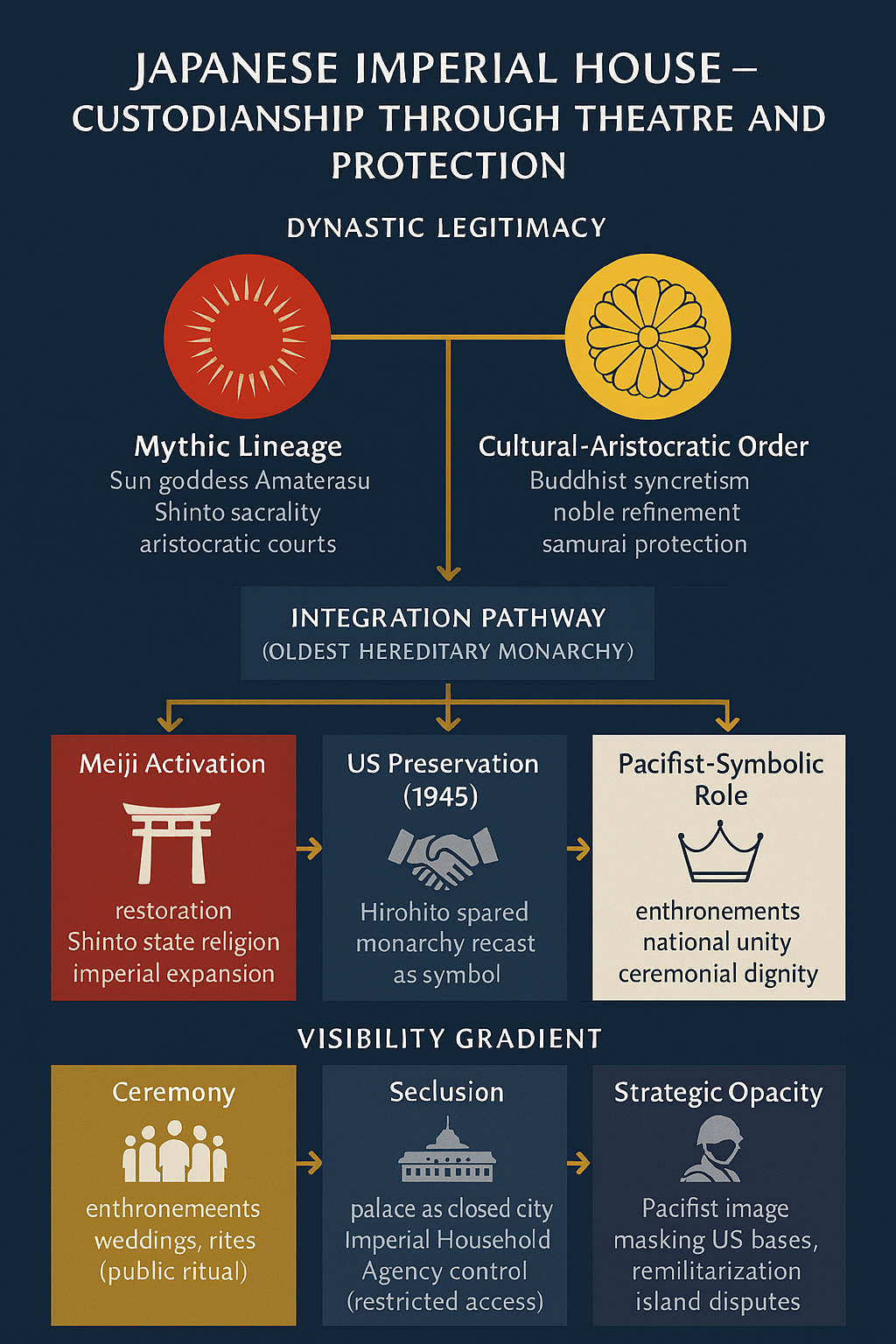
The Japanese Imperial House claims the world’s longest continuous monarchy, tracing descent from the sun goddess Amaterasu. This mythic lineage was embedded within a noble–religious–military order: emperors presided over aristocratic courts that fused Shinto ritual with imported Buddhism, sacralising sovereignty through temples, festivals, and rites. Yet practical power often shifted to regents or samurai-led shogunates, with the emperor remaining a sacred figurehead. A defining feature was seclusion: the palace functioned as a closed city, akin to Beijing’s Forbidden City, where the sovereign was rarely glimpsed, access strictly controlled. This separation heightened mystique — presence preserved through ritual rather than governance. Regionally, the dynasty’s legitimacy was shaped by borrowing from China (writing, bureaucracy, Confucian codes) and rivalries with Korea, reinforcing the emperor as custodian of a uniquely Japanese identity. Thus imperial authority fused myth, Buddhism, Shinto, noble refinement, and martial guardianship, maintained by distance as much as proximity.
Integration Pathway
The Meiji Restoration (1868) remobilised the emperor as active sovereign, binding mythic lineage to state modernisation. Nobles and former samurai reformers redefined the throne as the axis of a centralised, industrialised nation, with Shinto elevated to state religion. The emperor thus became both divine symbol and political command, sacralising Japan’s imperial expansion into Korea, Taiwan, and Manchuria.
Defeat in 1945 brought rupture yet continuity. US occupiers preserved the throne by recasting Hirohito as a constitutional symbol rather than prosecuting him as a war criminal. Imperial legitimacy was re-legitimated under American protection, now functioning as cultural ballast for a pacified, US-aligned Japan. Since then, integration has occurred through ceremonial continuity, pacifist symbolism, and deep embedding in the US security alliance.
Functional Role
The Imperial House functions as custodian of cultural continuity and stabiliser of Japan’s US dependency. Domestically it embodies unity through ritualised theatre — enthronements, seasonal rites, imperial weddings — sanctifying the state while remaining constitutionally apolitical. Internationally it validates Japan’s transformation: an unbroken dynasty that survived defeat, proof that cultural essence could persist within democracy and US hegemony.
Yet this symbolic pacifism coexists with a hard strategic reality. Japan hosts one of the largest US military presences in the world, and under US pressure has steadily expanded its “Self-Defense Forces” into de facto military capability. Disputes with Russia over the Kurils/Northern Territories, and regional tensions with China, expose how the dynasty’s pacifist aura masks an increasingly militarised order. At the same time, the US base network generates local resentment — especially in Okinawa — where communities endure land seizures, crimes, and incidents of rape and violence by stationed personnel. These tensions sit uneasily with the emperor’s image as national unifier, highlighting how alliance protection imposes costs borne unevenly across Japan.
Methods of Maintenance
Legitimacy rests on ritual continuity, seclusion, and controlled appearances. The Imperial Household Agency acts as a gatekeeper bureaucracy, regulating imperial appearances and carefully curating imagery, ensuring the throne remains insulated by distance and ritual control. Unlike wealth-based dynasties, maintenance relies less on financial insulation than on cultural reverence and ritual reproduction. Ceremonial rites, enthronement rituals, and controlled public appearances keep the monarchy sacrosanct, while political neutrality ensures it avoids contestation. US protection substitutes for military self-defence, making survival contingent on alliance stability rather than domestic strength.
Visibility Gradient
The monarchy projects high visibility through ceremonial theatre but maintains opacity in daily function. Enthronements, funerals, imperial weddings, and Shinto-linked festivals are staged as national spectacles, reinforcing continuity. Yet the palace itself is a closed precinct, its inner workings hidden by the Household Agency. Unlike the Windsor model of media intimacy, the Japanese throne cultivates aloof dignity: seen in ritual, absent in politics, veiled in mystique. This balance between exposure and seclusion sustains reverence, transforming absence into authority.
Immunity & Exceptions
Immunity derives from sacral distance at home and American sponsorship abroad. The post-1945 settlement shielded Hirohito and reconstituted the throne as a stabilising device. But this immunity is conditional. As Japan has re-militarised under US direction, the monarchy’s survival depends on aligning its pacifist symbolism with an increasingly assertive strategic posture. Hosting massive US bases and acquiescing to alliance priorities (including revived disputes with Russia) ensures continuity, but underscores the paradox: the throne projects pacifist dignity while sheltering within an American-led military order. This order is not frictionless; the social costs of the US presence — crime, environmental damage, cultural resentment — are suppressed politically but remain visible at the local level, revealing the conditional nature of immunity.
Durability Horizon
The Imperial House has survived by constant adaptation: from mythic sovereign, to ritual figurehead under shoguns, to divine nationalist monarch in Meiji, to pacified symbol under US hegemony. Its durability lies not in resources but in ceremonial theatre and mystique — continuity sanctified by seclusion rather than transparency. Challenges loom: demographic decline, debates on female succession, regional tensions. Yet as long as the dynasty maintains its dual strategy — public ritual visibility coupled with guarded opacity — and remains indispensable to US strategic order, it will endure. Like the British Crown’s dramaturgy or the House of Saud’s sacral guardianship, the Japanese throne illustrates how dynasties endure by transmuting theatre into legitimacy, whether through pageantry, religion, or mystique. The emperor survives as custodian not of wealth or empire, but of cultural sanctity: an aloof theatre of continuity that ties mythic origins to a US-bound present.
V. French Custodianship – Not crowned, but continuity through Fifth Republic empire, Françafrique as postcolonial fief
Origin Mechanism
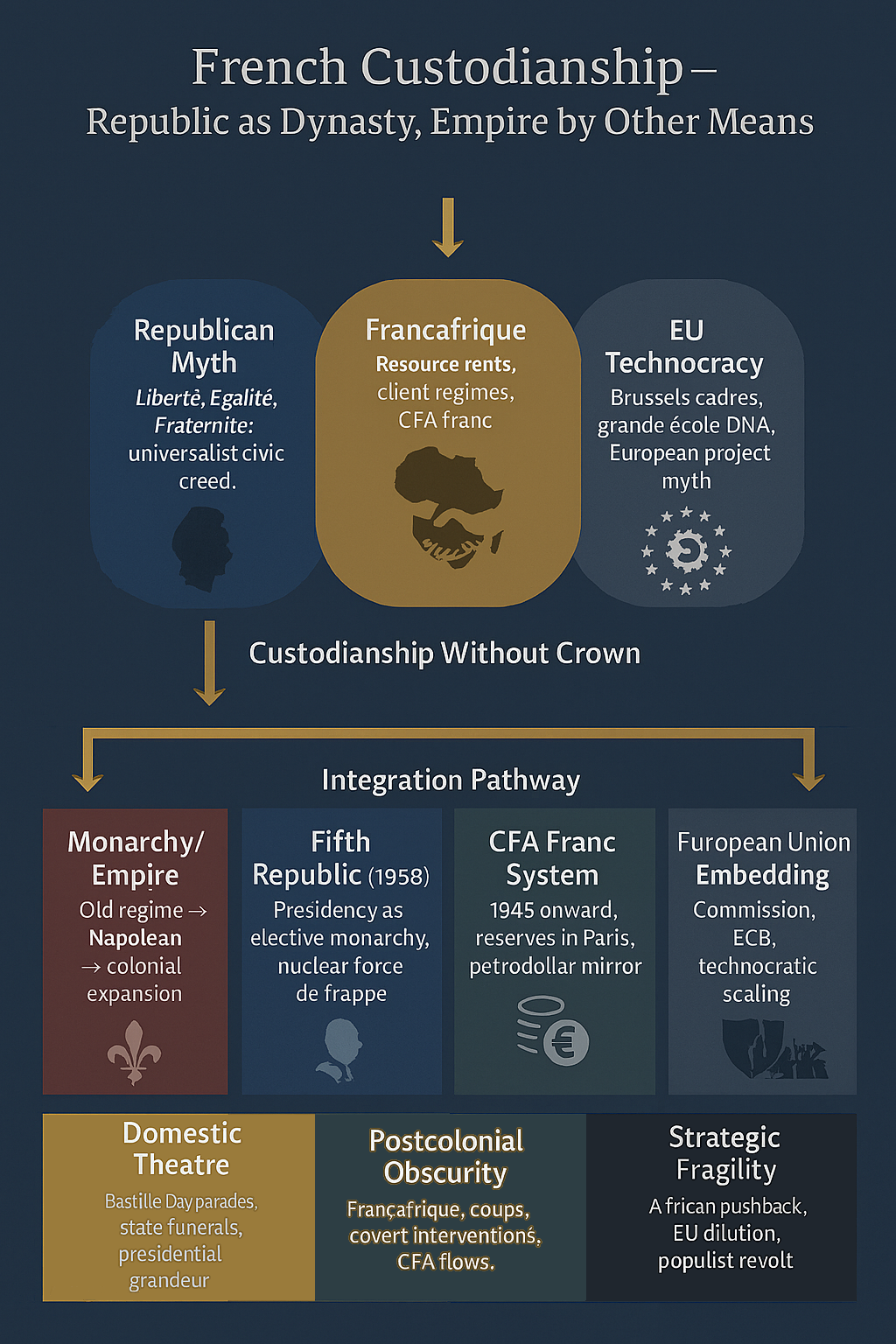
The French monarchy fell with the Revolution, but custodianship reconstituted itself through state, ideology, and empire. Napoleonic centralisation and codified law became secularised absolutism, transferring dynastic function into bureaucratic form. Where the Bourbons were sanctified by coronation at Reims, the Republic sanctified itself through civic myth: “liberté, égalité, fraternité” became the ritual creed. Universalist mission substituted for sacral dynasty, while colonial expansion re-legitimated Parisian supremacy. The empire framed France as custodian of “civilisation universelle,” veiling resource extraction under republican doctrine.
Integration Pathway
The Fifth Republic (1958) institutionalised modern custodianship. De Gaulle concentrated presidential power, armed the state with nuclear force de frappe, and staged grandeur through parades and commemorations. Decolonisation was managed not by relinquishment but by transformation: Françafrique. African states were given nominal independence, but remained tethered through compliant leaders, French corporations—Elf, Bolloré—and the CFA franc currency zone, which required reserves be held in Paris. This monetary design replicated the logic of dollar hegemony in miniature: reserves anchored in the metropole, stability promised, sovereignty curtailed.
The grandes écoles system reinforced this domestically, reproducing a narrow technocratic elite who cycled through ministries, state firms, and corporate boards. This elite logic migrated into Brussels: the European Commission and ECB mirrored French technocracy, insulating administrators from popular contestation while legitimising themselves through the myth of the “European project.” Thus custodianship integrated across three scales — national (Fifth Republic), postcolonial (Françafrique), and supranational (EU technocracy).
Functional Role
French custodianship operates as republican monarchy at home, imperial manager abroad. Domestically, the president functions as an elected king, his office sacralised through military parades, Bastille Day, and state funerals. Abroad, France maintains informal empire: military interventions in Mali, Côte d’Ivoire, and Chad; intelligence networks sustaining client rulers; and resource extraction tied to the CFA franc. Within Europe, France positions itself as co-pillar alongside Germany, leveraging nuclear capacity and UN Security Council status to project grandeur. In all three domains — domestic, African, European — custodianship is exercised through ceremonial theatre, technocratic control, and covert resource leverage.
Methods of Maintenance
Maintenance rests on technocracy, monetary control, and patronage. The grandes écoles perpetuate a narrow elite, rotating seamlessly between ministries, corporations, and international institutions. In Africa, Paris sustains networks through arms, aid, and covert backing of regimes. Military interventions reinforce authority when patronage falters. The CFA franc provided systemic insulation: African reserves flowed into the French treasury, underwriting stability in Paris much as the petrodollar underwrites Washington. Asset insulation thus operated on two scales: national elite reproduction and imperial monetary control. At home, presidential immunity and centralised executive authority provided a shield for ruling strata, creating a republic with dynastic protections in all but name.
Visibility Gradient
France projects republican theatre at home and obscurity abroad. Bastille Day parades, presidential inaugurations, and funerals of state provide spectacle of unity, replicating monarchic pageantry in secular guise. Abroad, however, visibility fades: Françafrique is disguised as “partnership” or “counterterrorism,” while the mechanics of currency control, corporate capture, and covert operations remain shadowed. Ritual visibility at home legitimises the state, while opacity abroad sustains its extractive base. The dual gradient mirrors other dynasties: Orange financial mystique, Saud religious theatre, Japan’s seclusion — France fuses republican pageantry with postcolonial concealment.
Immunity & Exceptions
Immunity derives from layers: civic myth at home, nuclear deterrence, UN Security Council veto, and monetary empire abroad. Presidents enjoy legal immunity while in office, shielding them much like monarchs. The postcolonial compact has long provided insulation, but it is conditional: scandals like Elf Aquitaine or exposed coups reveal the fragility of hidden custodianship. Today, challenges mount as African states (Mali, Niger, Burkina Faso) expel French troops and explore alternatives to the CFA franc, echoing broader global cracks in dollar hegemony. Immunity persists because France remains embedded in NATO, the EU, and the UN — but reliance on African rents and symbolic grandeur makes the shield thinner than it appears.
Durability Horizon
French custodianship has outlasted monarchy, empire, and multiple republics by re-encoding dynastic functions into republican institutions. The presidency functions as elective monarchy; Françafrique ensured postcolonial continuity; the CFA franc replicated global dollar logic regionally. Yet the durability horizon is now contested. African states are defecting from Paris, EU integration dilutes sovereignty, and domestic unrest (gilets jaunes, pension revolts, populist insurgencies) challenges the republican myth.
Even so, the technocratic DNA of France has migrated into the EU itself: Brussels now operates with the same logic as Paris — insulated cadres, elite reproduction, legitimacy through “project myth” rather than popular mandate. This ensures that even if Françafrique collapses and the Fifth Republic weakens, the custodial logic France pioneered survives embedded within the supranational frame. France may lose direct control, but its model of technocratic custodianship remains durable, scaled up to Europe.
Continued in Addendum 4b…
Acknowledgement:
Frames and concepts from Land, Yarvin, and Thiel are referenced across the Overlords series as diagnostic tools, repurposed to expose the structural logic, custodianship and continuity of the system—in no way should this be constructed as evidence of my support or advocacy for their positions.
Published via Journeys by the Styx.
Overlords: Mapping the Operators of reality and rule.
—
Author’s Note
Produced using the Geopolitika analysis system—an integrated framework for structural interrogation, elite systems mapping, and narrative deconstruction.