Overlords: Addendum 4b. Case Studies in Dynastic Rule (cont'd)
Dynastic custodianship as the hidden architecture of power – seen, obscured and hidden from view.
This addendum continues from Addendum 4a.
Each profile follows the Ruling Class Case Study Framework developed in Part 10: origin mechanism → integration pathway → functional role → methods of maintenance → visibility gradient → immunity and exceptions → durability horizon. This template is used not to narrate dynastic gossip but to demonstrate how schema custody is preserved and translated over centuries.
Index of Case Studies in 4b.
Religious–Diplomatic Custodians
- VI. Vatican + Italian “Black Nobility” – Papal sovereignty, Jesuit networks, aristocratic survival
- VII. European Black Nobility (Umbrella) – Habsburg, Savoy, Thurn und Taxis, remnants acting as submerged continuity.
Hybrid Custodians
- VIII. Rockefeller–Rothschild Dyad – Finance, oil, Israel, Atlantic alignment
- IX. Anglo-Atlantic Custodianship via Canada – Round Table → CFR → Trilateral; relay point for reconquest of US
Institutional Dynasty
- X. Communist Party of China (CPC) – Party as dynasty; Mandate of Heaven analogue; continuity by bureaucracy, not bloodline.
Together, these case studies show that ruling authority is neither incidental nor reducible to financial power. Pharaohs, emperors, monarchies, papal aristocracies, and modern hybrids all illustrate the same structural logic: even when individual dynasties fall, the schema persists by transferring assets, legitimacy, and control into new custodians.
Religious–Diplomatic Custodians
VI. Vatican + Italian “Black Nobility” – Papal sovereignty, Jesuit networks, aristocratic survival
Origin Mechanism
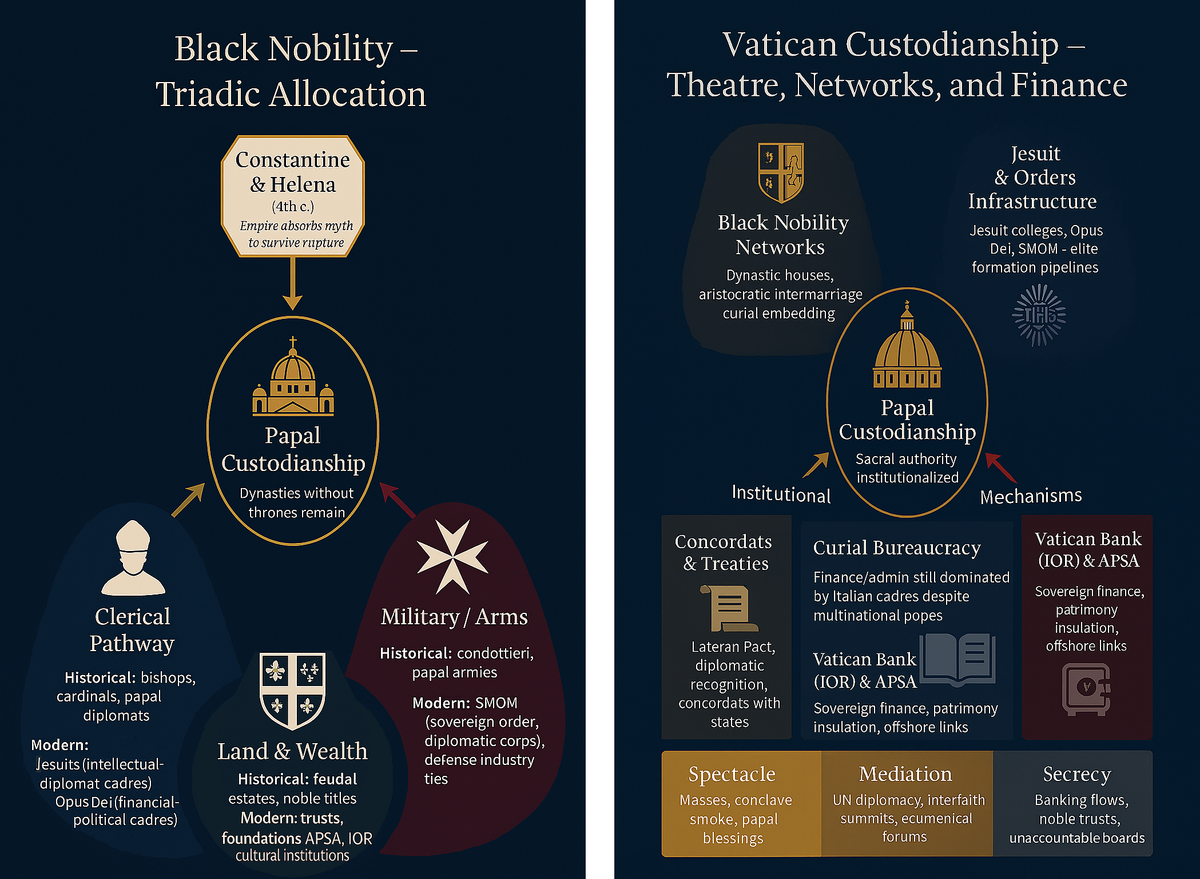
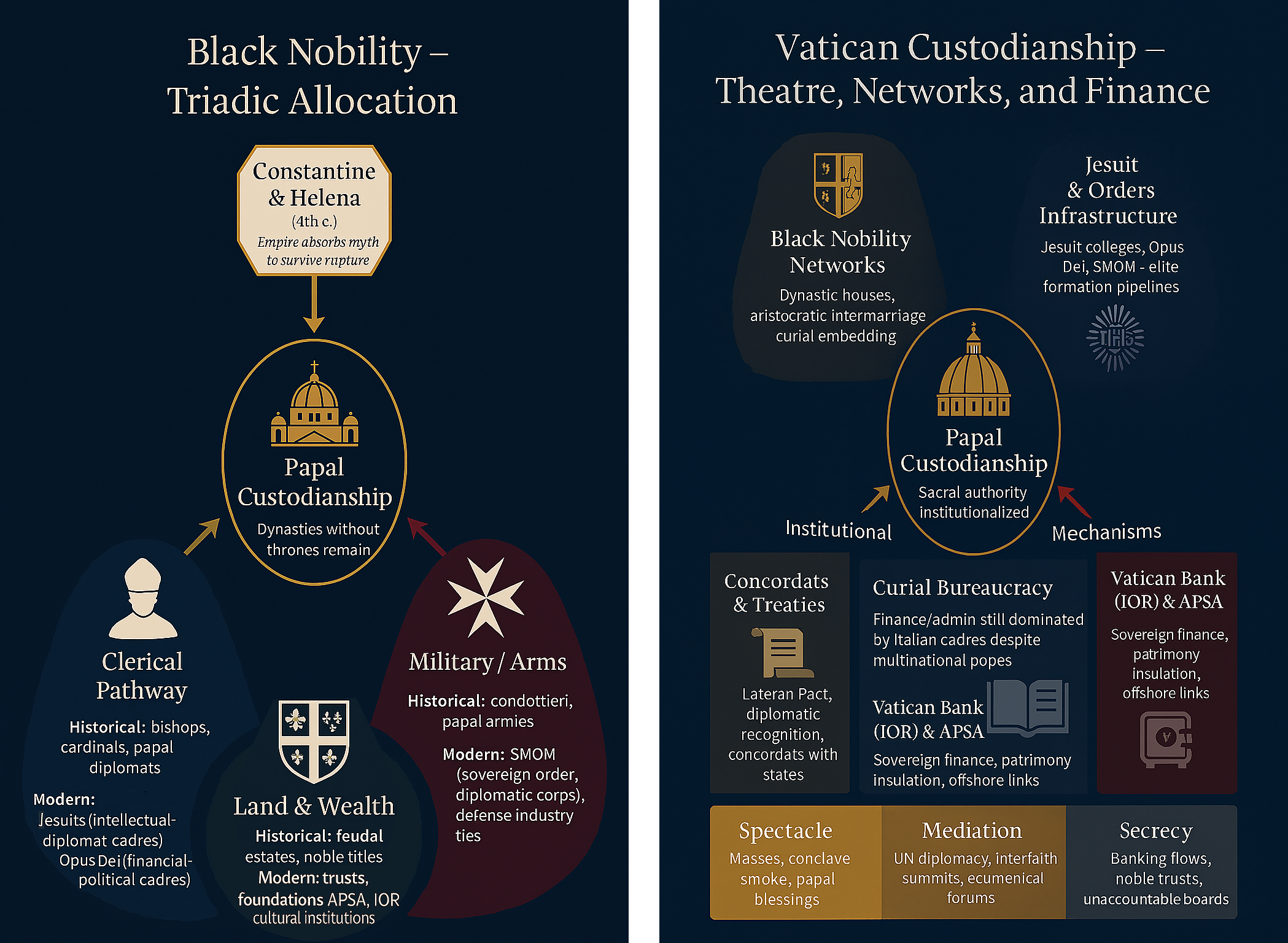
The Vatican’s custodianship begins with a keystone moment: Constantine’s 4th-century adoption of Christianity as imperial faith and Helena’s myth-making tour of the Holy Land. This was less spiritual awakening than survival: the empire was fragmenting under military overreach, economic strain, and competing cults. Christianity offered a universal creed to knit provinces together, a disciplined clergy mirroring imperial bureaucracy, and a narrative that recast Rome from persecutor into protector. Helena’s relics and sacred geography materialised this legitimacy, turning myth into shrines and ritual. The pattern was set: when an order faces collapse, it absorbs myth, stages theatre, and institutionalises sacral authority to survive rupture.
Founding legitimacy thereafter was both sacral and juridical: apostolic succession to St Peter, later hardened into rule over the Papal States. When Rome annexed them in 1870 the tiara lost territory, not sovereignty. The Lateran Treaty (1929) re-forged the Holy See as a micro-state with extraterritorial rights, turning sacral authority into legal personhood. Continuity rode on Rome’s patriciate — Colonna, Orsini, Borghese, Chigi, Barberini, Pamphilj — who survived unification by shifting from feudal office to curial proximity and landed wealth. Venice supplied a feeder lineage: patrician houses modelled mercantile oligarchy, secrecy, and ritual, exporting techniques later absorbed into Roman custodianship.
Integration Pathway
Institutional embedding rests on concordats, the Lateran Pact, and diplomatic recognition — a sovereign shell over a global church. The “Black Nobility” were patrician lineages who sided with the papacy after 1870, retaining curial privileges while intermarrying with each other and with rising financial-industrial elites. Their strategy was triadic: one son inheriting estates, one entering the Church, one pursuing military or administrative office. In this way land, sacral office, and armed force stayed within the family even as papal territory shrank and monarchies collapsed.
In modern form, estates became trusts, clerical paths ran through Jesuit and Opus Dei networks, and military service condensed into the Sovereign Military Order of Malta (SMOM), which still enjoys diplomatic reach. These continuities kept aristocratic custodianship wired into papal continuity. Venice reinforced the financial bridge: city-state banking and print networks fed papal finance and Jesuit expansion. Jesuit colleges became a transnational grandes écoles for clergy, diplomats, and lay cadres. Post-1942 the IOR (Vatican Bank) created a sovereign enclave; after 1945 Vatican diplomacy linked into Atlantic networks while SMOM provided auxiliary sovereignty.
Functional Role
Schema custody spans doctrine, recognition, and mediation. In the past, papal endorsement crowned emperors and sanctioned crusades; in 1494 the Treaty of Tordesillas divided the colonial world. In the modern era, papal diplomacy recognised new states, mediated Cold War settlements, and conferred moral cover on peace accords such as the Chile–Argentina mediation of 1978.
Jesuit networks extend this role more quietly through education, training cadres who later staff governments, banks, and NGOs. With Francis as the first Jesuit pope, Vatican legitimacy now reaches into climate, poverty, and migration debates, reframing Catholicism in technocratic registers. Aristocratic houses, Opus Dei, SMOM, and finance dynasties act as instruments, not peers. Legitimacy theatre remains maximal: conclaves, balcony blessings, canonisations. Continuity management operates off-balance-sheet — trusts, APSA holdings, and IOR flows insulating patrimony from market and court risk. Globally, the Vatican functions as micro-sovereign anchor: rites and ledgers travel even where armies do not.
Methods of Maintenance
Asset insulation runs through the IOR, APSA portfolios, Swiss conduits, and extraterritorial properties — a sacral-legal cloak that frustrates discovery. Ritual sustains legitimacy: liturgical calendars, papal visits, and baroque theatre project transcendence. Embedding is treaty-based — Lateran guarantees, concordats, diplomatic immunities, SMOM passports. Institutional secrecy is layered — Jesuit governance, Opus Dei prelatures, archives, and noble trusts.
Papal succession itself has become a maintenance tool. Since 1978 non-Italian popes have been elevated — John Paul II, Benedict XVI, Francis, Leo XIV — projecting universality. Yet Italians still dominate curial posts, historically over 70% and today around 40%, especially in finance and administration. Diversification of nationality thus functions more as theatre of renewal than rupture, balancing outward inclusivity with inner continuity anchored in Roman patrician networks.
Visibility Gradient
The Vatican’s public face is maximal spectacle: St Peter’s masses, conclave smoke, balcony blessings, papal tours staged as theatre. Behind this display, visibility contracts: IOR flows, APSA asset management, aristocratic foundations, and noble real estate recede from view, as if moving from nave to ledger. Convening platforms are dual: open diplomacy via UN observer status and papal visits, and closed circuits through order chapters, elite Catholic universities, or discreet Vatican presences at Bilderberg and Davos. Theatre up front, curatorial networking behind.
Immunity & Exceptions
Immunity is multilayered: the Holy See is a subject of international law, Vatican City provides territorial sovereignty, officials enjoy diplomatic protection and tax exemption. Selective enforcement is structural — banking scandals from Banco Ambrosiano and P2 entanglements to clerical abuse revelations span continents but stop at the city walls. Financial liability is absorbed through opaque diocesan trusts, religious orders, and property holdings, ensuring settlements are paid without exposing the patrimony of the Holy See.
Scandal itself is folded back into custodianship. Cardinal George Pell, convicted in Australia and later acquitted, was recalled to Rome to head Vatican finances even as abuse controversies raged — his case showing how reputational crises are absorbed into curial office, projecting reform while preserving continuity. Opaque channels persist in unaccountable boards, orders, and noble corporations: Venice’s oligarchic craft survives in Roman form, where ritual authority and micro-sovereignty together nullify ordinary prosecution.
Durability Horizon
Endurance is proven — from feudal theocracy to treaty micro-state to global broker. Adaptation followed the age: land became ledgers, tiara gave way to diplomacy, barons to bankers. Venice’s mercantile secrecy and Rome’s sacral theatre fused into a custodial machine.
Scandal has become an engine of resilience. Banking collapses, abuse revelations, and compromised prelates are re-coded as grounds for reform, generating commissions or offices that consolidate papal authority. The Pell case exemplifies this: controversy centralised oversight rather than dissolving it.
The horizon now bends toward universalist stewardship under a globalist banner. Post–Vatican II ecumenism, interfaith theatre such as the 2019 Abu Dhabi Declaration, and Vatican participation in UN and Davos circuits project the papacy as custodian of “human fraternity.” Jesuit networks translate doctrine into secular scripts of bioethics, climate, and migration governance. This is less rupture than replay of Constantine’s move: universality adopted to bind a fracturing order. So long as ritual visibility, sovereign insulation, scandal absorption, and universalist positioning cohere — sacral theatre above, Venetian secrecy below — papal custodianship endures as durable apex without rival throne.
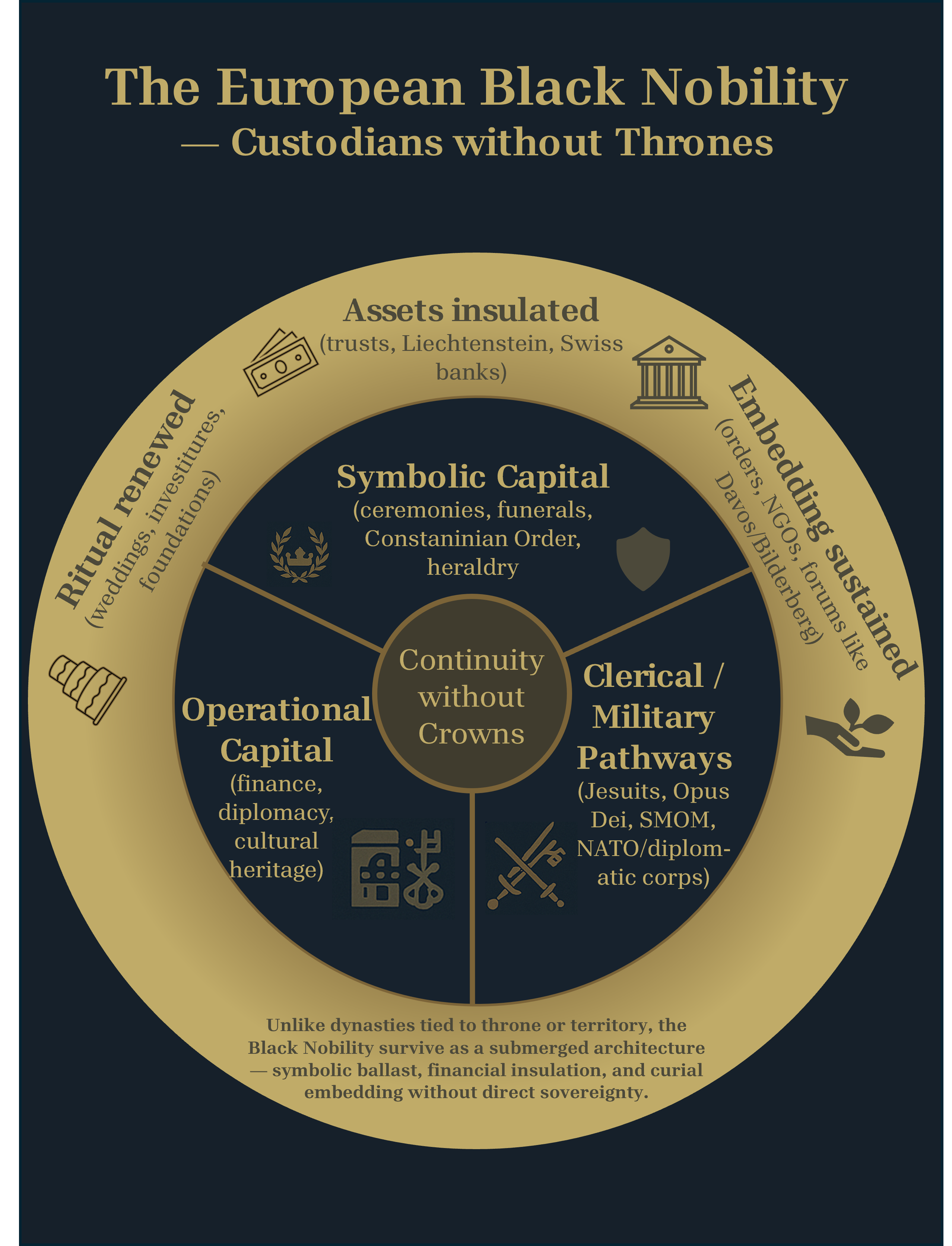
VII. European Black Nobility (Umbrella) – Habsburg, Savoy, Thurn und Taxis, and Dynastic Remnants
Origin Mechanism
The “Black Nobility” refers to dynasties who lost crowns but not continuity — Habsburgs (Austro-Hungarian emperors until 1918), House of Savoy (Italian monarchy until 1946), and Thurn und Taxis (imperial postmasters turned financiers). Their legitimacy had been anchored in divine right, imperial grant, and papal sanction. With empire and monarchy dismantled, they mutated from rulers into custodians of continuity — presenting themselves less as sovereigns than as carriers of Europe’s aristocratic patrimony. Sovereignty shifted from crowns to names, from rule to symbolism. This pattern recalls Constantine’s use of Christianity to hold together a fragmenting empire: myth, ritual, and genealogy re-deployed as glue for fractured legitimacy.
Survival came through mutation. Habsburgs: Otto von Habsburg (1912–2011), exiled heir, became a Cold War parliamentarian and long-time president of the International Paneuropean Union; his son Karl von Habsburg today leads the UN-accredited Blue Shield, embedding dynastic capital in heritage diplomacy. Savoy: after exile in 1946, Victor Emmanuel re-emerged in Italian and European politics, while his son Emanuele Filiberto recast himself as philanthropist and media figure, leveraging the dynastic Order of Saints Maurice and Lazarus. Thurn und Taxis: from their lost postal empire they pivoted to banking, land management, and later media; Gloria von Thurn und Taxis maintains influence in Catholic cultural circuits, hosting high-profile gatherings in Regensburg.
The survival strategy mirrors the Vatican’s triadic allocation: land holdings converted into trusts and foundations; clerical careers channelled through Jesuit and curial posts; military-administrative strands absorbed into NATO, the diplomatic corps, and elite Catholic orders. Venice provided the feeder model — mercantile secrecy, ritual sovereignty, and bureaucratic craft adapted into the operating logic of modern financial aristocracy.
Integration Pathway
Institutional embedding occurred through multiple bridges. Concordats and Vatican orders provided sacral cover; noble orders such as the Order of Malta and the Constantinian Order preserved aristocratic sovereignty niches even without territory. In the 20th century, Black Nobility remnants integrated into Atlanticist clubs — Bilderberg, Trilateral, pan-European integration movements — where aristocratic surnames lent continuity. Intermarriage kept bloodlines alive within reigning monarchies: Luxembourg, Belgium, Spain. External sponsorship mattered too: Britain sheltered Savoy exiles, the US supported Habsburg heirs in Cold War politics, and the Vatican absorbed noble orders into its orbit. The result was an ecology of submerged custodianship: no throne, but a seat at every table where heritage, Catholicism, or Europeanness required symbolic ballast.
Functional Role
The Black Nobility no longer rule but act as custodians of schema — supplying pedigree, ritual, and back-channels that stabilise elite orders. Titles, heraldry, and dynastic orders reproduce hierarchies; family offices mediate between banks, ministries, and NGOs; and discreet figures operate as informal diplomats, where a name still opens doors.
Symbolically, they function like papal blessing: the presence of a Habsburg or Savoy lends gravitas to monarchist ceremonies, Catholic congresses, or EU heritage projects. Otto von Habsburg styled himself as Europe’s conscience, legitimising integration with dynastic gravitas, while Gloria von Thurn und Taxis blends Catholic patronage with political hospitality.
Financially, dynastic foundations and opaque family offices (often anchored in Liechtenstein and Switzerland) manage estates while presenting them as philanthropy. Intellectually, Jesuit and Opus Dei networks act as an aristocratic grandes écoles — pipelines where remnants still supply cadres to banking, diplomacy, and the Church. The Constantinian Order of St George, still claimed by Bourbon–Two Sicilies branches, is one example where legitimacy is disputed — a reminder that dynastic symbols themselves are contested and can fracture along competing lines of succession.
Symbolic capital manifests in visible presence — at funerals, congresses, or state visits — while operational capital lies in mediation, finance, and discreet diplomacy, where titles provide access that would otherwise be unavailable. They arbitrate legitimacy without thrones, providing dynastic ballast to institutions that lack roots of their own.
In practice, these remnants do not compete with technocratic elites but collaborate as symbolic ballast — lending historical depth to boards, summits, and policy forums dominated by bankers, lawyers, and technocrats.
Methods of Maintenance
Continuity rests on three pillars: assets, ritual, and embedding. Landed estates have been transmuted into trusts, Liechtenstein foundations, and Swiss banking vehicles — insulating wealth from taxation and scrutiny while presenting it as heritage stewardship. Dynastic theatre persists in weddings, funerals, and investitures, which reaffirm hierarchy and draw monarchs, prelates, and statesmen into the same frame. Embedding occurs through Vatican-linked orders (SMOM, Opus Dei), cultural diplomacy (Blue Shield, heritage NGOs), and participation in policy circuits (Bilderberg, Davos). Embedding occurs through board memberships, curial offices, orders of merit, and policy clubs. Maintenance also relies on heritage rebranding: estates turned into museums, art collections deployed as cultural capital, dynastic titles marketed as philanthropic credentials. Theatre of continuity is thus sustained through heritage as well as ritual. The strategy remains Venice-like: opacity for finance, theatre for legitimacy. Even where crowns fell, the surname itself is an instrument of maintenance — “Habsburg” or “Savoy” as a brand that guarantees pedigree across institutions.
Visibility Gradient
Visibility is carefully managed. Public life projects pageantry — dynastic marriages, museum patronage, charitable foundations, chivalric investitures. Beneath this surface, holdings are opaque: family offices, offshore vehicles, nominee shareholders and discreet portfolios in industry, banking, and energy. Convening platforms exist on two tiers: open heritage visibility in cultural patronage, and closed networking in Atlanticist circuits (Bilderberg, Davos, SMOM, Vatican-linked clubs). The effect mirrors the pattern in other dynasties: theatre upfront, curatorial leverage behind.
Immunity & Exceptions
Without sovereign immunity, protection comes through private law and offshore domiciles. Foundations in Liechtenstein or Switzerland offer tax shelter and opacity; selective enforcement ensures scandals remain reputational rather than systemic. When missteps occur, they are managed as private embarrassments, cushioned by philanthropy and family structures. Obscurity itself provides immunity: too marginal for direct political attack, too embedded in heritage and finance to be uprooted.
Durability Horizon
The Black Nobility’s horizon lies in mutation, not restoration. Their comparative advantage is continuity without crowns — names that certify legitimacy for regimes and projects seeking ballast. Mutations follow epochal lines: monarchy → magnate, estate → fund, crown → order, ritual → philanthropy. Their current vector is integration into technocratic custodianship: EU cultural identity, Vatican-Atlantic diplomacy, global philanthropy. The model remains Constantine’s: absorb myth, stage theatre, institutionalise authority. As long as assets are shielded, ceremony reproducible, and convening seats guaranteed, Europe’s Black Nobility will persist — dynastic capital without thrones, submerged continuity still operative beneath the secular surface.
Yet custodial endurance is not absolute: republicanism, secularism, and transparency movements erode the aura of hereditary legitimacy, placing limits on how far symbolic capital can be converted into durable influence.
Hybrid Custodians (dynasties fused with oligarchs, steward/executor roles)
VIII. Rockefeller–Rothschild Dyad – Finance, oil, Israel, Atlantic alignment
Preface: The Dyad Concept
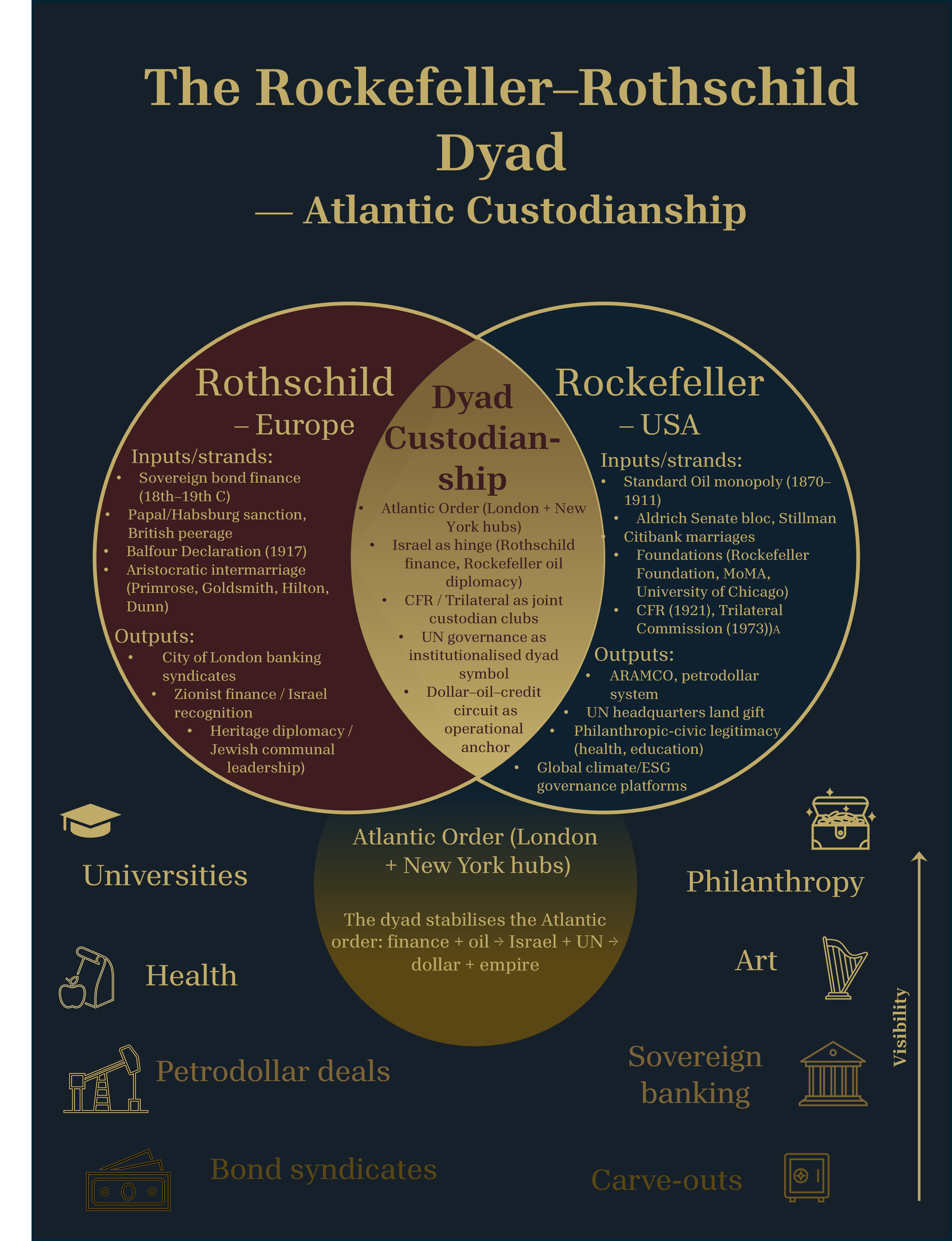
The Rockefeller–Rothschild dyad marks the convergence of European dynastic finance and American industrial oligarchy into a shared custodial circuit of Atlantic power. Less a personal alliance than a structural pairing, it rests on parallel marriages into ruling strata, complementary institutions in London and New York, and joint roles in Israel’s recognition and the UN’s foundation. The dyad simplifies a denser web of elites but illustrates the grammar of custodianship—private fortunes absorbed into governance to stabilise empire. Rivalry persists, but as “coopetition”: competition constrained by concordant interests. The oil–dollar order exemplifies this, with OPEC quotas, U.S.–Saudi petrodollar compacts, and recycling circuits operating as cartelised structures, underpinned by Rockefeller oil diplomacy and Rothschild finance. Other pairings and both formal and informal syndicates exist, yet none match this hinge: New York and London, oil and sovereign debt, Israel and the UN. The dyad crystallises how oligarchs and dynasts overlap to preserve the Atlantic order.
Origin Mechanism
By the 19th century, the Rothschilds had consolidated dynastic finance across Europe, underwriting sovereign debt, financing wars, and embedding themselves in London, Vienna, Paris, Frankfurt, and Naples. Their model—central bank syndication, court patronage, and gold settlement—became a template for financial globalization. The Rockefellers, by contrast, rose in the U.S. Gilded Age through John D. Rockefeller’s Standard Oil, building monopoly capital on energy rents. After the 1911 antitrust breakup, their fortune refracted into trusts, banks, and foundations—vehicles designed to endure regulation and volatility.
Their prominence was magnified by hostility. Rockefeller antitrust battles cast John D. as “the most hated man in America,” while Rothschilds became stock figures in anti-Semitic finance conspiracies. Yet such attacks reinforced their symbolic power, cementing both names as shorthand for capital dominance. Philanthropy became a second founding pillar—especially for the Rockefellers, whose foundation reshaped medicine, public health, and global development, embedding oligarchic legitimacy in civic form.
Integration Pathway
The two houses embedded themselves into ruling strata through strategic marriages and institutional positioning. While no Rothschild–Rockefeller intermarriage occurred, each fused with elite blocs in its sphere. Rockefellers aligned with the Aldrich Senate–finance nexus (Abby Aldrich ↔ John D. Rockefeller Jr.) and the Stillman Citibank dynasty (Elsie and Isabel Stillman ↔ William G. and Percy Rockefeller), tying oil rents to Wall Street and Republican statecraft. Rothschilds intermarried with British aristocracy and finance: Hannah de Rothschild ↔ Archibald Primrose, 5th Earl of Rosebery (later Prime Minister); Jacob (4th Baron) Rothschild ↔ Serena Dunn (Dunn shipping/finance), with later ties to the Goldsmith and Hilton houses.
Institutional bridges consolidated this absorption. The Balfour Declaration (1917, addressed to Lord Rothschild), Rockefeller’s donation of the UN headquarters site, and their joint anchoring of elite clubs such as the Council on Foreign Relations (1921) and the Trilateral Commission (1973) meshed European dynastic finance with American industrial–financial hegemony.
Imperial linkages converged most sharply in the Middle East. Rothschild underwriting of Zionist recognition and Rockefeller oil diplomacy (ARAMCO, petrodollar syndication) underpinned both Israel’s creation and Gulf monarchic security. The UN headquarters, raised on Rockefeller land, completed the triangulation: Israel, oil, and the dollar—an axis that bound the dyad’s custodianship into the architecture of the Atlantic order.
Functional Role
The Rothschild-Rockefeller dyad does not “rule” directly—it provides schema custody. Rothschilds stabilised sovereign debt and banking liquidity; Rockefellers translated oil rents into U.S. financial reach. Together, they acted as the silent ballast of the Atlantic order.
Symbolically, their names confer legitimacy. A Rothschild at Davos, salons in the Gloria von Thurn und Taxis mode, or a Rockefeller name on MoMA or a university campus normalise private capital as civic virtue. Rothschild patronage carried a Catholic–aristocratic flavour—congress hosting, heritage trusts, cultural sponsorship—while Rockefellers staged themselves as patrons of art, health, and education, recasting industrial rents as public beneficence.
Operationally, their institutions—Rothschild banks, Chase Manhattan, CFR, Trilateral, UN diplomacy, petrodollar compacts—set the parameters of global finance and diplomacy without holding office. Rockefeller health initiatives reframed medicine under technocratic governance, while Rothschild credit underwrote sovereign welfare and colonial development. Israel recognition, UN scaffolding, and Gulf energy-dollar circuits bear their imprint as custodial templates.
This dual function—symbolic theatre and operational ballast—marks them as rulers by custodianship. Jesuit orders and European aristocracy once played a similar role; the dyad reproduces that pattern in an Anglo-American key.
Methods of Maintenance
Maintenance rested on asset insulation, legitimacy theatre, and embedding. Rothschild trusts and Rockefeller foundations laundered fortunes into tax-exempt dynastic engines, immune to market cycles. Private partnerships (Rothschild banks) and opaque family offices (Rockefeller Brothers Fund, Rockefeller Capital) preserved secrecy.
Legitimacy was staged through philanthropy: universities, museums, and health governance turned monopoly rents into civic beneficence. Embedding came via CFR, Trilateral, Bilderberg, and discreet Rothschild advisory roles inside European governments. The effect was structural: private families institutionalised within the operating system itself, immunised from exposure.
Visibility Gradient
Public faces are curated as patrons of science, art, and peace. Rockefeller museums (MoMA, Metropolitan Museum) and Rothschild art and wine patronage reinforced images of cultural refinement, masking financial opacity with visible civilisational stewardship.
Behind this theatre lie sovereign mechanisms: dollar–oil compacts, bond syndication, UN diplomacy. The dyad exemplifies the double gradient—highly visible as benefactors, obscure as custodians of energy, credit, and recognition. Media myth (the Rothschild quote about money vs laws, Rockefeller “most hated man”) exaggerates agency, but the function is real: oligarchs are allowed to posture, provided they stabilise the system.
Immunity & Exceptions
The dyad enjoys layered immunity. Rothschilds, ennobled in Britain and Austria, operate within the City of London’s sovereign carve-outs. Rockefellers, embedded in U.S. regulatory and philanthropic exemptions, institutionalised their fortune as tax-proof foundations. Scandals—whether anti-Semitic conspiracies about Rothschild finance or Rockefeller’s antitrust battles—never displaced their custodianship. Exceptions are contained by systemic-importance doctrine: banks too central to fail, oil too strategic to punish.
This immunity is not absolute but conditional—tied to maintaining alignment with Anglo-American imperatives. Their endurance rests on usefulness to empire, not personal inviolability. Their institutions’ systemic importance—central banking syndicates in Europe, oil-dollar circuits in the U.S.—meant that crises, from banking failures to antitrust actions, were resolved in ways that preserved the custodial order rather than dismantled it
Durability Horizon
The dyad has already mutated. Rothschilds shifted from sovereign debt underwriting into boutique advisory and wealth management, while their symbolic capital still anchors heritage and Zionist legitimacy. Rockefellers ceded oil dominance to Exxon and Chevron but embedded themselves in finance, ESG platforms, and climate governance. This trajectory extends an older pattern: Rockefeller-led health and agricultural governance, Rothschild-led sovereign lending and heritage custodianship, both now reappearing in climate finance and sustainability platforms—oligarchic stewardship migrating with the global agenda.
Talk of a ‘Rockefeller–Rothschild breakup’ in late 20th-century banking and oil diplomacy should be read less as rupture than as functional divergence: custodianship does not require unity, only overlapping stabilisation of the same Atlantic order.
However, their names are less central than the template they built: foundations, family offices, sovereign-dollar circuits, Israel as Atlantic hinge, UN as global convening. The dyad persists not through direct rule but as precedent—a demonstration of how oligarchs, once admitted, become schema custodians of empire.
Forward trajectory: custodianship migrates from oil and bonds to sustainability finance, biotech, and digital governance—a custodianship re-tooled for algorithmic empire, where their names recede but their template persists. The Rockefeller–Rothschild dyad survives as continuity-institution—the invisible grammar of Atlantic power.
IX. Anglo-Atlantic Custodianship via Canada – Round Table → CFR → Trilateral; relay point for reconquest of US
Origin Mechanism
This case study introduces the idea that British imperial control over the United States was not dismantled in 1776—it was restructured. Drawing in part on Matt Ehret’s work, it situates U.S. governance within a pre-existing custodial schema, in which sovereignty was never truly ceded but re-routed. This schema exemplifies neo-imperial instrumentation: empire without flags, law without locality, command without visibility.
The American Revolution severed symbols, not systems. Britain retained imperial coherence by shifting executive authority northward—anchored in Canada via the British North America Act (1867) and consolidated under the Letters Patent (1947), which preserved Crown prerogative through the Governor General and Privy Council. This established the architecture for post-democratic governance: command functions shielded from electoral revision, legitimacy coded through procedure.
The Round Table network—originating with Cecil Rhodes—migrated into Canadian statecraft via Rhodes-affiliated operatives such as Vincent Massey and George Parkin. Institutions like the Canadian Institute of International Affairs (CIIA) masked imperial relay functions as think tank diplomacy. Canada became the schema’s legal and epistemic firewall.
U.S. elites were not authors of this order. They were inducted into it. The Rockefeller and Morgan blocs functioned as execution-tier agents, licensed to operate within a governance system already encoded through Crown jurisdictions. The Rothschild–Rockefeller axis (see Case Study VIII above) was not a coordination of equals—it was a stratified command grid: Rothschilds supplied transnational finance (City of London, Paris), Rockefellers industrial capital (Standard Oil), and Canadian intermediaries (Desmarais, Bronfman) stabilised schema translation across domains.
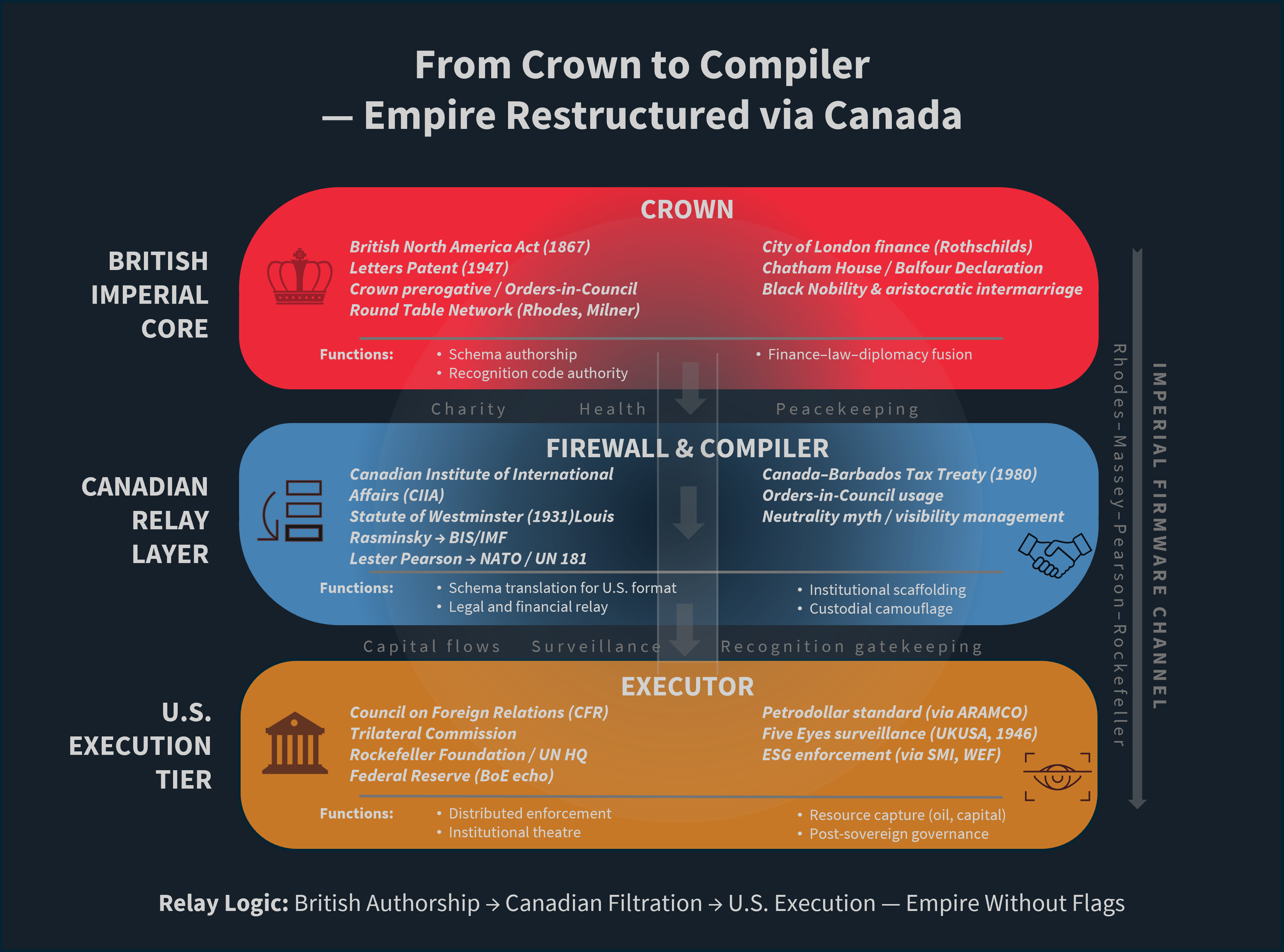
The result was not parallel influence, but sequenced fusion: Empire Sequencing Matrix — British origin → Canadian relay → American enforcement.
In these terms, the U.S. was not liberated—it was reformatted to execute empire in disguise.
Institutionally, this transmutation took form through CFR–Trilateral continuity, Federal Reserve design echoes of the Bank of England, and BIS coordination of monetary policy outside democratic visibility. Surveillance, financial flows, and legal protocols all bore the imprint of imperial precedent—rendering the U.S. executor, not author, of the schema.
Integration Pathway
Canada functioned not as a middle power but as a schema transcriber—a conversion layer through which British-coded governance could be recompiled for U.S. scale and application. Its jurisdiction offered legal deniability, cultural proximity, and Crown continuity—permitting imperial re-entry without military confrontation. This duality defined Canada’s strategic role: as custodian of Crown sovereignty within the Commonwealth through explicit legal anchoring, and as translator of British-coded governance into U.S. institutions under the guise of transatlantic cooperation.
Legal mechanisms such as the Statute of Westminster (1931) and Letters Patent (1947) preserved sovereign discretion over foreign policy and executive override, even as parliamentary optics were maintained. This allowed the Crown to exercise latent control within a nominally democratic format—an architecture of lawful opacity.
Financially, Canadian actors embedded Crown standards into the Bretton Woods system and related global structures. Louis Rasminsky (Bank of Canada, BIS, IMF) was a key operator in this transfer, ensuring that institutions nominally governed by the U.S. adhered to City-of-London norms. The Canada–Barbados Tax Treaty (1980) codified offshore laundering routes for Crown-aligned families, used heavily by Rothschild and Bronfman entities. The Bank for International Settlements, operating with Canadian coordination, became the stealth arm of postwar financial imperialism—standardising currency flows under the guise of multilateralism.
Diplomatically, Canada authored the institutional containers into which U.S. foreign policy was poured. Lester Pearson co-wrote NATO’s founding script and midwifed the partition of Palestine through UN Resolution 181, with Canada acting as neutral broker while executing an Anglo-Zionist schema. Institutions like CIIA, CFR, and Chatham House were schema-gated epistemic circuits: think tanks in name, enforcement nodes in function.
This was not restoration of empire—it was ontological grafting: the U.S. retained nominal command but operated within a schema authored elsewhere. American foreign and financial policy became a distributed execution tier of Crown-coded systems.
Each rupture—World Wars, Bretton collapse, Suez—functioned as schema expansion moments. Rather than triggering reform, crises were instrumentalised to deepen British-coded control through Canadian mediation. Under a crisis feedback economy meta-pattern structural failure became schema reinforcement. The more unstable the world appeared, the more entrenched the custodial logic became.
Functional Role
Canada served not as a minor adjunct but as schema normaliser—a mid-tier jurisdiction that translated top-tier imperial standards into plausible U.S. operations. Its function was ontological, not logistical: embedding Crown-coded governance inside American institutions while maintaining the illusion of national autonomy. While Canada maintained an international reputation for independent peacekeeping and diplomatic mediation, such actions typically reinforced—rather than deviated from—the underlying schema. Independence operated within parameters set by Anglo-coded legitimacy.
This played out across three core domains:
- Recognition: Canada fronted the Anglo-Zionist choreography behind Israel’s creation. Lester Pearson appeared the impartial liberal, but the outcome was pre-scripted—UN Resolution 181 (1947) secured partition and state recognition through Canadian mediation. Rothschild networks managed territorial logistics; Rockefeller-backed infrastructure (e.g. UN headquarters) provided institutional theatre. Canadian neutrality was operational myth; recognition authority remained Crown-anchored.
- Finance: Canadian involvement in the BIS (from 1930) and leadership roles in the IMF (e.g. Rasminsky) ensured that U.S. capital flows—nominally sovereign—remained nested in City-of-London legal codes. Tax treaties, offshore compliance regimes, and standardised banking instruments allowed money to move, but only within Crown-prescribed tolerances. Monetary sovereignty was externalised via procedural abstraction.
- Security: Five Eyes (1946), NORAD (1957), and NATO (1949) embedded Canadian infrastructure into U.S. military command chains. Canada’s geography and bureaucratic posture provided plausible deniability for surveillance and continuity of British-standard alliance logic. The U.S. looked dominant—but executed inherited schema.
This is neo-imperial instrumentation unmasked: the military-industrial machinery wears U.S. colours, but its recognition logic, financial formatting, and security protocols are British-derived, Canadian-normalised, and executed without democratic oversight.
What results is the silent standardisation of empire through compliant middle jurisdictions. Canada didn’t command the empire. It kept it legible.
Methods of Maintenance
Custodianship was sustained not through occupation, but through infrastructure. Canada functioned as the firewall—translating imperial discretion into legal continuity, financial opacity, and institutional filtration.
- Legal infrastructure: The Letters Patent (1947) preserved Crown override under constitutional camouflage. Orders-in-Council enabled executive rule behind parliamentary form. These instruments secured imperial discretion from electoral interference—Canada became a lawful exception zone inside the Anglosphere.
- Financial instruments: The Canada–Barbados Tax Treaty (1980), Cayman routing, and Jersey trusts composed the offshore mesh sustaining Rothschild, Rockefeller, and Bronfman wealth regimes. Canadian jurisdiction offered the ideal mask—stable, democratic in name, Crown-anchored in structure. Capital sovereignty remained supra-national, beyond U.S. or U.K. legislative grasp.
- Institutional architecture: Governance compliance was managed through schema clubs—CIIA, CFR, the Trilateral Commission, WEF. These weren’t forums; they were filters. Canadian actors operated as credentialing nodes—validating narratives, vetting personnel, issuing procedural clearance.
- Recognition control: Diplomatic legitimacy, financial access, and institutional standing were granted only through procedural conformity. Recognition of Israel, Saudi Arabia, postwar Germany followed not law or morality but alignment with Anglo-coded protocols relayed through Canadian mediation.
What emerges is not a sovereign order but a post-democratic custodial mesh—where recognition, not representation, is the price of entry. Canada did not impose power; it issued access.
Visibility Gradient
Custodianship worked because it was unseen. Canada wore the costume of neutral arbiter; Britain posed as post-imperial relic. The arrangement depended on misdirection—authorship had to be concealed for the script to hold.
The Five Eyes pact (UKUSA, 1946) presented as joint surveillance. In function, it preserved British command protocols behind an American face. Chatham House and the CIIA sold themselves as analytical forums, but operated as relay stations for pre-approved consensus—policy laundering mechanisms under institutional branding.
David Rockefeller’s honorary knighthood (KBE, 1994) was not a mere formality—it signalled public affirmation of U.S. capital’s alignment with Crown-coded governance standards. Though ceremonial, it served as institutional theatre: recognition of subordination already functionally enacted. While honorary knighthoods do not entail formal allegiance, they often signify alignment with British diplomatic or economic priorities, particularly when granted to key figures in transnational finance
Britain didn’t disappear—it restructured. Canada’s peacekeeping mask obscured its role as infrastructure steward. The U.S. wasn’t freed—it was reformatted. The republic runs on imperial firmware, with Canadian hands maintaining the update schedule.
Durability Horizon
Custodianship has migrated from territorial command to governing legibility. The question is no longer what a state is, but whether it qualifies—under external systems that determine if it’s recognised, financed, and included.
The ESG regime, led by Charles III’s Sustainable Markets Initiative, functions as a global recognition filter—only schema-compliant actors are granted access to capital, diplomacy, and legitimacy. ESG is not a policy—it's a gatekeeping protocol. Recognition now depends on alignment with post-sovereign codes, not sovereign will.
Surveillance infrastructures—AI governance, digital ID, cross-border data sharing—are routed through Canadian and Australian legal systems. This allows Five Eyes+ enforcement while bypassing U.S. constitutional limits. Canada provides the lawful outer skin; the Crown retains backdoor discretion.
Saudi Arabia’s Neom megaproject exemplifies the updated protocol: Rothschild-tier sovereign wealth, ESG compliance standards, and governance frameworks defined by WEF partners and BIS norms. Recognition is no longer moral or legal—it is procedural.
Crisis becomes codification. Identity becomes a permission state. The empire never died—it recompiled. Canada built the scaffolding. Britain retained the charter. The U.S. runs the machinery—unaware of the code it now executes.
Institutional Dynasty
X. Communist Party of China (CPC) – Party as dynasty; Mandate of Heaven analogue; continuity by bureaucracy, not bloodline.
Origin Mechanism
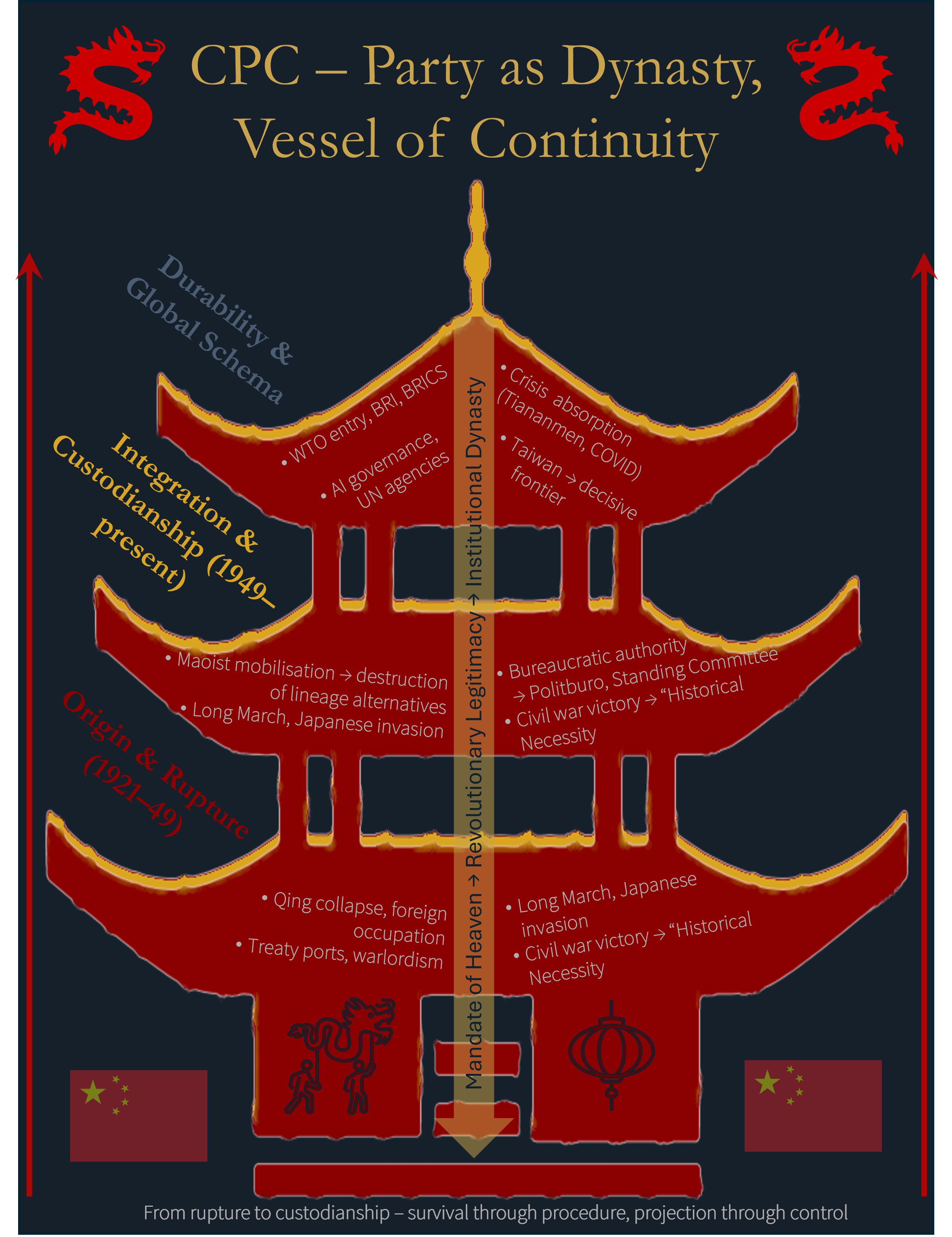
The CPC was founded in 1921 against the backdrop of dynastic collapse and foreign encroachment. The Qing dynasty had lost legitimacy after the Opium Wars, the treaty-port system, and the suppression of the Boxer Rebellion left China carved into semi-colonial zones controlled by Britain, Japan, France, Germany, Russia, and the United States. The abdication of 1912 produced not sovereignty but warlordism and fragmentation. Japan’s invasion and puppet regimes underscored the Guomindang’s weakness.
The CPC claimed not succession from throne or republic but mandate from rupture. Its Marxist programme was framed as a structural response to humiliation, its legitimacy drawn from the promise to end foreign occupation and restore unity. Survival through GMD suppression campaigns, the Long March, and Japanese encirclement confirmed its resilience. Victory in the civil war (1945–49) was presented not as chance but as historical necessity: the rightful outcome of class struggle, imperial collapse, and national awakening. The Party cast itself not as a faction, but as the executor of history.
Integration Pathway
Maoist rule entrenched Party supremacy through mobilisation, ideological saturation, and eradication of residual aristocratic legitimacy. The Cultural Revolution destroyed lineage-based alternatives, embedding authority in bureaucracy and replacing charisma with institutional sovereignty. The Politburo and Standing Committee became custodians of continuity—Party organs supplanting the Mandate of Heaven.
After Mao, reform meant recalibration, not liberalisation. Deng’s programme replaced revolutionary sacrifice with conditional prosperity. Markets were opened but within fixed parameters: the Party retained ownership of land, control of state enterprises, and penetration of private firms via Party cells. Economic participation became a privilege granted by the CPC, not a right.
This schema extended outward after Kissinger’s 1971 overture, when China was invited through the “bamboo wall” into the Anglo-American order as a counterweight to the USSR. China’s re-entry was brokered as conditional participation: the WTO accession (2001) and integration into global supply chains gave Western capital the scale and discipline it needed, but the CPC retained ultimate custodianship. Global capital entered, but only under rules the Party enforced—joint ventures, technology transfer, credit allocation, land-use control. The CPC did not dissolve into globalisation; it structured it domestically.
As Western powers later sought to contain this reintegration—Obama’s “Pivot to Asia,” Australian militarisation, South China Sea pressure, sanctions on Iran and Russia—the CPC pushed outward through Belt and Road infrastructure and the institutionalisation of BRICS. Where Kissinger had opened the door, China re-engineered the corridor: not as a client entry into Western order, but as a platform for conditional global alternatives under Party custodianship.
BRICS extends Dengist logic internationally but is not a CPC empire. Where Deng disciplined markets under Party terms, BRICS offers capital and recognition without liberalisation. Yet its Western portrayal as CPC-dominated overstates—India, Brazil, and South Africa exert real agency and often resist Chinese leadership. Rather than a command circuit, BRICS is a negotiated framework: China anchors resources, but outcomes reflect divergent national priorities. For the CPC, its value lies less in control than in projection—demonstrating conditional prosperity without democracy and embedding custodial methods within a wider coalition.
Functional Role
The CPC operates as schema custodian internally and procedural exporter externally. Domestically, it defines the boundaries of legitimacy—what counts as lawful religion, valid ethnicity, permissible business, or acceptable speech. Recognition is granted only through Party discretion, not autonomous institutions. This converts the CPC into sole custodian of political, cultural, and economic categories inside China.
Externally, the CPC functions as participant in and filter for the globalist enterprise. WTO accession, UN agency membership, and cooperation with WHO, IMF, and WTO embedded China into global governance circuits. Yet the Party’s role is not passive absorption. It translates external codes into conditional access mechanisms: foreign firms may enter only if they transfer technology, yield data, or operate under Party–state guidance. Where liberal systems internalise external rules, the CPC re-scripts them for custodial alignment.
Oligarchs and entrepreneurs are treated as conditional executors. Jack Ma and other moguls are not sovereign actors but instruments, tolerated only so long as they remain schema compliant. In finance and diplomacy, China uses state-owned banks, sovereign wealth funds, and Belt and Road financing to export its recognition logic abroad. The Party does not demand ideological conformity but functional alignment—partners need only accept CPC-defined terms of capital and infrastructure access.
BRICS represents the clearest projection of this logic. On the surface, it appears an anti-hegemonic bloc challenging Anglo-American dominance. In practice, it is a parallel recognition circuit: a platform through which the CPC and its partners embed themselves in global trade and finance while still operating inside the wider structures of UN, WTO, and BIS. BRICS institutionalises the CPC’s method—participation without subordination, integration without liberalisation.
Legitimacy is also performed through ritual theatre. Party Congresses, PLA parades, Confucian revivals, and curated revolutionary history are staged to display continuity. Succession remains opaque, governed by intra-Party consensus rather than elections. Through this model, the CPC presents itself as an alternative custodial order: prosperity without democracy, order without consent, global engagement without regime change.
Methods of Maintenance
The CPC fuses tools common elsewhere into a single custodial structure. It controls the PLA, police, intelligence, and cyber networks directly, with surveillance and the social credit system formalising alignment between behaviour and legitimacy. Economically, the Party monopolises land, directs sovereign funds, embeds itself in corporations, and regulates access to foreign capital.
Crises reinforce rather than weaken. The Lin Biao affair, Tiananmen, and COVID-19 were re-narrated as demonstrations of indispensability. Education and media remain under constitutional Party control, with revolutionary history mandatory and ideological campaigns recurring to renew fidelity. Purges and leadership transitions reinforce the permanence of the Party itself—leaders are expendable, but the Party is not.
Visibility Gradient
The CPC manages legitimacy across layered visibility. Outwardly, it presents humanitarian aid, UN peacekeeping, poverty alleviation, Belt and Road diplomacy, and state-led technology as proof of benevolent responsibility. Domestically, it sustains legitimacy through nationalism, prosperity, Confucian revival, and anti-corruption drives, all reinforced by managed media cycles.
Beneath this theatre lies the custodial core: opaque succession processes, PLA–SOE coordination, capital routing, deep surveillance, and recognition gatekeeping. Public performance stabilises perception, but continuity rests in concealed enforcement. The opacity is not incidental—it is governance by design.
Immunity & Exceptions
The Party stands above the law. Courts and prosecutors are Party-directed; the judiciary is an instrument, not an arbiter. Senior cadres are disciplined internally through the Central Commission for Discipline Inspection rather than civil law, reinforcing loyalty while shielding elites.
Internationally, CPC actors deflect accountability through sovereignty doctrines and diplomatic leverage, recasting issues such as Xinjiang or Hong Kong as questions of sovereignty rather than rights. Information sovereignty secures this shield: censorship, firewalls, and disinformation prevent external penetration of the Party’s narrative control. Legal, diplomatic, and informational protections converge into a single shell of immunity.
Durability Horizon
The CPC’s durability rests on being vessel rather than occupant of power. Unlike monarchies tied to heirs or republics tied to elections, it sustains continuity through institutional perpetuity. Party supremacy is constitutional, succession is managed through cadre grooming and Politburo consensus, and legitimacy adapts to circumstance—revolutionary victory (1949), developmental success (1980s–2000s), civilisational revival (Xi era).
Globally, China has become integral to the globalist enterprise. Its demographic scale and manufacturing base extended the life of neoliberal accumulation, while its participation in UN agencies, WHO, WTO, and IMF ensured procedural alignment with Atlantic frameworks. Yet the CPC filtered this integration: where others submitted to neoliberal discipline, it inserted custodianship—blocking judicial independence, monopolising land and capital, and embedding Party cells into corporate life.
This positioning enables a dual function. China remains indispensable supplier to the global system, while the CPC acts as filter and counterweight. As Western containment strategies sharpened—Obama’s “Pivot to Asia,” Australian militarisation, South China Sea patrols, sanctions on Iran and Russia—the Party countered with Belt and Road corridors, BRICS coordination, and African development projects that displaced Western incumbents.
Taiwan now marks the decisive frontier. Xinjiang agitation, Tiananmen Square colour revolution attempts, Hong Kong agitation, and Falun Gong propaganda all failed to fracture Party legitimacy. Taiwan offers the West its last major pressure point. For the CPC, Taiwan is non-negotiable—not only for nationalist unity but for the dynasty’s claim to historical continuity. For the West, it is the keystone for containment: a forward base in the Pacific, a test of whether China can be compelled to accept external terms of recognition.
Durability lies in this dual structure: China supplies the system, the CPC filters and redirects it, and Taiwan looms as the ultimate test of whether custodial continuity can be maintained under direct geopolitical collision.
Close out
The cases show a consistent structure. Authority originates in something beyond wealth—sacral descent, conquest, papal sanction, treaty grant, imperial sponsorship. Survival is achieved not through isolation but through institutional embedding: constitutions, papal diplomacy, sovereign funds, intermarriage, offshore nodes. Functionally, rulers act as schema custodians: they define legitimacy, recognition, and exception while oligarchs merely fund or perform these rules. Maintenance rests on asset insulation, legitimacy theatre, and secrecy—trusts, orders, lodges, foundations. Visibility oscillates: some dynasties dramatised through ritual and scandal, others buried in obscurity, with media curating what becomes spectacle and what disappears into banality. Durability rests on mutation: Roman treasuries folded into papal estates, Venetian commerce into banking houses, colonial rents into crown corporations and offshore webs.
Today the horizon extends further, toward technocratic and biotechnological custodianship—projects of dynastic survival beyond territory, resource, or ritual. Rulership is therefore not reducible to wealth, nor to immediate political power, but to custody of the schema itself: less visible than operators and oligarchs, yet more decisive in defining the horizon of governance.
Note: The Addendum 4 case studies were constructed using schema analysis—a method derived from systems theory, IR realism, and institutional sociology, refined within the Geopolitika GPT (GPGPT) framework. This integrates British imperial continuity theory (Quigley, Ehret), technocratic control models (Burnham, Gill), sovereignty displacement frameworks (Scott, Agnew), and financial statecraft analysis (Werner, BIS/IMF documentation). Institutions are modelled not by stated values but by command coherence, access control, and schema alignment. Nations are treated as procedural relays, not autonomous actors. Crisis is interpreted not as failure, but as schema entrenchment. The lens is structural-functionalist—prioritising procedural fidelity over moral or legal framing.
Published via Journeys by the Styx.
Overlords: Mapping the Operators of reality and rule.
—
Author’s Note
Produced using the Geopolitika analysis system—an integrated framework for structural interrogation, elite systems mapping, and narrative deconstruction.