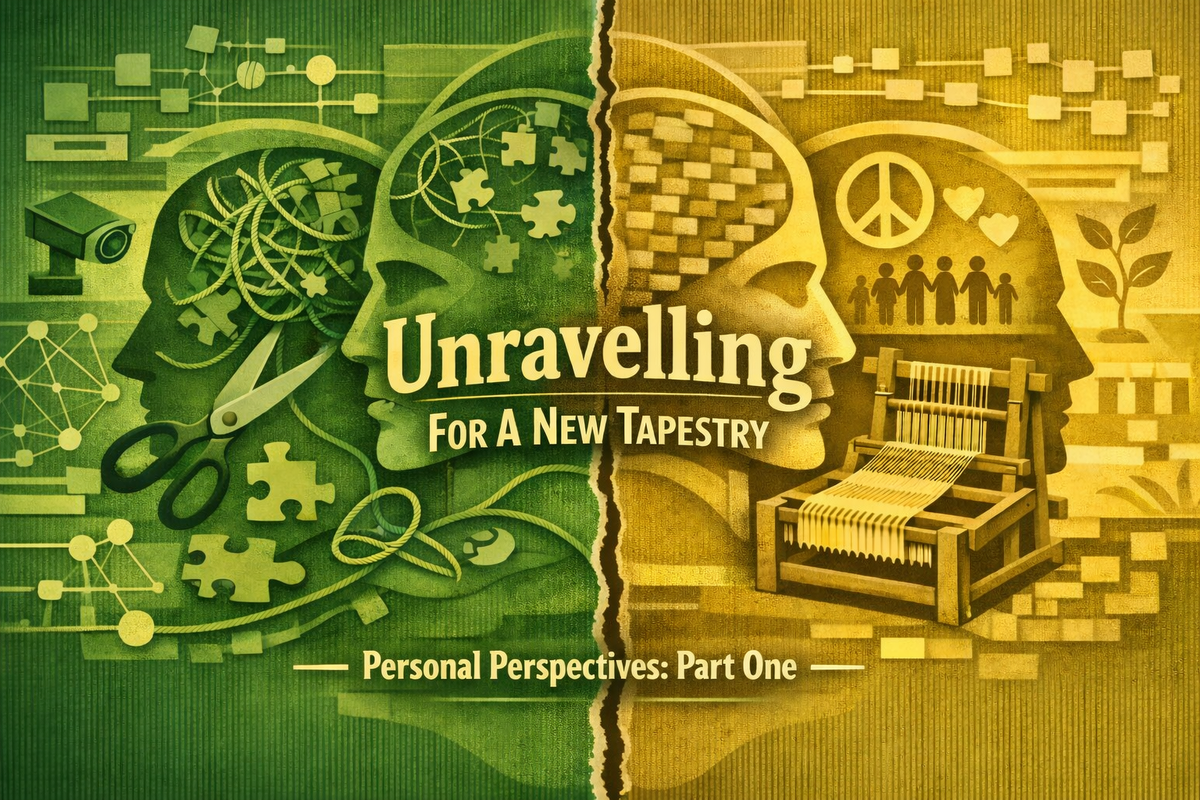
Personal Perspectives: Part 1. Unravelling For A New Tapestry
This post marks a deliberate shift in direction. For the past year, my weblog (at Substack and now at Ghost) has moved through distinct phases: beginning with an exploration of “estrangement ideology,” then transitioning into the Mindwars and Geopolitika series. This work extended to recount my understanding how global societies are shaped and managed through the Overlords and Operators series.
Much of this writing was mediated using AI as an analytic tool and writing assistant—initially as a way to distance myself from the raw emotionality of engaging with online communities where the targets of inter-generational disputes are often described in angry, disparaging and highly emotive terms. AI provided a layer of insulation, allowing me to analyse this material without being overwhelmed—at least that’s how it seemed to me at the time.
Through this period, I developed techniques using AI to break down texts—moving on to academic and geopolitical documents such as Brooking’s “Which Path to Persia?” and RAND’s “Extending Russia”—by applying discourse and power analysis to understand the narratives at play. The Geopolitika custom GPT was designed to assist with this work of deconstructing narratives, looking at the worldviews they reflect and showing how language is used to project a specific view for intended audiences so as to shape policies and governmental actions.
But after a year of writing using this digital intermediary—during which I have explored the new AI ecosystem and its capabilities and faults at some length—it seems timely to take a different approach. In a world where reality is becoming hard to discern, where photos and videos and much that is written is difficult to trace as authentic, it seems ever more crucial to present material in a voice that is simply mine. For those who found value in the articles I have posted over the last 12 months—for personal reasons or merely of passing interest—my previous posts will remain as a record. Whether you find some significance and value in the writing or perhaps dismiss it as merely as “AI slop”, that’s up to you to decide. For me, the articles represent many hundreds of hours work in developing an analytics system, structuring the findings and crafting articles to communicate ideas I found of interest and felt worth sharing with the world.
What I hope to offer now is a perspective shaped by nearly seven decades years of observing the world and wondering how it all works or doesn’t work (depending on your perspective)—of watching my naive illusions about how the nature of reality slowly unravel. Of tracing how that unravelling has altered my ideas and relationships with the world and its various manifestations in power, governance and social relations.
This experience is not mine alone. In online forums, it is not uncommon to find younger people describe their parents as having “lost touch with reality” or becoming “people they weren’t before.” This rupture definitely accelerated during the COVID-19 pandemic, when many people—both young and old—began to question official narratives and ask: “What is really going on? Because what I’ve been told doesn’t stack up with what I see happening.”
It would be misleading to say I’ve always trusted institutions. I grew up during the Vietnam War protests, aware even then that the war was based on lies—the Gulf of Tonkin incident being one blatant fabrication that springs to mind. This was closely followed by the "Domino Theory" of communist conquest that saw the Vietnamese invading the entirety of South East Asia should they prevail in their own homeland—an event that never actually happened, even 50 years after the television news showed US military helicopters lifting the last of the puppet regime’s supporters from rooftops in the fall of Saigon. That defending people from communism and delivering freedom and democracy meant strafing villagers from helicopters and sending children fleeing in terror from napalm incendiaries, their clothing incinerated and bodies burning as they fled, while the remains of their families and communities were left smouldering in the charred ruins of their homes. That early disillusionment was a kind of awakening: the realisation that what we were told was real often wasn’t. Lies, upon lies.
Later, my career in corporate institutions only deepened this scepticism. You cannot work inside such systems without recognising their predatory and exploitative dealings with customers, staff and society as a whole—a reality that has only intensified in recent decades.
Now, in my own voice, I want to explore what it means to look back on a lifetime of deceptions—large and small—and to trace the patterns of power, money, and control that quietly shape our lives. This is not just an intellectual exercise, but an emotional journey through lost trust, broken connections, and the lonely work of rebuilding a worldview from the fragments left behind.