Personal Perspectives: Part 2. The Naïve Belief System
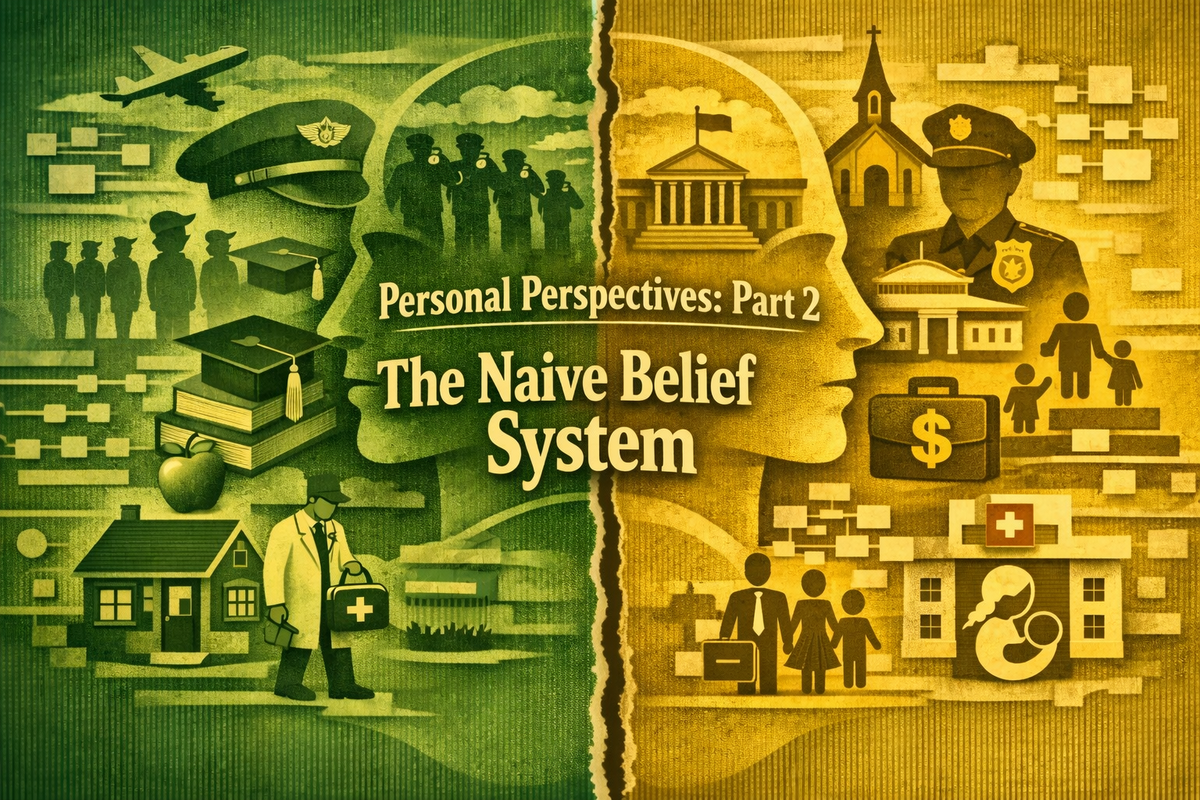
In my Mindwars article “Are System-Trusting Beliefs Harmless?”, I posed a thought experiment—a parody of a serious psychological study on conspiracy theories, in which academics use the Conspiracy Mentality Questionnaire (CMQ) to argue that significant harms stem from those who believe in conspiracy theories.
I reverse the question: what if the real harm lies at the other end of the spectrum—among those who trust official narratives too much? Using the same structure, the article demonstrates that extreme trust in government and institutional narratives—what I call a “prospiracy mentality”—can also lead to measurable harms. But where does this prospiracy mentality come from?
Looking back across the decades it’s now easy to see how it’s the product of a naive belief system—one I inherited, was educated into, and later embodied as a corporate professional and “upright citizen.” As we grow-up we are inculcated and trained to absorb this belief system through our upbringing, education and the cultural consensus that makes it seem like the natural and only way of seeing reality—together, they construct a seemingly stable world.
It begins early. I remember at five, all of the children were lined up outside the classroom, we waited for the teacher’s permission to enter, and we took our seats in orderly rows. That structure continued in Cub Scouts—a system of sixes, each with a leader and an Akela pack leader, all modelled on Baden-Powell’s military hierarchy. Then came Boy Scouts: saluting flags, standing in formation, obeying authority without question. Sports were very much the same.
My father served in the Air Force. His uniform, his parades, the crisp salutes—all reinforced the natural order of authority. University extended the pattern: lecturers dispensed wisdom, we absorbed it, reproduced it in essays, and proved our worth through examinations. The hierarchy was ever-present: lecturers reported to senior lecturers, then professors, then chancellors.
Entering the workforce meant entering another hierarchy where the uniform was a suit and ties rather than military weeds. After university, I found employment at a bank; when working at a branch office, I answered to the branch accountant, who reported to the manager, who reported to the district manager, and so on up to the General Managers and CEO at head office. This layering felt normal—the way things worked. And the bank’s systems worked in just such a regimented way, money was held securely, transactions were paid when funds were in accounts, bad debts were collected. When you had enough for a deposit, the bank would lend you the money to buy a house. If you were bed ridden the doctor would come to your house on the weekend to check you out and issue a prescription. When the baby was due, it would be delivered at the local hospital. None of this required medical insurance or going into debt to pay inflated medical bills, it was part of the social contract.
This layer of trust extended into government. Most people believed lawmakers acted in the public interest, that democracy translated the will of the people into fair and just laws, and that everyone was treated equally under a system designed for order and collective benefit. That judges and magistrates were inherently learned, wise and unbiased arbiters of truth and justice—people to be looked up to as the very essence of our society. That what was passed into law was largely in the interests of the people and that we lived in democratic and free society where we could do and say as we pleased within the limits of social and moral acceptability.
As far as we were concerned the media honestly reported events. The Kennedy assassination was a lone gunman, later killed while in custody by another gunman—surely just rough justice. Unfortunate assassinations seemed the order of the day as Kennedy was followed by Malcolm X, Robert Kennedy and then Martin Luther King. Strangely, most seemed to be associated with the human rights movement—nothing to see here. Glued to the black and white TV, we watched in awe as fuzzy images of Neil Armstrong stepping on to the moon streamed into our living room and, thanks to the miracle of science, he and Aldrin even spoke to the President by telephone. Entertainment being just that, we later marvelled at the special effects in Kubrick's 2001 A Space Odyssey at the movies and, years later, the disturbingly unreal events in Eyes Wide Shut, Kubrick's swan song.
In those days, Church leaders were pillars of ethics; politicians were mediators; policemen were fair, even if “fair” sometimes meant taking a young troublemaker behind a building for a “corrective” hiding—an act then seen not as brutality, but as community stewardship. Today, such systemic violence is publicly condemned—although, apparently not so much when it comes to Palestinian supporters, people opposed to the Gaza genocide and anti-lock-down protestors during COVID. But at the time, it was woven into the fabric of trusted authority. We believed those in power acted, even harshly, in everyone’s best interest—even if occasionally falling short, as in Nixon's involvement in the Watergate scandal.
This is the double-edged nature of system trust: what once passed as ethical and necessary is now seen as abusive or corrupt. Yet that trust was part of the very fabric and order of the society we lived in—the invisible logic of a world that seemed to work.
Of course, the working class who benefited from the system to some degree often supported it too. Those in the armed forces and the police, especially, often voted conservative because they saw that side of politics being more inclined to fund the military and police forces them. Those working in factories and health more likely voted for liberal or socialist parties—aiming for better labor laws and health funding. For these working class people the system worked, they were able to get married, have a family, buy their own home.
The prospiracy mentality rests on an inherent faith in systemic integrity—a trust so deep it feels naïve in retrospect. For instance, the Cub Scouts, once proudly associated with Lord Mountbatten, the Queen’s cousin and Viceroy of India, later revealed to have had pedophilic tendencies. Yet even while such exposures are often framed as proof the “system works”—self-correcting, transparent, applying to all—it is an incontrovertible fact that the scouting movement, the Church and many other previously respected institutions have suffered greatly in recent decades from numerous revelations other instances of systemic abuse.
Of course, there were always those for whom the system did not work—those who never trusted it at all.
For many in the working class and the poor, the police were not protectors but enforcers of an order that rarely served their interests. The labor movement, born in the late 1800s and strengthened through the early 1900s, arose precisely because workers saw that corporations and the state were not on their side. Even when hard-won rights were formalised into law, conflict persisted.
In New Zealand, the dockworkers’ strike of the 1950s was broken Pinkerton style by the government sending in the army to take over the wharves. Striking workers were dismissed and replaced with those deemed “less radical”—a clear demonstration that the system could and would use force to preserve itself when challenged. Even a decade later, this event was still raw in people's minds.
For many, especially through the 1960s and ’70s, the answer was to opt out entirely. Motorbike gangs and other alternative collectives formed their own systems of defence, social support and economy—often based on theft, black markets and drug dealing. They built their own world because the official one offered them nothing but exclusion or coercion. Middle-class dropouts escaping the system formed communes and collectives where they built houses in odd shapes, planted gardens to feed the community and raised their kids off-grid. But they were the exceptions.
In essence, the prospiracy mentality for the middle and lower classes is a question of benefit. It is a worldview that flourishes among those for whom the system does deliver some measure of security, status, or stability. For the upper class and upper middle classes (senior bureaucrats, corporate managers, accountants, lawyers, doctors etc) trust is inherent; they are the system. For many of those at the bottom, trust was never an option.
In sum, the belief in a just and functioning order was not universal—it was the privilege of those positioned to benefit from it, and the blindness of those taught to see its failures as exceptions, not features. For them, to believe otherwise was irrational, deviant, self-sabotaging.