Personal Perspectives: Part 3. Narrative Cracks and Cognitive Dissonance
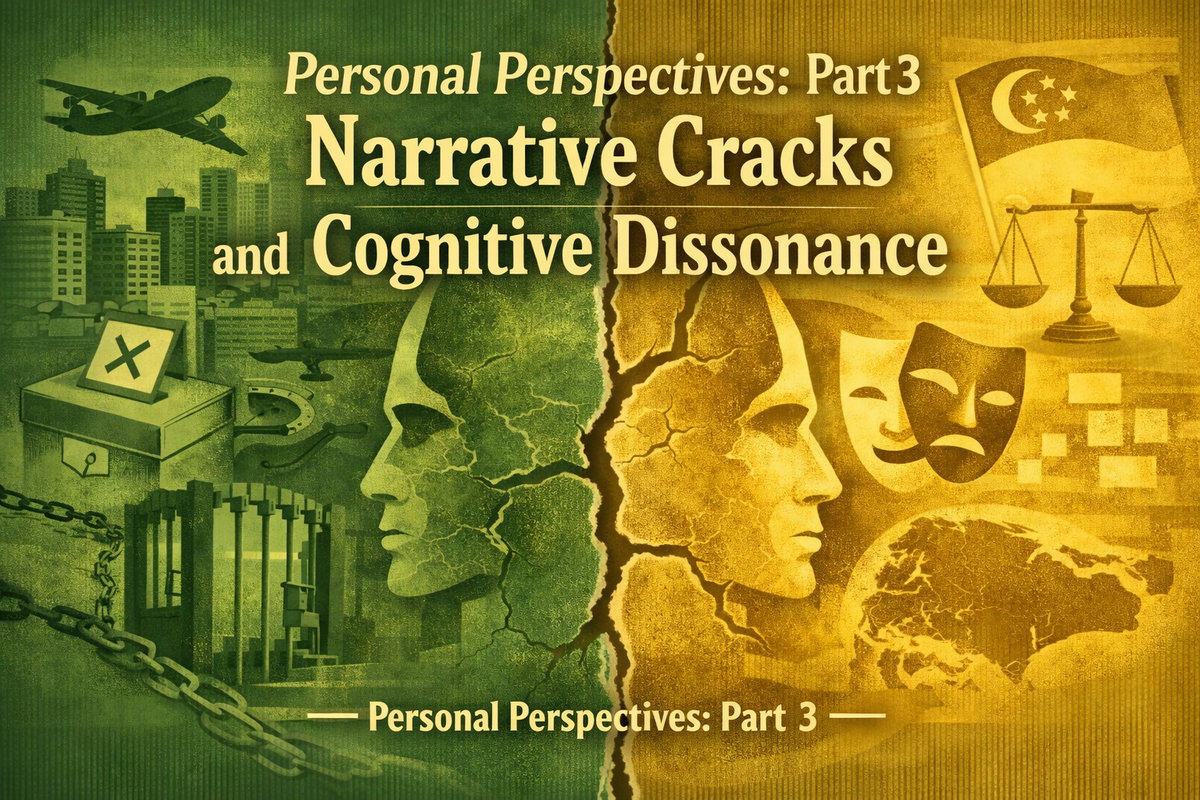
My first real awakening—that the world was not as orderly or benevolent as I had been taught—came not from books or distant headlines, but from living inside a place that proudly called itself a young democracy while quietly demonstrating what that word could mean under firm hands.
In 1971, my father was posted to Singapore with the New Zealand Air Force as part of the transition arrangements following the final British withdrawal. The British bases were closing, the old colonial presence fading, and Singapore—barely six years independent—was forging its own path under Lee Kuan Yew’s vision. We lived there for two years, through 1973, during the early rollout of what he presented as a modern, multiracial society built from four main groups: Chinese, Malay, Indian, and Others. The ideal was harmony through integration—mixed housing estates, four official languages, campaigns to erase old divisions and build a single Singaporean identity. It felt purposeful, forward-looking.
At the same time, the discipline was unrelenting and visible everywhere. No spitting—fined. No littering—heavy penalties, S$500 in some cases, enforced with real zeal. The streets were scrubbed clean, the city transformed into something orderly and efficient. People spoke of it with a mix of pride and resignation: this was the price of progress in a vulnerable young nation surrounded by larger neighbors.
Yet the paradox was impossible to miss, even as a teenager absorbing it all second-hand through family conversations and the atmosphere. Alongside the boasts of building a Garden City came open admissions about how opposition was handled. Lee Kuan Yew and his People’s Action Party made no secret of removing threats to stability—jailing opposition leaders under the Internal Security Act, detaining without trial those deemed subversive, sidelining parties like Barisan Sosialis through arrests and restrictions that had begun years earlier but set the tone that lingered. The message was clear and unapologetic: in a small, resource-poor island, survival demanded control. Dissent that might fracture unity or invite chaos was not tolerated. Leaders spoke of it as necessary surgery—cut out the infection to save the body.
For someone raised with stories of fair play and democratic ideals, it was unsettling. Here was a system forging modernity through iron discipline on one hand, while on the other ensuring no real challenge to power could take root. The “democracy” had elections, but the field was cleared in advance. I watched it unfold in real time, not as abstract politics but as the air we breathed during those two years. Beyond doubt it was a city in transition from the old to a bright technocratic future, the old village kampongs were being emptied and the Singapore river, then little more than a back and oily sewer, was later to be transformed to a clean estuary lined with renovated shop houses and cafes. When I visited it some 20 years later the place was unrecognisable, the old wet markets gone and the village life replaced with tall housing estates lined up like Lego building blocks and with just as much character.
That early exposure planted seeds of doubt I didn’t fully grasp then. When we returned, those doubts stayed dormant for a while—life moved on, university, early career in banking, the inherited faith in systems still strong. But they sprouted later.
My next reckoning came through a close friend, a farmer who served on a national farming board. While serving, some people at his bank suspected—falsely—that he had reported them for corrupt practices. The accusation traveled up the chain without anyone bothering to check with him. The bank froze his operating facilities and called in all his loans, including the farm mortgage, right when he needed credit for the season’s stock. He was forced to sell. It later emerged the local manager had talked it over with a real estate agent and others in the community. Coincidentally, a neighboring farmer offered almost exactly the sum owed—far below market value. Thankfully, he and his wife found another buyer at a realistic price, repaid the bank in full, and left farming with a small nest egg.
I was working for a different bank myself at the time, in my late 30s and early 40s, and had never imagined such coordinated predation happened in the systems I was part of. But I soon learned it was not isolated. A relative, a property developer, had a loan for refurbishing an old mid-city hotel called in abruptly near completion. Unable to refinance quickly, the bank sold the property to another customer—who happened to be a local competitor.
These incidents echoed back to Singapore: systems that could present as fair and rule-bound while acting with ruthless coordination when interests aligned. They opened a door wider.
Years later, as I delved into world events and historical patterns, those early seeds connected to larger threads. The U.S. military’s conduct in Vietnam—detailed in works like Douglas Valentine’s The Phoenix Program, exposing CIA-led torture and mutilation—resonated with family stories from the Malayan Emergency in the 1950s. My father, then an airman in the New Zealand Air Force, had photographs of dropping supplies from DC-3s into fortified British camps designed to control local populations under the guise of protecting them from communists. Only later did the grimmer picture emerge: strategies signaling the end of colonial domination, selected winners replacing those old structures and suppression of opposition reframed as anti-insurgency.
Those two threads—the personal betrayals in trusted institutions and the military’s brutal realism—wove together into something colder and clearer. I have always been a pacifist. I’ve never struck anyone, never owned a gun, never believed violence solves anything. I would never join the military, because I do not see it as a force for good—rather a manipulation of good people to act, often brutally and murderously, in the interests of a few. Instead, I strongly view militaries as instruments of corporate and resource interests—protecting oil, minerals, and hegemony, not people or principles. The more I study history, how it is written and by whom, the more this view is confirmed.
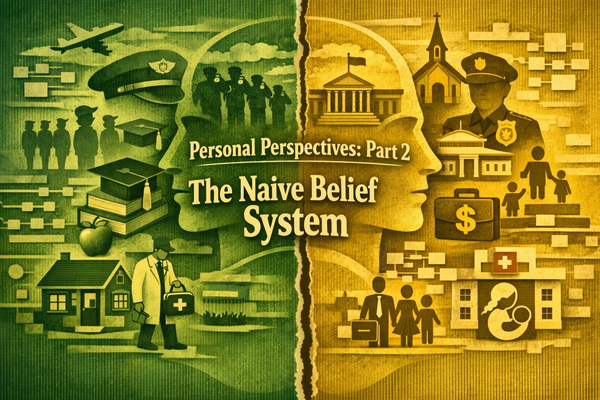
My faith in the West as a benevolent force—America as the “world’s policeman,” defender of democracy and freedom—slowly dissolved. Stepping into that geopolitical rabbit hole stripped away the “goodies vs. baddies” frameworks peddled by media and governments. What remained was a more nuanced, unsettling view: the narratives we are fed are not meant to explain the world, but to control how we see it.
This was not just an intellectual shift. It was the unwinding of a lifetime of assumptions—a personal and political awakening that would eventually distance me not only from institutions, but from those who naïvely still believe in them.