Reflections: Dancing At The End of Time
A cautionary look at Moorcock’s far-future fantasia as a mirror of elite dreams for immortality, meaninglessness, and escape from the human condition.
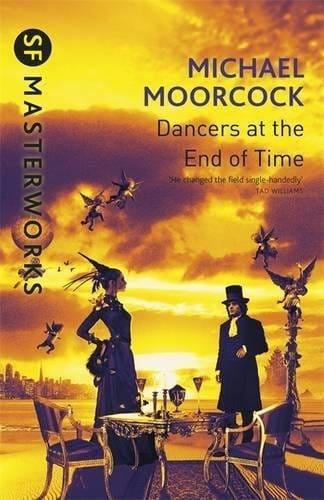
This one’s personal. I’ve been carrying Michael Moorcock’s The Dancers at the End of Time around with me—figuratively and literally—for a few decades now. First stumbled into it through the Eternal Champion cycle when I was still young enough to think the multiverse was just a cool concept. Over time, the story got under my skin. I didn’t always know why. Now I do.
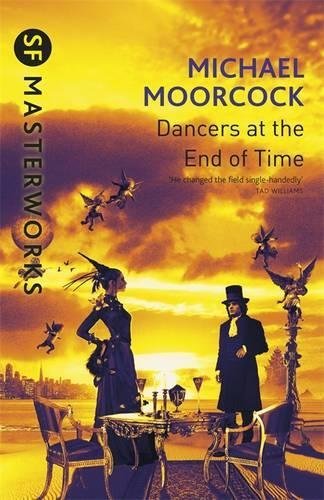
The Dancers Are Real—Moorcock and the Endgame of Elite Immortality
"What if they succeed? What if the Pharaohs break the curse of death, and live forever?"
Michael Moorcock's The Dancers at the End of Time reads, at first glance, like a satirical romp through the entropic collapse of civilisation. It’s camp, decadent, indulgent. A far-future tale where immortal beings—the Dancers—play aesthetic games as the universe winds down. Their lives are hollow, their pleasures theatrical, their cruelty unmoored from consequence.
But read from our current vantage point—in the shadow of transhumanist billionaires, gene-hacking labs, AI consciousness projects, and cryonic legacies—Moorcock’s world stops being fiction. It begins to feel like a diagnosis. Or worse, a blueprint.
The Ancient Dream: Elite Immortality, Then and Now
The dream of immortality was never democratic. Ordinary people found meaning in religion, kinship, land, and tradition. The elite—from Pharaohs to oligarchs—sought preservation: of self, of legacy, of bloodline. Not transcendence for all, but exemption for the few.
For millennia, this took the form of dynasties and monuments. Kings mummified in pyramids. Names carved into obelisks. Families bound by marriage to concentrate wealth across centuries. Even the Church offered canonisation as elite continuity.
Today’s elite no longer settle for remembrance. They seek literal continuance:
- Digital immortality through mind uploading
- Biological suspension via cryonics
- Genomic reprogramming for radical longevity
- AI-powered personal clones and simulation.
The transhumanist movement is not a cultural revolution. It’s a technocratic update to the oldest desire in history.
Moorcock’s Dancers: Post-Elite, Post-Human, Post-Moral
In The Dancers at the End of Time, Moorcock presents a class that has succeeded. The Dancers are immortal. Time no longer threatens them. Scarcity no longer disciplines them. History no longer matters. They exist in a technological future of limitless power—yet with no understanding of the technologies they wield, no memory of how their civilisation came to be, and no grasp of their place in the universe. All-powerful, but severed from context, they drift through a world they can reshape but no longer comprehend.
And so they perform: art without meaning, conflict without risk, affection without commitment. They reshape reality as play, treating creation itself as a palette. Yet behind the baroque hilarity lies a profound spiritual collapse. The Dancers have become gods—and have no idea what to do with divinity.
This is not far from where we’re heading. The real-world elite—the transhumanist vanguard—are inching toward this condition:
- Freedom from death, but also from responsibility
- Infinite expression, but no foundation for truth
- Systems of control, but no grounding in purpose.
Amelia and Jherek: The Return of the Human
The heart of Moorcock’s trilogy is not the Dancers, but the arrival of Amelia Underwood, a time-displaced Victorian woman. She brings with her something alien to the Dancers: shame, morality, memory, love.
Jherek Carnelian’s obsession with her—and his clumsy attempt to love her—is more than character development. It’s a rupture in the post-human illusion. Through Amelia, Jherek rediscovers limits. And in that rediscovery, he begins to change.
This is Moorcock’s real warning: transcendence without memory is erasure. Without death, there is no sacrifice. Without limits, no longing. Without history, no love.
When the Pharaohs Succeed
The Dancers at the End of Time is not just a satire of decadence. It’s a prophecy. It shows us the final form of elite power when it no longer needs the world—or the rest of us.
If Orwell warned us of the boot stamping on a face forever, Moorcock warns of something subtler: no boot, no face—just eternal play, and total forgetting.
The Pharaohs no longer die. They dance.
My question is: Will the rest of us will become the dust beneath their stage?
Published via Journeys by the Styx.
Reflections: Watching the theatre of power crack, where the stage collapses and the actors lose the script.
—
Author’s Note
Written with the assistance of a conditioned ChatGPT instance. Final responsibility for the framing and conclusions remains mine.