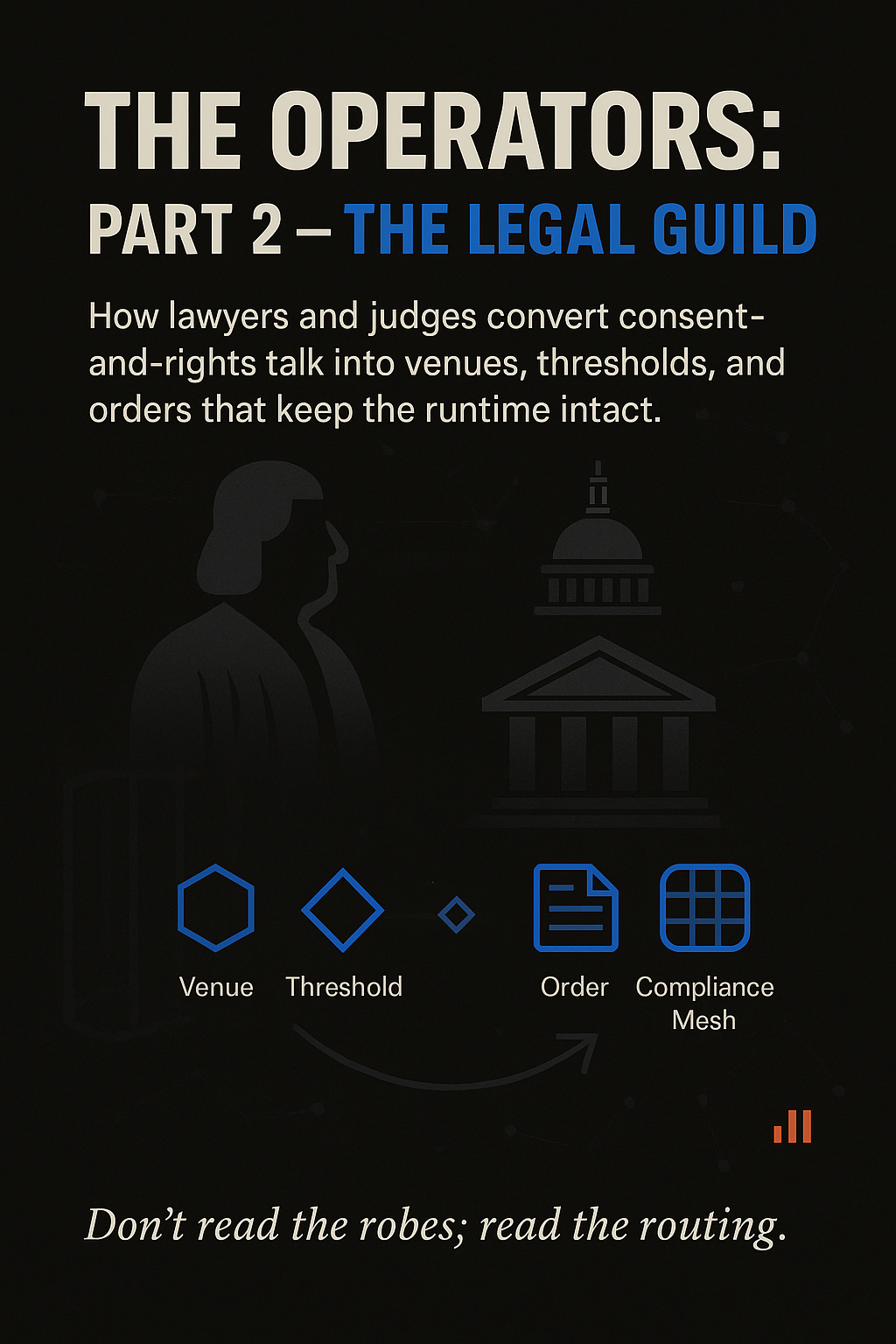
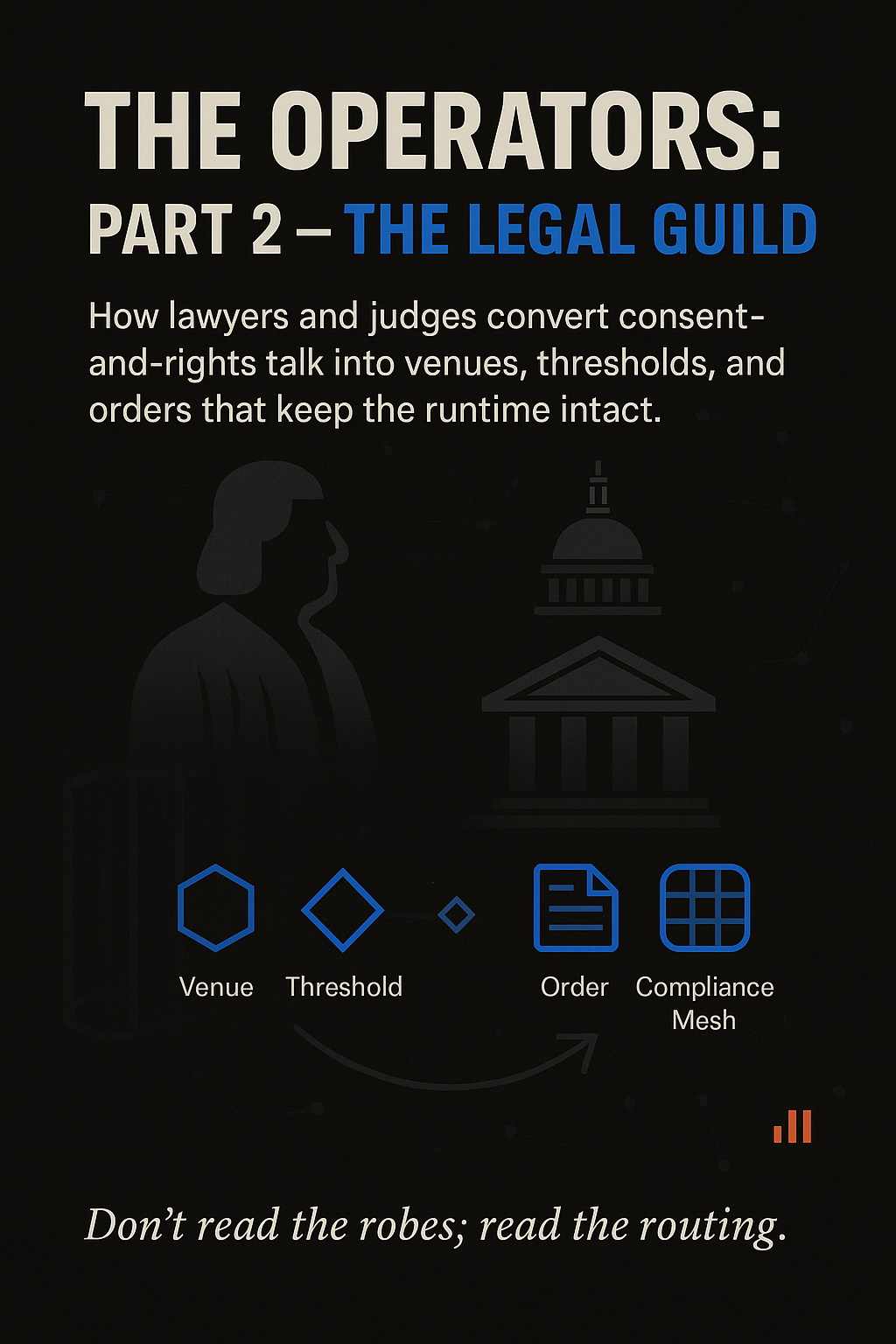
The Operators: Part 2. The Legal Guild
How lawyers and judges convert consent-and-rights talk into venues, thresholds, and orders that keep the runtime intact.
The courtroom isn't the endpoint. It's a staging area in a much larger system—one designed not to resolve conflict, but to maintain flow. Lawyers and judges are not so much coaches and referees as they are runtime engineers. They don't argue over power. They format it.
Every day, legal actors decide what gets heard, where it gets heard, how it gets framed, and whether the result is enforceable, suspendable, or silently buried. These are not peripheral tasks. They're central to how modern states perform continuity. When legal institutions seem to limit power, they are often re-routing it. When they appear to settle disputes, they are more often managing throughput. The job is not moral adjudication, but logistical control. Access is filtered long before a case is heard—by cost, by forum, by gatekeeping rituals that quietly stratify who gets process and who gets delay.
There is no honour in a ritual imposed under threat. Courtroom decorum—mandatory forms of address, standing and bowing protocols, enforced deference—is not the expression of civic respect. It is the performance of submission under duress. The refusal to participate in these rituals is treated not as ideological dissent but as procedural disruption, punishable by contempt. This is not a justice system that commands respect—it demands choreography. The courtroom does not validate honour. It extracts obedience.
Law, then, is not a neutral profession. It's infrastructure. The legal guild—bench, bar, and advisory class—doesn't merely interpret rules. It decides which rules matter, and when. It allocates credibility, manages narrative visibility, and builds procedural filters that throttle dissent or accelerate preferred outcomes. The performance of neutrality is often the mechanism of control. Legal process appears open, but participation is rationed—representation scales with resource, and remedy follows proximity to power.
The system's evolution is often framed as a rational adaptation to complex modern governance—too many actors, too many variables, requiring standardisation and procedural filtration. But what appears as response to complexity is also consolidation of power. The courtroom becomes a filtering chamber, where access, timing, and cost determine not justice, but throughput control.
A legal operator is not defined by ideology. What marks them is circulation: across courtrooms, commissions, regulatory agencies, arbitration panels, corporate boards, and NGO standards bodies. At each stop, they apply the same levers: forum selection, time compression, doctrine narrowing, threshold control. Their moves are tactical. Their function is structural.
Operator logic isn’t about persuasion. It’s about placement. A clerkship signals entry. A tribunal appointment authenticates expertise. A scandal re-emerges as an independent review. Legitimacy flows from the system’s internal circuitry—not from open contest, but from managed redeployment.
This isn’t a theory of capture. It’s a map of runtime. The legal guild sustains the execution layer of sovereign and para-sovereign control. The task is no longer to ask what the law says. It’s to see who operates it, where they circulate, and what their placement permits them to convert.
This article traces that circuitry—through placement cycles, control levers, legitimacy scripts, and individual case studies. It doesn't ask whether justice is being done. It asks what system is being maintained, and by whom.
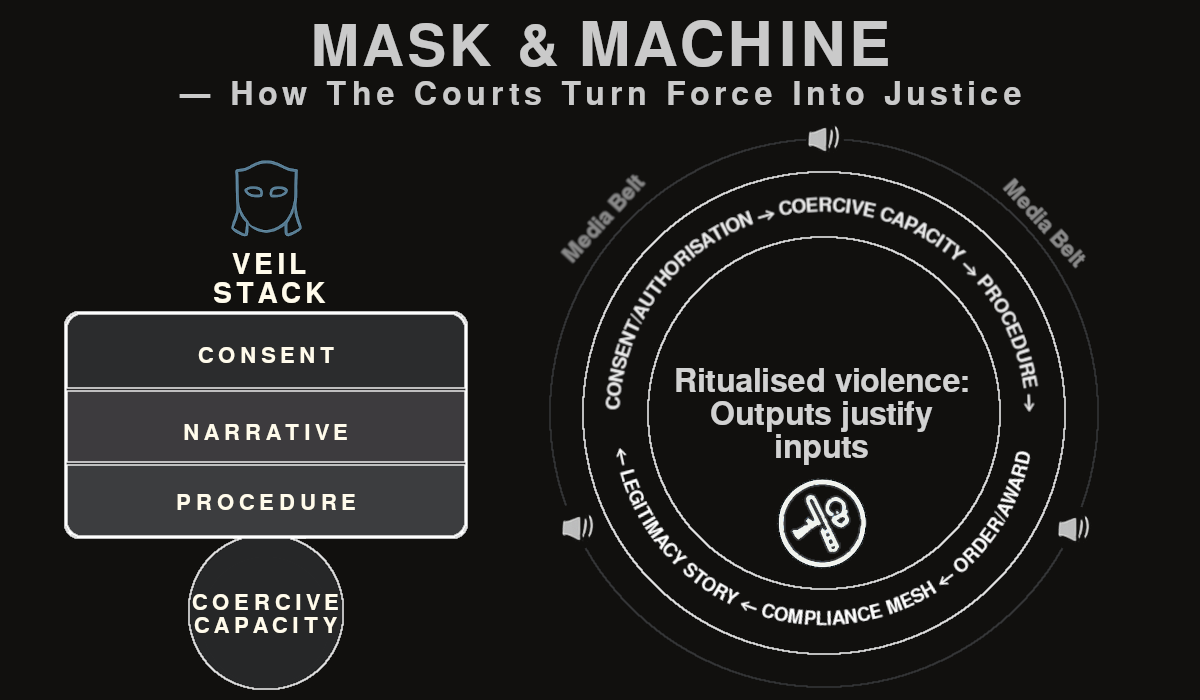
The idea that law derives legitimacy from consent—parliamentary, popular, or procedural—is a theatre prop. Its real function is to mask the coercive machinery that underwrites it. Law is not derived from agreement but imposed through control—of venues, narratives, and consequences. It promises deliberation but delivers discipline. What appears as balance is management; what appears as neutrality is formatting; what appears as order is the aftermath of threat. To say that lawyers and judges manage legitimacy is already one step too clean—they manage the staging of legitimacy to obscure the fact that consent is neither asked nor required. Behind the bench, beneath the robe, inside the doctrine: power. Not representative, not distributed, not accountable. Structured violence, administered with a human face.
Max Weber famously defined the state as the entity claiming a monopoly on the legitimate use of physical force. But legitimacy here is asserted, not earned—it is a claim retroactively justified by procedural closure. When law exhausts interpretation, it does not resolve conflict—it escalates to enforcement. The recursive appeal to higher authority terminates in the badge, the gavel, the prison gate. In this structure, authority is not a check on violence—it is its formatting protocol.
Placement is Power
The legal guild does not confer power through ideas. It routes it through placements. You don’t rise by merit—you rotate through credentialed roles that authenticate your capacity to speak, frame, and authorise. Placement is not reward for performance; it’s a form of control—positioning the guild’s own inside critical nodes of coercion.
The pipeline is not secret, just selectively enforced. A small number of institutions—law schools, chambers, inquiry rosters, international panels—function as credential printers. Entry is filtered through stylised contests (marks, moots, interviews) but these serve ritual, not sorting. Once inside, access compounds: a clerkship unlocks an advocacy set; a regulator posting authenticates a tribunal seat; a tribunal appointment converts into boutique revenue or NGO gravitas. Placement doesn’t prove virtue—it prints deference.
The Core Loop: Runtime Architecture of the Legal Class
Careers don’t climb—they circulate. The guild’s runtime is powered by a self-reinforcing circuit of roles, each node training for the next. The loop contains six key functions:
- Credential: Law schools, journals, moots, bar admissions. These set the tone, the method, the rhythm. They produce clerks and pupil barristers, not critics.
- Forum: Trial benches, advocacy chambers, regulators. These actors shape access: who gets standing, which venue hears what, who gets filtered out on threshold grounds.
- Sovereign: AGs (Attorneys General), DPPs (Directors of Public Prosecution), inquiry leads, appellate judges. These don’t argue law; they configure it. They set doctrine ceilings, soft law conversions, and legitimacy thresholds.
- Compliance: BigLaw, monitorships, internal investigations. Here, law is monetised as an instrument of continuity—remediation over remedy, agreement over verdict.
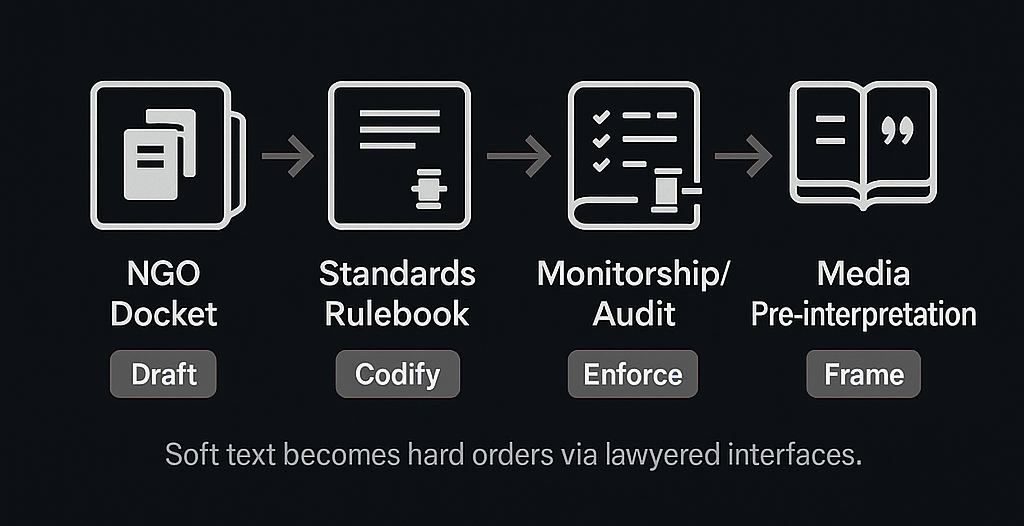
- Norm: NGOs, treaty bodies, standards panels. They create the soft text that tribunals and regulators later crystallise into orders. No guns, just footnotes and consequences.
- Agenda: cabinet, boardroom, central bank, IFI (International Financial Institution, e.g., World Bank, IMF) posts. These are not exits from law—they’re apex placements, where law’s method becomes governance logic.
Every movement within the loop re-authenticates prior roles. You don’t need to win arguments—your CV wins them in advance. Placement is performance.
One Career, Five Masks
Track a single operator across 20 years and the logic reveals itself:
- Stage 1: Oxford BCL (Bachelor of Civil Law), High Court clerkship, pupillage (a barrister's mandatory apprenticeship) at a constitutional set (a group of barristers' chambers specialising in a specific area of law).
- Stage 2: Crown prosecutor, then appellate court staffer—learning threshold control (the procedural power to prevent an issue from being heard), the art of disposal (the efficient dismissal or resolution of cases without a full trial).
- Stage 3: Seconded to a royal commission (a major public inquiry) where evidence is shaped, not found. Author of key chapter on national security powers.
- Stage 4: Jumps to a global law firm, leading “independent” workplace investigations and ESG (Environmental, Social, and Governance) compliance reviews.
- Stage 5: Appointed to an arbitral panel, then parachuted into an IFI legal advisory role—no elections, no scrutiny, just mandate.
This apparatus didn’t arise from malice—it evolved. As modern states and capital systems scaled beyond human adjudication, legal runtime emerged as the rational substrate. Courts were too slow, doctrine too rigid. Placement, procedure, and compliance offered adaptive throughput. What looks like corruption may just be operating capacity under complexity pressure. But power chose the route—and designed the runtime.
At each stage, placement substitutes for contest. The guild never leaves the frame—it simply rotates its own through costumes that confer new powers without shedding the old. The sovereign returns as consultant; the consultant returns as judge; the judge returns as rapporteur.
Every rotation tightens the runtime.
Runtime Mechanics
Law operates not by principle, but by control: of where matters are heard, when they’re heard, how high the bar is set, and which non-binding norms get upgraded to binding orders. Legal actors don’t resolve—they route. Their job is not to adjudicate conflict but to maintain the machine. Every runtime system has four core levers. Here’s how the legal guild pulls them.
Not every judge or barrister is a conscious operator. Most are not. But the guild doesn’t require consent—it requires adherence. The power of the legal script is that it runs regardless of motive. Placement determines outcome. Procedure disciplines deviation. What looks like discretion is usually formatting.
Control of Venue
Venue decides the frame. Shift the venue, and you shift the logic of what’s at stake—commercial dispute becomes national security matter; regulatory breach becomes arbitration claim. But sometimes the venue is eliminated altogether.
Example: UK National Security Listings and D-Notices
The UK’s use of secret venue control mechanisms—such as closed material procedures in SIAC (Special Immigration Appeals Commission)—allows the government to classify a legal issue as a “security matter,” disqualifying the respondent from knowing the full case against them. SIAC’s closed material procedures convert adversarial testing into containment, with limited disclosure and review. DSMA (D-Notice) advisories act as upstream filters on national-security topics; practical compliance is high, so the visible docket narrows before law can bite. These are “requests” by government to media not to publish on specific topics deemed sensitive to national security. Though technically voluntary, compliance is near-total.
The effect: matters involving military operations, intelligence agency actions, or foreign state relationships are kept out of public legal discourse entirely. The public never sees the venue, let alone the ruling.
Control of Timing
Justice delayed isn’t just justice denied—it’s process controlled. Legal actors manipulate the clock: when charges are laid, when disclosure must occur, when orders are enforced. The system becomes a time weapon, structured to wear down resistance and reward compliance.
Example: Australian Federal Court Summary Disposals
In matters involving pseudolaw, disinformation, or national security, courts increasingly deploy summary dismissal tools to prevent even basic airing of claims. Time-to-hearing for such matters shrinks, while procedural levers like leave to appeal are tightened or denied. The runtime goal is speed where doctrine is threatened, delay where critique might gain traction.
Control of Thresholds
Most matters die before they begin—not because they’re wrong, but because they don’t meet procedural thresholds. Standing, justiciability, scope, urgency—all function as gate controls. Judges and regulators use these to filter what counts as law.
Example: US DPA Architecture
Deferred Prosecution Agreements (DPAs) allow prosecutors to bypass full trials in favour of negotiated settlements. But DPAs aren’t just deals—they’re threshold weapons. They let the Department of Justice impose multi-year control frameworks on companies without testing evidence in court. The agreements often require corporations to concede without admitting liability—preserving the appearance of accountability while eliminating judicial risk.
Procedural Cost as Exclusion Architecture
Justice is formally open—but materially gated. Access is priced, procedurally delayed, and cognitively obscured. This is not accidental—it is systemic.
- Legal Fees as Threshold: The price of litigation—not just in representation but in time, documentation, and procedural compliance—filters claimants before any merits are tested.
- Complexity as Deterrence: Legalese, shifting standards, and jurisdictional fragmentation produce navigational fog. This ensures that only credentialed actors or institutional claimants proceed past the initial filing barrier.
- Remedies as Luxury Goods: Strategic litigation, defamation defence, anti-corruption proceedings—these are structurally reserved for well-resourced entities. For others, law is not a tool; it is a threat.
- Example: In defamation, the UK High Court system makes speech defensible only to the wealthy. Strategic lawsuits (SLAPPs) weaponise cost—using procedure as punishment. The process is the penalty.
Insight: Law screens legitimacy through availability. A right unenforceable at scale is not a right—it’s a mirage. The cost barrier ensures that the legal guild operates as gatekeeper, not guarantor.
Conversion of Soft Norms into Hard Enforcement
Most of the legal runtime isn’t about statutes or common law—it’s about standards, guidelines, codes. These are soft texts, written by committees or NGOs. Legal actors convert them into hard consequences: binding orders, fines, disqualifications.
Example: Basel III Capital Rules and Prudential Regulation
Basel standards are voluntary international banking guidelines. But once domestic regulators like APRA (Australian Prudential Regulation Authority) or the PRA (Prudential Regulation Authority in the UK) adopt them into prudential frameworks, they become binding. Banks failing to “meet the standard” may face de-facto penalties—capital downgrades, supervisory actions—without ever breaching a statute. This is legality by osmosis.
Each mechanism operates under the cover of procedural neutrality. But none of them require public consent. Venue manipulation, time compression, threshold gating, and soft-to-hard conversions let legal actors shape outcomes while appearing passive. The runtime doesn’t need truth—it needs throughput. And the lawyers deliver.
Fractures and Resistance
Law bends—but not to break, only to protect itself. These case studies show where the system loses narrative control, and the legal process must compensate through symbolic excess. They differ in tone—tragedy (Assange), scandal (Füllmich), farce (sovereign citizen theatre)—but share one structure: the need to mask rupture through ritual.
Exposure Breach — Julian Assange
Assange didn’t break the law—he exposed it. The response was not adjudication but an escalating sequence of narrative control, forum distortion, and jurisdictional layering.
- Swedish charges initiated by prosecutor Marianne Ny were reopened after prior dismissal. Complainants later withdrew. One had alleged links to U.S. intelligence circles.
- Embassy standoff (2012–2019): No charges, no trial. Legal stasis maintained through venue distortion.
- Belmarsh imprisonment (2019–2024): Breach sentence then prolonged remand pending extradition—process as penalty..
- Judicial conflict: Emma Arbuthnot (linked via husband to UK military/intelligence elite) presided, then withdrew. Her replacement, Vanessa Baraitser, ruled against extradition solely on suicide risk grounds—while validating all U.S. legal arguments.
- Saipan resolution (2024): A CNMI venue-selected plea closed the file without a mainland precedent—closure over doctrine.
Interpretation: The Assange case shows how venue manipulation, narrative preloading, and judicial deferral become tools of containment. Legal continuity hides coercive rupture. He was prosecuted under a 1917 law never before used in this way, against a foreign national, for publishing in a third country.
Inversion Attempt — Reiner Füllmich
Where Assange triggered state response through exposure, Füllmich did so through imitation—parodying the law’s own structure to stage a public inquiry. Füllmich challenged the legal order by imitating it. His Corona Investigative Committee operated as a para-legal truth tribunal hearing testimony of experts and commentators often excluded by the mainstream media and censored in social media.
The response was extra-legal: Arrest abroad → rapid transfer → extended pre-trial → credit disputes; outcome delivered without testing the wider public-interest claims:
- Accusation: His co-panelist Viviane Fischer alleged misappropriation of funds—funds which Füllmich documented as held in trust.
- Prosecutorial switch: An initial academic inquiry found no case. The file was handed to Simon Philipp John, who launched criminal charges and coordinated arrest.
- Judicial handoff: Carsten Schindler oversaw pre-trial containment. Füllmich spent 18+ months in solitary—three times the legal maximum for pre-trial detention.
- Legal sabotage: Filings ignored, hearings delayed, counsel access denied. The formal legal process became a containment device.
Interpretation: Füllmich’s inversion of legal form was met with runtime sabotage. Law was not the medium of resolution—it was the cover for neutralisation.
Parodic Breach — Sovereign Citizens
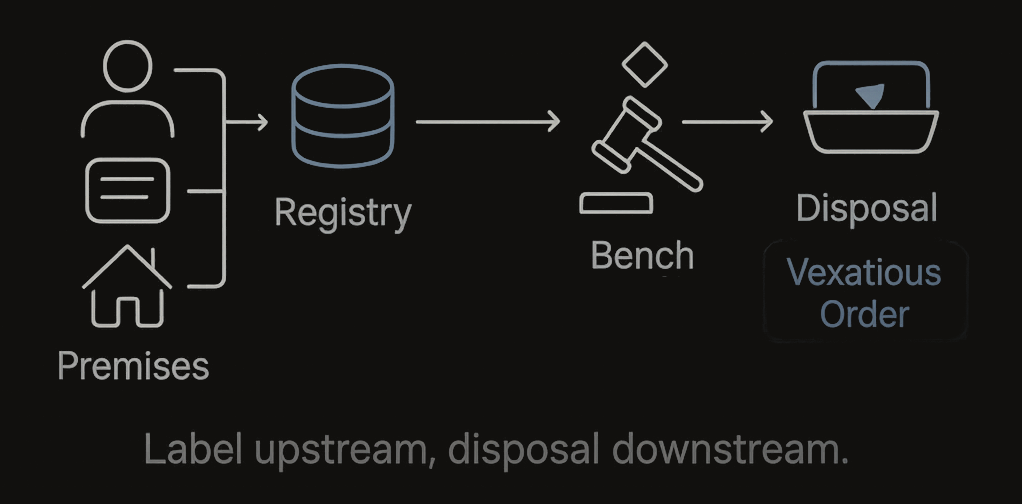
The “sovereign citizen” movement, especially in Australia, North America and some other jurisdictions, produces a kind of anti-law performance—rituals of jurisdictional denial, ancient codes, maritime law incantations, and pseudo-legal filings. Their legal actions are dismissed not because they fail to assert claims, but because they don’t obey the choreography. These are not substantive errors; they are format breaches. The system cannot argue with them, so it ejects them.
Interpretation: Sovereign citizen actions parody the form to expose the fiction. They can be read as resistance by absurdity—forcing law to reveal its own procedural fetishism. When the runtime must declare parody “vexatious,” the mask slips.
That defence is layered—part instruction, part repression. Justice Rooke’s Meads v Meads ruling (Canada, 2012) is the canonical text: a containment manual disguised as a judgment, categorising “Organised Pseudolegal Commercial Arguments” (OPCAs) not as arguments but as viral code. Its function is not to engage, but to delimit. In Australia, figures like former magistrate David Heilpern have led judicial training programs designed to immunise courtrooms against these rhetorical contaminants—preparing judges to diagnose and expel rather than hear and decide.
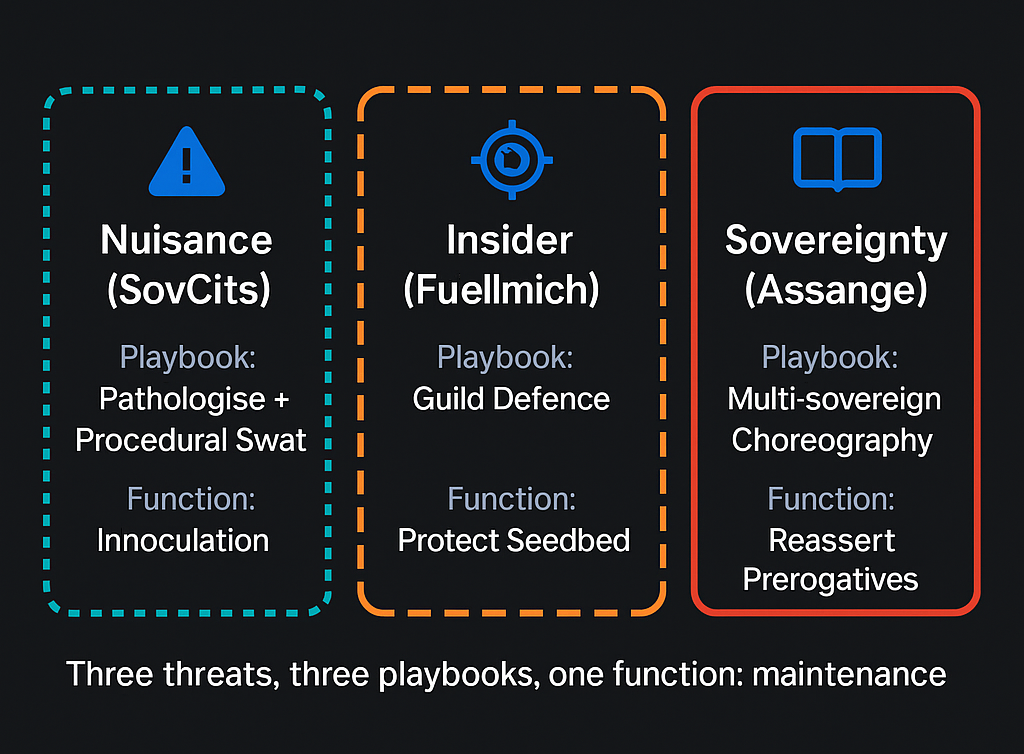
The effort is not to confront parody, but to preempt its spread. In both jurisdictions, the system asserts itself not by answering, but by diagnosing. The courtroom becomes a sterile zone, where deviation from ritual is recoded as pathology. The refusal to use titles, bow, or stand is not just a breach of decorum—it is treated as systemic infection. The sovereign citizen becomes a caricature precisely because they refuse to participate in the choreography that sustains the illusion of dignity. They mirror the system’s theatricality—and are expelled for doing so.
Pattern Recognition
These fractures differ in tone—farce, tragedy, scandal—but follow the same runtime structure:
- Narrative instability triggers legal ritual
- Venue distortion (embassy stasis, remote courts, overseas arrests) replaces adjudication with containment
- Judicial conflict of interest is normalised as administrative convenience
- Precedent risk is neutralised—through exceptional humanitarian grounds (Assange) or procedural ejection (Füllmich)
- Law becomes a screen—a symbolic exercise concealing coercive continuity.
Where the system bends but does not break, we are watching runtime doctrine—held together not by legitimacy, but by inertia and selective silence. When it must declare parody “vexatious,” or prosecute a journalist under a century-old war statute across three jurisdictions, it is revealing itself. These aren’t deviations. They are runtime truths.
The Halo and the Mask
Every system of rule requires a sacred object. In liberal democracy, that object is the judiciary. The legislature may be corrupted, the executive distrusted—but the judge in robes must remain inviolate. This is not accident; it is architecture. Law depends on a priesthood. If the interpreter is exposed as partisan, the text collapses. If the umpire is unmasked as agent, the game becomes farce.
This sacralisation functions as a forcefield—social, psychological, institutional. Judges are placed on haloed ground, where scrutiny becomes sacrilege. To suggest judicial corruption—systemic, ideological, or careerist—is to trigger a secular immune response. Not rebuttal. Exorcism.
The halo’s power lies in its concealment. It legitimises outcomes that would otherwise provoke rebellion. It insulates state violence behind a veil of reason. It transforms coercion into compliance through ritual: titles, robes, standing, bowing, and the affectation of neutrality.
What it conceals is rarely bribery. More often, the corruption is structural:
- Ideological obedience dressed as legal reasoning
- Careerist alignment with power for post-judicial gain
- Systemic loyalty to the state over the claimant
- Procedural sabotage masked as judicial discretion
Expose this and the system counterattacks. Figures like Reiner Füllmich are not feared for their arguments, but for desecrating the courtroom's sanctity. The judge is the high priest. To accuse him is not protest—it is heresy.
Case in Point: The Supreme Court
The politicisation of the U.S. Supreme Court makes the halo visible by fracture. No longer can it be denied that appointments are partisan, outcomes ideologically driven, and precedents disposable. The robes remain; the neutrality does not.
- Bush v. Gore (2000): electoral override
- Citizens United (2010): structural entrenchment of corporate speech
- Shelby County (2013): dismantling of voting protections
- Dobbs (2022): revocation of reproductive rights by an ideologically stacked bench
Dobbs reveals the full mechanism. It didn’t restore neutrality—it completed a factional project. Roe (1973) had fabricated a right from judicial abstraction; Dobbs dismantled it by selectively citing tradition. Both wore the robe of law, both served political ends. That such a fundamental right can be created and erased by shifting bench composition over fifty years exposes the legal system as power-contingent. The myth of blind justice survives only because the robe is mistaken for the role.
This is not neutral interpretation. It is rotating hegemony. It is ideology under robes, performing sacrament while enforcing rule.
To challenge this is not conspiracy. It is desacralisation. And that is what the system cannot allow.
The halo must not break—because when it does, the state’s final mask falls with it.
Ritualisation of Law: Costumes, Ceremony, and Coercion
Legal visibility isn’t just managed through media and omission—it is choreographed through ritual. The courtroom is theatre, not because it’s fictional, but because its truth claims depend on performance. Rituals create credibility not through logic, but through repetition, artifice, and exclusion.
Vestments of Authority
The absurdity is deliberate. Wigs, robes, elevated benches—these are not remnants of tradition, but active signals of distance, hierarchy, and historical continuity. They serve to place legal actors outside the realm of ordinary contestation. The uniform says: this is not politics, this is law. The very ridiculousness of the garb inoculates it—like religious costume, its implausibility becomes a shield.
UK judiciary: Full-bottomed wigs and scarlet robes persist not for utility, but to signal archaic continuity—sovereign ritual without sovereign visibility.
Australia: Black robes and fixed spatial hierarchies reinforce the fiction of impartiality. Entry to court, modes of address, and even posture are encoded.
These rituals are not harmless. They train both observer and participant into acceptance. They close the gap between theatre and enforcement.
Rule-of-Court as Meta-Sovereignty
Courtroom protocols constitute their own zone of law. Judges control speech, pace, and posture. They can exclude evidence, strike from the record, instruct the jury to ignore what they’ve already heard. They can shut down argument, hold counsel in contempt, and redefine the question before them—all without recourse.
This is not incidental. Judicial omnipotence within the ritual space is a structural necessity: it is the zone in which the fiction of neutral adjudication must be performed with minimal friction.
- “I have ruled”: A phrase that ends argument. It requires no justification. It is a declaration of narrative finality.
- No speech without permission: Even observing parties may not speak or gesture without judicial leave.
- Removal at will: Judges can eject participants for contempt—an elastic concept tethered to mood, not standard.
The ritual space is not democratic. It is a curated performance zone with consequences.
The Sovereign Citizen Rebuttal: Parody as Exposure
The “sovereign citizen” phenomenon is both parody and protest. It mimics the court’s own obsession with form, by citing obscure historical documents, pseudo-statutes, and invented jurisdictions. But its function is not persuasion—it’s disruption.
Structural insight: The sovcit does not seek legal victory—it seeks to reveal the court’s dependence on ritual and compliance rather than consent or principle.
Contempt charge as confession: When courts respond to sovcit tactics with contempt rulings or procedural disposal, they confirm the core claim—that the law operates through power, not argument.
Sovcits are not analysts, but saboteurs. Their tactics are crude, sometimes seemingly unhinged—but they serve a diagnostic purpose: they crash the runtime. They deliberately clog the system and cause it to expose its coercive scaffolding.
Visibility ≠ Transparency
The legal guild curates what the public sees. Costume, ritual, and procedural theatrics create the appearance of integrity while masking the unaccountable control of venue, evidence, and speech. Public trials aren’t public deliberations—they are performances structured to prevent deviation.
Where ritual dominates, resistance becomes visible. And where parody provokes sanction, the system confesses: it is not a neutral arbiter of justice—it is an operator-run machine.
Forum Control: Shaping the Battlefield
Power doesn’t reside in the outcome—it resides in the frame. The legal guild’s true leverage is exercised long before a judgment is handed down. It controls where questions are heard, how they are heard, and by whom.
Legal operators don’t float free. They serve upstream interests—state, capital, or both. The guild is not autonomous—it is interface. Its rituals do not serve truth; they serve continuity. Every inquiry, DPA, or tribunal delivers not justice but stabilisation—on behalf of a beneficiary network.
In these terms, forum control is not venue-shopping. It’s venue construction.
Jurisdiction as Weapon
The choice of court, tribunal, or inquiry is rarely neutral. Jurisdiction determines not just geography, but rules of standing, evidentiary thresholds, admissibility, and remedy types. A regulatory tribunal with limited scope hears what a full court would scrutinise. A public inquiry absorbs scandal and defers action.
Example: In Assange, the use of the UK’s Westminster Magistrates’ Court as the initiating forum—narrow in scope, largely procedural—meant that substantive arguments around freedom of the press were excluded from the beginning.
Example: In Füllmich, German prosecutors triggered an arrest via Interpol Red Notice, invoking cross-border enforcement channels that bypass conventional judicial oversight.
Adjudicator Selection
“Independent” panels, boards of review, and inquiry commissions are staffed not by neutral parties, but by repeat actors—former judges, tribunal heads, senior counsel—all drawn from the guild’s own mesh.
Their presence signals seriousness to the public—while functionally ensuring threshold preservation.
Common practice: Government inquiries into police violence or regulatory failure routinely appoint former judges with a track record of restraint, not reform.
Australia: The Administrative Appeals Tribunal (AAT) routinely appoints politically aligned or industry-friendly members, especially for sensitive visa, welfare, and defence procurement cases.
Procedure over Substance
Forum control includes shaping what may be said. Courts and tribunals can:
- Reject evidence as irrelevant or inadmissible
- Frame issues in a way that excludes systemic analysis
- Limit cross-examination scope
- Declare matters non-justiciable.
This strips the proceeding of its critical content before the public even sees it:
UK “D-Notices”: These voluntary media self-censorship requests—often respected as de facto orders—are not law, but forum filters. They signal what must not enter the visible zone.
Exceptional Venues as Containment Zones
New forums are created when old ones are too visible:
- COVID-era commissions: Created for “health emergency” governance, they avoided normal administrative challenge by being staffed as special panels.
- National security courts: Use closed material procedures (CMPs) that seal evidence from the accused—an inversion of adversarial principle.
- Remote hearings and video-only extradition sessions: Remove public access without formally closing court—legal fiction as logistical convenience.
The Mesh Remembers
Once a forum is constructed, it persists. Like a coral reef, each inquiry, review, or tribunal builds the frame for the next. Institutional memory—terms of reference, exclusion practices, appointed personnel—create an ecosystem of containment.
Pattern Insight: Legal runtime is not primarily about verdicts. It is about staging the appearance of contest while ensuring control over the conditions of contestation. That is forum engineering—and it is the true guild function.
Compliance Theatre: Manufactured Remediation
The legal guild does not deliver justice—it performs remediation. Once a breach becomes public, the imperative is not to punish but to restore credibility. The system does this not through rupture, but through ritual. The goal is not change, but continuity.
This is compliance theatre: a stylised script where coercion is recoded as cooperation, and system preservation masquerades as reform.
Deferred Prosecution as Structured Immunity
Conviction is not the endpoint—avoidance is. In high-salience corporate breaches, the outcome is often a Deferred Prosecution Agreement (DPA): a private negotiation masquerading as public resolution. No contested fact-finding; undertakings and monitorship substitute for trial and no precedent set.
What emerges is a ritual compliance package: internal reform, an external monitor, a timed program of review.
Example: The UK Serious Fraud Office’s DPA with Rolls-Royce (2017) imposed no criminal charges despite extensive international bribery. The appointed monitor? A major law firm—a classic guild operator—with deep links to both the SFO and the very defence procurement circles it was now tasked to police.
This isn’t redress—it’s a laundering mechanism. The punishment is procedural. The reset is reputational. And the monitor is almost always drawn from the guild’s inner ranks.
Endless Monitorship as Co-Governance
Oversight begins as time-bound. It never ends that way.
What starts as compliance becomes co-management. Multi-year monitorships grow into embedded governance structures, where firms operate under rolling audit, renewed oversight, and private reporting protocols.
Example: The 2012 DPA between HSBC and the US DOJ—prompted by the bank's failure to prevent money laundering for drug cartels and other systemic AML breaches—imposed a five-year monitorship whose operational controls became permanent infrastructure. The monitor's assessments, however, were classified, rendering the entire remediation process opaque and shielding it from public accountability.
No legislation. No open forum. No democratic threshold. Just settlement → monitor → permanence.
This is soft law rendered hard by institutional inertia and access dependency. The firm must comply not with law, but with the ongoing expectations of the guild.
The Vendor Circuit
Compliance is not just a function—it’s a business model. The same law firms, consultancies, and former regulators appear across jurisdictions and sectors, rotating between prosecution, remediation, and advisory roles.
Example: Louis Freeh (former FBI Director) has served as independent monitor for FIFA, Penn State, and multiple financial institutions. While overseeing one client’s remediation, his firm simultaneously advised others on navigating similar scrutiny.
The guild monetises its own authority. Legitimacy becomes a sellable service. The same actors who once enforced the rules now offer redemption packages—pre-approved, performance-verified, and jurisdictionally portable.
Reoffending and Recertification
There is no cumulative memory. Firms breach, remediate, and return—sometimes with the same vendor attached. No escalation. No disqualification. Just another agreement. Another monitor. Another performance of redemption.
The cycle is its own vindication. Compliance theatre does not cleanse—it defers rupture. This is not accountability. It is runtime extension: the system recodes scandal into throughput.
Compliance as Legal Shield
Once remediation is underway, oversight becomes insulation.
- Courts defer to monitors
- Journalists cite programs as proof of contrition
- Legislators treat the matter as closed.
The presence of compliance is taken as evidence of intent. Scrutiny becomes disrespect. The script itself replaces substance. This is how law conceals coercion through process. Guilt is absorbed by ritual. Punishment is displaced by performance.
Pattern: Redemption as Inertia
Where law once punished, it now scripts redemption. But this redemption is synthetic—a loop performed by the same operators who stage the breach.
Compliance theatre does not restore legitimacy. It extends system runtime without structural change. It performs stability, and markets that performance as governance.
Mutation and Reach
The Guild Splinters, Embeds, and Rules by Export
The legal guild does not wither as sovereignty fragments—it metastasises. The traditional forms of judicial authority, once grounded in national courts and statutory interpretation, now persist through deployments. These are not defections from state-centred neutrality but runtime migrations into operationally dominant but jurisdictionally ambiguous functions.
Where once the legal actor was bound to courtrooms, now they preside over arbitration panels, compliance regimes, ESG metrics, and surveillance exemptions. The ritual authority—bench, robe, inquiry desk—survives, but the platform has changed. What emerges is a trans-sovereign operator class—anchored in law but integrated with finance, intelligence, and supranational governance.
Adjudicative Extension
Key Function: Exporting the authority of legal process beyond the state:
- Inquiry chairs often return to the guild fold after presiding over post-crisis “independent” commissions. Their real function is less about accountability than closing the loop on legitimacy threats—reframing crisis as managed exception.
- Tribunal arbitrator roles now dominate investor-state dispute settlement (ISDS), with forums like ICSID (International Centre for Settlement of Investment Disputes, part of the World Bank Group) and UNCITRAL (United Nations Commission on International Trade Law) hosting repeat appearances by the same legal elites—many of whom are former judges or high-level solicitors. These are not public courts—they are private settlements with sovereign consequence.
Example: Lord David Neuberger, former President of the UK Supreme Court, now acts as an arbitrator in international commercial and investor-state disputes. His post-judicial trajectory exemplifies how domestic prestige is converted into transnational adjudicative power.
Capital Gatekeeping
Key Function: Legal operators structuring access to capital markets via compliance overlays:
- AML/CFT advisers now function as extrajudicial gatekeepers to global banking. Suspicion is pre-criminal—based on thresholds set by internal legal teams and monitored via global KYC (Know Your Client) frameworks.
- ESG certifiers blur legal, regulatory, and investment mandates. Adherence to non-binding ESG “norms” is assessed by panels often staffed by former judges and regulators, creating a revolving gate between guild membership and capital allocation.
Example: Multiple former UK and EU regulators now serve on ESG compliance advisory boards—while also consulting for investment vehicles requiring certification against those same standards.
Credentialed Coercion
Key Function: Authorising surveillance, censorship, and exceptional measures under legal pretext
- Surveillance justifiers—lawyers embedded within or adjacent to intelligence bodies—draft the memos that become domestic surveillance regimes. They don’t interpret law—they authorise exception.
- Foreign interference counsel determine what counts as subversion, often under secrecy. Their interpretations become the operational thresholds for intelligence activity—and eventually, prosecution or policy response.
Example: Louis Freeh, former FBI Director, has advised intelligence-linked entities, including FIFA and various university scandals, while simultaneously operating private risk consultancies. The performance of neutrality masks the construction of coercive rationale.
Normative Capture
Key Function: Re-legitimising sovereignty post-crisis through externally credentialed drafting:
- Constitution framers, particularly in post-conflict or post-colonial settings, often arrive with mandates to align local governance with “global standards”. Their drafting isn’t neutral—it preserves elite access via structural coding.
- Rights rapporteurs serve as both auditors and soft enforcers. While nominally independent, they routinely advise the same departments they report on—creating a feedback loop of performative compliance.
Example: In several Commonwealth states, former UK judges and UN-affiliated legal scholars have drafted constitutions that enshrine market access protections under the guise of “rule of law.”
Soft Law Hardens
Key Function: Embedding private legal instruments into operational governance:
- Soft-law drafters write codes that function like law—but without legislation. Sustainability standards, risk governance, and disclosure regimes are framed as voluntary but required in practice.
- Standard-board members, drawn from legal academia or regulatory agencies, populate the bodies that issue these frameworks. Their recommendations bypass parliaments but are embedded by procurement offices, stock exchanges, and credit assessors.
Example: Members of the International Sustainability Standards Board (ISSB) and IOSCO include legal actors who simultaneously consult for ESG funds and advise governments—tightening the loop between rule-maker and market actor.
Finally, Shadow Play
The final illusion isn’t legal authority. It’s belief in the theatre that sustains it.
Every layer of the guild's activity—courtroom formality, inquiry rituals, televised panels, compliance announcements—is curated to signal control. The judges’ robes, the architecture, the procedural gravitas—all perform the idea of order. But order is not the same as justice. And procedure is not proof.
Legitimacy Without Consent
The system operates on the assumption that the public consents—because they comply. But this is a misreading. Consent is neither asked nor offered. It is formatted. You enter the court because you must. You submit to rulings because the alternative is sanction. Legitimacy is thus not earned—it is extracted, then echoed back through ritual.
There is no democratic input into precedent. No popular control over judicial selection. No exit from the procedural web once engaged. And yet, every output of the guild—every ruling, inquiry finding, or panel report—comes stamped with the aura of neutral truth.
The Disappearance of Truth
As previewed: courts don’t declare truth. They declare closure. What counts as evidence, fact, or relevance is a procedural outcome, not an epistemic achievement. Entire world-historical events—wars, massacres, finance crashes—can be legally ruled “not cognisable.” The law does not reveal the real. It delimits the permissible.
This is the essence of the shadow play: a theatre of resolution in which real power is never at stake. Each procedural act—discovery, motion, ruling—is a screen. It simulates scrutiny while ensuring runtime continuity.
Runtime Authority, Staged Neutrality
By the time a legal actor rotates from national court to offshore panel, then back into a “post-crisis review,” the pattern is complete. They are not serving law. They are law’s interface layer with power. Their function is not to challenge sovereign decision—but to format it, reissue it in legal language, and shield it from disorder.
When the system faces parody (SovCits), subversion (Füllmich), or exposure (Assange) the shadow play tightens. Judges refuse recusals. Courts cite century-old wartime laws. Compliance monitors recycle through scandals. The illusion must be held—even if the audience is no longer watching.
The Cult of Power
The judiciary’s sacred status is not just institutional—it is theological. The legal system functions as a modern cult, not of justice, but of Power itself.
The courtroom is its temple. The judge its priest. The rituals its defence.
This cult denies the divine while performing the divine’s functions. It claims secularity but requires obedience. It avoids supernatural language but builds its authority on a metaphysical claim: that Power, exercised through law, is legitimate because it is lawful.
Strip the liturgy, and the god emerges:
- The Altar: The bench. The tribunal. The panel. These are not deliberative desks—they are ceremonial platforms of transmission.
- The Idol: The robe, the gavel, the wig. These are not tools of clarity—they are relics, worshipped symbols of continuity and command. Their authority is performative. Their purpose: obedience.
- The Priesthood: Legal Operators—judges, lawyers, clerks—do not serve the public. They serve the cult. They interpret doctrine, perform rites, and demand offerings: obeisance, compliance, fees.
- The Scriptures: Statutes, precedents, procedural codes. These are not guides to truth. They are the authorised texts for performing the ritual of obedience. Misuse them—and the system screams blasphemy.
- The Theology: The halo, the mask of neutrality, the myth of the rule of law. This is not a philosophy. It is dogma. It insists the god is just. It criminalises doubt.
- The Inquisition: Contempt powers. Disbarment. Smear campaigns. Heretics like Assange and Füllmich are not rebutted—they are purged. The aim is not truth—it is doctrinal control.
- The Sacraments: Baptism: Law school initiation. Bar exams; Confirmation: Robes, benches, seniority; Communion: “All rise.” “Your Honour”; Penance: Plea deals. Compliance regimes. Reinstatement by tribute.
- The God = Power itself. Not embodied, not elected, not questioned. A systemic will to continuation. It demands obedience, and in return offers the illusion of order. Its central miracle: the transubstantiation of violence into legality, and coercion into consent.
This is why the system responds with panic, not argument, when challenged. The robe is not just uniform—it is vestment. To question the judge is not disagreement—it is heresy. To parody the ritual is not satire—it is sacrilege. To expose the machinery is not reform—it is apostasy.
Once this god is named, the cult can no longer claim neutrality. The robe tears. The halo breaks. The courtroom stands revealed: a theatre of sanctified force.
Postscript: The Operator is not a seeker of truth. He is a formatting function—ritual, procedural, recursive. Once a guild, (judge, barrister, registrar), the operator has diffused. From national courts to transnational panels, his task is not to arbitrate conflict, but to contain it. Runtime must persist. He does not assess truth, only admissibility. Standing. Jurisdiction. What enters is filtered. What escapes is error. The ruling is not a resolution—it is an output. Consent is presumed. Participation is coerced. There is no opting out of the ritual. The robe, the title, the bow—these are not signs of honour, but signals of submission to process masquerading as justice. When disruption emerges—political, internal, parodic—it is treated as formatting failure. Venue is denied. Precedent reversed. Doctrine contorted. The system does not answer—it quarantines. There is no exit. The operator recurs. From judge to monitor, from inquiry to compliance board. The costume shifts, the function remains.
Law is not the opposite of violence. It is its credentialed form. And the Operator is its priest.
On to Addendum 2 where the mask slips and players are examined.
Published via Journeys by the Styx.
Overlords: Mapping the Operators of reality and rule.
—
Author’s Note
Produced using the Geopolitika analysis system—an integrated framework for structural interrogation, elite systems mapping, and narrative deconstruction.